Nikko Day Trip from Tokyo: What Fits in One Day?
A good day in Nikko starts with choosing which part of it you have time to see.
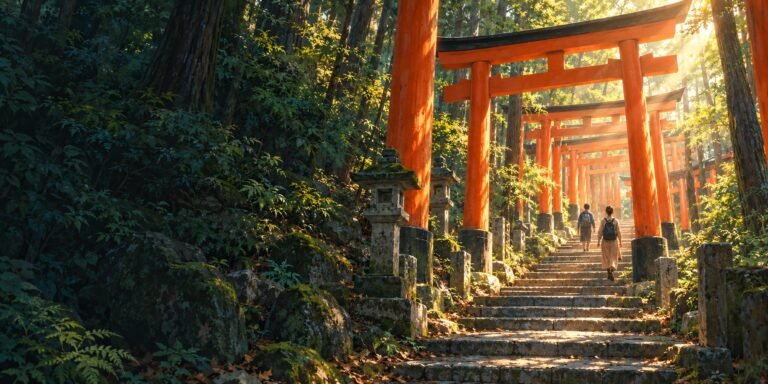
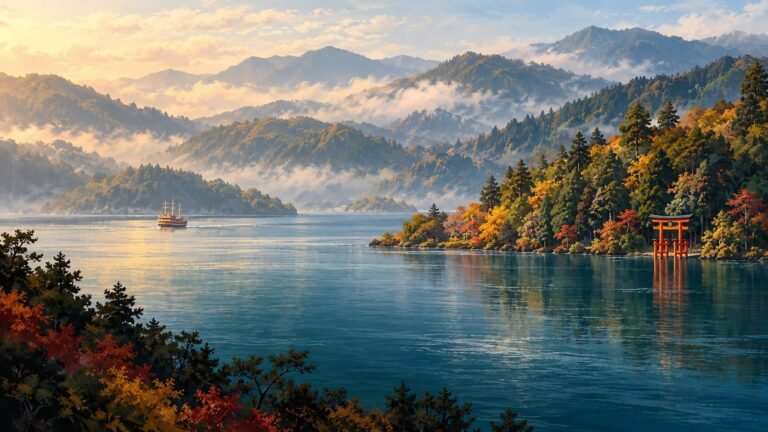
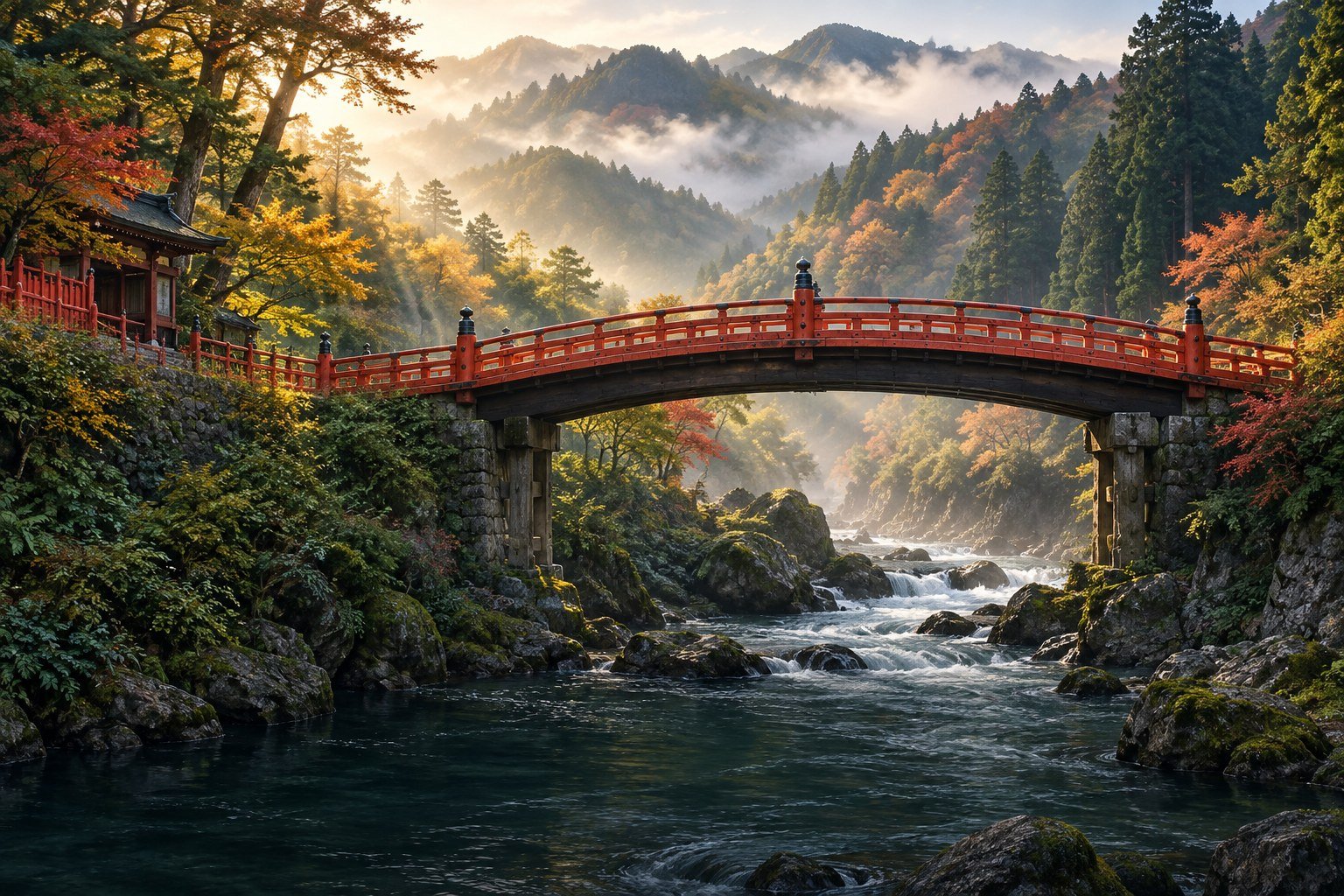
Original AI-assisted editorial illustration of Nikko; not an eyewitness photograph.
A Nikko day trip from Tokyo can comfortably centre on Toshogu Shrine, one further temple visit, Shinkyo Bridge and time for lunch. The awkward decision is Lake Chuzenji: it belongs to the same Nikko region, but reaching it adds a mountain bus journey beyond the central shrines. [1][3]
For a first visit, the strongest plan protects the heritage area and treats the lake as a separate choice. This guide sets out a workable day, the cuts needed for a combined itinerary, and when an overnight stay gives you a much better return for the journey.
This guide contains affiliate links. Taylor’s Trailblazing Travels may earn a commission when you book or buy through them, at no extra cost to you.
Planning decision 01
Best first visit
Toshogu, one further paid site and a flexible town-and-bridge finish.
Planning decision 02
Rail commitment
About two hours each way on a suitable limited express, before hotel transfers. [1]
Planning decision 03
Lake decision
Choose nature first if it is the reason for travelling; reduce the shrine list.
Planning decision 04
Current closure
Akechidaira Ropeway is suspended until at least 31 August 2027; reopening may be later. [21]
What a Nikko day trip from Tokyo can cover
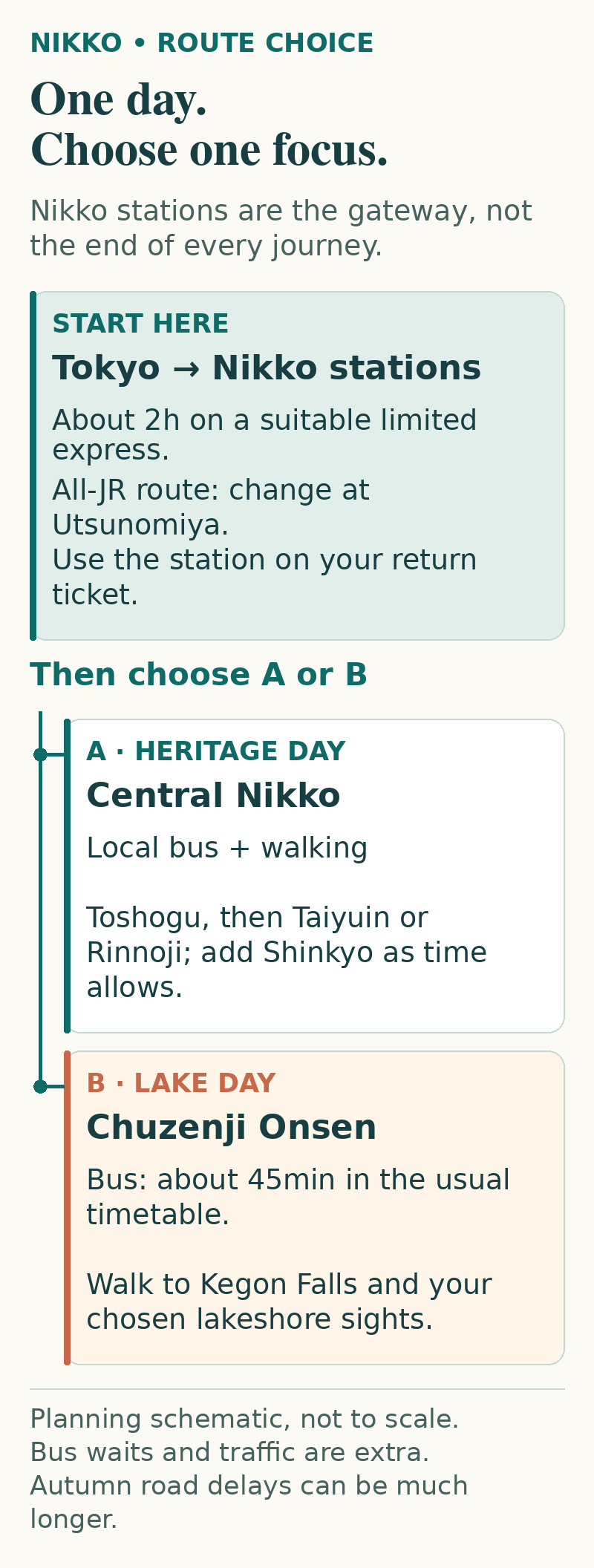
The useful dividing line is between central Nikko and Okunikko, the higher area around Lake Chuzenji. Toshogu, Taiyuin, Rinnoji and Futarasan belong to the central sightseeing area. Kegon Falls and the lake need another journey; they are not neighbouring stops that can be added after a late lunch. [1][3][13]
| Your priority | A sensible one-day scope | What to leave out |
|---|---|---|
| First visit; temples and architecture | Toshogu, Taiyuin or Rinnoji, Futarasan precincts, Shinkyo | The mountain bus journey |
| Lake scenery and a waterfall | Kegon Falls, the Chuzenji lakeshore and lunch nearby | A full circuit of the central temples |
| One shrine plus a glimpse of nature | Toshogu and a shortened lake-and-falls visit, only with favourable timings | Extra temples, long lunches and a cruise |
| Unhurried heritage and substantial nature | One night away, with a separate day for each area | The obligation to return to Tokyo that first evening |
The heritage option is particularly worthwhile if ornate architecture and wooded sacred precincts appeal. If you mainly want an easy stroll between cafés, or cannot leave Tokyo early, the rail commitment may feel disproportionate. A day trip should have a reason strong enough to justify around four hours on intercity trains. [1]
Build the day around your trains
Choose the departure station that fits your Tokyo base
Tobu limited expresses from Asakusa take about two hours to Nikko; direct services also run from Shinjuku. Compare the actual departures and your hotel-to-station journey before deciding which is easiest. Local trains from Asakusa take roughly an hour longer, so their saving comes out of your sightseeing time. [1][2]
If you already hold a valid nationwide Japan Rail Pass, compare the JR route from Tokyo or Ueno via Utsunomiya, changing to the JR Nikko Line. That route is covered by the pass. JR Nikko and Tobu-Nikko are different arrival stations: use the one on your ticket when checking the return. Do not assume a JR pass covers a Tobu departure from Asakusa. [1]
Budget for the hotel, not just the railway
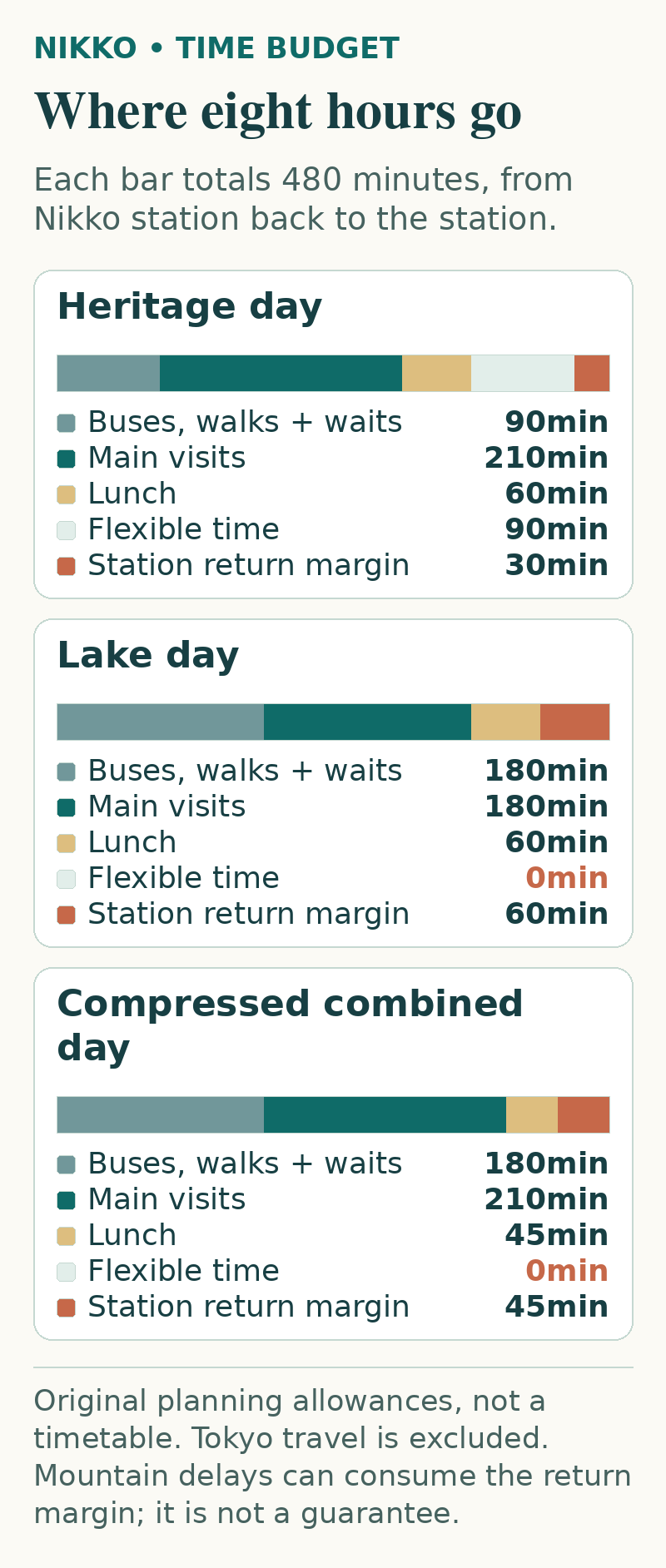
A worked example is four hours of intercity rail, 90 minutes for Tokyo approaches and station margins, and eight hours between arriving in Nikko and leaving again: 13½ hours in total. Setting aside roughly 12–14 hours door to door is more useful than calling this a two-hour trip. The approach and visiting allowances are editorial estimates; your hotel location, service and pace change the result.
Choose an outward service that gets you to Nikko around 09:00 and a return around late afternoon or early evening, then build the visits between them. The times below are a sample day, not a claim that a particular train is available. Use Tobu’s dated inbound and outbound timetables and reserve the return as well as the outward journey. [2]
Arrange your pass before an early departure. Tobu’s Asakusa Tourist Information Center opens at 07:20, so a paper voucher that needs exchanging there can prevent you catching an earlier train. Use a suitable digital pass or collect the paper pass beforehand, and check the collection instructions for the product you buy. [9][18]
Compare the whole ticket
Compare Tokyo–Nikko listings on 12Go if you want another booking option. Check the named departure station and whether the selected item is a pass, base fare, limited-express ticket or a combination. Compare its final total and collection conditions with Tobu; use the operator’s timetable to plan the day. [9][16]
A realistic central-Nikko itinerary
This route assumes an arrival around 09:00, a return train around 17:00, and a traveller comfortable with several hours of walking, including steps. All visiting blocks are proposed allowances. Change them to suit your pace, then drop the flexible stops if the morning runs late.
| Time | Plan | Why this order helps |
|---|---|---|
| 09:00–09:30 | Arrive, sort any ticket exchange and take a local bus towards the shrine area | The arrival buffer absorbs practical tasks before the main visit |
| 09:30–11:30 | Toshogu Shrine | Protect the main reason for the trip before adding extras |
| 11:30–12:30 | Lunch and a short break | A full day is easier when lunch has its own space |
| 12:30–14:00 | Taiyuin and nearby Futarasan precincts; substitute Rinnoji if preferred | One substantial second paid visit keeps the afternoon manageable |
| 14:00–15:30 | Shinkyo viewpoint, town browsing or a café | These are the first things to shorten if queues have grown |
| 15:30–17:00 | Return towards the correct station, collect belongings and keep a boarding margin | The return is part of the itinerary, not spare sightseeing time |
Keep Toshogu as the anchor
Toshogu enshrines Tokugawa Ieyasu; its elaborate buildings and carvings give the visit its focus. Two hours is an editorial allowance for looking properly, navigating the grounds and handling queues, rather than a promised completion time. Readers wanting every building, museum and staircase should give it more of the day and trim the second stop. [4]
Taiyuin is the mausoleum of Iemitsu, Ieyasu’s grandson, and makes a coherent second visit. Futarasan adds a different context through Nikko’s mountain worship. Treat its paid sacred garden as a further choice, not an automatic inclusion in every route. [5][6]
Finish with a view of the red Shinkyo Bridge. Crossing the bridge is a separate paid visit, currently ¥300; the sample schedule does not depend on doing so. If you are tiring, shorten the shopping and take a bus back instead of trying to walk every connecting stretch. [7]
A ticket detail that changes your arrival
You can check the Toshogu entry ticket on GetYourGuide if you prefer to arrange admission in advance. This particular product requires exchanging the voucher at Tobu-Nikko Station Tourist Center before going to the shrine. It requires a live ticket screen and internet access; screenshots and printed copies are not accepted for that exchange. Allow for the stop and follow your voucher’s instructions. It is not a promise of queue-free access. [14]
If you still need mobile data for the live voucher screen, browse Airalo eSIM options and select a Japan package. Check that your phone supports eSIM and is network-unlocked before buying. Install using a stable connection before leaving Tokyo, following your chosen plan’s activation instructions. [19][20]
When Lake Chuzenji and Kegon Falls fit
The operator’s current summer timetable shows many journeys from Tobu-Nikko to Chuzenji Onsen taking about 45 minutes, with the return commonly around 40 minutes. These are running times, before waiting, walking to attractions or disruption. For planning, allow roughly an hour for each mountain bus leg in ordinary conditions, plus the time between services. Severe autumn congestion can be much longer. [17][12]
For a nature day, go directly up to the lake
Take a bus bound for Chuzenji Onsen, or a suitable through service towards Yumoto, and alight at Chuzenji Onsen for Kegon Falls and the nearby lakeshore. Check the displayed route and stop with station staff. Concentrate on this small area: a waterfall visit, a lakeside walk and lunch are a coherent excursion. Kegon’s lower viewing platform is a separate paid attraction. [3][13]
That plan does not also need Ryuzu Falls, Senjogahara, a boat cruise and a long temple circuit. Each additional journey reduces the room available for your return. If walking or scenery is the main purpose, extra time at the lake is more useful than a hurried late shrine visit.
For a lake-only day, choose a downhill bus scheduled to reach the correct Nikko station at least 60 minutes before your booked train. This is an editorial planning margin, not a guarantee against road delays. Check current traffic notices, allow more time in busy periods and keep an earlier bus option available. [3][12][17]
If you want both, decide which sight you could lose
For a lake-priority day, travel uphill first and consider Toshogu on the return only if the buses have run well. For the sample 17:00 return train, use about 14:00 as an editorial cut-off for reaching the shrine entrance in either season. A two-hour visit then leaves roughly an hour for the journey to the station and boarding. If you arrive later, shorten or skip the shrine visit to protect the return margin. This target is earlier than last admission; the actual closing times appear below. [4]
If Toshogu is non-negotiable, use the heritage itinerary. Putting the lake first makes the shrine vulnerable to road delays; putting the lake after a leisurely shrine morning compresses the return. Either version can work on a favourable day, but neither gives you the freedom of a one-area plan.
Choose tickets for your actual route
These are adult advertised prices checked on 18 October 2026, in yen. A pass’s validity is not a recommendation to use all of its attractions, and a transport pass does not include every ticket you will need.
| Ticket | Adult price / validity | Use it for | Important exclusion |
|---|---|---|---|
| NIKKO PASS World Heritage Area | ¥3,000 / two days | One return Asakusa–Shimo-Imaichi journey, covered local Tobu rail and heritage-area buses | Limited-express tickets, shrine admission and the bus up to Lake Chuzenji [9] |
| NIKKO PASS All Area | ¥8,000 / four days | A wider Nikko visit, including the mountain bus area and other listed benefits | Limited-express tickets and shrine admission [10] |
| World Heritage local bus pass | ¥600 / one day | The covered central sightseeing-bus area when rail is bought separately | Tokyo rail and the lake journey [11] |
| Chuzenji Onsen bus pass | ¥2,300 / two days | The covered bus area between the stations and Chuzenji Onsen | Tokyo rail and travel beyond its mapped boundary [11] |
Two comparisons worth making
For the heritage itinerary, price your return railway journey plus the ¥600 local bus pass against the ¥3,000 World Heritage Area product. Add the required limited-express tickets to either calculation if using those trains. Buying a pass does not reserve a limited-express seat. The NIKKO PASS products have visitor-eligibility conditions; check these before purchase. [9][11]
For a simple central-Nikko-and-lake visit, the World Heritage Area pass plus the Chuzenji bus pass totals ¥5,300. That is ¥2,700 below the ¥8,000 All Area pass before the same limited-express and admission extras. This arithmetic is useful only when those smaller passes cover your whole route; compare All Area again if you want its other included activities or a wider stay. [9][10][11]
Allow ¥1,600 for Toshogu and ¥550 for Taiyuin, if choosing both. Their ¥2,150 combined admission is separate from rail and bus passes. Lunch, drinks, Tokyo local transport and optional gardens or bridge entry remain extra; they are easy to miss when comparing a headline pass price with a tour. [4][5][6][7]
Back to top ↑Independent travel, a tour or one night away
Independent travel buys control over visiting time
Use the train-and-local-bus heritage plan if Toshogu is your priority and you prefer to decide when to move on. You can linger over one complex, stop for a longer lunch or abandon the second admission without changing anyone else’s schedule. The trade-off is managing your own tickets and return.
A guided excursion can simplify a compressed day
A tour is a reasonable comparison if you want a brief visit to both the shrine and the lake without organising each connection. For example, the Nikko Toshogu and Kegon Waterfall tour on GetYourGuide, supplied by GORYO TRAVEL, advertises about 10.5 hours, with approximately 75 minutes at Toshogu and 20 minutes at Lake Chuzenji. Those published stops illustrate the compromise: broad coverage with much shorter visits. Its itinerary can change with traffic and weather. [15]
Before booking, compare your selected meeting point, shrine admission, meal arrangements, walking requirements and cancellation terms. Check whether Kegon’s lower viewing platform is included. A coach removes the job of coordinating public buses; it still uses roads, so a guaranteed traffic-free autumn return is not a sensible expectation.
Stay overnight when both areas matter
One night lets you stop making the shrine and the lake compete for the same afternoon. A central-Nikko stay suits a shrine-led visit; if early lake scenery is the priority, accommodation around Chuzenji can put you above the Irohazaka road bottleneck for the following morning. This is also the tourism board’s suggested approach for autumn visitors who especially want the upper area. [12]
Compare location before room price
Browse Nikko accommodation on Agoda and compare Nikko stays on Booking.com. These are broad destination searches. Use the map to check central Nikko, Chuzenji or another part of the region, then check the actual bus stop, evening meal arrangements and check-in time. A room labelled “Nikko” is not automatically close to the sight you want first.
Seasonal changes that alter the plan
Autumn needs a different margin
Nikko’s tourism board reports that a station-to-lake journey normally taking about 45 minutes has sometimes taken up to four hours during severe foliage-season congestion. That is a historical warning, not a prediction for your date. It is still enough to make a tightly booked lake-plus-shrine day a poor default in busy autumn periods. A weekday or early start can help, but neither guarantees clear roads. [12]
The higher areas and the central shrines do not reach their best colour together: the foliage generally works down from the mountains, with the shrine area typically later. Choose the area you actually want to see and consult current conditions. Do not chase two different foliage reports across the region in one afternoon. [12]
Closing time is part of the route
Toshogu is listed as open 09:00–17:00 from April to October and 09:00–16:00 from November to March, with last entry 30 minutes earlier. Rinnoji lists 08:00–17:00 and 08:00–16:00 for those periods, also stopping admission 30 minutes before closing. Check special notices for your date. Turning up just before last entry leaves little time to appreciate a paid visit. [4][8]
Do not plan around the ropeway
Akechidaira Ropeway is suspended from 16 January 2026 to 31 August 2027, and Tobu notes that the works may take longer. Older itineraries that include a ride there need changing. [21]
Check Tobu Bus notices as well as the timetable: central sightseeing routes and boarding arrangements can change. Keep your return train details available, identify the correct station and aim to be back well before departure. A bag-collection stop or ticket queue needs time too. [3]
Back to top ↑Questions that change the plan
Can I start late and still visit Nikko?
Yes, with a reduced purpose: one main paid sight, lunch and perhaps Shinkyo. Work backwards from your return train and the shrine’s closing time. An arrival near lunchtime does not support the full itinerary above plus the lake. [4]
Is a Nikko day trip suitable with young children?
It can be, if the family is comfortable with the long return journey. Choose one anchor sight, leave room for food and breaks, and treat the second temple as optional. Parents who would be disappointed by dropping stops should consider an overnight stay.
Is this a step-free itinerary?
No step-free route has been established for this schedule. Shrine visits involve different paths and buildings, so a general attraction listing is not enough to confirm access to every part. If steps or prolonged walking are difficult, ask the attraction about the specific areas you want to enter and reduce the route before buying tickets.
Would a hire car make the full list easy?
It can make individual connections more flexible, but it does not remove the congested road to the lake. Add parking and the return drive to your comparison. Choosing a car solely to rescue an overloaded autumn day is unlikely to address the main problem. [1][12]
What should I remove first when running late?
In the heritage itinerary, cut browsing, then the optional garden or second paid visit. Keep the return margin. On a lake-priority day, drop the late shrine visit if the road journey has used its time allowance. Decide that priority before leaving Tokyo, while the choice is still easy.
Back to top ↑The one-day recommendation
For most first-time visitors, choose Toshogu, one further paid site, a proper lunch and a flexible Shinkyo-and-town finish. That is a complete Nikko day with room to enjoy what brought you there.
If Lake Chuzenji and Kegon Falls are the reason you are making the journey, give them the day. Book a guided excursion if brief coverage of both areas is the right trade-off, or stay one night when you want both without repeatedly watching the clock.
Back to top ↑Sources and research
Reference links used for this article and editorial analysis reviewed on 18 October 2026. Check current fares, opening arrangements and services for your travel date.
- Nikko City Tourism Association — Getting Here & AroundTokyo routes, journey estimates and regional transport.
- Tobu Railway — Limited Express Train TimetableLinks to the inbound and outbound timetables; service dates must be checked.
- Tobu Bus — Nikko AreaRoute information, fares and current operating notices.
- Tochigi Prefecture Tourism & Local Products Association — Nikko Toshogu ShrineShrine context, opening hours and adult admission.
- Nikko City Tourism Association — Taiyuin TempleMausoleum context, access and admission.
- Nikko City Tourism Association — Nikko Futarasan-jinja ShrineMountain worship and separate sacred-garden admission.
- Nikko City Tourism Association — Shinkyo BridgeBridge context and crossing admission.
- Nikko-zan Rinnoji — Visitor InformationSeasonal opening hours and admission cut-off.
- Tobu Railway — NIKKO PASS World Heritage AreaCurrent price, validity, coverage, exclusions and eligibility.
- Tobu Railway — NIKKO PASS All AreaCurrent pass price, transport coverage and exclusions.
- Tobu Bus — Nikko Bus Free PassesCurrent World Heritage and Chuzenji Onsen bus-pass prices.
- Nikko City Tourism Association — Autumn Foliage and Congestion AdviceAutumn road delays, different foliage periods and overnight advice.
- Nikko City Tourism Association — Kegon FallsFalls location and paid lower viewing platform.
- GetYourGuide — Toshogu Shrine Ticket, Exchange at Tobu-Nikko StationProduct-specific exchange and live-screen requirements.
- GetYourGuide — Nikko Toshogu Shrine and Kegon Waterfall TourProvider, indicative tour duration and stop lengths; options and itinerary can change.
- 12Go — Tokyo to Nikko ListingsAlternative booking comparison; operator timetables govern the itinerary.
- Tobu Bus — Nikko Summer Timetable, April–November 2026Scheduled mountain-bus running times; use the timetable for your travel season.
- Tobu Railway — Sightseeing Service CentersAsakusa Tourist Information Center opens at 07:20; pass sales and exchange services. Checked 18 October 2026.
- Airalo — Japan eSIM plansJapan data-plan availability and installation using a stable connection; no price or local signal guarantee is quoted. Checked 18 October 2026.
- Airalo — Device compatibilityAn eSIM-compatible device without carrier restrictions is required. Checked 18 October 2026.
- Tobu Railway — Notice of Temporary Suspension of Akechidaira RopewayOperator notice dated 24 December 2025: closed 16 January 2026–31 August 2027, with possible extension.
Illustrations in this article were created for Taylor’s Trailblazing Travels. Third-party photographs, where used, are credited beside the image or in the source list.