Visiting Japanese Onsen with Tattoos: What to Check Before Booking
Confirm the exact bath, tattoo conditions and reservation before paying for your stay or visit.
- Check the specific bath
- Public and private options
- Ready-to-adapt enquiry
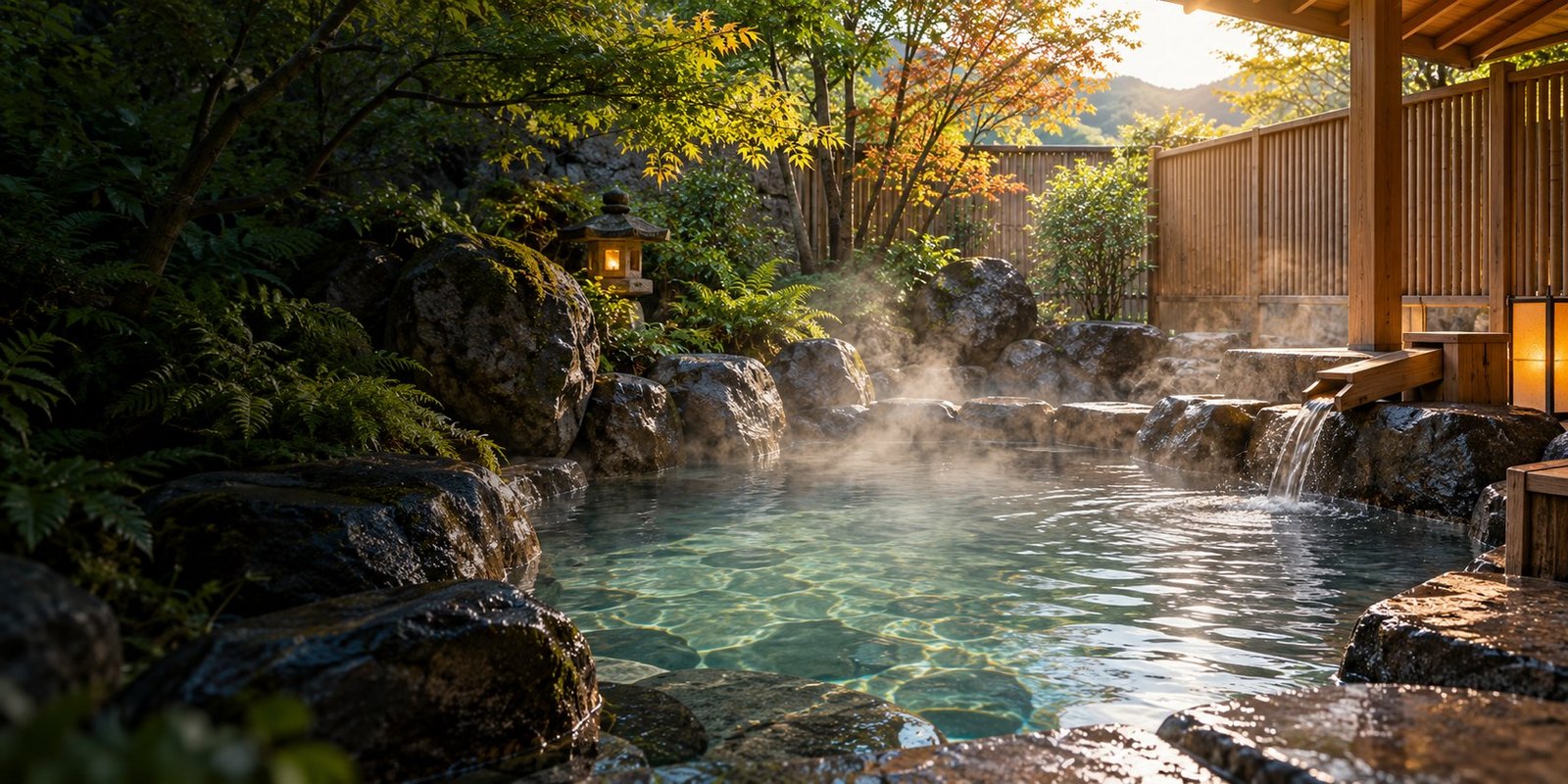
AI-generated editorial illustration of an imagined onsen setting; it does not depict a named venue or establish its tattoo policy.
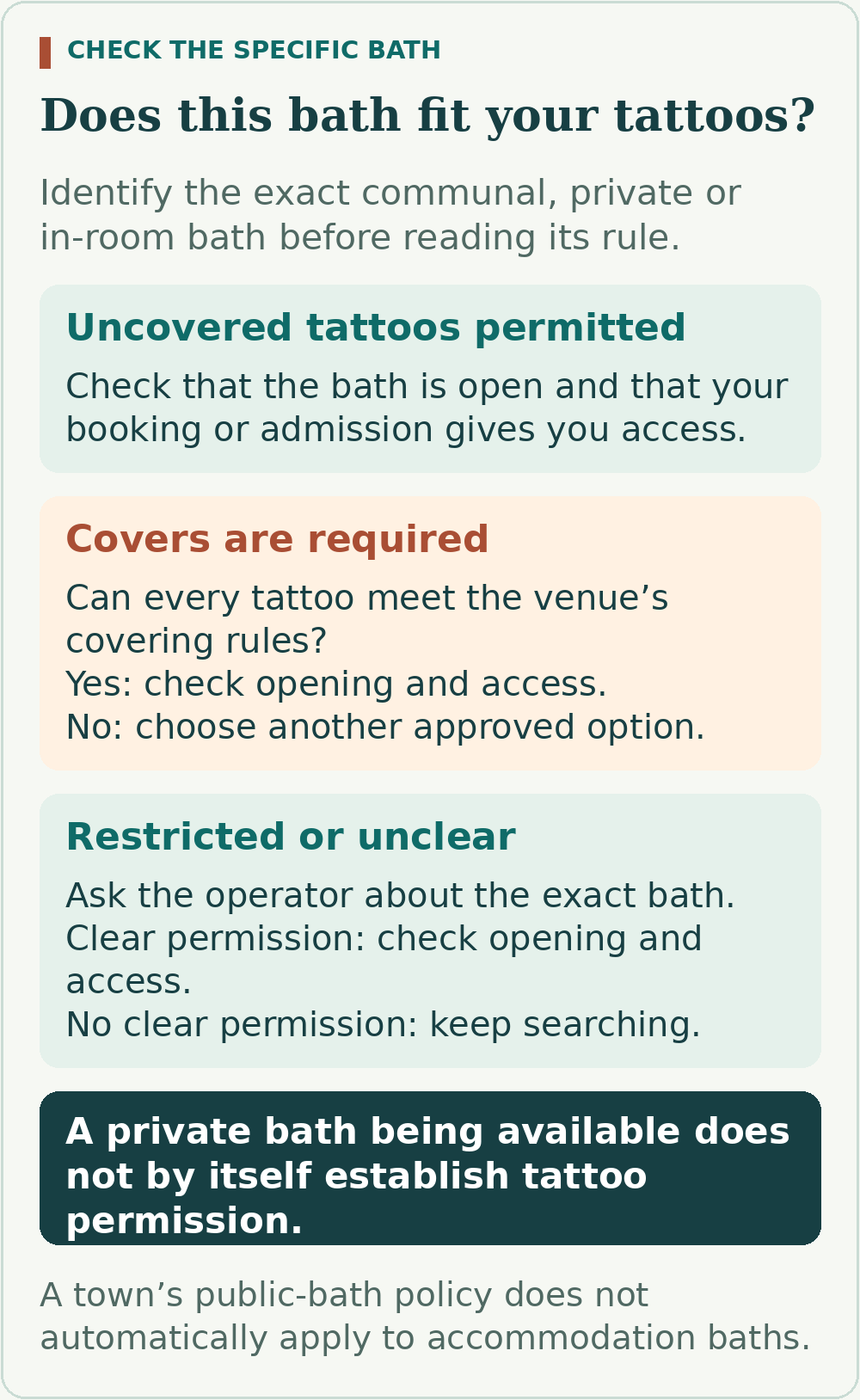
You can enjoy Japanese onsen with tattoos when the facility’s policy allows it. The useful question is which bath that permission covers. Kinosaki’s public bathhouses welcome uncovered tattoos of any size, while the town’s official visitor guidance warns that accommodation baths may have different rules. [1]
Before paying, identify the bathing experience you want and confirm three things: permission for your tattoos, access to the specific bath, and the booking conditions. A room reservation or a photograph of a private bath does not establish all three.
Your preferred experience
Decide whether you want communal bathing, privacy or a bath attached to your room.
Tattoo conditions
Check uncovered permission or the venue’s complete-cover requirements.
A separate reservation
An available private bath still needs a confirmed booking arrangement.
Before paying
Confirm the bath, your party, the full charge and cancellation terms.
Choose the bath you want to use
Start with the experience, then look for a policy that supports it. If you want to share the atmosphere of a communal bath without covering your tattoos, an explicit uncovered-tattoo policy is the clearest match. If privacy or bathing with your companion matters more, investigate a private bath and its party rules.
| Arrangement | What to confirm |
|---|---|
| Town public bathhouse | The policy and opening status of the individual bathhouse you will enter. |
| Shared bath inside your hotel or ryokan | Permission for that accommodation’s communal bath, including any cover requirement. |
| Private bath reserved for a session | Tattoo permission, exclusive use, eligible guests and a bookable time slot. |
| Bath attached to your room | The exact room category, tattoo conditions and whether the bath uses hot-spring water. |
A ryokan is a traditional Japanese inn. The term kashikiri describes a bath hired for private use; rotenburo describes an open-air bath, which may be shared or private. Neither word answers the tattoo question on its own. [2]
If a room description only says “private bathroom”, ask specifically about its bath and water source before treating it as the onsen experience you want.
Use current official policies to check your shortlist
These examples were selected because their published conditions illustrate different booking decisions. They are not a ranking, a complete directory or confirmation of availability for your dates.
| Place and bathing option | What the official guidance says | Booking implication |
|---|---|---|
| Kinosaki Onsen’s public bathhouses, Hyogo | Tattoos of all sizes are permitted without covers. Accommodation baths can have different rules. [1] | Check the bathhouses’ opening notices and your accommodation separately. |
| Yamamotoya, Kinosaki | The ryokan explicitly permits tattooed guests to use its hotel baths. Its Senyu private bath is restricted to staying guests and requires advance reservation. [3] | A clear hotel policy is useful, but confirm a private session separately if you need one. |
| Hakone Yuryo, Hakone | This day-use facility states that it removed tattoo-related bathing restrictions on 1 April 2025. It offers communal and private baths. [4] | Use its current guidance when an older listing says tattoos are prohibited; choose the type of bath you want. |
| Solaniwa Onsen, Osaka | Its admission policy allows tattoos when completely covered with stickers sold by the facility. The FAQ says the sticker-number limit ended on 1 December 2023. [5] | Confirm that the available covers will work for your tattoos and intended areas of use. |
Kinosaki’s tattoo policy does not mean seven baths are currently open
At this review, Kono-yu’s official notice lists a renovation closure from 11 May to 30 October 2026. Satono-yu remains listed as closed indefinitely for renovation from 1 April 2024. Recheck both notices for your travel dates; a scheduled end date is not confirmation that work has finished. [6] [7]
Choose the bathhouses you particularly want to visit before fixing your dates. Leave an alternative if a closure would otherwise remove the main reason for your stay.
Read cover rules and private-bath conditions precisely
When covers are required
Measure the tattoos you need to cover and ask about the usable dimensions, permitted quantity and whether the venue requires its own product. “Small tattoo” is too vague to settle whether a particular design, placement or group of tattoos meets a rule.
At Solaniwa, complete coverage and use of its own stickers remain requirements despite the removal of the quantity limit. Its separate tattoo notice also requires tattoos visible outside the provided yukata robe to be covered while inside the facility. A private-bath enquiry should therefore cover the route through shared areas as well as the bath itself. [5] [8]
Ask what to do if a cover loosens, and whether replacements are available. If you cannot meet the stated condition, choose a bath that explicitly permits your uncovered tattoos or confirms a suitable private arrangement.
When a private bath is advertised
Private use describes who shares the space. Tattoo admission is a separate condition. For example, Hyakkannon Onsen in Kuki, Saitama, advertises private baths on the same official guide that refuses use by people with tattoos, including small tattoos and temporary tattoo stickers. That page states no private-bath exception. Its private-bath listing alone is therefore insufficient grounds to treat it as an option for tattooed visitors. [9]
Ask the operator whether the restriction covers the whole facility, only communal baths, or the particular private bath you want. A generic answer such as “private baths are available” leaves that question unresolved.
Confirm permission and a usable reservation
For a bath that requires a reservation, treat permission and availability as two separate checks. A welcoming policy with no suitable time slot does not deliver the planned bath. Equally, a slot in a booking calendar does not establish permission for your tattoos.
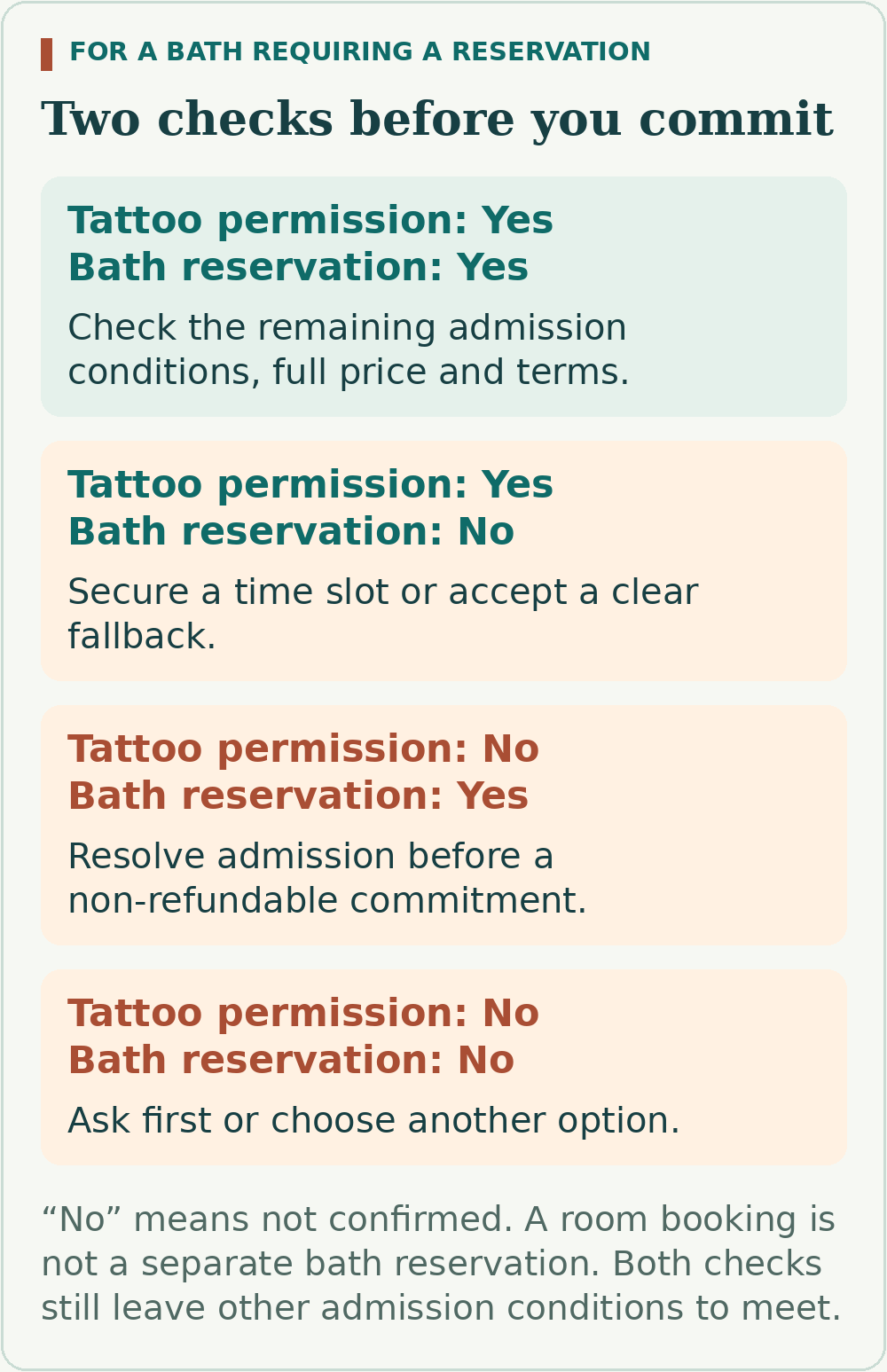
The difference is practical at Yamamotoya: its published Senyu arrangements allow up to two staying guests for 40 minutes, with advance reservations by email. Hakone Yuryo’s private-bath page lists two-hour sessions and different room capacities; online reservations open one month ahead and close at 3pm Japan time (JST) the previous day, after which it directs customers to telephone. These are operator arrangements, not a universal onsen booking timetable. [3] [10]
Check the party and total charge
Tell the operator who will bathe together, including children’s ages where relevant. Do not assume a bath marketed to couples accepts every party: Solaniwa’s FAQ limits private-bath use to the family, blood-relative or same-sex groupings it specifies. Ask how its conditions apply to your group. [5]
Compare the complete cost: the stay or entrance ticket, private-bath fee, any per-person charge, covers, towels and applicable taxes. Solaniwa expressly excludes admission from its private-bath price, illustrating why a room or session price may not be the total. [5]
For the surrounding accommodation and travel allowance, the Japan trip budget guide provides a separate whole-holiday model.
Check the time allowed, arrival procedure, cancellation deadline and late-arrival terms before paying. If the only private option is allocated after check-in, decide whether you would still want the stay without it. Keep a flexible booking or a confirmed alternative when that uncertainty matters to you.
Send an enquiry that names the bath and your tattoos
Use the property’s official contact form, email address or reservation message channel. Give the operator enough detail to answer your actual question, then keep the reply with the booking. For a hotel, distinguish the room reservation from any separate bath reservation.
A message you can adapt
Hello. I am considering [a stay / a day visit] on [date] for [number of adults and children’s ages]. I have [number] tattoos on [body areas], approximately [dimensions in centimetres].
May I use [name of communal bath / named private bath / bath in exact room category] with these tattoos? Are covers required? If so, must I buy your covers, and what sizes and quantity are permitted? Please also confirm any tattoo restrictions in the changing areas and other shared spaces.
For private bathing, can our party reserve this bath for exclusive use at [preferred time]? What is the duration and total charge, including any separate admission? Is the bath supplied with hot-spring water, and what are the cancellation terms? Thank you.
Check the answer before committing
- It refers to your tattoos and the named bath, rather than simply welcoming you to the hotel.
- Any cover condition is specific enough for you to follow.
- The operator has accepted your party and clarified access to shared areas.
- A requested reservation has a time and confirmation, or its remaining uncertainty is clear.
- You know what you are paying for and when cancellation charges begin.
A description and measurements are a useful starting point. If staff need an image to assess coverage, ask how to provide it privately; do not turn a bath’s shared changing area into a place to take photographs. Use clear English or ask the accommodation for language help if the reply is unclear.
Keep the plan workable on the day
Recheck opening notices shortly before travelling and keep your confirmation accessible without a working mobile connection. At reception, resolve any mismatch between the reply, the current sign and the bath you have booked before paying an additional charge or entering the changing room.
If access is refused, ask staff to clarify the relevant condition and show the earlier confirmation calmly. Ask about an approved alternative or the applicable refund process; written permission does not itself guarantee a refund or allow you to override staff instructions. Retain the correspondence for the booking provider if the issue remains unresolved.
Once admitted, the usual bathing rules still apply. JNTO advises washing and rinsing before soaking, keeping towels and hair out of the water, and leaving phones outside the bathing area. Swimwear is generally left in the changing room, so do not plan to use it as a tattoo cover without explicit permission. [11]
Questions that can change your plan
Can I use an onsen soon after getting a new tattoo?
A venue’s tattoo permission does not answer the healing question. Cleveland Clinic’s dermatologist-led aftercare guidance advises avoiding immersion in baths, hot tubs and pools until a tattoo is fully healed. Follow your aftercare instructions and seek clinical advice if healing is uncertain; a cover sticker or a private bath does not establish that soaking is suitable. If you plan to get a tattoo during the trip, arrange bathing before that appointment or after healing. [12]
Make the decision that fits your trip
If uncovered communal bathing is your priority, shortlist an operator with an explicit policy permitting it. If you want privacy, secure both tattoo permission and the private arrangement that fits your party. Before making the stay or bath booking non-refundable, confirm the exact facility, current opening status, conditions, full cost and cancellation terms. When an essential answer remains unclear, keep the plan flexible or choose an option with a clear fit.
How this guide was researched
Researched on 17 October 2026 using official destination and operator policies, JNTO guidance and a medical provider’s tattoo-aftercare advice. The examples were chosen to show different admission and reservation conditions. The decision framework and enquiry text are original planning tools; no firsthand bathing, test booking or direct operator confirmation is claimed. Published rules and closure notices were checked, but availability for a traveller’s dates was not.
Sources
Official guidance and operator information reviewed on 17 October 2026. Recheck time-sensitive details for your own travel dates.
- Visit Kinosaki — Tattoo Friendly Onsen of Kinosaki
- JNTO — Onsen Hot Springs: On Tattoos and Etiquette
- Yamamotoya — Onsen and Private Baths
- Hakone Yuryo — Visitor Guide and Tattoo Policy
- Solaniwa Onsen — FAQ and Contact
- Visit Kinosaki — Kono-Yu Renovation Notice
- Visit Kinosaki — Satono-Yu Closure Notice
- Solaniwa Onsen — For Visitors with Tattoos
- Hyakkannon Onsen — Visitor Guide (Japanese)
- Hakone Yuryo — Public and Private Hot-Spring Baths
- JNTO — How to Best Enjoy Japan’s Onsen
- Cleveland Clinic — Tattoo Aftercare Tips From a Dermatologist
Illustrations in this article were created for Taylor’s Trailblazing Travels. Third-party photographs, where used, are credited beside the image or in the source list.