Kinkaku-ji and Northern Kyoto: How to Plan a Temple Day
Follow one compact temple corridor, give each stop room to breathe, and know when two temples are enough.
- Two or three temples
- Pacing, not a checklist
- Independent or guided
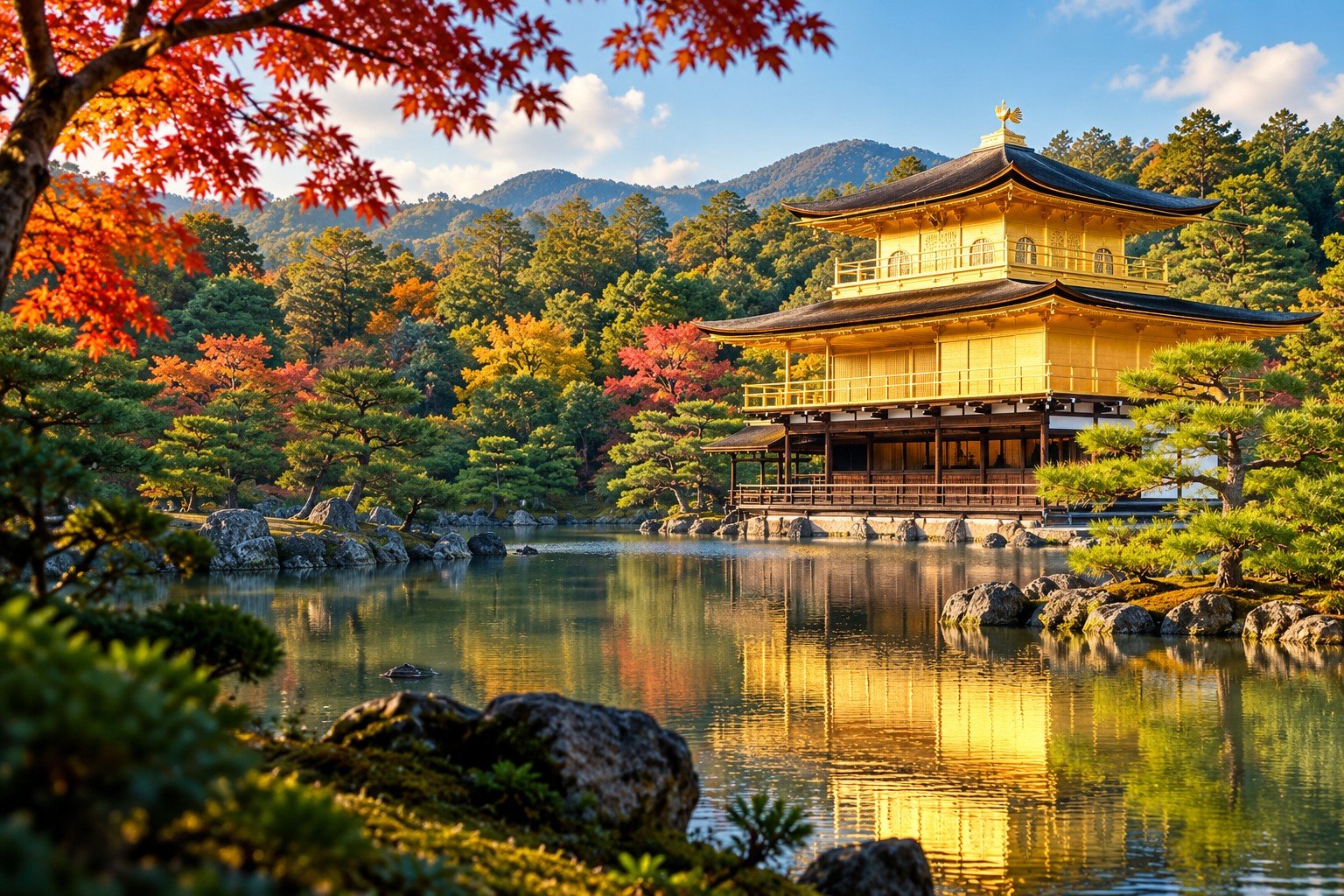
Original illustrative interpretation of Kinkaku-ji; not a documentary photograph or a prediction of seasonal conditions.
The most satisfying northern Kyoto day is not the one with the longest temple list. It is the one in which the places feel different: the Golden Pavilion reflected in water, a dry-landscape garden to sit beside, and a spacious temple precinct with a choice of paid interiors.
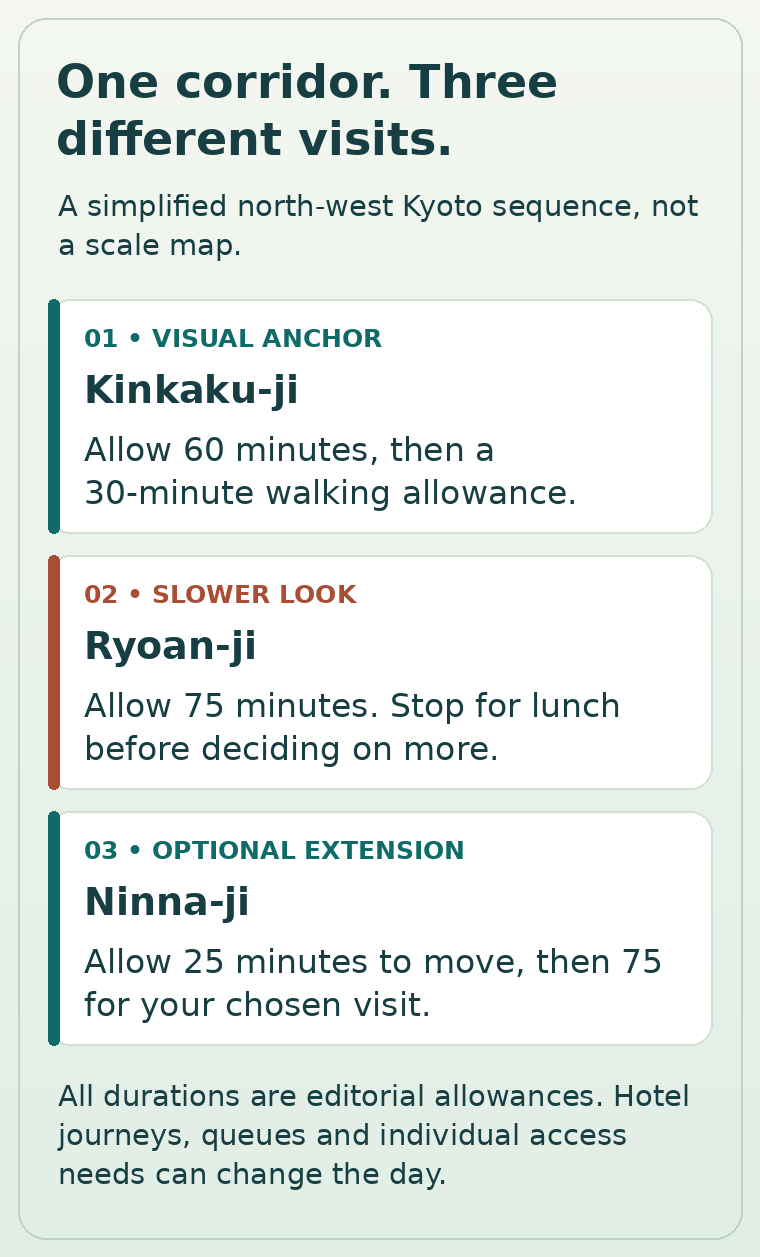
Kinkaku-ji, Ryoan-ji and Ninna-ji share the Kinukake-no-michi corridor in north-west Kyoto. That makes them a more coherent combination than adding an unrelated temple on the other side of the city. [1] This guide turns that geography into a workable day, with a shorter version for travellers who prefer more time at fewer stops.
This article contains affiliate links. If you book or buy through them, Taylor’s Trailblazing Travels may earn a commission at no extra cost to you.
Best default
Kinkaku-ji plus Ryoan-ji, with an optional third stop.
Fuller day
Six hours on the corridor; hotel travel is extra.
Admission model
¥1,900 for three specified adult admissions at the checked rates.
Main constraint
Uneven garden routes and steps matter more than a map’s short distances.
Choose the day by interest, not temple count
Treat Kinkaku-ji as the visual anchor, Ryoan-ji as the slower garden stop, and Ninna-ji as the optional architectural and garden extension. Ryoan-ji’s dry garden and Ninna-ji’s palace-and-garden visit are different experiences, not substitute photographs of the same building. [3][4]
| Your priority | Best combination | What to leave out |
|---|---|---|
| A first Golden Pavilion visit without fatigue | Kinkaku-ji + Ryoan-ji; roughly four hours with lunch | A third temple unless energy remains |
| A sustained temple-and-garden day | All three; roughly six hours on the corridor | A cross-city evening booking with a tight start |
| Less walking or uncertain mobility | One main stop; confirm its usable route first | Assuming a taxi solves steps inside grounds |
| A distinctive seasonal visit | Choose the seasonal highlight, then one nearby contrast | Treating blossom or snow as guaranteed |
Before committing, ask everyone to choose one thing they want to notice at each stop. Someone keen on architecture may enjoy Ninna-ji more than an extended rock-garden pause. A traveller already saturated with temples may prefer a long lunch after Ryoan-ji. That is a successful edit, not an incomplete day.
For more ideas to combine with this quieter Kyoto day, browse our Japan things-to-do guides or return to the Japan travel hub to plan the wider route.
Visit Kinkaku-ji without building the day around one photograph
The temple publishes opening hours of 09:00–17:00, with general admission of ¥500 and ¥300 for primary and middle-school pupils. Special exhibitions can alter arrangements. The listed bus stop is Kinkakuji-michi. [2] Keep the temple’s own access page handy rather than relying on an old screenshot of a bus number.
Use a 60-minute visit allowance as a starting point. Look at the pavilion and its setting before concentrating on a camera angle; leave space for the route through the grounds. If the entrance or viewing area is busy, add time instead of trying to recover every minute by rushing the next garden. No time of day can promise an empty viewpoint.
Access is not the same as completing the garden circuit
Kinkaku-ji says the path is wheelchair-accessible as far as the pavilion, but steps beyond that point mean wheelchair users, pushchairs and visitors unable to manage the steps must return towards the entrance. The temple also says it has no luggage storage and no garden space for eating a meal. [5] Leave large bags elsewhere and plan lunch outside the grounds.
For a group with different walking capacities, agree on the return route before separating. Set the meeting point at a place everyone can reach, not at the end of a path that one member cannot use. A shorter shared visit can be preferable to one person waiting alone while the others complete the circuit.
Continue to Ryoan-ji for a different kind of attention
Ryoan-ji is known for its dry-landscape rock garden; the local Kinukake association also describes the surrounding grounds and the uncertainty around the garden’s original designer and meaning. [3] You do not need to solve the stones as a puzzle. Sit, look, and allow a little quiet time rather than treating the garden as another queue for a photograph.
Budget 30 minutes for moving from Kinkaku-ji to Ryoan-ji on foot, including navigation and crossings, then 75 minutes for the visit. These are deliberately rounded allowances. Check the actual walking route and conditions on the day; they are not measured door-to-door walking times.
The association currently lists adult admission at ¥600. Its page also identifies Ryoanji-mae as the stop for bus 59 and Ryoanji-michi as the nearby Randen station. [3] Recheck the temple’s own current arrangements before an unusually early or late visit; the itinerary here does not depend on an early opening.
Make the lunch decision here
After the second temple, assess hunger, concentration and the weather. Continue to Ninna-ji only if you still want another temple experience. Reserve an hour for finding and eating lunch; do not assume a particular restaurant will have seats, accommodate every diet or serve quickly. A confirmed lunch booking can be useful for a larger party, but keep its time compatible with the first two stops.
Use Ninna-ji as an extension, not a compulsory finale
Ninna-ji’s official page lists 09:00–17:00 from March to November and 09:00–16:30 in winter, with ticket booths closing 30 minutes earlier. The main grounds are normally free outside the charged cherry-blossom period; Goten palace and gardens, the museum and other special visits have separate arrangements. [4]
For this day, choose the Goten palace and gardens if that is what interests you. The published adult rate is ¥800. The museum is a separate choice, with seasonal opening; special viewing periods can change the ticket combinations. [4] A generic “Ninna-ji ticket” label is not enough: check the part of the site it covers.
Allow 25 minutes to move from Ryoan-ji towards Ninna-ji, then 75 minutes for your selected visit. Again, these are planning allowances. Do not bolt a museum visit and a tea-room session onto that same 75 minutes and expect the day to remain unchanged.
If seasonal flowers are your main reason to come, check the temple’s own announcements before fixing the day. A seasonal admission charge is not evidence that flowers will be at their best on your date. Keep the route worthwhile even without that one visual highlight.
A six-hour plan with somewhere for delays to go
| Time | Plan | Allowance |
|---|---|---|
| 09:00–10:00 | Kinkaku-ji | 60 minutes |
| 10:00–10:30 | Walk and navigate to Ryoan-ji | 30 minutes |
| 10:30–11:45 | Ryoan-ji | 75 minutes |
| 11:45–12:45 | Lunch outside the temple grounds | 60 minutes |
| 12:45–13:10 | Move towards Ninna-ji | 25 minutes |
| 13:10–14:25 | Ninna-ji: the chosen visit | 75 minutes |
| 14:25–15:00 | Flexible time for earlier delays or a pause | 35 minutes |
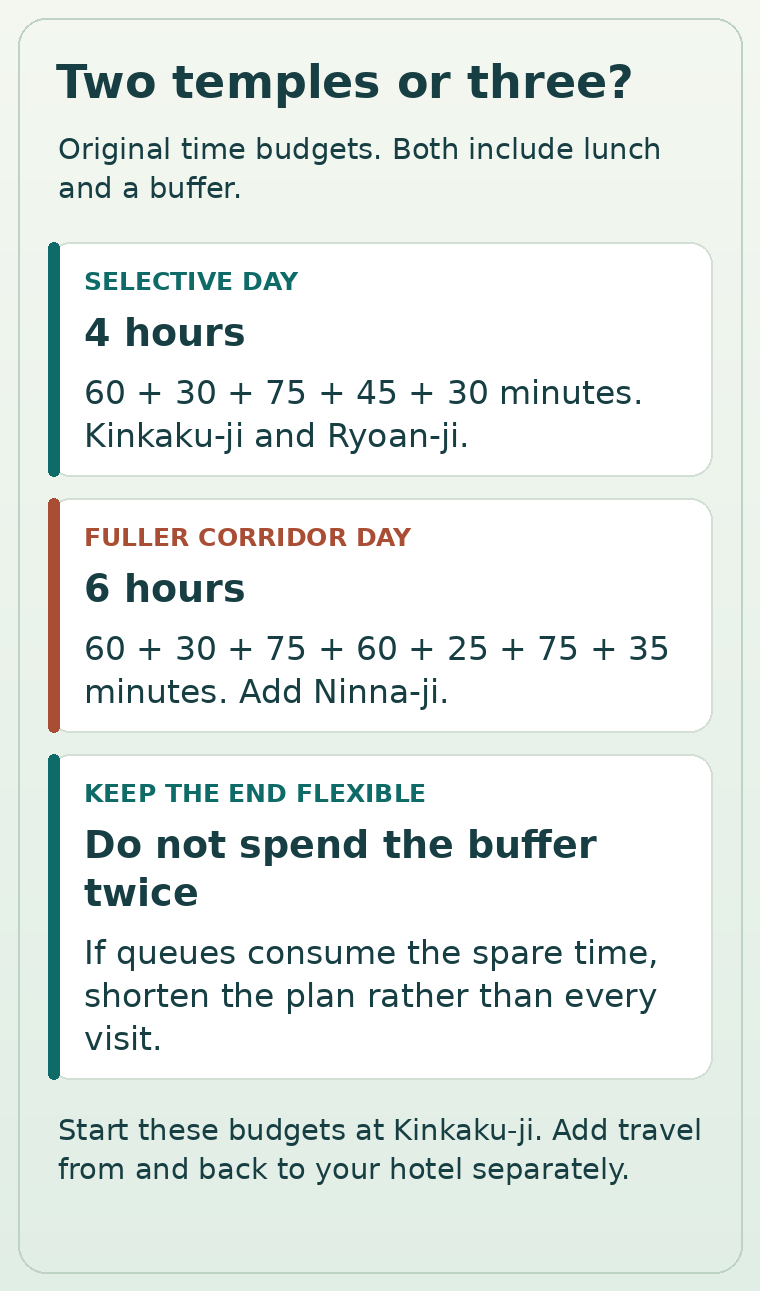
The sum is 360 minutes: six hours. The final 35 minutes are deliberately unassigned; they may be used earlier by a queue, a slower walk or lunch. Add the real outward and return journey from your accommodation separately. A 15:00 finish on this model is not a promise that you will be back at Kyoto Station at 15:00.
For the two-temple version, use 60 minutes at Kinkaku-ji, 30 minutes between sites, 75 minutes at Ryoan-ji, 45 minutes for lunch and 30 minutes of flexibility. That totals four hours. When a delay exceeds the buffer, dropping Ninna-ji preserves the quality of the first two visits better than cutting every stop to a hurried circuit.
Budget the admissions and choose transport deliberately
| Item | Planning amount | Basis |
|---|---|---|
| Kinkaku-ji general admission | ¥500 | Temple’s published rate [2] |
| Ryoan-ji adult admission | ¥600 | Kinukake association listing [3] |
| Ninna-ji Goten palace and gardens | ¥800 | Temple’s published rate [4] |
| Selected admissions total | ¥1,900 | ¥500 + ¥600 + ¥800 |
| Food and transport | Add your own allowance | Not included above |
The two-temple admission subtotal is ¥1,100. Do not add ¥800 for Ninna-ji automatically when you only intend to use free precinct areas outside a charged season; equally, do not assume the palace or special exhibitions are free.
Kinkaku-ji lists city buses 12, 59, 205 and M1 at Kinkakuji-michi. [2] Choose the service from your actual starting point with the current city route information. A long bus journey across the city can be a different proposition from a rail journey followed by a shorter bus or taxi connection.
Walking between the temples keeps the day simple for people comfortable with the distance and terrain. A taxi may help a tired group or reduce exposed walking in poor weather, but get a live estimate rather than budgeting from an invented fixed fare. It cannot remove steps within temple grounds. Local buses and Randen are more relevant to this short corridor than an intercity booking page.
Small changes that make the day more considerate
Leave space at popular viewpoints, follow signs about photography, and step out of the walking line before checking a phone. Keep voices low in temple buildings. These are working religious sites, not sets that guarantee unrestricted access to every attractive doorway.
Bring shoes that are comfortable both for outdoor walking and for any areas where you are asked to remove them. Keep a light layer and weather protection available. On a hot or wet day, spend your flexibility on breaks and slower movement rather than on one more paid stop.
Do not make the entire day depend on snow on the Golden Pavilion. The temple directs visitors to forecasts and its live image information rather than promising seasonal conditions. [5] The same principle applies to blossom and autumn colour: plan around the place, then treat seasonal conditions as a possible bonus.
Questions that change the plan
Can this be a half-day from Osaka?
A two-temple visit can occupy about four hours on this model, but that excludes the journey from Osaka, movement within Kyoto and the return trip. Add those legs before calling it a half-day. Keep an onward train reservation away from the last temple’s closing time.
Is Kinkaku-ji the same place as Ginkaku-ji?
No. They are separate temples in different parts of Kyoto; the Kinkaku-ji access page even gives travel directions between them. [2] Check the full name and map pin before boarding a bus. Adding both requires a new cross-city time budget.
Should everyone buy the same admissions?
Not necessarily. Age bands and concessions differ between sites. Use the relevant temple’s definitions and ask about any overseas disability documentation before assuming a discount. The ¥1,900 example is for one adult choosing the three specified admissions, not a family package.
What if the group is tired after the Golden Pavilion?
Have lunch and reassess. It is reasonable to stop after the one visit that mattered most. The spare stops are alternatives, not obligations.
The northern Kyoto day worth keeping
Choose two temples as the core, make lunch a real part of the schedule, and let Ninna-ji earn its place as a third stop. Your useful measure is not how many gates you pass through, but whether each visit has enough time to feel different.
Sources and further checking
Source pages checked on 18 October 2026. Recheck date-sensitive visitor arrangements and booking terms before committing.
- Kinukake-no-michi Road Association — the three-temple corridor
- Kinkaku-ji — official access, hours and admission
- Kinukake-no-michi Road Association — Ryoan-ji
- Ninna-ji — official English visitor information
- Kinkaku-ji — official accessibility and luggage FAQ
- GetYourGuide — private customisable Kyoto day tour
Illustrations in this article were created for Taylor’s Trailblazing Travels. Third-party photographs, where used, are credited beside the image or in the source list.