
Thailand Airport Guide: Main Airports and Connections
Know which airport serves your trip, what the terminal change means and how to complete the last part of the journey.
Original airport-scene illustration; the architecture is interpretative rather than an exact terminal map.
A useful Thailand airport guide starts with a deceptively simple question: which airport puts you closest to the holiday you have actually planned? The answer is not always the airport with the cheapest flight, the largest terminal or the most familiar destination name. A mainland gateway can be excellent for one itinerary and an awkward detour for another.
This guide covers the airports most relevant to independent travellers combining Bangkok, the north and the main southern holiday areas. It explains the difference between airport codes, terminal changes and airport changes, then follows the journey through arrivals, onward transport and connections. Airports are grouped by the places they serve and the planning problems they solve, not ranked by passenger numbers or an unverified claim to be best.
The factual checks were completed on 4 October 2026. Terminal assignments, flight schedules and pickup arrangements can change, so your airline's current instructions and the airport's live information remain the final checks. Suggested timing margins are editorial planning allowances, not promises about queues or guaranteed connection times.
BKK is not DMK
Check for an airport change before assuming your flights connect.
Hotel location first
Choose HKT or KBV around the places you actually plan to stay.
Island or mainland?
USM and a URT-to-island combination solve different journeys.
CNX is not CEI
Choose Chiang Mai or Chiang Rai around your route, not a similar-looking name.
Thailand airport guide: the codes to recognise
Use the code as the booking reference point
Airport names can be shortened, transliterated differently or displayed under a wider region. The three-letter code is the quickest way to check that a flight, taxi reservation and hotel plan are talking about the same place. Put it beside each flight in your itinerary rather than relying on a city name alone.
The following selection concentrates on common leisure routes and a few useful alternatives. It is not a complete airport directory. Codes and airport identities are cross-checked against airport and airline information; the suggested use is an editorial judgement about routing, not a guarantee of flights from your chosen origin. [1][2][3][5][4]
On a small screen, swipe the table sideways to see every column.
| Code | Airport or area | Useful starting point for | Main planning trap |
|---|---|---|---|
| BKK | Suvarnabhumi, Bangkok | Bangkok and many connecting itineraries | Confusing it with DMK |
| DMK | Don Mueang, Bangkok | Bangkok and domestic or regional journeys | Treating an airport change as a terminal change |
| HKT | Phuket | Phuket and onward Andaman travel | Underestimating the drive to a distant beach |
| KBV | Krabi | Krabi Town, Ao Nang and further connections | Assuming every hotel is directly accessible by road |
| USM | Samui | Koh Samui | Mistaking a Samui pier for the airport |
| URT | Surat Thani | Mainland travel and Gulf-island transfers | Booking the wrong pickup: airport, town or station |
| CNX | Chiang Mai | Chiang Mai and northern itineraries | Treating Chiang Rai as the same city |
| CEI | Mae Fah Luang Chiang Rai | Chiang Rai and its surrounding area | Adding a long road transfer to reach Chiang Mai |
| UTP | U-Tapao Rayong-Pattaya | Eastern seaboard journeys | Assuming it is central Bangkok |
| TDX | Trat | Trat and onward island travel | Forgetting the road-and-ferry stages |
| THS | Sukhothai | Sukhothai-area visits | Expecting the terminal beside the historical park |
Check the arrival airport twice
For multi-city trips, check the airport again when booking each hotel transfer. A copied reservation can retain an earlier airport even after you change flights. Meanwhile, a broad search result may include nearby pickup points that are useful to somebody else but wrong for your itinerary. Read the actual product details, not just the heading above the results.
Suvarnabhumi: understand the main terminal before the gate
BKK is an airport, not a neighbourhood in Bangkok
At Suvarnabhumi, your transport choice depends partly on whether you are entering the city, meeting another flight or continuing directly elsewhere. The official airport transport guide lists rail and road options. Before deciding, compare the complete route to the hotel, including any transfer between rail lines and the final walk with luggage. [6]
Think in levels and signs, not a memorised gate number
The main terminal handles airline check-in and onward passenger processes. Bangkok Airways currently lists its Suvarnabhumi check-in facilities on Level 4. Arriving passengers should follow the signs appropriate to immigration, baggage collection or a confirmed connecting itinerary rather than moving upstairs simply because another guide mentions departures. [1]
Write down the meeting point stated by your transfer supplier. A door number, floor and meeting desk together are far more useful than 'outside arrivals'. If a driver cannot find you, send that exact location and stay somewhere clearly identified instead of repeatedly changing exits. Keep the booking contact available before leaving the controlled arrivals area.
SAT-1 is part of Suvarnabhumi, not Don Mueang
Follow the transfer process that matches your ticket
Suvarnabhumi's SAT-1 satellite is linked with the main terminal by an automated people mover. AOT's current guidance distinguishes connections within SAT-1, between SAT-1 and the main terminal, and onward domestic or international processes. Therefore, a satellite arrival can add movement before you reach the stage you were expecting. [7]
The practical response is to read the transfer signs and boarding information as you go. Do not leave an appropriate airside connection route simply because a general airport guide describes collecting luggage first. Conversely, independently booked passengers should not assume that a transfer corridor removes the need to enter Thailand, collect bags or check in again.
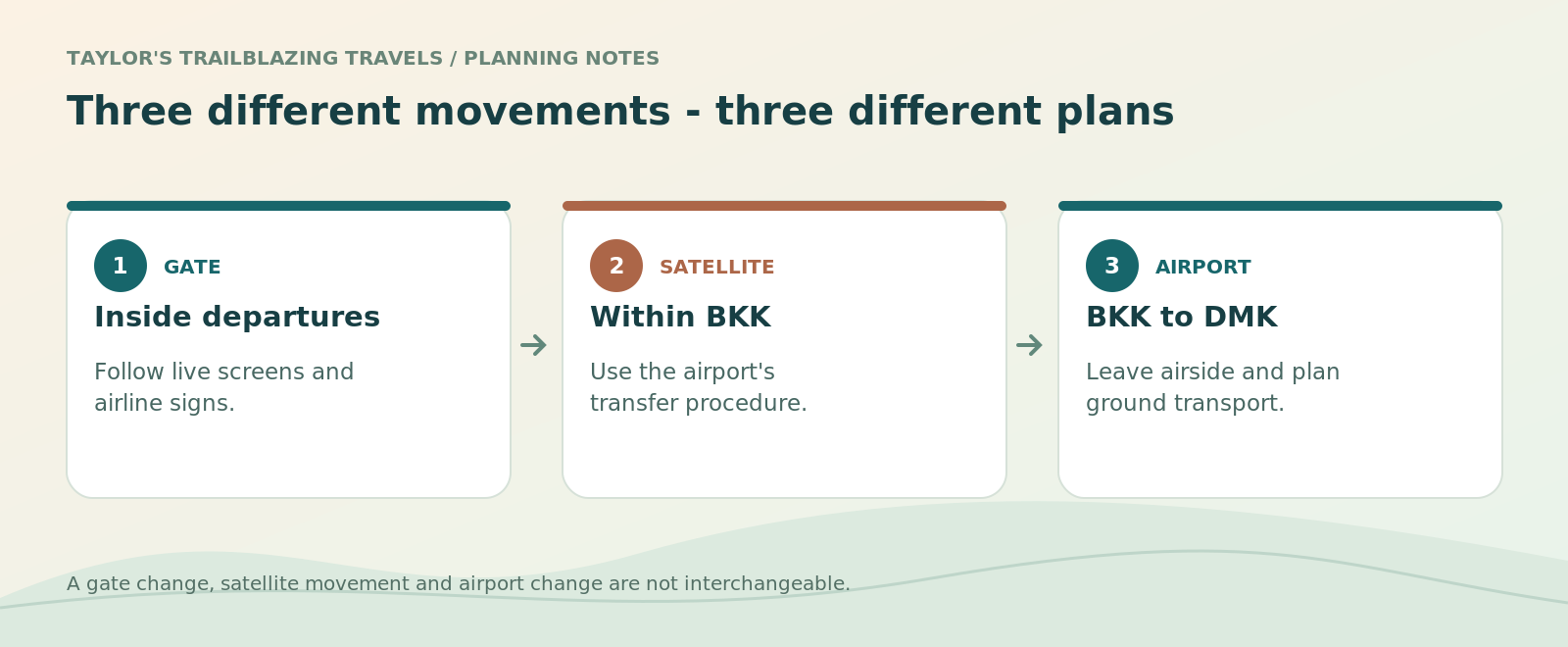
Do not confuse three different kinds of movement
A gate change is movement within the departure system. A terminal or satellite change can involve an internal airport connection. An airport change from BKK to DMK is a landside journey across the metropolitan area. The amount of time and the documents involved are not interchangeable.
Before booking, ask the ticket issuer where immigration and baggage formalities take place for your exact itinerary. Then leave walking time after those formalities. The airport's published people-mover journey does not represent the total time from aircraft seat to the next gate. Disembarkation, directions, lifts and queues belong in the calculation as well.
Don Mueang: domestic and international terminals
Confirm Terminal 1 or Terminal 2
Don Mueang uses Terminal 1 for international passenger operations and Terminal 2 for domestic operations in its current passenger guidance. Check your airline's latest terminal details, especially when a return journey changes from domestic to international. An airport hotel or driver needs the terminal as well as the DMK code. [8]
Unlike a BKK-to-DMK change, moving between Don Mueang's terminal areas is not a journey to another airport. Nevertheless, allow for walking and the required passenger processes. Being in the airport does not mean you are already at the correct check-in desk, and the terminal named on your arrival is not automatically the one used by the next departure.
The Red Line helps, but is not every traveller's complete route
The SRT Red Line's Don Mueang station has a connection to the domestic terminal, according to the operator's station information. It can form part of a city journey, but your hotel may still require another train or road transfer. Check the final connection before deciding that rail is either effortless or unsuitable. [9]
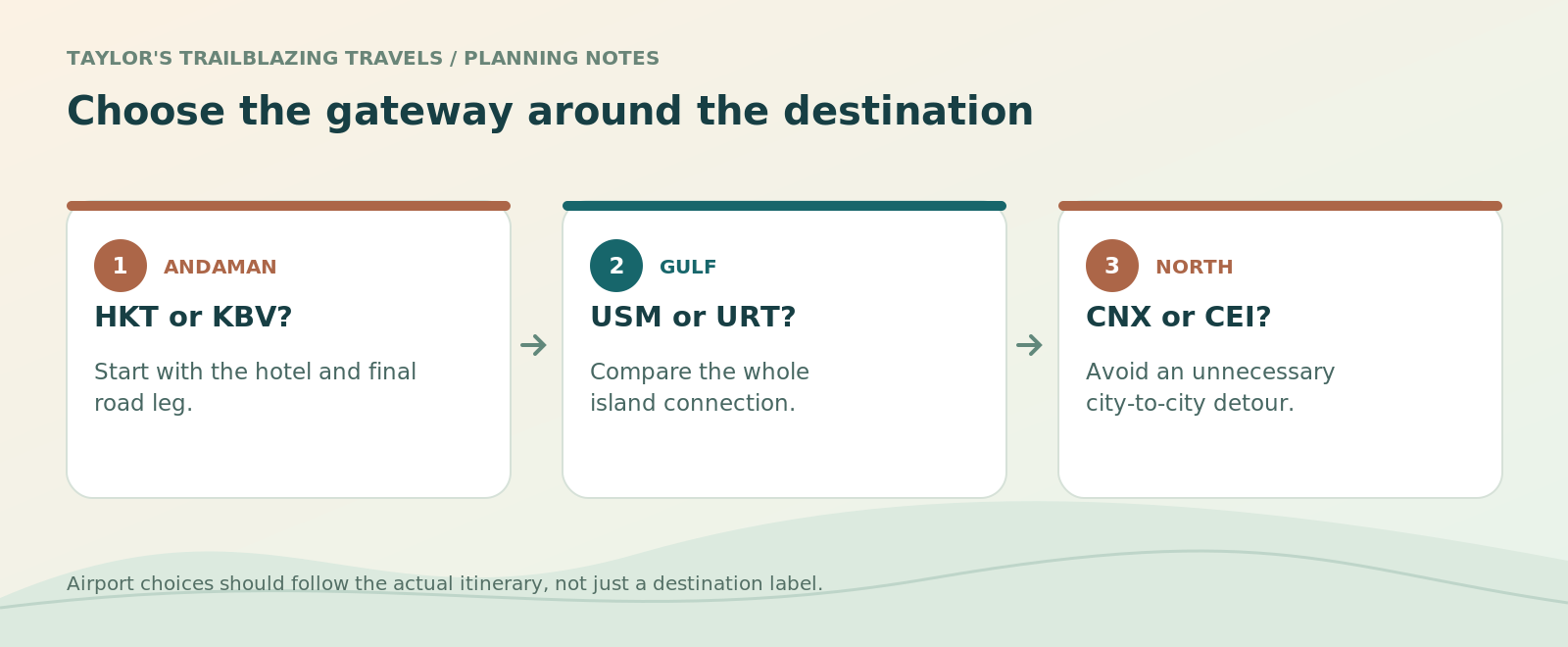
Phuket and Krabi: choose the right Andaman gateway
HKT works best when Phuket is actually your first stop
Phuket Airport serves an island with accommodation spread across several areas. Therefore, the location of your beach matters to the transfer more than a hotel's general Phuket label. Compare Phuket Airport to Patong transport against a quote for your exact address if you are staying somewhere else. Do not reuse a Patong journey estimate for every resort.
Phuket has domestic and international terminal operations. Bangkok Airways' airport information lists different check-in areas for them, so identify the sector you are taking and follow the current airport display. A connection between flights can require more than walking from one sign to another, especially when bags are not checked through. [1]
KBV can be a simpler start for Krabi accommodation
For an Ao Nang holiday, Krabi Airport avoids beginning with a cross-province journey from Phuket. However, not every Krabi-area hotel has the same access requirements. A booking aimed at Railay can involve a boat, while a road transfer to Ao Nang is a different product. Check the actual destination in each listing. [10]
Use Krabi Airport to Ao Nang options to compare the full arrival arrangement, not just the lowest result. A slightly earlier flight can be useful when you need a further connection, but avoid booking a tightly timed excursion for the arrival afternoon. First-night flexibility is often worth more than squeezing an extra activity into an uncertain landing day.
Samui and Surat Thani are not interchangeable
USM puts you on Samui
Samui Airport is on the island, and the airport's official information is the appropriate starting point for arrival services. Your onward journey is still shaped by the beach or hotel location, but it is not the same road-and-ferry arrangement required after a mainland landing. [11]
For a northern-island stay, compare Samui Airport to Bophut transfers and then confirm the particular property's address. A district name can cover more than the part you pictured when booking. Meanwhile, if you intend to continue to another island, investigate the pier connection and sailing time before deciding which Samui flight fits.
URT is a separate mainland decision
Surat Thani Airport can be a practical gateway when your itinerary includes mainland travel or a suitable Gulf-island connection. Nevertheless, a search result labelled Surat Thani can refer to the airport, town, railway station or an operator's office. Pickups at those locations are not substitutes for one another. [4]
Read Surat Thani Airport to Samui combinations for the actual road and sea stages. Check whether the final stop is a pier or your hotel and whether waiting time sits inside the displayed duration. Compare the total with a flight to USM. Neither choice wins automatically: the right answer depends on flight timing, luggage, your accommodation and how much transfer complexity you are prepared to accept.
Chiang Mai and Chiang Rai: choose your northern starting point
CNX and CEI serve different city plans
Chiang Mai Airport uses CNX, while Mae Fah Luang Chiang Rai Airport uses CEI. Their official airport sites provide separate passenger and ground-transport information. Similar names do not imply neighbouring terminals or a short city taxi ride between them. [2][3]
For a Chiang Mai-based trip, compare Chiang Mai Airport to the city with the transport recommended by your accommodation. Check where a shared option drops passengers and whether your hotel lies inside that area. An airport transfer to the centre does not automatically include a remote resort or a mountain accommodation pickup.
Let the itinerary decide the order
If both cities are on your route, consider arriving in one and departing from the other when flights and road arrangements make that sensible. This can remove backtracking without requiring another short flight. However, check actual departures before committing all hotel nights: a convenient route on one day may not exist at the same time on another.
For Chiang Rai, airport-to-city transfer options are a useful comparison rather than a reason to prebook every journey. Ask the hotel for its exact location and preferred arrival instructions. If the accommodation is outside town, a central drop-off followed by another car may be less economical than one properly specified transfer from the airport.
Smaller airports can be useful, not automatically better
Treat alternatives as routing tools
U-Tapao is branded Rayong-Pattaya and has its own passenger and transport information. It can suit an eastern-seaboard visit, but should not be treated as another central-Bangkok terminal. Check the origin and destination of the flight itself, then calculate the journey to the address you need. [5]
Trat and Sukhothai also appear in Bangkok Airways' airport information. They can be relevant when those areas are the purpose of the visit. However, a place name on the ticket does not mean the airport is beside the attraction or that every onward connection operates whenever your aircraft lands. [1]
Avoid creating complexity to save one transfer
A smaller airport is attractive when it removes a long drive and fits the itinerary. It is less attractive when it forces awkward flight connections, a costly overnight stay or a long detour at the other end. Compare the entire route, including how you will leave the region, before booking on the strength of the arrival alone.
Thailand's tourism authority has highlighted regional airport-and-road combinations as part of its domestic connectivity work. That provides useful context, not proof that a proposed route is available on your dates. Use the actual airline booking result and a confirmed ground arrangement rather than interpreting a tourism announcement as a live timetable. [12]
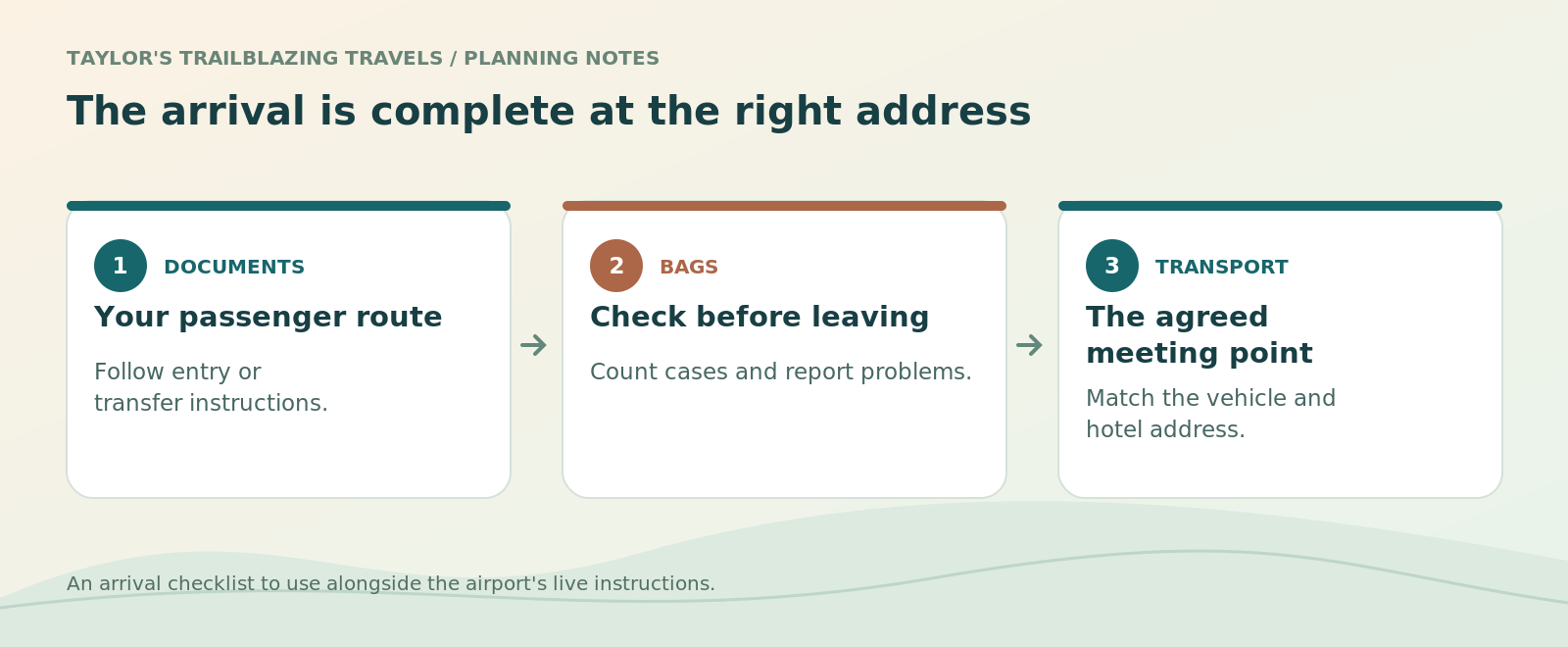
Arrivals: a calm sequence from aircraft to transport
Follow your passenger category
For an international arrival, follow the airport's immigration and arrivals instructions unless you have a confirmed connection process that directs you elsewhere. For a domestic arrival, use the appropriate domestic route. Do not follow a stranger solely because they seem confident: passengers from the same aircraft may have different onward arrangements.
Before reaching any document check, have your passport and relevant arrival information accessible. Thailand's official Digital Arrival Card guidance explains the requirement for eligible foreign arrivals and the stated exemptions. Use the immigration authority's own service, and remember that an arrival card does not itself establish permission to enter the country. [13]
Finish the luggage check before leaving
At baggage collection, identify the flight on the screen and check the luggage tag rather than choosing a familiar-looking suitcase. Count every bag before moving towards the exit. If something is missing or damaged, ask the airline's baggage staff about the reporting process while you are still in the appropriate arrivals area.
Once landside, pause to confirm the transfer meeting point and the next address. A few deliberate minutes are better than leaving through the nearest door and trying to fix an unclear pickup outside. Tell the driver the terminal or exit shown on your booking, and match the supplier and vehicle details before loading your bags.
Connecting flights: ask four questions before booking
Establish the ticket and baggage arrangement
First, are both sectors sold as a protected connection? Second, will your bags be checked to the final destination? Third, where do immigration and security take place? Fourth, is the second flight at the same airport? Answers should come from the airline or ticket issuer for your exact journey, not from a general description of the airport.
One payment does not answer all four questions. A booking website can combine separate travel products, and a connection labelled self-transfer needs close attention. Equally, a through-ticket can have a particular transfer procedure that differs from a landside arrival described in a holiday blog. Avoid replacing the airline's instructions with a generic rule.
Build the connection around the failure you can tolerate
For a same-airport self-transfer after an international arrival, several hours of margin can be sensible; for a different-airport connection, an overnight stay may be the better choice. These are planning judgements, not published airport guarantees. The more expensive or irreplaceable the next booking, the less attractive a tight connection becomes.
A useful stress test is to add a two-hour delay to the first flight. If the whole itinerary immediately fails, consider a later onward departure or a different routing. Then look at the last flight of the day: missing it may mean more than a short wait for the next service. Plan around the recovery options as well as the planned arrival.
Changing between BKK and DMK
This is a landside transfer
A BKK-to-DMK journey requires leaving the airport and travelling to another one. Passengers arriving from overseas must be able to enter Thailand where immigration clearance is required. After the ground journey, the next airport's check-in, security and any departure immigration processes still apply. It is not an airside shuttle between adjacent terminals.
AOT publishes an inter-airport shuttle service for connecting passengers, with eligibility and departure information that should be checked before travel. Do not assume that every airport bus is that shuttle or that it is intended as a general free ride to a hotel. Read both the origin and destination carefully. [14][6]
Compare convenience without buying a false guarantee
A prebooked BKK-to-DMK transfer can simplify meeting arrangements, especially for a group. Nevertheless, it uses the road network and cannot eliminate congestion or a late incoming flight. Tell the supplier the arrival flight, passenger numbers and baggage, then read the waiting policy and what is included in the quoted price.
Where a rail itinerary is more suitable, it involves separate services and interchanges, not one direct airport-to-airport train. Allow time to walk between systems and reach the correct terminal. Above all, calculate the transfer from the arriving aircraft to the next reporting deadline, not merely from one airport's front door to the other.
Put numbers into the airport day without mistaking them for promises
Construct a time budget for the tasks
A useful airport plan separates fixed requirements from uncertain stages. The airline's stated reporting deadline is a requirement; your estimate for baggage delivery or the road journey is an assumption. Write them in different columns so you can see what must change when the flight is delayed.
The following three examples were constructed on 4 October 2026. They are not official minimum connections or measured airport averages. Their purpose is to show how several ordinary tasks can consume a generous-looking gap.
On a small screen, swipe the table sideways to see every column.
| Illustrative situation | Planning calculation | What it demonstrates |
|---|---|---|
| Domestic arrival followed by a nearby hotel | 45 minutes to reach landside plus 60 minutes for meeting and driving | A short flight is not an immediate hotel arrival |
| International arrival followed by a separate domestic flight at the same airport | 90 minutes for arrival tasks plus 30 minutes to relocate plus 120 minutes before departure | Even without an airport change, several hours can be committed |
| International arrival followed by another Bangkok airport | 90 minutes for arrival tasks plus 30 minutes to meet transport plus 90 minutes on the road plus 120 minutes before departure | The base calculation is already five and a half hours, before extra disruption |
Add a buffer where the uncertainty actually sits
For a hotel on a distant beach, enlarge the road allowance. When the ticket needs a second check-in, protect the next airline's reporting time. A flight connecting to the last usable ferry also needs an overnight fallback. Adding a vague extra hour without identifying the weak stage can give reassurance without solving the problem.
After booking, update the plan when a flight is retimed. A thirty-minute change can matter greatly to the last ferry or a late-running airport shuttle, even when it looks minor on the airline email. Check the entire chain rather than simply accepting the new time and assuming every later reservation still fits.
Rail, taxis and hotel vehicles: compare the actual journey
Public transport can solve the middle, not the last metre
Rail is valuable when stations line up with your route and operating times. However, an inexpensive train followed by two changes and an awkward walk may not suit every arrival. Compare the number of lifts, stairs, interchanges and bags rather than judging the mode solely by the fare. The relevant airport and rail operators publish their current service information. [6][9]
For an unfamiliar city hotel, save the address in a format your driver can recognise. A map pin is helpful, but a property with a similar name can still cause confusion. Ask the hotel to confirm its entrance if the building sits behind another property or on a road with restricted access.
A transfer quote needs more than a passenger count
Confirm luggage capacity, waiting time, tolls, parking and the exact drop-off. If you require a child seat or step-free access, ask about that specifically before paying. A listing that says suitable for four passengers may assume much less luggage than four international travellers are carrying.
Keep the return transfer as a separate planning task. Departure timing, pickup location and traffic can differ from the arrival journey. Arrange a pickup that gets you to the airport with an appropriate check-in margin rather than subtracting the shortest drive someone remembers from your flight's departure time.
Overnight stops and late arrivals
A nearby hotel is useful only if the transfer works
An airport-area hotel can make a long connection easier, but check the actual driving route, shuttle frequency and operating hours. A property can be geographically close yet inconvenient to reach because of road access. Additionally, a hotel shuttle may require a reservation or a telephone call after baggage collection.
For BKK, Suvarnabhumi-area hotel searches provide a starting point. Filter for the facilities you genuinely need, then verify the details with the property. Do not assume that a room advertised with airport in its name is inside the terminal, walkable or available for a short daytime rest.
Read the date around midnight
A room for the night before an early-morning departure is not the same booking as a room beginning after that departure date. Similarly, arriving at 01:00 usually requires a room held from the previous evening if you want immediate access. Tell the hotel the actual arrival time and ask for written confirmation.
Keep expectations proportionate to the stop. For a brief overnight connection, reliable pickup, a clean room and a usable breakfast or early checkout can matter more than resort facilities. If you have a much longer stop and enough transport time, a city stay may be more rewarding than spending the entire day beside an airport.
Don Mueang has a different overnight geography
For an early DMK departure, compare Don Mueang-area accommodation instead of selecting a hotel near Suvarnabhumi because both advertise Bangkok airport access. Verify which terminal the property's shuttle serves and how to reserve the seat. A short distance on the map does not replace a confirmed early-morning arrangement.
When an airport hotel offers a return transfer, check whether the wording means one arrival pickup, one departure trip or both. Read whether it is charged per room, per vehicle or per person. Those differences matter to a family booking several rooms and can change the total more than a small difference in the nightly rate.
Luggage, accessibility and connectivity at the terminal
Plan around the journey's least convenient stage
A case that is easy to roll across an airport can be difficult on a station interchange or a ferry ramp. Before packing, identify the stage where you will carry it yourself. Split essential items so that a delayed hold bag does not leave you without documents, medication, a charger or a change of clothes.
Assistance should be arranged with the airline for the tasks you need, rather than assumed from the existence of an airport wheelchair. Explain walking limitations, aircraft-stair concerns and any mobility equipment. Meanwhile, when booking ground transport, verify that the vehicle meets the same needs; an accessible terminal does not automatically make every onward vehicle suitable.
Keep information available without a live connection
Save boarding documents, hotel addresses and transfer instructions on the phone itself, with another accessible copy where practical. A signal problem should not prevent you from reading the meeting point. Charge devices before travel and organise them so that you can produce a ticket without unpacking several bags in a queue.
Mobile data is useful for contacting a supplier, but it should support the plan rather than replace it. A data-only service may not make ordinary telephone calls, while some hotel shuttle instructions request a call. Establish the communication method in advance instead of discovering that the number on the voucher is unusable with your chosen setup.
Money, communications and the first hour landside
Deal with essentials in a deliberate order
Before leaving arrivals, identify what you need immediately: a usable payment method, the hotel address, transport contact details and enough connectivity to manage the journey. You do not necessarily need to complete every shopping task at the first counter. Prioritise anything that would prevent you reaching the hotel, then leave optional purchases until the arrival is settled.
If changing money, compare the displayed rate and any stated fees before handing over cash. If using an ATM, read the on-screen terms and check your own bank's charges. This guide does not claim one airport or counter always has the best exchange rate; the practical aim is to understand the transaction you authorise.
Choose a phone setup that matches the transfer instructions
An eSIM needs a compatible device and the correct activation process. A physical SIM involves a different purchase and installation step. Before travelling, establish whether your intended plan can receive the messages or calls used by the driver or hotel. A data-only service can still work well when the supplier accepts an internet-based contact method.
Keep the first address offline even when you have bought data. Save the hotel name, full address and booking contact separately from a live map. In particular, do not make a driver wait while you recover a password merely to identify the property you booked several months earlier.
Confirm the vehicle before moving the bags
Use the meeting arrangement described in your booking or the airport's recognised transport process. Match the booking name, supplier and vehicle details where supplied. If someone approaches offering to replace the booked transfer, verify that change through the original contact before accepting it.
Count luggage before loading and again when you reach the hotel. Keep passports, payment cards and essential items with you rather than in a boot that you may forget to check. Once you are safely at the accommodation, confirm the next travel day without leaving the airport paperwork mixed with unrelated hotel messages.
Three example airport choices, explained
Bangkok, Chiang Mai and one beach base
For a multi-region holiday, first compare a route that arrives in Bangkok, continues to Chiang Mai and ends in one southern base. Search all flight sectors before fixing the hotel order. A convenient direct middle flight can make a different sequence preferable, while a forced return to Bangkok might use an extra travel day.
Keep the international departure in view from the beginning. If it is from BKK on a separate ticket, the final domestic arrival should be planned around that airport rather than around whichever Bangkok result happens to be cheaper. Returning the day before can also turn the safety margin into a final city evening.
A Samui holiday with a mainland excursion
USM can be the simpler airport for a Samui-only stay. URT can become more attractive when you genuinely intend to spend time on the mainland. The decision changes once the road transfer is part of your holiday rather than a cost you are trying to avoid. Compare the journey in both directions before choosing.
An Andaman trip without needless backtracking
For time in both Phuket and Krabi, compare arriving at one airport and departing from the other. That can remove a return road journey, but only if the flight schedule and baggage costs remain sensible. An open-jaw plan should simplify the itinerary; it should not force a poor connection merely to make the route look elegant on a map.
Hiring a car after landing: put collection into the itinerary
A hire-car reservation is not an instant airport exit
Allow time for the rental desk, document checks, the agreed payment process and inspection of the vehicle. Confirm whether collection is inside the terminal, beside it or reached by a supplier's shuttle. A booking described as airport pickup can involve an additional movement before you receive the keys.
Read the supplier's current driver, licence, deposit and insurance requirements directly. Do not assume that a card used to reserve the vehicle meets every collection condition. If a late flight could put you outside normal desk hours, ask in advance how collection works and whether an extra charge applies.
Plan a gentle first drive
After a long flight, choose an arrival plan that leaves room to rest and get organised. Inspect the vehicle with enough time to record existing damage and understand the controls before joining unfamiliar roads. Save the first hotel's entrance and parking instructions while you still have a reliable connection.
For a multi-airport route, confirm whether the car can be returned at the airport you intend to depart from. A one-way rental can be useful, but it needs an actual agreement and a complete price. Do not design an open-jaw flight itinerary around a car-return arrangement you have only assumed is available.
Return time belongs before airline check-in time
On departure day, budget for refuelling where required, vehicle inspection, paperwork and the walk or shuttle to the terminal. Arriving at the rental return area two hours before the flight is not the same as reaching the airline desk then. Add the rental process before the airport reporting margin instead of making those two tasks compete for the same time.
Large gateways versus closer regional airports: pros and cons
The advantage of a large gateway
A larger gateway can offer more routing choices and alternatives when plans change, although the actual options depend on your dates. It can be a good place to begin an unfamiliar country trip because you can choose from several onward strategies rather than committing immediately to one remote transfer.
The limitation is complexity. A long concourse, busy arrivals period or hotel far across the city can erode the apparent convenience. Do not assume that a well-known airport is automatically the quickest way to your actual destination.
The advantage of a closer airport
A regional airport can remove hours of road travel and make a short stay more worthwhile. The trade-off can be fewer convenient flights or less flexibility if your preferred service changes. Compare the whole trip, including departure, rather than selecting solely on the first arrival.
The most preventable mistakes are booking the wrong Bangkok airport, confusing city and airport pickup points, and buying the last viable ferry connection after a late flight. Another is assuming that international in an airport’s name guarantees the overseas route you need. Check actual bookable services and your final address, then allow space for ordinary delays.
Common mistakes beyond the airport code
Selecting a transfer by its cheapest starting price
A starting price can apply to a shared seat, a particular pickup time or a limited drop-off area. Before comparing it with a private vehicle, match the actual service you need. Check whether waiting, baggage, tolls and hotel delivery are included, and whether the fare is per person or for the whole vehicle.
A reservation can be valid and still be unsuitable when it ends at a central office rather than your hotel. Put the missing last stage into the calculation. This is especially important at unfamiliar beach destinations, where a place name can cover several access points rather than one compact centre.
Believing a proposed connection is already operating
Airport expansion announcements and tourism plans can describe future services rather than flights you can book today. Use those announcements as context only. A confirmed timetable and a usable ticket for your date are the relevant evidence when deciding the holiday route.
Likewise, do not assume an airport is open for unrestricted overnight waiting just because flights arrive late. Check the practical arrangement you need directly. A room, luggage-storage service or accessible facility should be verified individually when the plan depends on it.
Frequently asked questions
Which airport should a first-time visitor use?
There is no single correct airport for every Thailand holiday. BKK or DMK can suit a Bangkok start; HKT or KBV can simplify an Andaman-focused visit; and USM is directly on Samui. Choose around your first base, available flights and onward transport rather than automatically arriving in Bangkok for a trip that never needs the capital.
Are Suvarnabhumi and Don Mueang connected terminals?
No. They are separate airports, using BKK and DMK respectively. Moving between them is a landside ground journey, followed by the next airport’s passenger procedures. Check whether you must collect luggage and enter Thailand, and do not use a normal terminal-transfer allowance for the journey. [1][14]
Is SAT-1 a different airport?
No. SAT-1 is part of Suvarnabhumi and has a people-mover connection with the main terminal. Your route through it depends on the flight and connection arrangement. Follow the airline and airport transfer instructions rather than leaving airside or collecting baggage unnecessarily. [7]
Does Phuket have separate domestic and international areas?
Yes. The airline airport information used for this guide identifies domestic and international terminal check-in arrangements. Check the current instructions for your flight, particularly on a separate-ticket connection where luggage and document procedures may need to be repeated. Do not assume every Phuket departure uses the same desk or floor. [1]
Is Surat Thani Airport on Koh Samui?
No. It is a mainland gateway, and travel to Samui needs additional transport. Choose an airport-origin combination rather than a town or railway-station pickup, then read which pier or hotel is the final destination. Compare the full itinerary with flying to Samui Airport before deciding. [4][11]
Can I go straight from Krabi Airport to Railay by car?
A listing for Railay can include a road stage followed by a boat, rather than a car reaching the hotel door. Check the transport combination, pier, luggage handling and final walking stage with the supplier. An Ao Nang search heading alone is not enough to establish which arrival arrangement you are buying. [10]
How much time should I leave for an airport transfer?
Work backwards from the airline’s reporting deadline and add the whole landside journey, not just driving time. Then allow extra room for the arrival process and disruption. A same-airport connection, an inter-airport transfer and an airport-to-ferry journey have different weak points; a single universal transfer time would be misleading.
Do I need an arrival card for a domestic flight?
A flight entirely within Thailand is not a new international entry. The official TDAC guidance concerns entry and its stated exemptions. If your journey involves arriving from overseas or leaving an international transit area to change airports, check the immigration requirements for that actual itinerary rather than treating it as purely domestic. [13]
Should I book airport transport before travelling?
Prebooking can help when you have a late arrival, a group, particular accessibility requirements or a remote hotel. It is less essential when several suitable options are available and you prefer flexibility. Either way, compare the exact destination, luggage capacity and reporting instructions rather than assuming all airport transfers are equivalent.
Can an airport hotel solve a tight connection?
It can help when you deliberately choose a longer overnight connection, but it cannot fix an already impossible transfer. Confirm the room date, check-in availability and transport to the correct terminal. An airport-area property is useful only when its actual access arrangements fit your departure, not simply because it looks close on a map.
Choose the airport after the itinerary, not before it
Start with your first hotel and final departure, then choose the airports that connect those points with the fewest awkward stages. Read every three-letter code, distinguish a terminal change from an airport change and treat a mainland-to-island connection as a complete journey. These checks prevent more trouble than memorising an airport's shop list.
Once the route is chosen, put each airport, terminal, flight number and ground meeting point in one simple travel record. Keep the official airport and airline links available for a final check, but do not fill the day with such tight commitments that one changed gate ruins the plan.
A good airport choice should make the first and last days easier. Paying slightly more for the right location or adding one well-placed overnight stop can be sensible when it removes multiple uncertain transfers. Equally, a regional gateway can be excellent value when it is genuinely part of the holiday you want to take.
Sources and fact-checking notes
Last editorial source check: 04 October 2026. Official airport, railway, government and airline pages support operational facts; booking-platform and operator pages support their own product information. Timings described as planning allowances are editorial judgements, not guaranteed connections. Constructed price examples are labelled and are not live offers.
Availability, pickup instructions, baggage conditions and operating details can change. Recheck the actual ticket and current operator guidance before travel. The original scene artwork is illustrative and should not be used as a map or evidence of a specific terminal layout.
- Bangkok Airways: airport check-in, airport codes and counter deadlines.
- Airports of Thailand: Chiang Mai Airport.
- Airports of Thailand: Mae Fah Luang Chiang Rai Airport.
- 12Go: Surat Thani Airport to Koh Samui, individual transfer listings.
- U-Tapao Rayong-Pattaya Airport: official passenger information.
- Airports of Thailand: Suvarnabhumi ground transport.
- Airports of Thailand: SAT-1 connecting-flight procedures.
- Airports of Thailand: Don Mueang passenger information.
- SRT Red Line: Don Mueang station, terminal connection and facilities.
- 12Go: Krabi Airport to Ao Nang, individual transfer listings.
- Samui Airport: official airport information.
- Tourism Authority of Thailand: regional airports and onward road travel.
- Thai Immigration Bureau: official Thailand Digital Arrival Card guidance.
- Airports of Thailand: Don Mueang inter-airport shuttle.
Illustrations in this article were created for Taylor’s Trailblazing Travels. Third-party photographs, where used, are credited beside the image or in the source list.