Seasons / Rainy-season planning
Thailand Rainy Season Guide
Choose a holiday that still works when the weather changes, from the right coast to a sensible final-night buffer.
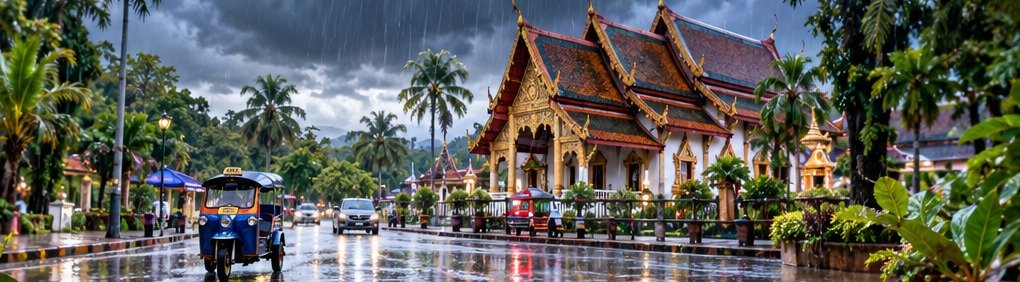
Original rainy-street concept, not a documentary photograph, current flood report or prediction for a particular destination.
A Thailand rainy season guide is most useful when it helps you decide what to change, rather than simply telling you not to worry. Rain can be a short interruption, a reason to spend the afternoon indoors or part of a wider event that affects roads, boats and access to your accommodation. Those situations need different responses.
The country also does not have one identical wet-season calendar. A holiday on the Andaman coast and a holiday around Koh Samui can face different seasonal patterns, while a city break has different practical weaknesses from a route built around ferries and remote beaches. Choosing a destination by the word Thailand alone leaves too much out of the decision.
My planning approach is to separate the experience you want from the conditions it needs. Food, galleries and a comfortable hotel can work with considerable flexibility. A short holiday whose entire value depends on clear-water snorkelling has much less room for disappointment. This guide combines official seasonal and safety information with clearly labelled itinerary and budget examples. It does not turn climate averages into a promise about your week, or a lower room price into evidence that a particular journey is safe.
Best fit
A flexible holiday
Food, culture and a comfortable base keep options open.
Regional choice
Compare the two coasts
A national wet-season label leaves too much out.
Protect the flight
Finish the boat leg earlier
A paid ticket is not a weather guarantee.
Daily decision
Use current official advice
Read warnings for the route as well as the hotel.
Thailand rainy season guide: decide whether the trip suits you
Start with the holiday you would still enjoy
Imagine two days when outdoor plans change. Would you be happy eating locally, visiting suitable indoor attractions and taking the trip more slowly? If so, a flexible rainy-season visit may still deliver what you came for. If those days would remove the only activities you value, the same dates deserve more caution.
This is not a ranking of brave and cautious travellers. It is a question of fit. A photographer hoping for varied skies has different priorities from a family booking a brief swimming holiday, and both can make sensible decisions from the same forecast.
Compare the consequences, not just the chance of rain
A shower outside a city restaurant and a cancelled final ferry do not have equal consequences. List the parts of the route that cannot easily move: flights, an important event, medication access or a short connection. Then place flexibility around those points instead of trying to make every minute predictable.
The decision table is an editorial framework. It does not claim measured probabilities or guarantee that any destination will remain dry.
| Trip priority | Rainy-season fit | Main adaptation | A reason to reconsider |
|---|---|---|---|
| Food and urban culture | Often workable | Short outdoor legs and indoor alternatives | Hotel or route affected by warnings |
| Relaxed resort stay | Depends on the property | Enjoyable room and covered facilities | Swimming is the only valued activity |
| Remote island hopping | More fragile | Fewer crossings and spare time | Tight flight after the final boat |
| Trekking and waterfalls | Activity-specific | Confirm access and use responsible operators | Closures, flash-flood or landslide risk |
| Snorkelling-focused short break | Strongly conditions-dependent | Flexible activity days and local advice | No tolerance for lost water time |
Understand the seasonal calendar without overreading it
The broad national pattern
The Thai Meteorological Department places the main rainy season broadly around mid-May to mid-October, with regional differences and year-to-year variation. Southern east-coast rain can continue later as the wind pattern changes. Treat those boundaries as climate guidance, not as dates when weather switches on or off. [1]
A booking for the first week of November is not automatically dry everywhere, and a June booking is not automatically a washout. A seasonal description tells you which questions deserve attention; the conditions near departure determine the practical answer.
Peak rainfall and the wider unsettled period differ
Official sources do not always describe the same window. TAT’s coast-specific explanation highlights later-year rain around Samui, while FCDO gives a broader November-to-March rainy-season window for Koh Samui and southeast Thailand. These descriptions are not a reason to promise a particular month is safe or dry; they serve different planning levels. [2] [3]
When sources appear to disagree, avoid choosing whichever sentence supports the holiday you already want. Look for the exact place, whether the text describes a peak or a broader risk period, and the date of the current local warning. That method is more useful than forcing all of Thailand into one neat calendar.
Compare the Andaman and Gulf coasts carefully
Andaman choices need a sea-state plan
TAT’s monsoon guidance identifies rougher crossings and weather-related restrictions as issues on the Andaman side. That matters because an attractive beach hotel does not independently solve access, excursion or swimming conditions. Build the route so you can enjoy the base without taking a boat every day. [2]
For a Phuket or Krabi stay, ask what you would do when a chosen beach is unsuitable for swimming. A comfortable property, safe access to food and several land-based options can preserve the holiday. A remote location whose only appeal is an exposed shore gives you fewer alternatives.
Gulf does not mean permanently calm
The Tourism Association of Koh Samui describes a different seasonal pattern, with later-year monsoon conditions. That makes the Gulf a relevant comparison for some summer dates, but not a guarantee of sunshine, flat water or uninterrupted ferries. Check the actual island and travel day rather than treating an entire sea as one uniform destination. [4]
Bangkok and the north: build days with short exposed sections
Urban flexibility is a real advantage
A city-based day can often be rearranged more easily than an excursion that requires a long crossing. Put outdoor walking, indoor stops and meals close enough together that you can change the sequence. Do not scatter a day’s bookings across the city and then expect rain to be the only source of delay.
In Bangkok, shortlist accommodation near the areas you actually plan to visit rather than selecting purely by a broad district name. Ask about the last part of the walk from transport, stairs and sheltered access when those details matter to your group. A map’s straight-line distance does not describe that experience.
Northern scenery still requires access checks
Greener landscapes can be part of the appeal, and TAT promotes nature, food and slower travel during the shoulder period. However, marketing about full waterfalls is not permission to enter a closed or hazardous area. Separate the visual appeal from the route’s current safety and access conditions. [5] [6]
For a northern stay, mix suitable cultural and indoor activities with weather-dependent outdoor plans. Keep the ambitious excursion optional until its conditions are clear, and avoid making a distant mountain outing the only worthwhile day in the itinerary.
Read forecasts for the decision you need to make
A rain icon is not a complete description
Different forecasts summarise different areas and periods. A daily icon cannot tell you exactly when rain will fall on a particular street, and a probability should not be interpreted as the percentage of your holiday that will be wet. Read the forecast’s location, time window and explanatory text before drawing a conclusion.
For travel decisions, consult the Thai Meteorological Department’s current warnings as well as the ordinary forecast. Note the issue time, affected provinces, expected hazards and period covered. A screenshot forwarded without a date can be misleading even when it originated from a legitimate source. [7]
Check the route, not only the destination
A dry-looking forecast at the hotel does not describe the road, river or sea you must cross to reach it. Look at departure points and intermediate areas when the journey is exposed. Then ask the operator whether the service is running and whether any relevant restrictions apply.
Build the checks into moments that can still change the plan: before a cancellation deadline, the evening before a transfer and again before leaving. Rechecking continually after you have lost every alternative is less useful than checking at a decision point while options remain.
Distinguish an ordinary shower from a hazard
Comfort problems and safety problems need different responses
An ordinary shower may justify waiting, using a suitable rain layer or swapping the order of activities. Rapidly rising water, official warnings, closed access, thunder nearby or an operator cancelling for safety are different signals. Do not reduce them to an inconvenience because you have already paid.
A sheltered cafe can make a pause comfortable, but it does not establish that the route outside is suitable. Ask a responsible local source about conditions and follow official instructions. Avoid treating another traveller’s successful crossing as evidence that the same choice is safe for you.
Have a simple stop rule
Agree in advance that nobody needs to argue for continuing through floodwater or against a closure. When an activity depends on a guide or operator, ask how decisions are made and what happens when the plan changes. A useful answer explains the process, not merely that the company usually goes ahead.
Keep the trip’s purpose in view. Missing an excursion is disappointing, but it is not a reason to turn a manageable change into a serious problem. The money already spent does not alter the weather or the consequences of the decision.
Swimming, red flags and thunderstorms
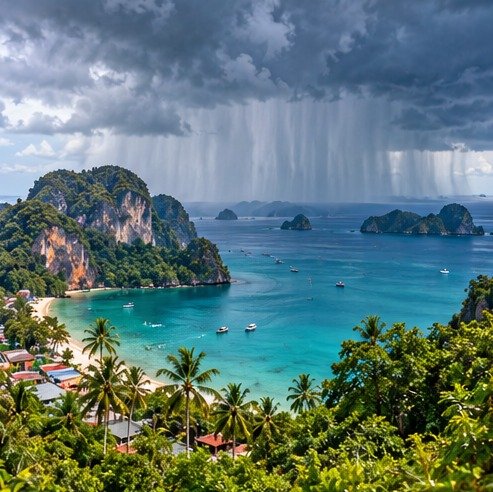
Beach weather is more than the sky above you
A bright interval can coincide with dangerous water conditions. Follow local flags, lifeguard instructions and official restrictions; do not use sunshine, calm-looking surface water or other swimmers as the deciding test. FCDO specifically warns about the risks associated with sea conditions and water activities in Thailand. [3]
Choose a property partly by the alternatives it offers when the sea is unsuitable. A pool can be a useful amenity, subject to its own weather and safety rules, but it is not a reason to ignore lightning or staff instructions. A good base leaves room for a different day.
Leave exposed places when thunder is near
For lightning, seek a substantial building or enclosed hard-topped vehicle rather than a tree, tent or open beach shelter. National Weather Service guidance recommends waiting at least 30 minutes after the last thunder before resuming exposed activities. Follow any stricter local instruction. [8]
Ferries and the final-flight problem
A ticket is a booking, not a weather clearance
Confirm the actual operator, departure pier, check-in requirements and current service status. Timetables and search platforms help organise travel, but the operator and authorities still decide whether a crossing can proceed. Keep the relevant contact details and instructions accessible offline.
For example, compare Surat Thani to Koh Samui transport options by what the booking includes, not just the headline time. Some journeys contain a land connection as well as a boat. Understand each component and where responsibility changes before relying on the total journey to fit a tight day.
Protect the expensive onward journey
For a valuable international departure, my planning preference is to finish the weather-sensitive island leg earlier and spend the final night on the mainland or in the departure city. This is a risk-reduction choice, not a guaranteed minimum connection rule. More separation may be appropriate when warnings or disruptions are expected.
Do not use the last advertised boat as the only route to a non-refundable flight. Compare the cost of a buffer night with the consequences of missing the onward journey, then make that trade-off before booking rather than during an anxious wait at the pier.
Roads, rail and longer transfers
Keep the transfer day honest
A journey occupies more than the time printed beside a departure. Packing, reaching the station, waiting, arriving and finding the next hotel all belong in the day. Rain adds another reason not to stack an important afternoon appointment immediately after an already complicated route.
When reviewing Bangkok to Chiang Mai transport options, compare the actual mode and operator requirements. A railway or airport connection is not automatically immune to weather, and choosing a different mode should solve a particular weakness rather than merely create a new complicated itinerary.
Ask what changes when the route is disrupted
Find out how the operator communicates a cancellation, delay or different pickup point. Keep the booking reference and a working contact method. A compatible Airalo Thailand data option can help with messages and rebooking, but save the essential details before leaving reliable connectivity.
Allow yourself a practical fallback: a reachable hotel, funds for an extra night and enough time to contact the next property. These are more useful preparations than assuming every disruption can be repaired with the first available vehicle, regardless of its condition or the route’s status.
Accommodation matters more when you spend time indoors
Book a room you would willingly use during the day
Look beyond the pool photograph. Consider ventilation or air conditioning, space, daylight, seating, food access and whether children or travelling companions can comfortably spend several hours there. A room chosen only for sleeping may feel very different during a long wet afternoon.
Use Phuket accommodation comparisons on Agoda to identify possible bases, then inspect recent details and ask specific questions. Check whether facilities in the description will be available during your dates, particularly when an amenity is essential to the holiday you have planned.
Inspect the cancellation wording carefully
Refundability is a feature of the particular rate and booking terms, not an automatic property of a platform or destination. Record the deadline, local time basis and any penalties before paying. A room being labelled pay later does not by itself answer whether cancellation is free.
Avoid paying a flexibility premium without understanding what it buys. If the free-cancellation deadline falls before useful local weather information becomes available, the rate may still have value, but it is not complete weather insurance. Compare that limitation with the price difference and your tolerance for changing plans.
Create indoor alternatives that are worth doing
Choose activities for interest, not merely shelter
A good alternative should feel like part of the holiday rather than a punishment for rain. Consider cooking, galleries, museums, craft sessions or a longer meal somewhere you genuinely wanted to try. Check current opening, access and whether the supposedly indoor activity includes a substantial exposed transfer.
You can compare Bangkok cooking classes by the actual format and location. A class with an outdoor market visit may still need a weather discussion. Read the inclusions and cancellation terms rather than assuming every cooking activity takes place entirely inside one building.
Keep the reserve plan nearby
Prepare two or three options near your base, then choose according to conditions and energy on the day. Bangkok museum and indoor-activity listings can help identify possibilities, but confirm the attraction’s current opening directly before travelling across the city.
National parks, caves and waterfalls
A dramatic scene can have a difficult approach
Heavy water flow is visually impressive, but the attraction and the route to it need separate safety decisions. Do not cross barriers, enter a closed trail or assume that a popular photograph shows current access. A site can be open in general while a particular path, cave or waterfall zone is restricted.
TAT’s current annual guidance explains that closures vary by attraction, weather and park conditions. Check with the relevant park before committing to a journey, especially when an online booking page still appears to sell the excursion. Availability on a sales page is not authoritative access information. [6]
Keep a nature day replaceable
Place the excursion where it can move within the stay, rather than fixing it to the only possible morning. Ask the operator about the safest suitable alternative and whether a change affects the price or refund. Keep those answers in writing when the activity is a substantial part of the budget.
Avoid going independently into unfamiliar caves or drainage channels because the rain has paused locally. The relevant conditions can be beyond the place where you are standing. A responsible decision considers the whole route and current instructions, not just the view at the entrance.
A flexible two-week route example
Use bases rather than collecting destinations
This is an editorial example for 14 days and 13 nights, not a forecast or a fixed recommendation for every month. Allocate three nights in Bangkok, five in Chiang Mai or another suitable northern base, four at one chosen coast, then one final night in Bangkok before departure. The repeated Bangkok stop is a buffer, not a fourth sightseeing project.
Place travel on Days 4, 9 and 13, leaving the other days with room to rearrange activities. The exact services must suit the dates, and warnings may justify replacing a region entirely. Do not preserve the example mechanically when conditions point elsewhere.
Decide the beach section last when possible
Compare the relevant coasts for the dates, access and activities you value. Keep that stay at one base rather than spending four nights across three islands. More hotel changes reduce your ability to move an excursion to another day and add additional moments when bags and travellers must be outside.
For a one-week trip, simplify further: one main base with a short city element may be preferable to a compressed version of the two-week route. The goal is not to fit the same list into fewer days. It is to retain a holiday that still works when one or two plans change.
Is the rainy season actually cheaper?
Compare like with like on the dates you need
Lower-season offers can be attractive, but there is no universal discount that applies to every destination, room and school-holiday period. Compare the same room type, meal basis, cancellation conditions and total fees. A cheaper non-refundable rate is not equivalent to a more flexible one.
TAT promotes the shoulder period partly through travel value and a quieter pace. Treat that as destination marketing rather than a measured promise that your exact trip will cost less. The only useful saving is the difference between bookable arrangements that meet your own needs. [5]
Include the cost of the weather response
Consider a constructed example dated 5 October 2026: four nights at THB1,800 total THB7,200, compared with four nights at THB2,000 totalling THB8,000. The difference is THB800. These are invented planning inputs, not hotel quotes. An extra THB1,400 of transport would more than remove that apparent saving.
That does not make the cheaper room a bad choice; it shows why location and facilities belong in the arithmetic. Include any additional transfer, buffer night or replacement activity you would realistically buy. A holiday can still represent good value without being the lowest possible accommodation total.
Pack for wet transitions and drying time
Protect the things whose failure matters
A light ventilated rain layer can help during ordinary showers, while a properly used dry bag or inner luggage barrier protects items that should not get wet. Keep documents and essential electronics separately protected rather than assuming the outer bag will handle every exposure.
Use equipment within its stated limits. A rain cover or pouch is not evidence that a device can be submerged, and no accessory removes the need to wait when conditions are unsuitable. The most useful packing decision may be leaving unnecessary electronics in secure accommodation.
Give damp items somewhere to go
Bring comfortable footwear and a useful alternative, such as secure walking sandals for appropriate everyday surfaces. Keep wet items apart during transfers, then unpack and dry them at the next stop. A sealed compartment contains moisture temporarily; it does not solve drying.
Health, floodwater and the ordinary daily routine
Avoid preventable exposure
Do not wade through floodwater just to preserve an activity. CDC guidance warns that potentially contaminated water can transmit leptospirosis, and illness after relevant exposure deserves medical advice. Protective clothing is not a reason to choose an avoidable crossing. [9]
Keep basic hygiene and safe drinking-water arrangements practical, especially when a journey is delayed. Store essential medicines according to professional instructions and retain the details needed to seek care. Any personal condition that affects travel planning deserves advice from a qualified clinician rather than a generic seasonal checklist.
Keep sun and insect protection in use
Overcast conditions are not a reason to abandon sun protection, and the rainy-season label does not define when mosquitoes can bite. Follow appropriate sunscreen and repellent instructions, using clothing and shade as part of the routine. CDC recommends sunscreen before repellent when both are used. [10]
For a serious medical emergency in Thailand, the local emergency medical number is 1669. Keep the hotel address and a way to describe your location accessible, and ask staff for immediate assistance when needed. Do not delay urgent care while trying to solve an insurance or booking question. [11]
Make the cancellation plan before you need it
Separate three different decisions
A traveller deciding not to go, an operator cancelling and an authority closing access can lead to different contractual outcomes. Read the terms rather than assuming that bad weather produces a universal refund. Keep the booking confirmation, cancellation wording and any relevant messages together.
When an operator changes the plan, ask what is now being offered and whether accepting it affects your options. Avoid agreeing in a hurry to an unsuitable substitute simply to finish the conversation. You can be polite and still request a clear explanation of the available choices.
Preserve evidence without making promises about cover
Travel insurance is policy-specific. Review the relevant disruption, cancellation and medical sections, including exclusions and the timing of purchase. A forecast or a general concern about rain is not automatically an insured event. Ask the insurer directly about uncertainties before relying on cover.
Keep receipts and written notices when disruption occurs, but do not assume that collecting them guarantees reimbursement. The practical aim is to understand your position and make a sensible next move, not to force a hazardous journey because the refund answer is unclear.
Make the arrival day resilient
Arrange the difficult details before boarding
A wet arrival becomes harder when you still need to find the address, understand the pickup or discover whether reception will be open. Save the property details and arrival instructions, and tell the accommodation about a late or uncertain arrival. Ask where the vehicle can stop and how far the last walk is.
Keep a small accessible bag with documents, necessary medication and a dry change. This is not an emergency expedition kit; it is a way to avoid opening all the luggage in an exposed place. A working phone connection is useful, but the essential instructions should remain available when data does not connect immediately.
Leave the first evening lightly planned
Avoid attaching an expensive timed activity to a complicated arrival. Check in, establish the local situation and decide what feels worthwhile once the journey is finished. A nearby meal can be a better first plan than crossing the city again to meet a booking that no longer fits.
For a family or someone with mobility needs, ask about steps, sheltered access and assistance in advance. The property can give a more useful answer to a specific question than to a vague request for easy access. Clear arrangements reduce pressure to hurry across wet ground or accept an unsuitable last-minute transfer.
Use a good weather window without overcommitting
Keep a short list of nearby possibilities
When conditions improve, it helps to know which enjoyable activities can be reached easily and ended without difficulty. A short local walk, suitable viewpoint or outdoor meal can make good use of the interval. The improvement does not automatically justify beginning a long exposed excursion with a difficult return.
Choose the activity by the current conditions and available time rather than trying to recover every cancelled plan at once. An overloaded sunny interval can become as rushed as the original itinerary. Leave enough margin to reach proper shelter or return to the accommodation if the situation changes.
Preserve the distinction between local and route conditions
A dry patch above the hotel says little about a distant mountain road or the sea crossed by an excursion. Check the conditions relevant to the whole activity before committing. For organised trips, use the operator’s current decision rather than assuming the improved view outside your window overrides it.
Plan differently for couples, families and short breaks
Match the fallback to the people taking it
A long cafe afternoon may suit one couple and frustrate a family with young children. A museum can be a worthwhile alternative for one traveller and an irrelevant expense for another. Build the reserve day from activities the actual group enjoys, not from a generic list of things tourists are supposed to like.
Discuss priorities before booking. When one person values swimming above everything else and another is happy with food and culture, the season can affect them differently. Acknowledge that difference rather than assuming that a lower hotel rate makes the compromise equally attractive to everyone.
Short trips have less room to absorb disruption
A two-night stay centred on one excursion is more fragile than a longer visit with several suitable activity days. The same amount of rain or one cancellation can remove a much larger share of the short break. Compare the consequence before deciding that a seasonal bargain is worth taking.
For a longer holiday, concentrate time in a few useful bases. For a brief break, choose a destination whose main appeal remains accessible without complicated weather-sensitive travel. Neither approach guarantees conditions, but both reduce dependence on everything working perfectly at a particular hour.
Photograph the weather without chasing a hazardous scene
Work from a suitable location
Rain, reflections and changing light can create interesting scenes, but a photograph is not a reason to enter a flooded road, cross a barrier or remain on an exposed beach during thunder. Choose a safe sheltered position and keep clear of traffic and other people using the space.
Protect equipment before stepping outside, and carry less when conditions make handling awkward. A phone or camera inside a suitable pouch is useful only when it can be operated without creating another problem. Avoid blocking a doorway with open bags or leaving loose covers where others could trip.
Let the destination remain an ordinary place
Residents still need to work, travel and deal with the weather. Ask before photographing people in a difficult situation, and do not treat local disruption as a spectacle. A respectful pause or a different composition is preferable to making someone’s day harder for a dramatic picture.
You do not need to document every part of a changed itinerary. Sometimes the useful choice is to put the equipment away, enjoy a suitable indoor stop and return when conditions are better. That leaves both the holiday and the photographs less dependent on pushing a situation beyond what is sensible.
Review bundled bookings one component at a time
Find out what the total price actually includes
A transfer sold as one journey may contain a pickup, a land leg and a boat, while an excursion can combine transport, a meal and access to an attraction. Read the confirmation to understand the components and who operates them. A single payment does not explain what happens when only one part becomes unavailable.
Before booking, ask how a cancelled boat or closed attraction changes the rest of the arrangement. Does the operator offer a substitute, a different date or a particular refund process? Keep the answer with the confirmation. Those practical terms matter more than a general promise that the company always looks after travellers.
Avoid creating duplicate arrangements in a hurry
When a service is disrupted, establish what has actually been cancelled before buying a complete replacement. You may still have a valid onward ticket or a pickup that needs to be amended separately. Equally, do not assume one company’s message automatically updates every other provider on the itinerary.
Make a simple list of the next transport, room and activity, then contact the relevant providers in order. This is not a guarantee that changes will be free; it reduces the chance of paying twice or arriving where someone is still expecting the old plan. Keep the revised instructions accessible offline once the change is agreed.
Use local advice without expecting anyone to predict the weather
Ask a precise operational question
Accommodation staff and activity operators can often help explain access, normal meeting arrangements and current local instructions. Ask whether the road to the property is open, where the sheltered pickup is or whether today’s service has been confirmed. Those questions are more answerable than asking someone to promise that the whole holiday will be fine.
A hotel cannot guarantee a ferry decision made elsewhere, and a boat operator cannot tell you whether a distant mountain route will remain suitable. Use the source responsible for the part of the journey you need to understand. Combining specific answers produces a more useful picture than collecting general reassurances.
Accept a changed recommendation
Someone who supported the plan yesterday may advise against it today because conditions have changed. Treat that as new information rather than evidence that the original answer was dishonest. Ask what the practical alternatives are and when the next useful update is expected.
This approach also makes communication easier when everyone is dealing with disruption. Keep the booking reference ready, describe the decision you need to make and separate the immediate travel question from any later refund discussion. Clear, courteous requests are more useful than demanding certainty no responsible person can provide.
Advantages and disadvantages of a rainy-season visit
Where it can work particularly well
A slower trip can leave more room for food, indoor culture and enjoying a comfortable base. Varied skies and greener scenery may be appealing when you are not depending on a single ideal photograph or beach day. A flexible itinerary lets you take advantage of suitable conditions without pretending they can be ordered in advance.
There may also be attractive rates for particular dates and properties. The useful approach is to compare real totals and choose a stay you would enjoy even when outside plans pause, rather than assuming every low-season offer is automatically good value.
What you give up
You accept a greater need to monitor conditions and change activities. Some excursions or access routes may not be available, drying can be inconvenient and a carefully chosen buffer can consume a night you would otherwise spend elsewhere. Those are real trade-offs, not details to hide beneath a reassuring description of short showers.
For a brief, expensive holiday built around a single water-based activity, different dates may be the more suitable choice. Recognising that mismatch before paying is a successful planning outcome, not a failure to appreciate the destination.
Common mistakes that weaken the whole itinerary
Believing the reassuring version of every source
Avoid assuming rain always falls at the same hour, stops quickly or affects only one coast. Equally, do not interpret a weather icon as a certainty that every day is lost. Read the source’s actual scope and distinguish climate patterns, local forecasts and official warnings.
Another mistake is treating a booking platform’s availability as evidence that an attraction is open or a boat will depart. Confirm the operational detail with the appropriate authority or operator, particularly when the excursion is the reason for travelling to that base.
Removing every useful alternative to save a little money
A remote room, non-refundable activity and last-boat flight connection can each look efficient in isolation. Together they create a route with very little room to recover. Compare the combined consequences rather than approving each item solely because its individual price is lower.
Finally, avoid adding too many destinations. Every move creates another set of weather-sensitive details, while longer stays make it easier to rearrange the enjoyable parts. A slightly shorter destination list can deliver a more complete holiday.
Frequently asked questions
Does it rain all day during Thailand’s rainy season?
Not necessarily, but short showers are not the only possible pattern. Some periods bring prolonged or intense rain, and disruption can continue after rain stops locally. Plan for a range of conditions rather than relying on the claim that every shower ends quickly. The nearer-term forecast and official warnings are more useful for daily decisions than a reassuring generalisation.
Which coast should I choose in July or August?
Compare the Gulf and Andaman patterns for the exact destination and the activities you want. The Gulf has a different seasonal rhythm and is a relevant summer comparison, but it is not a guarantee of calm seas or uninterrupted sunshine. Check access, accommodation alternatives and current conditions before turning a broad seasonal preference into a booking.
Is October a good month for Thailand?
It depends strongly on the route and your expectations. It is a transition period in broad national descriptions, while southern weather has its own pattern. Do not assume that a change of month brings an immediate change of conditions. A flexible city-and-culture trip and a brief remote-island break can have very different suitability on the same dates.
Should I book all excursions before travelling?
Not automatically. Reserve activities early when their availability matters, but understand the cancellation and change terms. Weather-sensitive excursions benefit from room to move within a stay. A useful compromise is to secure the essential structure of the holiday while leaving a few suitable activity days unassigned until you have better local information.
Is a pool enough to make a beach holiday weatherproof?
No. A pool can provide an alternative to unsuitable sea conditions, but it still has weather and safety limitations, including lightning. Consider the whole property: comfortable rooms, covered areas, food access and activities everyone values. A pool photograph alone does not establish that several changed beach days will still feel enjoyable.
Can I use the last ferry before an international flight?
That creates a fragile connection, especially when the consequences of a missed flight are substantial. My planning preference is to finish the island leg earlier and keep an appropriate mainland or departure-city buffer. The amount of separation depends on the route, forecast and ticket arrangements; no fixed number of hours guarantees protection against a cancelled crossing.
Are national parks closed throughout the rainy season?
Not as one uniform rule. Official guidance describes closures that vary by park, attraction and conditions, including partial restrictions. Check the exact place and date with the park, rather than assuming all access is available or that an entire region is closed. An activity listing on a sales website is not authoritative confirmation. [6]
Will travel insurance refund a rainy holiday?
Not simply because the weather disappoints you. Cover depends on the policy, the event, exclusions and the circumstances of the claim. Read the relevant sections and ask the insurer before relying on protection. Keep disruption evidence when something happens, but distinguish that administrative preparation from a promise that cancellation or replacement costs will be paid.
Final recommendation: buy flexibility where it matters
Choose rainy-season Thailand when the route still offers a holiday you value without perfect outdoor conditions. Give each base enough time, select accommodation you can enjoy during the day and keep weather-dependent activities replaceable. Compare the coasts and regions, but resist any promise that one choice removes the need for local checks.
Protect the points with expensive consequences. A sensible buffer before a long-haul flight, clear booking terms and a reachable alternative hotel can be worth more than a slightly lower headline rate. For a short trip centred entirely on swimming, snorkelling or a particular remote excursion, consider whether different dates would fit the goal better.
Once travelling, let current information lead. Use official warnings, responsible operators and local restrictions rather than trying to defend an itinerary against the weather. Keep the useful rain equipment, save the important details offline and leave enough space in the schedule to make a changed day feel like part of the holiday rather than a failure of it.
Sources and fact-checking notes
- Thai Meteorological Department: Seasons of Thailand
Climatological seasonal boundaries and the different late-year rainfall pattern in southern Thailand; not a forecast for a particular visit.
Reviewed 5 October 2026. - Tourism Authority of Thailand: Monsoon patterns and regional travel checks
Background regional explanation, published in 2018; used for broad coastal seasonality only, not current operational status.
Reviewed 5 October 2026. - UK Foreign, Commonwealth & Development Office: Thailand safety and security
Travel safety, swimming, boat travel and intense rainfall. The broad southeast rainy-season window is not identical to TMD's peak-rain description.
Reviewed 5 October 2026. - Tourism Association of Koh Samui: Travel essentials and seasons
Local tourism-association seasonal context. Promotional statements about calm seas or healthcare are not treated as guarantees.
Reviewed 5 October 2026. - Tourism Authority of Thailand: Blooming and Bright Amazing Thailand
July 2026 shoulder-season campaign. Value and scenery descriptions are identified as tourism marketing, not measured discounts or access confirmation.
Reviewed 5 October 2026. - Tourism Authority of Thailand: Annual national-park opening and closure information
Official guidance says closure dates vary by attraction, weather and park conditions. Recheck with the park; a bookable excursion is not proof of access.
Reviewed 5 October 2026. - Thai Meteorological Department: Weather warnings
Rolling official warning page. Check its issue time, dates and affected provinces when travelling.
Reviewed 5 October 2026. - US National Weather Service: Lightning safety outdoors
Substantial building or enclosed hard-topped vehicle rather than an open shelter; wait at least 30 minutes after the last thunder before resuming exposed outdoor activity.
Reviewed 5 October 2026. - US Centers for Disease Control and Prevention: Preventing leptospirosis after flooding
Avoid contact with potentially contaminated floodwater; seek clinical advice after relevant exposure and illness.
Reviewed 5 October 2026. - US Centers for Disease Control and Prevention: Preventing mosquito bites
Repellent, clothing and sunscreen order. Product age limits and label directions still apply.
Reviewed 5 October 2026. - UK Foreign, Commonwealth & Development Office: Thailand health advice
Emergency medical number 1669, destination healthcare planning and regional air-pollution concerns.
Reviewed 5 October 2026.
Illustrations in this article were created for Taylor’s Trailblazing Travels. Third-party photographs, where used, are credited beside the image or in the source list.