Siam vs Sukhumvit: Which Bangkok Base Is Better?
Shopping convenience, two rail networks and the ordinary journeys that decide a modern-city stay.
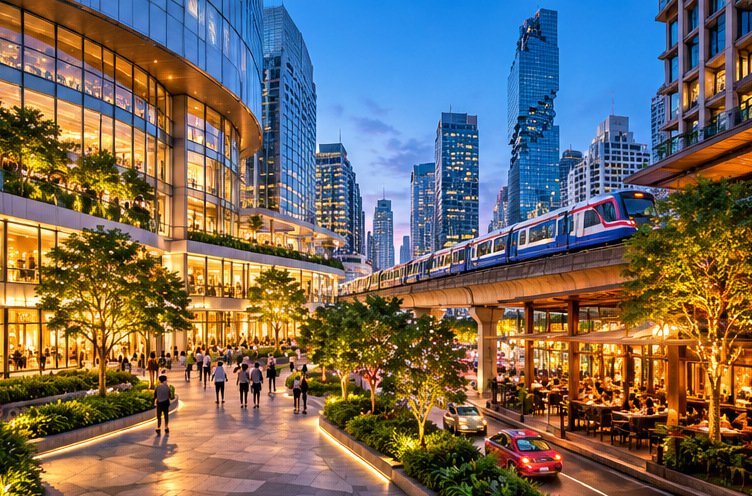
Modern Bangkok illustration inspired by shopping and rail districts; not an exact map, named hotel view or shopping-centre photograph.
Siam vs Sukhumvit is a choice between two versions of a modern Bangkok base. Siam puts major shopping areas and the BTS interchange close together, which can be particularly useful for a short stay built around shopping and indoor activities. Sukhumvit offers a longer chain of neighbourhoods, with Asok adding MRT access and other sections providing their own restaurant and hotel routines.
The confusing part is that Siam already sits on the BTS Sukhumvit Line. In hotel discussions, however, Sukhumvit usually means the districts farther east around Nana, Asok, Phrom Phong, Thong Lo and beyond. This guide compares the Siam shopping-and-station area with those central Sukhumvit hotel bases, not one railway line against another.
The better choice depends on what you will do between the big sightseeing moments: carrying purchases back to the room, finding breakfast, meeting a tour or returning from dinner. You will find practical micro-area advice, real hotel-location examples and cost calculations that do not pretend every room in one district is cheaper. Recommendations are research-led, with no claim of personally reviewing each hotel.
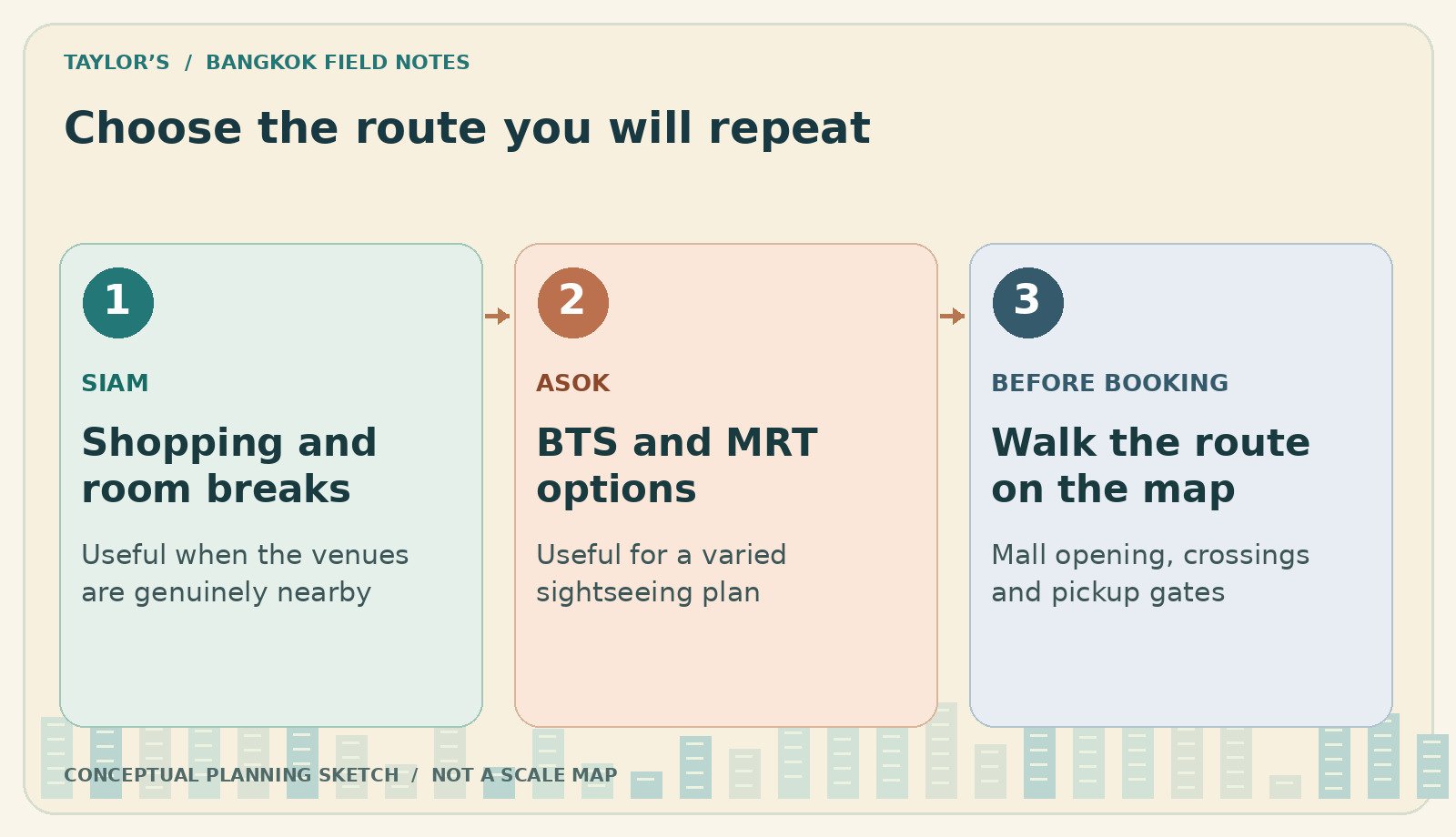
Siam
Stay near the actual centres you will use repeatedly.
Asok
Two networks can matter more than a BTS interchange alone.
National Stadium
Consider it for the western shopping and BACC area.
The covered connection
Confirm the destination, opening hours and step-free route.
Siam vs Sukhumvit: the useful starting decision
When Siam makes the most sense
Choose Siam when shopping, indoor attractions and frequent hotel breaks are central to the stay. A room genuinely close to Siam BTS or the relevant shopping centre can reduce repeated journeys with bags. The BTS Sukhumvit and Silom lines meet at Siam, but that does not make it a direct station for every Bangkok attraction. [1] [2]
Siam also works for visitors who prefer a relatively concentrated set of daytime options. You can plan one area carefully and find several ways to shorten a day when weather or energy changes. However, the shopping district is busy, and proximity to a large mall is not the same as a peaceful room or an entirely covered walking route.
When central Sukhumvit is more useful
Choose Asok when a mixed sightseeing itinerary makes MRT access valuable alongside BTS. Choose Phrom Phong or another specific section when restaurants, the hotel and nearby activities form the daily pattern. Sukhumvit can be the more flexible choice, but only after you define which part of the long corridor you are considering. [3]
| Your priority | Siam area | Central Sukhumvit |
|---|---|---|
| Repeated shopping returns | Strong when the chosen venues are close to the hotel | A BTS trip may be fine once, less attractive repeatedly with bags |
| Rail-network choice | BTS interchange at Siam | Asok adds MRT as well as BTS |
| Indoor fallback | Concentrated around the selected shopping and culture venues | Available in particular pockets, including Asok |
| Restaurant-led longer stay | Works when the dinners are nearby | Choose the exact pocket matching the restaurants |
| Hotel-and-family routine | Short breaks work if the real walk is easy | A suitable room or facility may outweigh shopping proximity |
| Most common mistake | Treating all central shopping districts as Siam station | Treating the whole Sukhumvit corridor as Asok |
Practical comparison reviewed 3 October 2026, not a hotel quality or safety ranking.
What this comparison does not claim
This is not a ranking of the neighbourhoods' cultural value, a safety league table or a survey of current hotel averages. The recommendations compare transport, known venue locations and practical patterns of use. Named properties illustrate different kinds of convenience; they have not been personally inspected for this guide.
Write down your main shopping stops, two likely dinners and one sightseeing day before booking. Then compare actual hotel doors with those places. The district that wins a broad online argument may not be the district that makes your particular three days easier.
Back to the guide ↑Define Siam before choosing a hotel
Siam BTS and Siam Square
A hotel in the immediate Siam station and Siam Square area gives the clearest version of the Siam proposition: a short return from nearby shopping and straightforward access to the BTS interchange. Siam Paragon's official directions identify Siam BTS and the relevant shopping-centre connections. [2]
Check the correct side of Rama I Road and the route to your hotel entrance. A map pin near a station does not tell you whether the comfortable walk uses a footbridge, a shopping centre or an exposed pavement. That distinction becomes more important with a buggy, mobility needs or several shopping bags.
National Stadium is related, but not identical
The National Stadium area can be a useful alternative near the western side of the shopping district. BACC's official visiting information describes its connection with BTS National Stadium and its position opposite the MBK and Siam Discovery area. A hotel here can suit visitors who expect to use those places frequently. [4]
However, National Stadium is not Siam station. A short BTS connection or a walk may be needed depending on the destination. That can be entirely reasonable, but compare it honestly with a hotel beside the interchange rather than treating both locations as the same station access.
Chit Lom, Ratchaprasong and Pratunam need their own map check
Search platforms sometimes group a wide central shopping area under familiar labels. A property near Chit Lom or Pratunam may suit your shopping plans very well, but it is not automatically beside Siam BTS. Save the actual venues you want and measure the usable walking route between them.
Do not pay a premium for a Siam description when the address does not provide the convenience you expected. Conversely, do not reject a nearby district merely because it has a different name if it is closer to the shops and restaurants on your list. The objective is a useful location, not the right word in the listing.
Back to the guide ↑Define Sukhumvit just as carefully
Asok: two rail systems, one busy junction
Asok is the strongest comparison for travellers who want both shopping and wider sightseeing. BTS Asok and MRT Sukhumvit provide different network options, with a pedestrian interchange rather than one universal ticketed system. BEM's station details are the useful source for the MRT exits and nearby connections. [3]
Check whether a hotel is close to the entrance you will actually use. A property on the opposite side of a major road or deeper into a soi may need more walking than its straight-line distance suggests. For a short stay, a simpler route can matter more than a marginally larger room.
Phrom Phong: choose it for the local routine
Phrom Phong can be a good fit when the hotel, restaurants and shopping nearby are substantial parts of the holiday. It remains on the BTS corridor, while a Blue Line journey usually requires an additional connection compared with Asok. That is not a major drawback when old-city sightseeing occupies only one day.
Assess the specific side street and any shuttle arrangements. A property can be appealing precisely because it sits away from the busiest road, but that choice may mean more transport in the evenings. A shuttle shown in a photograph needs confirmed hours and a return arrangement before it counts as reliable access.
Farther east can suit a longer stay
Thong Lo, Ekkamai and more distant stations may suit visitors with particular restaurant plans or a preference for a larger serviced room. They are less useful as an automatic answer to a short Siam-focused shopping break. Add the repeated rail time before treating a lower nightly rate as a clear saving.
The same logic applies to Nana: it can be convenient for a particular itinerary, but the immediate street and room orientation deserve inspection. Do not reduce Sukhumvit to either a nightlife stereotype or a promise of universal convenience. It is a corridor of different local choices.
Back to the guide ↑Shopping: the strongest reason to stay in Siam
Carrying purchases changes the value of proximity
A hotel near your main shopping stops lets you return with bags, take a break and go out again without a cross-city journey. That can be particularly useful during a short shopping trip or when somebody in the group wants to rest while others continue browsing. The convenience is repeated, not just a one-off advantage.
Before booking, identify the actual shopping centres rather than simply writing shopping on the itinerary. Siam Paragon, MBK and a destination farther east do not occupy the same building or entrance. A hotel that is ideal for one may still require a meaningful walk to another.
Opening hours affect the day
Siam Paragon's official website checked on 3 October 2026 lists general opening from 10:00 to 22:00. Individual venues and special areas may differ, so confirm anything essential. A traveller hoping to start shopping immediately after an early breakfast needs a different first activity rather than assuming the whole district is already operating. [5]
Use that early period for breakfast, a quiet hotel morning or a planned outing elsewhere. Then keep the busiest shopping session to a manageable length. Being nearby makes it easier to stop, and that flexibility is one of the real reasons to choose Siam.
Sukhumvit can still handle a shopping-focused day
From a well-located central Sukhumvit hotel, BTS provides a route to Siam without a road journey. This can work well when shopping is one full day rather than the purpose of the entire stay. Carry only what you need and allow for the station walk on the return.
If shopping becomes an everyday activity, reconsider the repeated journey rather than automatically taking taxis with bags each evening. The balance may shift towards Siam for the last part of a holiday, particularly when the final days are deliberately reserved for purchases and a slower city routine.
Back to the guide ↑Transport: why the BTS interchange is not the whole answer
Siam is strong within the BTS network
Siam is the interchange between the BTS Sukhumvit and Silom lines. That is useful for destinations on those lines, but it does not create a direct MRT station at Siam or put the river temples beside the hotel. Start with the attraction's actual nearest useful transport point, then plan backwards. [1]
For Asok, the additional Blue Line connection is the distinguishing feature. It can be useful for Chinatown and the southern old-city station area. A traveller who repeatedly needs those directions may value Asok more than a BTS interchange that does not remove the final network change. [3] [6]
A map connection still contains walking
Allow time to leave the hotel, reach the correct entrance, pass through the station and walk at the far end. With a buggy or wheelchair, check lifts and the step-free route rather than following the nearest stair symbol. A journey can be simple in network terms while still demanding in heat or crowds.
The table below gives broad planning allowances, not official train times. They are intended to show which tasks fit each base, not establish a guaranteed minute-by-minute winner. Check live routes for your actual accommodation and departure time.
| Plan | Siam-area base | Asok-area base |
|---|---|---|
| A day around Siam shopping | Walk or short local connection; check each entrance | BTS to Siam, then the venue walk; allow roughly 25-45 minutes each way |
| BACC / National Stadium | Walk or one BTS stop as appropriate | BTS with interchange at Siam, or a planned walk from Siam |
| Chinatown / old-city station area | Plan an MRT connection or road journey | MRT from Sukhumvit towards the appropriate Blue Line stop |
| A Phrom Phong restaurant | BTS and a restaurant-specific final walk | Shorter corridor journey, but the final soi can still matter |
| Airport with luggage | Choose the current airport connection and usable hotel approach | The same decision; two networks do not remove all luggage handling |
Editorial route suggestions reviewed 3 October 2026. The example time is a door-to-door planning allowance, not an official BTS running time.
Choose the direction of the whole day
Group nearby activities together. A Siam shopping afternoon and a BACC visit can form one coherent area-based day, while an old-city morning and Chinatown evening can form another. Constantly returning to the hotel between distant clusters can make either base feel poorly located.
A station-linked hotel becomes most valuable when the rest of the itinerary respects the network. It cannot rescue a plan that requires multiple cross-city journeys every few hours. Sometimes the best improvement is moving dinner to the day's existing area rather than changing where you sleep.
Back to the guide ↑Indoor activities and the family-weather advantage
An indoor option is useful when it is genuinely wanted
Siam's concentration of indoor venues can help a family or mixed-interest group adjust a day around weather or fatigue. The advantage is having alternatives nearby, not an obligation to buy an attraction ticket whenever it rains. A hotel break or a simple meal can be enough.
For a paid venue such as SEA LIFE Bangkok Ocean World at Siam Paragon, check current entry conditions, age rules, available time slots and the exact ticket combination. A multi-attraction bundle is only good value when the group actually wants the included visits and can use them within the stated period. [5]
BACC adds a different kind of indoor stop
BACC offers an art-and-culture alternative near National Stadium rather than another shopping session. Its official page checked on 3 October 2026 lists Tuesday-to-Sunday opening from 10:00 to 20:00, closure on Mondays and free general exhibition entry, with exceptions for some events. Check the current programme before treating it as a guaranteed interest match for everyone. [4]
Allow the visit to be as long or short as the exhibitions justify for your group. It works well as a flexible part of a nearby day, but should not be used as a promised Monday rain plan. Small scheduling details can matter more than the broad claim that an area has lots to do indoors.
Check the last uncovered section
A nearby shopping centre does not necessarily create an entirely covered journey from the hotel. Ask whether the connection depends on mall opening hours, whether it includes stairs and which entrance remains available later in the evening. A protected section can still end with a difficult road crossing.
Carry a compact rain option and keep the hotel address saved. During a heavy downpour, a short wait somewhere appropriate may be more comfortable than forcing a dash across a crowded pavement. Being close gives you options, but only when you know the actual route.
Food and evenings: convenience after the shops close
Siam for an easy dinner after a local day
Siam works when dinner naturally follows shopping or an indoor attraction. The group can eat nearby and return without another long journey. However, a shopping centre's restaurant range is not a guarantee that every dietary requirement or budget is met at every venue. Choose an actual restaurant or counter rather than relying on general variety.
Pay attention to individual kitchen closing times and reservation requirements. A mall's overall opening hours are not necessarily the last time every restaurant will seat you. For a late arrival, save a hotel or street-level alternative rather than counting on one particular dining floor.
Sukhumvit for restaurant-led evenings across several nights
Central Sukhumvit can be a more natural base when particular restaurants or evening venues shape the trip. Nevertheless, locate them precisely. A Thong Lo reservation and an Asok hotel may still involve a substantial last section away from rail, so the shared Sukhumvit label should not replace route planning.
Near Asok, Terminal 21's official dining directory offers a useful example of an easy indoor fallback, including Pier 21. A food court can solve a tired evening without needing to become the main culinary experience of the holiday. [7]
Choose noise exposure, not a nightlife label
Both districts can have traffic, event activity and busy evening streets. A room's orientation, glazing and neighbouring businesses matter more than a simple claim that one area is lively and the other quiet. Read recent room-specific comments and ask about any construction that could affect your dates.
For light sleepers, identify what the hotel can genuinely provide: a room away from a certain road, a different building or a known quiet-facing category. Do not assume a request can be guaranteed unless the property confirms it. The right room in either district may be better than the wrong room in your preferred area.
Back to the guide ↑Hotel examples: three different kinds of central convenience
Novotel Bangkok on Siam Square
The hotel's official location page places it on Siam Square Soi 6 in the immediate Siam Square area. It is a useful example of staying in the Siam Square side of the district rather than merely somewhere within a broad central-Bangkok search area. Use that address to assess your actual walking routes. [8]
Compare the exact room type, bedding and cancellation terms for your dates. A central address does not establish that every category suits a family or that every advertised facility will be available during maintenance. This example is about location, not a claim of personal inspection or a best-price guarantee.
Siam Kempinski and a covered mall connection
Siam Kempinski's official location information describes a covered second-floor walkway to Siam Paragon. That illustrates a more hotel-centred version of the Siam choice, where direct access to a particular shopping centre is part of the value. Confirm the route's operating hours and accessibility for your own needs. [9]
Do not read the connection as proof that every outing is indoors or every city attraction is a short walk. It solves one useful part of the stay. The room, hotel facilities and total booking cost should justify the rest of the decision independently.
Grande Centre Point Terminal 21 in Asok
Grande Centre Point Terminal 21's official information describes its position with the shopping centre and access to BTS Asok. It provides a helpful comparison with Siam's station-and-mall model, while adding the nearby MRT Sukhumvit connection. Again, the value depends on which routes you expect to use most. [10]
Check the room category and facilities rather than assuming all accommodation in the building is equivalent. Compare a complete stay against the Siam options, including breakfast and flexibility. These three hotels represent different propositions and price points, not a ranking in which one must win for every traveller.
Back to the guide ↑Budget: when paying for location is worth considering
Compare equal bookings first
Search the same dates and enter every guest accurately. Match room size, beds, breakfast, taxes and cancellation conditions before interpreting a price difference. A lower headline figure can reflect a stricter booking or less suitable room rather than a cheaper neighbourhood.
No universal nightly-price claim is made here. The calculations below are hypothetical planning examples prepared on 3 October 2026, not live hotel offers or measured district averages. They show how a location premium can be weighed against repeated journeys.
| Three-night example | Siam hotel near your shops | Asok hotel in this example |
|---|---|---|
| Assumed nightly room | 3,200 baht | 2,800 baht |
| Room total | 9,600 baht | 8,400 baht |
| Added shopping returns | 0 incremental fares counted | 2 adults x 2 returns daily x 3 days x 100 baht = 1,200 baht |
| Room plus modelled shopping travel | 9,600 baht | 9,600 baht |
| Change shopping to one return only | 9,600 baht | 8,600 baht: a different travel pattern changes the answer |
Hypothetical calculations prepared 3 October 2026. Rooms are not live offers; the 100-baht return per adult is an assumption, not a quoted fare. Other costs are excluded equally.
Include the shopping return trip
A stay built around shopping may involve more returns to the room than a sightseeing holiday. Count those trips rather than assuming one outing per day. A hotel that lets you drop bags and continue nearby may be worth considering even when the nightly rate is higher.
For a visitor who shops only once, the calculation can reverse. A comfortable Asok room with good MRT access may support the rest of the itinerary better, and one BTS return from Siam is a manageable compromise. The answer comes from frequency, not the abstract claim that central is always better.
Do not confuse spending opportunity with value
Being surrounded by shops can make unplanned purchases easier. Set a shopping allowance independently from the hotel budget and decide which purchases genuinely matter. A location that saves transport does not automatically save money if it encourages spending you would otherwise avoid.
Keep space and baggage allowances in mind before buying large items. A hotel close to shops makes carrying purchases easier, but it does not change airline limits or the effort of taking everything home. Check the actual airline booking rather than relying on a generic cabin-bag rule.
Back to the guide ↑Who should stay where?
A two-night shopping break
Siam is the clearer starting point when shopping is the purpose and most chosen venues sit nearby. Stay close to the relevant entrance or station, use the room for breaks and avoid adding too many distant attractions. A short focused trip benefits from concentration rather than maximum geographic coverage.
Asok can still be sensible when the hotel is materially better for your requirements or the evening plans are farther east. However, make that a deliberate trade-off rather than assuming the BTS makes repeated bag-carrying journeys effortless for everyone.
A four-night first visit with mixed interests
Asok often provides a balanced starting point for a first visit combining historic sights, Chinatown, shopping and varied evenings. Siam remains a strong alternative for a group valuing indoor options and the BTS interchange more than immediate Blue Line access. Compare the two actual hotels and their walks before deciding.
Keep the old-city day together and the shopping day together. Neither base requires you to spend every evening locally, but travelling for one carefully chosen dinner is different from crossing the city repeatedly because the itinerary has no geographic structure.
Families with different energy levels
Siam can be helpful when one adult needs to return with a child while others continue nearby. That benefit depends on a genuinely short and usable hotel route. A long walk through several shopping buildings may be less convenient than the map suggests, especially with a tired child.
Phrom Phong or Asok may work better when a larger room, a particular hotel facility or familiar dining options are the priorities. Enter children's ages accurately, confirm bed arrangements and check whether facilities belong to the booked property rather than an associated building. The family decision should be about daily comfort, not a generic family-friendly label.
Couples and repeat visitors
A couple planning a few special restaurant evenings may prefer a specific Sukhumvit pocket. A couple combining shopping with a comfortable hotel break may prefer Siam. Both can visit the other district without moving accommodation, so the decision need not carry more weight than it deserves.
Repeat visitors can be more selective: stay near the experiences you already know you enjoy. There is little value in choosing the broadest transport hub when most of the week will be spent in one smaller area. A precise routine can justify a less obvious location.
Longer stays and work days
For a longer stay, think beyond the first weekend. A desk, reliable internet, laundry, storage and a comfortable ordinary breakfast can matter more than being beside the largest shopping centre. Confirm those features for the actual room, particularly when a property offers several different accommodation categories.
A more spacious Sukhumvit base can be worthwhile when you are not sightseeing across Bangkok every day. Conversely, Siam can suit someone whose appointments and routines genuinely sit nearby. Evaluate a normal working or rest day as carefully as the most exciting sightseeing day.
Back to the guide ↑Airport journeys and tour meeting points
Your airport code comes first
Suvarnabhumi and Don Mueang have different transport arrangements. Use the airport code on your booking and consult current airport guidance before selecting a transfer. Siam's BTS access and Asok's BTS-MRT choice can both be useful, but neither removes the need to plan the airport-to-city connection and final walk. [11] [12]
With several passengers, bulky bags or a late arrival, a pre-arranged vehicle may be simpler in either area. Check the meeting point, waiting policy and luggage capacity. A vehicle advertised for a certain number of passengers may not comfortably carry that many large suitcases as well.
A central hotel does not guarantee hotel pickup
Tour operators may collect only within defined zones, use a meeting point or charge extra for some addresses. Check the exact arrangement before booking a day trip. A hotel near Siam can be geographically central yet still require a journey to the operator's chosen meeting place.
Save the location and arrival instructions, then allow time to find the correct entrance. If the tour starts before the shopping centres open, do not assume your usual covered walking route will be available. Ask the hotel for the appropriate early-morning exit and road pickup point.
Keep the arrival evening simple
Do not attach an expensive timed activity to an uncertain airport arrival. Immigration, bags and the transfer separate landing time from the moment you reach the hotel. A nearby meal and an uncomplicated room are more useful than a tightly scheduled first evening.
Confirm late check-in and which calendar night is booked when arriving after midnight. Then keep the first full day flexible enough to account for sleep. A centrally located hotel provides options; you do not have to use every one immediately.
Back to the guide ↑Test two sample itineraries before deciding
A Siam-based shopping-and-culture stay
Use one day for the specific shopping centres that interest you, with a room break before dinner. On another day, add BACC when open and a different nearby activity rather than repeating the same shopping circuit. Keep the historic sightseeing day separate and allow a proper journey to and from that part of the city.
This plan uses Siam's concentration without pretending the rest of Bangkok is immediately outside. It is particularly effective when the group wants a shorter final stay at the end of a wider Thailand holiday, with time for purchases and a less ambitious sightseeing schedule.
An Asok-based mixed city stay
Use MRT for a Chinatown or old-city day, BTS for a dedicated Siam shopping day and the local area for at least one easy evening. Add a park or chosen restaurant rather than filling every spare hour with a cross-city transfer. The two networks become useful because the plan gives each a coherent job. [3]
After shopping, consider whether you need to return directly to the hotel or whether dinner belongs in Siam before the final journey. Making that decision in advance avoids carrying bags between several unnecessary stops. The simplest route often provides the most relaxed evening.
Back to the guide ↑The booking checks that prevent disappointment
Verify a connected-hotel claim
Ask what the connection reaches, when it opens and whether it includes stairs or outdoor sections. A walkway to a mall may not be a direct link to the station, and the route available at midday may differ late at night. A clear answer is more useful than a broad connected-to-everything description.
For accessibility, request the entire route from room to street or station, including lifts and any changes of level. Do not accept distance alone as evidence that it works. A slightly farther hotel with a reliable step-free route may be the more comfortable choice.
Choose the correct pickup point
Large shopping complexes can have several vehicle entrances. Use the hotel's designated driveway or the venue's official pickup location rather than a general map pin. Siam Paragon, for example, publishes a specific taxi and Grab pickup arrangement in its access information. [2]
Keep the driver informed of the exact entrance and avoid moving between gates after the booking is accepted unless you communicate the change. A few minutes confirming the location can prevent an unnecessary loop through busy roads and a confusing start to the evening.
Make the phone useful without depending on it completely
Save the hotel address, first-day route and booking confirmations offline. Mobile data helps with pickup messages and changing plans, but check whether your existing plan already covers Thailand. An eSIM requires a compatible unlocked device and terms that fit the trip.
Back to the guide ↑Pros and cons of Siam and Sukhumvit
Siam: a concentrated modern-city base
The strengths are shopping convenience, nearby indoor alternatives and access to the BTS interchange. For travellers who return to the room with purchases or need frequent breaks, a genuinely close hotel can make the day noticeably easier. Its value is strongest when the selected venues are actually in the immediate area.
The limitations are busy surroundings, the absence of a direct MRT station at Siam and the risk of overpaying for a broad district label. Mall connections also need their own practical checks. Siam is a useful base for specific patterns, not a guarantee that every journey across Bangkok will be short.
Sukhumvit: flexibility through a precise micro-area
The strengths are varied hotel choices and the ability to choose a section around your restaurant, shopping or transport needs. Asok's Blue Line access is particularly useful for a mixed itinerary. Other sections can suit longer stays or a more hotel-centred routine.
The limitations are the corridor's scale, deep side streets and repeated journeys when most of the trip actually belongs in Siam. A good deal can still be a poor location. Define the station and street before comparing the room price with a property at the heart of the shopping area.
Common mistakes in this comparison
Treating Siam as a separate rail line
Siam is a BTS interchange on the two core lines, while hotel-area Sukhumvit usually refers to neighbourhoods farther east. Use network and station names accurately when planning routes. A hotel description can otherwise make an ordinary journey sound more complicated or more direct than it is.
Assuming all central shopping areas are one walk
Siam, Chit Lom and Pratunam can appear close on a city map but still create distinct hotel routines. Check the exact venues, crossings and entrances. Choose the property near your plans rather than the one with the broadest central-location claim.
Buying a room for a facility you cannot use
A breakfast that starts after your tour pickup, a pool closed for maintenance or a mall link unavailable late at night may have little value for your dates. Confirm the features that motivated the booking. The longer the amenity list, the more useful it is to identify the two or three items that actually matter.
Changing hotels merely to visit the other area
For a short stay, BTS can usually make a visit to the other district more straightforward than packing and checking in again. Split the stay for a genuine change of purpose or hotel experience, not because both areas sound appealing. A well-planned day visit is often enough.
Back to the guide ↑Frequently asked questions
Is Siam or Sukhumvit better for shopping?
Siam is the stronger starting point when most of your chosen shopping venues are in its immediate area and you expect repeated returns with purchases. Central Sukhumvit can work well for one dedicated shopping day, particularly when the rest of the trip benefits from Asok's MRT access. Identify the shops first, then choose the base.
Is Siam more central than Asok?
It is a major BTS interchange and an important shopping centre of the city, but central is not the same as convenient for every destination. Asok offers a different advantage through MRT Sukhumvit. Compare your actual routes instead of assuming one point on the map is universally better placed for all of Bangkok.
Is Sukhumvit cheaper for hotels?
It has a broad range of locations and property types, but that does not establish the cheaper equivalent room for your dates. Compare the same requirements and include repeated transport. A distant Sukhumvit hotel may cost less precisely because it offers a different location, while a station-linked property may command a premium.
Which area is better with children?
Siam can help when shopping, indoor activities and short hotel breaks dominate. Asok or Phrom Phong may be better when the chosen hotel offers more suitable space and the itinerary is mixed. Confirm beds, age policies, lifts and walking routes directly. The family benefit comes from the actual hotel-and-day combination rather than the area name alone.
Can I visit the temples from Siam?
Yes, with a planned rail connection or road journey and a final walk appropriate to the attraction. Siam is not directly beside the old-city sights, so keep the temple day as a coherent cluster. Check the current opening calendar and allow enough time that the journey does not force a rushed visit.
Should I stay in Siam for the last two nights of Thailand?
That can work well when the final days are intended for shopping, indoor activities and a comfortable hotel routine. It is less compelling when the final plans are elsewhere or you already have a familiar hotel that works. Arrange the airport transfer separately and keep the departure day free of an ambitious distant excursion.
Back to the guide ↑My recommendation: choose frequency over the word central
Choose Siam for a concentrated shopping-and-indoor-activity stay, especially when you will return to the room several times. Choose Asok for a more varied first visit that needs both BTS and MRT, or a specific Sukhumvit section when its restaurants and hotel routine are the real attraction.
Then compare the actual walking paths, room categories and total booking conditions. A hotel that makes your repeated activities easy is more valuable than one described vaguely as the most central. Once those details are right, either base can support an enjoyable Bangkok trip without constant second-guessing about the area you did not choose.
Back to the guide ↑Sources and fact-checking notes
Siam and Sukhumvit are compared as hotel areas, not separate rail lines. Venue hours and BACC entry conditions are dated. Named hotels illustrate location and connections only; no live rate survey or inspected hotel ranking is claimed.
Editorial review: 3 October 2026. Search and comparison links do not guarantee a particular product, room, departure or price. Confirm the final details with the operator before paying.
- BTS Skytrain: routes and station structure
Used for line structure and interchange relationships, not individual journey guarantees.
- Siam Paragon: getting here and vehicle pickup
Official or first-party information checked 3 October 2026; confirm operating details for your date.
- BEM: MRT Sukhumvit station and connections
Official or first-party information checked 3 October 2026; confirm operating details for your date.
- Bangkok Art and Culture Centre: plan your visit
Published hours, general entry conditions and National Stadium connection checked 3 October 2026. Special events may have different charges.
- Siam Paragon: official venue information
General opening and venue directory checked 3 October 2026. Individual restaurants and attractions can differ.
- BEM: MRT Sanam Chai station and exits
Official or first-party information checked 3 October 2026; confirm operating details for your date.
- Terminal 21 Asok: Pier 21 directory
Official or first-party information checked 3 October 2026; confirm operating details for your date.
- Novotel Bangkok on Siam Square: official location
Location example only, not a room review or guarantee of current rates.
- Siam Kempinski: official location and covered connection
The mall walkway is the relevant fact. Other distance and drive-time claims on the page are not adopted.
- Grande Centre Point Terminal 21: official hotel information
Used for the Asok connection and hotel context. Confusing airport text elsewhere on the site is not used as route guidance.
- Airports of Thailand: Suvarnabhumi transport guide
Consult the airport for current boarding arrangements; no guaranteed road journey time is assumed.
- Airports of Thailand: Don Mueang transport connections
Consult current airport and operator notices for connections and operating hours.
Illustrations in this article were created for Taylor’s Trailblazing Travels. Third-party photographs, where used, are credited beside the image or in the source list.