
Nusa Penida or Nusa Lembongan: Which Island Should You Visit?
Dramatic viewpoints or a more settled waterfront rhythm? Decide what you want your time on the island to feel like.
Original conceptual illustration of cliffs and a settled waterfront; not a verified view or geographical map.
Nusa Penida or Nusa Lembongan is best answered by separating the island you want to explore from the island you want to stay on. Penida is the largest of the three Nusa islands and draws attention for its coastal scenery. Lembongan offers a smaller setting with waterfront areas, mangroves and access to neighbouring Ceningan. [1]
A famous viewpoint is a reason for an outing, not automatically the best address for the whole holiday. Equally, sleeping on Lembongan does not mean giving up every marine experience associated with Penida. Start with the activities you will repeat, then assess the one-off excursions.
A scenery-led visit
Group viewpoints instead of racing around the island.
A settled island break
Choose a waterfront area and check the local terrain.
Operator before island
Both islands can access shared marine sites.
One base usually wins
A hotel move consumes more than the crossing itself.
Nusa Penida or Nusa Lembongan: the useful differences
This is a comparison of holiday styles rather than a ranking of beauty. The assessments below use the tourism board’s island overview, a local transport provider and a dive operator with a presence on both islands. [1][4][6] Their descriptions inform the choices; the recommendations remain editorial judgements.
| Decision | Nusa Penida | Nusa Lembongan |
|---|---|---|
| Main reason to go | Land scenery and a deliberate viewpoint itinerary. | A smaller coastal base with unhurried time between outings. |
| How to organise days | Group sights by area and arrange road transport. | Build a local routine, then add selected island outings. |
| Diving priority | Compare the centre, schedule and suitable sites. | Can also be a base for shared Nusa marine sites. |
| Two or three nights | Stay if Penida itself is the objective. | A strong default for a settled island break. |
| An island combination | Worth considering with enough time and a clear extra purpose. | Do not move hotels solely to collect a second island name. |
| Accessibility | Check each vehicle, viewpoint and property individually. | Smaller does not mean flat or universally step-free. |
Penida is not simply Lembongan with a few more sights, and Lembongan is not a waiting room for Penida. Choose between them by imagining your least ambitious day. Would you prefer another planned excursion or a familiar waterfront routine with an optional outing?
Choose Penida when the land itinerary is the reason
Indonesia Tourism’s Nusa overview highlights Penida’s dramatic coastline, including Kelingking, Broken Beach and the eastern beach scenery around Atuh. [1] The planning implication is to select a coherent area rather than treat every famous location as a compulsory stop on one day.
For a short visit, write down your two essential viewpoints, then ask a driver how to group them with your arrival point and hotel. Leave room for traffic, waiting, weather and the time you actually want at each place. A route that technically reaches several locations can still be a poor sightseeing day.
A viewpoint visit is not a beach descent
Seeing a bay from above and reaching its sand are different activities. Do not assume that every photographed beach has a straightforward route down or a suitable swimming area. This guide’s proposed scenery days are viewpoint-led; they do not depend on descending difficult coastal paths.
Ask about current access before travelling and follow local restrictions. The reward should not depend on stepping beyond barriers, approaching a cliff edge for a photograph or squeezing a demanding descent into the last part of the day. FCDO’s warnings about currents and dangerous sea conditions reinforce the need to assess water activities separately. [7]
For accommodation, identify the port, the road route to your intended sights and the place you will eat in the evening. A beautiful isolated room may suit a stay centred on the property; it may be inconvenient for someone planning repeated excursions. Ask the host to explain the final access road and vehicle arrangements.
Choose Lembongan for a more settled coastal routine
Lembongan’s visitor areas include Jungutbatu, the southwestern coast around Dream Beach and the mangroves to the northeast. [1] Those names are useful for orientation, but they are not interchangeable accommodation addresses.
Make your daily triangle small
Shortlist the room, your preferred waterfront and two places you would happily eat. Then inspect the routes between them. A compact daily triangle is often more useful than being notionally central to every attraction on an island.
The Lembongan Traveller’s local transport guidance describes walking, scooters, buggies and vehicles, and explains that the Yellow Bridge connection to Ceningan has its own access limitations. [6] Do not assume that every vehicle can take you across, or that a route which looks short will be comfortable on foot in the heat.
Consider Jungutbatu when a waterfront routine is central to your plans, or inspect another small area when its accommodation and atmosphere suit you better. A hotel search can help locate options, but contact the property about steps, gradients and transport rather than inferring access from the map pin.
Smaller does not mean you should walk everywhere. Build the holiday around enjoyable local distances, with arranged transport for the rest. Nor does a quiet-looking waterfront guarantee safe swimming: assess the entry, current conditions and boat activity separately.
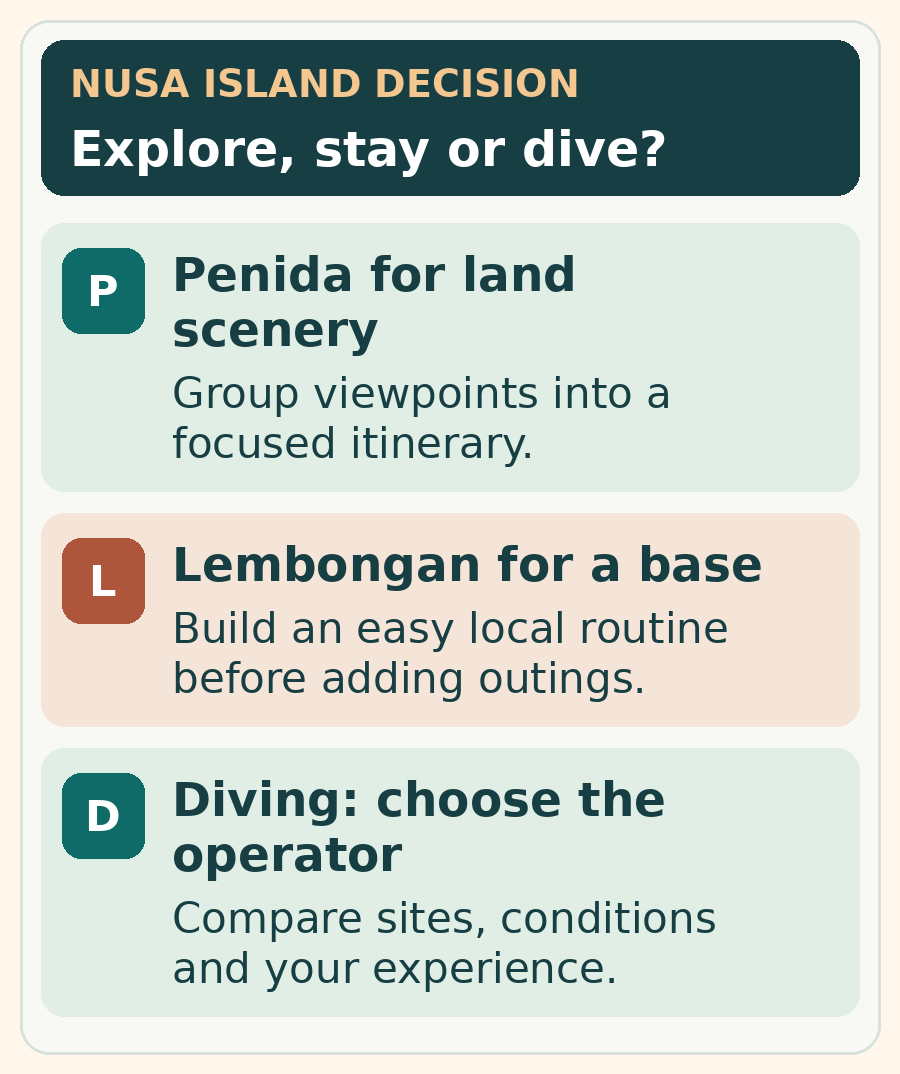
For diving and snorkelling, compare the operation first
Blue Corner Dive explains that its Lembongan and Penida bases access the same broad set of Nusa dive sites. [4] That directly challenges the idea that the name of the marine destination dictates where you must sleep. The centre’s day-to-day route, weather assessment and your experience matter more.
Ask which sites are appropriate for your qualification and recent diving history, how the group is formed, what equipment is included and what happens if conditions rule out the advertised location. The operator’s own site descriptions identify changing currents and conditions around the Nusa islands. [5] This is a reason to select an appropriate guided activity, not a reason to assume every site is equally suitable.
Keep snorkelling separate from a diving promise
A snorkelling excursion may visit different locations and provide a different level of supervision from a certified dive trip. Explain your swimming ability and ask about flotation, time in the water, reboarding and alternatives. A wildlife-themed title does not guarantee that wildlife will appear.
The listings include trips with different starting points and inclusions. [8] Check that the actual departure is on the island where you will be staying; a product appearing in a destination search is not proof of a convenient hotel pickup.
Do not book the sea activity that matters most into the only available morning. Leaving a flexible alternative day can be more valuable than changing accommodation to be nominally closer to a site. For mixed-interest couples or groups, give non-participants an enjoyable plan of their own.
Sanur departures: the boat is only one part of the move
Rocky Fast Cruise publishes Sanur-Lembongan services and asks passengers travelling from Sanur to check in roughly forty-five minutes to an hour before departure. [2] That check-in allowance sits outside the time on the water. Confirm the operator’s current instructions for your booking rather than treating this as a universal rule for every carrier.
Sanur-Penida route listings are also available, but the exact operator and arrival point vary. [3] An island name alone is insufficient when arranging your onward driver. Send the full port name and booking details to the accommodation or transfer provider.
| Component | Example allowance |
|---|---|
| Hotel to Sanur departure point | 60 minutes |
| Check-in and boarding margin | 60 minutes |
| Time on the water | 45 minutes |
| Disembarkation and bags | 20 minutes |
| Arrival transfer and settling in | 45 minutes |
| Total before extra disruption | 230 minutes: 3 hours 50 minutes |
Only the cited Rocky check-in guidance is an operator instruction; the other figures are deliberately chosen modelling assumptions. Replace every input with information for your hotel, carrier and destination. The example shows why even a short crossing does not produce a forty-five-minute hotel change.
Ask about the precise landing arrangement, assistance and onward transfer. Rocky’s own FAQ describes its Lembongan arrival operation and coordinated vehicle services. [9] Another operator may use different facilities, so do not carry one company’s arrangements over to a different ticket.
One island or both? Count the mornings you keep
A three-night stay gives two full mornings between the arrival and departure days. If you split those nights across two islands, one of those mornings may be absorbed by packing and moving. That is a large trade for a short holiday, even when the crossing itself looks quick.
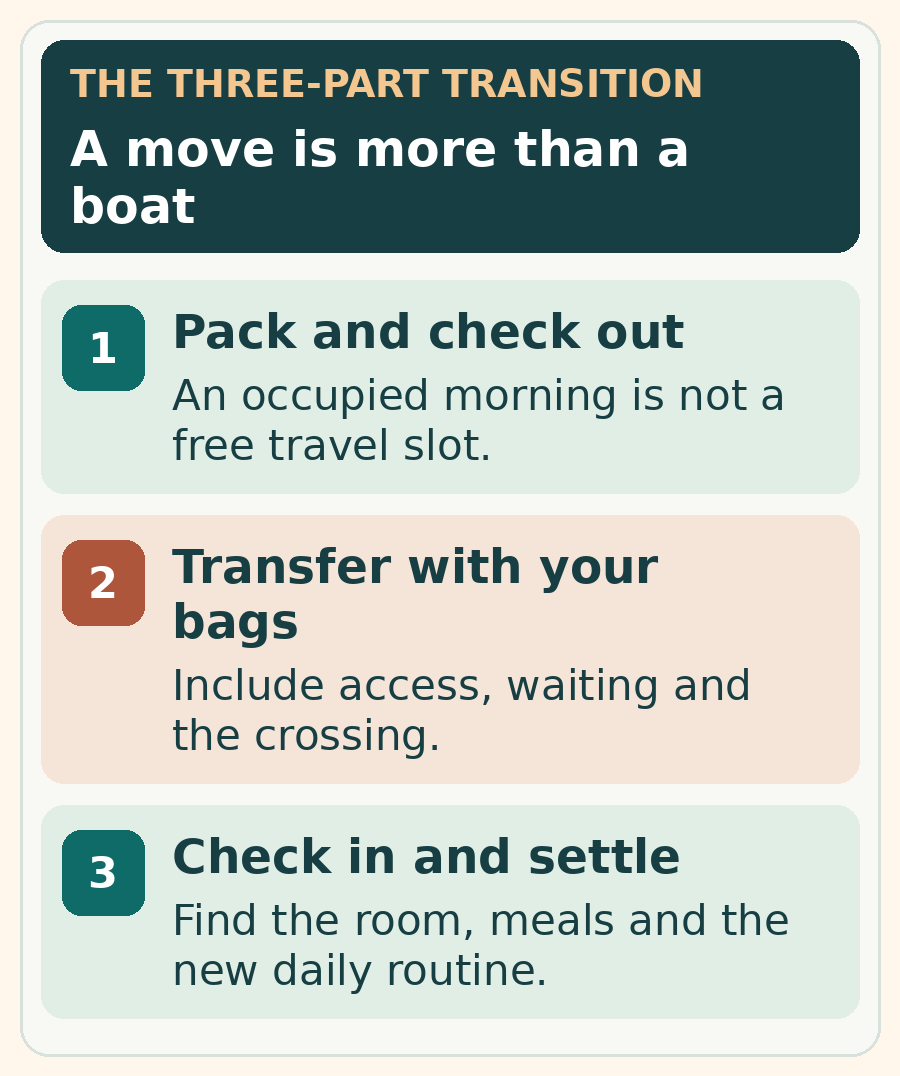
Consider this original planning model: two bases, one additional move, three extra transition tasks. You pack and check out, transfer with your luggage, then check in and establish a new routine. The water taxi is only the middle task. Assign a realistic allowance to all three before deciding that a split stay is easy.
| Time available | Recommended shape | What to avoid |
|---|---|---|
| A day excursion | Pick one island and a focused programme. | Trying to combine both islands and several water activities. |
| 2-3 nights | One base that fits your main purpose. | Moving purely because the neighbouring island is close. |
| 4 nights | Usually one settled base; consider an outing if conditions suit. | Treating every spare day as a transport day. |
| 5-6 nights | A split can work if each island has a different job. | Two near-identical stays with duplicated transfers. |
For six nights, a three-and-three split is a plausible starting point only when the two stays have distinct purposes. A scenery-led Penida section followed by relaxed Lembongan time can justify the move. For divers using the same site network, the benefit may be much weaker.
Use the Itinerary Pace Checker with your own door-to-door estimates. Keep a mainland return buffer when a missed connection would have serious consequences; the tool does not verify sailings.
Cost, mobility and accommodation trade-offs
Compare complete island stays rather than headline nightly prices. Add boat tickets, transfers, local vehicles, meals and the activities you actually intend to do. A cheaper room can lose its advantage when it adds a daily paid journey or makes an early departure awkward.
For a two-person trip, separate per-person charges from shared vehicle costs. A private transfer quoted for a vehicle should not be multiplied by two, while two return boat tickets must be. Record baggage and cancellation terms before comparing totals.
The Hotel Comparison Calculator is useful when you have two real room offers. Enter rates in the same currency and include breakfast or other extras consistently. It does not fetch availability or certify a hotel’s location.
Questions to ask before a non-refundable booking
Can a vehicle reach the entrance? How many steps lead to the room and pool? What is the surface between the room and the nearby restaurants? Can the boat operator provide the assistance you require, and has it confirmed the boarding arrangement in writing?
For travellers who do not ride scooters, make a realistic transport plan before paying. Lembongan’s smaller footprint does not eliminate the need for transport, while Penida’s scenery itinerary can be organised around a driver rather than self-riding. [6] Do not let an included scooter become the reason to accept a journey beyond your ability.
Mistakes and frequently asked questions
Can I cross a bridge from Lembongan to Penida?
No. The Yellow Bridge connects Lembongan with Ceningan, not Penida. [6] A Penida visit involves a separate sea transfer; do not build a route around a road connection that does not exist.
Which island is better for a first visit?
For someone seeking a relaxed overnight island break rather than a list of viewpoints, Lembongan is the editorial default here. For someone whose specific reason for travelling is Penida’s land scenery, choose Penida and give that itinerary proper time.
Must I stay on Penida for manta-related activities?
Not necessarily. Operators on both islands access the wider Nusa marine area. [4] Compare the actual route, conditions policy and suitability; neither your accommodation address nor a tour title guarantees a sighting.
Is a Penida day trip a bad idea?
Not automatically. A tightly focused day can answer a specific wish. The mistake is expecting an unhurried island holiday from a programme that combines transfers, distant sights and water activities without acknowledging the trade-offs.
What commonly makes a short stay disappointing?
Booking a room for its view while ignoring access, using the boat time as the entire transfer allowance, or moving accommodation before enjoying a full day at the first base. All three can be addressed before booking.
Choose what you want to repeat
Penida is the stronger choice when the land itinerary is the central attraction. Lembongan is the stronger starting point when the goal is a settled coastal stay with selected outings. For diving, put the quality and suitability of the operation ahead of the island label.
On a short break, one thoughtfully chosen base usually creates a better holiday than two hurried introductions. Add the second island only when you can explain the extra experience it buys and the time you are prepared to exchange for it.
Continue through the Indonesia travel-planning hub to fit the island stay around your mainland nights.
Sources and editorial approach
Independent review of key sources: 2 November 2026. Official tourism guidance establishes destination context; transport and activity providers describe their own services. The recommendations, night allocations and clearly labelled calculations are editorial planning judgements, not first-hand hotel tests, live booking quotes or guarantees of conditions. Recheck operator instructions and local advice before travelling.
- Indonesia Tourism: Nusa island overview
- Rocky Fast Cruise: current timetable and check-in guidance
- 12Go: Sanur to Nusa Penida route listings
- Blue Corner Dive: choosing Lembongan, Penida or both
- Blue Corner Dive: Nusa island dive sites
- The Lembongan Traveller: local transport and the Yellow Bridge
- FCDO: Indonesia coastal, road and sea-travel safety
- GetYourGuide: Lembongan snorkelling departure choices
- Rocky Fast Cruise: transfer and arrival questions
Illustrations in this article were created for Taylor’s Trailblazing Travels. Third-party photographs, where used, are credited beside the image or in the source list.