Nusa Penida Travel Guide: Clifftop Viewpoints and Island Logistics
Spectacular cliffs deserve a plan that takes the crossing, roads and return journey seriously.
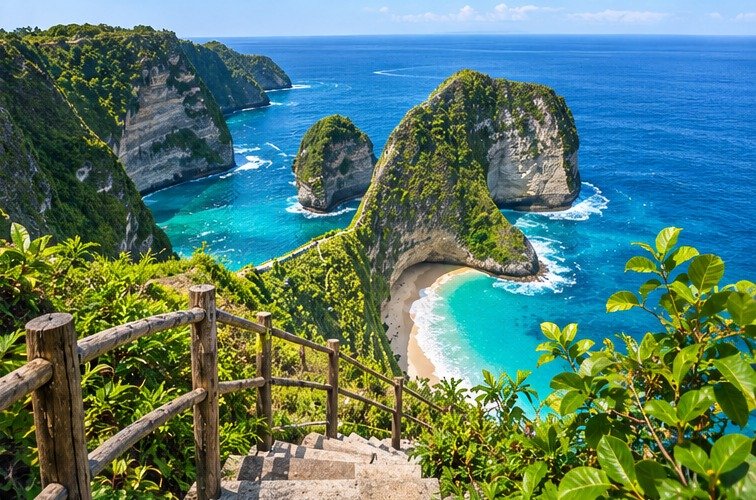
An original Nusa Penida-inspired illustration. It does not show verified current paths, barriers or beach access.
Some links in this guide are affiliate links. Taylor’s Trailblazing Travels may earn a commission if you book or buy through them, at no extra cost to you.
This Nusa Penida travel guide starts with the part a beach photograph cannot show: getting from your Bali accommodation to the right boat, meeting the island driver and still leaving enough time to enjoy the cliffs. A short crossing is only one part of that day.
Indonesia’s tourism board describes Nusa Penida’s dramatic coastal scenery, harbour connections and challenging access to Kelingking Beach. [1] The practical choice is not simply which viewpoints look best. It is whether you want one focused outing or enough nights to separate the island’s different sides.
Pick one side rather than promising a complete island circuit.
Separate the crossing from the longest sightseeing day.
The worked example takes 4 h 35 min to the first viewpoint.
Bali levy, island entry and attraction tickets are different items.
Nusa Penida travel guide: day trip or overnight stay?
A day trip is reasonable when you have one clear priority, accept an early start and can abandon an optional stop. It is a poor fit when the wish list includes both coasts, a long beach descent, a snorkelling outing and a relaxed lunch. A package that advertises many stops does not create more time between them.
| Choice | Works best for | Main limitation |
|---|---|---|
| Focused day trip | One viewpoint group with transfers coordinated | The boat schedule controls the day; delays reduce sightseeing. |
| One night | Separating outward and return crossings | Still only partial days if arrival is late and departure early. |
| Two nights | A light arrival plus one complete island day | You still need to choose priorities. |
| Three nights | A separate east day and west day, or a flexible water-activity day | More accommodation and transport cost; no guarantee against weather disruption. |
For a first visit centred on the cliffs, two nights is a useful starting point. Choose three when both sides genuinely interest you. Do not spend extra nights only to justify a list: a smaller selection with time to stop is usually easier to manage.
Book the harbour and the whole transfer chain
Sanur is a common departure point, but the booking must identify the operator, check-in location, departure terminal and arrival harbour. Nusa Penida has several landing areas rather than one universally interchangeable pier. The tourism board names Toyapakeh and Sampalan; local orientation information also distinguishes Banjar Nyuh and Buyuk. [1][10]
Send the complete ticket to your island driver. A message saying only “Nusa Penida, morning boat” leaves too much unresolved. Agree where the driver will wait, what happens if the operator changes the arrival point and whether waiting charges apply. Save the contact information before leaving your Bali accommodation.
A published sailing is not a guaranteed connection
When checked on 1 November 2026, Golden Queen published a Sanur departure at 07:30 with 06:30 check-in and 08:20 arrival, plus an 08:30 departure with 07:30 check-in and 09:20 arrival. The same page says schedules may change. [2] These examples show why the check-in hour belongs in the plan; they are not a reservation or a promise for your date.
Read the terms for luggage, children, boarding assistance and cancellation. Ask what the actual boarding arrangement involves rather than assuming that every vessel and harbour has the same access. For someone with limited mobility, request details of the gangway, steps, seating, toilet and assistance at both ends.
Sea conditions can change quickly and safety standards vary. FCDO advises checking safety equipment, including suitable life jackets. [4] Smartraveller also recommends delaying unsafe crossings and choosing another provider when appropriate equipment is missing. [9] A low price or online rating is not a substitute for those checks.
A 50-minute sailing can mean a 4-hour-plus arrival
The following original door-to-viewpoint model combines one published 50-minute crossing example with deliberately visible planning allowances. Only that boat duration comes from the operator schedule. Replace the other figures with quotes for your hotel, actual harbour, driver and chosen stop. [2]
| Stage | Allowance | Basis |
|---|---|---|
| Bali hotel to check-in office | 60 | Assumption; your starting point may require much more or less. |
| Check-in and boarding window | 60 | Matches the one-hour published check-in example. |
| Sea crossing | 50 | Golden Queen Sanur-Penida schedule example. |
| Disembark, find driver and organise bags | 30 | Planning assumption. |
| Island road journey to first viewpoint | 75 | Planning assumption for the chosen outing. |
| Total before sightseeing | 275 = 4 h 35 min | Add further delay allowance where needed. |
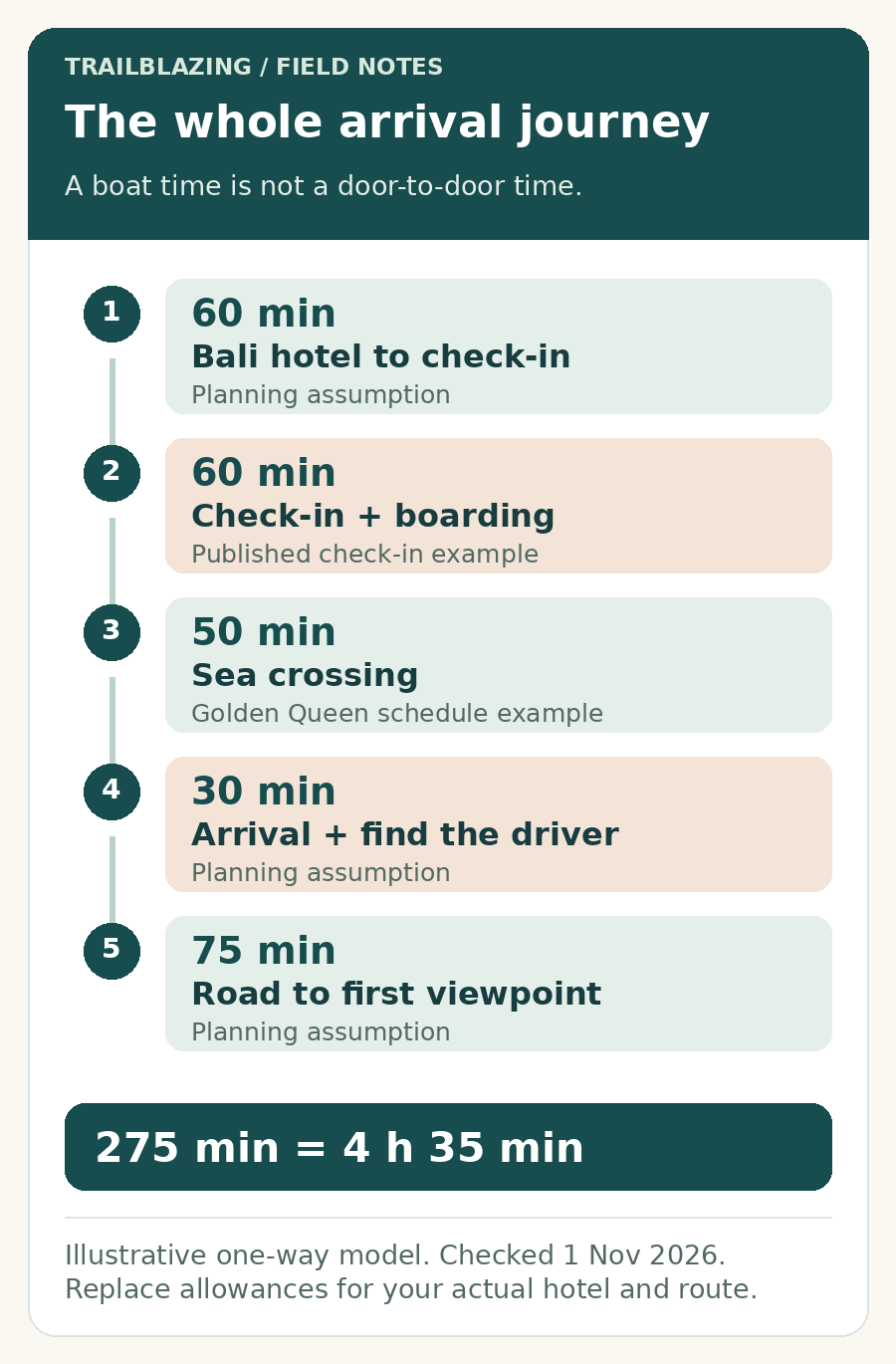
The point is not that every visitor needs exactly 275 minutes. It is that a crossing time should never be used as a hotel-to-attraction time. A nearer hotel may reduce the first stage, while a different port or a late departure can enlarge the later ones.
For a day trip, build the return calculation backwards from the operator’s required check-in time. Agree the latest time to leave the last attraction and a stop that can be dropped. Lunch, queues, walking and rests need their own space; they are not absorbed by the driving allowance.
Use the Itinerary Pace Checker with your own door-to-door estimate when deciding whether Penida fits your wider holiday. It flags pressure in an entered plan; it does not forecast the crossing or road conditions.
Keep west, east and the north-coast base distinct
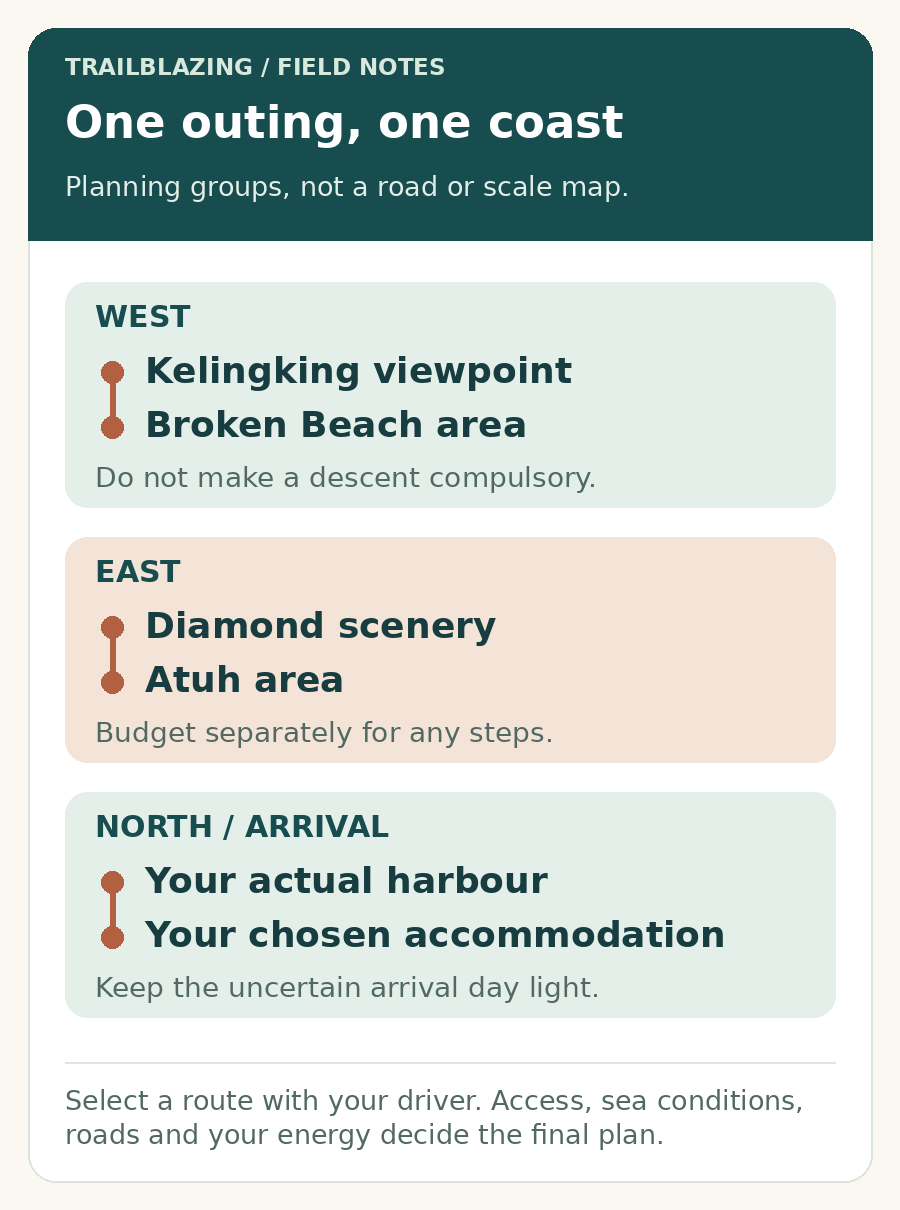
Organise the island as three planning groups rather than as a continuous list of famous photographs. The west contains Kelingking and the Broken Beach/Angel’s Billabong area; Diamond and Atuh belong to the eastern outing; harbour and accommodation choices sit around the northern side. Use a current map for the specific property and road route. [1][10]
| Group | Choose it for | Keep the day realistic |
|---|---|---|
| West-coast outing | Kelingking viewpoint and the Broken Beach area | Treat a beach descent as a separate demanding decision, not a compulsory extra. |
| East-coast outing | Diamond and Atuh coastal scenery | Allow for road time and steps; agree which viewpoints suit your group. |
| Northern base and arrival day | Settling in, a nearby meal and confirmed short outings | Do not make an uncertain boat arrival the start of the longest circuit. |
Kelingking is a viewpoint before it is a beach plan
The tourism board describes the descent as steep and dangerous, and Bali Police have specifically urged visitors to avoid risky clifftop photographs and follow staff instructions. [1][5] The default recommendation here is to enjoy an authorised viewing area without committing to the descent. Do not stand outside barriers or back towards an edge for a photograph.
Diamond and Atuh need their own energy budget
A view from above and a visit down at beach level are different activities. Ask what the current access requires and keep enough energy for the return climb. A driver can transport you between stops but cannot remove the physical demands of a path. Decide together before anyone starts down.
Broken Beach and Angel’s Billabong are not a swimming promise
Treat the coastal formations as places to observe from permitted ground. Do not step onto wave-washed rock or enter a pool because it looks still in a photograph. A tide label alone is not a safety assessment. Follow current barriers and instructions, and leave when conditions or crowding make a comfortable margin impossible. [9]
A driver, a private tour or a combined package?
For this guide’s viewpoint-focused plan, a car with a driver is often the most workable option. Compare the structure of the service rather than the number of attractions in its title. Some offers begin at a Penida harbour or hotel; others start at your accommodation on Bali and coordinate the boat. Those are materially different products. [11]
For example, the Viator private-driver listing consulted for this guide explicitly excludes Bali-side transfers and fast-boat tickets. [12] That makes it useful to someone already organising the crossing, but unsuitable as a presumed all-in day trip. The advertised itinerary is not a recommendation to attempt every stop.
Agree what happens when the boat is late. For a private car, ask whether unused time can be adjusted or whether the day simply becomes shorter. For a combined excursion, identify who is responsible for the return ticket and how you will receive changes. Keep the company contact as well as the individual driver’s number.
Hiring a scooter is not a shortcut around the planning. The relevant licence, insurance, experience and local road conditions still matter. [4] Travellers who are uncomfortable with the roads should reduce the number of stops and pay for an appropriate vehicle rather than learn on an unfamiliar island.
Choose your base around the harbour and daily route
Start with the location of your confirmed boat arrival and the sightseeing group you value most. A northern harbour-area stay can simplify arrival and departure; a view-focused property farther away may be worth the extra transfer when you intend to spend time there. Neither is automatically better.
For each property, ask for the driving route from your actual harbour, not just its distance from a generic “port” map pin. Confirm the last approach, stairs, meal access, hot water and the arrangements for a late arrival. Rooms overlooking a bay can sit well above the shore; a sea view does not imply beach access.
With two nights, avoiding a hotel change is usually more useful than trying to sleep beside each coast. With three or more, a split stay is possible, but compare the packing, checkout and luggage transport against the drive it saves. Accommodation that looks more central on a map may not minimise the road journeys you will actually make.
Use the hotel comparison tool to include transfers or breakfasts that differ between two quotes. When a remote property adds a journey for every meal, the room rate is only part of the decision.
Separate the island fees from Bali's tourist levy
A ticket described as “tax included” needs clarification. Bali’s provincial foreign-tourist levy and Klungkung’s island-area and attraction charges are separate systems. The FCDO lists Bali’s provincial foreign-visitor levy as IDR 150,000 per person and directs readers to Bali government payment information. Check the official Love Bali system, current exemptions and any receipt requirements for your circumstances. [8]
Klungkung’s August 2026 notice states that, from 1 September 2026, the island tourism-area fee is IDR 25,000 for a foreign adult and IDR 15,000 for a foreign child. It also describes separate attraction fees of IDR 25,000 for adults and IDR 15,000 for children, applying to foreign and domestic visitors at the relevant attractions. The official notice defines the child band for the island-area charge as ages four to thirteen; confirm how each attraction applies its own tariff before travelling. [7] Do not interpret one payment as automatic admission to every stop.
| Item | Adult amount stated | What to ask |
|---|---|---|
| Bali provincial foreign-tourist levy | IDR 150,000 per person, subject to applicability | Have I paid through the official system, and do any exemptions apply? |
| Penida tourism-area fee | IDR 25,000 per foreign adult | Is this included in the ticket, and where is the receipt issued? |
| Relevant attraction fee | IDR 25,000 per adult in the government notice | Which stops are covered, and are there separate parking or activity charges? |
Keep payment evidence and ask the operator to itemise inclusions. A commercial activity, photograph platform or parking charge may not be the same thing as the official attraction fee. The figures above explain the distinction; they are not an assurance that every stop has the same total payable cost.
Build a whole-day budget
For two adults, use: two return boat tickets + Bali-side transfers + island vehicle + applicable island fees + selected attraction charges + food + contingency. Confirm whether the vehicle is priced per car or per person. For an overnight stay, add room nights, extra meals and each further day’s transport separately.
A comparison is unfair when the cheaper option leaves out a harbour pickup or required fee. Conversely, do not pay for an all-inclusive package whose attraction list is not the day you want. Enter your checked figures in the Travel Budget Calculator; its inputs are GBP, so use a consistent current conversion from your own payment provider.
Water, clifftops and access: the non-negotiable checks
Bali Police have specifically reminded visitors of swimming prohibitions at Kelingking and Diamond Beach. [6] This guide does not recommend swimming at either. At other locations, conditions still need a local assessment: a beach, snorkelling site or boat excursion is not safe simply because it is popular.
For any snorkelling or diving booking, discuss swimming ability, supervision, flotation equipment, entry and exit, currents, weather and emergency arrangements with the actual operator. Confirm your insurance covers the activity. Do not buy a water excursion expecting a guaranteed wildlife sighting, and do not touch or chase animals. [9]
At viewpoints, protect your distance from the edge rather than trying to reproduce a social-media pose. Rain, fatigue and crowding are reasons to shorten a visit. The current local instructions take priority over an older photograph or itinerary. [5]
For children or anyone with limited mobility, check each part of the chain: boat boarding, the car, parking-to-viewpoint surface, toilet access and steps. “Private tour” means private transport; it is not an accessibility certification. A view-only day may be the better design, but the route still requires confirmation.
A workable two- or three-night pattern
For two nights, make arrival a logistics day: travel, reach your accommodation, eat and confirm tomorrow’s plan. Use the complete middle day for either west or east. On departure day, stay near the arrangements that get you back to the correct harbour without rushing.
For three nights, add the other coast on a separate full day, or reserve that day for a carefully chosen water activity and rest. Do not automatically add both. A spare period is valuable when a crossing, road journey or activity changes.
Keep essential addresses, tickets and contact numbers offline. Check your current roaming or local data option; compare Airalo plans by selecting Indonesia only after confirming your handset and activation requirements. Airalo markets Indonesia plans, but that does not guarantee coverage at every cove or on the crossing. [13]
When assembling a larger trip, enter Penida and your final mainland stay as different stops in the trip itinerary planner. Reserve the return buffer before allocating the remaining nights. It is harder to protect a flight when every night has already been committed elsewhere.
Final questions before you commit
Can I see both coasts on one day trip?
Some packages offer it, but this guide does not make it the default. Compare the usable time after both crossings and transfers, then decide how much of the day you are willing to spend in a car. One coast is a more forgiving choice for a first visit.
Must I descend to a beach to enjoy Penida?
No. A properly planned viewpoint visit can be the main experience. Choosing not to descend is sensible when the surface, heat, steps, access restrictions or your energy make the return difficult.
What happens if the boat is cancelled?
Follow the operator’s instructions and the cancellation terms of the booking. Contact your accommodation and driver promptly. A separate hotel or flight reservation is not automatically protected by the boat ticket, which is why a contingency plan matters.
Are Lembongan and Ceningan the same destination?
No. They are neighbouring islands, not alternative names for Nusa Penida. Check the boat destination and accommodation map carefully. Changing islands adds another transport decision rather than simply choosing a different Penida neighbourhood. [10]
What should I book first?
Decide the length of stay and mainland return buffer, then coordinate the boat, arrival harbour, accommodation and driver. The Indonesia travel hub is the starting point for placing the island within the rest of your trip.
Sources & editorial approach
Independent editorial review: 2 November 2026. The selection, suggested plans and labelled calculations are research-led editorial judgements, not reports of personal visits, measured journeys or live offers. Confirm changeable fees, access, schedules and booking conditions before travelling.
- Indonesia Ministry of Tourism: Nusa Penida landscapes, harbours and visitor access.
- Golden Queen Fast Ferry: published Sanur-Penida check-in and sailing schedule.
- 12Go: Sanur to Nusa Penida route-comparison page.
- FCDO: Indonesia sea and road travel safety.
- Bali Police: Kelingking clifftop safety advice, 30 September 2026.
- Bali Police: swimming prohibitions including Kelingking and Diamond, 28 May 2025.
- Klungkung Government: island-area and attraction fees effective September 2026.
- FCDO: Bali foreign-tourist levy and official payment information.
- Smartraveller: Indonesia swimming and marine-transport precautions.
- NusaPenida.org: independent local orientation and harbour information.
- GetYourGuide: Nusa Penida private-tour comparison.
- Viator: island-based private-driver listing and exclusions.
- Airalo: Indonesia data plans.
Illustrations in this article were created for Taylor’s Trailblazing Travels. Third-party photographs, where used, are credited beside the image or in the source list.