
Bali or the Gili Islands: Which Is Better for Beach Time?
A beach holiday is about the hours you enjoy by the water, not just the colour of the sea in a photograph.
Original conceptual illustration of contrasting coastal settings; not a photograph or a map of the Bali-Gili route.
Bali or the Gili Islands becomes a much easier decision when you define “beach time”. Do you want a pool and promenade, snorkelling outings, a sandy island without ordinary car traffic, or a lively evening after a surf lesson? Those are different holidays, even if they all appear under the same tropical-beach label.
Here, the Gili Islands means Gili Trawangan, Gili Meno and Gili Air off northwestern Lombok. They are not part of Bali and should not be confused with every other island called “Gili”. [1] The comparison is with staying on Bali’s main island, not with Bali’s separate Nusa islands.
Bali is simpler
An extra island is not always extra relaxation.
Look at the Gilis
Choose Air, Meno or Trawangan deliberately.
Check the shoreline
Tide, current, entry and boat activity matter.
Compare the operator
Wildlife sightings are never guaranteed.
Bali or the Gili Islands: start with your beach brief
The fairest comparison pairs an actual Bali base with an actual Gili island. Comparing all of Bali with the quietest corner of Gili Meno would hide the decisions that most affect your holiday. Use the table to make a shortlist, then inspect accommodation and access in that particular area.
| What you want | A sensible first shortlist | The condition to check |
|---|---|---|
| A short beach break | Stay on Bali rather than add a crossing. | Can your chosen hotel support an enjoyable full day nearby? |
| A small-island routine | Gili Air, Meno or Trawangan. | Does the arrival and return effort fit your available nights? |
| A livelier evening scene | Gili Trawangan or an appropriate Bali coast. | Check the room location and nearby noise. |
| A deliberately quiet retreat | Consider Gili Meno, then compare the individual property. | Are limited fallback activities a benefit or a frustration? |
| A surf-focused coast | Consider Canggu rather than choosing the Gilis for their sand. | Choose a lesson and conditions suitable for your ability. |
| Gentle swimming with children | Shortlist exact beaches and pools, not islands. | Ask about current conditions, supervision and the entry. |
Indonesia Tourism distinguishes Trawangan’s entertainment from the quieter positioning of Meno and Air, and identifies Canggu as a surf coast. [1][2][4] The remaining recommendations are editorial judgements about how to turn those characteristics into usable holiday time.
Write your non-negotiable first. “I want to snorkel on two mornings” gives a clearer answer than “I want the best beach”. So does “I want to reach dinner without arranging another vehicle”.
Which Gili matches the evenings you want?
Gili Trawangan: choose the room, not just the island
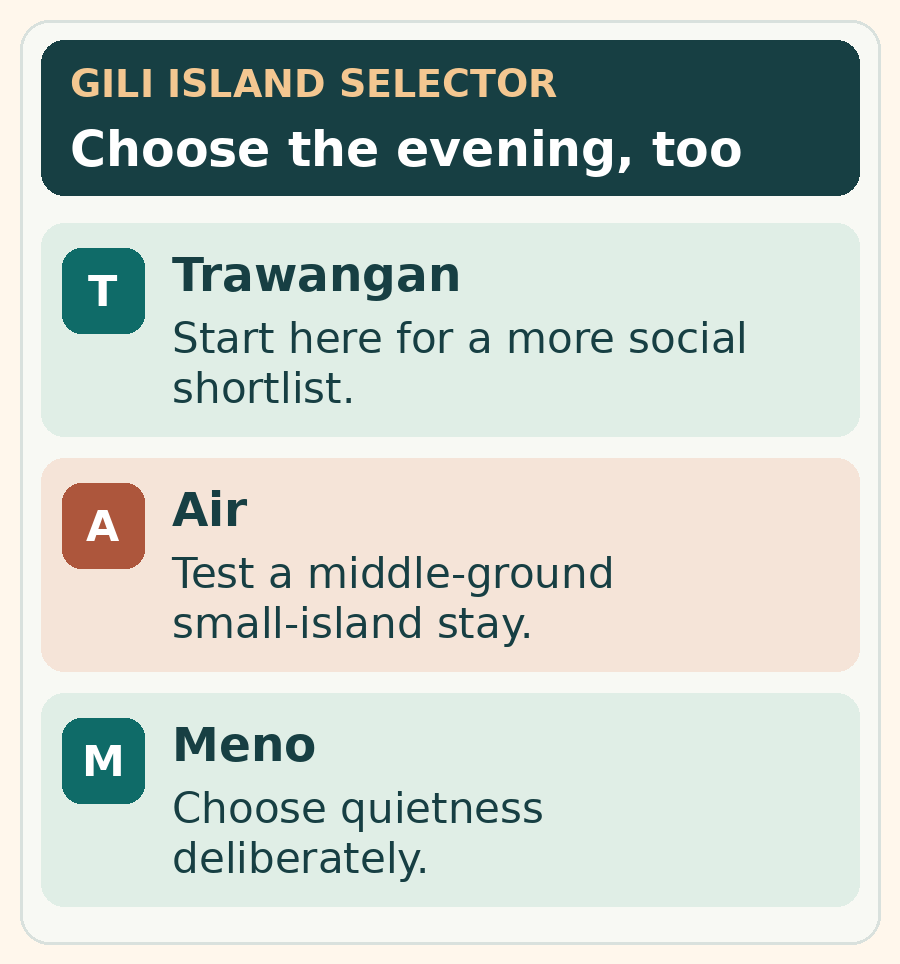
Trawangan is the largest of the three and is described by Indonesia Tourism as the liveliest, with restaurants and nightlife. [1] That makes it a logical starting point for travellers who want a social evening as well as water activities. It does not mean every room has the same atmosphere.
Before booking, look at the route from the landing point to the property, the nearest evening venues and how you would get back after dark. Someone who enjoys going out can still prefer a quieter sleeping location. Ask for recent information about the immediate surroundings rather than relying on a general island description.
Gili Air: test the middle-ground option
Air is the closest of these three islands to Lombok, and tourism guidance presents it as a quieter alternative to Trawangan. [1] It is a useful first comparison when you want a small-island setting without choosing solely for nightlife or seclusion.
However, “balanced” is an editorial shorthand, not a measured score. A comfortable property in the right part of the island matters more than an abstract promise that Air suits everyone. Match your dining expectations, room facilities and preferred water activities to the address.
For a second view of the same island, compare Gili Air room offers on Booking.com. Match the exact room, dates, meals and cancellation terms rather than comparing headline prices alone.
Gili Meno: make quietness an active choice
Indonesia Tourism describes Meno as the smallest and quietest of the three. [2] Choose it because you welcome a slower routine, not because you assume that fewer distractions must suit every traveller.
Imagine an afternoon when the planned boat outing is cancelled. If reading, conversation, a pool and a leisurely meal still sound excellent, the island may fit. If you would immediately want a long list of alternative activities, choose a different base or shorten this part of the trip.
The Gilis are promoted as car- and motorbike-free, with walking, bicycles and horse-drawn carts among the usual options. [1] Do not translate that into a promise of step-free paths or effortless luggage transfers. Agree an arrival plan with your accommodation.
When staying on Bali gives you better beach time
Bali wins this comparison when the avoided transfer is more valuable than a change of island. For example, someone with three nights between inland sightseeing and an international flight may gain more from a well-positioned coastal hotel than from another boat-based excursion.
Sanur: compare the actual stretch of coast
Sanur’s offshore reefs create a different coastal setting from an exposed surf beach, but tides still affect the water experience. [3] Treat that geography as a reason to investigate, not a safety guarantee. Ask the hotel where guests usually enter the water and what changes at low tide.
A property with an enjoyable pool and convenient meals can be especially useful when the beach is only one part of the day. Compare the hotel-to-shore route, shade and seating, rather than treating the word “beachfront” as a complete description of a stay.
Canggu: choose it for a surf-and-social brief
Canggu’s dark-sand coast is known for surf. [4] That can be a strong reason to visit, but it does not make it the automatic alternative to a small-island snorkelling holiday. A traveller who mainly wants calm floating should not choose a surf beach because the accommodation photographs look appealing.
For other Bali coastal areas, repeat the same test rather than assuming they behave like Sanur or Canggu. Check the exact beachfront, daily access, planned activities and room location. A Bali resort break and a Gili guesthouse stay can both work well, but they solve different problems.
Swimming, snorkelling and the shore are separate questions
A beautiful shoreline answers only the scenery question. Before swimming, consider the entry and exit, moving boats, local warnings and current conditions. FCDO highlights strong currents and dangerous sea conditions in Indonesia. [6] Treat local closures and instructions as more important than any recommendation in a destination comparison.
For snorkelling, choose the provider before choosing the most dramatic tour description. Ask about the group size, guide supervision, flotation, equipment fit, getting back into the boat and the plan for less confident swimmers. An attractive underwater photograph tells you none of those things.
GetYourGuide lists Gili snorkelling trips with different departure islands, durations and private or shared arrangements. [7] Compare the actual itinerary and meeting point: a trip labelled “Gili Islands” may not begin beside your hotel. Do not assume that a turtle-themed title guarantees an encounter.
For families, establish a separate plan for anyone who does not want to snorkel. Splitting the group between a supervised activity and an enjoyable land-based afternoon can work better than expecting every traveller to love the same outing. The right trip is the one that accommodates the least confident participant without pressure.
The beach-time test: does the crossing earn its hours?
Use a simple model: usable holiday time equals waking time minus transfer-related time. This is not a prediction of your journey. It is a way to expose what happens when a short stay carries two additional travel days.
For an illustrative four-day block, assume ten useful waking hours per day: forty hours in total. If staying on a Bali coast consumes four hours in the relevant arrival and departure transfers, thirty-six hours remain. If adding the Gilis consumes twelve hours across the comparable transfers, twenty-eight remain. The eight-hour difference is the price in time of that particular island choice.
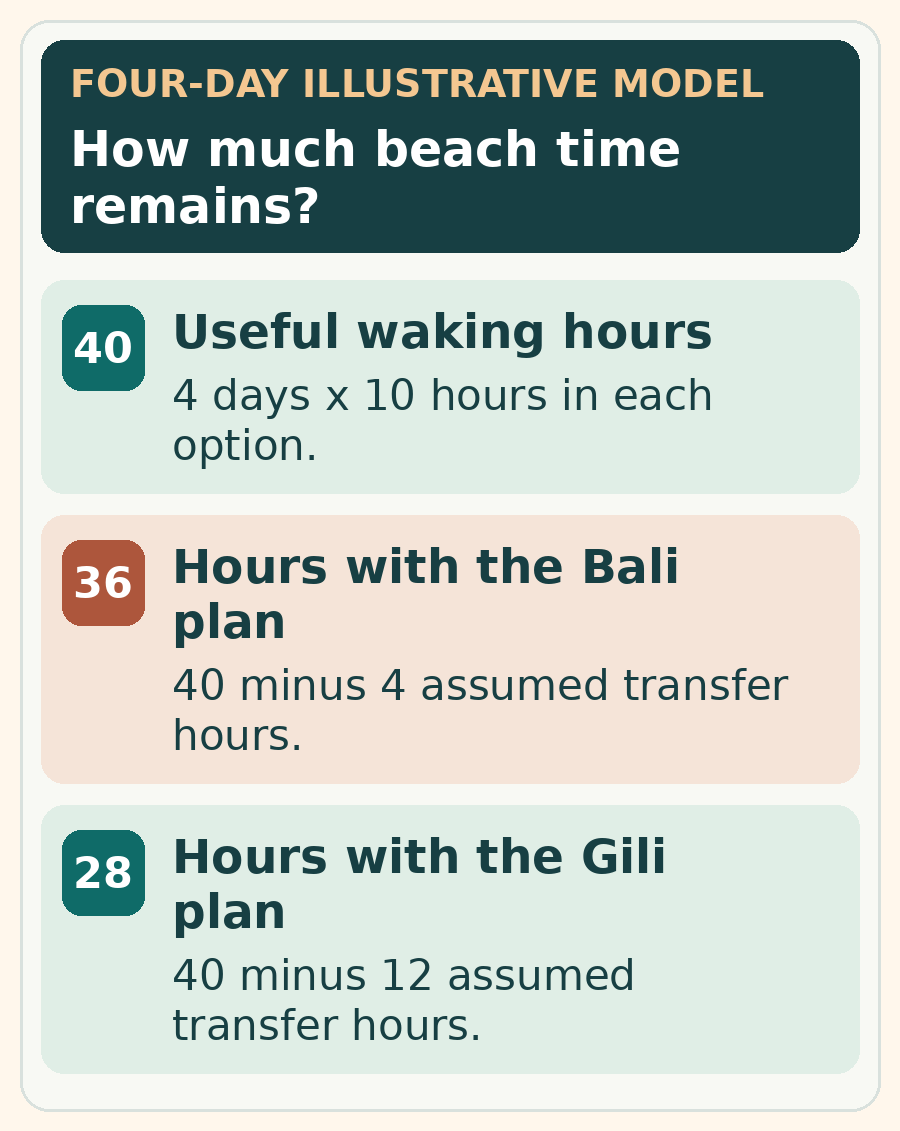
Those four- and twelve-hour inputs are deliberately hypothetical. Replace them with your actual hotel locations, chosen ports, check-in instructions, stops and arrival arrangements. On a different itinerary the gap may narrow or widen. The model compares the same start and finish points; it does not count a flight transfer in one option and omit it from the other.
Eight hours less downtime is not automatically a bad trade. Two keen snorkellers might happily accept it for the island setting. A tired family wanting a pool and easy meals might not. What matters is making the exchange consciously.
| Available time | Editorial recommendation |
|---|---|
| 2-3 nights | Usually remain on Bali unless the island visit is the central objective. |
| 4-5 nights | A single Gili base becomes easier to justify; avoid hopping between all three. |
| 6 nights or more | Compare a longer settled island stay with your preferred Bali coast; protect the return. |
The Itinerary Pace Checker can help you review your own nights and transfer estimates. Leave the weather-sensitive journey separate from a tight, unprotected long-haul flight connection.
Booking the boat without overlooking the last mile
BlueWater Express’s published network connects Bali ports with Gili Trawangan, Gili Air and Bangsal on Lombok. [5] Do not assume the same service also lands at Meno. Confirm whether your chosen ticket includes the precise island you want or requires another local connection.
The operator’s published schedules include different seasonal routes and intermediate calls, so a Bali–Gili ticket is not necessarily a non-stop crossing. For Meno, establish both parts of the journey, their operators, baggage handover and any separate payment before finalising accommodation. A port absent from one company’s network does not mean the island has no transport service. [5]
Port choice also depends on your starting hotel. The operator distinguishes southern Bali access via Serangan from central Bali access via Padang Bai. [5] Compare the whole journey rather than selecting the shortest advertised sailing and discovering a longer road leg.
Read the voucher for the operator name, port, check-in time, included land transport, luggage and cancellation terms. Ask your accommodation about the final arrival route and assistance with bags. A return ticket should fit your departure island, not just carry the same general destination label.
Allow a sensible mainland buffer before an important onward flight. There is no universal number of hours that makes a sea-to-air connection safe. The consequences of a missed flight, the weather and the flexibility of both bookings should determine how conservative your plan is.
For travellers with reduced mobility, ask for a description of both boarding points and the final route to the room. A short distance on a map may involve steps, uneven surfaces or a transfer method that does not meet your needs.
Budget and weather: avoid two false bargains
The first false bargain is a cheaper nightly rate that requires extra transport. Compare accommodation for the same number of nights and occupants, then add transfers, luggage, meals and the fallback costs of a disruption. Where breakfast or an arrival transfer is included, record that explicitly.
The second is a low room price in a period when the activities you value are less dependable. Indonesia Tourism describes a broad wetter season from November to March and a drier period from April to October for much of the region including Bali. [8] That broad pattern does not forecast a particular crossing or snorkelling day.
Choose flexibility around the activities that matter most. For a snorkelling-led break, leave more than one possible outing day. For a pure rest break, spend more attention on the room, pool and meals than on filling the schedule with pre-paid activities.
Use the Hotel Comparison Calculator with actual offers from your dates. A pair of rates in different currencies, with different taxes or cancellation terms, is not yet a meaningful comparison.
Neither “Bali is expensive” nor “the Gilis are cheap” is a useful budget on its own. The specific room-and-transport combination is the unit that needs to fit your spending limit.
Common mistakes and remaining questions
Must I visit all three Gilis?
No. Moving hotels between them can undermine the settled beach routine you travelled for. Choose one base that matches your evenings and consider an outing only when it adds something you actually want.
Can I visit the Gilis as a day trip from Bali?
Do not make that the default for a relaxing beach holiday. Work out the complete return journey and the time left ashore first. If the attraction is the island rhythm, an itinerary dominated by getting there and back defeats the purpose.
Which option works best without a scooter?
Choose a compact daily routine in either destination. On the Gilis, normal transport is centred on walking, bicycles and local alternatives rather than ordinary car traffic. [1] On Bali, select a base where your essential outings are close and arrange vehicles for longer journeys. Neither approach requires turning a holiday into a riding lesson.
Is Gili Meno always the best choice for couples?
Only for couples who want that sort of quiet break. A pair who enjoy varied dinners and lively evenings may prefer another island or Bali. Romantic is a preference, not a destination category that fits everyone.
What is the most costly mistake?
Booking the scenery before the logistics. A room on the wrong island, an awkward arrival route or a rushed return can matter far more than a small difference in nightly price.
The beach-time verdict
Choose the Gilis when the small-island setting is the point of the holiday and you can stay long enough to enjoy it. Start with Air for a middle-ground shortlist, Meno for deliberate quiet, or Trawangan for a more social stay, then judge the actual property.
Choose Bali when you mainly want comfortable downtime, have few spare nights, or prefer to mix the beach with other outings. The best beach decision is often the one that leaves you enough time to enjoy an ordinary afternoon.
Use the Indonesia travel hub to place the beach stay within the wider trip, and keep the last sea journey away from a fragile flight connection.
Sources and editorial approach
Initial source review: 1 November 2026; the ferry network rechecked on 2 November 2026. Official destination material and the named boat operator provide context. The four-day beach-time model is original editorial analysis using hypothetical time inputs, not checked passage durations or live availability. Ask the selected boat provider about the actual sailing, stops and onward connections.
- Indonesia Tourism: Gili Trawangan and the Gilis
- Indonesia Tourism: Gili Meno
- Indonesia Tourism: Sanur
- Indonesia Tourism: Canggu Beach
- BlueWater Express: Bali and Gili route schedules
- FCDO: Indonesia swimming and sea-travel safety
- GetYourGuide: Gili Islands snorkelling listings
- Indonesia Tourism: broad seasonal climate patterns
Illustrations in this article were created for Taylor’s Trailblazing Travels. Third-party photographs, where used, are credited beside the image or in the source list.