Indonesia Tourism Fees, Conservation Permits and Visitor Charges Explained
Know what each payment buys, who collects it, and which costs still need confirming before you book.
Original illustrative island scene; it does not depict a verified fee counter or an official permit design.
Indonesia tourism fees are easier to manage when you stop treating every payment as an entrance ticket. A visa concerns permission to enter the country; Bali has its own visitor levy; a protected area may require a separate permit; and the boat taking you there is another purchase. Paying one does not automatically settle the others. [1][2][3]
The useful question is not simply “How much is the fee?” It is “What does this charge cover for my nationality, activity, route and dates?” This guide separates the main layers, explains where current information needs extra care, and gives you a reusable way to compare quotes without inventing a single national tariff.
Some links in this guide are affiliate links. If you make a purchase through them, Taylor’s Trailblazing Travels may earn a commission at no additional cost to you.
Visa, provincial levy, park admission and transport are different purchases.
Per person, per visit, per day and per group produce different totals.
Use the issuing authority or an operator who identifies the charge and receipt.
Save vouchers offline and mark which fees your booking already covers.
Indonesia tourism fees: the four layers to separate
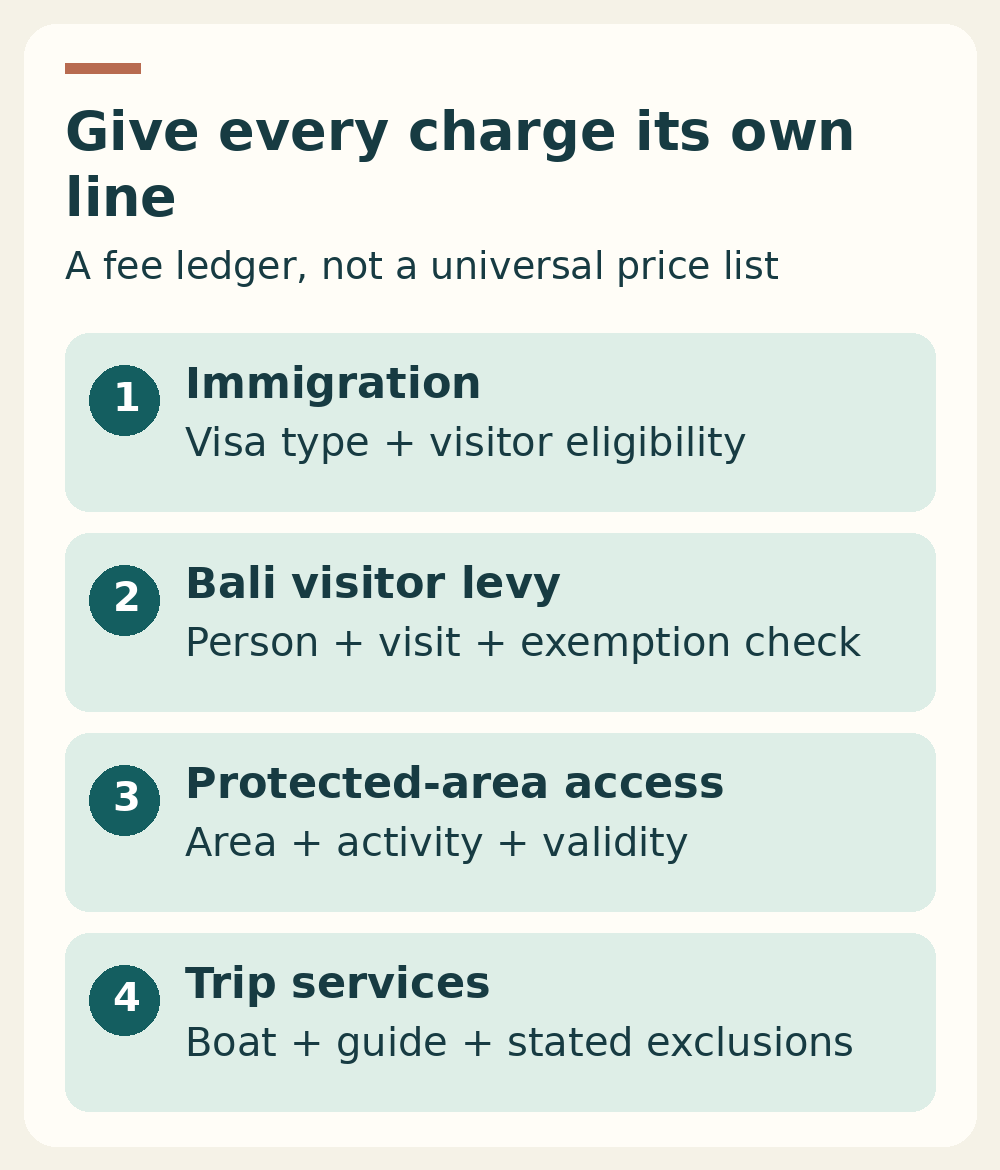
Start with a small ledger rather than a miscellaneous “tourist tax” allowance. The table below is a classification tool, not a claim that every traveller pays every charge. Which rows apply depends on your passport, places visited and activities.
Make a one-page checklist of the places on your route before adding figures. A valid charge in Komodo or Raja Ampat does not belong in a Bali-only budget. For every included item, record the collector, person or group covered, charging unit and whether the tour invoice already includes it. Leave unknown amounts clearly marked as to confirm, not as zero.
| Layer | What it concerns | What it does not prove |
|---|---|---|
| Immigration | Your visa or permission to enter and stay. | That provincial levies or attractions are paid. |
| Provincial visitor levy | A destination-wide obligation, such as Bali’s foreign-tourist levy. | Admission to every temple, beach or national park. |
| Conservation or site access | The named protected area, site, visitor category and validity period. | A boat seat, equipment hire or every activity. |
| Services and local charges | Guiding, transfers, parking, equipment, accommodation or a separately identified local charge. | That the money is a statutory conservation payment. |
These distinctions follow the separate immigration, Bali and park arrangements described by the authorities. [1][2][3][4] An operator may collect several items together. That can be convenient, but ask it to retain the categories on the invoice. A bundle is easier to assess when you can see the service price and compulsory charges separately.
Check the charging unit before comparing totals. Two people paying once is not equivalent to two people paying on three separate visiting days. Likewise, a private guide charged per group should not accidentally become a per-person allowance in your budget. Where the written terms are unclear, request a worked total for your actual party.
Bali: what the IDR 150,000 levy does and does not cover
The national tourism authority describes Bali’s foreign-tourist levy as IDR 150,000 per person, paid electronically through Love Bali. Its guidance treats it as one payment during the visit before leaving Indonesia. The charge supports the protection of Bali’s culture and natural environment; it is not an attraction pass. Published amount and guidance rechecked on 2 November 2026. [2]
For two non-exempt adults, that is IDR 300,000. Enter that sum once in a Bali-trip ledger, not once for every hotel. Keep the payment confirmation available even when your phone has no signal. If an itinerary leaves Indonesia and later returns to Bali, recheck the applicable levy treatment rather than assuming an earlier voucher covers another trip.
Use the official payment route
Begin with the official Love Bali website, reached through a trusted government source. The official guidance directs travellers to the Love Bali system for payment. [2] Do not let an advertisement or an unsolicited message become your only evidence that a payment page is genuine.
Love Bali’s official exemption notice distinguishes automatic exemptions, including KITAS/KITAP holders and specified official, family and student categories, from Golden Visa and other eligible visa categories that require an approved application. Check the current category and evidence requirements before paying; an ordinary tourist visa is not evidence of exemption. Do not assume everyone needs the same application process. [5]
A transfer company collecting money on your behalf should explain whether the levy has already been paid, what service fee it adds, and how you receive the official voucher. A vague “Bali fee included” statement is not enough to reconcile your ledger.
Entry paperwork: a paid visa is not the free arrival declaration
For full British-citizen passport holders using the standard eligible tourist route, FCDO guidance lists the visa on arrival at IDR 500,000. The same guidance says the All Indonesia arrival declaration is free and is completed in the 72 hours before arrival. These are separate processes. Check the current immigration rules for your own nationality and purpose; this guide is not a substitute for visa eligibility checks. [1]
That distinction matters when a website charges for completing an arrival form. You may be buying an intermediary’s service rather than paying a government charge. Before entering passport information, establish which service you need and who operates the website. Use the official links provided in FCDO’s entry guidance rather than a search advertisement. [1]
Do not add an assumed “Indonesia arrival tax” on top of every transaction. Instead, ask the seller to identify the actual fee by name. A receipt showing the issuing authority, visitor name and purpose is much more useful than a bank statement showing only an unfamiliar company.
Keep immigration costs separate from discretionary sightseeing. This prevents an attractive day-tour price from masking the money you must set aside before the holiday starts. It also makes changes easier: replacing a boat trip does not remove a visa obligation that still applies to your visit.
Komodo: distinguish park admission from the whole boat trip
Indonesia’s tourism ministry currently lists foreign-visitor admission to Komodo National Park at IDR 250,000 per person and scuba diving at IDR 25,000 per person. Its page says the published access tariff includes trekking, wildlife observation and snorkelling, but not boats, accommodation or tour-operator services. These are published components rechecked on 2 November 2026, not a guarantee of your final trip total. [3]
The same official page describes online SIORA registration and a daily visitor limit introduced in April 2026. Ask your operator how it secures the required reservation for your actual date. A paid boat deposit does not, by itself, tell you whether admission has been arranged. [3]
The quote should identify exclusions
Request a breakdown covering the park entry, any applicable activity charge, ranger or guiding service, harbour costs and boat fare. Check whether a multi-day sailing pays for more than one visiting day, whether a local charge is collected separately, and what happens if weather or admission availability changes the route. Do not reuse an old weekend-price table without checking the present visitor category.
For comparison, a reviewed Viator listing separates its operator-described park and ranger charges from the tour payment. That is evidence about that listing’s terms, not proof that its bundle is the statutory price for every Komodo visit. [6]
Browse Labuan Bajo tours on GetYourGuide and compare Labuan Bajo day trips on Viator. These are destination and excursion listings, not official park-ticket portals. Open the selected product’s exclusions and ask for a written total before booking. [7][8]
A cheaper headline can still become the dearer outing if it excludes essential services. Conversely, a higher quote is not automatically better: make sure it adds something you need, such as a smaller group or a more suitable route, rather than merely using a different label for the same costs.
Raja Ampat: verify conservation and regency charges separately
Raja Ampat requires extra care because different public-facing systems describe different responsibilities. The marine conservation authority’s site issues the TLPJL environmental-services permit. The regency’s SIPARI portal separately describes visitor registration and official tourism levies. Do not assume that a document bearing one name settles every payment associated with the other. [4][9]
A national tourism page reviewed for this guide quotes IDR 700,000 for foreign visitors’ TLPJL and a 12-month validity period. However, the conservation authority’s current terms say the applicable amount is the lawful tariff at payment, and its accessible booking form did not expose a final visitor-specific price before details were entered. Treat the ministry figure as a published reference, not a confirmed checkout amount for your trip. [10][4]
This guide therefore does not present one supposedly definitive all-inclusive Raja Ampat permit total. Before committing to accommodation or a liveaboard, ask the operator or authorities for a dated written explanation of the conservation permit, SIPARI registration and any regency charge applicable to your itinerary. Ask explicitly whether one payment replaces another, or whether both are required, and request the basis for the answer.
Ask about validity, children and existing permits
Specify each traveller’s nationality, age, dates and visiting areas. If you already hold a permit, send the details through the authority’s legitimate channel and ask whether it remains valid for the new trip. Do not assume an earlier payment is reusable just because another traveller’s permit was, or that a child exemption applies to every separate charge.
“Please list every compulsory public fee for our itinerary, name the collecting authority, state the charging unit and validity, and show which items your price includes. Please also identify any charge we must pay separately on arrival.”
A worked fee ledger without pretending it is the whole holiday budget
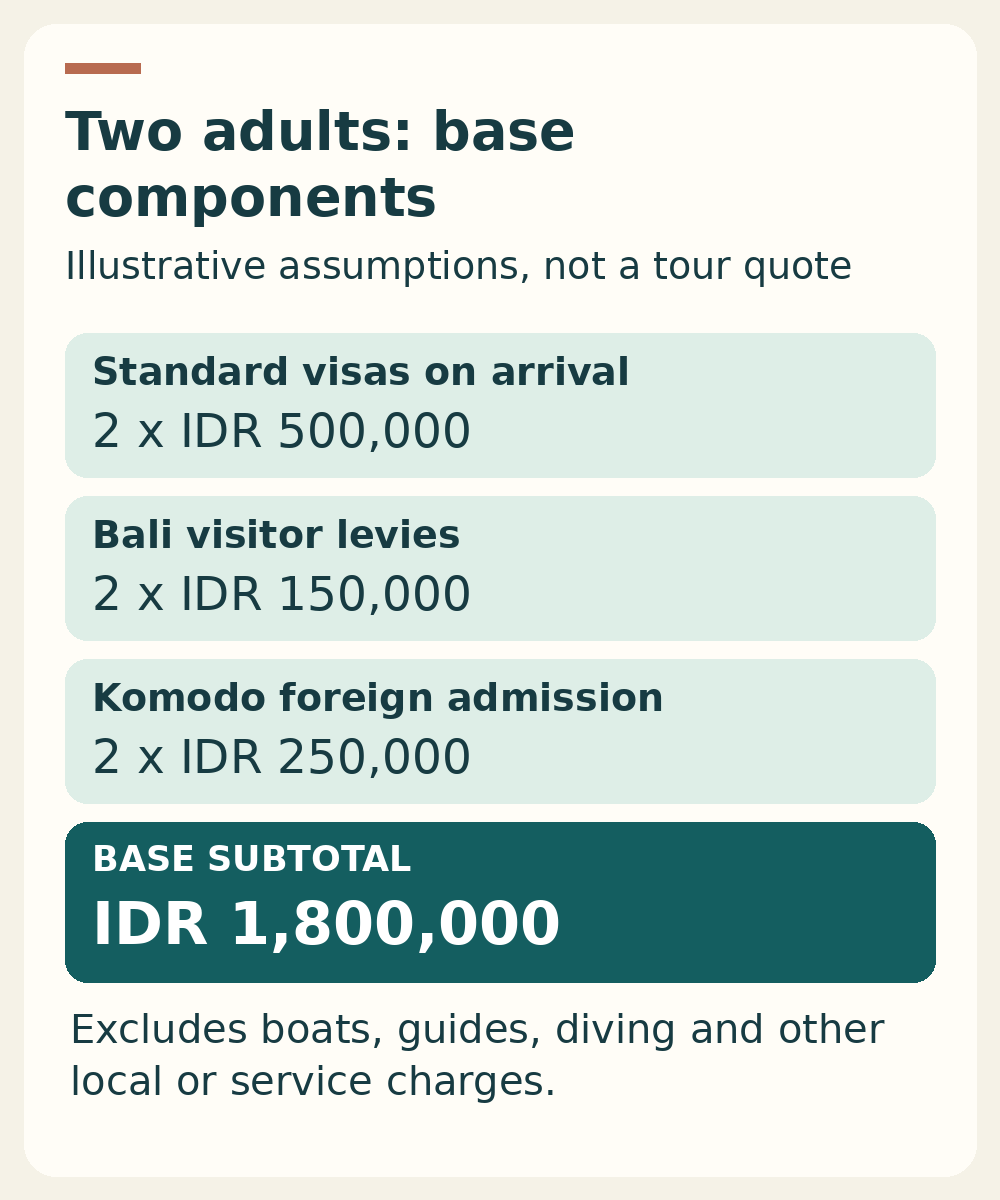
Here is a deliberately narrow model for two adult British tourists who are eligible for the standard visa on arrival, are not exempt from Bali’s levy, and make one Komodo visit. It includes only the three published base components below. It does not price flights, hotels, boats, guides, local charges, diving, card fees or other attractions. The assumptions are the point: they stop a useful subtotal being mistaken for a complete quote.
| Component | Calculation | Two-adult subtotal |
|---|---|---|
| Standard visa on arrival | 2 × IDR 500,000 [1] | IDR 1,000,000 |
| Bali levy | 2 × IDR 150,000 [2] | IDR 300,000 |
| Komodo foreign-visitor admission | 2 × IDR 250,000 [3] | IDR 500,000 |
| Known base components only | 1,000,000 + 300,000 + 500,000 | IDR 1,800,000 |
Now add the individually quoted services. If a tour includes Komodo admission, mark the IDR 500,000 as “included in tour payment” rather than adding it again. The economic cost still exists; it simply sits inside another payment. Do the same for accommodation packages that collect a permit on your behalf.
For a longer holiday, build your full trip budget using your own room prices, transfers and activity quotes. The calculator’s editable figures are a planning aid, not a current authority on Indonesian permit tariffs. Keep this fee ledger alongside it rather than expecting a generic daily allowance to include every protected-area visit.
Amounts here remain in rupiah so the arithmetic is reproducible. For a GBP allowance, use the rate and card charges applicable when you pay, and leave a separate contingency. Do not add a falsely precise pound equivalent copied from a different travel date.
Before paying: receipts, permissions and common mistakes
Use a five-field payment record
For every compulsory item, record the traveller or group, the named charge, the issuer, the covered dates and places, and the proof of payment. Add a sixth column for “included elsewhere” if you are using tours. This simple record is more useful than a collection of screenshots with no explanation of what each one buys.
Confirm whether the charge is refundable if a boat is cancelled, a site closes or your party changes. A tour cancellation policy and a public permit’s refund rules can be different. The conservation authority in Raja Ampat publishes its own terms; use the issuing body’s rules rather than assuming a booking platform’s policy governs every payment. [4]
Do not confuse a donation with compulsory admission
Where you are asked for an unfamiliar contribution, politely ask whether it is mandatory, who sets it and what receipt is issued. Optional donations deserve a clear description. Parking, a sarong hire or a guide service may be legitimate costs, but they should not be passed off as the national immigration charge.
Avoid confrontations at checkpoints. If a payment seems to duplicate a voucher, show the voucher and ask the operator or official counter to explain the difference. Keep private documents off public social-media complaint threads. Resolve the payment with the collector before attempting to bypass a restricted entrance.
Questions travellers still need answered
Does Bali’s levy include Komodo or Raja Ampat?
No. Bali’s levy and those destinations’ access arrangements belong to separate systems. Build the relevant costs into each part of your route rather than treating a Bali voucher as a nationwide pass. [2][3][4]
Is a higher foreign-visitor price automatically a scam?
No. Official visitor categories can have different tariffs; Komodo’s published table distinguishes Indonesian and foreign visitors. The useful checks are the official category, current amount and receipt, not whether every visitor pays the same sum. [3]
Should I pay every permit far in advance?
Not blindly. First confirm your travel dates, reservation requirements and refund terms. Pay through the correct channel in time for the visit, but avoid making non-refundable payments against an itinerary that is still changing.
What is the best final check?
Ask each operator to reconcile your ledger against its invoice. Any unresolved line should stay visible as an unknown, not disappear into a guessed total. For a straightforward Bali holiday, that takes little effort; for a multi-island conservation itinerary, it is part of the essential planning.
Budget by named charge, not by a single “tourism fee” number. Pay official costs through the appropriate channel, compare full tour totals, and keep evidence of what is already included. Return to the Indonesia planning hub when choosing the next part of your route.
Sources & further reading
Editorial sources gathered on 1 November 2026; key fee information rechecked on 2 November 2026. Follow the linked authority for changes and the provider for your specific booking.
- FCDO: Indonesia entry requirementsBritish-citizen visa guidance, VOA amount and free arrival declaration.
- Indonesia Travel: Bali visitor-levy guidancePublished levy, payment method and stated visit basis.
- Indonesia Travel: Komodo National ParkPublished admission and diving components, inclusions and SIORA information; Indonesian-language source.
- KKP Raja Ampat: terms of the marine park feeAuthority, payment evidence and tariff-at-payment terms; read alongside its official booking form.
- Love Bali: official levy-exemption noticeOfficial notice distinguishing automatic categories from application-based exemptions; individual evidence must still be checked.
- Viator: early-morning Komodo speedboat listingAn example of operator-described exclusions, not an official tariff schedule.
- GetYourGuide: Labuan Bajo toursDestination-level tour comparison; no date-specific inventory or safety certification implied.
- Viator: Labuan Bajo day tripsExcursion comparison page; individual terms vary.
- SIPARI Raja Ampat: visitor regulationsRegency registration and levy framework; verify the itinerary-specific interaction with conservation payments.
- Indonesia Travel: Raja Ampat planning informationPublished TLPJL reference amount and validity, qualified in the article rather than treated as a current checkout quote.
Illustrations in this article were created for Taylor’s Trailblazing Travels. Third-party photographs, where used, are credited beside the image or in the source list.