
How to Travel Responsibly in Indonesia: Wildlife, Reefs and Local Communities
Choose the encounter, the operator and the everyday habits that respect the places you came to enjoy.
An original illustration of forest and reef environments; it is not a photograph or a depiction of a named dive site.
To travel responsibly in Indonesia, start with the activity rather than the advertising. An animal encounter is not made responsible by adding the word “rescue” to its name. A boat trip needs more than beautiful underwater photographs. A village visit should make sense for the people who live there, not just for a visitor’s camera. Animal-welfare and reef-conservation organisations both advise judging the behaviour an experience encourages. [1][2]
You do not need to solve every environmental problem before taking a holiday. You do need a few clear boundaries, specific questions for sellers, and the willingness to change an outing when the answers are poor. This guide turns those decisions into a usable booking screen, followed by practical advice for forests, reefs and communities.
Some links in this guide are affiliate links. If you make a purchase through them, Taylor’s Trailblazing Travels may earn a commission at no additional cost to you.
Do not buy wildlife contact just because the experience is described as educational.
Ask what the guide does when guests ignore the wildlife briefing.
Look for named hosts, guides and services rather than a vague community promise.
An activity must fit your ability and conditions as well as your values.
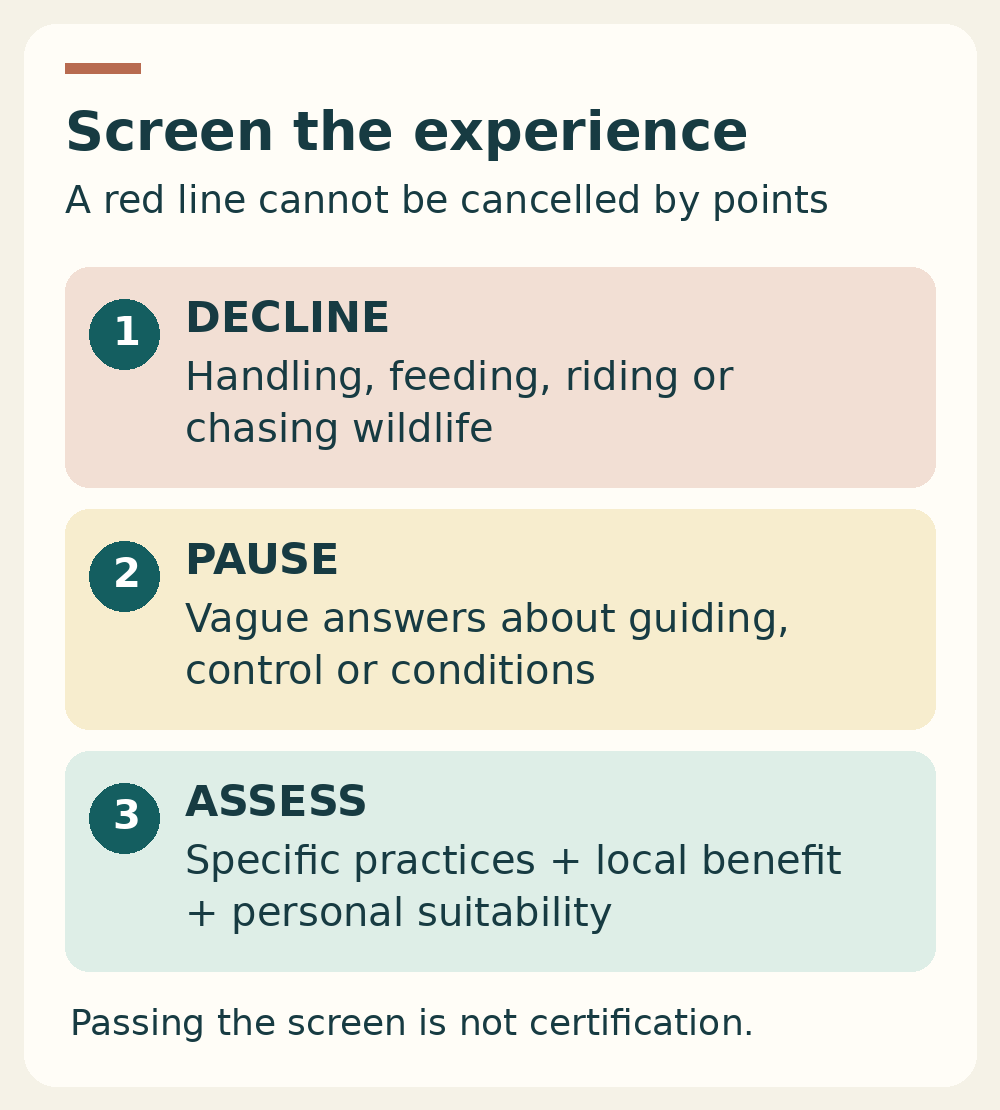
How to travel responsibly in Indonesia: screen the activity first
This three-stage screen is an editorial decision tool, not a sustainability certification. It deliberately avoids a points score: a good lunch or a local donation should not cancel out an animal-welfare problem. Use it before paying, then revisit it if the actual outing differs from the description.
| Stage | Ask or inspect | Your next move |
|---|---|---|
| 1. Check the activity | Does it sell touching, riding, feeding, chasing or a staged close wildlife photograph? | Decline that experience; look for observation with boundaries. [1][2] |
| 2. Check the operation | Who guides it? What is the briefing? What happens if conditions or guest behaviour become unsuitable? | Pause until the operator gives a specific answer. |
| 3. Check local benefit | Which guides, hosts and services receive payment, and who agrees access? | Prefer an arrangement you can understand, without assuming a label proves fair distribution. |
For example, compare two hypothetical snorkelling trips. One promises feeding fish for photographs; the other describes a no-feeding briefing, controlled entry and a guide who will move the group if conditions deteriorate. The second has the more appropriate operating plan. It still needs ordinary checks on safety, equipment, suitability and cancellation terms. Conservation language does not replace those checks.
Ask the question in writing: “Please explain your wildlife-contact policy, group supervision and response if a guest breaks the rules.” A useful reply describes action. “We love nature” tells you little about how a difficult moment is handled.
Ask about the withdrawal choice before paying as well: if the actual trip introduces feeding, handling or another activity not advertised, can you decline to participate, and what refund or alternative is available? A clear answer reduces the pressure to accept a poor practice merely because the excursion has already started. Do not put yourself or others at risk to challenge an operator on the water.
Forest wildlife: let the animal keep its distance
For orangutan viewing, Sustainable Travel International recommends keeping at least 10 metres away, not feeding animals and following responsible guiding practices. Treat that distance as the organisation’s viewing guidance, not a universal Indonesian legal boundary; follow stricter local rules and the ranger’s instructions. Its advice also distinguishes wild encounters from settings involving rehabilitated animals. [4]
Ask what kind of experience is being sold. Is it a forest walk seeking wild animals, viewing near a rehabilitation programme, or a captive attraction? Those are different propositions. Do not assume a photograph of an orangutan in trees proves that a particular outing is a wild encounter.
If an animal approaches, give it space and follow the guide’s direction rather than treating the approach as permission to touch. Keep food secured, do not block its route, and never request a closer encounter to improve a picture. Discuss illness before a primate-viewing trip and follow the operator’s health precautions; protecting wildlife may mean missing the activity. [4]
Be comfortable with an uneventful sighting
A worthwhile wildlife outing need not produce a close-up portrait. Bring expectations that allow the guide to keep distance, wait or leave. An operator promising guaranteed intimate contact is offering a different kind of experience from careful observation. World Animal Protection identifies tourist handling, rides and performance-based attractions as serious welfare concerns. [1]
The same principle does not mean every animal has the same viewing rules. In Komodo, official tourism guidance calls for following the ranger and not touching, feeding or provoking dragons. Use the species-specific instructions at the place you visit rather than applying an orangutan distance to every encounter. [5]
Reef visits: match the outing to your control in the water
UNEP’s reef guidance emphasises buoyancy, avoiding contact with coral, and not feeding, touching or chasing marine animals. It also recommends asking about reef-protective boat practices, including using moorings rather than anchoring on coral where appropriate. [2] These are concrete questions to put to a marine operator before comparing photographs and prices.
Describe your actual swimming and snorkelling experience. Ask how entry, exit, flotation and supervision work for someone at that level. A life jacket may be part of a suitable plan, but it does not make every current or open-water site suitable. Choose an easier outing, or remain on the boat, when the conditions or support are wrong for you.
Once in the water, look ahead rather than only down through the mask. Keep fins, equipment and camera away from the reef. If you need to rest or adjust a mask, ask the guide for a safe method instead of standing on coral. Avoid pursuing an animal that moves away; a photograph is not a reason to turn observation into a chase. [2]
“Where do we enter and leave the water, what should I do if I become tired, and how will you keep our group clear of the reef?” A clear answer is more useful than a promise that the site is suitable for everyone.
Do not make an entire environmental decision from a sunscreen marketing phrase. Clothing and shade can reduce the amount of exposed skin, while sun protection still needs to suit your circumstances. Follow relevant health advice and local requirements; this guide does not certify a product as harmless to reefs.
Manta encounters: leave a clear route, not a ring of swimmers
The Manta Trust’s Swim with Mantas guidance gives a useful example of species-specific behaviour. It advises entering quietly at least 10 metres from a manta, not deliberately approaching closer than 3 metres, approaching from the side rather than blocking its route, and never chasing or touching. A manta choosing to approach does not invite contact. [6]
For a beginner, the most useful question is how the guide will maintain that space for the whole group. A briefing on shore is not enough if everyone is then encouraged to race towards the animal. Tell the guide when you are uncomfortable keeping pace, and accept that suitable conditions and sightings cannot be guaranteed.
At cleaning stations, follow the guide’s positioning instructions and avoid obstructing the area where animals gather. Divers should maintain appropriate control without settling on living reef. The Manta Trust’s guidance specifically addresses keeping the manta’s path and the cleaning area clear. [6]
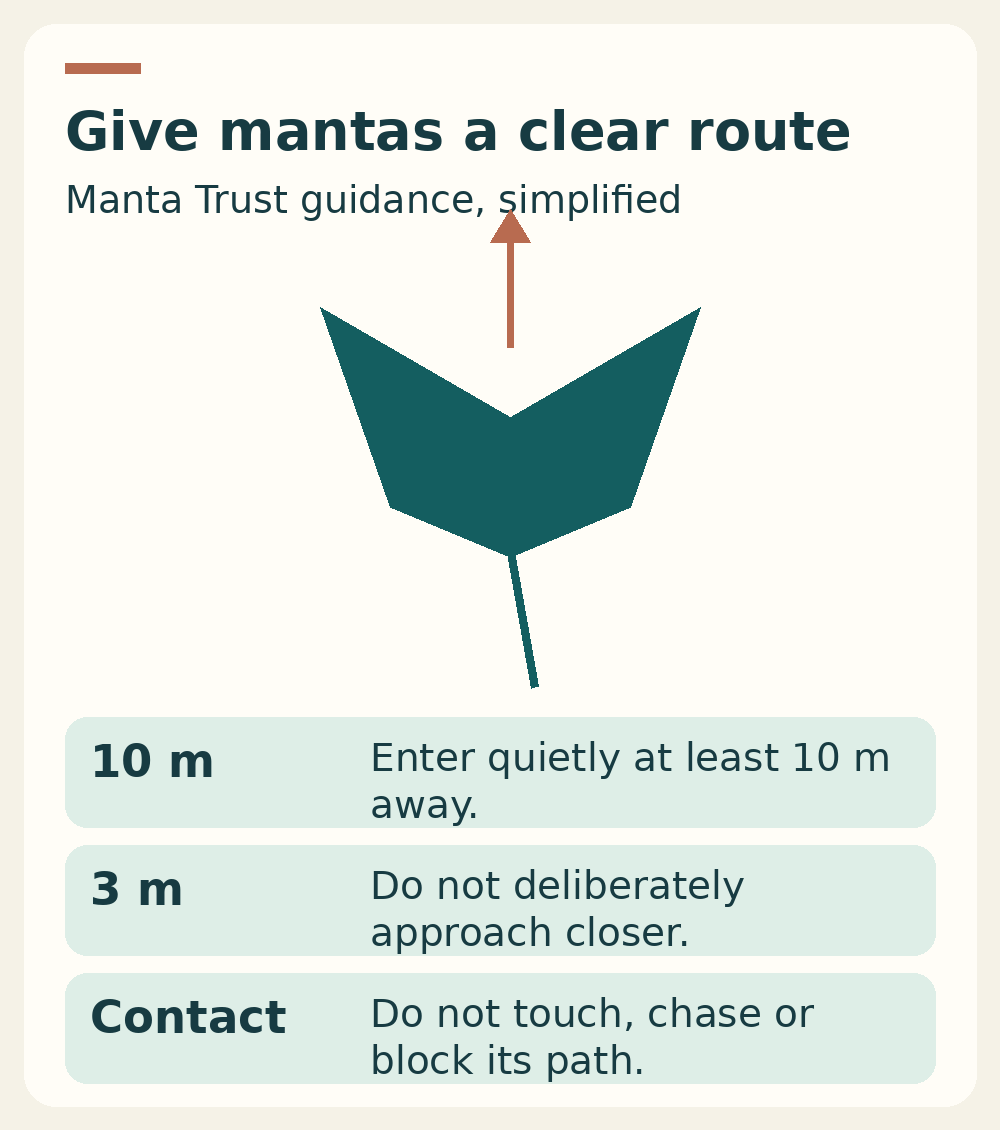
The graphic is a behavioural reminder, not a navigation map or a substitute for an in-water briefing. An operator listed in a programme or carrying a conservation message still needs checking for your particular trip, staff and conditions.
Local communities: ask permission and make spending understandable
Start with the simple question “Is this welcome here?” before entering a courtyard, photographing a person or approaching a ceremony. A public-looking space may still be a place of worship or somebody’s everyday working environment. Being invited into one area does not establish permission to enter every other area.
Bali’s provincial tourism guidance asks visitors to respect sacred places and local customs, dress appropriately, and follow access restrictions at temples. Wearing a sarong does not override a restriction on a sacred inner area or a ceremony. Read signs, ask the attendant or guide and accept a refusal without bargaining. [3]
Follow the payment, not just the label
Before a community visit, ask who hosts it, who sets the fee and what the host has agreed visitors can do. For a craft demonstration, clarify whether a purchase is optional. For a guided village walk, ask whether the guide is from the community and how access has been arranged. These are transparency questions, not a claim that every locally owned business is automatically responsible.
Pay the agreed price, buy things you genuinely want and request permission before taking close photographs. A direct purchase can make the recipient of your money easier to identify, but avoid promising yourself that one purchase benefits an entire village. The meaningful unit is the actual person or business providing the service.
A hosted food activity can be a better fit for a traveller interested in conversation and everyday culture. Explore Ubud cooking classes on Viator, then check the host, group size, dietary suitability and what the visit involves. This is a category of bookable classes, not a list certified for community benefit. [7]
The Indonesia food and culture hub is another way to orient your planning without turning a private celebration into an attraction you assume you can attend.
Choose accommodation and a pace you can defend
For accommodation, replace a broad question such as “Are you eco-friendly?” with two or three checks you care about. Ask how drinking-water refills are provided, whether housekeeping frequency is optional, how waste is handled and whether local guides can be booked through a transparent arrangement. Ask about accessibility or dietary needs at the same time: a responsible choice must also work for the person staying there.
Neither a small homestay nor a large hotel is automatically the right answer. A small property may offer direct contact with the owner; a larger one may have clearer published procedures. Compare evidence and practical fit rather than awarding virtue from size or decor.
Search Bali accommodation on Agoda or compare Bali stays on Booking.com. Use these destination searches to identify suitable rooms, then ask the chosen property about its actual practices. A listing, review score or booking-platform label is not this guide’s sustainability endorsement. [8][9]
Consider whether an itinerary needs every planned move. Removing an unnecessary transfer gives you more time in the places you retain and avoids that particular journey; it does not establish a quantified carbon saving. Use the Itinerary Pace Checker with your own nights and transfer estimates to spot a rushed plan. The tool does not validate transport schedules or environmental performance.
Carry out what you bring into a natural area and do not collect coral or marine souvenirs; UNEP includes avoiding coral purchases in its reef-protection guidance. [2] Carry a refillable bottle only with a plan for a suitable drinking-water source. A refill point’s existence is not itself assurance that its water is appropriate to drink.
Questions that help when the decision is awkward
Does paying a conservation fee make a tour responsible?
No. A required payment and the operator’s behaviour are different checks. Keep the receipt, but still ask about guiding, wildlife boundaries and the actual itinerary. Komodo’s official information, for example, separates access charges from operator services and gives behavioural rules as well. [5]
Should I cancel if the description is vague?
First ask a precise question. If the reply remains vague on an issue that matters to you, do not let a non-refundable deadline become the reason to ignore it. Choose a different activity before committing. This is a decision rule, not evidence that every poorly written listing operates badly.
What should I do if the outing changes on the day?
Explain the boundary you agreed before booking. Decline the problematic part when it is safe to do so, record the discrepancy without putting yourself at risk, and raise it with the operator and booking service afterwards. Do not confront wildlife handlers in a way that endangers you, staff or animals.
Is staying longer always the responsible option?
Not automatically. A longer stay still needs appropriate accommodation, water use, access and behaviour. The practical benefit of a simpler route is that you can spend more time understanding one place instead of treating each stop as a photograph between transfers.
Set the non-negotiable wildlife boundaries first. Then choose a suitably guided activity, ask who benefits locally and leave room to change plans. A clear explanation of what will happen is worth more than a polished environmental slogan.
Sources & further reading
Editorial sources gathered on 1 November 2026; key wildlife, reef and visitor-conduct guidance reviewed again on 2 November 2026. Follow the linked authority for changes and the provider for your specific booking.
- World Animal Protection: wildlife tourismWelfare concerns associated with handling, rides and performance-based attractions.
- UNEP: five ways to protect coral reefsBuoyancy, wildlife contact, boat practices and coral souvenirs.
- Bali Provincial Tourism Office: visitor conductRespect, dress and sacred-site access guidance.
- Sustainable Travel International: viewing wild orangutansDistance, feeding, health precautions and encounter types.
- Indonesia Tourism: Komodo National ParkRanger guidance, animal-contact rules and separate operator services.
- Manta Trust: Swim with MantasSpecies-specific approach distances and in-water behaviour.
- Viator: Ubud cooking classesScope of the linked bookable category; no sustainability certification inferred.
- Agoda: Bali accommodationDestination search; no dates or individual property practices verified.
- Booking.com: Bali accommodationDestination search; no dates or individual property practices verified.
Illustrations in this article were created for Taylor’s Trailblazing Travels. Third-party photographs, where used, are credited beside the image or in the source list.