Ubud or Canggu: Which Bali Base Is Right for You?
Choose where your ordinary mornings and evenings work best, then organise the one-off outings around them.
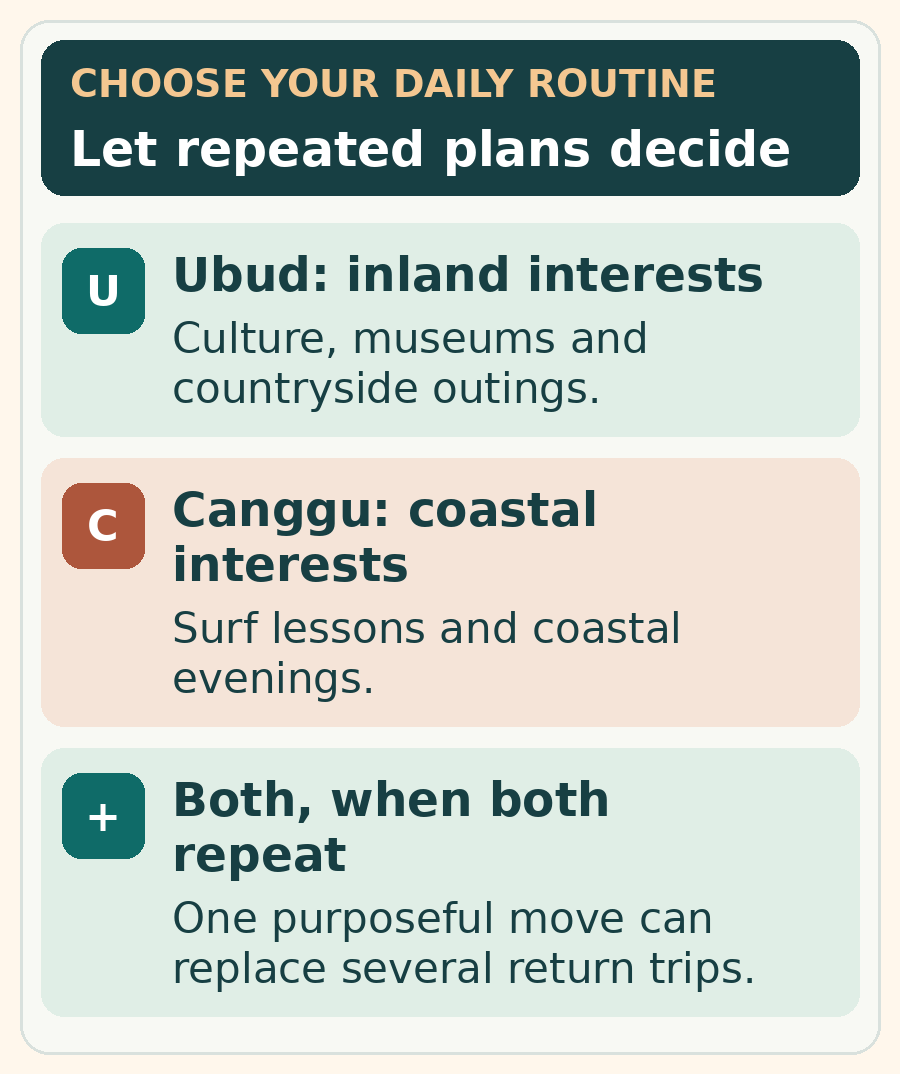
Original conceptual illustration contrasting inland and coastal routines; not a photograph of one real location.
Ubud or Canggu is a choice between two very different daily routines. Ubud is an inland base associated with art, culture and surrounding countryside. Canggu is a coastal area known for surf, with different beach neighbourhoods and a strong dining-and-social appeal. [1][2] Neither is a convenient shorthand for all of Bali.
The decision becomes clearer when you stop asking which place is “better” and list what you want within easy reach every day. A cultural outing once during the trip can be arranged from another base. A surf lesson or a late dinner that you want repeatedly should influence where you sleep.
Inland culture
Choose the room location around the outings you value.
Surf and coastal evenings
Beach access is not a calm-swimming guarantee.
Room, breakfast, dinner
Inspect the practical routes between all three.
Split for repeated interests
Do not commute across Bali just to avoid unpacking.
Ubud or Canggu: compare your repeat activities
The table below is an editorial decision aid, not a ranking of cultural value, safety or hotel quality. It draws on the official destination descriptions and the actual activity categories available in each place. [1][2][5][6] Use it to shortlist a base, then test the individual property.
| Your recurring plan | Start with | Why the base fits |
|---|---|---|
| Museums, workshops and cultural outings | Ubud | An inland arts-and-culture itinerary has a natural centre. |
| Surf lessons and coastal sunsets | Canggu | The coast is the reason for staying, not an occasional excursion. |
| A quiet room and a pool | Either, after property-level checks | An area name cannot establish noise, privacy or access. |
| Several days in each setting | A planned split stay | Repeated long return outings can cost more time than one move. |
| A gentle-swimming beach holiday | Reconsider the exact coastal brief | Ubud is inland; a surf coast is not automatically a suitable swimming beach. |
| A holiday without riding a scooter | A compact daily neighbourhood | Walkable essentials and arranged transport matter more than the destination label. |
Try a simple weighting exercise without pretending the results are scientific. Mark each planned activity as “daily”, “twice” or “once”. Let the daily activities carry the decision. If the once-only list pulls you towards one base while your everyday routine belongs in the other, the everyday routine is usually the better guide.
When Ubud is the stronger base
Ubud works best when you want an inland day to feel complete without adding a beach. The tourism board identifies its museums, galleries, market and surrounding rice-field landscape, while Neka Art Museum provides a specific cultural anchor. [1][3] You do not need to fill every day with a distant excursion.
Choose one cultural focus, then leave room around it
A museum visit, a workshop or a carefully chosen local outing can form the centre of a day. Build meals and rest around that focus instead of adding every famous attraction within reach. Cultural visits are more useful when you have time to understand what you are seeing rather than merely reach the next entrance.
Indonesia Tourism’s cultural guidance highlights Ubud’s artistic heritage and the wider context of Balinese temples and performance. [4] Treat religious places as living sites with their own rules, not as interchangeable photo stops. Check current visitor access and follow local dress and conduct instructions.
Cooking classes: compare more than the menu
Ubud cooking-class listings include different formats, locations and durations. [5] Decide whether you want a market element, a farm setting, a shorter class or particular dietary accommodation. Ask what is hands-on, what is demonstrated and whether transport reaches your actual hotel.
Ubud is a weaker fit when you would spend most mornings travelling back to the coast. Nor does an inland address guarantee silence: ask about the immediate room location and nearby activity. The right setting should support the holiday you intend, not just the view you would like to photograph.
When Canggu is the stronger base
Canggu makes more sense when the coast is part of your repeat routine. Official tourism guidance distinguishes beach areas including Berawa and Echo Beach and discusses their surf character. [2] That is a reason to choose deliberately within the area, not to assume every beach or room offers an identical experience.
Build the stay around a suitable lesson
For a beginner, the quality and judgement of the surf instructor matter more than the most famous beach name. Ask about instructor-to-student ratio, equipment, the learning area, your swimming ability and what happens when conditions are unsuitable. Do not choose a lesson solely because it promises standing up quickly.
The listings offer different lesson formats and meeting points. [6] Confirm the exact arrangement before paying, especially when a product serves several beaches. A coastline known for surfing should not be described as an all-purpose calm-swimming beach. [8]
Make evenings easy, not just possible
Choose two or three places you would genuinely use for dinner, then look at the route back to the room. A location that is convenient at lunchtime may feel different after dark. Check lighting, road crossings and whether you would rely on a vehicle every evening.
Canggu is a weaker fit when the beach is incidental and most of your planned days are inland. It can also disappoint someone expecting the destination name alone to deliver a quiet retreat. Choose the actual surroundings you need, and ask about nearby construction or venues before committing to a non-refundable stay.
The hotel-location test that matters in both places
Use a five-point test on each shortlisted property: the arrival route, breakfast, dinner, your repeat activity and the room itself. The room can be excellent while the overall location is a poor match. Look beyond the search result’s broad destination label.
First, ask whether your vehicle can reach the entrance and where bags will be unloaded. Second, check whether breakfast is available when you need it. Third, identify a realistic evening meal without an awkward journey. Fourth, check the route to the activity you will repeat. Finally, ask about steps, noise, air conditioning and the specific room category.
| Requirement | Question to ask the property |
|---|---|
| Arrival | Can a car stop at the entrance, and who handles the last part of the route? |
| Walking | What is the actual route to nearby meals, including lighting and road crossings? |
| Quietness | What is beside this room, and is any building work expected during the stay? |
| Mobility | Are there steps, steep sections or changes of level between the room and facilities? |
| Daily activity | Where does the class or driver actually collect guests? |
| Working during the trip | What connection and workspace are available in this room, not just the lobby? |
These questions are more informative than describing either destination as wholly walkable or wholly inaccessible. Ask for recent photographs or a short description where a particular access requirement determines whether the booking works.
Use the map to narrow the area, then compare the same room type and cancellation terms on Booking.com for Ubud or Booking.com for Canggu. Both destination searches require your own dates for a meaningful quote. [10][11]
One base or a split stay: a transparent travel-time model
Staying in one place avoids packing, but it is not automatically the least tiring option. If you repeatedly travel to the other area, one deliberate hotel move can be the simpler plan. The important comparison is between the journeys you would actually make.
Here is a hypothetical model for a longer stay. Suppose you want three full activity days in the other area. Using a deliberately assumed ninety minutes for each inter-area leg, three return outings create six legs and nine hours of road travel. A split stay creates one such leg, plus an assumed one hour for the extra packing and check-in administration: two and a half hours in total.

The model therefore saves six and a half hours. That is arithmetic, not a claim that Ubud-Canggu always takes ninety minutes. Replace the journey time with an estimate for your actual addresses and travel period. The model excludes airport transfers and short local journeys; compare those separately because the two plans may differ.
For an eight-night example, four nights in Ubud followed by four in Canggu can provide three full mornings at each base, with the move between them. That structure suits repeated interests in both settings. It is unnecessary when the other area has only one attraction you want to visit.
Check your own sequence with the Itinerary Pace Checker. Include the hotel change as a real task, not a blank gap between two activity days.
Transport and cost without a scooter assumption
Plan Ubud-Canggu as a road journey between your actual addresses. Ask the accommodation or an established transfer provider for the current estimate, vehicle size, luggage space and any pickup restrictions. A generic destination-to-destination estimate is not a guaranteed arrival time.
Arrange the move around checkout, the next room’s availability and the rest of that day’s plans. A late lunch and an easy afternoon can be a better transfer-day design than an expensive activity immediately after the expected arrival. Build in more margin when a missed booking would be costly.
You do not need to ride a scooter to make either destination work. Choose local essentials carefully and budget for arranged vehicles where needed. FCDO advises that road travel can be hazardous and that anyone driving needs the appropriate licence and insurance. [7] A rental being available is not proof that riding is appropriate for you.
Compare daily costs, not just the room
A hypothetical room that saves £12 per night but adds £18 in daily transport leaves you £6 worse off per day. Across six days, that is £36 more, despite the cheaper headline rate. These are illustrative inputs, not quoted Bali prices.
Put your actual room offers and included extras into the Hotel Comparison Calculator. Add transport separately where it changes between options. Avoid comparing a non-refundable room without breakfast with a flexible offer that includes it and calling the difference pure savings.
Four traveller scenarios that clarify the choice
A first-time couple with varied interests
List the experiences each person would regret missing, then distinguish repeat activities from one-offs. A longer stay with several cultural days and several surf or coastal days can justify a split. A short break needs a priority, not an attempt to fit both people’s entire wish lists into every day.
A family that mostly wants a pool and easy meals
Start with the property, access and daily routine. Do not choose Canggu simply because it is coastal or Ubud simply because it is inland. A suitable room arrangement, comfortable meals and an enjoyable low-effort day may matter more than the destination’s headline attraction.
A solo traveller who wants company
Look for structured activities and accommodation that genuinely supports the level of interaction you want. A cooking class or suitable group lesson can give a day a social element. Neither destination guarantees friendship, and a sociable holiday does not require choosing the noisiest room.
A traveller who needs to work some days
Confirm the practical requirements with the exact property: a usable desk, a quiet call location, connection performance and backup arrangements. Do not use an area’s reputation for remote workers as evidence that a particular room will support your work. Separate workdays from the most demanding excursions.
Across all four scenarios, the best base is the one that supports the ordinary day. The occasional memorable outing should enrich that routine rather than dictate an inconvenient address.
Weather, mistakes and the questions still left
Both places are on Bali. Indonesia Tourism gives the island a broad April-October dry season and November-March wetter season. [9] This is not a promise of clear skies, nor a reason to assume that moving between Ubud and Canggu will escape the weather.
Keep an enjoyable indoor or sheltered alternative beside the activity that matters most. For a surf-led trip, leave some flexibility in the lesson schedule. For an inland trip, avoid making every day depend on a single exposed outdoor activity.
Is Ubud automatically peaceful?
No. “Inland” does not establish what is outside your window. Ask about the immediate room setting and how you will reach meals and activities. A peaceful photograph can omit an inconvenient access route or nearby noise.
Is Canggu the better beach holiday?
It is the coastal option in this comparison, but that does not answer a gentle-swimming brief. Choose it for the actual coastal experience you want, especially surfing and sunsets, rather than assuming all beach needs are interchangeable.
Can I stay halfway between them?
You can consider any property whose location genuinely works, but a midpoint is not automatically a compromise. It may leave both daily routines inconvenient. Test breakfast, dinner and your repeat activities before deciding that geographical balance means practical convenience.
How many nights should I give each?
There is no fixed ratio. Give more nights to the activities you want repeatedly and enough full days to enjoy them. With a short stay, choose one base; with a longer trip, use the transfer model before splitting.
What should I avoid booking first?
A remote villa chosen entirely from room photographs. Establish the daily routine and arrival arrangements before making the accommodation non-refundable.
The base that makes your normal day work
Choose Ubud for an inland cultural routine; choose Canggu for repeated surfing and coastal evenings. Choose a split when both sets of interests occur often enough to justify one purposeful move. Do not spend the holiday commuting simply to preserve the appearance of a single-base trip.
Before paying, map the room, two meals and your main activity, then ask about the exact access and surroundings. Those checks will often improve the holiday more than another round of destination rankings.
The Indonesia guide hub provides the wider planning context once you have chosen the shape of your Bali stay.
Sources and editorial approach
Independent review of key sources: 2 November 2026. Official tourism guidance establishes destination context; transport and activity providers describe their own services. The recommendations, night allocations and clearly labelled calculations are editorial planning judgements, not first-hand hotel tests, live booking quotes or guarantees of conditions. Recheck operator instructions and local advice before travelling.
- Indonesia Tourism: Ubud, culture and inland setting
- Indonesia Tourism: Canggu areas and beach experiences
- Indonesia Tourism: Neka Art Museum in Ubud
- Indonesia Tourism: Balinese cultural experiences
- GetYourGuide: Ubud cooking-class options
- GetYourGuide: Canggu surf-lesson options
- FCDO: Indonesia road, personal and swimming safety
- Indonesia Tourism: Canggu Beach and its surf character
- Indonesia Tourism: weather, climate and seasons
- Booking.com: Ubud accommodation search and locations
- Booking.com: Canggu accommodation search and locations
Illustrations in this article were created for Taylor’s Trailblazing Travels. Third-party photographs, where used, are credited beside the image or in the source list.