
Bali or Lombok: Which Indonesian Island Suits Your Holiday?
Choose the island that fits the holiday you actually want, rather than the one with the most persuasive photographs.
Original generated conceptual landscape combining inland greenery and a tropical bay; not a photograph or a geographical map.
Bali or Lombok is not simply a choice between a busy island and a quiet one. Bali combines a substantial cultural landscape with very different coastal areas; Lombok combines southern beach country, a western resort coast and a mountainous interior. The useful comparison is between the bases you would genuinely book, not two island-wide stereotypes. [1][2]
Start with the three experiences you would most regret missing. Then test how easily each island delivers them without moving hotels every other night. This guide compares whole holidays on Bali and mainland Lombok; the small Gili Islands are a separate accommodation and transfer decision, not a substitute name for Lombok.
Variety in one trip
Match an inland stay with a carefully chosen coast.
A clear outdoor brief
Choose south-coast beaches or a western base deliberately.
Usually one island
Avoid spending a large share of the break changing places.
Compare complete trips
Room savings can disappear into extra transport.
Bali or Lombok at a glance
There is no universal winner. The table translates the destinations’ documented geography and attractions into editorial choices. These are planning judgements, not measured quality scores or claims that every beach, hotel or neighbourhood behaves alike.
| Your priority | Start with Bali | Start with Lombok |
|---|---|---|
| Culture plus coast | An Ubud-and-coast combination gives two distinct settings. | Build around Sasak culture and a selected coastal base. |
| Southern beach exploring | Choose a specific coast rather than assuming the whole island is a beach resort. | Look at Kuta Lombok and the Mandalika area. |
| A settled resort stay | Compare the exact beach frontage and services. | Examine Senggigi and its neighbouring coast. |
| Inland arts and museums | Ubud gives this itinerary a clear centre. | Do not choose Lombok expecting an equivalent Ubud experience. |
| A mountain-led trip | Check the mountain and activity individually. | Rinjani is a separate, demanding undertaking, not a casual beach excursion. |
| Few moving parts | One island, one or two bases. | One island works well when flights and your chosen base align. |
The underlying distinctions come from Indonesia Tourism’s Bali, Lombok, Ubud, Mandalika and Senggigi guides. Their promotional descriptions are not guarantees of swimming conditions or transport convenience. [1][2][3][4][9]
A practical rule is to finish this sentence: “Most mornings, I want to…” If the answer changes between galleries, countryside and a beach, Bali is the stronger starting point. If it stays focused on a particular coastline or outdoor activity, Lombok deserves a closer look.
A three-question island selector
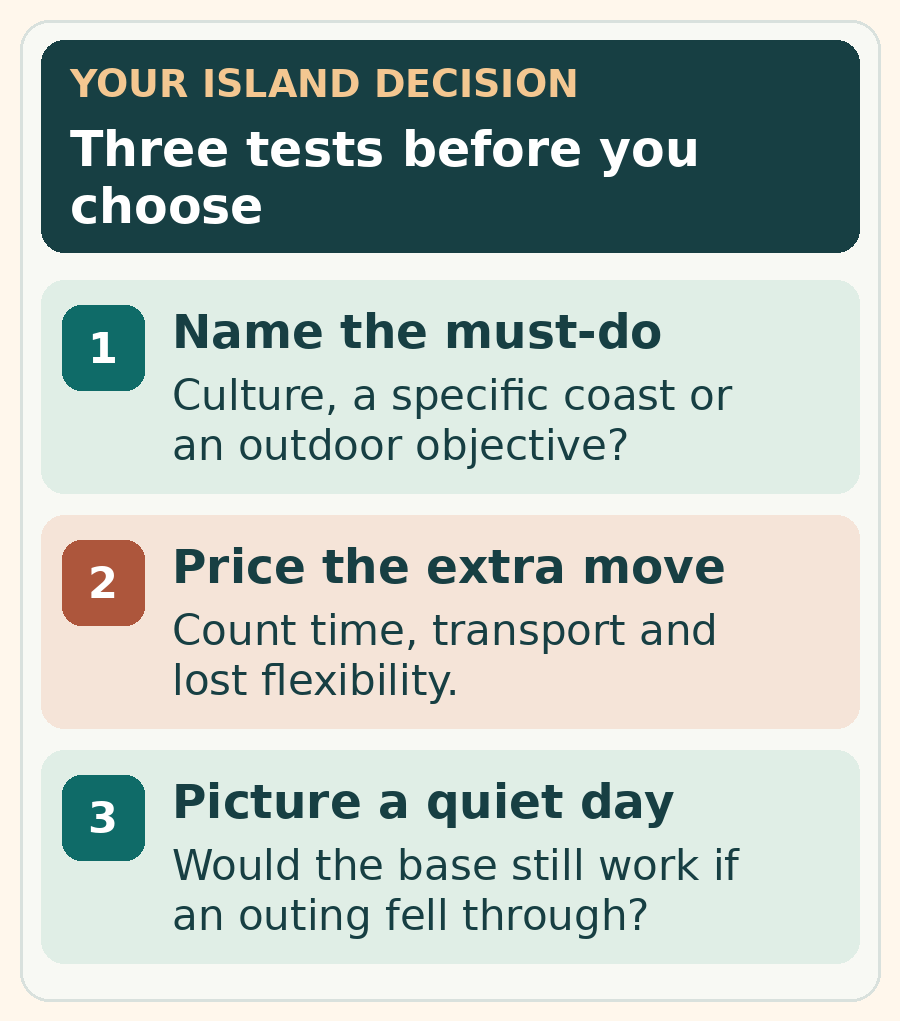
Use three questions, in order. First, is there a non-negotiable experience? Someone determined to explore Ubud’s museums should not choose Lombok because an unrelated hotel is cheaper. Equally, someone travelling specifically for Lombok’s southern bays should not replace them with a convenient Bali room and expect the same trip.
Second, how much travel effort are you happy to absorb? Include packing, checkout, the journey, finding the next room and settling in. An island switch is worthwhile only when the destination difference matters more than that lost flexibility.
Third, what would make an ordinary day enjoyable if your headline activity did not happen? A pleasant pool, easy meals and a workable neighbourhood can protect a holiday better than an ambitious list of excursions.
Apply the questions to a real disagreement
Suppose one traveller wants three cultural outings while the other wants four unstructured beach days. Start by testing an Ubud-and-coast Bali plan. It addresses both priorities without making an inter-island journey necessary. If the beach traveller specifically wants Lombok, a longer two-island itinerary may be justified; otherwise the extra move solves a problem the couple does not actually have.
Conversely, two travellers who mainly want the same southern Lombok beach base do not need Bali as a compulsory introduction. Compare a practical route to Lombok first. The busiest itinerary is not automatically the most complete holiday.
Compare bases, not island reputations
On Bali: separate the inland and coastal jobs
Ubud is an inland cultural base, with museums, galleries and surrounding countryside. It is not a beach resort. Sanur offers a coastal alternative with reef-fringed waters, although tides and conditions still determine what the sea is like on the day. [9][10] Treat these as complementary choices rather than asking one hotel to provide both settings.
For a first shortlist, put two candidate rooms on a map and identify where dinner, the main activity and your arrival point sit. A room advertised with a famous destination name can be a poor fit if every ordinary outing needs a lift. Ask about the final approach, steps, lighting and the return journey after dinner.
On Lombok: south and west are different holidays
Kuta Lombok and the Mandalika area give a southern beach itinerary its focus, including beaches such as Tanjung Aan and Gerupuk. Senggigi belongs to the western coastal corridor; its resort area stretches along a coastal road rather than forming one compact hotel enclave. [3][4] Kuta Lombok is not Kuta in Bali.
Choose the south when nearby southern beaches are the point of the trip. Choose a western property when its setting and a western or northern itinerary suit you better. Do not select a hotel on the wrong side of the island simply because its room photographs are more attractive.
The Lombok search covers a wider region: check the property’s actual island and address before comparing it with a mainland hotel. None of these links represents a checked room quote for your dates.
What the journey adds to your holiday
Compare the complete itinerary from your departure airport, including baggage, connection protection and the last road journey. A shorter final flight does not necessarily produce an easier overall travel day. There is no need to route through Bali by default if a different connection suits your dates and destination better.
For a Bali-to-Lombok sea transfer, BlueWater Express lists services involving Bali ports, the Gilis and Bangsal. Its own guidance distinguishes Serangan for southern Bali from Padang Bai for central Bali. [5] That is a useful starting point, not a promise that one port always wins from every hotel.
Before paying, establish the precise departure port, arrival port, intermediate stops, luggage allowance, check-in requirement and onward vehicle. “Lombok” on a search page is not the address of your hotel. A northwestern arrival may be sensible for one itinerary and create an unwelcome road leg for another.
If southern Lombok is the goal, compare two complete arrival plans: a flight into Lombok’s airport, or a boat to Bangsal followed by the road journey to your hotel. Both need actual dates and onward transport checked. Put the time you expect to reach the room beside each option, rather than comparing only flying time with sailing time. [5]
Use the comparison to inspect operators and endpoints, then cross-check the selected sailing with the operator. FCDO warns that sea conditions can change rapidly and that safety standards vary. [6] For a separately booked long-haul departure from Bali, a mainland overnight buffer is a prudent planning choice, not a guarantee against disruption.
Limited mobility changes the comparison. Ask each provider about steps, moving gangways, assistance, luggage and vehicle access before choosing the island, not after booking a non-refundable room.
Seven, ten or fourteen nights: when to combine them
The following allocations are original pacing suggestions, not minimum-stay rules. They assume that arrival and departure arrangements are workable and that changing island consumes a substantial part of a day. Count nights on the ground, rather than the number of calendar dates touched by international flights.
| Available nights | A workable starting plan | Why it earns its moves |
|---|---|---|
| 7 | One island; one base, or two with a clear purpose. | Protect several full days rather than collecting arrivals. |
| 10 | Stay on one island unless the second has a specific must-do. | An extra transfer has to buy a meaningful difference. |
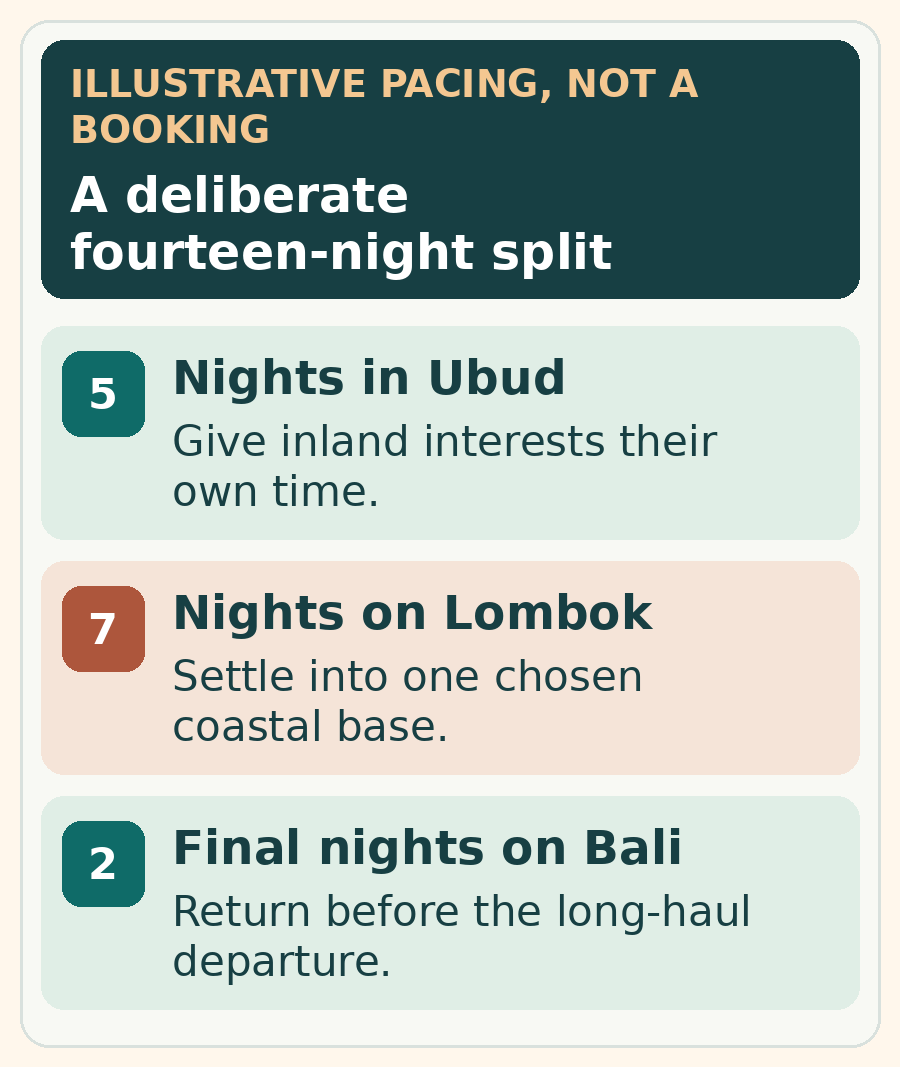
| 14 | For example: 5 Ubud + 7 Lombok + 2 Bali return-buffer nights. | A longer stay makes the island switch more proportionate; verify the actual connections. |
In the fourteen-night example, the two final Bali nights are deliberately assigned to the return side of the route. They are not two bonus nights created by overlooking the transfer. Choose the final coastal or airport-side location around the real departure time; the example does not claim any particular connection is bookable.
For a seven-night break, write down the number of full mornings at each hotel. A three-night stay normally gives only two mornings between the arrival and departure days. Two full mornings may be enough for one concentrated objective, but feel meagre when paired with several excursions.
Enter your own stops and door-to-door estimates in the Itinerary Pace Checker. Its output is a pacing prompt, not confirmation that transport services connect.
Which island costs less? Compare the entire decision
Neither island earns a reliable blanket label of “cheaper”. Your room standard, chosen area, number of occupants, paid activities and transport arrangements can outweigh the island name. Compare equivalent refundable rates, included meals and the same luggage needs before drawing a conclusion.
A useful calculation is: extra transfer cost divided by the nightly saving. If the extra transport required by one option totals £120 per couple and its comparable room is £15 cheaper per night, it takes eight nights to recover that difference. Those figures are hypothetical inputs, not Indonesian price quotations or currency conversions.
At six nights, the room saving would be £90, leaving that option £30 dearer overall before valuing your travel time. At ten nights, the saving would be £150, leaving £30 in hand. This is why a cheaper room can be a poor bargain for a short stay but worthwhile for a longer one.
The same method works in rupiah: use one currency consistently and enter your actual quoted totals. Include checked luggage, transfers at both ends, booking fees, taxes, breakfast and any difference in cancellation terms. Keep international flights separate until you have compared the whole route.
The Hotel Comparison Calculator lets you compare your own rates and extra charges. It does not fetch live hotel prices.
Weather, activity choices and traveller fit
Indonesia Tourism describes Bali’s broad dry season as April to October and wet season as November to March, while its Lombok guidance commonly favours May to October for outdoor trips. [7][8] These are climate patterns, not a forecast, and neighbouring islands do not offer a dependable escape from the same regional weather system.
During a weather-sensitive holiday, choose accommodation you would enjoy during a cancelled outing and leave a flexible day beside the activity that matters most. Moving between islands to pursue an imagined guarantee of sunshine adds complexity without establishing that guarantee.
Families and quieter holidays
Judge a family stay by pool supervision, room arrangement, meals, shade and a safe daily routine. An attractive beach photograph does not confirm an easy swimming entry. For a quieter couples’ trip, verify the immediate surroundings of the room rather than relying on either island’s reputation.
Outdoor enthusiasts
Lombok’s Rinjani is a major mountain objective. Indonesia Tourism identifies the mountain among the island’s outdoor attractions; it should be planned separately from a simple coastal break. [2][8] Check current official access, guide arrangements, fitness requirements and insurance before committing. This comparison is not a trekking safety assessment.
For cultural travellers, Bali’s Hindu traditions and Lombok’s Sasak heritage are different reasons to visit, not competing versions of the same experience. [1][2] Ask permission before photographing ceremonies, follow local dress guidance and treat villages as communities rather than scenery.
Mistakes to avoid and questions worth asking
Three errors that change the trip
First, do not treat Lombok and the Gilis as one interchangeable hotel location. Second, do not choose a remote property and later discover that your preferred meals and activities are elsewhere. Third, avoid adding an island merely to make the itinerary look more adventurous: a well-used extra day in the right base has real value.
Is Lombok automatically quieter than Bali?
No useful recommendation can promise that for every room and neighbourhood. Compare the specific address, nearby venues, access road and recent location-related feedback. Quietness is a property-level requirement as much as a destination choice.
Can Bali and Lombok share one holiday?
Yes, but make the extra island earn its transfer. Begin with the purpose of each stay, then allocate nights and a sensible return margin. Do not reverse that process by booking a boat first and trying to find a reason for the move.
Which should a first-time visitor choose?
Bali is the editorial default for someone whose interests are varied and not yet firmly defined, because an inland-and-coast plan offers distinct settings. Lombok is the stronger choice when its particular beaches or outdoor experiences are already the reason for travelling. Neither recommendation implies a personal visit or hotel test.
Should I book hotels or inter-island transport first?
Check both together. Establish that the route and arrival point fit, shortlist flexible rooms, then coordinate the bookings. A good room rate is not a bargain when the transport cannot support the intended stay.
The recommendation: choose the shape of your days
Choose Bali when you want a varied first Indonesian holiday and can give the inland and coastal parts separate time. Choose Lombok when its specific coast or outdoor focus is the holiday, rather than a cheaper imitation of Bali. With only a week, resist the pressure to include both.
Before booking, write a one-line purpose for every base, price the complete route and identify one enjoyable fallback day. When those three tests work, the decision is far more dependable than any island-wide popularity ranking.
Continue with the Indonesia planning hub to organise the rest of the journey.
Sources and editorial approach
Initial source review: 1 November 2026; route and planning information reviewed again on 2 November 2026. Official island tourism material and the named boat operator establish the factual context, but the 5 + 7 + 2-night allocation is an original, illustrative choice. It is not confirmation of a sailing, hotel rate, local access or onward flight. Recheck operator conditions for the itinerary you actually book.
- Indonesia Tourism: Bali geography and culture
- Indonesia Tourism: Lombok destination guide
- Indonesia Tourism: Mandalika and southern beaches
- Indonesia Tourism: Senggigi resort coast
- BlueWater Express: routes and schedules
- FCDO: Indonesia safety and security
- Indonesia Tourism: weather, climate and seasons
- Indonesia Tourism: Lombok activities and seasonal planning
- Indonesia Tourism: Ubud destination guide
- Indonesia Tourism: Sanur and its reef-fringed coast
Illustrations in this article were created for Taylor’s Trailblazing Travels. Third-party photographs, where used, are credited beside the image or in the source list.