
Indonesia Travel Safety: Volcanoes, Earthquakes, Sea Conditions and Scams
Know which checks matter before a mountain walk, island crossing or ordinary day out.
Original editorial illustration, not a photograph of current conditions.
Indonesia travel safety is best approached as a series of decisions, not a country-wide promise that everything is safe or unsafe. A hotel stay, a volcano hike and an exposed boat crossing need different checks. The useful question is whether the particular activity still makes sense today, with your equipment, companions and exit options.
This guide separates official warning sources from an original planning framework. It does not rate individual boats, certify a hiking route or replace local emergency instructions. Start with the current FCDO country and regional advice, then narrow the checks to the place and activity you are actually considering. [1][2]
This article contains affiliate links. Taylor’s Trailblazing Travels may earn a commission when you book or buy through them, at no extra cost to you.
Volcanoes
The current local restriction matters more than an old blog distance.
Island crossings
Check the route, the forecast and the actual vessel separately.
Earthquakes
Learn the immediate action before you need it.
Resilience
Allow time and money to abandon a fragile connection.
Indonesia travel safety: a practical stop-check framework
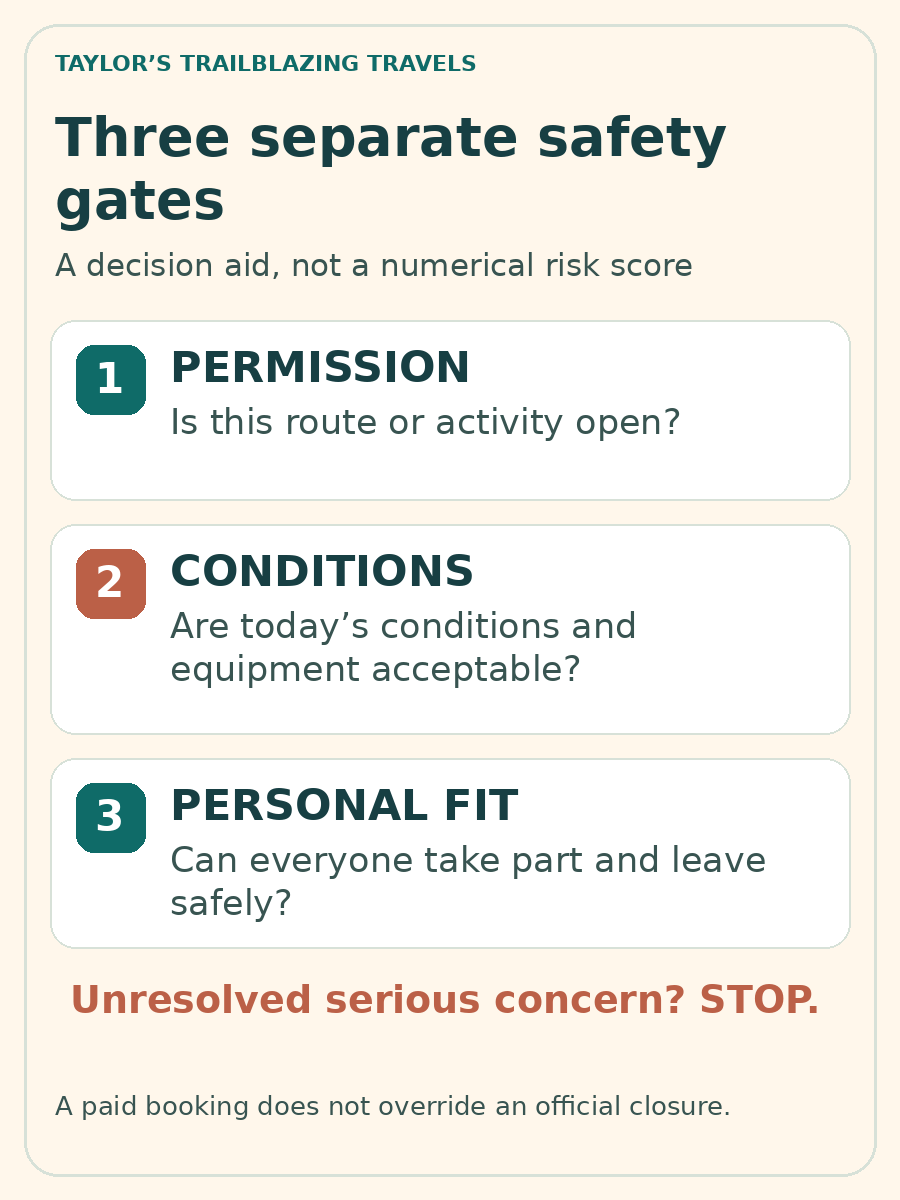
Use three separate gates before an exposed activity. First ask whether it is permitted; next whether today’s conditions and the provider are acceptable; finally whether it suits your party. A negative answer at the first gate ends the decision. A reassuring answer at the first does not automatically pass the other two.
| Gate | Question to answer | Change the plan when… |
|---|---|---|
| Permission | Is the trail, landing place or activity currently open? | An authority has closed it, restricted access or ordered evacuation. |
| Conditions | What is happening along this actual route? | The forecast, equipment or operator’s explanation leaves an important concern unresolved. |
| Personal fit | Can everyone participate and leave safely? | A child cannot use the available life jacket, a traveller cannot manage boarding, or the party lacks the required skills. |
This is an editorial decision aid, not a probability calculator. It deliberately gives no numerical safety score: several minor positives cannot cancel one serious problem. Apply it again when a departure time, weather forecast or vehicle changes, rather than treating yesterday’s decision as permanent.
For example, suppose a family has already paid for an island excursion. The weather is unsettled and the operator cannot confirm a suitable child’s life jacket. The useful action is to resolve the equipment question or choose another day, not to argue that the ticket must be used. Money already spent should not become the deciding safety criterion.
Volcanoes: check the restriction, not just the view
FCDO’s guidance changed in September 2026: it no longer automatically advises against all travel around Indonesian volcanic eruptions. Local exclusion zones and evacuation instructions remain critical. Eruptions can occur without warning; ash and debris effects can extend beyond a simple circle drawn around a summit. [1][3]
Use MAGMA Indonesia, the Indonesian geological authority’s portal linked by FCDO, to look for the relevant volcano’s latest bulletin. Ask the accommodation or a qualified local guide to help interpret Indonesian-language restrictions. Confirm the bulletin date, the named slopes or valleys and the exact trail you intend to use. A screenshot without a date is not a useful clearance. [3]
Questions worth asking a hiking operator
Request the route name, current access authority, turnaround arrangements and response to deteriorating conditions. Also ask about fitness demands, weather exposure and the equipment supplied. These questions are a purchasing checklist, not a substitute for an official bulletin. A guide who promises to bypass a closure is not offering a special advantage.
Keep the volcano outing separate from a must-catch onward journey. A cancelled hike need not spoil a holiday when a town, food or museum day can replace it. Conversely, a route built around one summit with no alternative turns a predictable planning uncertainty into pressure to continue.
Ash disruption and flights
Check the airline and departure airport directly when an eruption affects your route. Ash can disrupt airports away from the volcano itself. Do not assume that a clear sky at your hotel means the aircraft can operate, or buy a replacement flight until you understand the original airline’s options. [3]
Earthquakes and tsunami warnings: two different responses
During shaking, the standard protective action is to drop, cover and hold on. Indoors, stay inside rather than rushing down stairs or outside beneath falling material. Keep away from windows. For a wheelchair user, lock the wheels if possible and protect the head and neck; practise an accessible response with companions beforehand. [4]
Once shaking stops, the coastal decision is different. A strong or prolonged earthquake, an unusual sudden sea-level change or a loud ocean roar can be a natural tsunami warning. Move promptly to higher ground or inland along local evacuation routes; do not wait to photograph the sea or for a phone alert to confirm what you have experienced. Return only when authorities say it is safe. [5]

Make the accommodation answer practical
At check-in, ask which exit and assembly area to use, whether the building is within a tsunami evacuation area and where the nearest designated safe place is. Walk the beginning of the route in daylight when appropriate. A coloured sign is more useful when you know which junction it refers to.
Travellers with limited mobility should ask how the evacuation plan works without lifts and who can assist. Do not accept a generic statement that staff will help as a complete plan: identify the route, equipment and responsible person. A room with a convenient lift may still have an unsuitable emergency exit.
Keep shoes, a small torch, necessary medicines and your phone accessible overnight. The purpose is to avoid searching in darkness, not to delay evacuation while collecting luggage. Agree a meeting point with companions and a contact outside the immediate area who can relay messages.
Sea conditions, ferries and the decision to board
BMKG’s marine service provides information by waters, ports and sailing routes, as well as high-wave warnings. Look at the crossing, not just a weather icon for the resort. Ask the operator which forecast and port instructions govern the departure and what happens if conditions change before the return. [6]
Australia’s Smartraveller warns that Indonesian boat safety and maintenance standards vary. Check the actual vessel, usable life jackets and loading arrangements rather than relying on a familiar booking platform or attractive photographs. For children, confirm the correct life-jacket fit before departure. [7]
| Before paying | At the pier | Before the return |
|---|---|---|
| Identify the operator, landing place, inclusions and cancellation terms. | Check the boat supplied, boarding method, life jackets and any obvious crowding. | Recheck conditions and the confirmed return arrangements. |
| Ask about steps, wet boarding and luggage handling. | Raise concerns before luggage is stowed and boarding pressure builds. | Keep enough flexibility to remain ashore if necessary. |
| Separate an onward flight from a weather-sensitive crossing. | Do not treat other passengers boarding as evidence of safety. | Contact accommodation and airline early if plans change. |
A booking service can help compare commercial details, but cannot decide whether you should board a particular boat. For the Sanur-Nusa Penida route, compare ferry listings on 12Go and read the named operator’s conditions separately. The comparison page is not a vessel inspection or a guarantee that a sailing will operate. [8]
Swimming is a separate decision
Being comfortable on a boat does not establish that a beach is suitable for swimming. Ask about local currents, follow posted restrictions and lifeguard advice, and do not enter water simply because other visitors are doing so. Smartraveller warns about dangerous currents and limited lifeguard provision at some beaches. [7]
A calm-looking photograph is a poor basis for choosing where to swim. Prefer a clearly supervised location where you can obtain a current explanation of conditions. Never turn a closed swimming area into an improvised snorkelling outing.
Build a disruption buffer that is actually usable
An extra night is not a guarantee against a lengthy closure. It is a way to reduce the consequences of ordinary delays. For a weather-sensitive island visit, consider returning to the island or mainland with your departure airport before the final flight day. This is a conservative planning preference, not a universal minimum connection rule.
Here is a transparent example. A traveller has a Tuesday international departure and initially plans an island ferry on Tuesday morning. Moving the ferry to Monday creates one overnight opportunity to deal with a cancellation, but a multi-day closure could still defeat the plan. A flexible hotel and access to emergency funds make the buffer useful; a rigid chain of prepaid commitments can remove much of its value.
Use the site’s Itinerary Pace Checker to spot an overloaded sequence of travel days. Its planning prompts do not validate weather, timetables or minimum airline connections. Check those separately.
Match insurance to the activity
Ask the insurer about the actual activities and arrangements: hiking altitude, guided versus unguided trips, riding as a passenger, diving qualifications and disruption cover. Read the wording and keep the written answer. Insurance is a way of managing some financial consequences, not permission to ignore a warning. FCDO says insurance should cover your itinerary, planned activities and emergency expenses. [1]
Before hiring a scooter or motorcycle, confirm the licence category and insurance. FCDO says a UK licence alone is not enough to drive in Indonesia and highlights serious motorbike accidents. A familiar bicycle habit is not a substitute for motorcycle training. Choosing a car with a driver can avoid taking on an unfamiliar riding task. [3]
Scams: remove urgency from the transaction
Bank Indonesia requires authorised money changers to display their licensing information. Check the business identity, confirm the total rupiah you will receive and count it before leaving. A superficially attractive rate is not worthwhile if the exchange becomes confusing or you are pressed to move away before checking. [9]
For card problems, contact the issuer through your banking app or the number on your card, not a number stuck beside an ATM. Keep your card in sight. FCDO specifically warns about fraudulent ATM contact numbers and card fraud. [3]
A repeatable pause-check-pay method
Pause when a stranger introduces unexpected urgency: an attraction is supposedly closed, a payment must move to an unfamiliar account, or a replacement driver arrives without explanation. Check with the business using the contact details you already have. Pay only when the identity, service and amount match your understanding.
For a prearranged transfer, compare the vehicle and driver with the booking details and resolve a mismatch before getting in. This is basic identity checking, not an assumption that all informal transport is fraudulent. A genuine change can happen; it should still be explainable through the original provider.
Do not physically challenge someone over a disputed charge. Move to a staffed public place, keep receipts or screenshots when safe and ask your accommodation or the appropriate authority for assistance. Recovering a small amount of money is not worth escalating a threatening situation.
Drinks deserve separate care. Smartraveller reports methanol poisoning and drink-spiking incidents. Do not leave drinks unattended; seek urgent medical attention if contamination is suspected rather than waiting for symptoms to pass. [7]
Prepare an offline help plan
Save the accommodation address, insurer’s emergency contact, transport bookings and a trusted contact somewhere accessible without mobile data. Keep a paper version of essential numbers separate from your phone. Decide how companions will meet if their devices fail.
FCDO lists 118 for ambulance assistance, 110 for police and 112 for fire services in Indonesia. Confirm local assistance arrangements with your accommodation, particularly away from major centres. An emergency number is not a promise of English-language support or a particular response time. [10]
A mobile data plan is useful for checking alerts and contacting providers, but it cannot guarantee coverage during an outage. An eSIM-capable, unlocked-phone user can browse Airalo and select Indonesia; compare the supported network, validity and whether voice calls are included before buying. A data-only plan is not a substitute for an ordinary telephone service. [11]
Before heading to less familiar regions, read the separate FCDO regional risks page. Conditions in one province should not be inferred from a successful holiday in another. [2] Avoid demonstrations rather than incorporating them into sightseeing. [3]
Questions that change the plan
Should I cancel Indonesia because there are active volcanoes?
A country-wide yes or no would be misleading. Identify the actual destinations and activities, read the latest official advice and discuss relevant cover with your insurer. A closed hiking route may justify replacing that excursion; a wider warning or transport disruption may require a larger change.
Does a successful online booking mean a ferry is authorised to sail?
No. A reservation establishes a commercial booking, not the day’s weather, port clearance or equipment condition. Recheck before departure and make your own boarding decision using current information.
Is one spare night enough before flying home?
It reduces one kind of timing pressure but cannot cover every closure. Choose a buffer based on the consequences of missing the flight, the crossing’s flexibility and your ability to remain in place. Travellers unable to extend a trip may need to remove the final island stay entirely.
What should I do after making a payment to a suspected scammer?
Contact your bank or payment provider through an independently verified channel promptly, preserve the transaction details and seek local assistance when a crime may have occurred. Do not pay an additional supposed recovery agent merely because they promise to retrieve the first payment.
The final decision
Choose the itinerary you can change. Keep one clear rule: unresolved concerns about permission, equipment or personal suitability mean pause, not proceed. Pair current official information with an ordinary offline plan, and allow a missed excursion to remain a missed excursion rather than become a larger emergency.
Sources and editorial approach
This research-led guide combines official travel advice and hazard guidance with an original decision framework. It is not a live warning service, route inspection or individual medical assessment. Recheck official alerts and local instructions before exposed activities.
Independent editorial review: 2 November 2026. Selected official and operator information was rechecked; prices, conditions and links can change, so confirm key details with the provider before travel.
- FCDO – Indonesia warnings and insurance
- FCDO – Regional risks
- FCDO – Safety and security
- CDC – Safety during an earthquake
- US National Weather Service – Tsunami alerts and natural warnings
- BMKG – Marine forecasts and warnings
- Australian Department of Foreign Affairs and Trade – Indonesia advice
- 12Go – Sanur to Nusa Penida comparison listings
- Bank Indonesia – Requirements for non-bank money changers
- FCDO – Getting help in Indonesia
- Airalo – Indonesia eSIM package information
Illustrations in this article were created for Taylor’s Trailblazing Travels. Third-party photographs, where used, are credited beside the image or in the source list.