10 Days in Japan: Tokyo, Kyoto and Osaka Without Rushing
A three-city first trip with nine hotel nights, two sensible moves and afternoons you can leave open.
- 10 calendar days · 9 nights
- Tokyo 4 · Kyoto 3 · Osaka 2
- One long rail journey
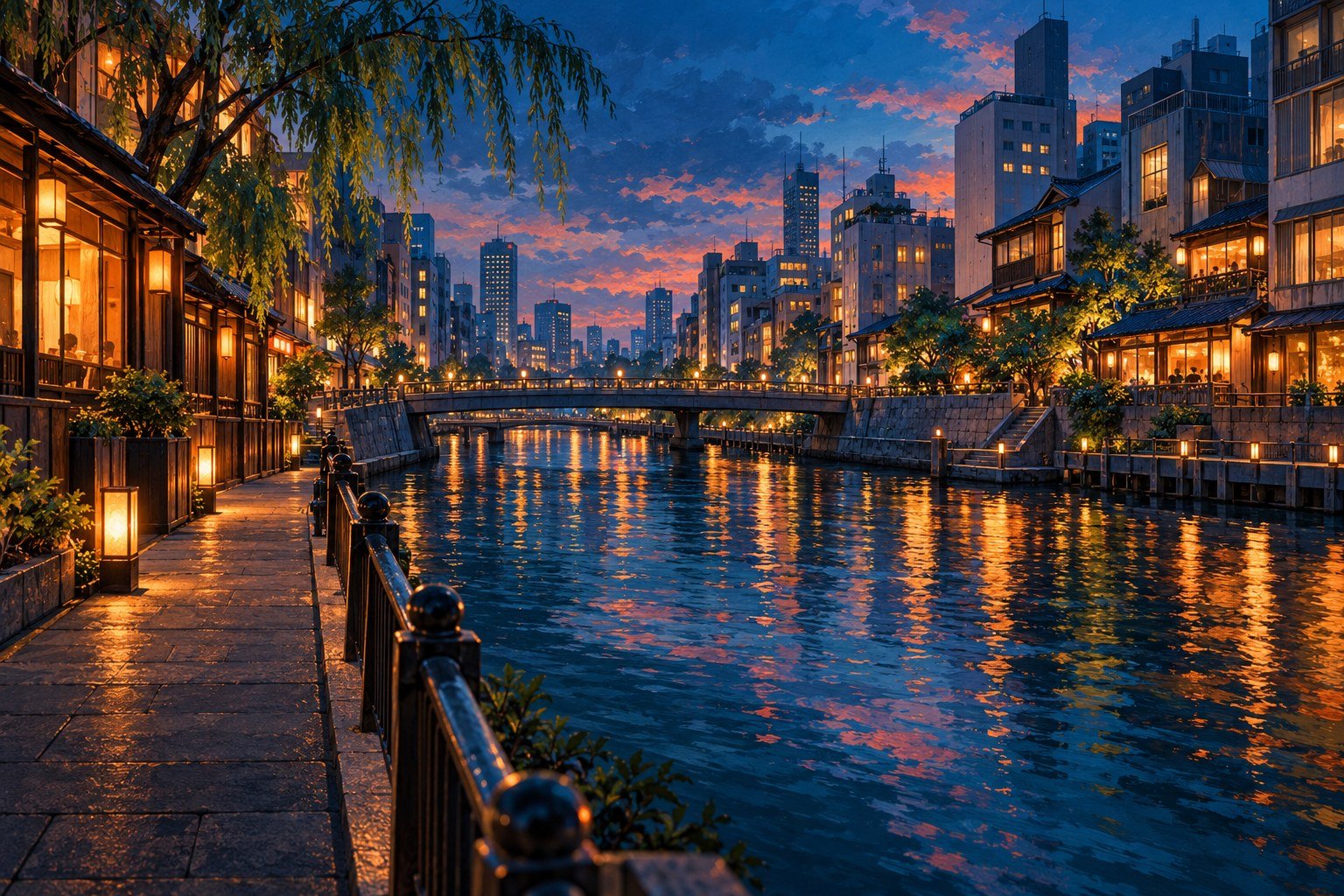
AI-generated editorial illustration inspired by Osaka’s waterways; an imagined canal scene, not a photograph of a verified viewpoint.
Ten days in Japan can give Tokyo, Kyoto and Osaka a fair share of your attention. Spend the first four nights in Tokyo, move to Kyoto for three, then finish with two Osaka nights before flying from Kansai. The extra Tokyo day and two deliberately loose afternoons make the route adaptable when the weather changes or a neighbourhood deserves longer.
This is a researched itinerary for a first visit with moderate walking, casual food stops and a small number of booked experiences. It counts arrival and departure within the ten days. Use the broader Japan guide for first-time visitors alongside it for the countrywide planning decisions.
Arrival and departure are inside the ten days. Osaka gets one full day plus the afternoon after moving.
Tokyo for contrasting neighbourhoods, Kyoto for cultural sights, Osaka for a food-focused finish.
Leave Day 4 and Day 7 afternoons open for rest, a missed priority or weather changes.
Extra towns and theme parks replace a planned day. They do not fit harmlessly between these stops.
The route for 10 days in Japan
The core plan assumes a Tokyo airport arrival and Kansai Airport departure. Check the actual flight dates: a UK departure the previous day does not create another sightseeing day in Japan. The three stays total nine nights, and the two moving days remain lighter than the full days around them.
| Day | Focus | Overnight base |
|---|---|---|
| 1 | Tokyo arrival and a neighbourhood dinner | Tokyo · night 1 |
| 2 | Asakusa and an eastern-Tokyo choice | Tokyo · night 2 |
| 3 | Meiji Jingu, Harajuku and Shibuya | Tokyo · night 3 |
| 4 | Tsukiji and Ginza; free afternoon | Tokyo · night 4 |
| 5 | Shinkansen to Kyoto; optional Fushimi Inari | Kyoto · night 1 |
| 6 | Kiyomizu-dera and southern Higashiyama | Kyoto · night 2 |
| 7 | Arashiyama; free afternoon | Kyoto · night 3 |
| 8 | Move to Osaka; Namba and Dotonbori | Osaka · night 1 |
| 9 | Osaka Castle or an art-museum day; dinner | Osaka · night 2 |
| 10 | Kansai Airport transfer and departure | No hotel night included |
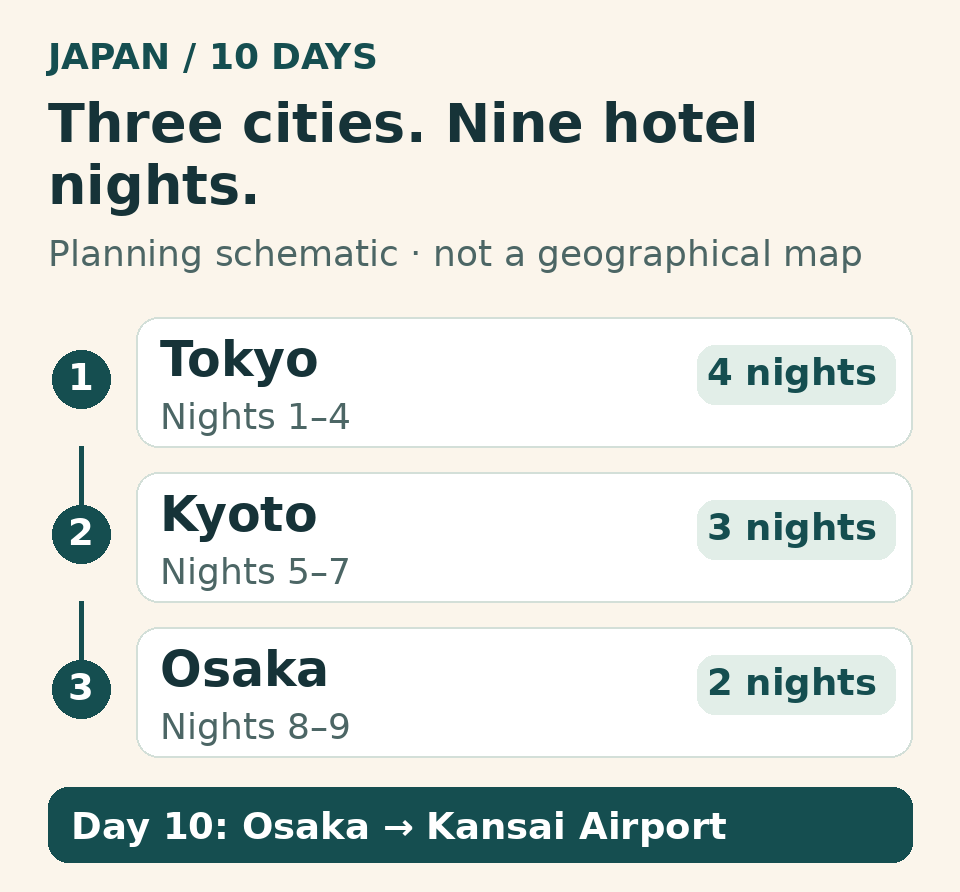
The organising rule is one main geographical area at a time, plus a clear stopping point. Tokyo and Kyoto each have an afternoon that can stay empty. Reserve a meal or experience when it matters to you, but leave enough freedom to move an outdoor morning if rain or fatigue intervenes.
If the available holiday length is still unsettled, the separate guide to how many days you need in Japan can help with that decision. This page is the operational plan once ten days is the constraint.
Days 1–4: use Tokyo’s extra day well
Day 1: settle into one neighbourhood
After arrival, reach the hotel, get oriented and choose dinner within an easy walk. Save a screenshot of your airport route and the hotel’s Japanese address before the flight. A morning landing may leave a few usable hours, but baggage collection, the journey into the city and room availability vary.
Keep this evening free of paid commitments. If you are awake enough, locate your nearest station entrance, buy a drink and enjoy the immediate streets. That makes tomorrow’s start easier without asking the first day to carry the sightseeing schedule.
Day 2: Asakusa, then time for one interest
Start with Senso-ji and Asakusa’s surrounding streets. After lunch, choose the park and market area around Ueno, a museum, or a gentler riverside afternoon. Tokyo’s official guide groups Asakusa and Ueno in the east and treats Meiji Jingu, Harajuku and Shibuya as a separate western cluster. [2]
Art and history enthusiasts can make the Tokyo National Museum the afternoon’s main event. Its collections and exhibition calendar deserve more than a hurried stop; check the opening day and relevant ticket before going. [3] If shopping is your preference, swap the museum for the Ueno area and leave the evening unstructured. There is no need to do both.
Day 3: a western-Tokyo day with a long lunch
Spend the morning at Meiji Jingu and around Harajuku, then take a proper seated lunch break. Move to Shibuya for your later afternoon and dinner. This combines woodland shrine surroundings, shops and the contemporary city without crossing Tokyo repeatedly. [2]
Choose how you want to use Shibuya: browsing, a booked skyline view, or simply the crossing and somewhere to eat. If you book an observation deck, allow space around the time slot and consider whether poor visibility would still make the visit worthwhile. Keep late-night plans optional rather than assuming everyone will want a long evening after a full walking day.
Day 4: Tsukiji, Ginza and an unclaimed afternoon
Visit Tsukiji Outer Market for breakfast or an early lunch, then browse nearby Ginza. The Outer Market remains a food-shopping and dining district; the central wholesale market and its auctions moved elsewhere. Use the market’s own calendar and shop information when choosing your visit time. [4]
Protect the afternoon. It can absorb a museum displaced by a closing day, shopping you enjoyed enough to revisit, laundry or a hotel break. If a theme park is a major reason for your trip, replace all of Day 4 with it and recognise that this removes your flexible Tokyo day. Avoid adding a distant excursion while keeping the market morning on paper.
Day 5: move to Kyoto and keep the afternoon light
Take a late-morning Tokaido Shinkansen from Tokyo or Shinagawa to Kyoto. The Nozomi journey from Tokyo Station is approximately 130 minutes according to Kyoto’s official access guide. [1] Budget about four hours for the whole move: 40 minutes to check out and reach the station, 30 minutes for boarding preparation, 130 minutes on the train and 40 minutes to reach the Kyoto hotel. Those added margins are planning estimates; a complicated hotel approach or assistance arrangements may need longer.
Book through JR Central’s official reservation route, or compare Tokyo–Kyoto options on 12Go. Its route page includes rail and other transport, so compare the correct mode, stations, seat type, ticket-collection arrangements and final price. An overnight bus is a different pacing choice, not an equivalent drop-in replacement for this restful daytime move. [5]
Leave your bags at the hotel if the room is not ready. If you feel comfortable and the day is running to plan, visit the main precinct and lower torii paths of Fushimi Inari. Kyoto’s official transport guidance recommends the JR Nara Line from Kyoto Station to Inari; check that your train calls there. [6] Set a turn-back point before the climb becomes your afternoon’s main undertaking.
Otherwise, have lunch and a local walk, then save Fushimi Inari for the open portion of Day 7. This is one reason for leaving that gap: a delayed journey need not trigger a chain of missed reservations.
Days 6–7: Kyoto in two geographical groups
Day 6: eastern Kyoto, at your own pace
Use Kiyomizu-dera as the morning’s main visit, then work through the southern Higashiyama streets towards lunch and, if you want, Gion. Check the temple’s current opening details before choosing your start. The surrounding slopes, steps and busy narrow streets make a leisurely route more useful than a long list of individual photo stops. [7]
Choose one extra interest: a tea session, a craft shop, a garden or a longer lunch. A booked experience should replace some free wandering. This is already a cultural day; adding several temples in other parts of Kyoto would repeat the theme while increasing travel.
In Gion, observe local signs and stay out of restricted or private lanes. Kyoto’s current visitor guidance asks people not to follow, touch or photograph geiko and maiko without permission, and to avoid blocking streets. [8] Plan an ordinary dinner and enjoy the area respectfully, without making an encounter with someone at work the purpose of the evening.
Day 7: Arashiyama, then a genuine choice
Start in the Saga–Arashiyama area, keeping the bamboo grove and Togetsukyo riverside together. The official area guide highlights both and acknowledges how busy the popular spots become. [9] A half-day allows travel, walking, stops and lunch. Add one garden only if you want more time here; the scenic train and boat are separate activities needing their own planning.
Return to central Kyoto with the afternoon still usable. You can rest, recover the missed Fushimi Inari visit or pursue a particular cultural interest. Avoid a compulsory late-afternoon attraction: this space keeps the itinerary comfortable for travellers whose interests or walking speeds differ.
Days 8–10: an easy Osaka finish
Day 8: change hotels, then explore Namba
After breakfast, move from Kyoto to Osaka. A JR Special Rapid takes approximately 30 minutes between Kyoto Station and Osaka Station. That is the station journey, not a complete hotel transfer. [1] Allow around two hours for checkout, station approaches, the train and bag drop; room access may still wait until the hotel’s check-in time.
Osaka Station, Shin-Osaka and the different Namba stations are distinct. Select the railway around your actual hotel: the JR Special Rapid suits Kyoto Station to Osaka/Umeda, while a downtown Kyoto departure may make another operator more convenient. There is little reason to choose the Shinkansen simply for its shorter headline ride if it leaves you at the wrong station.
Keep the afternoon around Namba and Dotonbori, with a café break and dinner. Dotonbori’s riverwalk is accessible from the Namba station area, making it a useful evening focus rather than another cross-city journey. [10] Two Osaka nights give you this arrival afternoon and one complete day; they are not two full sightseeing days.
Day 9: one main outing and a food-focused evening
Choose Osaka Castle and its park as the daytime anchor if history and an outdoor walk appeal. The current main tower is a twentieth-century reconstruction containing a museum, rather than an intact sixteenth-century interior. Osaka’s official tourism page lists adult admission at ¥1,200 when checked on 18 October 2026; confirm current opening and entry details before visiting. [11] Allow for the approach through the grounds, and leave the later afternoon light.
For an art-centred or wet-weather alternative, choose an exhibition at the Nakanoshima Museum of Art and arrange lunch around that visit. Check the exhibition calendar and its specific admission arrangements; do not assume every gallery or display is available every day. [12]
If help choosing food and understanding the area would improve the evening, consider the Dotonbori and Namba walking or food-tour options on GetYourGuide. DeepExperience lists different walking, street-food and ramen options, so check the selected option’s duration, meeting point and included food. Its current page says vegan and gluten-free requests cannot be accommodated. This is an optional guided evening, replacing an independently organised dinner, and needs an additional budget. [13]
Day 10: depart from Kansai Airport
From a Namba base, Nankai trains provide the direct airport connection; Rapi:t is the reserved-seat limited express, with a separate limited-express ticket required as well as the normal fare. The fastest advertised journey is 34 minutes, which should not be used as a hotel-to-terminal allowance. [14]
Choose a real departure, then add getting to the correct station, reaching the terminal and your airline’s required check-in margin. A very early flight may justify replacing the final Osaka night with an airport-area hotel. Leave airport day clear even if a late departure appears to allow one last excursion.
Hotel bases, rail tickets and luggage
Choose a base that supports the evenings
| City | Useful area decision | Check before booking |
|---|---|---|
| Tokyo · 4 nights | Tokyo Station or nearby central connections for the Kyoto train; Ueno for the east; Shinjuku for dining and evening energy | Airport route, the actual station entrance, room size and how quiet the room will be |
| Kyoto · 3 nights | Kyoto Station for easy moves; Shijo/Karasuma for a central base with evening options | Route to your chosen sights and whether luggage can be held before check-in |
| Osaka · 2 nights | Namba for the planned food evenings and Nankai airport connection; Osaka/Umeda for an easy JR arrival | Which of Osaka’s similarly named stations your route actually uses |
Check Tokyo rooms on Booking.com against the first four nights, then compare Kyoto stays on Agoda for the next three. For the final two nights, use the map on Booking.com’s Osaka accommodation search to compare Namba with Osaka/Umeda. These links open city searches; enter your own dates and compare the total cost, room type, taxes and cancellation terms.
A national rail pass is not the default purchase
There is one long Shinkansen journey in this plan and one short regional move. Add their actual fares and the eligible local travel before evaluating a pass. The official adult Ordinary seven-day Japan Rail Pass costs ¥50,000 online or ¥53,000 through overseas JR-designated agencies at the 18 October 2026 check. Nozomi journeys need an additional pass-holder ticket. [15] For this exact route, individual tickets are the sensible starting point.
Measure suitcases before reserving the Shinkansen. More than 160 cm and up to 250 cm in combined length, width and height requires a seat with an oversized baggage area on the Tokaido route. The storage-space reservation is part of choosing the right seat, and current trial deck storage does not exempt oversized bags. [16] Confirm luggage-holding arrangements with each hotel and keep the shorter Kyoto–Osaka move outside the busiest commuter period where possible.
What this nine-night trip could cost
This original model uses Japanese yen per adult, with two adults sharing one private room. It was reviewed on 18 October 2026 and assumes moderate hotel spending, ordinary reserved rail, casual meals and selected paid sights. These are budget inputs, not advertised room offers or guaranteed ticket prices. International flights are separate.
| Item | Calculation or assumption | JPY |
|---|---|---|
| Tokyo hotel share | 4 nights × ¥18,000 per room ÷ 2 | 36,000 |
| Kyoto hotel share | 3 nights × ¥20,000 per room ÷ 2 | 30,000 |
| Osaka hotel share | 2 nights × ¥16,000 per room ÷ 2 | 16,000 |
| Meals and non-alcoholic drinks | 10 days × ¥4,500 | 45,000 |
| Tokyo–Kyoto train | Planning allowance | 15,000 |
| Kyoto–Osaka move | Planning allowance | 1,000 |
| Local transport | 10 days × ¥900 | 9,000 |
| Airport connections | Both ends combined | 6,000 |
| Admissions | Ordinary sights; premium experiences extra | 8,000 |
| Accommodation-tax reserve | Check each hotel’s treatment | 2,500 |
| Mobile data | Planning allowance | 2,500 |
| Subtotal | All items above | 171,000 |
| Contingency | 10% of subtotal | 17,100 |
| Total | Round to about ¥190,000 for planning | 188,100 |
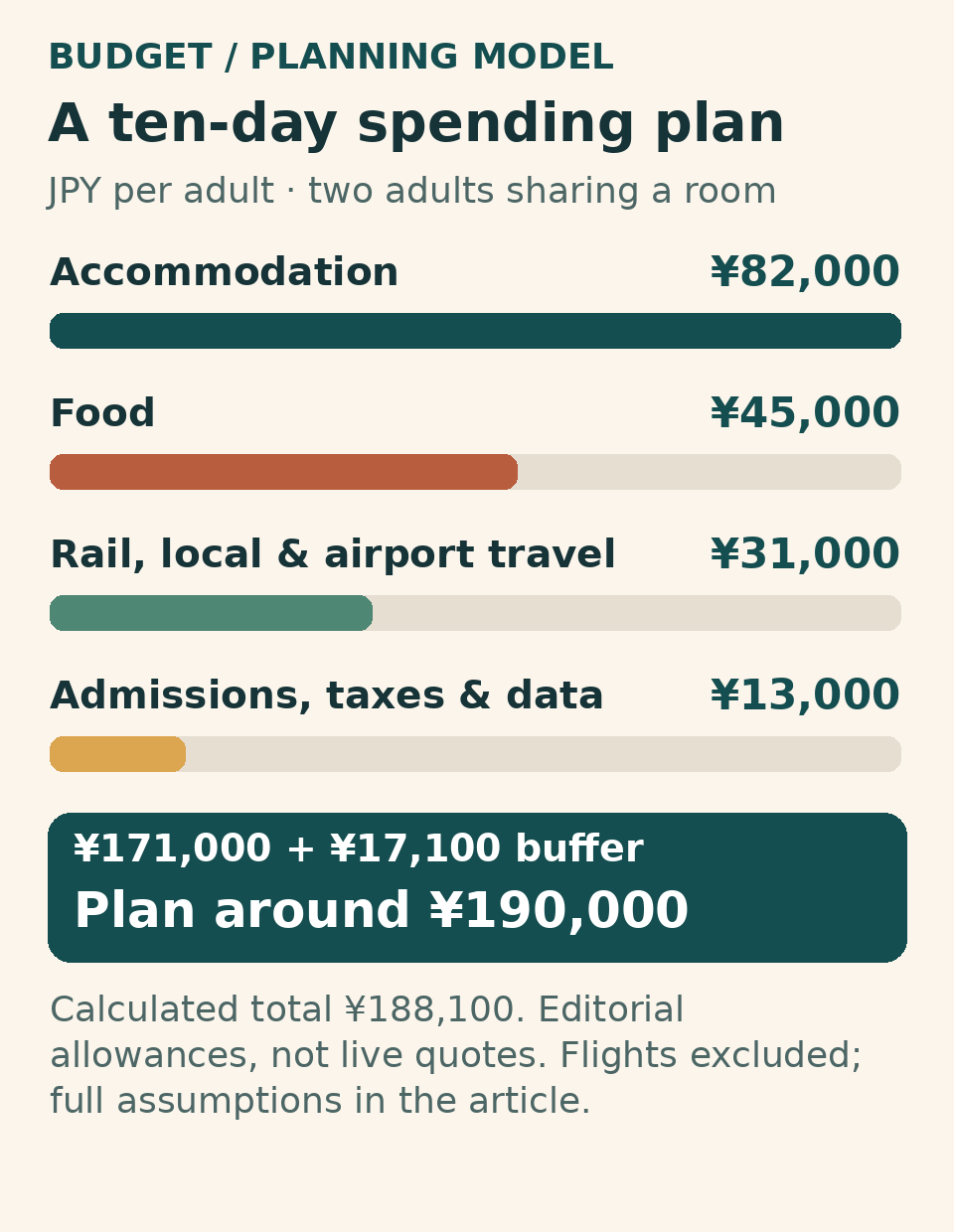
The exact two-adult total is ¥376,200; rounding gives about ¥380,000 before international flights. Insurance, shopping, alcoholic drinks, guided tours, theme parks, premium ticketed experiences and paid luggage delivery need their own lines. If you book a food tour, add its price and remove only the ordinary meal spending that it genuinely replaces.
At the assumed Kyoto rate, the room share is ¥10,000 per person per night. Under the accommodation-tax bands effective from 1 March 2026, that implies ¥400 a night, or ¥1,200 for the three-night stay. The larger ¥2,500 reserve allows for charges across the trip; replace it with the actual amounts, taking care not to count a tax twice if the hotel already includes it. [17]
Room prices have the biggest impact on this model. A ¥5,000 increase per room per night adds ¥22,500 per adult before contingency: nine nights × ¥5,000 ÷ two. A solo traveller using the same rooms adds ¥82,000 to the subtotal. Search real dates before deciding the budget is sufficient, especially when holiday-period or seasonal room quotes differ sharply from the allowances.
For a wider look at flights and spending styles, use the Japan trip-cost guide for UK travellers. Keep this page’s nine-night calculation separate when comparing totals.
Adapt the route while keeping its pace
If both flights use Tokyo
Keep Tokyo’s initial four nights and Kyoto’s three, then stay one Osaka night and one final Tokyo night. Day 9 becomes the Osaka–Tokyo rail move, replacing the Osaka Castle or museum day. Budget the second long-distance ticket and the extra hotel change. An alternative is to remove the Osaka overnight stay and devote more time to Kyoto, but either version needs a protected final-night location for the flight.
If you want only two hotels
Four nights in Tokyo and five in Kyoto remove a hotel move. Osaka then becomes a day trip replacing one Kyoto day, with the corresponding return travel and an evening journey back. Choose this version when unpacking less matters more than staying out in Osaka. For the main plan, two Osaka nights buy that different evening experience and a simpler Namba-based airport finish.
When weather or walking changes the day
Move outdoor Tokyo activities around the open afternoon and museum calendars. In Kyoto, the Railway Museum is a practical indoor replacement for an Arashiyama outing if you enjoy trains; its regular Wednesday closure has calendar exceptions, so check first. [18] In Osaka, keep the castle and Nakanoshima alternatives as choices rather than doing both to catch up.
For hot days, prioritise an earlier outdoor start, lunch indoors and a shorter afternoon. For reduced mobility, choose step-free station approaches and ask the relevant attraction about its specific route. Kiyomizu-dera provides a wheelchair-access map and a different approach, while the usual Higashiyama street walk includes steps and slopes. [7] The time estimates here are not an accessibility assessment; build the schedule around your own access needs.
Confirm the essentials, then stop adding bookings
Book flights and the nine hotel nights before the optional experiences. Next, reserve the Shinkansen with the right baggage or assistance arrangements, and add the cultural or food experience that matters most. Check the Japan entry guide for British travellers alongside the current official rules before travel.
For maps, translation and tickets away from hotel Wi-Fi, compare your mobile provider’s roaming with a suitable data option. You can browse Airalo and choose a Japan plan; select validity covering all ten days and check when it starts. Airalo requires an eSIM-compatible, unlocked device. Review the actual data allowance, calling provision and activation terms, and save key travel details offline. [19] [20]
Finally, enter Tokyo four nights, Kyoto three and Osaka two in the Trip Itinerary Planner. Save or print the editable plan with the flexible afternoons still visible. Recheck operator timetables independently once the dates are fixed.
Questions before you book
Can Nara fit into these ten days?
Yes, as a replacement for Day 9’s Osaka sightseeing, with an earlier start and a return to Osaka that evening. That changes the balance: you gain a separate cultural outing and lose most of your complete Osaka day. Keep the original plan if the purpose of the Osaka stay is to slow down and enjoy the city itself.
Is a Universal Studios Japan day compatible with this itinerary?
Use the whole of Day 9 and book the park arrangements appropriate to your priorities. Keep Day 8’s Dotonbori evening modest, and do not also promise yourself the castle or art museum. Add the actual admission, any chosen extras, park transport and meals to the budget; the sample admissions allowance is not intended to fund a theme-park day.
Can Osaka and Kyoto be reversed?
They can, but finishing in Kyoto gives you a longer airport approach on the last day. Keep the same night totals and check which hotel locations make the revised transfers sensible. The main order leaves the final stay close to the Osaka evening activities and the Namba airport railway.
How many experiences should be booked in advance?
Book the experiences with limited slots that are personal priorities, plus the essential rail and accommodation. There is no useful universal number. A museum visit, a walk and a dinner can fill a day without several timed reservations, and preserving the two open afternoons is central to this route’s pace.
Make the itinerary your own
Keep the four–three–two night split and give the loose afternoons a purpose: rest, curiosity or weather recovery. This produces a three-city trip with contrasting neighbourhoods, cultural sights and a relaxed Osaka finish. Once flights, practical hotel locations and the main rail journey are settled, the most valuable remaining choice is deciding what to leave flexible.
Sources and research
Research checked on 18 October 2026. The route and pacing choices are editorial planning recommendations. Journey estimates and cost allowances are identified where used; check current operators before booking.
- Kyoto Travel — Getting to Kyoto: Tokyo and Osaka rail connections.
- GO TOKYO — How to See the Best of Tokyo in 3 Days.
- Tokyo National Museum — Visitor information and opening calendar.
- Tsukiji Outer Market — Official market guide and calendar.
- 12Go — Tokyo to Kyoto transport comparison.
- Kyoto Travel — Comfortable access to Fushimi Inari Taisha.
- Kiyomizu-dera — Official FAQ and accessible routes.
- Kyoto Travel — Four Guidelines to Follow When Visiting Kyoto.
- Kyoto Travel — Saga and Arashiyama.
- Osaka Convention & Tourism Bureau — Tombori Riverwalk access.
- OSAKA-INFO — Osaka Castle Museum, history and admission.
- Nakanoshima Museum of Art — Exhibitions and visitor information.
- GetYourGuide / DeepExperience — Dotonbori and Namba tour options.
- Nankai Electric Railway — Limited Express Rapi:t.
- Japan Rail Pass — Official types and prices.
- JR Central — Current Shinkansen luggage information.
- Kyoto Travel — Accommodation tax from March 2026.
- Kyoto Railway Museum — Visitor information and opening calendar.
- Airalo — Device compatibility and network restrictions.
- Airalo — Japan eSIM plan information.
Illustrations in this article were created for Taylor’s Trailblazing Travels. Third-party photographs, where used, are credited beside the image or in the source list.