Bangkok day trips • 2026
12 Best Day Trips from Bangkok in 2026: Travel Times, Costs and Honest Comparisons
A practical comparison of historic capitals, railway and floating markets, national parks, cultural sites and easy local escapes.
Choose the day trip by its real payoff, not simply by how famous the destination sounds.
Bangkok is a strong base for far more than palaces, food streets and rooftop views. Within a long morning, travellers can reach a former royal capital, cycle through riverside greenery, watch a train edge through a working market or move from the city’s flyovers into national-park forest. The difficulty is not finding possible excursions. It is deciding which ones still feel worthwhile after Bangkok traffic, early starts, admission fees and the journey home are included.
This guide compares twelve of the best day trips from Bangkok. It does not pretend that Ayutthaya, Erawan Falls and Bang Krachao require the same effort. Instead, each section sets out the realistic travel load, likely planning cost, strongest reason to go and the point at which an organised tour, private driver or overnight stay becomes more sensible than independent travel.
Use it alongside the Bangkok travel guide when choosing a base, or the four-day Bangkok itinerary when deciding how many city days you can spare. A first visit usually benefits from one carefully chosen day trip rather than three dawn departures squeezed around Bangkok’s main sights.
Best overall
Ayutthaya
The strongest first choice for UNESCO-listed ruins, flexible transport and a full day that feels clearly different from Bangkok.
Easiest escape
Bang Krachao
A low-travel half-day of ferries, cycling and greenery when another dawn departure would weaken the holiday.
Best market route
Maeklong plus one floating market
Choose Damnoen Saduak for an early canal scene or Amphawa for a weekend afternoon and evening.
Best nature day
Khao Yai or Erawan
Khao Yai rewards guided wildlife interpretation; Erawan is the stronger choice when waterfalls and swimming matter most.
This guide was rechecked on 10 September 2026. The practical picture is stable, but the controlling source still matters: railway times can change, national-park access may be restricted by weather, and attraction pages do not always agree with one another.
| Planning point | What current official sources show | How to use it |
|---|---|---|
| Ayutthaya trains | The live 2026 State Railway timetable lists several ordinary and suburban journeys from Bangkok (Hua Lamphong), with many basic services taking roughly 1 hour 33 minutes to 1 hour 59 minutes.[1] | Check the exact departure station and return service for the travel date; the intercity fare is only one part of the day. |
| Maeklong train movements | The current Maeklong–Ban Laem timetable lists departures at 06:20, 09:00, 11:30 and 15:30.[6] | Build the market visit around a confirmed train movement and arrive early enough to follow staff instructions safely. |
| Hellfire Pass | The Australian Government lists free admission and daily hours of 09:00–16:00, with specified holiday closures and a variable annual maintenance closure in May.[11] | Treat Hellfire Pass as a focused outing from Kanchanaburi rather than a casual extra on an already long Bangkok day. |
| Sanctuary of Truth | The museum lists daytime ticket sales from 08:00 to 17:00, daytime tours from 08:20 to 18:00 and a 500 THB adult daytime admission.[12] | Check whether a tour includes the official ticket, local Pattaya transport and enough time for the scheduled visit. |
| Ancient City | The official ticket page shows 800 THB for a foreign adult and 400 THB for a child aged 6–14, while another official travel page still shows 700/350 THB.[13] | Use the higher figure as a planning allowance and confirm the live checkout because the museum’s own pages are inconsistent. |
What has not changed
Ayutthaya remains the best all-round first excursion. Khao Yai and Erawan still demand the greatest travel commitment, while Bang Krachao remains the easiest way to create contrast without surrendering a complete Bangkok day.
The ranges below are planning allowances, not guaranteed live quotations. They combine transport, basic admissions, food and ordinary local movement for one person unless a private-vehicle price is stated. A low independent cost can rise quickly when a taxi is needed at both ends, while a shared tour may look dearer but include the vehicle, guide and several difficult connections.
Major intercity and national-park day trips
| Day trip | Best for | Typical one-way load | Realistic day length | Planning cost | Best transport style |
|---|---|---|---|---|---|
| Ayutthaya | Ruins, history and first-time visitors | 1.25-2 hours | 9-12 hours | 700-2,800 THB per person | Train plus local transport, shared tour or private car |
| Maeklong + Damnoen Saduak | Railway market and canal-market atmosphere | 1.5-2 hours | 8-11 hours | 900-3,200 THB per person | Shared tour or private car |
| Maeklong + Amphawa | Weekend food, riverside evening and market contrast | 1.5-2 hours | 10-13 hours | 900-3,400 THB per person | Private car or weekend tour |
| Kanchanaburi | Wartime history and River Khwae context | 2.5-3.5 hours | 11-14 hours | 1,200-4,500 THB per person | Focused tour, excursion train or private car |
| Erawan Falls | Waterfalls, swimming and a demanding nature day | 3-4 hours | 12-15 hours | 1,500-4,800 THB per person | Shared tour or private car |
| Khao Yai | Forest, waterfalls and wildlife interpretation | 2.5-3.5 hours | 12-15 hours | 2,000-5,500 THB per person | Guided vehicle |
Coastal, cultural and lower-travel alternatives
| Day trip | Best for | Typical one-way load | Realistic day length | Planning cost | Best transport style |
|---|---|---|---|---|---|
| Pattaya + Sanctuary of Truth | Wood carving, architecture and one coastal stop | 2-3 hours | 11-14 hours | 1,800-5,000 THB per person | Bus plus local taxi, shared tour or private car |
| Ancient City + Erawan Museum | Thai architecture with a simpler transfer | 1-1.5 hours | 7-10 hours | 1,200-3,000 THB per person | BTS plus taxi or ride-hailing car |
| Nakhon Pathom | Temple, food and a lower-key local day | 1.25-2 hours | 7-10 hours | 500-1,800 THB per person | Train plus local taxi or private car |
| Nakhon Nayok | Reservoir scenery, seasonal waterfalls and road-based nature | 1.5-2.5 hours | 10-13 hours | 1,200-4,000 THB per person | Private car or small-group tour |
| Bang Krachao | Cycling, greenery and an easy half-day | 30-90 minutes | 4-7 hours | 300-1,200 THB per person | MRT/taxi, river crossing and bicycle |
| Ko Kret | Pottery, snacks and a weekend island walk | 1-2 hours | 5-8 hours | 400-1,500 THB per person | MRT/taxi plus ferry, or river excursion |
Fast recommendation
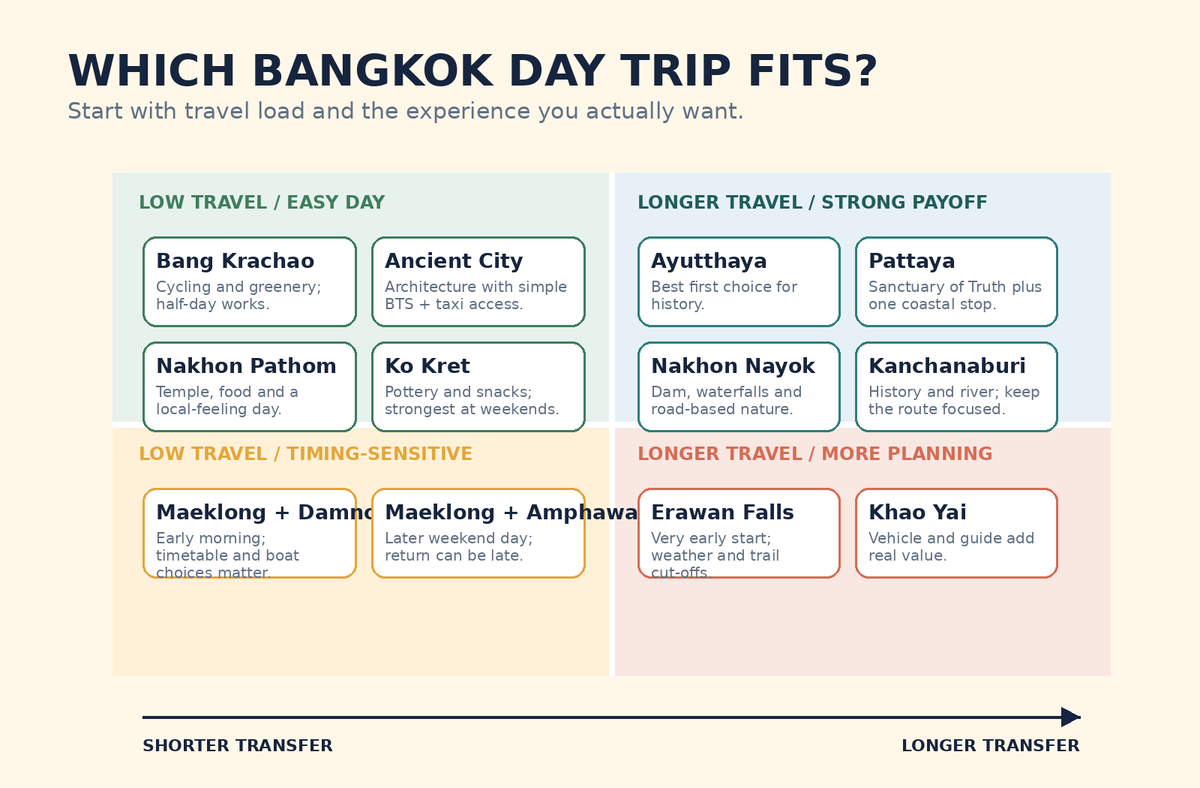
Choose Ayutthaya when you want one classic excursion and are unsure where to start. Choose Bang Krachao when the holiday already contains several long transfers. Choose Khao Yai or Erawan only when nature is important enough to justify a very early departure and a long return.
Compare the payoff with the door-to-door travel time
A place described as two hours from Bangkok may still consume four or five hours of the day. First, the traveller must reach the correct station, pier or pickup zone. Then there may be a wait, a highway stop, a transfer at the destination and a slower return through evening traffic. For that reason, the table uses a travel-load range rather than quoting only the fastest vehicle time shown on a map.
A practical ratio is one substantial experience for every two to three hours spent moving. Ayutthaya clears that test because the old city contains several major sites and a distinct historical landscape. Erawan can also clear it when the waterfall is the main reason for the day. By contrast, a rushed trip that combines Kanchanaburi town, Hellfire Pass and all seven Erawan tiers often turns into a series of vehicle windows and photo stops.
Pick one main purpose, not six unrelated stops
Day trips work best when they have a clear identity. A history day can link Ayutthaya’s central ruins with one riverside temple. Market-focused mornings can combine Damnoen Saduak and Maeklong because their timing and geography can work together. In Khao Yai, prioritise park interpretation, a short trail, one waterfall or viewpoint and patient wildlife searching rather than adding wineries, outlet shopping and a themed cafe.
This approach also helps when comparing tour descriptions. Count how many stops genuinely support the main purpose. A longer list is not automatically better. Extra attractions may reduce the time available at the place that made you book the trip in the first place.
Match the route to heat, walking ability and holiday pace
Ayutthaya’s exposed ruins can be tiring in midday heat. Erawan includes uneven steps and slippery sections. Bang Krachao is flat enough for many casual cyclists, although narrow raised paths require concentration. Ancient City covers a very large outdoor site, so visitors who dislike cycling should check the current tram, bicycle and internal-transport arrangements before arrival.
The surrounding holiday matters too. Someone following a busy two-week Thailand itinerary may gain more from a gentle local half-day than another 05:30 alarm. Conversely, a traveller spending six nights in Bangkok can justify one major history day and one shorter green escape without hollowing out the city itinerary.
Read the inclusions line by line
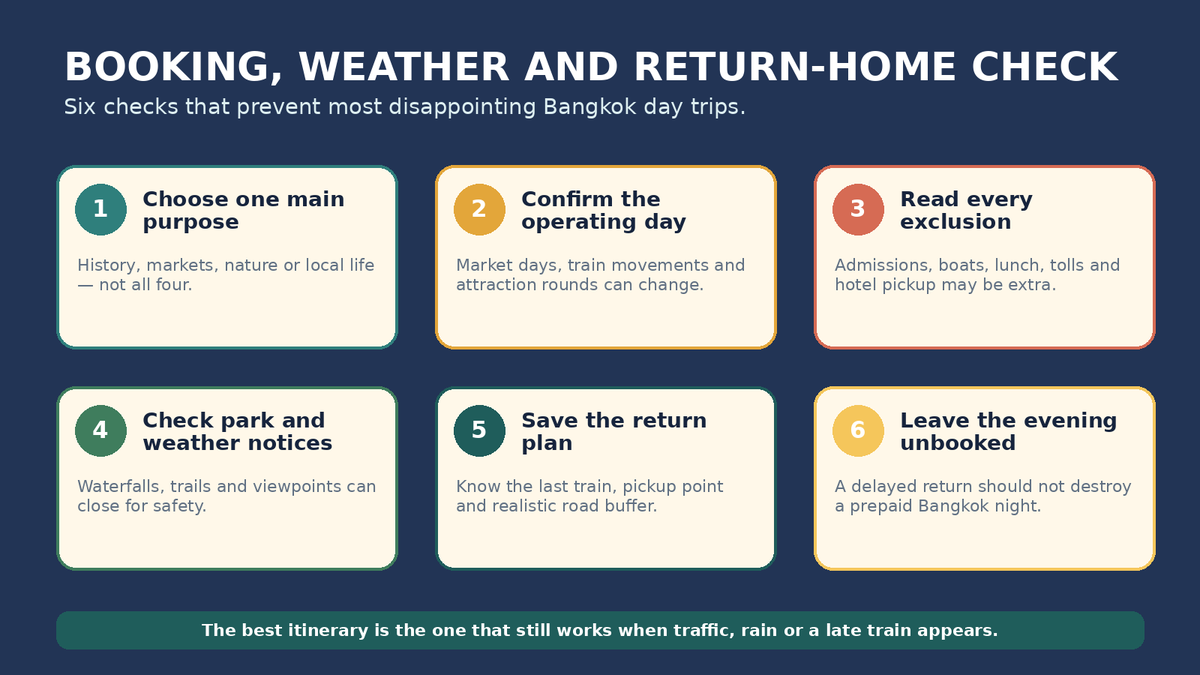
Tour prices are difficult to compare from the headline alone. One may include hotel pickup, guide, lunch, park admission and a boat ride. Another may cover only a seat in the vehicle. Check admissions, local boats, bicycle hire, lunch, tolls, pickup area, child pricing and the final drop-off point. For a private car, confirm whether the quote is per vehicle, how many hours are included and what happens when Bangkok traffic extends the day.
When an activity page says ‘free time’, find out how much time that actually means. Ninety minutes in Ayutthaya is very different from four hours. Likewise, a floating-market listing may include a shared motorboat through the canals but not a paddleboat among the stalls.
Confirm the operating day and the timetable-sensitive moment
Ko Kret and Amphawa are strongest on weekends, while individual shops, temples and local museums may keep their own days. Maeklong is particularly timing-sensitive because the spectacle depends on the train movement rather than the market merely being open. The State Railway of Thailand publishes timetable information, but services can change; recheck shortly before travel and allow time to be standing safely behind the marked line before the train arrives.
National parks create a different timing problem. Trails, waterfalls and viewpoints may close temporarily because of heavy rain, maintenance, wildlife activity or seasonal protection. The Department of National Parks publishes park pages and opening-closure data, yet a same-week park check remains sensible.
Protect the return journey before planning the outward one
The return is where many ambitious itineraries fail. A train, last local ferry or shared pickup is less forgiving than an outward taxi. Save the destination name in Thai, keep the driver’s number, screenshot the meeting point and know the fallback route. For a long road trip, do not reserve a non-refundable rooftop dinner or theatre ticket for the same evening.
Cancellation check before payment
Before paying, ask what happens if the park closes a trail, heavy rain makes a waterfall unsafe, the train timing changes or the attraction cannot be reached. Well-described alternatives are more valuable than a promise that every listed stop is guaranteed.
Why Ayutthaya earns the top position
Ayutthaya offers the clearest return on a full day outside Bangkok. The former Siamese capital has a recognisable landscape of brick prangs, monastery compounds and headless Buddha images rather than one isolated attraction. UNESCO inscribed the Historic City of Ayutthaya in 1991, and the scale of the old capital becomes easier to understand when several sites are visited in sequence rather than treated as separate photo stops.
It also suits different budgets. Independent travellers can use the railway and hire a bicycle, tuk-tuk or car locally. Shared tours simplify the transfer and often add a guide. A private driver gives the most control over heat breaks and the order of the ruins. This flexibility is why Ayutthaya works for a first Thailand trip, a repeat Bangkok stay and families who need a less rigid day.
A realistic one-day Ayutthaya route
Leave Bangkok around 07:00 and aim to be inside the old city by roughly 09:00. Start with Wat Mahathat before the busiest heat, then walk or ride the short distance to Wat Ratchaburana. Break for an early lunch and a long drink rather than trying to cover the central island continuously. In the afternoon, move to Wat Phra Si Sanphet and the former royal-palace area, then finish at riverside Wat Chaiwatthanaram when the light is softer.
Four substantial stops are enough. Adding Bang Pa-In Palace, a boat cruise, an elephant attraction and every famous ruin usually weakens the day. Wat Chaiwatthanaram is outside the central cluster, so it deserves a planned vehicle rather than being left as an optimistic final stop.
| Time | Suggested stop | Why it fits |
|---|---|---|
| 07:00 | Leave central Bangkok | Builds in time for station access or road traffic. |
| 09:00 | Wat Mahathat and Wat Ratchaburana | Two important sites in the same central area. |
| 12:00 | Lunch and shade | Avoids treating the hottest period as a race. |
| 13:30 | Wat Phra Si Sanphet area | Adds royal and ceremonial context. |
| 15:30 | Wat Chaiwatthanaram | A strong final site with a different riverside setting. |
| 18:30-20:00 | Return to Bangkok | Actual arrival depends heavily on transport and traffic. |
Train, shared tour or private car?
The official 2026 State Railway timetable shows several ordinary and suburban services between Bangkok and Ayutthaya, with many listed journeys taking around 90 minutes to two hours. The train can be inexpensive and atmospheric, but the timetable, Bangkok departure station and return service must be checked for the exact travel date. Once in Ayutthaya, allow a separate local-transport budget rather than assuming the monuments begin at the platform.
A shared tour is easier when a guide matters or when the traveller does not want to negotiate local transport. Private vehicles become good value for three or four people, especially if the group wants a slower lunch, a child seat or a specific final temple. For any road option, the final Bangkok drop-off time is an estimate rather than a fixed appointment.
Ayutthaya planning allowance
Allow roughly 700-1,600 THB per person for an independent day using public transport and local movement, or around 1,200-2,800 THB for many shared-tour formats. A private car commonly makes more sense as a per-vehicle calculation, with a broad 4,500-8,000 THB planning range before unusual extensions or premium inclusions.
Compare Ayutthaya transport and tours
Check the duration, number of ruins, admissions, lunch and Bangkok pickup area before choosing the cheapest headline price.
Why these two markets work together
Damnoen Saduak and Maeklong are often bundled because both sit southwest of Bangkok and reward an early start, yet they provide different experiences. Damnoen Saduak is a canal-market visit built around boats, waterside commerce and a busy visitor atmosphere. Maeklong is a functioning market where awnings and produce are pulled back as a train moves through the narrow track corridor.
The pairing works when the schedule follows the time-sensitive moments. Damnoen is strongest in the morning, while Maeklong must be planned around an actual train movement. A tour that reaches both places but misses the market’s train is not equivalent to one that allows a safe, unhurried viewing position.
Build the day around the train, not a vague market opening time
The State Railway of Thailand’s 2026 timetable lists Maeklong departures towards Ban Laem at 06:20, 09:00, 11:30 and 15:30. Arrival movements create additional viewing opportunities, but travellers should consult the current timetable in both directions rather than copying an old social-media graphic. Reach the track area early, stay behind staff instructions and never step forward for a photograph as the train approaches.
A sensible shared-tour pattern is hotel pickup around 06:00-06:30, Damnoen Saduak around 08:00, Maeklong around a later train movement, lunch or a salt-farm stop, then a return before the worst late-afternoon traffic. Exact order varies with the service chosen.
Boat prices and sales pressure
The canal experience can involve a shared motorboat, a slower paddleboat or simply walking along market edges. These are not interchangeable. Ask how long the boat ride lasts, whether it enters the busiest trading section, whether the price is per person or per boat, and whether the tour already includes it. Independent visitors should agree the complete price before boarding.
This is one of the more commercialised Bangkok day trips. That does not make it worthless, but it does mean the traveller should arrive with a clear purpose and feel comfortable declining purchases. A market visit should not become a sequence of commission-led stops that crowds out the actual canal and railway experience.
Keep expectations realistic
Damnoen Saduak is not a quiet undiscovered village. Choose it for the visual canal scene and early-morning activity. Travellers seeking a slower community atmosphere may prefer Amphawa later in the day or a smaller market on a separate route.
Compare railway-market and floating-market trips
Look for an exact train-viewing plan, clear boat inclusion and a realistic Bangkok return time.
How Amphawa differs from Damnoen Saduak
Amphawa creates a later, more food-focused day. Tourism Authority of Thailand material describes Damnoen as a morning market and Amphawa as an evening riverside experience. That contrast is useful: Maeklong can provide the railway-market moment earlier, while Amphawa offers wooden shopfronts, snacks, seafood and a slower waterside atmosphere as the day cools.
This combination is strongest on a Friday, Saturday or Sunday when Amphawa is active. On a weekday, a traveller may spend considerable time reaching a market that feels partially closed. Verify the current operating days before building flights or non-refundable transport around it.
A realistic weekend schedule
Leave Bangkok later than for Damnoen, but not so late that the road consumes the useful afternoon. One practical pattern is Maeklong around midday or early afternoon, a meal or nearby Samut Songkhram stop, then Amphawa from late afternoon into early evening. Return after dinner rather than promising yourself an early Bangkok night.
The trade-off is timing. Amphawa becomes more appealing as Bangkok’s evening commitments become less realistic. A private car offers the simplest return, while a shared tour should state the final departure time and drop-off area clearly. Independent public transport is possible but requires more confidence with the last connection.
Should you add a firefly boat?
Firefly trips are commonly offered after dark. Quality varies with season, weather, boat traffic and the operator’s behaviour. Treat wildlife sightings as a possibility, not a guaranteed show. Avoid operators who crowd vegetation, use intrusive lighting or imply that every departure produces the same result.
For many travellers, the market, food and river atmosphere are enough. Adding a boat only makes sense when the schedule remains comfortable and the return to Bangkok is protected.
Who should choose Amphawa?
Choose this route for a weekend food-and-river day when a late return is acceptable. Choose Damnoen Saduak instead when the priority is a classic canal-market morning and you want to be back in Bangkok earlier.
Keep the subject respectful and the route focused
Kanchanaburi is often marketed through the River Khwae bridge, but the day deserves more context than a quick photograph. The Thailand-Burma Railway was built through forced labour by Allied prisoners of war and Asian labourers, with enormous loss of life. A useful visit links the bridge area with a museum and cemetery, allowing time to understand the human cost rather than treating the railway as a novelty.
The town is far enough from central Bangkok that every extra stop matters. A focused itinerary can include the Thailand-Burma Railway Centre or another well-regarded museum, Kanchanaburi War Cemetery, the bridge area and a short rail segment if the timetable works. Trying to add Erawan Falls and Hellfire Pass to the same Bangkok day usually weakens all three.
Why Hellfire Pass changes the calculation
Hellfire Pass Interpretive Centre sits roughly 80 kilometres beyond Kanchanaburi town. The Australian Government’s visitor information states that entry is free and the centre normally opens 09:00-16:00. The short Blue Walk to the memorial is about 500 metres and takes around 45-60 minutes, while the longer Green Walk is 2.6 kilometres one way and can take about three hours return.
Those figures explain why Hellfire Pass is better treated as the centre of its own day from Kanchanaburi, not as a minor extension from Bangkok. The centre also has closure periods, including Songkran dates, selected year-end dates and a variable annual maintenance closure in May. Check the official notice before setting out.
Train, tour or driver
The railway journey is historically resonant but slow. Weekend excursion services can be attractive when their timetable matches the trip, while ordinary services require careful return planning. A shared tour reduces the connection problem but may spend limited time at each site. A private driver is most useful when the group has a specific museum, rail segment or mobility requirement.
Read the broader transport in Thailand guide before assuming that the cheapest ticket produces the easiest day. The station at the destination, hotel location and return service can matter more than the intercity fare.
Compare Kanchanaburi routes
Check whether the trip visits Kanchanaburi town only or continues to Hellfire Pass, Sai Yok or Erawan. Those are very different days.
What makes Erawan worth the long transfer
Erawan National Park is the strongest waterfall choice in this guide because the route rises through seven tiers rather than ending at one roadside viewpoint. Pale limestone pools, forest shade and the option to stop at lower levels give the day more depth than a brief swim. However, the park is a demanding Bangkok excursion: expect an early departure, a long road journey and less time in the water than the destination photos suggest.
The walk to the upper tiers includes uneven steps, roots, rock and slippery surfaces. Some visitors will enjoy the lower pools more than forcing a complete ascent. The sensible goal is not automatically tier seven; it is a safe, enjoyable route that leaves enough time to descend before staff restrictions or closing procedures.
Entrance fees, opening conditions and cut-off times
The Department of National Parks’ published entrance-fee dataset lists 300 THB for foreign adults at Erawan, with a lower child rate and separate vehicle charges. Because that dataset was last updated on 2 June 2023, confirm the live price and current local rules through the official park channels before travel. Higher-tier access, swimming areas and trails can be restricted for water levels, storms, maintenance or safety.
Arrive early enough to ask which tiers are open and when visitors must leave the upper route. Do not plan the day from a generic 16:30 closing time alone. A trail cut-off can be earlier than the final gate closure, particularly when conditions deteriorate.
A realistic Erawan day from Bangkok
A shared-tour or private-car day often begins around 05:30-06:00. Reaching the park by mid-morning leaves several hours for the lower and middle tiers, lunch, changing clothes and a controlled descent. Combining the waterfall with Kanchanaburi’s bridge may work in a tightly organised vehicle itinerary, but it creates a survey trip rather than a relaxed waterfall day.
Pack footwear with grip, a small towel, insect repellent, sun protection, dry clothes and a waterproof bag. Food restrictions near the waterfall help protect wildlife, so eat in the permitted zones and carry out everything brought in.
Swimming is optional, safety is not
Wet limestone can be deceptively slippery. Follow staff signs, avoid closed pools, keep children within reach and do not enter fast or discoloured water after heavy rain. The best waterfall day is one that ends with dry clothes and enough energy for the journey back.
Compare Erawan Falls day trips
Look for park admission, towel or changing arrangements, lunch, pickup area and whether Kanchanaburi is added.
Why a guide and vehicle add real value
Khao Yai is not a compact attraction beside Pak Chong station. The park covers a large mountain-and-forest landscape, and the useful sites are spread along roads. A vehicle is essential for most day visitors, while a naturalist guide adds value by interpreting calls, tracks, habitat and animal behaviour that an untrained visitor may miss.
Wild elephants, gibbons, hornbills and other wildlife occur in the park, but no ethical operator can guarantee a sighting. A good day is still worthwhile when it produces forest, a waterfall, a short trail and better understanding rather than a close elephant photograph. Never approach, feed or block wildlife on the road.
What a balanced day should include
Leave Bangkok around 06:00, enter the park in the morning and use the cooler hours for a viewpoint or short guided trail. After lunch, choose one waterfall area and continue with patient wildlife searching rather than racing between every named stop. Haew Suwat and Haew Narok create different route demands, so the guide should explain which one is included and why.
Some park attractions close seasonally or temporarily. The Department of National Parks maintains park information and an opening-closure dataset, and the park page provides a contact number for current access questions. Check again shortly before travel, especially during the wet season.
Costs and the question of an overnight stay
The Department of National Parks’ published fee dataset includes a 400 THB foreign-adult and 200 THB child rate among its Khao Yai entries, plus vehicle charges. Because the dataset contains more than one Khao Yai line and was last updated on 2 June 2023, confirm the live rate and the relevant entrance with the park before travel. The larger cost is the vehicle and guiding. Shared small-group days commonly sit around 2,000-5,500 THB per person, while a private car and guide can move into a 6,500-12,000 THB per-vehicle range depending on duration and inclusions.
An overnight near Pak Chong or the park entrance becomes worthwhile when wildlife, longer trails or a second early-morning period matters. It also avoids turning a nature experience into five or six hours of motorway travel in one day.
Compare guided Khao Yai trips
Prioritise a clear park itinerary, trained guide, park-fee disclosure and an honest wildlife policy.
Choose one headline attraction and one supporting stop
Pattaya can fill an entire holiday, so a Bangkok day trip needs strict editing. The strongest single reason to go is the Sanctuary of Truth in Naklua: a large carved wooden museum structure beside the sea. Pair it with one supporting stop – perhaps a quiet lunch, a viewpoint or a short beach walk – rather than trying to cover islands, gardens, waterparks and nightlife before returning to Bangkok.
Travellers considering a longer stay can use the Pattaya guide instead. Pattaya works as a day trip only when the selected experience matters more than the idea of ‘seeing Pattaya’ in a few hours.
Current Sanctuary of Truth planning details
The museum’s official visitor page currently lists day-ticket availability from 08:00 to 17:00, day tours from 08:20 to 18:00, and an adult day admission of 500 THB. Children measuring 110-140 centimetres are listed at 250 THB, while smaller children enter free. Evening tickets and tours have separate hours and higher prices.
Visitors must wear a helmet inside the structure and dress modestly. A shawl or sarong can be borrowed against a deposit, but it is easier to arrive appropriately dressed. The official page also lists wheelchair or collapsible-chair loans, a wooden lift and an on-site shuttle for visitors who need assistance; contact the museum before travel when access is important.
Public bus versus private day trip
Frequent road transport makes Pattaya independently possible. However, the Bangkok terminal, Pattaya arrival terminal and final local journey to Naklua all add time. A private driver or small-group tour can become worthwhile when the day includes the Sanctuary, a second stop and a fixed return.
Road traffic is the main uncertainty. A two-hour outward journey can become substantially longer on weekends or during Bangkok’s evening peak. Keep the final night flexible, even when the attraction visit itself has a fixed schedule.
A restrained Pattaya day
Leave early, visit the Sanctuary of Truth before the hottest part of the day, have lunch in Naklua or central Pattaya, choose one coastal or viewpoint stop, then begin the return before the evening peak.
Compare Pattaya transport and day tours
Check whether the route includes the official museum ticket and whether the return is to a central Bangkok meeting point or your hotel.
A useful alternative to a long intercity transfer
Muang Boran, commonly called Ancient City, is in Samut Prakan rather than central Bangkok. Its enormous outdoor grounds contain reconstructions, relocated structures and interpretations of Thai architecture arranged across a Thailand-shaped site. It does not replace visiting Ayutthaya, Sukhothai or northern temples, yet it provides a wide visual overview without committing to several hours on an intercity road.
This makes it a practical choice for families, short-stay visitors and travellers who want architecture but cannot manage a dawn start. It also works when a long-distance tour has been disrupted, although heavy rain still affects much of the outdoor experience.
Current hours, tickets and site scale
The current official ticket page lists daily opening from 09:00 to 19:00, with ticket sales closing at 18:00, and shows foreign admission at 800 THB for adults and 400 THB for children aged 6–14. However, another official travel-information page still shows 700 THB and 350 THB. Because the museum’s own pages are inconsistent, use 800 THB as the safer planning allowance and confirm the live checkout or ticket desk before travel.
The grounds are too large to approach as a simple walking museum. Use the current bicycle, tram, cart or vehicle arrangements, then select regions and structures rather than circling every road. A three- to five-hour visit can feel substantial when the route has a clear theme.
Should you combine it with Erawan Museum?
Erawan Museum, known for its monumental three-headed elephant, lies on the same broad Samut Prakan corridor. Combining the two can work, but only if the traveller accepts a full cultural day and checks last admission at both sites. Begin at the museum or Ancient City according to the current hours and transport, then leave a proper buffer between them.
BTS travel towards Kheha followed by a taxi or ride-hailing car is often the simplest independent approach. A tour may add hotel pickup, while a private driver is useful for people with limited walking ability or several children.
Check Ancient City visit options
Compare the official ticket with tours that add transport, Erawan Museum or a guide. Do not pay twice for an admission already included.
Why Nakhon Pathom feels different
Nakhon Pathom is less cinematic than Ayutthaya and less engineered for overseas day-trippers than the floating markets. That is part of its appeal. The city is centred on Phra Pathom Chedi, one of Thailand’s most prominent Buddhist landmarks, with everyday shops, markets and food surrounding the temple area.
Choose it when the aim is a calmer local-feeling day rather than a collection of internationally famous sights. It works particularly well for repeat Bangkok visitors, food-focused travellers and anyone who wants an independent railway outing without a very early start.
A simple one-day route
Travel in the morning, visit the chedi before the fiercest heat, then stop for lunch in the surrounding town. Depending on the operating day, interests and transport, add Sanam Chandra Palace grounds, a local market or a carefully chosen food stop. Avoid linking distant province attractions simply because they share the Nakhon Pathom label.
The railway can be convenient, but confirm the exact station and return timetable. A local taxi or ride-hailing car may still be required for anything beyond the central temple district. Private transport becomes more useful when combining the city with Don Wai Floating Market or a rural attraction.
Costs and expectations
A straightforward independent day can fit roughly 500-1,800 THB per person, depending on rail class, local taxis, food and any secondary attraction. There is little reason to buy a premium private tour unless the route includes several spread-out stops or the group needs door-to-door access.
Best use of Nakhon Pathom
Treat the day as a temple-and-food escape, not a race to manufacture a ten-stop itinerary. Its strength is the change of pace from Bangkok.
Reservoir scenery, waterfalls and seasonal conditions
Nakhon Nayok sits northeast of Bangkok and offers a different nature day from Khao Yai. Khun Dan Prakan Chon Dam, rivers, viewpoints and seasonal waterfalls create a flexible road trip, while rafting and adventure activities are available through local operators. The province can be rewarding without entering a major national park, but its sights are spread out and public transport rarely creates an efficient single day.
Water is also seasonal. A waterfall photograph taken after sustained rain does not describe every month. Before travelling, check the Thai Meteorological Department forecast, current local conditions and whether the intended waterfall or activity is operating safely.
A realistic route rather than a checklist
Start at the dam or one major natural site, then add a nearby waterfall, riverside lunch or planned activity. Sarika and Nang Rong are common names on itineraries, but access, flow and crowd conditions vary. Keep one backup stop that does not depend on swimming or high water.
A private driver is the simplest choice for most international visitors. Small-group trips can work when the inclusion list is clear. Self-driving requires confidence with Thai roads, insurance and local navigation; renting a vehicle solely to save money is not automatically a sensible decision.
Who should choose Nakhon Nayok over Khao Yai?
Choose Nakhon Nayok for reservoir views, a flexible road day and seasonal water activities. Choose Khao Yai for forest interpretation, wildlife possibility and a protected national-park environment. The former can be easier to customise; the latter usually offers the stronger naturalist experience.
Rain changes the route
Heavy rain can improve distant waterfall views while making paths, river activities and low-lying roads unsafe. Never treat a wet-season nature day as fixed.
A genuine change of pace without a long highway
Bang Krachao is a green Chao Phraya peninsula in Samut Prakan, often nicknamed Bangkok’s green lung. Tourism Authority of Thailand material highlights its community-based tourism and proximity to the capital. For travellers who have already endured several domestic transfers, that proximity is the main advantage: the day can feel different without consuming the morning in a van.
The classic experience combines a short river crossing, bicycle hire, quiet lanes, Si Nakhon Khuean Khan Park and a cafe or local lunch. Bang Nam Phueng Floating Market strengthens the route on weekends, but it should not be assumed to provide the same atmosphere every day.
A realistic cycling route
Cross early, fit the bicycle properly and begin with the park or the quietest lanes before the heat builds. Continue to a temple, cafe or weekend market, then return after lunch. Four to six hours is enough for most first visits; extending the ride simply to claim a full day can make the final kilometres less enjoyable.
Raised concrete paths, narrow corners and occasional motorbikes require attention. Riders who are not confident should stay on wider roads, use a guide or choose a walking-and-taxi version. A helmet is worth requesting even for a gentle route.
Which crossing should you use?
Different piers serve different parts of the peninsula. The most convenient crossing depends on the Bangkok hotel and the bicycle shop or route selected. Rather than copying one universal instruction, save both pier names in Thai, confirm the final boat time and ask the bicycle provider where the return crossing is located.
Allow roughly 300-1,200 THB for transport, ferry, bicycle, food and drinks. A guided cycling tour costs more but can remove uncertainty and provide context. It is one of the few trips in this guide that still works when the traveller wants to return to Bangkok for a relaxed afternoon.
Best low-travel choice
Bang Krachao is the strongest answer when the holiday needs greenery rather than another major attraction. It is also a good companion to a longer Ayutthaya or Khao Yai day later in the trip.
A river island with Mon heritage
Ko Kret sits in the Chao Phraya north of central Bangkok and is associated with Mon communities, pottery and food. The island’s lanes are largely free from ordinary car traffic, which creates a slower atmosphere than the surrounding urban area. Visitors can walk or cycle between temples, pottery workshops, snack stalls and riverside viewpoints.
Its character changes across the week. Weekends bring more stalls, visitors and transport options; weekdays can be peaceful but noticeably quieter. Choose the operating day according to whether you want market energy or a gentler island walk.
How to plan the island
A common independent route uses rail or road transport towards Pak Kret, then a short ferry crossing near Wat Sanam Nuea to the island temple area. Once across, follow a compact walking loop or hire a bicycle. Stop for Mon-style snacks and pottery rather than trying to complete the entire perimeter in midday heat.
Boat excursions from Bangkok or Nonthaburi can add river context, but schedules and boarding points vary. Confirm whether the boat actually allows useful time on the island or merely passes it. For the independent route, save the last practical ferry and onward ride before wandering away from the landing.
Who will enjoy Ko Kret most?
Ko Kret suits repeat Bangkok visitors, casual photographers, families with older children and travellers interested in food or craft. It is less suitable for someone who expects a headline monument on the scale of Ayutthaya. The reward is the pace and local detail.
Food-focused readers can prepare with the Thai food guide, then use the island as a place to notice regional ingredients and snacks rather than hunting only for one famous dish.
Weekend versus weekday
Choose Saturday or Sunday for the fullest market experience. Choose a weekday only when quiet lanes matter more than open stalls, and verify any pottery workshop or cafe that is central to the plan.
A good itinerary leaves Bangkok with a purpose, reaches the main experience before fatigue takes over and protects the return. The examples below are deliberately restrained. They do not promise six headline stops, and they leave the evening free because traffic, rain and slower-than-expected visits are normal parts of the day.
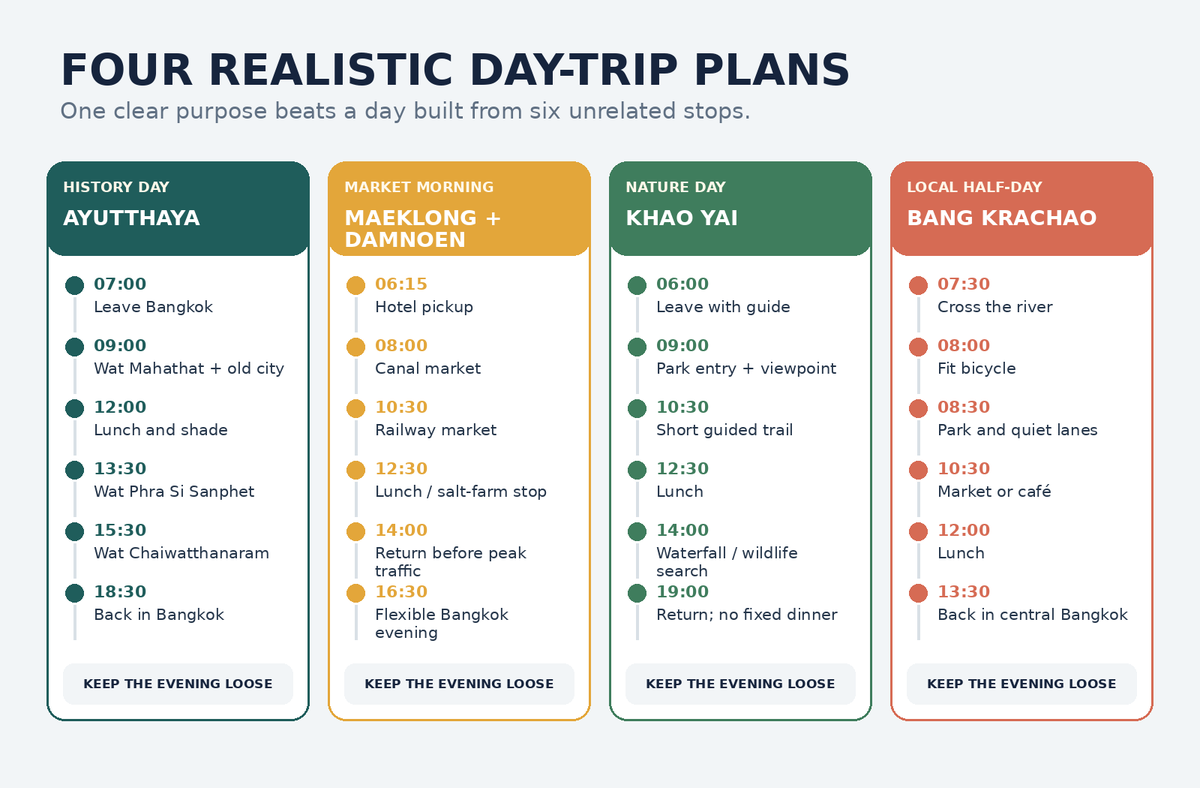
How to adapt these schedules
Move the departure earlier when the hotel is across the city from the station or pickup area. Remove a stop when travelling with young children, limited mobility or during the hottest months. Add an overnight when the destination itself matters more than preserving a Bangkok hotel booking.
Above all, avoid using the estimated Bangkok return as a guaranteed reservation time. Even a well-run tour cannot control every accident, storm or road closure.
Independent travel is best when the route is linear
Ayutthaya, Nakhon Pathom, Bang Krachao and Ko Kret have manageable independent versions because a traveller can understand the basic route: intercity rail or urban transit, then local movement around a defined area. Independence keeps costs low and allows longer meals, but it also transfers every timetable, ticket and return decision to the traveller.
Use independent transport when saving money genuinely matters, the schedule has slack and the final connection is clear. It is less attractive when several rural stops require separate taxis or when one missed service would remove the main experience.
Shared tours are best for awkward combinations
Maeklong plus a floating market, Erawan Falls and many Kanchanaburi routes are easier in a shared vehicle. The benefit is not merely a guide; it is the reduction of several small connections. However, group tours trade flexibility for efficiency. Pickup can be early, lunch may be fixed and a slow traveller can feel rushed.
Compare the real itinerary rather than the destination name. Two ‘Ayutthaya tours’ may differ by three hours of site time. Two ‘Khao Yai tours’ may differ on guide expertise, walking, wildlife searching and park admission.
Private drivers are best for groups and custom pacing
A private car can be the strongest value for three or four adults, a family with children or a traveller with mobility needs. It also allows an early retreat from heat or rain. Yet a driver is not automatically a licensed guide. Confirm whether historical explanation, park guiding, child seats, tolls, parking, overtime and admissions are included.
| Travel style | Best uses | Main advantages | Main drawbacks | Questions to ask |
|---|---|---|---|---|
| Independent train/transit | Ayutthaya, Nakhon Pathom, Bang Krachao, Ko Kret | Low cost, flexible stops, local experience | Timetable risk, local transfers, more planning | Which station or pier? What is the final return? |
| Shared tour | Markets, Erawan, Kanchanaburi, Khao Yai | Connections solved, guide may be included, easier booking | Fixed pace, variable pickup, exclusions | How long at the main stop? Which fees are excluded? |
| Private driver | Families, groups, custom routes, mobility needs | Door-to-door travel, flexible pacing, luggage space | Higher vehicle price, guide may be separate | Is the quote per vehicle? What are overtime terms? |
| Private guide plus vehicle | Khao Yai, history-led Ayutthaya or Kanchanaburi | Interpretation and route control | Highest cost | What qualifications and exact guiding hours apply? |
Compare total cost, not only ticket price
Add hotel-to-station transport, destination taxis, admissions, boats, food and the fallback journey home. A cheap train plus four local taxis may cost more than expected, while a private car divided between four people may be competitive.
Kanchanaburi when Hellfire Pass or Erawan matters
Stay in Kanchanaburi when the trip includes the town’s memorial sites plus Hellfire Pass, or when Erawan Falls deserves an unhurried morning. One night allows the history to be treated respectfully and prevents the waterfall from becoming a midday dash. Two nights are better when both subjects matter.
Check Kanchanaburi overnight options
An overnight can replace several hours of same-day backtracking. Compare the town centre, riverside and routes towards Sai Yok before booking.
Khao Yai when wildlife is the priority
A night near Pak Chong or the park entrance creates an early and a late wildlife period, rather than one compressed midday visit. It also gives the guide more freedom to react to trail access, weather and recent animal activity. Choose the hotel location with the pickup route in mind; a low room price far from the agreed meeting point can erase the saving.
Check Khao Yai and Pak Chong stays
Confirm whether the property is near Pak Chong town, a park entrance or a tour pickup route. These are not the same location.
Pattaya when beach time or nightlife matters
Pattaya is better overnight when the itinerary includes an island, several attractions or an evening experience. A Bangkok day trip should remain focused on the Sanctuary of Truth and one supporting stop. Stay over when the coast itself is the destination rather than the background.
Check Pattaya stays
Compare Naklua for the Sanctuary, central Pattaya for transport and Jomtien for a different beach atmosphere.
Hua Hin, Koh Samet and other stretched day trips
Hua Hin, Koh Samet and some larger Kanchanaburi combinations appear in Bangkok day-trip searches, but they spend too much of the day on road, rail or ferry connections for most travellers. They can be technically possible and still be a poor holiday decision. Treat them as separate stops in a wider Thailand route unless a very specific event or private transfer justifies the long day.
For Ayutthaya and railway-based routes
A hotel near the MRT or with a straightforward taxi route to the relevant station reduces the most frustrating part of an independent day: crossing Bangkok before the intercity journey begins. Do not choose a hotel solely from a station name, because different train services may use different Bangkok terminals. Check the exact 2026 timetable first.
For shared tours and private drivers
Central areas such as Sukhumvit, Silom and riverside Bangkok are widely served, but ‘hotel pickup’ often applies only inside a defined zone. A property on a narrow lane, across the river or far from the operator’s route may require a meeting point. Obtain that point before the cancellation window closes.
When one early night in Bangkok is worth paying for
An airport hotel or distant resort can be excellent for another purpose and inconvenient for a 05:30 market pickup. When a major day trip follows immediately after arrival, stay somewhere that reduces the morning transfer and leave enough sleep between the flight and the excursion.
Compare practical Bangkok bases
Check proximity to MRT or BTS, the operator pickup zone and the route to the correct station rather than choosing by district name alone.
What the planning figures include
The ranges in this article cover ordinary transport, local movement, major admissions, simple food and water. They do not assume luxury vehicles, premium private guides, shopping or high-end dining. National-park days and private-car routes sit higher because the vehicle and guide are part of the experience rather than a minor transfer.
Use the wider Thailand travel budget guide to place the excursion inside the total holiday. Spending 3,000 THB on one carefully chosen day may add more value than three cheap trips that repeat the same early start and reduce Bangkok sightseeing.
| Budget style | Expected spend | What it can cover | Where it becomes unrealistic |
|---|---|---|---|
| Low-cost independent | 300-1,200 THB | Bang Krachao, Ko Kret or a simple Nakhon Pathom day | Not realistic for private rural transport or park guiding |
| Standard independent | 700-2,000 THB | Ayutthaya by train, local transport, food and several admissions | Can rise when several taxis or boats are added |
| Shared day tour | 1,000-3,500 THB | Markets, Ayutthaya, Kanchanaburi or some park routes | Check whether admissions and lunch are excluded |
| Premium shared or specialist nature tour | 2,500-5,500 THB | Smaller group, park guide, longer day or stronger inclusions | Wildlife sightings still cannot be guaranteed |
| Private vehicle | 4,500-12,000 THB per vehicle | Custom timing, families, groups and difficult multi-stop routes | Guide, overtime and entry fees may be separate |
Costs that are commonly missed
- Taxi or ride-hailing transport from the Bangkok hotel to an early station or meeting point.
- A local tuk-tuk, songthaew or car after the intercity train or bus arrives.
- Paddleboats, motorboats, bicycle hire, lockers, towels or changing facilities.
- Park, museum and monument admissions excluded from the tour headline.
- Driver overtime when the return is delayed by traffic or an extended attraction visit.
- A meal at a motorway stop or tourist site where alternatives are limited.
Cash still matters
Carry small Thai-baht notes for ferries, markets, local food, bicycles and minor admissions. Keep a separate reserve for the journey home instead of spending the final cash at the destination.
The small kit that solves most problems
A day bag should remain light enough to carry through heat, stairs and station changes. The useful basics are a refillable water bottle, sun protection, tissues, hand sanitiser, small cash, a charged phone, an offline copy of the return details and a layer that covers shoulders or knees for temples. Add insect repellent and footwear with grip for nature routes.
The full Thailand packing list covers the wider holiday. For a single excursion, resist packing every possible item. A compact dry layer and dependable power matter more than a large bag of ‘just in case’ equipment.
Product comparison: what is worth buying?
| Item | Best for | Useful feature | Main drawback | Buying advice |
|---|---|---|---|---|
| Compact power bank | All long days | Enough capacity for maps, messages and return tickets | Heavy high-capacity models can be unnecessary | Choose a reputable model with airline-compliant capacity markings. |
| Small dry bag | Erawan, boats and wet-season travel | Protects phone, spare clothes and documents | Bulky roll-top designs can be awkward in town | A 5-10 litre size is usually enough for one person. |
| Packable rain jacket | Khao Yai, Nakhon Nayok and monsoon days | Hands-free rain protection | Can feel hot in humid weather | Prioritise vents and a small packed size. |
| Light walking shoes | Ruins, parks and long outdoor sites | Grip and support | Slow to dry if fully soaked | Use footwear already tested before the trip. |
| Small secure wallet | Markets and public transport | Separates daily cash from passport and cards | Adds another item to track | Carry only the money and cards needed for the day. |
Useful day-trip equipment
Compare size, weight and return policy. Familiar footwear and a reliable existing power bank are better than unnecessary new gear.
Keep the route available offline
Mobile data helps with ride-hailing, messages and live map changes, but rural coverage and battery life should not be treated as guaranteed. Save the hotel address, destination name in Thai, operator number and return ticket offline. Travellers arranging an eSIM can compare coverage before departure rather than setting it up during a 05:30 pickup.
Check Thailand eSIM options
Confirm device compatibility, data allowance and activation timing before travel.
Check the destination forecast, not only Bangkok
Bangkok can be dry while Khao Yai, Nakhon Nayok or Kanchanaburi receives heavy rain. The Thai Meteorological Department publishes national forecasts and warnings that are more useful than relying on a decorative weather icon. Check once before the cancellation deadline and again on the morning of travel.
Seasonal context is covered in the best time to visit Thailand guide, but a monthly average cannot replace a current warning. Waterfalls, forest roads and boat trips are especially sensitive to recent rainfall, not just the season name.
Road travel is the main shared risk
Long day trips involve early starts, high-speed roads and late returns. Wear the seat belt where one is fitted, avoid operators who appear to rush or drive unsafely and do not encourage an exhausted driver to maintain an unrealistic schedule. A coffee stop is less damaging than an unsafe return.
Motorbike taxis may solve a final connection, but they are not an automatic choice for children, luggage or nervous riders. FCDO travel advice highlights road-safety concerns in Thailand; travellers should review the current advice and ensure insurance covers the transport and activities they plan to use.
Waterfalls, boats and river edges
At Erawan and Nakhon Nayok, follow local signs and staff instructions rather than judging water safety by appearance. Sudden rain upstream can change flow and colour. On boats, use an available life jacket and keep phones secured instead of leaning out for an unobstructed image.
Market and crowd awareness
Maeklong requires a safe position behind the market’s instructions before the train arrives. Floating markets and busy stations also create normal pickpocketing and pricing risks. The Thailand scams to avoid guide explains how to agree prices, protect payment cards and leave a sales situation without turning every interaction into suspicion.
Accessibility and reduced-mobility planning
Accessibility varies sharply. Ancient City covers a large site but offers internal transport options that should be reconfirmed. Sanctuary of Truth lists wheelchairs, a lift and an on-site shuttle for visitors who need assistance. Hellfire Pass offers a free buggy for eligible visitors with physical limitations, although its outdoor trail remains uneven.
For Ayutthaya, a private car can reduce long exposed walks, but ancient surfaces, steps and thresholds remain. Bang Krachao’s narrow paths are not suitable for every wheelchair or unsteady cyclist. Contact the venue or operator with specific questions rather than accepting a generic ‘accessible’ label.
Families, solo travellers and older visitors
Families should ask about child seats, toilet stops, child admission rules and the walking surface. Solo travellers may find a shared tour worthwhile for remote parks even when they usually travel independently. Older visitors often gain more from a private vehicle and fewer carefully selected stops than from a high-volume itinerary.
Emergency planning
Save the hotel address, operator number, travel-insurance contact and Thailand Tourist Police number 1155. For immediate emergencies, follow local instructions and use the appropriate Thai emergency service.
| Advantages | Limitations |
|---|---|
| Keep one Bangkok hotel rather than repacking for every nearby destination. | Long transfers can consume the morning and evening. |
| Access UNESCO history, markets, forests, rivers and local communities from one base. | Bangkok traffic makes precise return times unreliable. |
| Choose between low-cost independent travel and fully arranged tours. | Headline tour prices may exclude admissions, boats or local transport. |
| Add contrast to an urban itinerary without changing the whole route. | Several destinations become much better with an overnight. |
| Private vehicles can work well for families and small groups. | Early starts and repeated long days can reduce enjoyment of Bangkok itself. |
| Short options such as Bang Krachao still leave part of the day free. | Weather and seasonal closures affect nature trips more than city sightseeing. |
How many day trips should you take?
For a three- or four-night Bangkok stay, take no more than one full-day excursion. With five or six nights, one long trip and one half-day can work. A longer stay can support two substantial days, provided they are separated by easier Bangkok time.
This is not a strict rule. A traveller visiting Thailand mainly for history may happily prioritise Ayutthaya and Kanchanaburi. The important point is to count the early departures and late returns, not merely the number of nights on the booking.
1. Booking from the destination name alone
Read the exact stops, time at each site, pickup area, exclusions and return point.
2. Treating map time as door-to-door time
Add hotel transfer, waiting, local movement and evening traffic.
3. Planning a fixed Bangkok dinner afterwards
Leave the evening flexible after Ayutthaya, Khao Yai, Erawan, Kanchanaburi or Pattaya.
4. Ignoring the operating day
Amphawa and Ko Kret change across the week; markets and museums keep individual schedules.
5. Copying an old train timetable
Use current State Railway information and recheck shortly before Maeklong or Ayutthaya travel.
6. Choosing the tour with the most stops
Extra names often mean less time at the main reason for travelling.
7. Assuming every fee is included
Check park tickets, monument admissions, boats, bicycles, tolls and lunch.
8. Underestimating heat and wet surfaces
Use shade, water, tested footwear and a shorter route when conditions demand it.
9. Treating wildlife as guaranteed
Choose Khao Yai for the forest and guiding; animal sightings remain unpredictable.
10. Refusing to turn a day trip into an overnight
A night in Kanchanaburi, Khao Yai or Pattaya can transform a rushed route into a proper visit.
What is the best day trip from Bangkok for a first visit?
Ayutthaya is the strongest first choice because it combines major historical value, a distinct setting and several transport options. It feels meaningfully different from Bangkok without requiring the extreme travel load of Erawan or Khao Yai.
Can you visit Ayutthaya independently from Bangkok?
Yes. Current State Railway timetables list several Bangkok-Ayutthaya services, and local bicycles, tuk-tuks or cars can be arranged after arrival. Confirm the exact Bangkok station and return service, then budget separately for movement around the old city.
Is the Maeklong Railway Market worth visiting?
It can be worthwhile when the trip is timed around an actual train movement and paired with a compatible stop such as Damnoen Saduak or Amphawa. It is less rewarding when the itinerary reaches the market between trains or allows only a rushed photograph.
Which floating market is better: Damnoen Saduak or Amphawa?
Damnoen Saduak suits an early, visually busy canal-market visit and is easier to combine with a morning tour. Amphawa suits a weekend afternoon or evening with food and riverside atmosphere. They serve different purposes rather than competing as identical attractions.
Can I visit Erawan Falls and Kanchanaburi in one day from Bangkok?
Some tours do, but the day is long and the time at each place can be limited. Choose a combined trip only when an overview is acceptable. Stay overnight when the waterfall hike, museums or Hellfire Pass deserves proper time.
Do I need a guide for Khao Yai National Park?
A guide is strongly useful for a first day trip. The park is large, wildlife is difficult to spot and current trail access can change. A guide cannot guarantee animals, but can improve route choices, interpretation and safety.
Is Pattaya too far for a day trip from Bangkok?
Pattaya is workable by road when the day is built around the Sanctuary of Truth and one supporting stop. It becomes too rushed when islands, beaches, gardens, shopping and nightlife are added. Stay overnight when the coast itself is the priority.
Is Ancient City in Bangkok?
Ancient City is in Samut Prakan, southeast of central Bangkok. Urban rail followed by a taxi or ride-hailing car can make the transfer easier than many intercity trips, but the site itself is very large and mostly outdoors.
Which Bangkok day trip is best with children?
Ancient City can work well because the route is flexible and internal transport may be available. Ayutthaya suits older children interested in history, while Bang Krachao suits confident family cyclists. Check child seats, heat, toilets and walking surfaces before booking.
Which day trip is best for older travellers or limited mobility?
A private Ayutthaya route, Ancient City with confirmed internal transport, or the Sanctuary of Truth with advance access questions can work. Avoid assuming that ancient ruins, waterfall paths or narrow cycle lanes are accessible simply because a tour listing uses a general accessibility label.
What is the cheapest day trip from Bangkok?
Bang Krachao, Ko Kret and Nakhon Pathom can be inexpensive when travelled independently. The cheapest option still depends on the hotel location and final taxi or ferry costs, so compare the complete route rather than the intercity ticket alone.
How early do Bangkok day trips start?
Market, national-park and waterfall trips often start between about 05:30 and 06:30. Ayutthaya commonly begins around 07:00, while Bang Krachao, Ko Kret and Ancient City allow a more conventional morning. Exact pickup depends on the operator and hotel zone.
Should I book Bangkok day trips before arriving in Thailand?
Book limited-capacity private guides, small-group park trips and high-priority weekend excursions ahead. Simpler independent trips can remain flexible, although train times, park access and market days still need checking.
Can I book a day trip on the same day?
Sometimes, but same-day choice is weaker for Khao Yai, Erawan, private drivers and early market departures. Same-day planning is more realistic for Bang Krachao, Ko Kret or an urban attraction when current opening information is confirmed.
What should I wear on a Bangkok day trip?
Use light breathable clothing, sun protection and tested footwear. Carry a shoulder-and-knee covering layer for temples. Nature days need grip and rain protection; waterfall days also need dry clothes and a waterproof bag.
How much cash should I carry?
Carry enough for small admissions, food, ferries, bicycles and the fallback journey home. The exact amount varies, but a separate emergency reserve should remain untouched. Do not assume every local stall or pier accepts cards.
For one classic excursion
I would choose Ayutthaya. It has the strongest balance of historical importance, visual impact, transport choice and time at the destination. The day can be independent, guided or private without changing its central purpose.
For nature
Khao Yai would be my choice with a reputable guide when forest and wildlife interpretation matter most. Erawan would suit me better when the aim is a physically active waterfall day and I was comfortable with the long road and changing trail conditions.
For an easier second escape
Bang Krachao would be my choice. It creates contrast, keeps the budget modest and does not demand another intercity transfer. Ancient City would be the stronger alternative when architecture matters more than cycling or greenery.
Whichever route wins, I would keep the final evening free, check the source that controls the experience – railway, park, market or museum – and remove one stop before adding another. That is the difference between a day trip that looks impressive on paper and one that still feels worthwhile on the way home.
Transport, admission, park, trail and safety details were rechecked on 10 September 2026. The sources below are primarily railway, tourism, heritage, national-park, museum, diplomatic and emergency-service references. Prices described as planning allowances are deliberately broader than a single live quote and should be reconfirmed before payment.
- State Railway of Thailand: 2026 Bangkok to Ayutthaya timetable.
- State Railway of Thailand: 2026 Ayutthaya to Bangkok timetable.
- UNESCO World Heritage Centre: Historic City of Ayutthaya.
- Tourism Authority of Thailand: Ayutthaya destination information.
- Tourism Authority of Thailand: Damnoen Saduak and Amphawa.
- State Railway of Thailand: Maeklong to Ban Laem timetable.
- Khao Yai National Park: Department of National Parks.
- Erawan National Park: Department of National Parks.
- Official national-park entrance-fee dataset: Department of National Parks.
- Official park opening and closure dataset: Department of National Parks.
- Australian Government: Hellfire Pass Interpretive Centre visitor FAQ.
- Sanctuary of Truth Museum: visitor hours, admission and access information.
- Muang Boran Museum: Ancient City tickets and opening hours.
- Bang Krachao one-day trip: Tourism Authority of Thailand.
- Nakhon Pathom destination information: Tourism Authority of Thailand.
- Nakhon Nayok destination information: Tourism Authority of Thailand.
- Kanchanaburi destination information: Tourism Authority of Thailand.
- Samut Songkhram visitor ideas: Tourism Authority of Thailand.
- Thai Meteorological Department: forecasts and warnings.
- UK Foreign, Commonwealth and Development Office: Thailand travel advice.
- Thailand Tourist Police: visitor assistance and emergency contact.
Illustrations in this article were created for Taylor’s Trailblazing Travels. Third-party photographs, where used, are credited beside the image or in the source list.
Traveller experiences
Share your experienceYour first-hand knowledge can help another traveller plan with more confidence. Share what you experienced, including anything you would change.
These are traveller contributions, separate from Taylor’s Trailblazing Travels’ editorial research. Contributions are reviewed before publication; a first-hand confirmation is not independent verification.
Be the first to share what you learned.
No traveller experiences have been approved for this article yet. Taken this trip? Help another traveller plan their day.
Your journey, someone else’s useful tipTaken this trip? Help another traveller plan their day.Share a first-hand experience · no account needed
Your day trip experience
Practical details, balanced views and small discoveries are all welcome. Please describe your own trip and avoid sharing someone else’s personal information.
Spotted something that’s changed?Help us keep this guide accurate. Reports stay private.Private report
Report an update
Tell the editorial team what appears to have changed. Reports stay private and are reviewed before any editorial decision; sending a report does not change this article.