Choose what to eat, understand regional flavour differences and order with more confidence—without turning every meal into a checklist.
4 regional flavour lenses
Checked 7 Sep 2026
Thai food becomes much easier to enjoy once you stop treating it as a list of famous dishes. Pad Thai, green curry and mango sticky rice are useful reference points, but they reveal only a small part of the country’s food culture. The more rewarding approach is to notice how rice, shared plates, herbs, grilled food, noodles, soups and condiments fit together — and then let each destination add something different.
This Thai food guide is designed for travellers who want specific choices rather than vague advice to ‘eat like a local’. It covers 35 dishes, regional differences, realistic 2026 planning prices, ordering phrases, street-food safety, vegetarian and allergy considerations, food tours, cooking classes and a route that works without turning every day into a food challenge. Facts and operator details were checked during the final 2026 research pass, although menus, opening hours, prices and dietary arrangements can change quickly.
This edition was refreshed against official cultural, health and tourism sources, plus live operator pages, on 7 September 2026. Any prices, tasting counts and schedules are dated planning examples rather than guarantees.
Best overall first meal
Khao man gai or pad see ew: clear flavours, familiar structure and easy heat control.
Best regional contrast
Bangkok, Chiang Mai and Phuket Town, with one Isan sharing meal along the way.
Best budget approach
One-plate lunches, shared dinners and one paid food experience that solves a real problem.
Most important difference
A spice preference is flexible; a serious allergy needs written information and a medical plan.
01How Thai meals work
Rice is the anchor, not a side thought
A restaurant menu can make Thai food look like a collection of independent dishes, yet many meals make more sense around rice. A family-style samrap places several contrasting dishes in the middle of the table: perhaps a soup, a curry, a stir-fry, vegetables and a chilli dip. Diners take small amounts and eat them with rice rather than finishing one plate before moving to the next. Thailand Foundation describes this rice-centred, shared structure as an important part of Thai food culture.[1]
That does not mean every meal must be communal. One-plate dishes such as pad krapao, khao man gai and noodle bowls are practical breakfasts and lunches. However, a group that orders four separate curries misses the balancing logic of the meal. A better dinner might combine one rich curry, one clear or sour soup, grilled protein, vegetables and enough plain rice to reset the palate.
Balance happens across the table
Sweet, sour, salty, bitter, aromatic and hot notes are often discussed as though each dish must contain every flavour. In practice, the balance may sit across the whole meal. Tomyum can be sharp and aromatic, a coconut curry rich and rounded, stir-fried morning glory savoury, and cucumber or herbs cooling. The contrast is the point.
This is why ‘Thai food is spicy’ is too blunt to be useful. Some dishes are naturally gentle, while others depend on chilli for their identity. Heat also varies by cook, region and batch. When you need a mild meal, choose a dish whose base is mild rather than asking a cook to remove the chilli from something built around pounded fresh chilli.
Condiments finish the dish
Noodle shops may provide chilli flakes, sugar, fish sauce and chilli vinegar. Diners adjust a bowl after tasting it. By contrast, a carefully balanced curry or soup may not need intervention. The practical rule is simple: taste first, then add one condiment at a time. Emptying every pot into the bowl before the first mouthful is neither necessary nor especially respectful to the cook.
02Choose your first Thai dish by appetite
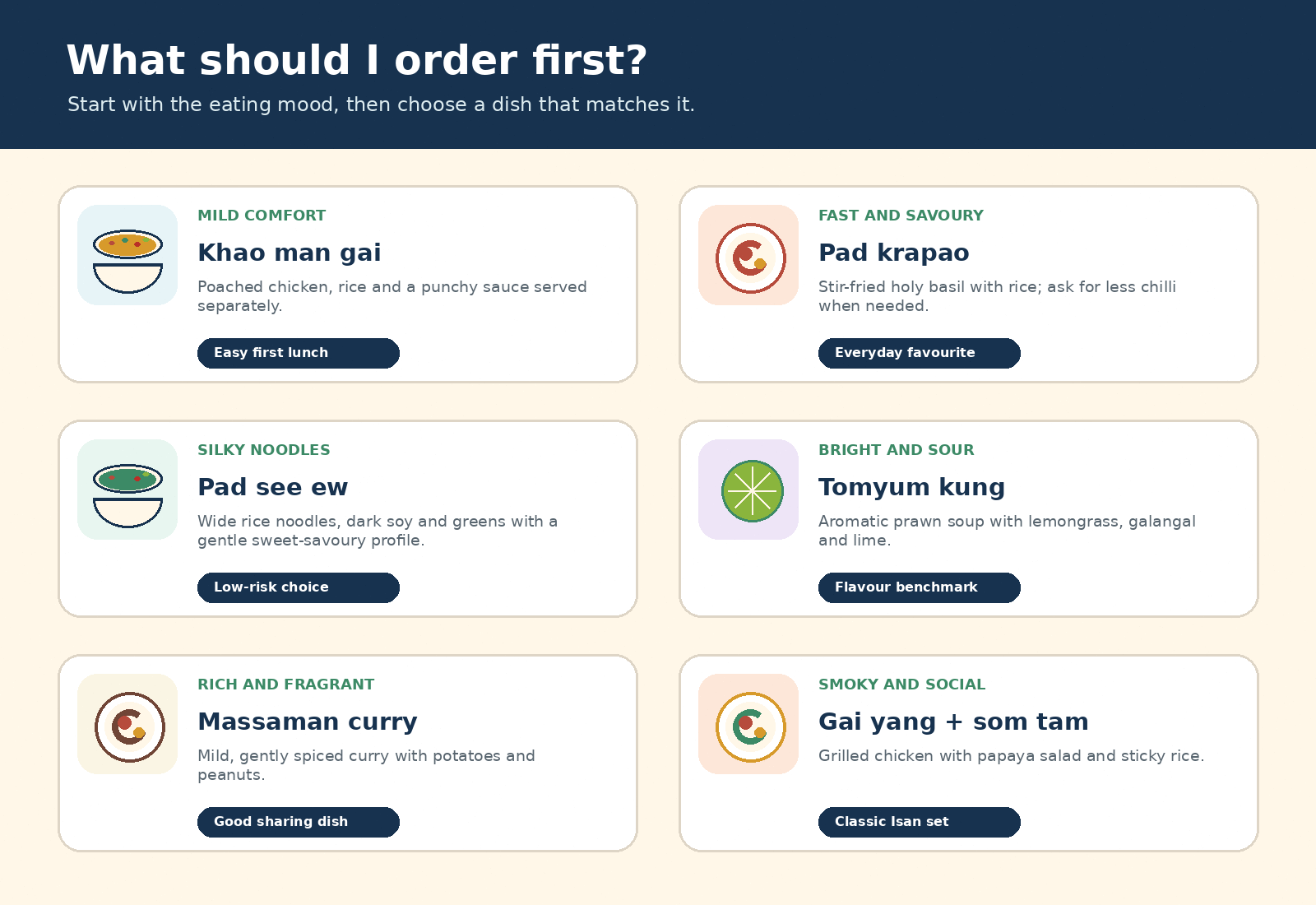
The strongest first order is not necessarily the most famous one. It is the dish that fits your hunger, heat tolerance and setting. A busy market lunch calls for something different from a long evening meal, while a traveller arriving after an overnight flight may appreciate a simple rice plate more than an elaborate curry spread.
| What you want | Start with | Why it works | Watch for |
|---|---|---|---|
| Mild, comforting and filling | Khao man gai | Simple chicken and rice with sauce served separately | The dipping sauce can still be punchy |
| Fast, savoury and distinctly Thai | Pad krapao | Basil, garlic, chilli and rice form a complete one-plate meal | Heat varies sharply; ask before ordering |
| Noodles without a chilli challenge | Pad see ew | Wide noodles and dark soy usually taste round and familiar | Can be sweet or oily at weaker stalls |
| Aromatic, sour and memorable | Tomyum kung | Lemongrass, galangal and lime show a core Thai flavour profile | Herbs perfume the broth but are not all meant to be eaten |
| Rich but generally gentle | Massaman curry | Potatoes, warm spice and coconut suit shared dining | Peanuts are common; unsuitable for many nut allergies |
| Smoky, fresh and social | Gai yang, som tam and sticky rice | A complete Isan-style set with contrast | Papaya salad can be extremely hot and may contain fish sauce or dried shrimp |
03Regional Thai food: what changes as you travel
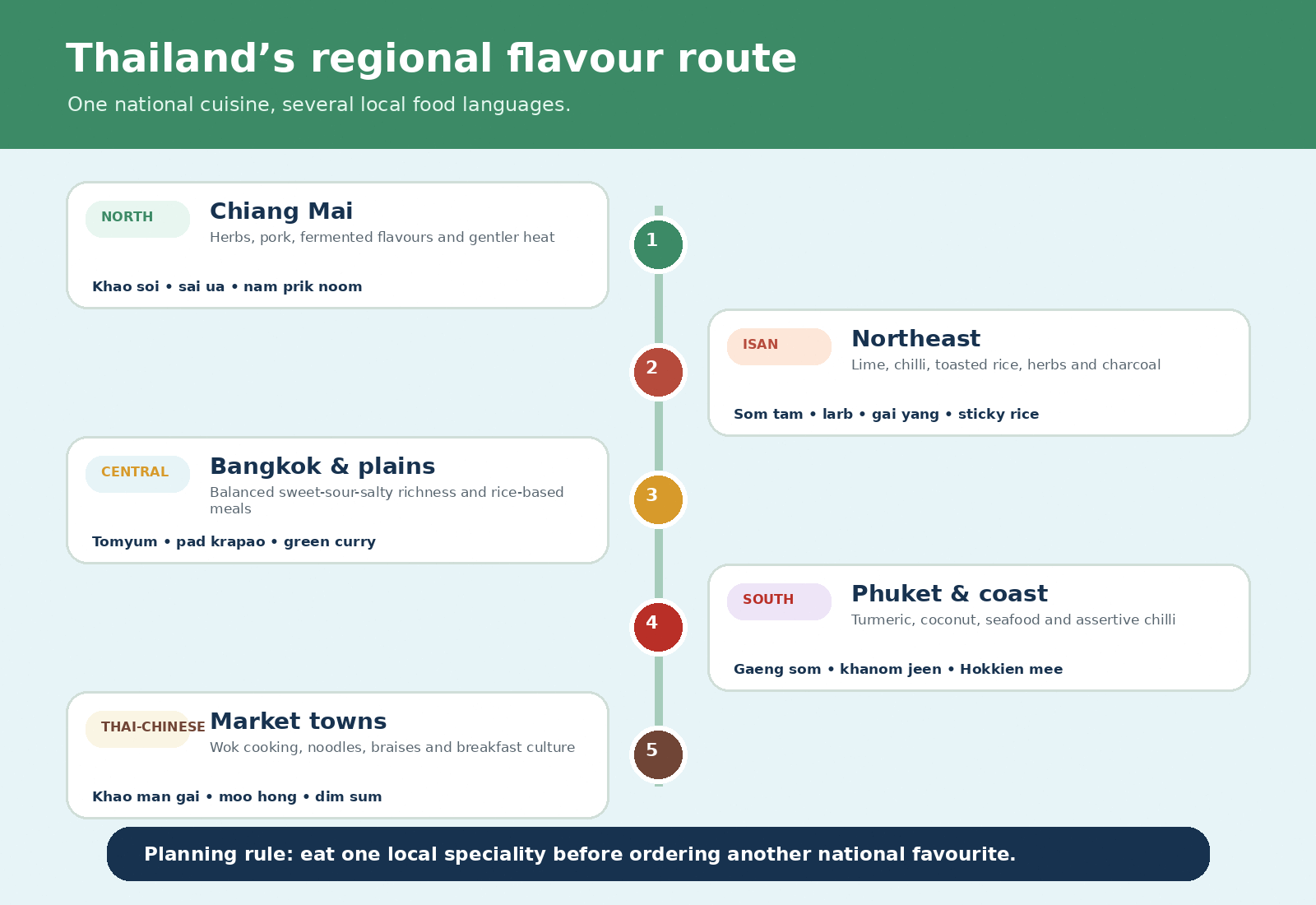
Thailand’s regions overlap, trade and borrow from one another, so no map creates hard culinary borders. Even so, regional patterns help a traveller understand why a Chiang Mai market, an Isan grill and a Phuket breakfast feel so different. The Tourism Authority of Thailand’s food mapping work likewise emphasises local specialities rather than presenting one uniform national menu.[2]
Northern Thailand
Northern food often brings herbs, pork, fermented flavours and a gentler style of heat than many southern or Isan dishes. Sticky rice appears frequently. Khao soi is the headline bowl, yet sai ua sausage, nam prik noom, nam prik ong and grilled meats reveal more of the region’s everyday character. Chiang Mai is the easiest base because markets, simple noodle shops and cooking classes can be combined without long transfers.[3]
Isan and the northeast
Isan food is direct, social and highly textural. Lime, chilli, fish sauce, herbs and toasted rice powder give dishes brightness and grip, while charcoal-grilled chicken or pork adds smoke. Sticky rice is eaten by hand in small pinches. Som tam, larb, nam tok and gai yang are best understood as a set rather than four disconnected menu items.
Central Thailand and Bangkok
Central food includes rich curries, aromatic soups, river ingredients, rice dishes and the enormous range of Bangkok’s migrant and market cooking. Tomyum kung is associated with the Central Plains and was inscribed on UNESCO’s Representative List of the Intangible Cultural Heritage of Humanity in 2024. UNESCO highlights its use of prawns with lemongrass, kaffir lime leaves, galangal and shallots, as well as its layered taste.[4]
Southern Thailand and Phuket
Southern food can be hotter, more turmeric-led and more seafood-focused, with coconut, sour curries and strong pastes playing important roles. Phuket adds a distinctive multicultural layer shaped by Thai-Chinese, Peranakan and wider trading influences. Its designation as a UNESCO Creative City of Gastronomy reflects that heritage, which is why Hokkien noodles, moo hong, dim sum and local sweets deserve as much attention as a beachside seafood dinner.[5]
Thai-Chinese and Muslim food traditions
Noodles, wok cookery, braises, roast meats and market breakfasts show deep Chinese influence, although they have developed local Thai identities. Muslim communities contribute biryani-style khao mok gai, roti, satay and regional curries. These traditions are not side notes: they are part of the country’s daily food landscape. Looking for the cooking method and community behind a dish often tells you more than a generic label such as ‘authentic Thai’.
04Thai food guide: 35 dishes worth knowing
The list below is organised by how you are likely to encounter the food, not by an artificial best-to-worst ranking. Prices vary by destination and venue, so the emphasis is on flavour, texture, ordering decisions and when each dish makes sense.
1. Pad krapao — holy basil stir-fry with rice
Pad krapao combines minced or sliced meat with garlic, chilli and holy basil, then serves it over rice. A fried egg, or khai dao, adds a crisp-edged white and runny yolk that softens the heat. The dish should smell intensely of basil and wok cooking rather than taste like a generic sweet stir-fry.
Order it when you want a fast, savoury meal. Say mai phet for not spicy or phet nit noi for a little spicy, although a batch sauce may already contain chilli. Pork and chicken are common; tofu versions still need checking for fish sauce or oyster sauce.
2. Khao man gai — Thai chicken rice
Poached chicken, fragrant rice, cucumber, clear broth and a fermented-soy dipping sauce make khao man gai look simple. The pleasure lies in texture: tender chicken, glossy grains and a sharp sauce that can be added in small amounts. Some stalls also offer fried chicken or a mixed plate.
This is a strong arrival-day lunch because the heat sits mainly in the sauce. Choose a busy specialist stall where chicken is being cut continuously. Travellers with soy, gluten or sesame concerns should ask about the sauce rather than assuming the plain-looking plate is allergen-free.
3. Khao kha moo — braised pork leg on rice
Khao kha moo is slow-braised pork leg served over rice with greens, pickled mustard, egg and a garlicky chilli-vinegar sauce. The meat is rich and tender, while the pickles and vinegar stop the plate becoming heavy. It is a Thai-Chinese comfort dish found at specialist stalls and food courts.
Ask for less skin when you prefer leaner meat, or point to the section you want as the vendor slices it. Because the braising liquid and accompaniments are prepared in advance, this is not an easy dish to modify for allergies or strict dietary requirements.
4. Khao pad — Thai fried rice
Thai fried rice is usually lighter and less heavily sauced than many takeaway versions in Britain. Rice is stir-fried with egg, onion, vegetables and a chosen protein, then served with lime, cucumber and fish-sauce chilli. Crab fried rice is especially popular near the coast.
Use khao pad as a calm meal between more intense dishes, not as a fallback you eat every day. Ask for chilli on the side when necessary. Vegetarian-looking fried rice may still contain fish sauce, chicken seasoning or shared-wok residue, so clarify before ordering.
5. Khai jeow — crisp Thai omelette over rice
Khai jeow is beaten egg seasoned and fried quickly in hot oil until puffed, deeply golden and crisp at the edges. Served over rice with chilli sauce, it is inexpensive, satisfying and more textural than a soft European omelette. Minced pork, herbs or vegetables may be mixed through it.
This works well at a simple rice-and-curry shop when nothing else feels familiar. However, fish sauce is a common seasoning and the high-heat frying method does not remove allergen risk. People avoiding pork should confirm the filling rather than relying on the English word ‘omelette’.
6. Khao mok gai — Thai-Muslim chicken biryani
Khao mok gai pairs turmeric-coloured spiced rice with tender chicken, cucumber, fried shallots and a bright green dipping sauce. Its warm spice profile is aromatic rather than chilli-led, so it offers a useful change from wok dishes and coconut curries. The dish is associated with Thai-Muslim food traditions.
Look for a specialist halal stall or restaurant, where stock turnover and seasoning are usually more consistent. Halal certification or signage answers a religious requirement more reliably than assumptions based on the dish name alone. The green sauce may still be hot, so taste it separately.
7. Pad Thai — stir-fried rice noodles
Pad Thai brings rice noodles together with tamarind, fish sauce, egg, bean sprouts, tofu and a chosen protein, often finished with lime and crushed peanuts. A good version tastes tangy and savoury with restrained sweetness; a poor one can be sticky and dominated by sugar.
Try it once at a specialist stall, then compare it with less internationally famous noodles. Peanuts may be served on top or at the side, yet cross-contact can occur even when they are omitted. Prawns, dried shrimp and fish sauce are also common, so vegan and allergy requests need more than ‘no nuts’.
8. Pad see ew — wide noodles with dark soy
Wide rice noodles are stir-fried with dark and light soy sauces, egg, Chinese broccoli and meat or tofu. The ideal plate has smoky edges, soft-centred noodles and enough bitter green vegetable to balance the sauce. It is usually less chilli-forward than pad krapao or drunken noodles.
Choose pad see ew when the group includes cautious eaters. Chilli is generally added at the table rather than defining the base. Gluten-free diners should not assume rice noodles make the dish safe because soy sauce and oyster sauce can contain gluten.
9. Rad na — noodles in savoury gravy
Rad na places wide rice noodles beneath a glossy gravy made with stock, soy and vegetables, usually Chinese broccoli. Pork, chicken or seafood adds substance. The texture is soft and comforting, with chilli vinegar available to sharpen the plate rather than heat cooked into the sauce.
This is a practical rainy-evening or low-spice option. Ask whether the noodles are first fried crisp or left soft, since both styles exist. Stock, soy, oyster sauce and shared utensils make the apparently gentle gravy unsuitable for casual allergy assumptions.
10. Kuay teow nam — everyday noodle soup
A Thai noodle-soup stall is a small decision system: choose noodle type, broth, protein and sometimes dry or soup style. Rice vermicelli, thin rice noodles, wide noodles and egg noodles behave differently in the bowl. Pork, beef, chicken, fish balls and wontons are common additions.
Watch what regular customers point to, then copy the basic combination before customising. Taste the broth prior to adding the condiment set. A clear appearance does not reveal whether the stock contains pork, shellfish, fish sauce or seasoning powder.
11. Boat noodles — dark, concentrated broth
Boat noodles are small bowls of rice noodles in a dark, aromatic broth with meat, herbs and often a thickening element. Historically associated with canal-side service, they are now commonly eaten in specialist shops where diners order several small portions. The flavour is deeper and more assertive than a basic noodle soup.
Order one bowl first because recipes vary widely. Traditional preparations may include blood as a thickener, so ask when that matters to you. The compact serving size encourages comparison, but six bowls still amount to a substantial meal and a surprising amount of sodium.
12. Yen ta fo — pink fermented-bean-curd noodle soup
Yen ta fo is recognised by its pink-red broth, coloured and flavoured with fermented red bean curd. A typical bowl may contain noodles, fish balls, squid, tofu, morning glory and crisp wonton pieces. It is tangy, savoury and slightly sweet rather than simply hot.
Choose it when you want something visually and texturally different from standard broth. Seafood and fish products are central to many versions, while the fermented sauce may contain ingredients that are difficult to verify at a busy stall. Severe allergies require a venue able to answer detailed questions.
13. Khao soi — northern curry noodles
Khao soi combines soft egg noodles and meat in a coconut curry broth, then adds crisp noodles, pickled mustard greens, shallot and lime. The toppings are not decoration: acidity, crunch and freshness keep the rich broth lively. Chiang Mai is the obvious place to compare several versions.
Start with chicken when you want the most widely available bowl, although beef and other styles can be excellent. Add lime and pickles gradually. Egg noodles contain gluten, while the curry paste, stock and condiments may include shrimp or fish products even when the visible protein is vegetable.
14. Tomyum kung — hot-and-sour prawn soup
Tomyum kung layers prawns with lemongrass, kaffir lime leaves, galangal, shallot, chilli and lime. Clear versions feel sharp and aromatic; creamy versions may include evaporated milk or chilli paste. UNESCO’s 2024 inscription recognises the dish as living cultural heritage rooted in Thailand’s Central Plains.[4]
The woody herbs perfume the broth but are not all intended to be chewed. Order a small bowl to share, especially when other dishes are coming. Shellfish is fundamental, and commercial pastes or stocks can complicate allergy questions even in a chicken variation.
15. Tom kha gai — coconut chicken soup
Tom kha gai uses coconut milk, galangal, lemongrass, lime leaves, mushrooms and chicken to create a fragrant soup that is rounder than tomyum. Sourness and salt should cut through the coconut rather than leaving a sweet, heavy broth. Chilli may be visible or built into the seasoning.
This can suit diners who want aromatics without the full heat of a fiery curry, although ‘coconut’ does not mean mild. Galangal slices and lime leaves are flavouring agents. Fish sauce is typical, so a vegetable version is not automatically vegan.
16. Gaeng keow wan — green curry
Green curry uses fresh green chilli, coconut milk, Thai basil and curry paste with meat, tofu or vegetables. The colour can suggest freshness and mildness, but green curry may be hotter than expected. Aubergines add bitterness and texture, while rice absorbs the concentrated sauce.
Share one portion rather than ordering it as a soup for one. When heat is a concern, ask before committing because the chilli sits in the paste and cannot simply be removed. Shrimp paste and fish sauce are common even in versions described casually as vegetable curry.
17. Massaman curry — warm spice and coconut
Massaman curry is rich with coconut milk, potatoes, onion, warm spices and usually beef or chicken. Tamarind adds quiet acidity, while roasted peanuts contribute texture. The profile is often gentler than green curry, making it an accessible shared dish without reducing Thai food to bland options.
Pair it with a sour salad or vegetables instead of another coconut curry. Peanuts are expected, and the sauce is normally prepared long before ordering, so omission is not a safe workaround for a severe nut allergy. Halal status depends on the venue and preparation, not on the curry’s historical influences.
18. Panang curry — thick, aromatic and concentrated
Panang is generally thicker and less soupy than green curry, with coconut, curry paste, lime leaf and a salty-sweet finish coating the protein. The sauce is concentrated, so a modest portion goes a long way with rice. It can be medium-hot even when it looks creamy.
Choose Panang when you want curry flavour without a full bowl of liquid. Balance it with a clear soup or vegetable dish. As with other curry pastes, shrimp paste may be hidden, and a busy kitchen cannot necessarily create a genuinely allergen-free version on request.
19. Gaeng som — sour orange curry
Gaeng som is a thin, sour curry rather than a coconut-rich one. Southern versions can be fiercely hot and turmeric-coloured, often containing fish or seafood with vegetables. The sharpness is refreshing in warm weather, but the chilli level makes it a poor surprise order for a cautious first meal.
Ask how hot the house version is and order it with plenty of rice plus a mild egg or vegetable dish. Fish and shrimp products commonly sit in the curry paste or broth. Travellers who dislike heat should explore southern food through Hokkien noodles, moo hong or grilled seafood before testing gaeng som.
20. Som tam — green papaya salad
Shredded green papaya is pounded with lime, chilli, garlic, tomato, long beans and seasonings. Central-style som tam Thai often includes peanuts and dried shrimp; Isan variations may use fermented fish sauce and different additions. The pounding bruises ingredients and pushes flavours together rather than merely dressing a salad.
State a chilli number when possible — one chilli is clearer than ‘medium’. Even then, the mortar may retain chilli, peanut, shellfish or fermented fish from earlier orders. Pair the salad with sticky rice and grilled chicken so each bite is not an undiluted hit of acid and heat.
21. Larb — minced-meat herb salad
Larb combines minced meat with lime, fish sauce, chilli, shallot, herbs and toasted rice powder. The toasted rice contributes a nutty aroma and slight graininess, while mint and other herbs keep the meat bright. Pork and chicken are common, though regional styles and raw preparations exist.
Ask for a cooked version and specify heat. Larb is better eaten with sticky rice, vegetables and another shared dish than as a dry standalone plate. Fish sauce is integral in many kitchens; raw or undercooked versions carry additional risk and are not the sensible choice for a short trip.
22. Nam tok — grilled-meat waterfall salad
Nam tok uses sliced grilled meat dressed with lime, fish sauce, chilli, herbs, shallot and toasted rice powder. It shares a flavour family with larb but keeps the chew and smoky edge of the meat. Beef and pork versions are common in Isan restaurants.
Order nam tok when you want the freshness of larb with more texture. The dressing is prepared quickly, yet the fish sauce and toasted rice seasoning are central. Requesting no chilli may be possible; requesting a fully redesigned sauce usually is not.
23. Gai yang — charcoal-grilled chicken
Gai yang is marinated chicken grilled over charcoal until smoky, juicy and crisp-edged. Marinades vary but may include garlic, coriander root, pepper, fish sauce or soy. Served with dipping sauces, sticky rice and papaya salad, it becomes the anchor of a relaxed group meal.
Choose a stall with whole birds turning steadily and a queue that keeps turnover high. Ask whether a quarter, half or whole chicken is being sold before pointing. The marinade can contain soy, fish sauce or gluten, while the dipping sauce may be much hotter than the chicken itself.
24. Moo ping — grilled pork skewers
Moo ping is pork marinated with savoury-sweet seasonings and grilled on skewers, often eaten with sticky rice for breakfast or a snack. Good skewers have caramelised edges without being dried out. Coconut milk may feature in the marinade, depending on the vendor.
Buy from a busy grill and eat the skewers hot rather than carrying them for hours. Ask the price per skewer because sticky rice is usually separate. Soy, fish sauce and seasoning sauces can sit in the marinade, so the simple appearance does not make the snack allergy-safe.
25. Sai ua — northern herb sausage
Sai ua is a coiled northern pork sausage perfumed with herbs, spices and curry-paste ingredients. Lemongrass, lime leaf and chilli can cut through the richness, while grilling gives the casing a smoky snap. Markets sell it by weight or in short lengths.
Taste a small portion while it is warm rather than buying a large coil immediately. Recipes differ in heat, fat and salt. Pork is obvious, but soy, seasoning powder and other ingredients may be less visible, making detailed allergen checks difficult at an open market.
26. Nam prik noom and nam prik ong — northern chilli dips
Nam prik noom is a smoky green-chilli dip, while nam prik ong is a tomato-and-minced-pork dip with a softer red colour. Both are served with vegetables, pork crackling and other accompaniments. They show how northern food uses dips to organise a platter rather than relying on one large main course.
Order a mixed platter for the table and compare the dips in small amounts. Chilli level, fish sauce and pork content vary, and the surrounding basket may include items fried in shared oil. Vegetarians need a specifically prepared meat-free set, not just the vegetable dippers.
27. Khanom jeen — rice noodles with curry and herbs
Khanom jeen are fermented rice noodles served with a choice of curry or sauce and a generous table of herbs, vegetables and pickles. The meal can look complicated, yet the rhythm is straightforward: noodles, a modest ladle of sauce, then crisp and aromatic toppings for contrast.
Ask which sauce is mildest, hottest and most local before choosing. Southern fish curry, coconut-based nam ya and sweeter sauces have very different profiles. Shared topping bars require sensible hygiene judgment, and sauces may contain fish, shrimp paste or meat stock.
28. Phuket Hokkien mee — yellow noodles with seafood or pork
Phuket-style Hokkien mee uses thick yellow noodles stir-fried or served in a little broth with pork, seafood, greens and often an egg. The dish reflects the island’s Thai-Chinese history and feels more like market-town comfort food than a resort-menu cliché.
Try it in Phuket Town, ideally at a specialist shop where noodle texture and wok heat matter. Seafood, pork stock, soy and oyster sauce may all appear. The UNESCO Creative City of Gastronomy designation is a reminder to explore the town’s multicultural food history, not proof that every venue is equally good.[5]
29. Moo hong — Phuket slow-braised pork
Moo hong is pork belly or shoulder braised until tender with pepper, garlic, soy and warm aromatics. It is glossy, rich and comforting, with a flavour profile shaped by Phuket’s Peranakan and Chinese heritage. Plain rice and a fresh vegetable dish are essential partners.
Treat this as a shared dish rather than a full bowl of sauce for one person. The recipe is prepared in advance, so low-sodium, gluten-free or soy-free alterations are rarely realistic. A small portion lets you appreciate the depth without making the meal feel heavy.
30. Roti with curry or condensed milk
Thai roti can be savoury or sweet. In Muslim communities it may accompany curry, while night-market versions are folded on a griddle and finished with banana, sugar, condensed milk or chocolate. The crisp-chewy layers make it tempting, although toppings can turn a light snack into a very rich dessert.
Choose either a savoury breakfast-style roti or one sweet version to share. Flour means gluten, and butter, margarine, condensed milk, egg or shared griddles may matter for allergies. Halal status should be checked through the venue’s signage or staff rather than inferred from the word roti.
31. Khao niaow mamuang — mango sticky rice
Ripe mango, coconut-enriched sticky rice and a lightly salty coconut sauce create one of Thailand’s most approachable desserts. The best versions depend on fragrant fruit and rice that is tender without being wet. Availability and mango quality shift with the season.
Share one portion after dinner rather than treating every market tray as essential. Coconut milk is central, and sesame or mung beans may be sprinkled on top. The dish is often vegan in principle, yet preparation details still need checking for strict diets or allergies.
32. Khanom krok — coconut-rice griddle cakes
Khanom krok are small coconut and rice cakes cooked in a dimpled griddle until crisp underneath and creamy in the centre. Spring onion, corn, taro or sweet toppings may be added. Freshly lifted cakes are dramatically better than a box that has sat steaming under a lid.
Buy a small tray from a stall cooking continuously and allow the centres to cool before biting. Coconut is obvious; shared batter tools, toppings and recipes may introduce other allergens. Because texture declines quickly, eat them nearby instead of carrying them around all afternoon.
33. Tub tim grob — red rubies in coconut milk
Tub tim grob uses crisp water chestnut pieces coated in red-tinted tapioca, served with coconut milk and ice. The contrast between chewy coating, crunchy centre and cool coconut makes it especially welcome after spicy food. Some versions include jackfruit or other additions.
Choose a busy dessert shop where ice and toppings are handled cleanly. Ask about dairy if the coconut mixture looks unusually creamy. Colours, syrups and shared topping spoons can complicate allergies, so do not assume a simple ingredient list from appearance alone.
34. Coconut ice cream
Coconut ice cream may be served in a cup or coconut shell with peanuts, sweetcorn, sticky rice, palm seeds or condensed milk. The base can taste clean and refreshing, while the topping bar turns it into a highly customised market dessert.
Ask which toppings are included before the vendor adds them automatically. Peanuts and shared scoops are obvious concerns, while dairy content varies by recipe. A sealed branded product may be easier to assess than an open tub when allergies are serious.
35. Cha yen — Thai iced tea
Cha yen is strongly brewed tea sweetened and poured over ice, usually with evaporated or condensed milk. Its orange colour and dessert-like richness make it appealing in the heat, though sweetness can be much higher than expected. It is a drink to enjoy occasionally rather than automatic hydration.
Ask for less sweet when the drink is mixed to order, but pre-made tea may limit adjustment. Dairy-free substitutes are not guaranteed, and a stall’s shared utensils can matter for severe milk allergy. Carry safe drinking water as well; tea does not replace regular hydration.
05How to order Thai food without overcomplicating it
Use the menu, the Thai name and one clear request
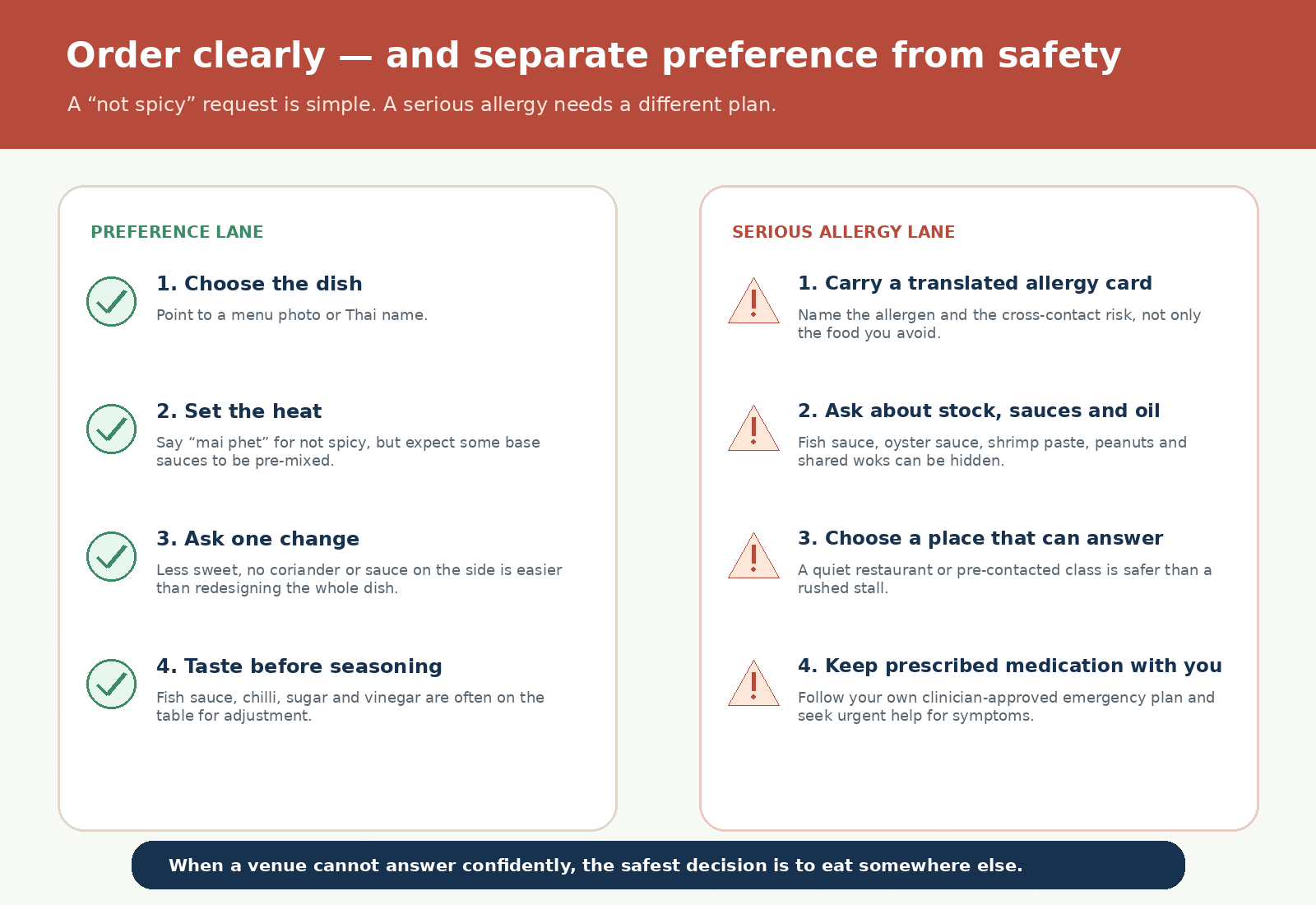
Pointing is not a failure. A menu photograph, Thai script or saved map listing can be clearer than uncertain pronunciation in a noisy market. Once the dish is understood, make one important request: perhaps less chilli, no coriander or sauce on the side. Stacking six changes onto a pre-prepared recipe increases the chance that something will be misunderstood.
Useful phrases include mai phet for not spicy, phet nit noi for a little spicy and mai sai followed by an ingredient for ‘do not add’. Romanisation varies, tones matter and staff may use different English. Therefore, a written Thai translation is more reliable when the request affects health rather than taste. A language-learning source can help with pronunciation, but it is not a medical communication tool.[19]
| Purpose | Approximate phrase | How to use it | Limitation |
|---|---|---|---|
| Not spicy | Mai phet | Say it before the order is sent to the kitchen | Some sauces or curry pastes are already spicy |
| A little spicy | Phet nit noi | Useful for a cooked-to-order stir-fry | ‘A little’ remains subjective |
| Do not add… | Mai sai… | Follow with the ingredient or show it in Thai | Does not address stock, sauces or cross-contact |
| Vegetarian food | Ahaan mangsawirat | Ask what can be prepared without meat | Fish sauce, stock and oyster sauce still need checking |
| Jay food | Ahaan jay | Look for yellow-red jay signs at specialist venues | Jay has its own rules and is not identical to every vegan preference |
Spice is easier to manage through dish choice
A request for no chilli works best with food cooked to order from separate ingredients. It works poorly with curry paste, chilli dip, som tam mortar residue or a broth that has simmered for hours. Instead of asking a southern sour curry to become mild, switch to khao man gai, pad see ew, khao pad, a simple omelette or a broth whose condiments arrive separately.
Also remember that cooling and neutral are not the same. Coconut milk rounds flavours but can carry substantial heat. Sugar softens an initial impression without removing chilli. Plain rice, cucumber and a less intense shared dish are more useful balancing tools than repeatedly ordering sweet drinks.
Taste before adding the condiment set
At a noodle table, the cook may expect you to finish the bowl with chilli vinegar, fish sauce, sugar or dried chilli. Begin with half a spoon of one condiment, stir and taste. In a restaurant serving a composed curry or stir-fry, however, pouring fish sauce over the plate before tasting can overwhelm the intended balance. Context matters more than a blanket rule.
06Vegetarian, vegan, jay and halal food
Vegetarian-looking dishes may contain animal seasonings
The visible protein is only one part of a Thai recipe. Fish sauce, oyster sauce, shrimp paste, dried shrimp, pork broth, chicken powder and shared frying oil can appear in food that otherwise looks vegetable-based. Asking for tofu instead of chicken therefore does not automatically create a vegetarian dish. A specialist vegetarian restaurant is easier than negotiating every ingredient at a mixed stall.
Use ahaan mangsawirat as a starting point for vegetarian food, then clarify fish sauce, oyster sauce, stock and egg according to your own diet. Keep the request focused and be prepared to choose another dish. A venue that answers confidently is more valuable than one that agrees immediately without checking the kitchen.
Jay food is useful, but it is not a perfect synonym for vegan
Jay food avoids animal ingredients and is often signposted with red Thai or Chinese characters on a yellow background, particularly during the annual Vegetarian Festival. It also follows religious rules that may exclude pungent vegetables such as garlic and onion. Consequently, jay food can be a useful vegan-friendly route, but the two concepts are not identical.[13]
During festival periods, choice expands dramatically in places such as Phuket and Bangkok. Outside those dates, dedicated jay restaurants and stalls still exist. Ask whether honey, milk, egg or shared equipment matter for your definition, since staff may understand the broad category without knowing every personal restriction.
Halal food is part of Thailand’s everyday food landscape
Muslim communities, markets and restaurants make halal food widely available in many cities and southern destinations. Khao mok gai, roti, satay and curries can be good starting points. However, the dish name alone does not establish halal preparation. Look for recognised halal signage, a clearly Muslim-run venue or direct confirmation from staff.
In mixed food courts, separate stalls may share seating but not preparation. That can make choices easier because each counter has a clearer identity. Travellers with strict requirements should still ask about sauces, cooking fat and shared utensils rather than relying only on a meat-free or pork-free appearance.
07Food allergies in Thailand: preference is not safety
Common hidden ingredients and cross-contact points
Thai kitchens can use fish sauce, oyster sauce, shrimp paste, dried shrimp, peanuts, soy, wheat-containing sauces, egg, coconut and milk across many dishes. One wok, mortar, fryer, chopping board or ladle may serve several recipes. Removing a visible garnish does not remove ingredients already in paste, stock, marinade or shared equipment.
| Concern | Where it can hide | Better question | Safer fallback |
|---|---|---|---|
| Peanut | Pad Thai garnish, som tam, massaman, sauces and shared mortar | Does the sauce or preparation area contain peanut? | A venue that can prepare and explain a separate dish |
| Shellfish | Shrimp paste, dried shrimp, fish balls, stocks and curry paste | Is shrimp or shrimp paste in the paste, stock or seasoning? | A specialist venue contacted in advance |
| Fish | Fish sauce, broth, dressings and chilli dips | Can the dish be made without fish sauce and fish stock? | Dedicated vegetarian or jay restaurant after checking cross-contact |
| Gluten | Soy sauce, oyster sauce, egg noodles, marinades and batter | Which sauces and noodles contain wheat? | Plain rice and a separately verified preparation |
| Milk | Thai tea, condensed milk, desserts and some creamy tomyum | Does the base contain dairy as well as coconut? | Packaged product with a readable ingredient label |
| Egg | Fried rice, noodles, omelettes, batters and baked goods | Is egg in the base or added during cooking? | A simple verified dish from a kitchen that can clean equipment |
Prepare before the trip
A professionally translated allergy card should name the allergen, examples of hidden sources, the seriousness of the reaction and cross-contact risk. Carry it in paper and digital form. University Hospitals of Leicester also advises travellers with severe allergy to keep medication in hand luggage, take supporting documentation, consider translation cards, identify medical help and arrange suitable insurance.[11]
People prescribed adrenaline auto-injectors should follow their own clinician-approved plan. NHS guidance describes anaphylaxis as a life-threatening emergency and advises using prescribed adrenaline promptly and seeking urgent help. It also advises carrying two auto-injectors when prescribed.[9] This article cannot assess whether a dish or restaurant is safe for you.
Choose the venue, not merely the dish
For a serious allergy, a quiet restaurant contacted in advance is generally a better setting than a queueing night-market stall. Ask who understands the ingredients, whether a clean pan and utensils are possible, and whether stock, paste or sauces are bought in. An enthusiastic ‘yes’ without details is not reassurance.
Cooking classes and food tours require the same scrutiny. Some operators advertise vegetarian or gluten-free alternatives, while another food tour may explicitly state that it cannot accommodate vegans or food allergies. Read the current activity page, contact the operator before booking and keep written confirmation. Operator claims are not a medical guarantee.[15][16]
08Street-food safety without unnecessary fear
Use turnover, heat and handling as clues
Street food is not automatically unsafe, and a polished dining room is not automatically careful. Look at what is happening now: ingredients protected from dust and insects, separate raw and cooked tools, food cooked thoroughly in front of you, hot dishes served steaming and a queue that keeps batches moving. A stall holding lukewarm food for hours is less attractive than one cooking continuously.
The World Health Organization’s Five Keys to Safer Food emphasise cleanliness, separation of raw and cooked food, thorough cooking, safe temperatures and safe water or raw materials.[7] Its traveller guidance similarly favours thoroughly cooked food served hot, safe water and produce that can be peeled when conditions are uncertain.[8]
Ice, water, fruit and raw garnishes
In established Thai cities and tourist areas, commercial ice is widely used, often identifiable by a manufactured shape. Even so, choose busy venues and use your own judgment. Drink sealed or properly filtered water, and be cautious with a jug or dispenser when its source and handling are unclear.
Fresh fruit cut to order is preferable to pieces exposed for long periods. Raw herbs and vegetables are part of many Thai meals, so avoiding every uncooked item would remove much of the cuisine. Instead, favour clean, busy venues and skip garnishes that look wilted, warm or poorly protected.
What to do when illness starts
Food-poisoning symptoms can include nausea, vomiting, diarrhoea, abdominal pain, fever and feeling generally unwell. Hydration matters, particularly in Thailand’s heat. NHS guidance recommends fluids and medical advice when symptoms are severe, persistent or accompanied by warning signs.[10]
Do not treat a severe allergic reaction as food poisoning. Breathing difficulty, swelling, collapse or rapidly worsening symptoms need emergency action according to your prescribed plan. Before travel, save your insurer’s assistance number and the route to an appropriate medical facility near each base.
09Thai food prices in 2026: realistic planning ranges
There is no national menu tariff, and the same dish can cost several times more in a resort, mall or rooftop restaurant than at a neighbourhood shop. The figures below are planning allowances for September 2026, not promised live prices. They are designed to help with a trip budget and should be checked against current menus.
| Meal or experience | Typical planning range | What that usually buys | Budget trap |
|---|---|---|---|
| Market snack | 20–80 THB | One skewer, small sweet, fruit portion or drink | Buying five snacks can cost more than lunch |
| Simple one-plate meal | 50–120 THB | Rice or noodles at a local shop or stall | Premium seafood and central tourist areas raise the price |
| Food-court meal | 70–180 THB | Main dish, sometimes with drink or dessert | Stored-value card deposits and mall pricing |
| Casual shared restaurant meal | 200–500 THB per person | Several dishes, rice and soft drinks for a group | Ordering too many curries and large seafood dishes |
| Seafood dinner | 500–1,500+ THB per person | Depends heavily on species, weight and venue | Unclear per-100g pricing and market-price items |
| Higher-end or tasting meal | 1,200–4,000+ THB per person | Set menu or premium dining | Service, tax, drinks and transport may be extra |
| Guided food tour | About 2.5–4 hours; live price varies | Guide, route and multiple tastings | Booking lunch immediately before or dinner immediately after |
| Cooking class | About 3.5–5 hours; live price varies | Market visit or ingredients, instruction and several dishes | Assuming every dietary need can be accommodated |
A practical daily food budget
A budget-conscious traveller can eat well on roughly 500–900 THB a day by combining a simple breakfast, one-plate lunch, shared local dinner, fruit and water. A more comfortable food-focused allowance of 1,000–2,000 THB allows café stops, a nicer dinner and more experimentation. Alcohol, beach clubs, imported coffee and premium seafood change the calculation quickly.
Instead of forcing every day into the same amount, set a weekly food budget. Keep three or four ordinary days inexpensive, then allocate money to one tour, one class or one restaurant that adds genuine understanding. This produces more memorable variety than upgrading every meal without a plan.
10Best places to eat on a first Thailand food trip
Bangkok: the widest range in the shortest distance
Bangkok works as a food base because it combines neighbourhood specialists, market streets, old Thai-Chinese districts, shopping-centre food courts and high-end dining. Yaowarat is an obvious evening destination, although the best approach is to treat it as a route rather than one restaurant. Arrive before peak hunger, choose two or three priority dishes and leave space for an unplanned queue that looks worthwhile. The Tourism Authority of Thailand likewise presents Chinatown as an evening food-and-street experience.[12]
Other useful patterns include morning markets, office-district lunches and mall food courts when heat or rain makes outdoor browsing difficult. Michelin’s Bib Gourmand list can help surface value-focused specialists, but it is an editorial commercial guide rather than a guarantee. Check the current listing, opening day and branch before travelling across the city.[6]
Chiang Mai: the easiest place to learn northern flavours
Chiang Mai is compact enough to combine a market, a specialist khao soi lunch, northern sausage, chilli dips and an evening food area without spending the day in taxis. The Old City is convenient for walking, while Nimman provides cafés and modern dining. Food-focused travellers should also look beyond the most photographed night-market lanes to daytime specialist shops.
A cooking class adds more value here than in many destinations because curry paste, herbs and market ingredients are central to the lesson. Choose one that explains techniques rather than simply dividing pre-measured ingredients. Current listings vary, with the checked Chiang Mai class running for about 3.5 hours and including a market and herb-garden element.[15]
Phuket Town: choose heritage food, not only beach restaurants
Phuket’s beach resorts can be convenient but geographically isolated from the island’s strongest heritage-food experience. A day or two in or near Phuket Town opens up Hokkien noodles, moo hong, dim sum, roti, southern curry and Peranakan-influenced sweets. The town’s UNESCO Creative City of Gastronomy status reflects a long multicultural food story rather than a single signature dish.[5]
A guided tour can solve the problem of opening hours and small specialist shops. However, one current Phuket Old Town tasting tour explicitly says it is not suitable for vegans or people with food allergies, despite offering a broad tasting route. Read limitations as carefully as the number of dishes.[16]
Isan restaurants: the social meal to seek anywhere
You do not need to reach the northeast to start understanding Isan food. Bangkok, Chiang Mai, Phuket and smaller towns all have som tam and grilled-chicken specialists. Look for mortars in constant use, a charcoal grill, baskets of sticky rice and tables ordering several dishes together.
For two people, a sensible first order is one papaya salad, grilled chicken, one larb or nam tok and sticky rice. Add vegetables or a soup only after seeing the portion size. This format naturally creates contrast and usually offers better value than two unrelated main courses.
Food courts: practical, air-conditioned and underrated
Food courts are useful for groups with different appetites, rainy days and the first jet-lagged meal. Stalls specialise, prices are visible and dishes are generally cooked quickly. They also let a cautious eater watch preparation and choose plain rice or a familiar noodle dish without making the whole group compromise.
The limitation is that dietary communication can still be rushed, while stored-value payment cards or tokens add a small layer of confusion. Photograph the stall number, keep the receipt and check how unused credit is refunded before leaving.
11Food tour, cooking class or independent market?
These experiences solve different problems. A food tour helps with navigation, context and ordering at several small venues. A cooking class slows down ingredients and technique. Independent exploring is flexible and cheap, but it demands more research and makes it easier to repeat familiar choices.
| Option | Best for | Typical time | Main advantage | Main limitation |
|---|---|---|---|---|
| Guided food tour | First evening in a complex food district | About 2.5–4 hours | Several tastings, route logic and local explanation | Dietary restrictions may be difficult or impossible |
| Cooking class | Travellers who want technique and ingredient context | About 3.5–5 hours | Hands-on learning and a full meal | Quality varies; some classes are demonstration-heavy |
| Independent market | Confident eaters with a short target list | 1–3 hours | Flexibility and low cost | Easy to miss opening windows or over-order |
| Specialist restaurant crawl | Comparing one dish across two or three venues | Half day | Depth rather than a long tasting checklist | Requires transport and current opening research |
When a Bangkok food tour earns its place
Yaowarat and older market districts can overwhelm a first-time visitor because the best-known stalls open at different hours and queues move unpredictably. A well-designed tour can turn that friction into a logical route. Current Bangkok examples run for roughly three to four hours and advertise multiple venues or around 15 tastings, depending on the operator.[14][17]
Check whether the quoted tastings are full dishes or sample bites, whether drinks are included, how much standing or walking is involved and what happens in heavy rain. Most importantly, disclose dietary needs before booking. A guide cannot make a cross-contact-heavy market safe simply by changing one stop.
How to choose a useful cooking class
A useful class teaches transferable skills: how to recognise herbs, build a curry paste, balance seasoning and control heat. A weak class becomes a photo session around ingredients already chopped and measured. Read the itinerary for hands-on preparation, market or garden context, recipe choice, group size and whether every person has a workstation.
Ask how the class handles vegetarian, vegan, gluten-free and allergy requests. ‘Options available’ may mean a simple substitution, not a separate clean kitchen. Severe allergies need direct discussion with the operator, written answers and your own risk assessment.
Independent market visits work best with limits
Set a target of three tastes, not twelve. One savoury dish, one regional snack and one sweet item leave enough appetite to notice quality. Walk the full market once, note stalls with strong turnover, then return to order. This reduces the chance of buying the first colourful item and missing the specialist two rows later.
Bring small notes, a phone with the Thai dish names saved offline, hand sanitiser and water. Avoid carrying cooked food around in the heat. Eat hot items immediately and save packaged snacks for later.
12A realistic 10-day food-first Thailand route
The route below fits a broader holiday rather than requiring every hour to revolve around eating. It combines Bangkok’s range, Chiang Mai’s northern specialities and Phuket’s southern and heritage food. Travellers with only seven days should remove Phuket or Chiang Mai instead of compressing all three into rushed transfers.
| Days | Base | Food focus | One deliberate experience | Keep flexible |
|---|---|---|---|---|
| 1–3 | Bangkok | One-plate lunches, Chinatown, central soups and Thai-Chinese food | Evening food tour or self-guided Yaowarat route | Jet lag, rain and market opening days |
| 4–6 | Chiang Mai | Khao soi, sai ua, northern dips, sticky rice and local markets | Half-day cooking class | Leave one dinner unbooked for a specialist shop |
| 7 | Travel day | Simple station or airport meal; hydrate | None | Do not schedule a tasting menu after a long transfer |
| 8–10 | Phuket | Hokkien mee, moo hong, southern curry, roti and seafood | Phuket Town food walk or cooking class | Check dietary suitability before booking |
Days 1–3: learn the Bangkok range
Begin with khao man gai or pad see ew rather than a maximal tasting crawl straight from the airport. On day two, use a neighbourhood lunch and Yaowarat evening to compare simple specialist food with a busy street-food district. Reserve day three for a market, a central Thai shared meal or a guided route.
A hotel near BTS or MRT access reduces taxi time and makes it easier to change plans in rain. Read the site’s Bangkok travel guide and Thailand transport guide before choosing the base.
Days 4–6: slow down in Chiang Mai
Travel north, then use the first evening for one bowl of khao soi and a short market walk. A cooking class fits day five because it replaces lunch or dinner rather than sitting beside it. On day six, compare northern sausage, chilli dips and a less famous noodle or rice dish.
Overnight train, daytime train, bus and flight options suit different budgets and time limits. Compare the live timetable rather than treating one mode as universally best.
Days 7–10: add Phuket’s southern and heritage food
Use day seven as a proper transfer day and keep the meal simple. From Chiang Mai, flying is usually the practical option; from Bangkok, flights, buses and combined routes can be compared. Once in Phuket, dedicate at least one half-day to Phuket Town rather than eating only around the resort.
Day eight can focus on Hokkien noodles and old-town snacks, day nine on a cooking class or southern shared dinner, and day ten on seafood or a favourite repeat. The best areas to stay in Phuket guide helps balance beach priorities with access to food areas.
Mobile data makes spontaneous food planning easier
Current opening hours, map pins, translated dish names and messages to tour operators all depend on reliable data. Download offline maps as a backup and save screenshots of critical allergy information. The site’s Thailand SIM card and eSIM guide compares the practical options.
13What to pack for a food-focused Thailand trip
Most specialist equipment is unnecessary. Thai food is eaten with the utensils provided, and carrying your own chopsticks rarely solves a real problem. The useful items are those that support communication, hygiene, hydration and an organised day without creating a heavy day bag.
| Item | When it adds value | Buying advice | When to skip it |
|---|---|---|---|
| Professionally translated allergy card | Serious or complex food allergy | Include Thai script, hidden sources, cross-contact and emergency seriousness | Do not rely on a generic card that names only the obvious ingredient |
| Small Thai phrasebook or offline phrase list | Ordering and reading common dish names | Choose food-specific examples and clear Thai script | Skip a bulky general dictionary if the phone covers routine needs |
| Pocket hand sanitiser | Markets, transport days and eating away from sinks | Use a leak-proof travel size and refill when possible | It does not replace washing hands when facilities are available |
| Insulated refillable bottle | Long market walks and hot days | Choose easy cleaning and a secure lid over maximum capacity | Do not refill from water sources you cannot verify |
| Small zipped pouch | Cash, tissues, card and medication | Keep medication accessible rather than at the bottom of a backpack | Avoid overloading it with cutlery and gadgets |
14Pros and cons of a food-focused Thailand trip
Why food deserves a place in the itinerary
| Advantage | What it adds | How to keep it useful |
|---|---|---|
| Regional understanding | Food reveals trade, agriculture, migration and local habits | Order one place-specific dish in each destination |
| Flexible budget | Excellent simple meals can cost far less than international dining | Mix ordinary food days with one paid experience |
| Easy social sharing | A shared table lets everyone taste more without huge portions | Balance soup, curry, grill, vegetables and rice |
| Practical cultural contact | Markets and specialist shops show everyday routines | Observe first, order clearly and avoid blocking service |
The trade-offs
| Challenge | Why it matters | Practical response |
|---|---|---|
| Heat and humidity | Long market walks reduce appetite and concentration | Schedule outdoor food areas later and keep water breaks |
| Dietary ambiguity | Sauces, stock and shared equipment may be hidden | Choose venues that can explain preparation |
| Opening-hour changes | Specialists may sell out or close unpredictably | Save a nearby second choice |
| Over-ordering | Shared portions and repeated tastings add up quickly | Begin with fewer dishes and add only after seeing portions |
| Food fatigue | A holiday built around constant rich meals becomes less enjoyable | Protect simple breakfasts, fruit, water and non-food activities |
15Common Thai food planning mistakes
Ordering only famous dishes
Pad Thai and green curry are reference points, not a complete picture. Add regional specialists and ordinary rice plates.
Asking every dish to be mild
Choose naturally gentle food instead of trying to remove the core paste or chilli from a dish built around it.
Treating vegetarian as self-explanatory
Fish sauce, stock, shrimp paste and shared woks still need clarification.
Using one allergy phrase as proof of safety
A serious allergy requires hidden-ingredient and cross-contact questions plus your own emergency plan.
Scheduling a tour after a full meal
Multiple tastings can amount to lunch or dinner. Leave appetite and recovery time.
Eating through every transfer
Heat, motion and disrupted sleep make travel days a poor time for ambitious food challenges.
Ignoring specialist opening patterns
A famous stall may open for only one meal period or close when sold out. Verify close to the visit.
Adding condiments before tasting
Seasoning pots are there for adjustment, not a compulsory four-step ritual.
Forgetting non-food priorities
Temples, beaches, walking and rest still matter. A balanced itinerary makes meals more enjoyable.
16Frequently asked questions
What Thai food should a first-time visitor try first?
Begin with khao man gai, pad krapao, pad see ew, tomyum kung, massaman curry and one Isan set of som tam, gai yang and sticky rice. These choices cover rice, noodles, aromatic soup, curry and grilled food without forcing every meal to be extremely hot.
Is all Thai food spicy?
No. Chilli level varies by dish, region and cook. Khao man gai, pad see ew, khao pad, khao mok gai and many omelettes can be gentle, while southern gaeng som, papaya salad and chilli dips can be very hot. Choosing a naturally mild dish is more reliable than asking a chilli-based recipe to become bland.
How do I ask for food that is not spicy in Thailand?
Say mai phet before the order is sent to the kitchen and show the request in Thai when possible. Remember that curry paste, stock, chilli jam or a shared som tam mortar may already contain chilli, so the phrase cannot make every dish completely chilli-free.
How much does Thai street food cost in 2026?
A simple rice or noodle dish often falls around 50–120 THB, while small snacks may be 20–80 THB. Tourist districts, premium seafood and mall locations can be higher. These are planning ranges rather than fixed prices, so check the current menu before ordering.
Is street food safe to eat in Thailand?
No venue is risk-free, but useful clues include strong turnover, food cooked thoroughly in front of you, hot dishes served hot, protected ingredients and separate handling of raw and cooked food. Avoid lukewarm food that has been sitting out and use extra caution when a serious allergy is involved.
Can vegetarians eat easily in Thailand?
Vegetarian food is widely available, especially at dedicated vegetarian or jay restaurants. However, fish sauce, oyster sauce, shrimp paste and meat stock can be hidden in vegetable-looking dishes. Ask specific questions rather than relying only on tofu or the absence of visible meat.
What is jay food in Thailand?
Jay food follows a religious vegetarian tradition that avoids animal ingredients and usually excludes certain pungent vegetables. Yellow-and-red jay signs are common during the Vegetarian Festival and at dedicated venues. Jay can be useful for vegans, but the concepts are not identical, so clarify your own requirements.
What should I do if I have a severe food allergy?
Discuss travel with your clinician, carry prescribed medication and two auto-injectors when advised, keep a translated allergy card, identify medical help and arrange suitable insurance. Ask about sauces, stock, curry paste and cross-contact. A food guide or tour listing cannot confirm that a venue is safe for an individual allergy.
Are Thai food tours worth it?
A good tour is worthwhile when a neighbourhood is difficult to navigate, specialist stalls have narrow opening times or you want context across several small tastings. It offers less value when you already know the area or dietary restrictions prevent most stops. Check duration, group size, walking, inclusions and dietary limits.
Is a Thai cooking class better in Bangkok, Chiang Mai or Phuket?
Chiang Mai is particularly strong for market visits, herbs, curry paste and northern dishes; Bangkok offers the widest range of class styles; Phuket can add southern and island ingredients. The operator, group size and hands-on content matter more than the city name alone.
Do I need chopsticks for Thai food?
Usually not. Spoon and fork are standard for many rice dishes, while chopsticks are used for certain noodle dishes and Thai-Chinese food. Venues provide the appropriate utensils, so carrying travel chopsticks is rarely necessary unless you have a personal accessibility or hygiene reason.
How many food-focused days do I need in Thailand?
Three Bangkok days can cover everyday dishes, Chinatown and one guided experience. Adding three Chiang Mai days introduces northern food and a class, while two or three Phuket days add southern and Peranakan-influenced food. Seven days suits two regions; ten days comfortably supports all three bases.
What is the best Thai food city for a first trip?
Bangkok is the strongest all-round choice because it combines central, regional, Thai-Chinese, Muslim, street, food-court and high-end dining. Chiang Mai is easier for learning northern flavours, while Phuket Town offers the clearest southern and Peranakan contrast.
Should I book restaurants before travelling?
Reserve only the places where a specific time, tasting menu or popular small dining room matters. Leave simple lunches, markets and at least half of your dinners flexible. Save two current backup options near each base because opening days, sell-outs and appetite can change.
17Final recommendation: the food week I would actually plan
For a first food-focused week, I would not book seven dinner experiences. I would give Bangkok three nights, begin with a simple rice plate, use one evening for Yaowarat and reserve only one guided tour. That leaves a lunch for a specialist noodle shop, an air-conditioned food court for the hottest part of the day and one shared central Thai meal.
Next, I would take two or three nights in Chiang Mai and make the cooking class the main food event of one day. Khao soi would get its own lunch, while sai ua and northern dips would form a market tasting rather than another full dinner. The final two nights could be Phuket Town or a Phuket base with easy town access, where Hokkien noodles, moo hong and one southern meal would add a genuinely different finish.
The important choice is what I would leave out: no food tour immediately after landing, no large tasting on a transfer day, no attempt to eat all 35 dishes and no dinner reservation simply because it appears on every social-media list. Appetite, weather and the quality of the current place would decide the final meal.
18Sources and fact-checking notes
Cultural, food-safety, allergy, destination and operator information was checked on 7 September 2026 against the Thailand Foundation, Tourism Authority of Thailand, Thai government, UNESCO, WHO, NHS, UK government and current activity pages below. Prices are broad planning ranges rather than quotations. Menus, opening hours, recipes, tasting counts and dietary arrangements can change after publication, so current official guidance and direct confirmation from a venue or operator should outrank an old review or screenshot.
- Thailand Foundation – Thai Food. Cultural context for rice-centred shared meals, samrap dining, flavour balance and culinary heritage.
- Tourism Authority of Thailand – Thai Foodie Map 2.0. Official tourism context for regional and local food diversity across Thailand; this Foodie Map was produced through a stated TAT and Booking.com partnership.
- Tourism Authority of Thailand – Northern Thai delicacies. Official regional context for northern dishes and flavours.
- UNESCO Intangible Cultural Heritage – Tomyum Kung. UNESCO description of tomyum kung, its ingredients, Central Plains roots and 2024 inscription.
- UNESCO Creative Cities Network – Phuket. Context for Phuket as a UNESCO Creative City of Gastronomy and its multicultural food heritage.
- Michelin Guide Thailand – Bib Gourmand selection. Current editorial selection used as one optional restaurant-research tool; listings and prices can change.
- World Health Organization – Five Keys to Safer Food. Food-safety principles: cleanliness, separation, thorough cooking, safe temperatures and safe water or raw materials.
- World Health Organization – A Guide on Safe Food for Travellers. Traveller-specific guidance on thoroughly cooked hot food, safe water, peelable produce and responding to illness.
- NHS – Anaphylaxis. UK clinical guidance on recognising a severe allergic reaction, using prescribed adrenaline and seeking urgent help.
- NHS – Food poisoning. UK clinical guidance on symptoms, hydration and when medical assessment may be needed.
- University Hospitals of Leicester – Travelling with a severe allergy. Practical pre-travel advice on medication, letters, translation cards, insurance and local medical planning.
- Tourism Authority of Thailand – Bangkok Chinatown. Official destination context for Yaowarat and its evening street-food culture.
- Tourism Authority of Thailand – Vegetarian Festival. Official context for the annual vegetarian festival and the meaning of jay food in Thailand.
- GetYourGuide – Bangkok Chinatown street-food tour. Operator page checked 7 September 2026 for its three-hour format, at least eight tastings, six stops, group cap and advice to contact the supplier about dietary needs.
- GetYourGuide – Chiang Mai cooking class and market visit. Operator page checked 7 September 2026 for its 3.5-hour format, market and herb-garden elements, and advertised dietary alternatives; severe allergies still require direct written confirmation.
- GetYourGuide – Phuket Southern Flavours food tour with 15+ tastings. Operator page checked 7 September 2026 for its four-hour, 15-plus tasting, small-group format and explicit limits for vegans, food allergies, shellfish, peanuts and coeliac requirements.
- Viator – Chef-designed Bangkok food tour. Operator page checked 7 September 2026 for its 15-plus tastings, eight-to-nine stops, maximum of eight guests and stated dietary limitations.
- UK Foreign, Commonwealth & Development Office – Thailand travel advice. Current UK government destination advice to consult alongside insurance and health preparation.
- Learn Thai with Mod – ordering food in Thai. Language-learning reference for practical ordering phrases; transliteration varies and is not a substitute for an allergy card.
- Thailand Government Public Relations Department – TAT culinary map featuring Thai GI products. Official update dated 5 August 2026, used for current place-linked product examples and the practical case for regional ingredient research.
- Thailand.go.th – A Journey of Taste and Culture to Advance Gastronomy Tourism. Government tourism update dated 24 August 2026, used for current context on provincial dishes, local ingredients and community food routes.
Illustrations in this article were created for Taylor’s Trailblazing Travels. Third-party photographs, where used, are credited beside the image or in the source list.