Bangkok Old Town vs Sukhumvit
Historic streets or a modern rail corridor? Choose the part of Bangkok you want to make effortless.
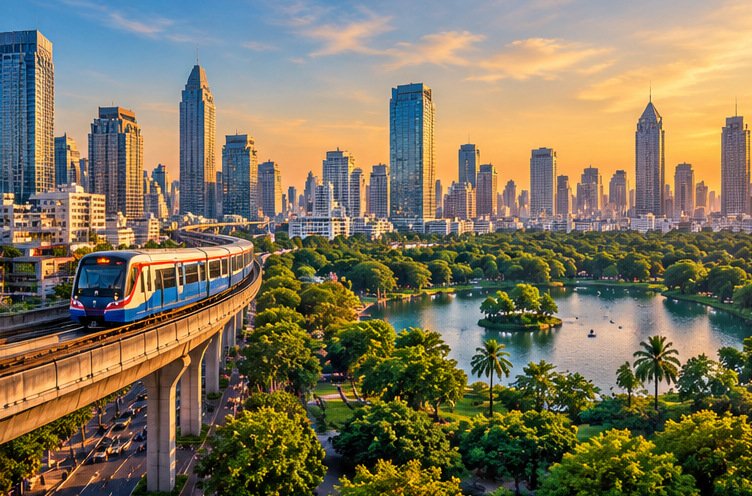
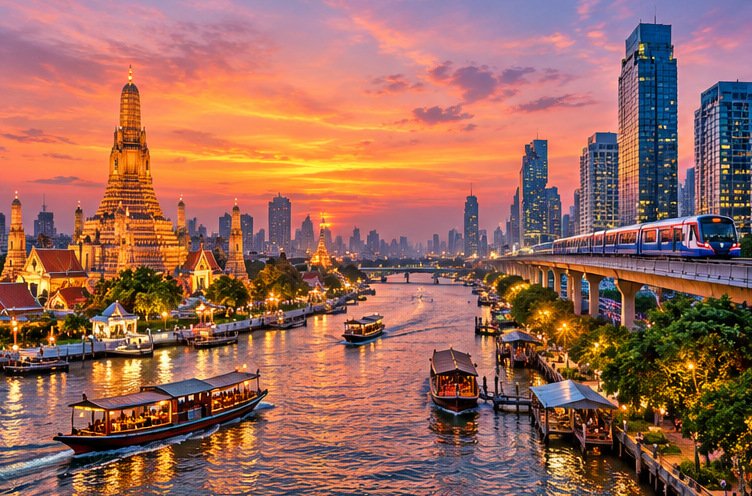
A conceptual Old Town and modern-Bangkok contrast; landmarks and transport are combined for illustration, not geographical accuracy.
Bangkok Old Town vs Sukhumvit is really a choice about what you want to find outside the hotel door. Old Town puts the historic city, river neighbourhoods and temple-focused days close to the centre of the trip. Central Sukhumvit makes modern shopping, varied restaurants and rail-based movement the easier everyday routine.
Neither choice works as a simple stereotype. Old Town is not all backpacker nightlife, and it is no longer accurate to describe the entire historic area as having no useful rail access. Meanwhile, Sukhumvit is not one compact neighbourhood: a hotel beside Asok and a property far down a side street can create very different holidays.
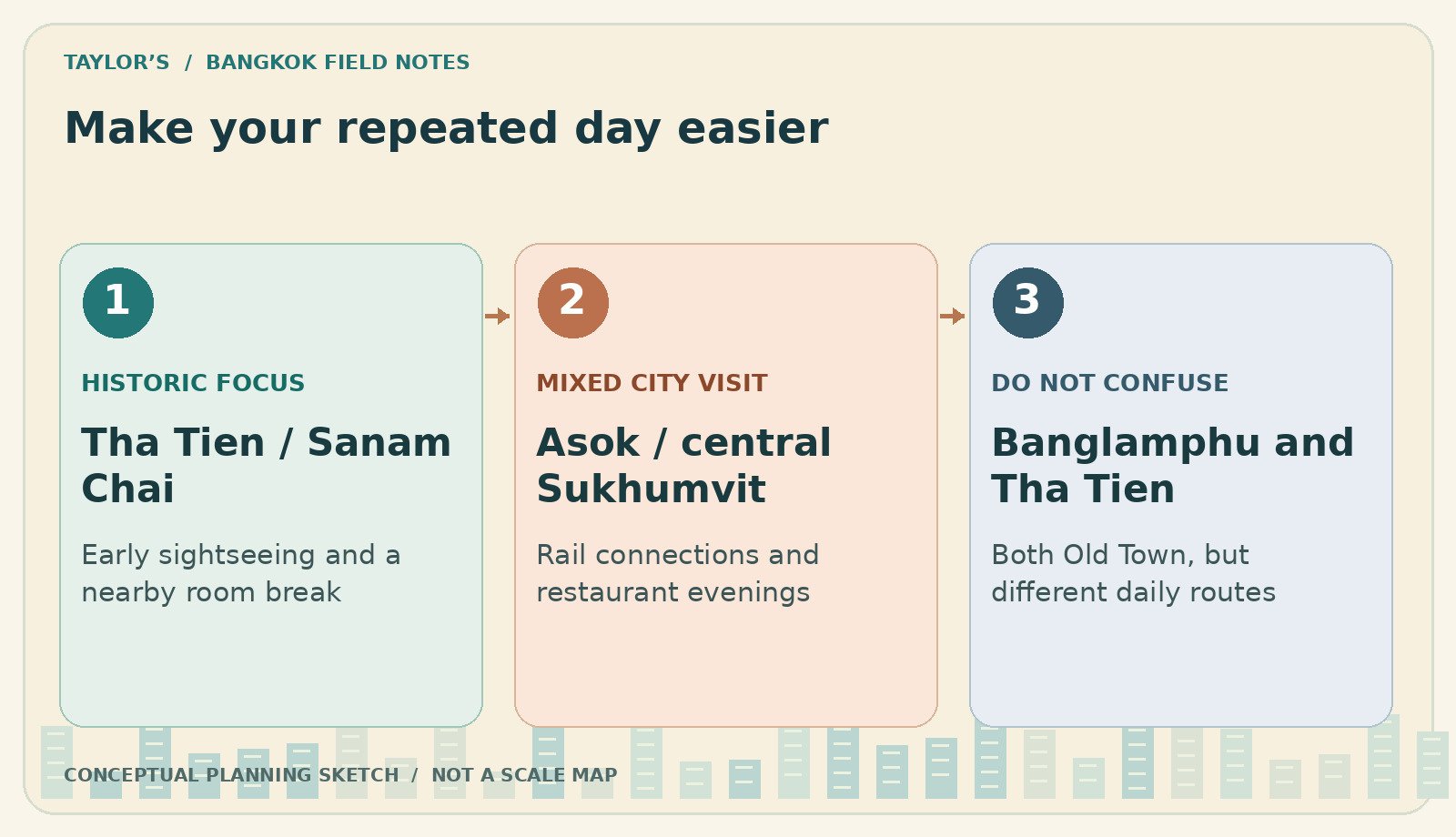
This comparison helps you choose the right small area rather than merely pick a side. It separates Tha Tien and Sanam Chai from Banglamphu, explains what Asok adds to a Sukhumvit stay, and looks at the actual cost of reaching the places you care about. Recommendations are research-led; hotel examples show location and booking questions, not claimed personal stays or an inspected quality ranking.
Tha Tien / Sanam Chai
Useful for the historic cluster you will revisit.
Asok
A modern base with a practical Blue Line route west.
Banglamphu
Choose it for its own streets, not assumed metro proximity.
Old Town has rail in parts
Sanam Chai and Sam Yot do not serve every hotel equally.
Bangkok Old Town vs Sukhumvit: what should drive the choice?
Choose the experience you want to repeat
Old Town is the stronger starting point when the Grand Palace, Wat Pho, the river and historic streets are the reasons you came to Bangkok. Being nearby can make an early start or a midday return to the room easier. However, that benefit depends on the particular hotel: Banglamphu and Tha Tien are not interchangeable walking bases. [1] [2] [3]
Choose central Sukhumvit when the stay mixes sightseeing with restaurant evenings, shopping and a preference for a familiar rail corridor. Asok's BTS-MRT interchange makes it more flexible than a generic Sukhumvit address suggests. You can visit the old city from there without making it the setting for every evening. [4]
| Question | Old Town | Central Sukhumvit / Asok |
|---|---|---|
| Main reason to stay | Historic sights and river-neighbourhood routine | Mixed city plans with restaurants, shopping and rail |
| Most relevant micro-area | Tha Tien / Sanam Chai for the southern historic cluster | Asok for BTS and MRT together |
| Different pocket to understand | Banglamphu is not beside the southern metro stops | Phrom Phong and deeper sois add a different daily pattern |
| Midday room break | Especially useful near the actual temple cluster | Especially useful during a modern-city or local hotel day |
| Rail access | Useful in parts, especially Sanam Chai / Sam Yot | Strong at Asok, but depends on the hotel walk |
| Potential frustration | Assuming every Old Town hotel has the same access | Assuming every Sukhumvit property is central |
Editorial comparison reviewed 3 October 2026; specific property locations determine the practical result.
How the recommendations were formed
This guide compares access to important sights, rail and river connections, the position of representative hotels and practical daily routines. It does not assume that historic streets are more authentic than modern neighbourhoods, or that a glossy shopping district offers a less worthwhile view of Bangkok. Both are parts of the same living city.
Decide where you want to wake up, where you expect to eat most evenings and how often you will return to the room during the day. Those repeated moments usually matter more than a single journey to a famous attraction. Then shortlist properties in a specific station or street area rather than searching the whole city at once.
Back to the guide ↑Old Town is several different hotel areas
Tha Tien and Sanam Chai
The southern historic area around Tha Tien and Sanam Chai is particularly useful for visitors interested in Wat Pho, the river and nearby palace-area sightseeing. BEM's official Sanam Chai station page identifies exits towards Museum Siam, Wat Pho, the Grand Palace area and river connections. This makes the claim that all Old Town hotels are isolated from rail too broad. [3]
Still, the station is not at every attraction entrance. A palace visit involves its own approach, queues and entry arrangements. Check the walk from your hotel to the exact entrance you need rather than treating the distance to a landmark's centre as the useful measurement.
Sam Yot and the eastern historic edge
Sam Yot can be a useful compromise for people who want an older urban setting with Blue Line access. It is a different base from sleeping directly beside the river, so judge it on the places you will reach on foot. A route towards historic streets may be convenient while a particular riverside restaurant still needs a separate journey. [5]
This kind of middle ground can work well for independent travellers who prefer a smaller hotel and do not need to look at a landmark from the room. Inspect room access, reception arrangements and the actual street as carefully as you would at a large property. Characterful surroundings do not answer practical accommodation questions.
Banglamphu, Khao San and the northern Old Town
Banglamphu is often included in broad Old Town searches, but it offers a different experience from Tha Tien. A hotel near Khao San Road may suit someone wanting a social evening environment, while another property several streets away can have a quieter immediate setting. The address is more informative than a general backpacker label.
The important transport distinction is that this northern pocket is not beside Sanam Chai or Sam Yot. Check the bus, boat, walking or road connection you would use before assuming the new metro access serves every Old Town property equally. An appealing room can still be worth that trade-off, but it should be a conscious choice.
Back to the guide ↑Central Sukhumvit: choose a usable section of a long corridor
Asok for a mixed sightseeing itinerary
Asok is the most useful Sukhumvit reference point for this comparison because it combines BTS Asok and MRT Sukhumvit. That gives you access along the modern shopping corridor and a Blue Line route towards Chinatown and the southern old city. The exact interchange and walking exits remain important with luggage or reduced mobility. [4]
Look at hotels within a comfortable walk of the station you will use most. A property described as Asok can still sit on a side street that changes the daily experience. The main road crossing, pavement condition and final entrance all deserve attention before you rely on a near-station description.
Phrom Phong for a hotel-and-neighbourhood rhythm
Phrom Phong can suit a stay in which shopping, restaurants and hotel facilities carry as much weight as the classic temples. It keeps you on the BTS corridor, although reaching the Blue Line adds another step compared with staying at Asok. That difference may be unimportant for one temple day and more noticeable for repeated old-city visits.
Compare the neighbourhood you would actually use. A hotel close to the main road can support an easy routine, while a more secluded property may require a shuttle or taxi more often. Neither is automatically better; the question is whether its advantages match your plans and walking tolerance.
Do not let a low rate move the goalposts
A hotel farther east may offer more space or a lower price, but it is no longer the same comparison as central Asok against Old Town. Add the extra rail time and any station transfer. Then decide whether the room improvement is worth it over the full stay.
This matters most on short visits. Saving a little on accommodation can be sensible, but repeatedly crossing the city to reach the reason you travelled there may not be. Start with a workable geography, then optimise the room rather than allowing search results to define the itinerary backwards.
Back to the guide ↑The temple-day advantage of sleeping in Old Town
Early starts are useful when they are genuinely early
Being near the sights can reduce the effort of arriving around opening time, but you still need current entry information. The Grand Palace's official site checked on 3 October 2026 lists opening from 08:30 to 16:30, ticket sales until 15:30 and a 500-baht foreign-visitor ticket. The official calendar can change access on particular dates, so check it before planning the morning. [1] [6]
Staying nearby is helpful when you will use that advantage. If your group prefers a long breakfast and leaving the hotel late, the location will not create an early start by itself. Consider whether the hotel's breakfast hours and your normal pace fit the plan before paying more for proximity.
A room break can be more valuable than another temple
After a substantial morning, returning to a nearby room can make the afternoon more enjoyable. It gives you somewhere to cool down, change clothes and decide whether to continue. This is particularly useful for children, older travellers or anyone who finds a full day of exposed walking tiring.
However, calculate the real return walk. A hotel at the northern end of Old Town may not provide the quick break you imagined after visiting Wat Pho. The district's overall closeness to historic sights is less useful than closeness to the specific cluster on that day's itinerary.
Dress and access still need preparation
Follow the attraction's current dress requirements and take the layers you need with you. The Grand Palace and active temples have their own entry rules; being nearby does not make those rules interchangeable or optional. Choose clothing that remains comfortable for the walk as well as appropriate for the site. [7] [2]
If an unsolicited person says an attraction is closed, verify with official staff or the official calendar before changing the day. Do not accept a replacement shopping or touring arrangement simply because it is presented confidently near the entrance. Keep control of the plan and use clearly identified official information.
Back to the guide ↑You can still visit the old city easily from Asok
The Blue Line changes the comparison
MRT Sukhumvit provides a route towards the Blue Line's old-city stations, including Sam Yot and Sanam Chai. That makes Asok a credible base for a first visit combining historic sights with modern-city evenings. It is more useful to understand this connection than to repeat the outdated idea that choosing Sukhumvit means using taxis for every temple day. [4] [3]
The remaining trade-off is door-to-door time. You still walk to the station, buy or use the correct ticket, wait, ride and walk to the attraction. A direct network connection is not the same as stepping out of an Old Town hotel near your first stop.
Build a full cluster before returning
From Sukhumvit, group the old-city sights into one coherent day rather than making separate return trips for the palace, a river meal and a temple. Add Chinatown in the evening only when the group has enough energy and you have checked the route home. A full-day plan should include a place to sit, not just more stops.
As editorial planning allowances, keep roughly forty-five to seventy-five minutes for many central Asok-to-old-city door-to-door journeys, depending on the actual hotel and attraction. These are not train running times or guarantees. A room directly beside the station and a sight close to Sanam Chai can perform differently from a deep-soi hotel and a distant entrance.
| Starting point | Useful approach | The overlooked final section |
|---|---|---|
| Tha Tien-area hotel | Walk where the chosen sights genuinely fit | The precise attraction gate and any compound perimeter |
| Sanam Chai-area hotel | Walk locally; Blue Line for farther outings | The station exit appropriate to the destination |
| Banglamphu hotel | Confirm local road, bus, boat or walking plan | It is not the same walk as staying at Sanam Chai |
| Asok hotel | MRT towards Sam Yot / Sanam Chai as appropriate | Allow roughly 45-75 minutes door to door for many old-city trips |
| Deep-soi Sukhumvit hotel | Reach the useful station first | Add the local shuttle, road transfer or longer walk |
Routes are planning suggestions checked against operator maps. The time range is an editorial allowance prepared 3 October 2026, not a timetable guarantee.
When road transport is the sensible answer
A taxi or private vehicle can be useful with awkward luggage, limited mobility, a late return or a group whose destination is not near rail. Check the pickup point and final address clearly. During congested periods, convenience may mean fewer walking changes rather than a shorter journey.
Do not compare a quiet-hour car estimate with a busy-hour rail route. Use live information and add room for delays. A paid transfer is most valuable when it solves a specific problem, not when it is bought automatically for a trip the group would find straightforward by metro.
Back to the guide ↑River access: atmosphere and transport are separate benefits
A river view does not establish a useful route
A room facing the Chao Phraya may be attractive even when you never take a boat. That is a valid accommodation choice, but it should be priced as a room experience rather than assumed transport convenience. The nearest visible pier may not serve the route or time you need.
Check the operator, pier name and direction. The tourist boat and commuter services have different tickets and stopping patterns. Official tourist-boat information lists several Old Town and riverside stops, but current operating details should be confirmed for the day rather than inferred from a view across the water. [8]
Crossing to Wat Arun is not the same as walking to it
Wat Arun is on the opposite bank from Tha Tien and Wat Pho. A view of the temple from an Old Town hotel does not mean the entrance is directly outside. Plan the current cross-river or other transport arrangement and leave time for boarding and the walk after arrival. [9]
For an evening viewpoint or restaurant, clarify whether the reservation is on the bank you intend to visit. Similar landmark names can conceal different locations. Send the precise venue pin to your travel companions so that the group does not discover the river separating two meeting points at dinner time.
Leave an alternative to the last boat
River services are useful but should not be the only way you know how to get home. Check the final departure before settling into a long meal, and keep a rail or road alternative available. Weather or a changed stopping pattern can make a familiar-looking plan less straightforward.
A hotel shuttle boat also needs its own timetable. Ask whether it runs on demand, whether reservations are required and which public transport point it reaches. A free shuttle has limited practical value if its operating window does not match your evenings.
Food and nightlife: decide where dinner belongs
Old Town for meals attached to the neighbourhood
Old Town can make food feel part of the day's exploration rather than a separate evening commute. Choose a small area around the hotel, a confirmed river restaurant or a daytime market that fits the route. However, businesses have individual hours, and a lunch-focused shop is not necessarily an evening fallback. [10]
Khao San's nightlife and Tha Tien's river setting are different reasons to stay. Do not book a hotel in one and expect the other to be immediately outside. For a quiet trip, inspect the surrounding streets and the room orientation rather than assuming every historic-area property is peaceful.
Sukhumvit for repeated restaurant choice
Sukhumvit is useful for travellers planning several restaurant-led evenings and wanting easy alternatives if one venue is full. Indoor shopping-centre dining can also help when heat, rain or mixed preferences make a more complicated food outing unattractive. Terminal 21's current directory gives a concrete example around Asok. [11]
Nevertheless, the address matters here too. A restaurant in Thong Lo is not necessarily close to your Asok hotel, and being somewhere on Sukhumvit Road does not eliminate the need for a taxi down a long side street. Save the actual dinner locations before choosing the hotel for their supposed convenience.
Make the evening journey count
Choose the base closest to the evenings you expect to repeat, then travel for occasional special meals. A single sunset reservation in Old Town does not automatically justify sleeping there for a week. Conversely, one shopping afternoon in Siam should not pull a temple-focused three-night stay away from the historic area.
For a mixed-interest couple, alternate evenings rather than trying to satisfy every preference each night. One local meal, one destination dinner and one flexible evening can work from either base. Keeping the final evening simple also leaves more room for packing and an orderly departure.
Back to the guide ↑Accommodation examples: four addresses, four different propositions
Riva Arun for the Tha Tien side
Riva Arun's official location information places it on Maharaj Road in the historic riverside area, with Sanam Chai as a nearby rail reference. It is useful as an example of an Old Town stay that combines historic sights and access towards the metro. The hotel's own distance claims should still be tested against the walking route you need. [12]
Do not assume every room has the same view, size or facilities. A river-facing category and an entry-level room may provide different experiences at the same property. Check the actual booked room, lift arrangements and access with luggage rather than treating the hotel's best photograph as the booking description.
Nouvo City for Banglamphu
Nouvo City's official contact page places it on Samsen Soi 2 in Banglamphu. That makes it a useful contrast with Tha Tien: both can appear in Old Town searches, yet they support different walking patterns and station access. The hotel describes itself as halal-certified; travellers for whom that matters should confirm the current services and their own requirements directly. [13]
Evaluate the surrounding streets, room choice and transfer plan on their own merits. The purpose of this example is not to imply that Banglamphu and the southern historic area are equally close to every temple. It is to show why one Old Town label needs a more precise map decision.
A station-linked option in Asok
Grande Centre Point Terminal 21 describes direct access to BTS Asok and its position above the shopping centre. This illustrates a modern convenience-led hotel proposition rather than a historic neighbourhood stay. Use the property's official information for facilities and the exact room description, but cross-check airport directions against the transport operator; even hotel websites can retain confusing or dated travel text. [14]
Compare the value of that connection with how often you will use it. If most evenings are in Old Town and every day is temple-focused, modern facilities may not compensate for the repeated journey. If the itinerary is mixed, the interchange can be an excellent reason to choose Asok.
A smaller hotel can also be the right answer
You do not need one of these named properties to follow the location advice. A smaller hotel nearby may suit the budget and style better. Use the examples as map anchors, then compare recent information on room conditions, reception hours, stairs, noise and cancellation terms.
Avoid turning star ratings into a substitute for needs. A simple property with a good bed, a useful location and clear access can be a better personal choice than a larger hotel with facilities you will not use. Equally, a pool, lift and dependable breakfast can justify paying more for the right group.
Back to the guide ↑Cost comparison: the room and the route belong together
Do not equate Old Town with cheap
Old Town contains different accommodation styles, from simple guesthouses to higher-priced boutique or riverside stays. Sukhumvit also covers a wide range. Without identical dates and room requirements, saying one district is cheaper provides little help with a real booking.
The following calculations are hypothetical examples prepared on 3 October 2026. They show how transport can affect the comparison and are not current offers, measured averages or predictions of the price you will find.
| Planning item | Nearby historic-area hotel | Lower-priced modern-base example |
|---|---|---|
| Assumed nightly room | 2,900 baht | 2,650 baht |
| Four-night room total | 11,600 baht | 10,600 baht |
| Extra cross-city travel in this example | 0 incremental trips counted | 2 adults x 3 return outings x 100 baht = 600 baht |
| Example subtotal | 11,600 baht | 11,200 baht |
| Remaining judgement | Are the nearby room breaks useful? | Is the 400-baht example saving worth the additional journeys? |
Hypothetical arithmetic prepared 3 October 2026, not current offers or actual district averages. The 100-baht return allowance per adult is a modelling assumption; all other trip costs are excluded equally.
Count a return-to-room habit
A traveller who stays out all day may manage well from either area. Someone who returns to the hotel after lunch and goes out again for dinner makes more journeys. That difference can alter both the cost and the value of a central location.
Write down one ordinary day rather than an idealised sightseeing marathon. Include breakfast, the first outing, a break and the evening meal. Then ask how the hotel location changes that day. Repeating the calculation for each day is often more informative than comparing a single airport fare.
Check the conditions behind the total
Match cancellation flexibility, breakfast, taxes, guest ages and bed requirements. A lower headline rate may exclude something the other listing includes. A room that allows extra occupants may still charge for an additional bed or breakfast, so enter the group accurately and confirm the final amount.
For a boutique property, pay particular attention to access and check-in times. For a large hotel, make sure the booked category and any advertised facility are available during your stay. The practical room details should remain visible beside the attractive area description.
Back to the guide ↑The airport and luggage question
A direct road transfer may be worth it on arrival
Old Town can be perfectly workable for an arrival when you arrange the final journey sensibly. AOT lists official taxi and other transport options from Suvarnabhumi, including the S1 bus towards the Khao San-Sanam Luang area. Check current boarding and operating information rather than assuming the same service suits every Old Town hotel. [15]
Rail can be convenient for a central Sukhumvit hotel, but it still involves city connections and the final station walk. A family with several bags or a traveller arriving late may prefer a vehicle in either area. Judge the transfer for that day, not as a contest between districts.
The hotel entrance can be the difficult part
Ask where a car can stop and whether staff can help with luggage. A charming small lane may be awkward for a large vehicle, while a hotel on a major road may have an entrance reached from a different street. Send the driver the confirmed pickup or drop-off point rather than only the postal address.
For an early departure, book the transport the previous day and work backwards from the airline's required arrival time. Keep a buffer for the route and the vehicle pickup. Do not rely on a single optimistic navigation estimate made at a different time of day.
Back to the guide ↑Rain, heat and mobility: compare the actual paths
Old streets and modern streets both require checking
Older areas may involve uneven surfaces, narrow pavements and exposed walking, but modern Sukhumvit streets can also have awkward crossings and congested footpaths. Neither label establishes a step-free or comfortable route. Check the entrance-to-station path that you will repeat.
For wheelchair users or travellers with limited mobility, ask about gradients, kerbs, steps and lift access inside the hotel as well as nearby transport. A short distance is not sufficient information. Request photographs or a clear description of the route when the answer will determine whether the stay works.
A midday retreat changes the itinerary
Choose the area that lets you take realistic breaks near the activities you most want. Old Town may be more comfortable for a temple-focused day with a room nearby; Sukhumvit may make an indoor shopping-and-dining day easier. There is no need to force the same base to excel at every possible outing.
Check weather and attraction notices before committing to a long exposed day. Move the more demanding walking earlier when conditions favour that choice, and leave room to replace an outdoor stop. An itinerary that can shrink gracefully is more useful than a list that only works in perfect conditions. [16]
Back to the guide ↑Which base suits your kind of visit?
Two or three nights focused on the classic sights
Choose the southern Old Town if the palace, Wat Pho and the river account for most of your plans. Staying near the right cluster can reduce repeated travel and support an early start. Keep one modern-city evening optional rather than travelling across Bangkok every night to prove you have seen both sides.
If the short visit is mainly shopping, restaurants and one temple day, central Asok is the more natural pattern. Use the Blue Line for the old-city outing and spend the other days close to the activities you actually value. A first visit does not require the same base for every traveller.
Families who need room breaks
Choose according to where the break needs to happen. A family spending two days around historic sights may appreciate a nearby Old Town room; another family planning malls, indoor attractions and varied meals may prefer central Sukhumvit. In both cases, bedding and access deserve confirmation before atmosphere.
Avoid assuming that all children want the same itinerary. A shorter temple morning followed by a pool can work beautifully, but only if the transfer back is realistic and the booked hotel actually provides the facilities you expect. Use the least comfortable journey as the test, not the best-looking photograph.
Return visitors and longer stays
Return visitors can choose a neighbourhood for its everyday rhythm rather than proximity to the standard sights. Old Town may reward someone interested in smaller streets, food and river life; Sukhumvit may suit a longer restaurant, shopping or work-oriented stay. Both choices become stronger when tied to specific routines.
For a week or more, include laundry, storage, workspace and noise in the decision. The fascination of a district should not hide an uncomfortable room. Consider whether the base still feels practical on a day when you are tired, it is raining and you simply want a quiet meal nearby.
Back to the guide ↑Should you split your Bangkok stay?
Usually not during a short continuous visit
A hotel move costs packing, checkout, transport and another check-in window. Even when the two areas are not far apart on the map, that can consume a useful part of the day. For three or four nights, one well-chosen base is usually simpler than trying to perfect the location for every outing.
A split becomes more reasonable when the hotels themselves are part of the experience or the stay is long enough to justify distinct phases. Move once with a clear purpose rather than switching because of uncertainty. Arrange luggage storage and avoid attaching a fixed activity to the uncertain check-in period.
Two separate Bangkok visits are different
When Bangkok appears at both ends of a Thailand holiday, choosing Old Town first and Sukhumvit later can provide variety without an extra mid-stay move. A historic first section and a shopping-oriented final section may align naturally with the trip's different needs.
Alternatively, keep the familiar base if simplicity matters more. Returning to a hotel whose entrance and nearby food you already know can be valuable before the flight home. Variety is optional; it should improve the travel experience rather than become another obligation.
Back to the guide ↑Pros and cons of each choice
Old Town: the practical balance
The strengths are proximity to the right historic cluster, an engaging setting for river and neighbourhood exploration, and the possibility of easier early starts. The Sanam Chai and Sam Yot areas also provide a rail option that broad descriptions sometimes overlook. A carefully located hotel can make a temple-focused visit feel less rushed.
The drawbacks depend on the pocket: rail may be less convenient in Banglamphu, small properties may have access limitations, and nightlife or road noise can still be an issue. Evening food choices and opening hours require some checking. Old Town is a strong specific choice, not a universal shortcut to every attraction.
Sukhumvit: the practical balance
The strengths are a useful restaurant and shopping routine, varied accommodation and flexible transport around Asok. It can support a mixed itinerary without making historic sightseeing impossible. A station-linked hotel is particularly attractive when the group values predictable movement and indoor alternatives.
The drawbacks are the size of the corridor, side-street distances and the temptation to assume every Sukhumvit property offers the same convenience. Repeated temple days can also create travel you would avoid by staying closer. The right section matters at least as much as the decision to choose Sukhumvit itself.
Common mistakes that change the whole stay
Treating Khao San as all of Old Town
Banglamphu, Tha Tien and Sam Yot have different transport and evening patterns. Choose the small area that fits the purpose of the stay. A hotel description that simply says Old Town is not enough to establish the right base.
Assuming the nearest rail station serves every entrance
Check where you leave the station and where you enter the attraction. Walking around a large compound can add meaningful distance. With mobility needs, the accessible exit may also differ from the nearest exit on a general route map.
Paying for a view you have not actually booked
A hotel photograph may show a premium room, rooftop or restaurant rather than your room category. Read the booking description and confirm the view when it is central to the purchase. Do not let a landmark photograph replace the room details.
Overplanning both sides of the city every day
Group historic sights together and modern-city activities together. Constantly crossing between Old Town and Sukhumvit can make either base feel inconvenient. The solution is often a better daily route rather than a different hotel.
Back to the guide ↑Frequently asked questions
Is Old Town better than Sukhumvit for a first Bangkok trip?
It is better suited to a short visit dominated by the palace, temples and river neighbourhoods, particularly when the hotel is in the southern historic area. Central Sukhumvit is more natural for a mixed stay with shopping, restaurant evenings and one or two historic days. Choose the routine you expect to repeat rather than treating first-time visitor as one fixed travel style.
Does Old Town have MRT access?
Parts of it do. Sanam Chai and Sam Yot are useful Blue Line stations for the southern and eastern historic area. That does not put every Banglamphu or Khao San hotel beside the metro. Check the specific property and final walk before relying on the general statement that Old Town now has rail. [3] [5]
Is it difficult to visit the Grand Palace from Asok?
It is manageable with a planned rail-and-walk or road route, but it is not the same as staying nearby. Allow time at both ends of the journey and check the official palace calendar before departure. Group the visit with nearby sights rather than making several separate cross-city trips during the same short stay.
Is Old Town always quieter at night?
No. The atmosphere changes between streets and hotel settings, and the Khao San area has a different evening pattern from some riverside pockets. Check nearby businesses and recent room-specific reviews. A historic location is not a guarantee of quiet sleep, just as a modern Sukhumvit address does not automatically mean a noisy room.
Can I stay in Sukhumvit and have dinner beside the river?
Yes, but choose the exact restaurant and bank before planning the journey. Leave a return option that does not depend on an unverified final boat. A special river evening can be a worthwhile outing from Sukhumvit without making a riverside hotel necessary for the whole stay.
Which area is best with large suitcases?
The hotel entrance and transfer matter more than the district. Ask about vehicle access, steps and luggage help, and check whether the rail route is realistic for your bags. A direct road transfer can simplify arrival in either area. A small Old Town lane and a deep Sukhumvit soi can both require more thought than their map distance suggests.
Back to the guide ↑My recommendation: stay beside the Bangkok you came to see
Choose Tha Tien or a workable Sanam Chai-area hotel when the historic city is the centre of a short trip. Choose Asok when you want a flexible modern base with a practical route to the old city, rather than a hotel beside the temples. Consider Banglamphu for its own atmosphere, not as a substitute for every other Old Town location.
Then check the room, entrance and daily routes before paying. A well-matched hotel in either area can support a memorable Bangkok stay. The most useful decision is not whether historic Bangkok or modern Bangkok is better, but which one you want to make effortless and which one you are happy to travel to.
Back to the guide ↑Sources and fact-checking notes
Official palace information and BEM station maps support the practical facts. Hotel descriptions are used as address examples, not first-hand reviews. Quoted admission is dated; hotel budgets and journey ranges are explicitly hypothetical or editorial.
Editorial review: 3 October 2026. Search and comparison links do not guarantee a particular product, room, departure or price. Confirm the final details with the operator before paying.
- The Grand Palace: official opening and ticket information
Published 500-baht foreign-visitor admission, opening and ticket-sale times checked 3 October 2026; check the separate calendar for exceptions.
- Wat Pho: official temple website
Consult the temple for current visiting and dress information. No unverified admission fee is quoted.
- BEM: MRT Sanam Chai station and exits
Official or first-party information checked 3 October 2026; confirm operating details for your date.
- BEM: MRT Sukhumvit station and connections
Official or first-party information checked 3 October 2026; confirm operating details for your date.
- BEM: MRT Sam Yot station
Official or first-party information checked 3 October 2026; confirm operating details for your date.
- The Grand Palace: official visitor calendar
Check your actual date for restricted access or closures.
- The Grand Palace: practical information and dress requirements
Official or first-party information checked 3 October 2026; confirm operating details for your date.
- Chao Phraya Tourist Boat: official operator
Use the operator for current piers and operating times. This is not the same ticketing system as commuter express boats.
- Tourism Authority of Thailand: Wat Arun
Temple and river-bank location; check current crossing arrangements separately.
- Tourism Authority of Thailand: Nang Loeng Market
Market-level information; individual vendor days and sell-out times differ.
- Terminal 21 Asok: Pier 21 directory
Official or first-party information checked 3 October 2026; confirm operating details for your date.
- Riva Arun Bangkok: official location and neighbourhood
Location example, not a reviewed recommendation. Verify the usable walking route and booked room category.
- Nouvo City Hotel: official address and contact
Banglamphu location example; certification and facilities are the hotel's own descriptions and should be reconfirmed as needed.
- Grande Centre Point Terminal 21: official hotel information
Used for the Asok connection and hotel context. Confusing airport text elsewhere on the site is not used as route guidance.
- Airports of Thailand: Suvarnabhumi transport guide
Consult the airport for current boarding arrangements; no guaranteed road journey time is assumed.
- Thai Meteorological Department: forecasts and warnings
Consult current official forecasts before travel. No live weather prediction is made in this guide.
Illustrations in this article were created for Taylor’s Trailblazing Travels. Third-party photographs, where used, are credited beside the image or in the source list.