Bangkok day-trip guide
A realistic one-day plan for Thailand’s former capital, with current train guidance, monument fees, route timing, local transport, tour comparisons and practical advice for the heat.
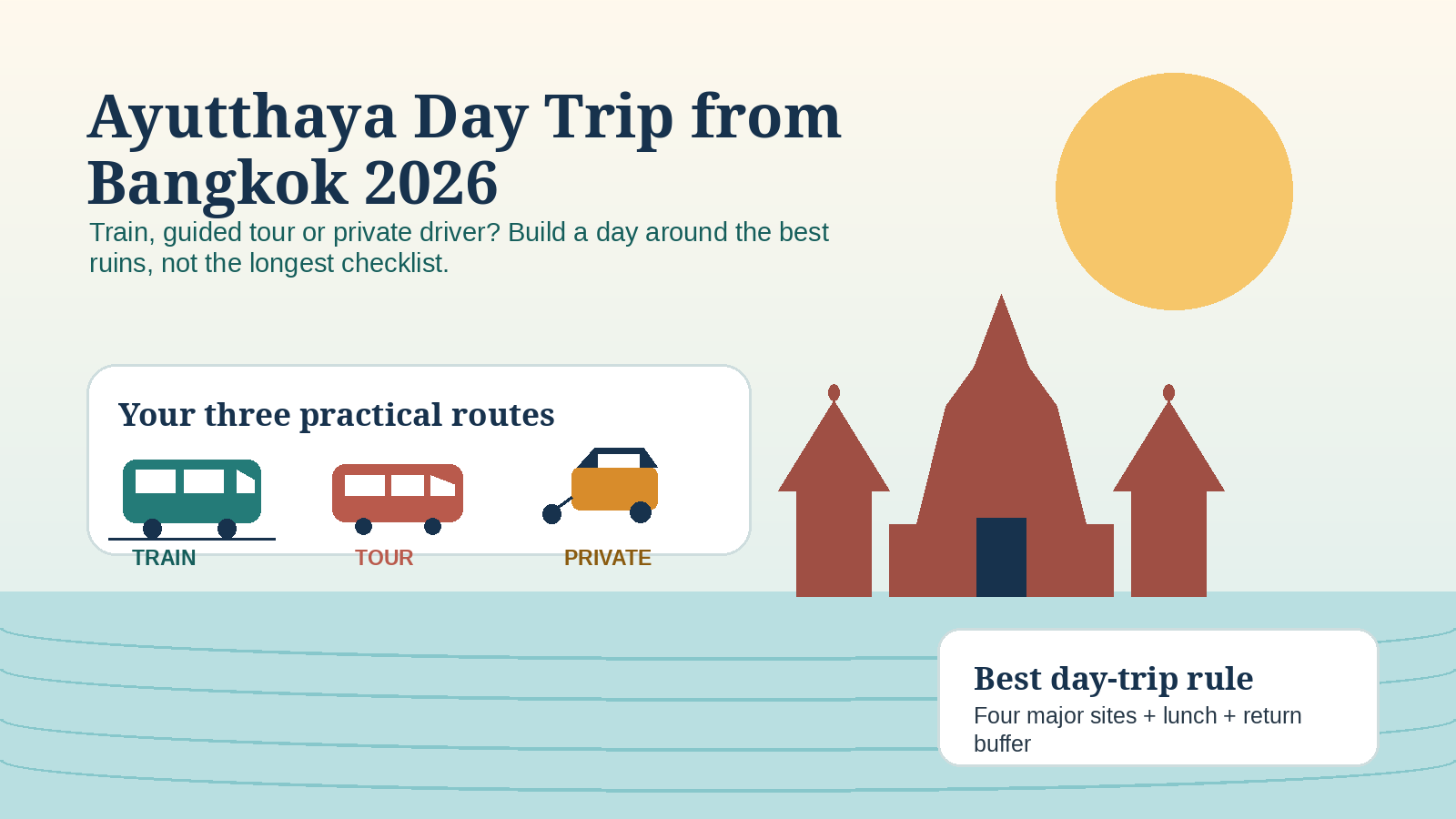
An Ayutthaya day trip from Bangkok can be one of the easiest ways to add serious history to a Thailand itinerary. The UNESCO-listed ruins sit about 86 kilometres north of the capital, yet the day feels very different from Bangkok: brick prangs rise above grass and trees, former royal compounds reveal the scale of the old city, and the rivers still explain why Ayutthaya became a major trading centre.
The difficult part is not deciding whether Ayutthaya is worth visiting. It is building a day that does not become a rushed sequence of hot temple stops. Trains are inexpensive but leave you to organise transport after arrival. Group tours remove most of the logistics but vary in pace and historical depth. A private driver gives flexibility, although a driver is not automatically a licensed guide.
This guide compares those choices door to door, then provides a route that works in real life. It also explains the 2026 monument fee shown on the current Fine Arts Department map, the newer Bangkok Connex railway trial, museum hours, realistic local transport costs and what to do when the afternoon heat changes the plan.
Best for most first-timers
A guided small-group tour with an early Bangkok departure and no more than four or five major sites.
Cheapest practical option
An ordinary or commuter train plus a locally negotiated tuk-tuk route shared between two or more people.
Time needed
Allow roughly 11 to 13 hours from leaving a central Bangkok hotel to returning, including transfers and waiting time.
Current monument planning price
The Fine Arts Department’s current map lists 80 baht per foreign visitor per ticketed site or 300 baht for a combined pass.
Ideal temple count
Four major sites, plus either the museum, a local-food stop or a quieter fifth temple.
What to book first
A peak-date tour or private vehicle; otherwise confirm the live outward and return train options before setting the day.
Is Ayutthaya worth a day trip from Bangkok?
Yes, particularly for travellers interested in Thai history, architecture or photography. Ayutthaya was founded around 1350, became the second Siamese capital and developed into an international centre connected to global diplomacy and trade. The city was attacked and largely destroyed in 1767; its surviving ruins were inscribed on the UNESCO World Heritage List in 1991. [1]
What makes the experience different from Bangkok’s temples?
Bangkok’s major temples are living religious complexes with elaborate decoration and active worship. Ayutthaya is more archaeological. Visitors move through exposed brick foundations, headless Buddha images, chedis, prangs and the remains of royal spaces. That difference makes the destination complementary rather than repetitive.
What a day trip can and cannot do
A well-planned day is enough to understand the former capital, visit four major sites, eat locally and return to Bangkok without an overnight stay. However, one day cannot cover the wider province, Bang Pa-In Palace, every riverside temple, the museum and a sunset cruise comfortably. Trying to include all of them usually produces more driving than discovery.
Who may prefer another day trip?
Travellers who dislike ruins, have little interest in history or struggle badly with exposed heat may enjoy a different excursion more. Ayutthaya has limited shade at several key sites, and much of its appeal comes from understanding what the fragments once represented. A guide, audio material or a museum stop can make a large difference.
Train, tour or private driver: the options at a glance
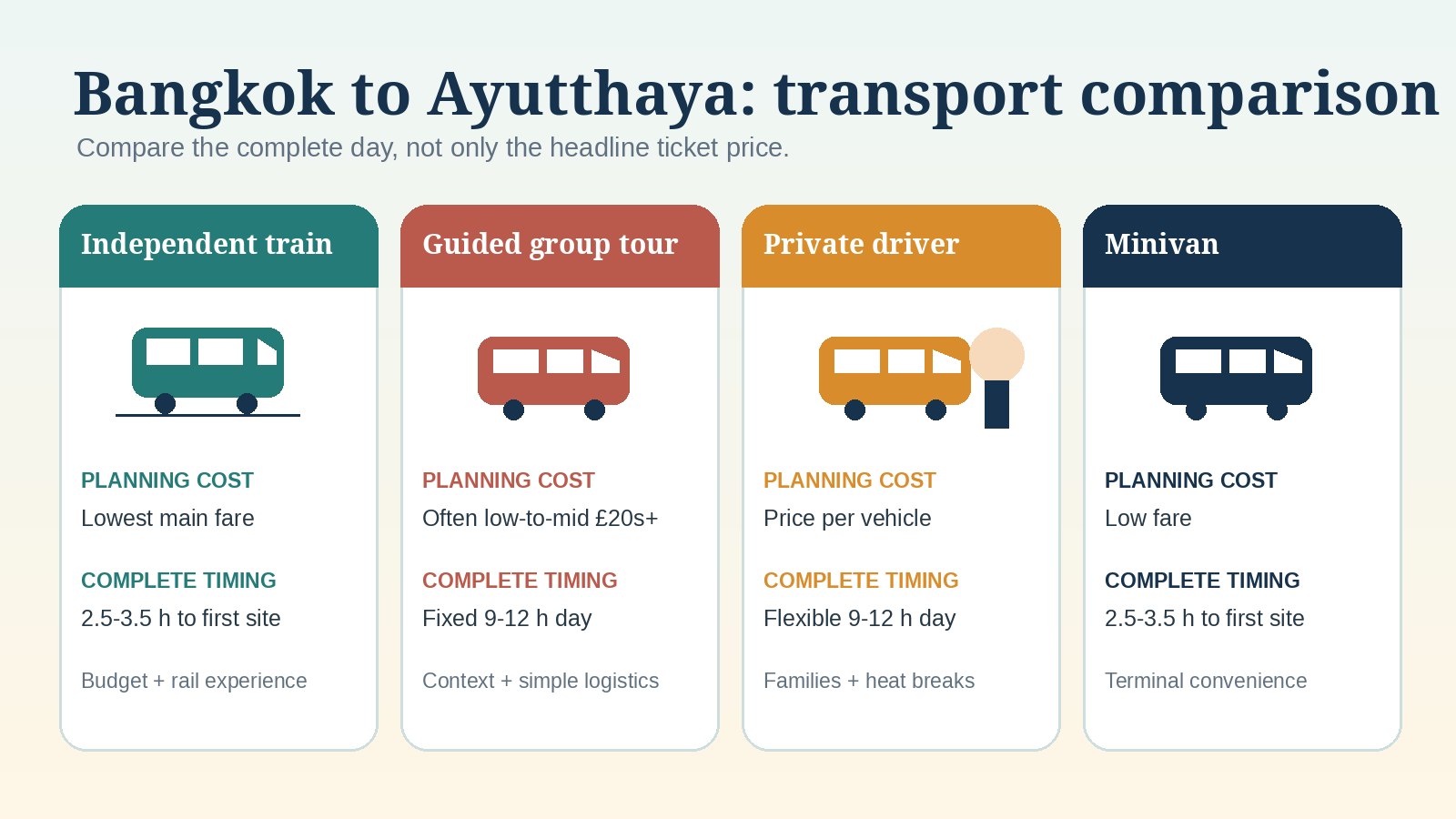
The right choice depends on more than the advertised journey time. Compare the full day: getting from the hotel to the departure point, waiting, travelling, moving between Ayutthaya sites and returning from the final stop.
| Option | Realistic Bangkok-to-first-site time | Planning cost | Best feature | Main drawback |
|---|---|---|---|---|
| Independent train | About 2.5-3.5 hours including hotel transfer, waiting and local transport | Low rail fare, then local tuk-tuk or bicycle cost | Cheap, flexible and memorable | You must solve the last kilometre and protect the return plan |
| Shared guided tour | Usually 2-3 hours from hotel departure or meeting point to the first visit | Current listings often begin around the low-to-mid £20s per person | Simple logistics and historical context | Fixed pace, group waiting and variable inclusions |
| Private driver | Often 1.5-2.5 hours depending on pickup and traffic | Usually priced per vehicle; useful value for three or four people | Flexible route, luggage space and air-conditioned breaks | A driver may provide transport only, not historical interpretation |
| Private driver plus licensed guide | Similar to a private driver | Highest cost of the main options | Best balance of flexibility and understanding | Needs advance booking and careful inclusion checks |
| Minivan | About 2.5-3.5 hours after Bangkok terminal transfer and local connection | Generally inexpensive | Frequent departures on some days | Less space, uncertain drop-off and weaker sightseeing flow |
The practical decision I would use
Choose a guided group tour when this is your first substantial Thai historical site and you want the day to work without local negotiation. Choose the train when budget and independence matter, but commit to an early start and a return backup. Choose a private vehicle when three or four people can share the cost, when mobility or heat is a concern, or when photography means you want to wait for better light.
Important Ayutthaya travel updates for 2026
Current historical-park prices are higher than many older guides show
The current English map published by the Fine Arts Department lists Ayutthaya Historical Park as open daily from 08:00 to 18:00. It shows a foreign visitor price of 80 baht for a single ticketed monument and 300 baht for a combined pass. Thai visitor prices are listed as 10 baht per site or 40 baht combined. [3]
Many older articles still quote 50 baht per monument and 220 baht for a pass. Even an older official QR page may surface in search results with earlier figures. For planning, use the newer park map, then confirm the price and included sites at the first staffed ticket office.
The Chao Sam Phraya museum also has conflicting official pages
The current English contact page lists daily opening from 09:00 to 16:00 and a foreign admission fee of 200 baht. An older Thai service page still displays 150 baht. The newer page is the safer planning figure, although checking before travel remains sensible. [6]
Bangkok Connex is a trial service, not a permanent promise
State Railway of Thailand introduced an air-conditioned KIHA 40/48 feeder trial between Don Mueang and Ayutthaya on 20 April 2026. The official announcement describes six weekday trains per day during an initial six-month period running to 31 October 2026, with stops including Rangsit, Thammasat University, Bang Pa-In and Ayutthaya. [5]
Later timetable information expanded the concept toward Krung Thep Aphiwat, but this remains a developing trial. Therefore, do not build a future trip around a screenshot. Search the live SRT timetable for the actual date or call hotline 1690.
Construction and station arrangements can change the experience
Rail infrastructure work continues around the wider corridor. Platform access, stopping patterns and station approaches may change. Arrive with enough time to read the departure board and ask staff, especially when a train number or Bangkok station differs from the route you expected.
How to travel from Bangkok to Ayutthaya by train
The train is the most characterful independent option and can be extremely cheap. It is not automatically the fastest door-to-door choice, because Bangkok’s station transfer, waiting time and the journey from Ayutthaya station to the ruins all count.
Which Bangkok station should you use?
| Bangkok departure point | Best for | Typical service type | Planning note |
|---|---|---|---|
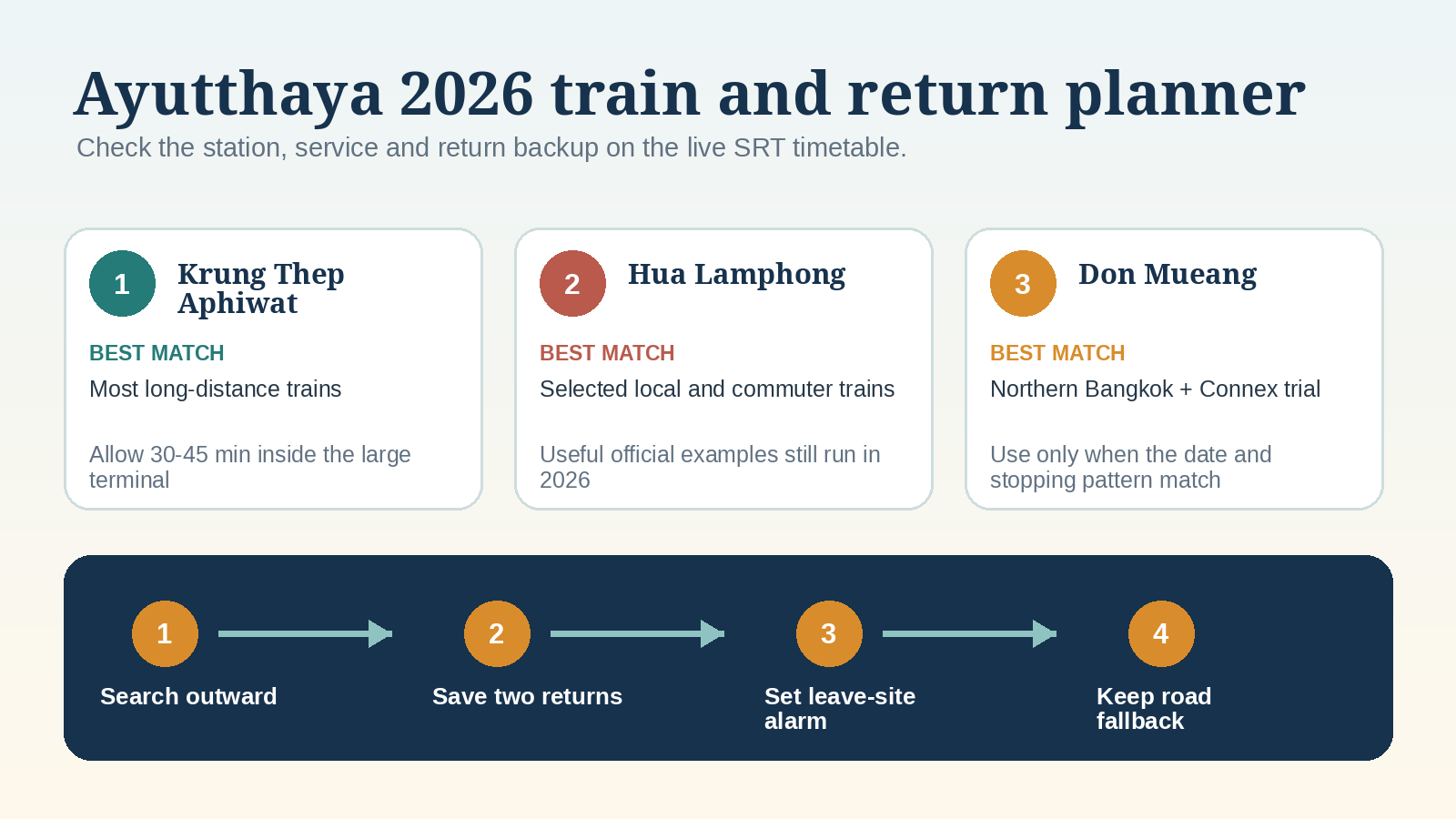
| Krung Thep Aphiwat Central Terminal | Most travellers using current long-distance Northern and Northeastern line services | Ordinary, rapid, express and special express trains | Large terminal linked to the Red Line and MRT via Bang Sue; allow time to find the correct area |
| Bangkok Hua Lamphong | People staying near the old station and using selected commuter or ordinary trains | Several local and ordinary services | The official timetable still lists services, but many long-distance trains no longer start here |
| Don Mueang | Travellers near the airport or northern Bangkok | Regular Northern line trains plus the 2026 Connex trial | Convenient only when the live timetable matches the day and stopping pattern |
Useful official timetable examples
The 2026 SRT timetable for Hua Lamphong to Ayutthaya shows how cheap local rail can be. For example, commuter train 303 is listed at 04:15-05:48 with a fare around 15 baht, while several later ordinary and commuter trains take roughly 1 hour 38 minutes to 1 hour 59 minutes. These are examples, not a recommendation to take a 04:15 departure. [4]
For a more practical tourist start, search Krung Thep Aphiwat to Ayutthaya on the official timetable and compare trains arriving around 08:00-09:15. The best departure is the one that lets you reach the first monument before the strongest heat without forcing an unsafe or exhausting hotel checkout.
How to buy the ticket
- Search the route on the official SRT timetable first, because it shows the Bangkok station, train number, class and planned time.
- Check SRT D-Ticket when the selected service is eligible for online booking. Not every inexpensive local ticket needs or accepts advance online purchase.
- When buying at the station, show the destination, travel date and preferred train number rather than saying only “Ayutthaya”.
- Keep the ticket accessible for inspection and listen for platform changes.
- Before leaving Bangkok, save at least two workable return options from Ayutthaya.
SRT’s official D-Ticket site explains the online process and lists hotline 1690. [7]
How early should you arrive?
At Krung Thep Aphiwat, allow at least 30-45 minutes if you have not used the terminal before. The building is large, and reaching the correct check-in or platform area takes longer than stepping out of a taxi. At Hua Lamphong, 20-30 minutes is often sufficient for a simple local service, but leave more time when collecting a ticket or travelling during a holiday period.
What the journey is like
Ordinary and commuter trains may have fan-cooled carriages, open windows, hard or basic seats and frequent stops. More expensive services can provide air-conditioning and reserved seating, although using a premium long-distance seat for a short day trip may not offer the best value. Toilets are normally basic. Carry water, tissues and a small amount of food, while keeping the aisle clear.
From Ayutthaya station to the historic island
Ayutthaya railway station is east of the main historic island. The small river crossing toward Chao Phrom Market is often the most enjoyable link, but operating arrangements can vary. Alternatively, a tuk-tuk or local vehicle can take you directly from the station. Do not assume the main ruins are immediately outside the station entrance.
Drivers often approach arriving passengers. That can be convenient, but agree the route, duration, total price, waiting time and final drop-off before setting off. A four-hour temple circuit should not become an open-ended hourly arrangement unless both sides understand the plan.
Planning the return train
The official Ayutthaya-to-Hua Lamphong timetable lists multiple services through the day; for example, train 210 is shown at 18:21-20:05. However, delays and altered schedules are possible, while some services run only on working days. [8]
Set a “leave the final site” alarm at least 60-90 minutes before the intended departure. That buffer covers traffic, payment, the station approach, buying a ticket and a modest delay in the sightseeing route. Also identify a later train and a road-transfer fallback.
Train pros and cons
Advantages
- Very low fares on local services
- No Bangkok road-traffic risk once aboard
- A memorable everyday-travel experience
- Flexible return choices on many dates
Drawbacks
- Separate transfers at both ends
- Basic comfort on the cheapest trains
- Delays can reduce sightseeing time
- Station and service changes require attention
Best for
- Independent and budget travellers
- People comfortable negotiating local transport
- Rail enthusiasts
- Visitors staying near a useful station
Bangkok to Ayutthaya by minivan or bus
Minivans can be useful when the departure terminal suits your hotel or the train times are awkward. Current route-comparison listings commonly show journeys of roughly 1.5-2 hours from the van terminal, but the complete trip is longer once you add the Bangkok transfer and the local journey from the Ayutthaya drop-off.
What to check before paying
- The exact Bangkok terminal, not just the word “Mochit”.
- The Ayutthaya drop-off point and distance from the historical park.
- Whether a large suitcase requires a separate seat or is refused.
- Whether the departure waits for the vehicle to fill.
- The last practical return service and its terminal.
- Cancellation terms and operator contact details.
Why a cheap van can still waste time
A van may look faster than an ordinary train, yet Bangkok traffic can erase that advantage. In addition, an unfamiliar drop-off can lead to an unplanned tuk-tuk negotiation. The option works best for light travellers who already understand the terminals and have a local sightseeing plan.
Who should avoid the minivan?
Tall travellers, people with motion sickness, families carrying bulky equipment and anyone who values predictable luggage space may prefer the train, a larger coach or a private car. Seats and driving styles vary significantly by operator.
Ayutthaya guided group tours from Bangkok
A guided tour is the easiest first visit when historical explanation matters. The value is not only transport. A good guide connects the ruins to the Ayutthaya Kingdom, explains the function of each site and prevents the day becoming four similar-looking brick complexes.
What current listings cost
GetYourGuide listings checked on 21 August 2026 showed shared Ayutthaya tours starting from roughly £22-£31 per person, depending on the route and inclusions. Examples included temple-and-lunch itineraries, sunset boat combinations and bike tours. Prices, currencies and availability change, so the final checkout page is the authority.
What should be included?
| Inclusion | Why it matters | Question to ask | Warning sign |
|---|---|---|---|
| Licensed guide | Turns ruins into a coherent historical story | Is the guide with the group throughout Ayutthaya? | The listing says only “English-speaking driver” |
| Temple entrance fees | Can materially change the total price | Which named sites are included? | “Entrance may be extra” without an estimate |
| Lunch | Protects time during a long day | Is it a set menu, buffet or own expense? | No dietary information |
| Pickup | A hotel pickup may save a separate early taxi | Is the pickup from the hotel or a meeting point? | A vague central-Bangkok location |
| Group size | Smaller groups usually move faster | What is the maximum number? | “Small group” without a limit |
| Return point | Bangkok traffic can make the final transfer tiring | Where and when does the tour finish? | Only “Bangkok” is stated |
Temple-heavy tours versus mixed itineraries
Four strong temples with a knowledgeable guide are enough for most people. A six- or seven-temple programme can feel impressive on a sales page but may leave little time to understand each place. Mixed itineraries add lunch, a market, a boat ride or Bang Pa-In Palace; they offer variety, although every extra component reduces time inside the core historical park.
Early departure is more valuable than a long list of stops
A tour leaving central Bangkok around 06:30-07:30 usually reaches Ayutthaya before the strongest midday heat. By contrast, a later departure may spend more time in road traffic and arrive as tour groups concentrate at Wat Mahathat. Read the timetable, not only the headline duration.
Private driver versus private guided tour
These are not the same product. A private driver controls the vehicle and route logistics. A licensed guide provides interpretation. Some drivers share useful local knowledge, but travellers should not assume that transport includes a formal historical tour.
When a private driver is enough
- You have already researched the main sites and prefer to explore alone.
- The group wants air-conditioning, flexible breaks and direct hotel pickup.
- Photography timing matters more than a narrated visit.
- Children or older relatives may need to shorten the route.
- You want to carry luggage or continue elsewhere after Ayutthaya.
When to add a guide
Add a licensed guide when the history is the main reason for travelling, when the group has detailed questions or when this may be the only Thai archaeological site on the trip. A guide is also useful for distinguishing royal, religious and defensive spaces that otherwise blur together.
Build the quote properly
Ask whether the price includes tolls, parking, fuel, waiting time, entrance tickets, lunch, the guide, overtime and pickup outside central Bangkok. Confirm the vehicle size with luggage, child-seat availability and cancellation terms. A low quote can rise quickly when those items are separate.
A sensible private route
Start with Wat Mahathat and Wat Ratchaburana, continue to Wat Phra Si Sanphet and Wihan Phra Mongkhon Bophit, take a relaxed lunch, then visit either the museum or Wat Lokayasutha before finishing at Wat Chaiwatthanaram. This sequence limits backtracking and leaves the visually strongest riverside stop until later light.
Best Ayutthaya option by traveller type
| Traveller | Best general option | Why | Alternative |
|---|---|---|---|
| First-time Thailand visitor | Guided group tour | Simple logistics and enough context to understand the ruins | Train plus a pre-researched route |
| Solo budget traveller | Train plus shared or negotiated tuk-tuk | Lowest overall cost without cycling in the heat | Small-group tour when guide value matters |
| Couple | Train and tuk-tuk or shared tour | Local transport costs can be split | Private car for a slower pace |
| Family with young children | Private vehicle | Air-conditioning, flexible toilet stops and simpler naps | Family-friendly small-group tour |
| Older traveller | Private guided vehicle | Shorter walking bursts and control over heat exposure | Tour with guaranteed pickup and limited temple count |
| Photographer | Private driver or overnight stay | Control over light, waiting and site order | Independent train plus late return |
| History enthusiast | Private licensed guide | Maximum depth and time for questions | Small expert-led group tour plus museum |
| Traveller with only half a day | Do not force the trip | Transfers consume too much of the available time | Choose a Bangkok historical attraction instead |
A realistic Ayutthaya one-day itinerary
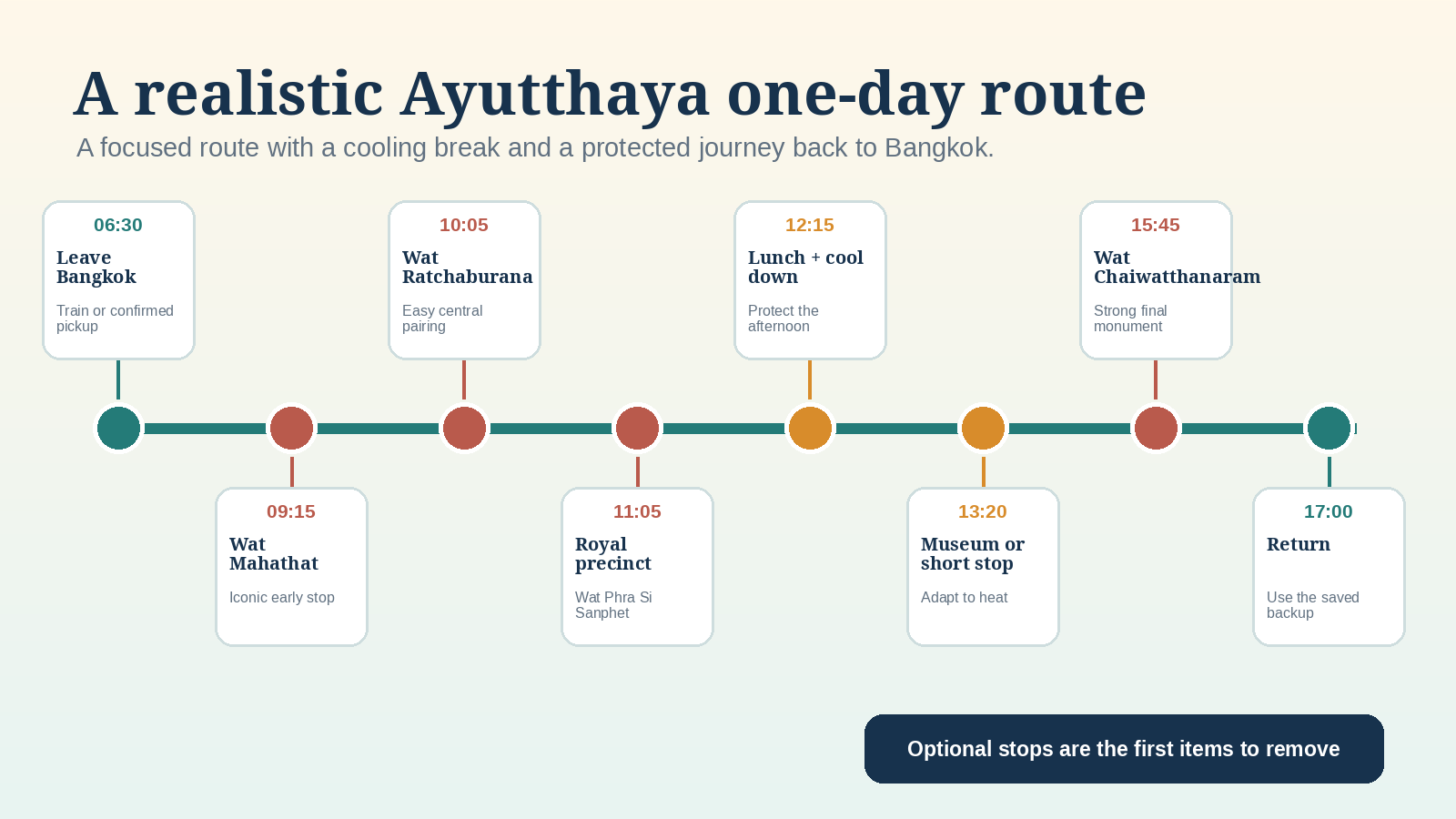
This route prioritises the central historic island in the cooler morning, adds a proper lunch and leaves Wat Chaiwatthanaram for later. It works with a private vehicle, a tuk-tuk hired after the train or many guided tours. Exact times should move with transport, weather and opening conditions.
| Time | Plan | Why this order works | Decision point |
|---|---|---|---|
| 06:30-07:30 | Leave central Bangkok | Reduces traffic and protects the cooler morning | Use the live train or confirmed pickup time |
| 08:30-09:15 | Arrive and organise local transport | Most ticketed park sites are open by 08:00 | Agree tuk-tuk route and total price before departure |
| 09:15-10:00 | Wat Mahathat | The famous Buddha head is calmer earlier | Move on before large groups concentrate |
| 10:05-10:50 | Wat Ratchaburana | Close to Wat Mahathat and historically rewarding | Use the museum later for deeper context |
| 11:05-12:10 | Wat Phra Si Sanphet and Wihan Phra Mongkhon Bophit | Royal precinct plus an active religious site | Respect dress and worship activity |
| 12:15-13:15 | Lunch and cooling break | Rest during the strongest sun | Choose shade and enough water over a rushed photo stop |
| 13:20-14:30 | Museum or Wat Lokayasutha | Indoor context or a shorter outdoor stop | Select according to heat, interest and museum hours |
| 14:45-15:30 | Optional quieter temple or cafe break | Prevents temple fatigue | Drop this when the return buffer is narrowing |
| 15:45-16:45 | Wat Chaiwatthanaram | Excellent riverside finale and softer light | Do not compromise the return train or Bangkok arrival |
| 17:00 onward | Return to station or drive to Bangkok | Allows a practical evening arrival | Use the planned backup when traffic or rail delay develops |
Step 1: leave Bangkok early, but not recklessly early
A 06:30-07:30 departure is usually a good balance. It reaches Ayutthaya before the day is at its hottest without requiring a 03:00 wake-up. When taking the train, choose a service based on the complete hotel-to-platform journey. Missing an early train creates more stress than taking a slightly later one that you can reach reliably.
Step 2: solve local transport once
After arrival, arrange a defined tuk-tuk circuit or meet the confirmed vehicle. Repeatedly negotiating individual rides wastes time and makes the final price harder to control. Show the route in writing, including the final station or pickup point.
Step 3: begin with the central pair
Wat Mahathat and Wat Ratchaburana are close enough to combine efficiently. They also introduce two recurring themes: the religious heart of the city and the royal history embedded in the architecture. Spend enough time to look beyond the most famous photograph.
Step 4: use lunch as heat management
Lunch is not an inconvenience between temples. It is part of the plan. Sit down, drink water, cool off and assess the group. If someone is already overheated, choose the museum or a cafe rather than adding an exposed ruin simply because it appears on the schedule.
Step 5: finish with a strong site, not the highest count
Wat Chaiwatthanaram provides a visually satisfying finish and a different riverside setting. Reaching it with enough energy is better than arriving after seven rushed stops. When the return deadline is tight, leave one optional site out.
Best temples and historical sights for one day
Ayutthaya contains hundreds of recorded historical locations across the island and surrounding area. One day needs priorities. The five choices below create variety in architecture, history and atmosphere without turning the visit into a race. [2]
| Site | Why include it | Time to allow | Best planning note |
|---|---|---|---|
| Wat Mahathat | Iconic Buddha head in tree roots and central monastic ruins | 35-50 minutes | Arrive early; stay lower than the Buddha head when posing nearby |
| Wat Ratchaburana | Impressive prang and royal history linked to the museum collection | 35-50 minutes | Pair with Wat Mahathat to reduce travel time |
| Wat Phra Si Sanphet | Former royal temple with three prominent chedis | 45-60 minutes | Combine with the former palace area and nearby active temple |
| Chao Sam Phraya National Museum | Objects and goldwork provide context that ruins alone cannot | 60-90 minutes | Use the hottest afternoon period; check the 16:00 closing time |
| Wat Chaiwatthanaram | Riverside Khmer-influenced layout and a memorable final view | 45-60 minutes | Visit later when possible, while protecting the return journey |
Wat Mahathat
Wat Mahathat is the most recognisable Ayutthaya stop because of the stone Buddha head surrounded by tree roots. The photograph is worth taking, but the wider monastery deserves attention. Walk slowly through the brick foundations and remaining prangs to understand the site’s former scale.
Visitors should crouch or sit so their head is not positioned above the Buddha image. Barriers and staff instructions should be followed even when another visitor ignores them. Arriving early improves both the experience and the photographs.
Wat Ratchaburana
Wat Ratchaburana sits close to Wat Mahathat and is easy to underestimate. Its central prang and royal associations provide a useful bridge to the treasures displayed in the Chao Sam Phraya National Museum. If the museum is part of the day, visiting Ratchaburana first makes the collection easier to place.
Wat Phra Si Sanphet
The three aligned chedis are among Ayutthaya’s defining silhouettes. This was the royal temple within the former palace compound, so it adds political and ceremonial context rather than another ordinary monastery. Allow time to walk the open area, but use sun protection because shade is limited.
Wihan Phra Mongkhon Bophit
The nearby hall contains a large bronze Buddha image and remains an active religious place. That contrast with the archaeological ruins is valuable. Dress respectfully, lower your voice and remove shoes where directed. Do not treat worshippers as part of the scenery.
Chao Sam Phraya National Museum
The museum is the best indoor addition for travellers who want to understand the sophistication of Ayutthaya rather than see only damaged architecture. Its collections include important material associated with discoveries at Wat Ratchaburana. It also provides a welcome air-conditioned pause during the hottest part of the day.
The current English contact page lists daily hours of 09:00-16:00 and foreign admission of 200 baht. Because older official pages show another fee, check the museum’s current notice before relying on a fixed budget. [6]
Wat Chaiwatthanaram
Wat Chaiwatthanaram stands west of the main island beside the Chao Phraya River. Its symmetrical layout, central prang and surrounding structures create a different visual rhythm from the central ruins. It is an excellent final stop, although sunset timing may produce a later Bangkok return.
Optional substitutes
- Wat Lokayasutha for the large reclining Buddha and a shorter outdoor stop.
- Wat Yai Chai Mongkhon for an active temple, a prominent chedi and a location outside the central island.
- Wat Phanan Choeng for a living religious complex and a different atmosphere.
- A river boat circuit when the group wants variety rather than another ruin.
- Bang Pa-In Palace only when using a private vehicle or deliberately reducing the Ayutthaya temple list.
Where and what to eat in Ayutthaya
The Tourism Authority of Thailand highlights river prawns, fish, boat noodles and roti sai mai among the province’s food associations. [2] A day trip does not need a complicated restaurant hunt, but it should include enough time to sit down and recover from the heat.
Boat noodles
Small bowls make it possible to try more than one variation, although spice levels and ingredients differ. Ask about pork, beef and offal rather than assuming every bowl is the same. A popular shop at noon can involve a queue, so tour itineraries may use a set restaurant elsewhere.
Grilled river prawns
Large river prawns are one of Ayutthaya’s better-known specialities, but the final bill depends heavily on size and market price. Confirm the price by weight or per prawn before ordering. This is better suited to a relaxed private day than a tightly timed independent train trip.
Roti sai mai
This sweet combines thin roti with fine strands of coloured sugar. It is easy to carry back to Bangkok, but buy it late enough that it does not sit in a hot vehicle for the entire day. Check the package date when available.
A practical lunch rule
Choose shade, clean facilities, fast service and a location on the route. The “best” restaurant is not good value when a 30-minute detour causes the group to rush Wat Chaiwatthanaram or miss a return train.
Getting around Ayutthaya after arrival
The historical area is spread across and beyond an island surrounded by rivers. Walking alone is not an efficient full-day strategy, particularly in hot weather. Most independent visitors use a tuk-tuk, bicycle, hired car or a combination of ferry and local transport.
| Local option | Planning price | Best for | Important caution |
|---|---|---|---|
| Tuk-tuk | Often negotiated around 200-300 baht per hour; full circuits vary | Two to four independent visitors | Agree total time, named stops, waiting and final drop-off first |
| Bicycle | Commonly around 50-100 baht per day | Confident cyclists in cooler conditions | Heat, traffic, bridges and exposed roads can make the day harder than expected |
| Private car with driver | Quoted per vehicle or day | Families, groups and heat-sensitive travellers | Confirm tolls, parking, overtime and whether a guide is included |
| Motorbike | Rental price varies | Experienced, correctly licensed riders | Insurance, licence validity, helmets and local road risk require serious attention |
| Station ferry | Usually a very small cash fare | Train travellers heading toward the island | Operating point and hours can change; it is not the whole sightseeing solution |
How to negotiate a tuk-tuk circuit
- Write the four core sites and one optional stop on the phone.
- State the total number of hours, not only an hourly rate.
- Confirm whether waiting at each site is included.
- Agree the final destination: station, hotel, van terminal or restaurant.
- Pay the agreed amount at the end unless the arrangement clearly requires otherwise.
- Take a photo of the vehicle or number when leaving bags inside.
Should you cycle?
Cycling can be pleasant from November to January when conditions are cooler, but it is not automatically the most responsible budget choice. Several major sites are separated by exposed roads and bridges. In April or on a humid wet-season day, a bicycle can turn a cultural visit into a heat-endurance exercise.
Should you rent a scooter?
Only experienced riders with the correct licence and insurance should consider it. A short distance does not remove road risk. Travellers who would not rent a motorbike elsewhere in Thailand should not make Ayutthaya the exception simply to save a tuk-tuk fare.
Ayutthaya tickets, opening hours and price conflicts
Entry information is more confusing than it should be because older articles and older official pages remain online. The table below separates the current planning figures from the caution needed at the gate.
| Place or ticket | Current planning figure | Published hours | What to verify |
|---|---|---|---|
| Ayutthaya Historical Park ticketed monuments | Foreigners 80 baht each; combined 300 baht | Daily 08:00-18:00 on current Fine Arts map | Which monuments the combined ticket covers on the visit date |
| Chao Sam Phraya National Museum | Foreigners 200 baht on current English contact page | Daily 09:00-16:00 | An older official page still shows 150 baht |
| Active temples | May be free, donation-based or separately ticketed | Varies | Religious events, dress rules and temporary closures |
| Special events or evening openings | Separate pricing may apply | Date-specific | Official event notice and final entry time |
Is the combined pass worth buying?
At the current planning prices, four separately ticketed monuments would cost 320 baht, so a 300-baht combined pass can make sense when the route includes enough participating sites. However, do not buy it automatically. Ask which places are included and check that your route actually visits them.
Carry small notes
Small denominations help at ticket booths, ferries, local food stalls and tuk-tuks. Cards and QR payments are increasingly common in Thailand, but a foreign visitor should not assume every small counter accepts an international card or foreign banking app.
Last admission may be earlier than closing
A published 18:00 closing time does not guarantee entry at 17:59. Ticket sales, access to particular structures and evening-event arrangements can close earlier. Arrive at the final monument with enough time to visit it properly.
How much does an Ayutthaya day trip cost?
The figures below are practical planning ranges for one adult, not guaranteed quotations. They use current official ticket information and current commercial route listings checked on 21 August 2026. Prices rise during holidays and vary by operator, class and group size.
| Cost item | Budget train day | Shared guided tour | Private vehicle shared by group | Planning note |
|---|---|---|---|---|
| Bangkok-Ayutthaya transport | About 30-200+ baht return depending on train class | Included in tour price | Included in vehicle quote | Add Bangkok station or meeting-point transfers |
| Local sightseeing transport | About 800-1,500+ baht per tuk-tuk circuit, shared | Usually included | Included | Route length and hours affect the total |
| Monument tickets | Up to 300 baht combined under current park pricing | Included or extra | Usually extra | Read the exact inclusion list |
| Museum | 200 baht current foreign planning price | Often omitted | Usually extra | Closes earlier than park sites |
| Food and drinks | 250-600 baht | Lunch may be included | 300-900+ baht | River prawns can cost much more |
| Likely total | About 1,000-2,200 baht solo; less per person when sharing tuk-tuk | Roughly £22-£50+ per person in current listings | Often competitive for three or four people | Checkout or written quote is final |
Solo traveller
A group tour can be better value than it first appears because a solo traveller cannot divide a tuk-tuk or car quote. The train remains cheapest when you share local transport with another visitor or accept a more limited route.
Couple
Two people can split a tuk-tuk, making independent travel attractive. Compare the combined local-transport, ticket and station-transfer cost against two tour places. The tour may still win when guide quality matters.
Family or group of four
A private vehicle can become the sensible mid-range choice once the price is divided. It also reduces the risk of paying for a tour that moves too quickly for children or an older relative. Ask for an appropriate vehicle rather than squeezing four adults and bags into the smallest car.
Approximate sterling conversions
The Bank of Thailand’s 21 August 2026 reference information placed sterling around 44 baht to £1, so 300 baht is roughly £6.80. Exchange rates and card fees change, and Thai-baht prices should remain the main basis for the day’s budget. [12]
Ayutthaya heat, rain and what to pack
Ayutthaya’s open ruins offer limited shelter. Even a moderate forecast can feel harder on exposed brick and stone, while wet-season downpours can appear quickly. Check the Thai Meteorological Department forecast close to travel rather than relying only on a monthly climate chart. [10]
Dry-season planning: November to February
This is generally the easiest period for walking and cycling, especially early in the morning. Nevertheless, midday sun still requires water, a hat and sunscreen. Popular dates can also be busier.
Hot season: March to May
Reduce the number of exposed sites, use an air-conditioned lunch or museum break and avoid cycling unless the group is genuinely heat-acclimatised. April can be punishing. A private vehicle may be worth the extra cost simply because it creates reliable recovery time between stops.
Wet season: roughly May to October
Rain may cool the air, but flooded paths, slippery bricks and sudden storms affect the route. Carry a compact umbrella or lightweight rain layer, keep electronics protected and wear shoes with grip. Do not climb restricted or wet masonry for a photograph.
Practical packing list
- Refillable water bottle plus an extra drink for the outward journey.
- Broad-brimmed hat or cap.
- High-SPF sunscreen and insect repellent.
- Light, breathable clothing covering shoulders and knees.
- Comfortable closed shoes or secure sandals with grip.
- Compact umbrella for both sun and rain.
- Small cash notes, tissues and hand sanitiser.
- Phone power bank and offline map.
- Resealable bag for tickets and electronics.
Staying connected
Mobile data helps with live SRT searches, maps, driver messages and changes to a meeting point. Download the key information and offline map as well, because coverage and battery life should not be the only plan.
Ayutthaya with children, older travellers or limited mobility
The historical park is not a single level, fully accessible attraction. Uneven ground, high steps, exposed paths, gravel and limited shade are common. A visitor may enjoy the day without entering every structure, but the transport and route should be adapted in advance.
Families with young children
A private vehicle offers the most control over naps, toilets, snacks and heat. Bring a compact carrier because a pushchair may struggle on rough surfaces. Limit the programme to three or four major stops and give children a non-temple break, such as lunch, a boat ride or the museum.
Older travellers
Choose shorter walking loops, use the vehicle between sites and avoid the steepest optional climbs. A midday museum visit is often more rewarding than pushing through another exposed ruin. Confirm that the pickup point is genuinely at the hotel rather than a distant meeting point.
Wheelchair users and travellers with limited mobility
Accessibility varies by site and can change with temporary routes or conservation work. Contact the historical park or tour provider with specific questions about steps, toilet access, vehicle loading and how close the car can stop. A statement such as “suitable for all ages” is not the same as step-free access.
Heat illness warning signs
Headache, dizziness, nausea, unusual fatigue, confusion and reduced sweating can indicate serious heat stress. Stop the visit, move to a cool place and seek medical assistance when symptoms are severe or do not improve. The purpose of the day is not to complete every ticketed site.
Road and travel safety
Use seat belts where fitted, helmets on motorbikes and reputable operators. UK travellers should also review current FCDO Thailand advice before departure, particularly for road safety, insurance and regional travel updates. [11]
Alternative Ayutthaya itineraries
Heat-smart itinerary
Visit Wat Mahathat and Wat Ratchaburana first, then Wat Phra Si Sanphet. Take an early lunch and spend 13:00-14:30 in the museum. Finish with one riverside site and return. This version removes the optional fifth temple.
History-first itinerary
Use a licensed guide, visit Wat Ratchaburana before the museum and spend longer in the royal precinct. Skip a market or boat ride. The day should explain the political and religious structure of the city rather than maximise photographs.
Photography itinerary
Travel by private vehicle or stay overnight. Begin at an east-facing site in early light, keep midday flexible and place Wat Chaiwatthanaram late. Check tripod rules, avoid blocking other visitors and never cross barriers for a cleaner angle.
Ayutthaya plus Bang Pa-In Palace
This combination works best with a private vehicle or a tour designed for it. Reduce the historical-park route to three core sites. Adding Bang Pa-In to a train-and-tuk-tuk day creates too many separate connections for most first-time visitors.
Overnight Ayutthaya stay
Stay overnight when quiet morning light, a sunset boat ride or a slower museum visit matters. The practical advantage is not merely more time. It is access to the city before day-trippers arrive and after many of them leave. An overnight also makes cycling more realistic in the cooler hours.
Rainy-day version
Keep the museum as the anchor, use a private vehicle or covered tuk-tuk and select sites with shorter walking routes. Allow extra time for slippery surfaces and traffic. When a severe storm is forecast, postpone rather than treating an exposed archaeological park as an all-weather attraction.
Ayutthaya day trip pros and cons
Why it works
- Close to Bangkok
- Major UNESCO heritage
- Several transport choices
- Strong value on an independent trip
- Easy to combine with a two-week Thailand itinerary
What can be difficult
- Exposed heat and limited shade
- Sites spread beyond one walkable centre
- Temple fatigue when the route is too ambitious
- Old online prices and changing rail details
- Bangkok traffic on road journeys
Who benefits most
- First-time visitors seeking historical context
- Photographers
- Families sharing a private vehicle
- Independent rail travellers
- Anyone who prefers a meaningful day trip to a shopping excursion
Common Ayutthaya day-trip mistakes
Trying to visit every famous temple
More stops do not produce a better understanding. After four or five major sites, heat and visual repetition reduce the value of each additional visit. Keep one optional stop and remove it without regret.
Planning the outward journey but not the return
Independent travellers often focus on reaching Ayutthaya cheaply. The real risk appears at 17:00 when the chosen return service is delayed, sold out or running from a different station than expected. Save two return options and a road fallback.
Assuming the railway station is beside the ruins
The station is across the river from the historic island. Include the crossing or road transfer and the time needed to hire local transport.
Hiring a driver when you wanted a guide
Transport and interpretation are separate services unless the listing explicitly combines them. Read the role description and ask for the guide’s language and licence when historical explanation is important.
Ignoring the current ticket structure
Old 50-baht figures remain widespread. Use the current Fine Arts Department map as the planning basis and confirm the combined-pass coverage at the ticket office.
Wearing unsuitable clothing
Ruins may feel informal, yet several places are sacred or active religious sites. Thailand’s official temple guide recommends modest clothing, no sleeveless or revealing tops, knee-length or longer lower garments, respectful photography and no climbing on historic structures. [9]
Using a bicycle as a heat test
A cheap rental is poor value when it leads to dehydration, unsafe road behaviour or abandoning half the route. Choose transport according to the weather and group, not a romantic image of cycling between ruins.
Leaving Wat Chaiwatthanaram too late
Later light can be beautiful, but an evening visit needs a realistic return plan. Do not miss a train or arrive in Bangkok extremely late merely to wait for sunset on a one-day itinerary.
Frequently asked questions
How far is Ayutthaya from Bangkok?
The Tourism Authority of Thailand describes Ayutthaya as about 86 kilometres north of Bangkok. The road distance and journey time depend on the starting district, traffic and final Ayutthaya stop. [2]
How long does an Ayutthaya day trip take?
Allow roughly 11-13 hours from a central Bangkok hotel. A typical day leaves between 06:30 and 07:30 and returns between 18:30 and 21:00. A headline seven-hour tour may describe activity time rather than the complete hotel-to-hotel day.
What is the cheapest way to get from Bangkok to Ayutthaya?
An ordinary or commuter SRT train is generally the cheapest main journey. Official timetable examples show local fares beginning around 15 baht from Hua Lamphong. The full day also needs local transport, tickets, food and Bangkok station transfers.
Can I book Bangkok-Ayutthaya train tickets online?
Some services can be searched and booked through SRT D-Ticket, while inexpensive local tickets may be bought at the station. Search the exact train because booking eligibility, classes and sales windows differ.
Is Hua Lamphong still used for Ayutthaya trains?
Yes, the official 2026 timetable still lists selected commuter and ordinary services from Bangkok Hua Lamphong to Ayutthaya. However, many long-distance Northern line trains use Krung Thep Aphiwat. Always check the station shown for the chosen train number.
What is Bangkok Connex?
Bangkok Connex is the name associated with a 2026 SRT trial using refurbished air-conditioned KIHA 40/48 trains. The original official announcement covered Don Mueang-Ayutthaya weekday services from 20 April to 31 October 2026. Future operation should not be assumed without a live timetable check.
How many temples can I visit in one day?
Four major sites are ideal for most visitors. Add a fifth only when the group still has time and energy. The museum can provide more value than another ruin because it explains objects and craftsmanship not visible in the surviving structures.
What are the best temples for a first visit?
Wat Mahathat, Wat Ratchaburana, Wat Phra Si Sanphet and Wat Chaiwatthanaram create a strong core route. Add Wihan Phra Mongkhon Bophit, the museum or Wat Yai Chai Mongkhon according to interest.
How much are Ayutthaya temple tickets in 2026?
The current Fine Arts Department park map lists 80 baht per foreign visitor per ticketed monument or 300 baht for a combined pass. Ask at the first ticket office which sites are included, because older official and unofficial pages may still display previous prices.
Is Ayutthaya Historical Park open every day?
The current Fine Arts Department map lists daily opening from 08:00 to 18:00. Individual access, last admission, active temples, events and restoration work may differ.
Should I take a tour or go independently?
Take a tour when historical explanation and easy logistics matter. Travel independently when budget, railway experience and route flexibility are more important and you are comfortable arranging local transport.
Is a private driver worth the cost?
It can be excellent value for three or four people, a family, an older traveller or anyone who needs air-conditioned breaks. Confirm whether the quote includes tolls, parking, overtime and a licensed guide.
Can I walk around Ayutthaya?
You can walk within clusters of central ruins, but a full day on foot is inefficient. Wat Chaiwatthanaram, Wat Yai Chai Mongkhon and other outer sites require transport for most visitors.
Can I cycle around Ayutthaya?
Yes, especially in cooler months. Nevertheless, traffic, heat, bridges and distances make it unsuitable for every visitor. Wear a helmet when supplied, carry water and avoid the hottest afternoon.
What should I wear?
Wear light clothing that covers shoulders and knees, comfortable footwear and sun protection. Carry a scarf or light layer, but do not rely on wrapping a tiny scarf around otherwise unsuitable clothing at an active temple.
Is Ayutthaya suitable for children?
Yes with a reduced route, regular shade and a private vehicle or family-friendly tour. Very young children may find a temple-only programme repetitive, so include lunch, the museum or a short boat element.
Can I combine Ayutthaya with Bang Pa-In Palace?
Yes, most easily by private car or an organised tour. Remove at least one or two Ayutthaya sites. Combining both independently by train and local transport is possible but inefficient for a first one-day visit.
Is an overnight stay better?
An overnight is better for sunrise or sunset photography, cycling in cooler hours, a museum-focused visit and travellers who dislike rushing. A day trip remains enough for the main historical highlights.
Do I need mobile data?
It is helpful for live train searches, maps and messages, but not essential when the trip is fully guided. Save offline maps, booking details and return information regardless of the connection.
My practical recommendation
For a first Ayutthaya day trip from Bangkok, I would choose one of two plans. The simplest is a small-group guided tour that leaves early, names the entrance-fee inclusions and limits the route to four strong historical stops plus lunch. The independent alternative is an early train, a pre-agreed four- or five-hour tuk-tuk circuit and a return plan saved before leaving Bangkok.
A private vehicle becomes the best choice when three or four people can share the price, when a child or older relative needs flexibility, or when the weather makes repeated air-conditioned breaks valuable. Add a licensed guide when the group’s main interest is history rather than transport convenience.
Whichever option you use, protect three things: the cooler morning, a real midday break and the return buffer. Those choices improve the day more than adding another temple. Ayutthaya deserves enough time to notice the details, not merely enough time to collect photographs.
Sources and methodology
Research was checked on 21 August 2026. Dynamic prices, timetables, opening conditions and tour availability should be verified again before booking. Commercial examples are dated planning anchors, not permanent offers.
- Historic City of Ayutthaya – UNESCO World Heritage Centre. Used for inscription, historical development and World Heritage context.
- Phra Nakhon Si Ayutthaya destination information – Tourism Authority of Thailand. Used for location, geography and local-food context.
- Ayutthaya Historical Park map, hours and rates – Fine Arts Department. Current planning source for 08:00-18:00 opening, 80-baht foreign single tickets and 300-baht combined tickets.
- Bangkok Hua Lamphong to Ayutthaya timetable – State Railway of Thailand. Used for 2026 train examples.
- KIHA 40/48 Don Mueang-Ayutthaya feeder trial – State Railway of Thailand. Used for the April-October 2026 Bangkok Connex trial description.
- Chao Sam Phraya National Museum contact and visitor information – Fine Arts Department. Used for current English-page hours and admission.
- SRT D-Ticket – State Railway of Thailand. Official booking process and hotline 1690.
- Ayutthaya to Bangkok Hua Lamphong timetable – State Railway of Thailand. Used for return-train examples.
- Thai Temple Travel Guide – Thailand.go.th. Used for dress, behaviour, photography and heritage-protection guidance.
- Seven-day weather forecast – Thai Meteorological Department. Used for current-weather planning advice.
- Thailand travel advice – UK Foreign, Commonwealth and Development Office. Used for current safety-planning signposting.
- Exchange rates – Bank of Thailand. Used only for the dated approximate sterling conversion.
Image credits
Illustrations in this article were created for Taylor’s Trailblazing Travels. Third-party photographs, where used, are credited beside the image or in the source list.