Travel Insurance for Japan from the UK: What to Compare
Match the cover to your trip before comparing the price.
- Trip-to-cover checklist
- Cancellation limits and excesses
- Medical and emergency support
AI-generated editorial illustration of an imagined travel-planning setting; no real policy, insurer or claim is depicted.
When comparing travel insurance for Japan from the UK, start with the travellers and trip the policy must cover. Japan’s healthcare can be expensive, and the FCDO says visitors should expect to pay the whole cost of treatment. A UK GHIC or EHIC does not provide healthcare cover in Japan. [1] [2]
The useful comparison is between policies that fit your circumstances, with clear medical terms, practical emergency assistance and limits matched to the money you could lose. This guide provides a comparison framework and an original worked example; it does not select a policy for an individual traveller.
Who and where
Match every traveller, destination and full journey to the policy.
Medical needs
Check the written outcome of screening and the help available in Japan.
Money at risk
Compare unrecoverable bookings with the limit and excess per traveller.
Cover starts
Confirm the cancellation start date as well as the departure date.
Start with your trip, then shortlist policies
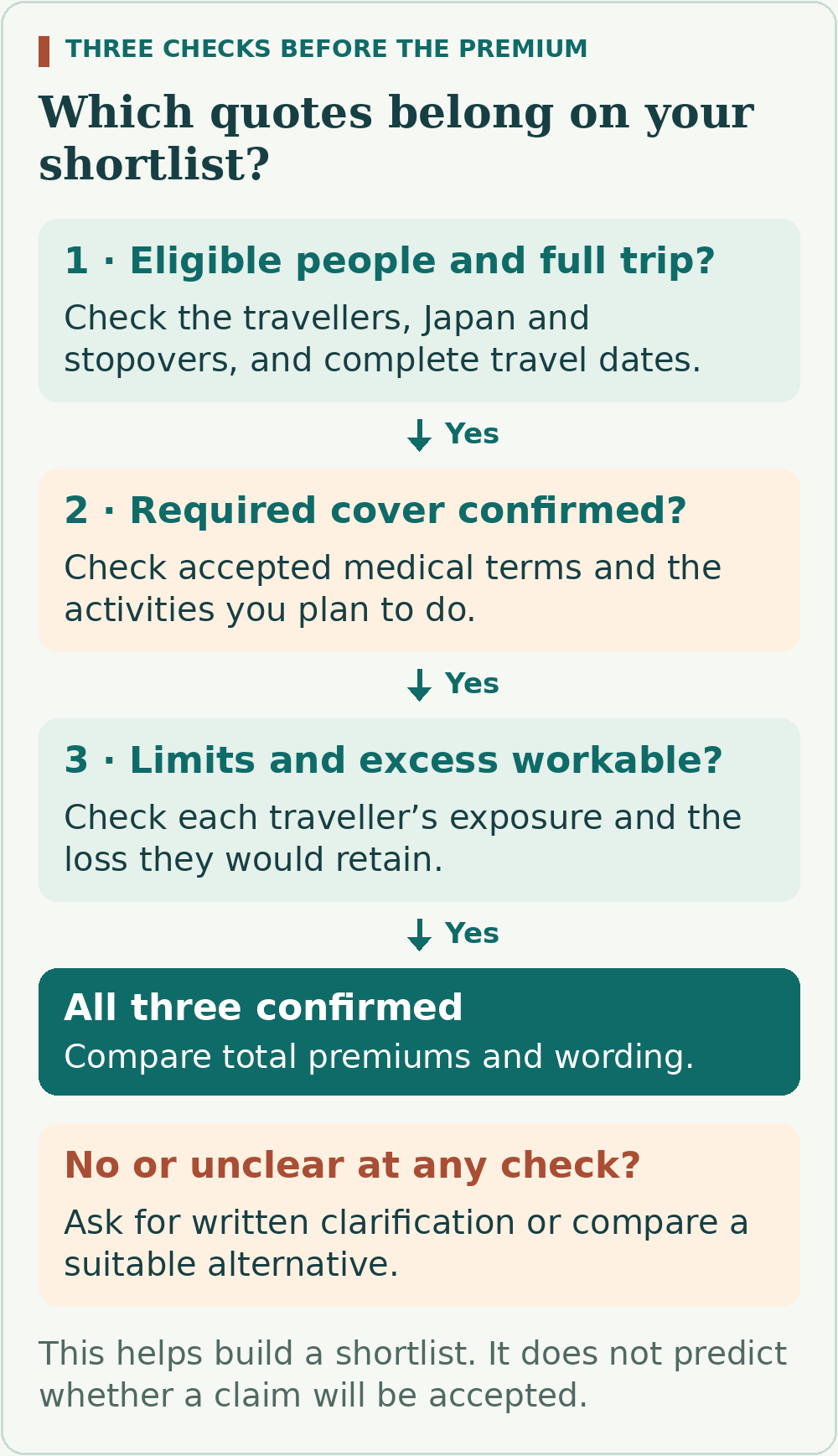
Use the same facts for every quotation. A cheaper result based on a shorter trip, omitted condition or different activity list is not a useful comparison.
| Write down | Check in the policy or obtain in writing |
|---|---|
| Everyone travelling | Names, ages and residency eligibility; who is insured and whether people can travel separately. Basic eligibility matters before any benefit limit. [4] |
| Complete route and dates | Japan, transit countries and other destinations; departure from and return to the UK; maximum trip duration and any annual total-day limit. [3] |
| Health information | The screening answers and which conditions are accepted, excluded or subject to extra terms. [6] |
| Actual activities | Named activities, relevant restrictions and any required extension. [3] |
| Bookings and belongings | Cancellation exposure for each person; limits for individual valuables and any relevant baggage exclusions. [11] |
Mark each answer as confirmed, excluded or unclear. An unclear answer is a question for the insurer or broker before purchase. Keep its written explanation with the policy.
Single trip or annual cover: check the dates
A single-trip policy covers a specified trip; annual multi-trip cover is intended for several trips during its insured period. Compare both if you have further travel planned, using the same destination, medical and activity requirements. There is no universal number of trips at which an annual policy becomes better value. [5]
Check an annual policy’s maximum length for one trip and any limit on total days away. Include the international journey when checking dates, not just hotel nights. [11]
Do not leave a gap before departure
Arrange suitable cover when you book, and confirm the exact date cancellation protection begins. The Financial Ombudsman warns that buying an annual policy with a future start date can leave earlier cancellation uninsured. Paying for the policy today does not itself resolve that gap. [4]
If existing annual cover expires before the Japan trip, ask how the booking and travel dates are treated across renewal. If insurance comes with a bank account, read that policy before buying another: MoneyHelper recommends checking its cover against your needs. [5] Record any upgrade cost in the comparison.
Compare medical cover and the help you could actually use
MoneyHelper’s broad guidance suggests at least £2 million of medical cover outside Europe. Treat that as a starting benchmark, not a Japan-specific treatment estimate or confirmation that a policy meets your needs. Compare what sits within the limit, what has a separate limit and what is excluded. [5]
Get the medical declaration right
Answer every screening question fully and accurately, using the period and definitions the insurer asks about. Check the answers recorded in your documents. Declaring a condition does not automatically mean it is covered: the insurer’s acceptance and any exclusions or extra terms matter. [5] [6]
Follow the policy’s requirements for changes in health after purchase or renewal. A significant new problem, urgent referral or investigation can matter before a diagnosis is confirmed; contact the insurer if the significance is unclear. The Ombudsman distinguishes these situations from minor, resolved illnesses, so do not assume either that every cold must be reported or that only a formal diagnosis matters. [7]
If standard quotations do not meet your medical needs, MoneyHelper’s travel insurance directory lists specialist firms. It does not guarantee an offer or an affordable premium. [8]
Ask how treatment and getting home would be arranged
The Japanese Embassy recommends support with hospital referrals, medical interpretation and cashless medical services. [9] Turn that into practical questions: can the assistance team help locate appropriate care, explain the payment process and arrange direct settlement where approved? What might you have to pay upfront?
Check the 24-hour assistance contact and the rules for contacting it before treatment. Confirm which hospitals or types of treatment the policy allows. Repatriation means arranging a return home after illness or injury; its timing and transport depend on medical assessment and policy terms. It is not an unconditional right to choose a flight home. [10]
Also ask whether emergency evacuation, a medically necessary companion and additional accommodation sit within the main medical benefit or have separate limits. [3]
Size cancellation cover around the money you could lose
List the flights, stays, transport and experiences you would be liable to pay for if you cancelled. Record supplier refunds and cancellation charges at each payment deadline. Compare the remaining exposure for each traveller with the policy’s cancellation limit, and revisit the figure as bookings accumulate.
The cause of cancellation must also be covered. A high limit does not turn a change of mind into an insured event; cancellation sections specify the circumstances and costs they cover. Check definitions affecting travelling companions and relatives as well as your own illness. [11]
A worked example: the same loss, three different settlements
Suppose two adults have each prepaid £3,000. Each receives £600 in actual supplier refunds, leaving £2,400 of eligible unrecoverable loss per person. For this example only, the insurer has accepted the reason for cancellation and every remaining cost is eligible.
The three options below are hypothetical, not real products. Each has one cancellation excess per traveller. The excess is deducted before the limit is applied, with no other deductions. The Ombudsman says this is the usual order, but the actual policy wording must be checked. [12]
| Option | Cancellation limit | Excess | Insurer pays | Loss you retain |
|---|---|---|---|---|
| A | £1,800 | £100 | £1,800 | £600 |
| B | £3,000 | £100 | £2,300 | £100 |
| C | £3,000 | £250 | £2,150 | £250 |
The calculation is: insurer payment = the lower of the limit and the eligible loss after the excess, with a minimum payment of zero. Your retained loss is £2,400 minus that payment.
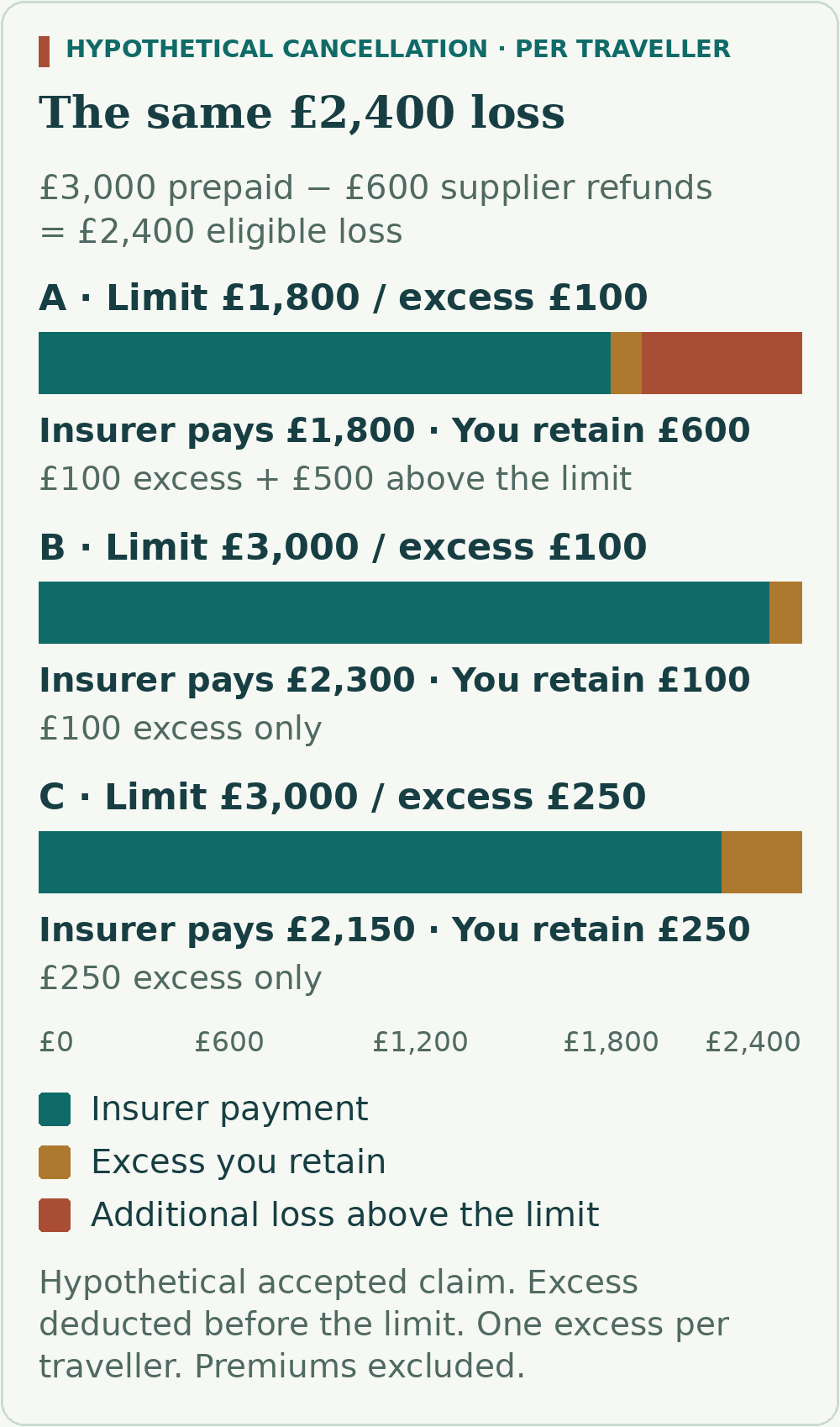
A leaves £100 as the excess and another £500 above the limit. B leaves the £100 excess. C has the same limit as B but leaves £150 more because of its higher excess. For both adults together, the retained losses would be £1,200, £200 and £500 respectively.
This example compares one accepted claim, with premiums excluded. It cannot establish the best-value policy. In a real quotation, check whether limits and excesses apply per person, per claim or per section; one incident can involve more than one excess. [12]
Check early return separately
Curtailment concerns cutting a trip short, with its own covered reasons and conditions. Check reimbursement for unused arrangements and additional transport, and the requirement to contact the insurer before returning. Do not assume a cancellation limit also describes every early-return benefit. [13]
Test activities and disruption against the route
Describe each planned activity precisely. For skiing, hiking, diving or vehicle use, ask about terrain, altitude, depth, equipment, licence and guide conditions, plus rescue and medical expenses. An extension may be necessary. [3]
Read missed departure, travel delay and abandonment separately. Their triggers and benefits differ; some policies restrict cover to particular legs of the journey. For a connecting flight or a separately booked domestic journey, ask which section would respond and whether it covers that part of your route. [14]
For weather or other disruption, find the covered causes, waiting period, maximum payment and rules on replacing or abandoning transport. Ask specifically about typhoons, earthquakes, supplier failure and events already known when booking or buying cover. Do not infer those benefits from a general “cancellation” heading. [11] [14]
Check the latest FCDO Japan advice and advice for transit countries before buying and again before departure. The current Japan page specifically reminds travellers to check connecting routes when disruption occurs elsewhere. [15]
Ask how the policy treats travel against FCDO advice and changes in advice after purchase; cover can be affected. [3]
Read the smaller limits, then compare the total price
A baggage headline limit may be much higher than the amount allowed for one phone, camera or other valuable. Compare the single-item limit, total valuables limit, excess and conditions for unattended items. Check whether the belongings you intend to carry require extra cover. Personal liability is a separate benefit worth checking in its own section. [11]
Build a short comparison record for each suitable quote:
- The insurer and seller, policy version and quote expiry.
- The full premium, including the medical and activity options you need.
- The limit and excess for medical expenses, cancellation, curtailment, baggage and any relevant disruption cover.
- The policy start and end dates, maximum trip length and written answers to unresolved questions.
- The policy summary, full wording, schedule and medical-screening outcome.
Use the FCA’s Firm Checker to check the firm and the permission relevant to the service it is offering. Authorisation is not an endorsement of a particular policy. The FCA also says the checker does not establish that Ombudsman or compensation-scheme protection will apply to your circumstances. [16]
Compare premiums after completing those checks. A lower price with an excess you could not comfortably fund, an excluded activity or an unresolved medical answer needs further attention before purchase.
Keep a usable assistance and claims file
Save the policy number and overseas assistance contact somewhere you and a companion can access without relying on one phone. Keep the screening confirmation, booking invoices, supplier terms and policy documents together. If something goes wrong, retain receipts, written disruption notices, medical paperwork and a dated record of contacts.
In a medical emergency in Japan, call 119 for an ambulance. Seek urgent help and contact the insurer’s assistance service as soon as practicable. Check approval requirements for ongoing treatment and arrangements; do not delay urgent care while trying to resolve insurance paperwork. [1] [10]
If a claim or sale is disputed
Complain to the firm first and keep its responses. For most complaints, it has up to eight weeks to issue a final response. If you remain unhappy, or the response is overdue, an eligible complaint can go to the Financial Ombudsman Service, which is free to use. Referral is normally required within six months of the firm’s final response. Check the deadline in that response and the Ombudsman’s eligibility rules. [17]
Make the decision that fits your trip
Complete the trip facts and comparison sheet before choosing a policy. Resolve any unclear medical, activity or exclusion answer in writing. Recheck the documents and cancellation start date before paying, then keep the assistance details accessible.
How this guide was researched
This guide draws on UK government, NHS, financial regulator, Ombudsman, MoneyHelper and Japanese Embassy guidance, with an independent editorial review on 18 October 2026. This is general policy-comparison information, not a personal recommendation or a test of insurers’ claims services. Policy wording and individual eligibility remain decisive.
The cancellation example is an original illustration with explicitly assumed costs, accepted cover and excess treatment. It contains no live premium, forecast medical bill or claim-success estimate. Check current travel advice and obtain current policy documents when buying.
Sources
Official guidance and operator information reviewed on 17 October 2026. Recheck time-sensitive details for your own travel dates.
- FCDO — Japan: Health
- NHS — Applying for healthcare cover abroad (GHIC and EHIC)
- FCDO — Foreign travel insurance
- Financial Ombudsman Service — Mis-sold travel insurance
- MoneyHelper — What is travel insurance?
- Financial Ombudsman Service — Pre-existing medical conditions
- Financial Ombudsman Service — Change in health
- MoneyHelper — Travel insurance directory
- Embassy of Japan in the UK — Overseas travel insurance
- Financial Ombudsman Service — Medical expenses and repatriation
- MoneyHelper — What does a good travel insurance policy look like?
- Financial Ombudsman Service — Policy excess and limits
- Financial Ombudsman Service — Curtailment
- Financial Ombudsman Service — Missed departure, delay and abandonment
- FCDO — Japan: Warnings and insurance
- FCA — FCA Firm Checker
- FCA — How to complain
Illustrations in this article were created for Taylor’s Trailblazing Travels. Third-party photographs, where used, are credited beside the image or in the source list.