Practical Indonesian Phrases for Travellers: Transport, Food and Accommodation
A useful question is only half the conversation. Learn how to check the answer as well.
An original everyday-travel illustration; the stall and vehicle are illustrative rather than named real businesses.
The most useful Indonesian phrases for travellers are the ones that let you complete a small task: find the correct departure point, order what you intend to eat, explain a room problem or confirm a total. A long vocabulary list is less helpful when the reply contains a number you do not recognise.
Indonesian, or Bahasa Indonesia, is the national language; Indonesia also has many regional languages. It is a practical starting point for a visitor, not a claim that every conversation sounds identical across the country. [1] The phrases here use straightforward everyday wording, with practical translations rather than a word-for-word grammar lesson.
Some links in this guide are affiliate links. If you make a purchase through them, Taylor’s Trailblazing Travels may earn a commission at no additional cost to you.
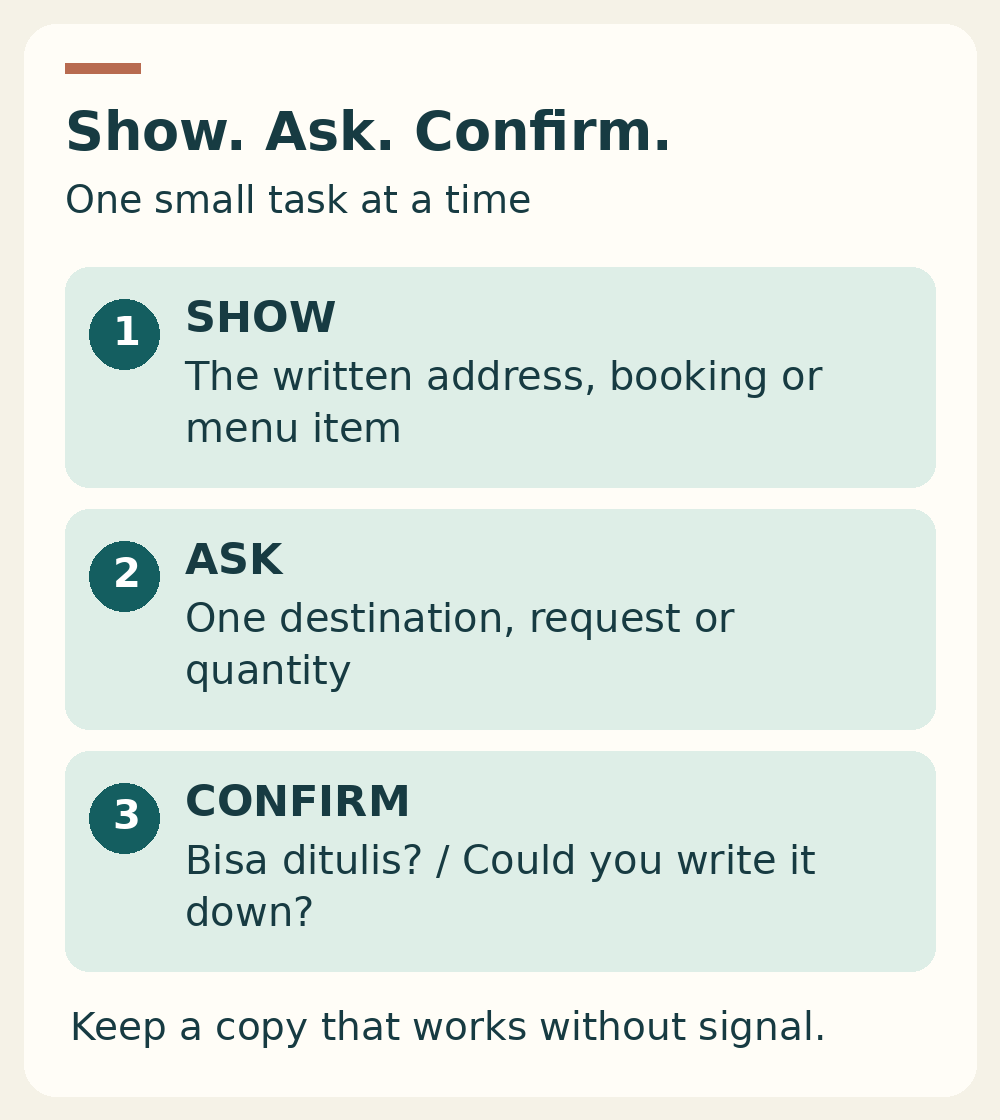
Use the written address, booking reference or item on the menu.
Keep one destination, quantity or request in each question.
Check the amount, date and inclusion in writing before agreeing.
Save essential phrases and addresses somewhere that works offline.
Indonesian phrases for travellers: show, ask, confirm
This guide’s working method is deliberately simple. Show the thing you mean, ask one question about it, then check the reply. It avoids the common trap of memorising a perfect question without having any way to understand the answer.
For transport, show the full address and ask about the total. For accommodation, show the booking and ask about one inclusion. For food, point to the item and make one clear request before checking it has been understood. A screenshot is useful only if it includes enough context: a hotel name without its address, for example, may still leave room for confusion.
The tables provide functional translations. An English “please” does not have one universal Indonesian replacement: tolong commonly introduces a request for help, while silakan invites someone to proceed. Use complete phrases rather than adding an unfamiliar politeness word to every sentence. The language references cover these everyday exchanges; the task sequences and sample situations below are original examples. [1][2]
When the answer is unclear, slow the exchange down. Asking for writing is more useful than repeatedly saying “yes” to keep the conversation moving. For anything expensive, time-sensitive or safety-related, a second check is worth the small pause.
Polite beginnings and ways to repair a conversation
| Indonesian | Meaning | When it helps |
|---|---|---|
| Permisi. | Excuse me. | Getting attention or passing someone. |
| Selamat pagi. | Good morning. | Starting a morning conversation. |
| Selamat malam. | Good evening. | A greeting in the evening. |
| Terima kasih. | Thank you. | Acknowledging help. |
| Sama-sama. | You’re welcome. | A familiar reply to thanks. |
| Maaf. | Sorry. | Apologising or softening an interruption. |
| Saya belum mengerti. | I don’t understand yet. | Stopping an exchange that is moving too fast. |
| Bisa diulangi pelan-pelan? | Could you repeat that slowly? | Asking for another attempt. |
| Bisa ditulis? | Could you write it down? | Checking a name, time or amount. |
| Bisa bahasa Inggris? | Can you speak English? | Asking whether switching language would help. |
Do not worry about delivering a long greeting before every practical request. A calm Permisi, followed by the question and a thank you, is a manageable starting point. Use a normal voice; speaking louder does not resolve a language gap.
A few sounds worth listening to
Do not read Indonesian words as if they were English. In common words, i is close to the vowel in “see”, while a is closer to “father” than “cat”. The ng sound is like the end of “sing”, without automatically inserting an extra hard g. The letter e has more than one pronunciation, so a universal English-style spelling key would be misleading. Listen to the audio examples in Indonesian Online’s pronunciation materials rather than treating these approximations as exact. [4][5]
You are aiming to be understandable, not to imitate an accent perfectly. Keep the written version available so the other person can read it if your pronunciation does not get the idea across.
Transport: confirm the destination, price and getting-off point
The words bandara (airport), stasiun (station), pelabuhan (port) and halte (bus stop) help orient a conversation. Still show the proper name: the general word does not identify the correct terminal, station entrance or harbour. Indonesian Online’s directions lesson demonstrates the value of combining a polite opening with a specific place. [6]
| Indonesian | Practical meaning |
|---|---|
| Saya mau ke alamat ini. | I’d like to go to this address. |
| Apakah ini bus ke Yogyakarta? | Is this the bus to Yogyakarta? |
| Berapa totalnya untuk dua orang? | What is the total for two people? |
| Sudah termasuk bagasi? | Is luggage included? |
| Jam berapa berangkat? | What time does it leave? |
| Di mana saya harus turun? | Where should I get off? |
| Bisa berhenti di sini? | Can you stop here? |
| Di mana loket tiketnya? | Where is the ticket counter? |
Use a stopping request only when it can be handled safely; do not expect a driver to stop immediately in an unsuitable place. For a fixed-route service, confirm the proper stop rather than treating it as a private taxi.
Short dialogue: a total you can check
TravellerSaya mau ke alamat ini. Berapa totalnya untuk dua orang?
I’d like to go to this address. What is the total for two people?
Illustrative replyTujuh puluh lima ribu.
Seventy-five thousand.
TravellerBisa ditulis? Sudah termasuk bagasi?
Could you write it down? Is luggage included?
The IDR 75,000 amount is a language example, not a researched fare. Ask about other relevant charges before agreeing, and check that the written total is for the whole party rather than each person. The number construction follows the Indonesian units described by Northern Illinois University. [7]
Food: make a request, then check what it covers
Menu vocabulary helps you point to the right thing: nasi is rice, ayam chicken, ikan fish, telur egg, tahu tofu and sayur vegetables. These are useful clues, not a complete ingredient list. Jembatan Bahasa’s food lesson provides everyday menu and ordering language. [8]
| Indonesian | Meaning |
|---|---|
| Saya mau pesan ini. | I’d like to order this. |
| Satu porsi, ya. | One portion, please. |
| Tidak pedas, ya. | Not spicy, please. |
| Tanpa cabai. | Without chilli. |
| Tanpa gula. | Without sugar. |
| Tanpa es. | Without ice. |
| Air minum, ya. | Drinking water, please. |
| Saya tidak makan daging atau ikan. | I don’t eat meat or fish. |
| Apakah ini mengandung telur? | Does this contain egg? |
| Boleh minta notanya? | May I have the bill? |
A request for no meat or fish does not communicate every vegetarian, vegan or allergy requirement. Ask separately about the ingredients and preparation that matter to you. Similarly, “not spicy” is a preference request rather than a precise measurement; a prepared sauce may not be adjustable.
Listen for makan di sini (eat here) and bungkus (take away), two useful alternatives when ordering. [8] Pointing to your intended option can be easier than trying to give a long explanation over a busy counter.
Saya alergi kacang tanah means “I am allergic to peanuts”, but that sentence does not explain severity, cross-contact or your other requirements. Allergy UK offers Indonesian translation cards and recommends preparing an allergy plan and travel arrangements with appropriate professional advice. Use a checked card covering your specific needs and confirm understanding with the person preparing the food; uncertainty is not reassurance. [3]
This is a language aid, not a medical assessment or a guarantee that any dish is safe. For a serious reaction or other emergency, seek urgent help rather than spending time composing a perfect sentence.
Accommodation: make the booking and the request concrete
Have the reservation name, dates and room details visible before starting the conversation. The aim is to identify your booking, not to recite a paragraph from memory. Keep one request in each sentence so staff can answer it clearly.
| Indonesian | Meaning |
|---|---|
| Saya sudah memesan kamar atas nama Taylor. | I have booked a room under the name Taylor. |
| Ini konfirmasi pemesanan saya. | Here is my booking confirmation. |
| Apakah sarapan sudah termasuk? | Is breakfast included? |
| Jam berapa waktu check-out? | What time is check-out? |
| Boleh titip tas di sini? | May I leave my bag here? |
| Ada air panas? | Is there hot water? |
| AC-nya tidak berfungsi. | The air conditioning is not working. |
| Bisa pindah kamar? | Could I move to another room? |
Short dialogue: a room issue
TravellerPermisi. AC-nya tidak berfungsi.
Excuse me. The air conditioning is not working.
Illustrative replySebentar, ya.
One moment, please.
TravellerTerima kasih.
Thank you.
Show the room number and, when useful, the problem itself. Avoid adding several unrelated requests while the first is being resolved. If a proposed room move changes the room category or price, confirm those details before agreeing rather than assuming that a simple “yes” answers everything.
For a stored bag, check when collection is possible and whether there is a receipt or other identification. The phrase asks permission; it does not establish insurance, security or overnight storage terms.
Numbers, money and time: the part worth confirming twice
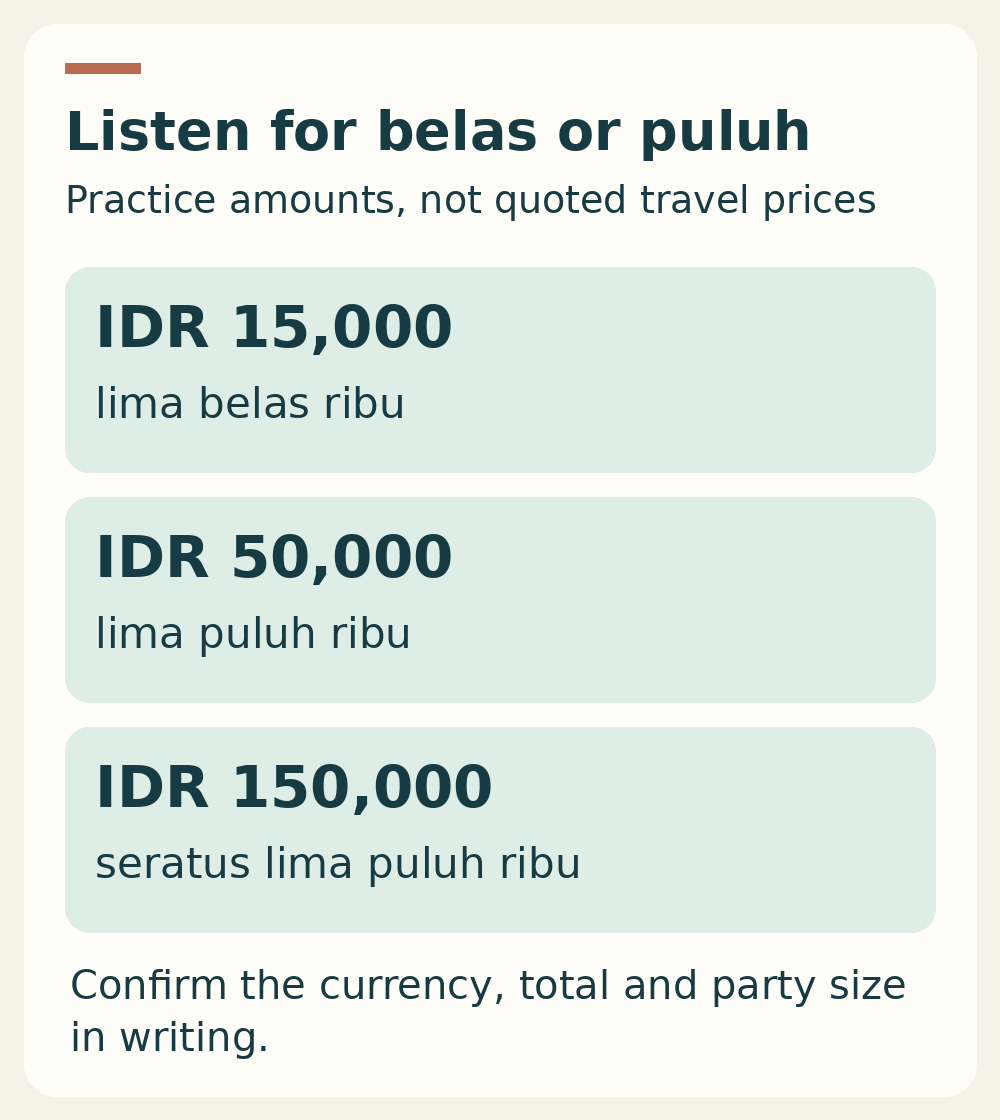
Learn the structure before trying to memorise every possible amount. Belas forms the teens, puluh the tens, ratus the hundreds and ribu the thousands. Northern Illinois University’s language resource shows how these parts combine. [7]
| Number | Indonesian | Number | Indonesian |
|---|---|---|---|
| 1 | satu | 6 | enam |
| 2 | dua | 7 | tujuh |
| 3 | tiga | 8 | delapan |
| 4 | empat | 9 | sembilan |
| 5 | lima | 10 | sepuluh |
| 15 | lima belas | 50 | lima puluh |
| 100 | seratus | 1,000 | seribu |
The difference between lima belas and lima puluh is particularly worth practising. Add ribu and you are distinguishing fifteen thousand from fifty thousand. Ask for the amount in digits instead of making a decision from the part you think you heard.
For a departure, confirm the date as well as the time. A written 14:30 is clearer than an English “half two” spoken into a translation app; it is also quite different from 04:30. Ask staff to show the booking date and departure time together. This is a checking method, not a claim about how every Indonesian timetable displays times.
Keep the currency and unit explicit. A number may be per person, per room or for the whole journey. Repeat the party size, point to the written total and check whether the quoted amount includes the thing you just asked about.
Offline preparation, useful help and a small practice plan
Save the address of your first accommodation, the next departure point, booking references and the clarification phrases before leaving a reliable connection. Test your chosen translation app in airplane mode rather than assuming a downloaded language or voice feature will work offline. A printed card remains useful when the battery is empty.
Compare mobile data plans at Airalo, then select Indonesia and check device compatibility, unlocking requirements, coverage and plan inclusions. The link opens Airalo’s general site, not a preselected Indonesian package. Its Indonesia page offers data options; a data plan should not be assumed to include ordinary telephone calls or coverage everywhere on your route. Offline preparation remains useful even with a plan. [9]
Asking for help
Tolong bantu saya means “Please help me”. Saya perlu dokter means “I need a doctor”, and Tolong panggil ambulans asks someone to call an ambulance. Show your location and involve a nearby staff member or other appropriate person immediately when help is urgent. These are communication phrases, not instructions to delay emergency assistance.
Do I need to learn Balinese as well?
Not to begin using this guide. Indonesian is the national-language starting point, while local languages are distinct. [1] Ask a host about a local greeting when you have time and interest, but do not assume an Indonesian phrase is a Balinese translation.
How many phrases should I memorise?
Begin with a polite opening, thanks, a request to repeat and a request for writing. Then practise one task you will actually face on arrival. The number you can use comfortably matters more than the size of the list you have saved.
Show an address and ask the destination question. Ask for a total for your actual party. Finally, ask for that total in writing. Repeat the same show, ask and confirm pattern at the hotel and when ordering a meal; it gives you a way to repair the conversation when your vocabulary runs out.
Sources & further reading
Key official and high-impact sources independently checked on 2 November 2026. Other references are provided for further checking; confirm current rules and the specific provider before travel.
- Indonesia Tourism: Bahasa IndonesiaNational-language context and common visitor expressions.
- Jembatan Bahasa: Indonesian phrases and expressionsEveryday greetings, requests and accommodation language.
- Allergy UK: travelling with allergiesIndonesian translation cards and advance allergy preparation.
- Indonesian Online: pronunciation guidanceVowels, nasal sounds and audio examples; English approximations are not exact phonetics.
- Indonesian Online: weak and strong eMore than one pronunciation of the written letter e.
- Indonesian Online: asking for directionsPolite direction questions and transport-location vocabulary.
- Northern Illinois University: Indonesian numbersNumber formation, including teens, tens, hundreds and thousands.
- Jembatan Bahasa: ordering foodCommon ingredients, food requests and eat-in/takeaway language.
- Airalo: Indonesia eSIM informationDestination data products and the need to check actual plan/device terms.
Illustrations in this article were created for Taylor’s Trailblazing Travels. Third-party photographs, where used, are credited beside the image or in the source list.