Koh Samui planning guide
A practical guide to Samui’s strongest boat days, beaches, temples, food and low-effort alternatives—without spending the holiday zig-zagging around the island.
A strong Samui plan balances one memorable sea day with beaches, culture, food and enough flexibility for changing conditions.
Koh Samui is easy to underestimate. The island has a ring road and plenty of familiar names, yet a beach morning in Chaweng, a waterfall in the interior, a south-coast temple circuit and sunset in Taling Ngam can still pull one day in four directions. A boat departure adds a fixed check-in time, a particular pier and a weather decision that cannot be solved by simply leaving the hotel earlier.
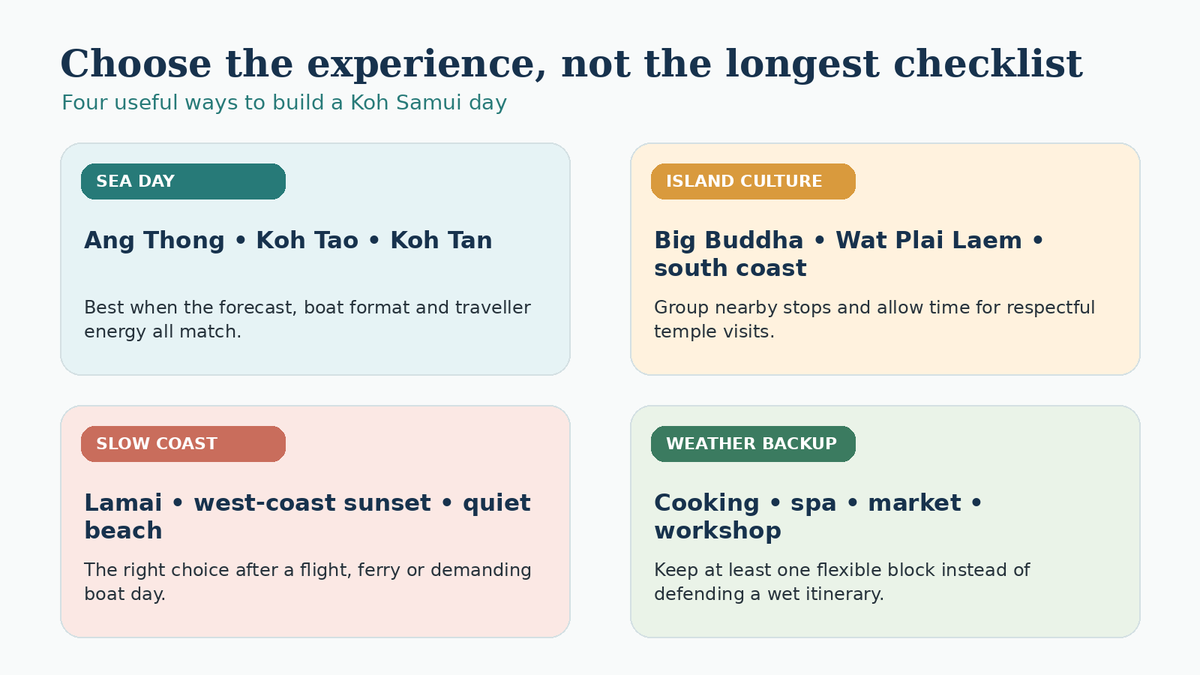
A better trip is built around contrast. Pick one major marine day, one efficient island circuit and at least one half-day that can move when the forecast changes. Travellers who are still shaping the whole stay can use the site’s Koh Samui itinerary, while the Thailand islands guide helps compare Samui with Koh Tao, Koh Phangan and the Andaman islands.
The costs and timings in this 6 September 2026 edition are planning ranges rather than promises. Operators, pickup zones, national-park access, ferry timetables and sea conditions change. Therefore, use the live product page, official park information and the current marine forecast as the final checks before payment or travel.
Best overall first splurge
Mu Ko Ang Thong when the park is open and marine conditions suit. It combines the strongest archipelago scenery with kayaking, viewpoints and a full-day sense of occasion.
Best shorter island option
Koh Tan and Koh Madsum are closer to southern Samui and usually easier to fit into a half or shorter day, although crowds, local fees and animal treatment still need checking.
Best realistic trip length
Five to seven full days gives room for one major boat day, one land circuit, two slower coast or food blocks and a movable weather buffer.
Most important practical difference
Hotel geography controls the trip. A cheap room can become false economy when every meal, pickup and sunset needs an expensive cross-island journey.
Start with travel time, weather and hotel geography
Start with travel time, not the headline attraction. A full-day Ang Thong trip can be excellent, but it normally includes an early pickup, pier waiting, repeated boat boarding and a late-afternoon return. The same traveller may enjoy a temple loop the following day but regret adding another dawn departure.
Next, match the activity to the weather and your tolerance for motion. Koh Tao is farther than Koh Tan, a speedboat feels different from a large tour boat, and a steep viewpoint is not a casual add-on in tropical heat. Meanwhile, waterfalls can look very different after weeks of dry weather.
Finally, decide what the hotel area should do for you. Chaweng reduces the effort of finding restaurants and nightlife. Bophut creates easier evenings around Fisherman’s Village. Lamai combines a substantial beach with a slower atmosphere. By contrast, Taling Ngam and Lipa Noi reward quiet-seekers but make east-coast pickups and dinners less convenient.
Compare the main choices by traveller priority
| Traveller priority | Best match | Why it works | Main trade-off |
|---|---|---|---|
| Iconic first trip | Ang Thong, Big Buddha and Bophut | Strong range of scenery, culture and evening atmosphere | Ang Thong needs a full day and a weather buffer |
| Best snorkelling priority | Koh Tao and Koh Nang Yuan | Longer marine day with more snorkelling focus | Lengthy boat time; rough conditions can be tiring |
| Shorter island day | Koh Tan and Koh Madsum | Closer to southern Samui and easier to pair with Thong Krut | Animal welfare, crowd levels and snorkelling quality vary |
| Low-transfer holiday | Chaweng or Lamai plus nearby food and spa | Easy to adjust around heat or rain | Less geographical variety |
| Culture and local context | Temples, south coast, Nathon and cooking class | Contrasts with resort and boat time | Usually easier with a driver |
| Quiet and romantic | Taling Ngam, Lipa Noi and west-coast sunset | Space, sunset and a slower rhythm | Longer journeys to airport and east-coast activity pickups |
Beaches, culture and major island days
| Experience | Time | Planning range | Best for | Main caution |
|---|---|---|---|---|
| Chaweng Beach | 2-6 hours | Free; food and loungers extra | Easy first day, swimming and nightlife | Central sections can feel busy |
| Lamai and Hin Ta/Hin Yai | 3-6 hours | Mostly free; transport extra | Beach plus an easy landmark | The rock stop is brief |
| Fisherman’s Village | 2-4 hours | THB 300-1,500+ for food/shopping | Walkable evening and mixed dining | Market schedules change |
| Big Buddha and Wat Plai Laem | 2-3 hours | Donation plus transport | Accessible cultural pairing | Dress and temple etiquette matter |
| Ang Thong Marine Park | 8-10 hours | THB 1,700-3,200 plus fee if excluded | Most dramatic archipelago day | Closed 1-30 November; steep options |
| Koh Tao and Nang Yuan | 8-10 hours | THB 2,000-3,600 plus fees if excluded | Snorkelling-led marine day | Longer and potentially rougher journey |
| Koh Tan and Koh Madsum | 4-6 hours | THB 1,200-2,800 plus local fees | Shorter southern-island trip | Crowds and animal context need care |
| Na Muang Waterfalls | 2-4 hours | Small local costs plus transport | Freshwater nature break | Flow and footing change seasonally |
| Central hills and Secret Buddha Garden | 4-6 hours | About THB 100 entry plus driver | Viewpoints and cooler green interior | Steep roads; not a casual scooter ride |
| South-coast culture loop | 4-7 hours | Donations, food and driver | Temples, villages and quieter coast | Stops are spread out |
Slower coast, food, recovery and flexible alternatives
| Experience | Time | Planning range | Best for | Main caution |
|---|---|---|---|---|
| Nathon or Taling Ngam sunset | 2-4 hours | Transport and food | West-facing sunset and slower evening | Return transport should be arranged |
| Quiet beach day | 3-7 hours | Free; food and transport extra | Recovery and space | Fewer walkable alternatives nearby |
| Thai cooking class | About 4 hours | THB 1,800-3,000 | Hands-on food and rainy-day value | Check menu and allergy handling |
| Local food and market crawl | 2-4 hours | THB 300-1,200 | Flexible, social and low commitment | Days and opening hours vary |
| Elephant observation experience | 3.5-4.5 hours | THB 2,500-3,800 | Can support better welfare choices | The word sanctuary proves nothing |
| Spa or wellness half-day | 2-5 hours | THB 800-5,000+ | Recovery after travel or boat day | Resort pricing varies widely |
| Muay Thai experience | 2-3 hours | THB 1,000-2,500+ | Live sport or structured training | Verify schedule and suitability |
| Coconut craft or community workshop | 1.5-3 hours | THB 500-2,000 | Short, local and weather-friendly | Availability can be limited |
| Private driver island circuit | 4-8 hours | THB 2,800-6,000 per vehicle | Efficient for families and mixed needs | Admission and meals may be separate |
| Koh Phangan extension | Half-day to overnight | Ferry plus transfers/hotel | Adds a different island atmosphere | Pier logistics and last ferry matter |
Planning ranges are broad 2026 estimates for decision-making. Confirm the live total, park fees, transfer zone, child policy, cancellation terms and any payment due locally.
The list below is organised by the kind of experience it provides, not by a false one-to-twenty score. Most visitors need five to eight well-chosen experiences, with the rest acting as alternatives for weather, energy and location.
1. Use Chaweng Beach at the right time of day
Chaweng is Samui’s most convenient all-round beach area, particularly for a first arrival day. The long east-coast bay offers swimming, food, massage, shops and nightlife without arranging a vehicle for every decision. However, the atmosphere changes substantially along the beach, and the busiest central stretch is not the only version of Chaweng.
Go early for walking and calmer water-side time, or return in the late afternoon when the heat softens. Midday is better used for lunch, shade or the hotel pool. Families and light sleepers should also distinguish between a hotel near the beach and one beside the loudest nightlife.
Advantages
- Easy first or final day.
- Large choice of food and services.
- Simple to shorten when weather changes.
Limitations
- Central areas can be busy and noisy.
- Beach conditions vary by season and section.
- Convenience can encourage visitors never to explore farther.
2. Pair Lamai Beach with Hin Ta and Hin Yai
Lamai is a useful alternative for travellers who want a substantial resort area without central Chaweng’s intensity. A beach morning can be combined with Hin Ta and Hin Yai, the coastal rock formations south of town, then extended to a café, temple or viewpoint rather than treating the rocks as a whole excursion.
The landmark stop is brief, which is exactly why it works well inside a broader Lamai day. Rocks can be slippery, sun exposure is strong and the surrounding commercial area may feel more prominent than expected. Therefore, arrive for the coast and the route, not for one photograph alone.
3. Eat and walk through Fisherman’s Village
Fisherman’s Village in Bophut is one of the easiest Samui evenings to enjoy without a rigid plan. TAT describes it as an old fishing community now lined with seafront restaurants, international and Thai food, clothing and souvenir shops. [2]
Arrive before full darkness to walk the waterfront, then choose dinner after checking menus and service charges. The famous walking-street atmosphere is not identical every night, so verify the current market schedule rather than building the whole itinerary around an old blog post. Outside peak market periods, Bophut can feel calmer and is often easier for conversation.
Best for
Couples, families, mixed dining preferences and travellers who want an attractive evening with minimal logistics. It is less compelling for someone seeking a purely local market with no resort influence.
4. Pair Big Buddha with Wat Plai Laem
Big Buddha and Wat Plai Laem sit close enough to form one cultural morning or late-afternoon circuit. This matters because temple visits are more rewarding when there is time to notice the setting, architecture and active religious use instead of rushing through a checklist of photo stops.
Dress with shoulders and knees covered, remove shoes where required, keep voices low and avoid blocking worshippers. A lightweight cover-up in the day bag prevents the common mistake of arriving in beachwear and trying to improvise. Meanwhile, the exposed surfaces can become hot, so midday is rarely the most comfortable choice.
Advantages
- Easy to combine in one short circuit.
- Strong cultural contrast with beach time.
- Low direct cost, although donations are appropriate.
Limitations
- Can become a rushed photo stop.
- Dress and conduct matter.
- Exposed areas feel hot in the middle of the day.
5. Explore Mu Ko Ang Thong Marine Park
Ang Thong is the strongest single day trip for dramatic Gulf scenery. The official national-park page describes a 102-square-kilometre archipelago of 42 islands around 20 kilometres west of Samui and Koh Phangan. It also confirms an annual tourism closure from 1 to 30 November because monsoon conditions make access unsafe; the normal open season is 1 December to 31 October. [5]
A typical trip combines viewpoints, beaches, kayaking or snorkelling, but the exact route depends on boat type and conditions. The highest viewpoint options are steep, hot and unsuitable for some knees, footwear or confidence levels. Therefore, do not judge a tour solely by the number of inclusions.
Current 2026 commercial listings commonly occupy most of the day, and some quote a separate park fee around THB 300 for an adult and THB 150 for a child. Confirm the live amount and whether it is included, because fee handling can differ between products. [21]
6. Choose Koh Tao and Koh Nang Yuan for a snorkelling-led day
Koh Tao and Koh Nang Yuan should be chosen for the marine experience, not because they are famous names to collect. The journey from Samui is longer than a southern-island circuit, and a speedboat can feel demanding when the sea is choppy. Bangkok Airways’ current guide gives a broad Samui-to-Tao travel window of roughly 1.5 to 3 hours depending on service. [9]
For a day trip, ask how much time is genuinely spent snorkelling, whether flotation aids are available, how confident swimmers are grouped and what happens if visibility or sea conditions disappoint. An overnight stay on Koh Tao can make more sense when diving, slower snorkelling or island atmosphere is the real priority.
7. Take a shorter southern-island trip to Koh Tan and Koh Madsum
Koh Tan and Koh Madsum provide a shorter alternative to Koh Tao. TAT describes Koh Madsum as roughly a 20-minute journey from Samui and highlights Koh Tan for snorkelling and a nature trail. [2][3]
The trip is often marketed around the pigs on Koh Madsum. Treat that as one element rather than a guaranteed ethical wildlife encounter. Do not chase, carry or feed animals unless clear local welfare guidance permits it, and do not assume a close photograph is harmless. Crowd levels and animal behaviour can also change the experience.
Snorkelling quality is never guaranteed, particularly after wind or rain. Consequently, choose the trip for a relaxed southern-island day and confirm the local island fee, meal, transfer and boat type before booking.
8. Visit Na Muang Waterfalls with seasonal expectations
Na Muang provides a freshwater contrast to Samui’s beaches. TAT describes Na Muang 1 as an approximately 18-metre waterfall dropping into a pool and warns visitors to take care around the surrounding rocks. [2]
Water flow, colour and swimming conditions depend on recent rain. After heavy weather, paths and rocks can be slippery; after a long dry spell, the waterfall may look less dramatic than promotional photographs. Wear secure footwear and stop when the route no longer feels safe.
Be cautious about add-on animal attractions or high-pressure sales nearby. The waterfall itself is the reason to visit. A driver-led south or central circuit is usually more efficient than crossing the island only for this one stop.
9. Explore the central hills and Secret Buddha Garden with a driver
Samui’s interior offers cooler-looking greenery, steep roads, viewpoints and the sculptural Secret Buddha Garden. Bangkok Airways’ May 2026 budget guide lists opening hours of 9:00am to 6:00pm and a THB 100 entry price, but both should be reconfirmed locally. [9]
The important planning detail is the road, not the admission fee. Gradients, bends, rain and loose surfaces make this a poor place to learn scooter skills. A suitable vehicle and experienced driver let the group concentrate on the route and make it easier to add a viewpoint, café or waterfall without improvising.
10. Build a south-coast culture and village loop
The south of Samui is best experienced as a connected route. Possible stops include Wat Khunaram, the red-toned Wat Ratchathammaram, Laem Sor, Ban Hua Thanon, Thong Krut and quieter coastal roads. The goal is not to stop at every pin; it is to understand how the island changes away from the busiest resort strip.
Group two or three cultural stops with lunch and one coast break. At temples, dress appropriately and behave as a visitor to an active religious place. At villages, avoid photographing people at close range without permission. In addition, allow spare driving time because a route that looks short can slow around local traffic and viewpoints.
Who will enjoy it most
Repeat visitors, photographers, culturally curious travellers and anyone staying in Lamai or the south. Families with very young children may prefer fewer stops and a longer lunch.
11. Watch sunset from Nathon, Lipa Noi or Taling Ngam
The west coast gives Samui a different evening rhythm. TAT identifies Nathon Beach as a strong sunset location and also highlights Taling Ngam for west-facing sky and coconut-lined scenery. [2]
Nathon works well when you want a town, market or simple meal around the sunset. Taling Ngam feels quieter and more resort-spread. Lipa Noi can be convenient for a relaxed beach, particularly when the hotel is already on the west side.
Arrange return transport before darkness if the area is unfamiliar. Ride-hailing coverage and vehicle availability can feel very different from Chaweng, and a sunset cocktail is not a reason to ride a scooter after drinking.
12. Protect one genuinely quiet beach day
A trip full of famous attractions can miss the reason many people chose Samui in the first place. One unstructured beach day at Lipa Noi, Maenam, Choeng Mon, Taling Ngam or a calmer section near the hotel can become the most restorative part of the holiday.
Choose the beach by geography and current conditions rather than by a universal ranking. Families may value gentle entry and facilities. Couples may prefer space and sunset. Strong swimmers still need to respect flags, currents and changing weather. Meanwhile, remote beauty is less useful when lunch, shade or the return transfer becomes a problem.
13. Take a Thai cooking class with a market or ingredient component
A cooking class is one of the most useful non-beach experiences because it combines food, conversation and a practical skill. Look beyond the number of dishes. Group size, hands-on time, ingredient explanation, transport, allergy handling and whether the menu is adjusted for dietary needs all matter more.
A current local-family class listing runs for about four hours and includes a market element, which makes it substantial enough to anchor a rainy morning or hot afternoon. [23]
14. Build a local food and market crawl
Samui food planning should extend beyond one famous walking street. Depending on the day, options may include Bophut, Nathon, Lam Din, Maenam or smaller neighbourhood markets. Because schedules change, confirm locally through the hotel, market page or current map listing.
Start with one or two dishes rather than ordering a full meal at the first stall. Share portions, carry small notes and keep an eye on how food is stored and cooked. Travellers with severe allergies should use a translated allergy card and still ask about sauces, pastes, shared oil and cross-contamination.
Markets are also a useful low-commitment plan after a late ferry or short rain shower. However, they should not be treated as guaranteed nightly events simply because an old article lists a weekday.
15. Evaluate elephant experiences by behaviour, not branding
The word sanctuary does not prove good welfare. World Animal Protection advises travellers to avoid riding, shows, bathing and direct-contact entertainment, and instead favour observation of natural behaviour at an appropriate distance. [20]
Before paying, ask whether visitors touch, wash or feed elephants, whether handlers use tools, whether animals perform, how much space they have and whether the visit remains worthwhile without a close-up photograph. If the business avoids clear answers, choose another activity.
Better signs
- Observation is the main activity.
- No riding, tricks or bathing.
- Animals can move away from visitors.
- Group size and noise are controlled.
Warning signs
- Constant touching is promoted.
- Baby elephants are used for selfies.
- Bathing is described as essential care.
- The name ethical replaces detailed evidence.
16. Schedule a spa, massage or wellness half-day
Recovery is a legitimate activity on a tropical island, especially after a long flight, speedboat or early pickup. Options range from simple massage shops to resort spas, yoga and multi-hour wellness programmes. Price alone does not indicate quality, so look for cleanliness, clear treatment descriptions and staff who ask about injuries, pregnancy or medical limitations.
Book a major treatment after, not immediately before, a demanding excursion. Deep massage can leave some people sore, while long sun exposure after certain skin treatments may be uncomfortable. A quiet half-day also works well when marine conditions cancel a trip but the rain is intermittent.
17. Watch or try Muay Thai responsibly
A stadium event can provide an energetic evening, while a beginner session gives more context about stance, movement and conditioning. Verify the current fight schedule directly because event nights change. For training, choose a reputable gym, explain your fitness level and avoid sparring pressure that exceeds your experience.
Hydration and heat matter even in a short class. Jewellery, hard contact lenses and unsuitable footwear can also create problems. By contrast, watching a fight is lower effort but may not suit young children, noise-sensitive visitors or anyone uncomfortable with combat sport.
18. Try a coconut craft or community workshop
Coconuts remain part of Samui’s landscape and identity, so a short craft, food or traditional-house activity can add local context without taking a full day. TAT material highlights heritage and coconut-related activities in the wider island route. [2]
A soap-making workshop is useful when the forecast is uncertain or the group wants something hands-on but not physically demanding. Check whether the session is a demonstration or a genuinely participatory class, how long it lasts and whether transport is included.
19. Use a private driver to build one efficient island circuit
A private driver is not automatically a luxury. For three or four people, mixed mobility, child seats or several distant stops, the per-person cost can compare well with repeated taxis and reduces uncertainty around return transport.
Agree the duration, pickup, route, vehicle size, waiting time, overtime, child-seat availability and what is excluded before departure. Then limit the plan. A six-hour booking does not become better because it contains twelve stops; it often becomes a sequence of car parks.
20. Add Koh Phangan as a day trip or short extension
Koh Phangan is close enough to combine with Samui, but the best format depends on the aim. A day trip works for a specific beach, event or private excursion. An overnight stay is better when the island itself, rather than the ferry ride, is the experience.
Bangkok Airways gives a broad Samui-to-Phangan travel time of roughly 30 to 50 minutes depending on service. Lomprayah publishes a current 2026 timetable with multiple Gulf departures, but the actual journey still depends on pier, check-in, transfer and weather. [9][11]
Check the last practical return, not only the advertised last ferry. A late arrival at the wrong Samui pier can create a long taxi journey. During major events, book transport and accommodation earlier and make an independent safety plan.
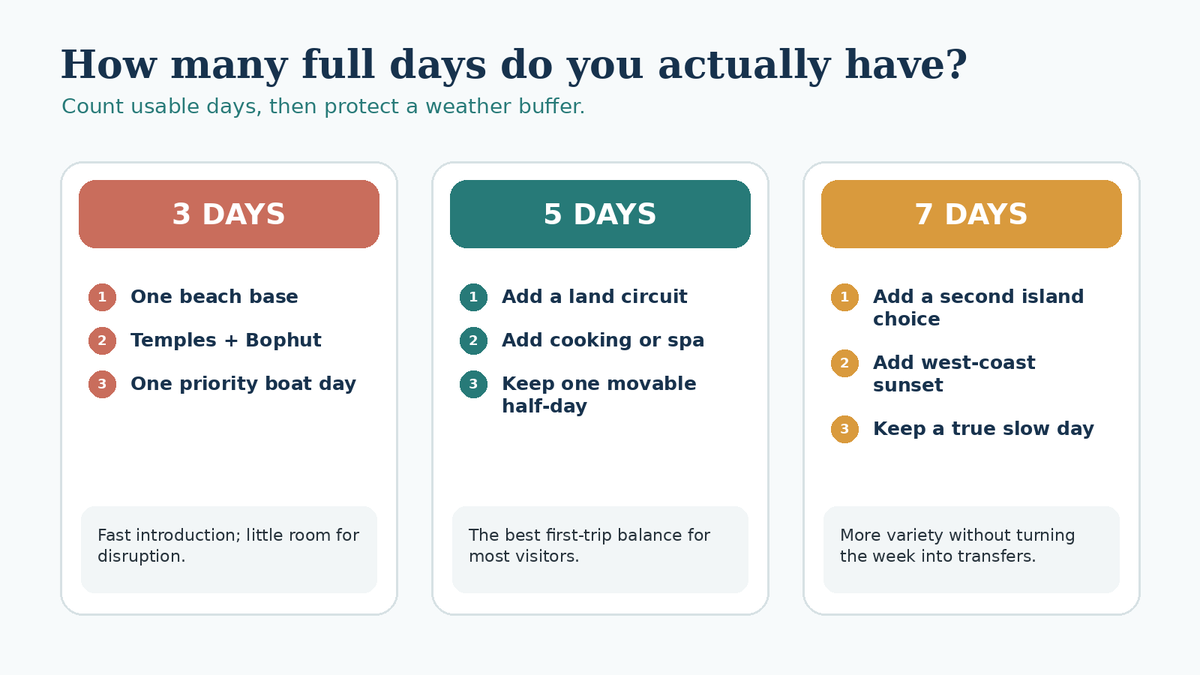
Count full usable days rather than hotel nights. A late airport arrival and an early ferry departure do not create two sightseeing days. Likewise, one boat day needs a backup slot if it is a core reason for the trip.
| Time available | Realistic structure | What it feels like |
|---|---|---|
| Three full days | Chaweng or Lamai; temples and Bophut; one priority boat day | Fast introduction with little weather flexibility |
| Five full days | Add Na Muang or the central hills; cooking or spa; keep one block movable | Best first-trip balance for most travellers |
| Seven full days | Add Koh Tao or Phangan, a west-coast sunset and a true slow day | Better variety and recovery without filling every hour |
| Ten or more days | Split the stay or add an overnight island extension | Useful when quiet beaches and local rhythm matter as much as headline sights |
A realistic three-day Samui plan
Use the first day for the beach area and Bophut, the second for temples plus a south or central circuit, and the third for Ang Thong or another priority boat day. Keep the land day and boat day interchangeable until the forecast is clearer.
A balanced five-day Samui plan
Add Na Muang or the central hills, a cooking class or spa, and one quieter beach or west-coast sunset. This format provides variety without requiring a 7:00am start every morning.
A seven-day Samui plan
Choose only one of Koh Tao, Koh Phangan or a second major boat experience unless marine travel is the main interest. Use the extra time for a slower south-coast route, quiet beach and recovery block.
The best hotel area is the one that reduces the journeys you will actually make. A remote sunset resort can be wonderful, but it is a poor match for nightly Chaweng plans and early east-coast pickups. Conversely, central Chaweng may waste the tranquillity a quiet-seeking couple travelled for.
| Area | Best for | Practical advantage | Main trade-off | Hotel link |
|---|---|---|---|---|
| Chaweng | First-time convenience, nightlife, restaurants | Airport access; broad taxi and tour coverage | Busy, potentially noisy; map position matters | Booking.com Agoda |
| Bophut | Couples, families and attractive evenings | Walkable Fisherman Village; north-coast access | Beach quality and road noise vary | Booking.com Agoda |
| Lamai | Beach holiday with a slower resort rhythm | Useful for south and waterfall routes | Farther from some north-coast departures | Booking.com Agoda |
| Choeng Mon or Plai Laem | Quieter north-east stay and temple access | Near airport and northern attractions | Fewer late-night choices than Chaweng | Compare hotels |
| Maenam | Longer stays and calmer north-coast feel | Useful for some ferry and island connections | More spread out for dinner and nightlife | Booking.com Agoda |
| Lipa Noi or Taling Ngam | Sunset, privacy and recovery | Quiet west coast; easier Donsak ferry side | Long transfers to east and north-east | Compare hotels |
Flights and mainland ferry connections
Direct flights save time, while land-and-ferry journeys can reduce cost. Bangkok Airways’ 2026 guide describes a direct Bangkok-Samui flight of around 1 hour 30 minutes and a bus-plus-ferry journey that can take roughly 10 to 12 hours overall. The full time depends on the selected connection and waiting. [9]
For the mainland ferry, current Seatran examples show Donsak to Nathon taking about 1 hour 30 minutes with an adult fare of THB 190 in August 2026. Treat that as a dated example rather than a permanent fare, and add the transfer to Donsak plus the onward island journey. [12]
Airport songthaew and island transport
Samui Airport announced in March 2026 that arriving passengers can use the Samui Local Public Bus, or songthaew, as a lower-cost island transport option. Confirm the current boarding point, route, operating hours, luggage practicality and fare on arrival because the airport notice does not make every hotel a direct stop. [30]
| Journey | Typical option | Planning time | Key check |
|---|---|---|---|
| Bangkok to Samui | Direct flight | About 1.5 hours in the air plus airport time | Best when holiday time is limited |
| Bangkok to Samui | Train or bus plus transfer and ferry | Often 10-14 hours end to end | Check connection protection and overnight comfort |
| Surat Thani to Samui | Joint transfer plus ferry | Several hours depending on gateway and waiting | Confirm airport, station, pier and hotel endpoints |
| Donsak to Nathon | Vehicle/passenger ferry | About 1.5 hours on current Seatran examples | Add Donsak and Nathon transfers |
| Samui to Phangan | High-speed or conventional ferry | Roughly 30-50 minutes on many services | Pier and hotel transfer can exceed boat time |
| Samui to Koh Tao | High-speed ferry or tour speedboat | Roughly 1.5-3 hours depending on service | Long sea time and weather exposure |
| Around Samui | Songthaew, taxi, ride-hailing, driver or rental vehicle | Highly route-dependent | Agree or confirm fare and endpoint before travel |
Do you need a scooter in Koh Samui?
No. Scooters can be convenient for properly licensed, insured and experienced riders, but they are not a compulsory island experience. Road surfaces, rain, gradients, traffic, sand, animals and unfamiliar junctions can turn a simple ride into a serious risk. If any part of the legal or insurance position is unclear, use a driver, taxi or songthaew.
Samui can be comfortable on very different budgets, but transport and location create the largest surprises. A cheaper west-coast hotel may need more taxis, while a premium Bophut room may reduce evening transport. Similarly, a tour with hotel pickup can cost less overall than a lower headline price from a distant pier.
| Day type | Planning range | What changes the total |
|---|---|---|
| Simple beach and food day | THB 500-1,500 | Meals, local transport and small extras |
| Temple or short driver circuit | THB 1,000-3,500 per group | Route length, waiting and vehicle |
| Private full island circuit | THB 2,800-6,000 per vehicle | Vehicle, hours, guide, admissions and overtime |
| Ang Thong or Koh Tao day | THB 1,700-3,600 per person | Boat type, park fees, transfer zone and activities |
| Koh Tan and Madsum | THB 1,200-2,800 per person | Group size, meal, island fee and boat type |
| Cooking class | THB 1,800-3,000 per person | Market, transport, menu and group size |
| Spa or wellness | THB 800-5,000+ per person | Local shop, resort setting and treatment length |
| Order | Decision | Reason |
|---|---|---|
| 1 | Hotel area | It controls airport transfer, beach access and the effort of every later plan. |
| 2 | Arrival and departure transport | Late arrivals and ferry days are poor times to improvise. |
| 3 | One priority boat activity | Book the experience you would be most disappointed to miss, with movable terms where possible. |
| 4 | Limited-place specialist activity | Cooking, a small-group tour or private driver may need advance space. |
| 5 | Flexible beach, market and temple time | These are easier to adjust around forecast and energy. |
Koh Samui has a Gulf weather pattern that differs from Thailand’s Andaman coast. Monthly averages help with broad planning, but the official short-range forecast and marine warning are more useful for a specific boat or waterfall day. TMD publishes both a Samui forecast and Southern East Coast wind-and-wave guidance. [7][8]
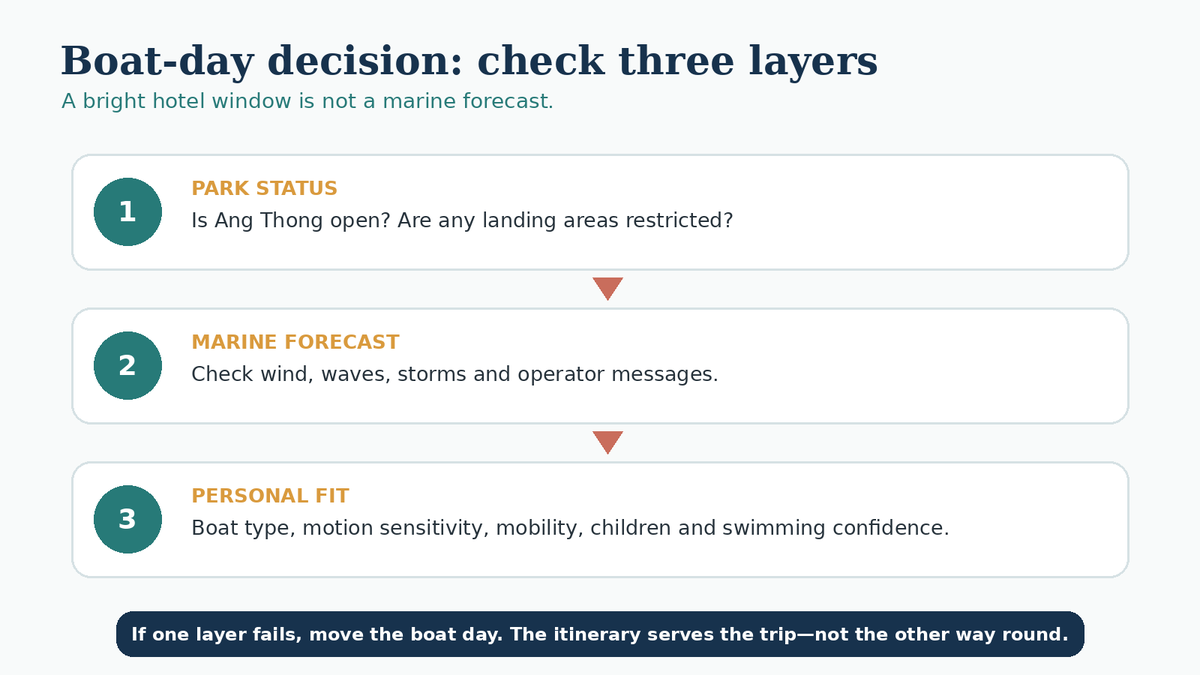
Rain does not always last all day, and a bright hotel window does not prove the sea is suitable. Follow licensed operator and official advice. When a trip is cancelled for safety, do not search for a less cautious operator at the pier.
Ang Thong has a clear annual exception: the official park page states that tourism closes from 1 to 30 November and normally reopens from 1 December to 31 October. This should be treated as a hard itinerary constraint, not a weather gamble. [5]
| Condition | Practical response | Better alternative |
|---|---|---|
| Calm forecast and confirmed pickup | Proceed after checking fees, pier and return time | Boat day |
| Thunderstorms or strong marine warning | Move the booking under the operator terms | Cooking, Bophut, spa or temple circuit |
| Heavy recent rain | Check road, waterfall and viewpoint access | Lower-level cultural route |
| Very hot still day | Start early and reduce exposed climbing | Beach shade, lunch and later sunset |
| Low energy after travel | Do not force a full-day tour | Nearby beach, massage or short market evening |
| Ang Thong during November closure | Choose a different destination | Koh Tan, land circuit or another open route if conditions suit |
A wet forecast should change the order of the trip, not automatically cancel the day. Samui rain can arrive as a short heavy burst, a grey half-day or a genuinely rough spell that also affects the sea. The useful question is whether the activity depends on dry roads, a safe marine forecast or a clear viewpoint.
Choose activities that still work between showers
A cooking class, massage, café-and-market route or short craft workshop can absorb a poor-weather block without feeling like a consolation prize. Fisherman’s Village can also work between showers when the rain is intermittent, although uncovered walking streets are less enjoyable in a sustained downpour. A temple circuit remains possible when roads are safe, but wet steps and tiled surfaces deserve more caution than the guidebook photographs suggest.
Move, rather than force, a boat day
Marine conditions matter more than the amount of rain visible from the hotel. Wind, waves and thunderstorms can affect small-boat comfort and safety even when the island itself looks bright. Follow the licensed operator’s decision, check the Thai Meteorological Department’s Gulf forecast and use a flexible cancellation policy. If Ang Thong is the main reason for visiting, place it early enough in the stay to allow one reschedule.
| Weather problem | Better response | Useful alternative |
|---|---|---|
| Short tropical shower | Wait under cover and keep the local plan | Café, massage or market stop |
| Persistent rain but normal roads | Choose an indoor-led activity | Cooking class, spa or craft workshop |
| Heavy rain on steep roads | Drop the central-hills route | Stay near the hotel or use a professional driver |
| Strong wind or rough sea | Move or cancel the boat day | Beach-area food, temples or wellness |
| National-park closure | Do not look for an unofficial workaround | Koh Tan, Koh Phangan or a land day when conditions suit |
Useful equipment solves a defined problem. It does not make unsafe conditions safe. A waterproof pouch should be tissue-tested, a dry bag may be splash-resistant rather than submersible, and water shoes do not make coral safe to stand on.
| Item | Useful for | Buying check | Limitation |
|---|---|---|---|
| Small dry bag | Spray, wet towels and separating documents | 5-10 litres for essentials; roll-top seal | Not a guarantee against full submersion |
| Waterproof phone pouch | Small-boat boarding and rain | Clear touch response; secure lanyard; test before use | Condensation and failed seals still occur |
| Water shoes | Wet landings, hot sand and rough entries | Secure heel; drainage; comfortable when wet | Do not walk on coral or sharp reef |
| Motion-sickness bands | Non-medicinal option for known motion sensitivity | Comfort, fit and realistic expectations | Evidence and personal response vary; seek medical advice for medication |
| Packable rain jacket | Ferry decks, showers and hill routes | Breathable, small and quick drying | Can feel hot; not a storm-safety tool |
| eSIM or local data | Maps, pickups, ferries and forecast checks | Unlocked compatible phone and suitable data amount | Keep screenshots because signal and battery can fail |
Responsible planning is not a separate luxury category. It affects wildlife, reefs, temples, communities and the safety of workers. Choose operators that explain environmental rules, use moorings rather than damaging reefs, provide suitable equipment and accept cancellations when conditions are unsafe.
Do not stand on coral, feed marine life or leave litter. At animal attractions, distance and choice matter more than touch. In villages and temples, ask before close photography and dress appropriately. Meanwhile, refillable water and a small day bag can reduce repeated single-use purchases without pretending that one product solves the whole environmental problem.
Some Samui activities are not automatically bad, but their risk or welfare implications are easy to hide inside attractive marketing. A short pause before paying can prevent a poor decision.
Be especially cautious with
- Elephant programmes built around bathing, riding, tricks or constant touching.
- Steep interior scooter routes when the rider lacks the correct licence, experience or insurance.
- Jet-ski agreements without a clear condition check and written price.
- Overloaded island circuits that promise ten or more stops in a few hours.
- Wildlife photographs that depend on feeding, restraint or guaranteed contact.
Look for instead
- Observation-led wildlife experiences with distance and animal choice.
- A driver for steep or unfamiliar roads.
- Fewer stops with time to understand each place.
- Clear inclusions, cancellation terms and local fees.
- Activities that remain worthwhile even without a staged photograph.
For road and water safety, the site’s transport in Thailand guide explains the trade-offs between self-driving, taxis, ferries and organised transfers in more detail.
Koh Samui works particularly well for travellers who want a beach base without giving up cultural sights, food experiences and substantial day trips. However, the same variety can create too much road time when the hotel, pier and chosen activities sit on different sides of the island.
What works well
- Direct island flights protect time on a shorter trip.
- There is a useful mix of beaches, temples, markets, cooking, spas and marine days.
- Several hotel areas support very different holiday styles.
- Rain need not cancel the whole day because indoor and low-commitment alternatives exist.
What needs planning
- Taxis and repeated cross-island journeys can become expensive.
- Sea conditions and annual park closures affect the most famous excursions.
- Some viewpoints and waterfalls involve steep, slippery or uneven ground.
- Busy east-coast areas feel very different from the quieter south and west.
The practical answer is to choose one main marine day, group land attractions geographically and leave one movable half-day. This protects the trip from weather changes without turning flexibility into an empty itinerary.
- Booking two or three major boat days because the island names look different, without accounting for repeated early pickups and sea time.
- Ignoring the official 1-30 November Ang Thong closure and assuming another operator can bypass it.
- Choosing a hotel by room photographs while overlooking the exact beach, road, nightlife and transfer geography.
- Treating every waterfall, viewpoint and snorkelling photograph as a year-round guarantee.
- Learning to ride a scooter on steep or wet island roads without the correct licence, insurance and experience.
- Crossing the whole island for one minor landmark instead of grouping stops by direction.
- Assuming a walking street or market operates every night because an old guide lists one schedule.
- Using the word sanctuary as proof of animal welfare without checking the actual visitor interaction.
- Waiting until sunset to arrange a return vehicle from a quiet west-coast location.
- Comparing tour prices without checking park fees, pickup zones, boat type, group size and cancellation terms.
- Filling every half-day so there is no space for weather changes, recovery or simple beach time.
- Keeping tickets and insurance only online when battery, signal or a wet phone could remove access.
For British citizens travelling on a full passport, current GOV.UK guidance says the passport should expire at least six months after arrival and have at least one blank page. It also states that foreign nationals must complete the Thailand Digital Arrival Card online and can register within the three days before arrival. [14][18]
Entry rules differ by nationality and can change, so check the authorities that apply to your passport. FCDO also advises appropriate insurance covering the itinerary, planned activities and emergency costs. Thai hospitals may ask for payment or an insurer guarantee. [13][15]
- Save insurance documents and the assistance number offline.
- Keep Tourist Police 1155 and medical emergency 1669 with your contacts. [17]
- Check CAAT registration and operating rules before packing or flying a drone. Samui Airport says operations within nine kilometres require prior approval through the UAS Portal, submitted at least seven days ahead. [19][31]
- Reconfirm every ferry pier and hotel pickup the evening before travel.
- Use official weather information and accept safety-led changes.
- Never assume scooter rental includes legal or insurance cover.
What are the best things to do in Koh Samui for first-time visitors?
Prioritise one major boat day such as Ang Thong, one land circuit covering temples or the south coast, Fisherman’s Village, a beach area that suits your style and one slow recovery block. Add Koh Tao only when snorkelling and a long sea day are genuine priorities.
How many days do you need in Koh Samui?
Four full days is workable, while five to seven full days gives a better first-trip balance and a weather buffer. Count usable days rather than hotel nights.
Is Ang Thong Marine Park worth it?
Yes for dramatic archipelago scenery, viewpoints and kayaking, provided the park is open and the day suits your mobility and sea tolerance. It is officially closed from 1 to 30 November each year.
Is Koh Tao a good day trip from Koh Samui?
It can be excellent for snorkelling-focused travellers, but it is a long day with substantial boat time. An overnight stay may be better when diving or slower island time is the main objective.
Is Pig Island worth visiting?
Koh Madsum and Koh Tan can make an enjoyable shorter island trip. Choose for the southern-island day, not only animal photographs, and check crowd levels, local fees, animal treatment and snorkelling expectations.
Which is the best beach in Koh Samui?
Chaweng offers the most convenience, Lamai balances beach and resort facilities, Choeng Mon can feel calmer, and Lipa Noi or Taling Ngam suit quiet and sunset. The best choice depends on location, season, facilities and preferred atmosphere.
Do you need a scooter in Koh Samui?
No. Songthaews, taxis, ride-hailing and private drivers can cover a trip. Rent a scooter only with the correct licence, insurance, experience and confidence in the actual road and weather conditions.
What can you do in Koh Samui when it rains?
Choose a cooking class, spa, short craft activity, Bophut between showers, covered food stops or a carefully planned temple circuit. Avoid forcing boat or hill plans against official warnings.
What is the best month for Koh Samui?
There is no perfect month for every traveller. Use seasonal patterns for broad planning, then check TMD’s live Samui and Gulf forecasts. Ang Thong is closed throughout November.
Can you visit Koh Phangan from Koh Samui for a day?
Yes, but confirm the exact departure and arrival piers plus the last practical return. An overnight stay is usually better when exploring Phangan itself is the main aim.
How much do Koh Samui activities cost?
A major boat day often falls around THB 1,700-3,600 per person, a cooking class around THB 1,800-3,000 and a private circuit roughly THB 2,800-6,000 per vehicle. Live fees and inclusions must be checked.
Where should first-time visitors stay in Koh Samui?
Chaweng is best for maximum convenience, Bophut for attractive evenings and mixed dining, and Lamai for a substantial beach with a slower resort feel. Map position matters more than the area name alone.
Are elephant sanctuaries in Koh Samui ethical?
The name is not evidence. Avoid riding, shows, bathing and forced direct contact. Prefer observation, space, natural behaviour and transparent answers about management.
What should you book first in Koh Samui?
Book the hotel area and arrival transport first, then one priority boat experience and any limited-place class or private vehicle. Keep beaches, markets and a backup half-day flexible.
Are Koh Samui waterfalls worth visiting in the dry season?
They can still be a pleasant nature stop, but the flow may be modest and the pools can look very different from wet-season photographs. Check recent conditions, treat the waterfall as part of a wider south or interior route, and avoid climbing on wet or unstable rocks.
What are the best things to do in Koh Samui with children?
Choose a calm beach close to facilities, an early temple-and-Bophut outing, a short southern-island trip when sea conditions suit, a cooking activity and one easy waterfall or viewpoint stop. Boat duration, life-jacket fit, shade, toilets and the journey back matter more than the number of attractions included.
For a first visit, choose one major island day, one land circuit and one area that works well without transport. Ang Thong is the strongest scenery-led boat choice when open. Koh Tao is better for a snorkelling priority, while Koh Tan and Koh Madsum suit a shorter southern-island day.
On land, pair Big Buddha and Wat Plai Laem, then choose either Na Muang with the south coast or a central-hills driver route. Keep Bophut or a quiet west-coast sunset for a lower-effort evening. Finally, leave enough empty time to enjoy the beach you paid to stay beside.
Final planning checklist
- Choose the hotel area before comparing every activity.
- Reserve one priority boat day with clear cancellation terms.
- Keep a second day movable for weather.
- Check Ang Thong closure dates and live park status.
- Group temples, waterfalls and coast stops by direction.
- Confirm pickup zone, pier, park fees and return time.
- Arrange west-coast return transport before sunset.
- Evaluate elephant activities by behaviour and distance.
- Carry insurance, tickets and emergency details offline.
- Protect one slow half-day with no paid booking.
Research for this edition was reviewed on 6 September 2026. Official tourism, national-park, meteorological, transport, entry and safety sources were prioritised; commercial listings were used only to illustrate current formats, inclusions and booking choices.
Official destination, park and weather sources
- Ko Samui Destination Guide – Tourism Authority of Thailand. Official island destination overview.
- Updated 15 Koh Samui Check-in Places – Tourism Authority of Thailand. Official practical detail for Na Muang, Koh Madsum, Koh Tan, Fisherman Village, Nathon and Taling Ngam.
- Koh Samui, Koh Tan and Koh Madsum Route – Tourism Authority of Thailand. Official three-island route and community context.
- Ko Samui and Surat Thani Four-Day Plan – Tourism Authority of Thailand. Official trip-planning context.
- Mu Ko Ang Thong National Park – Department of National Parks, Wildlife and Plant Conservation. Official geography, climate and annual closure dates.
- National Park Opening and Closing Data – Department of National Parks, Wildlife and Plant Conservation. Official national-park opening and closure data.
- Samui Province Weather – Thai Meteorological Department. Official current and seven-day Samui forecast.
- Southern East Coast Marine Forecast – Thai Meteorological Department. Official Gulf-side rain, wind and wave guidance.
Transport, entry and safety authorities
- Koh Samui Budget Travel Guide 2026 – Bangkok Airways. Current 2026 transport, island travel and budget-planning context.
- Koh Samui Travel Guide 2026 – Bangkok Airways. Current 2026 destination and access context.
- Lomprayah Timetable 2026 – Lomprayah High Speed Ferries. Current operator timetable for Samui, Phangan and Tao routes.
- Donsak and Nathon Ferry Inventory – Seatran Ferry. Current operator fare and journey-time examples.
- Thailand Travel Advice – UK Foreign, Commonwealth and Development Office. Current warnings, insurance and travel-advice context.
- Thailand Entry Requirements – UK Foreign, Commonwealth and Development Office. Current passport, visa and digital arrival-card guidance for British travellers.
- Thailand Health Advice – UK Foreign, Commonwealth and Development Office. Emergency treatment, payment and insurance context.
- Thailand Safety and Security – UK Foreign, Commonwealth and Development Office. Road, water, adventure-activity and local safety context.
- Tourist Police Contact – Tourist Police Bureau. Official Tourist Police hotline 1155.
- Thailand Digital Arrival Card – Thailand Immigration Bureau. Official TDAC portal.
- Quick Access Drone Licence – Civil Aviation Authority of Thailand. Official drone rules and registration procedures.
- Elephant-Friendly Tourist Guide – World Animal Protection. Welfare framework discouraging rides, shows, bathing and direct-contact entertainment.
Current activity and commercial inventory
- Ang Thong Day Tour with Kayak and Snorkelling – GetYourGuide. Live inventory checked for duration, fee treatment and activity format.
- Koh Tao and Koh Nang Yuan Snorkelling Tour – GetYourGuide. Live inventory checked for duration and long-boat-day relevance.
- Thai Cooking Class with a Samui Local Family – GetYourGuide. Live inventory checked for class length, market component and dietary information.
- Koh Samui Elephant Home Guided Tour – GetYourGuide. Commercial programme reviewed as a welfare-screening example; direct-contact elements mean the listing is not recommended or monetised in this guide.
- Pig Island and Koh Tan Tour – Viator. Live inventory checked for a southern-island day and stated local fees.
- Private Custom Sightseeing Tour – Viator. Live inventory checked for private-driver duration options.
- Coconut Soap Making Experience – Viator. Live inventory checked for a short craft activity.
- Koh Samui Transport Inventory – 12Go Asia. Current route inventory used only to confirm transport relevance.
- Koh Samui Accommodation Inventory – Agoda. Current accommodation inventory used only for location-led comparison.
Official Samui Airport updates
- Convenient Travel from Samui Airport with Local Public Transportation – Samui International Airport. Official March 2026 confirmation that the Samui Local Public Bus (songthaew) serves arriving airport passengers.
- Drone Operation Permission within Samui Airport Area – Samui International Airport. Official 2026 requirement for prior approval within nine kilometres of Samui Airport, with UAS Portal submission at least seven days ahead.
Illustrations in this article were created for Taylor’s Trailblazing Travels. Third-party photographs, where used, are credited beside the image or in the source list.