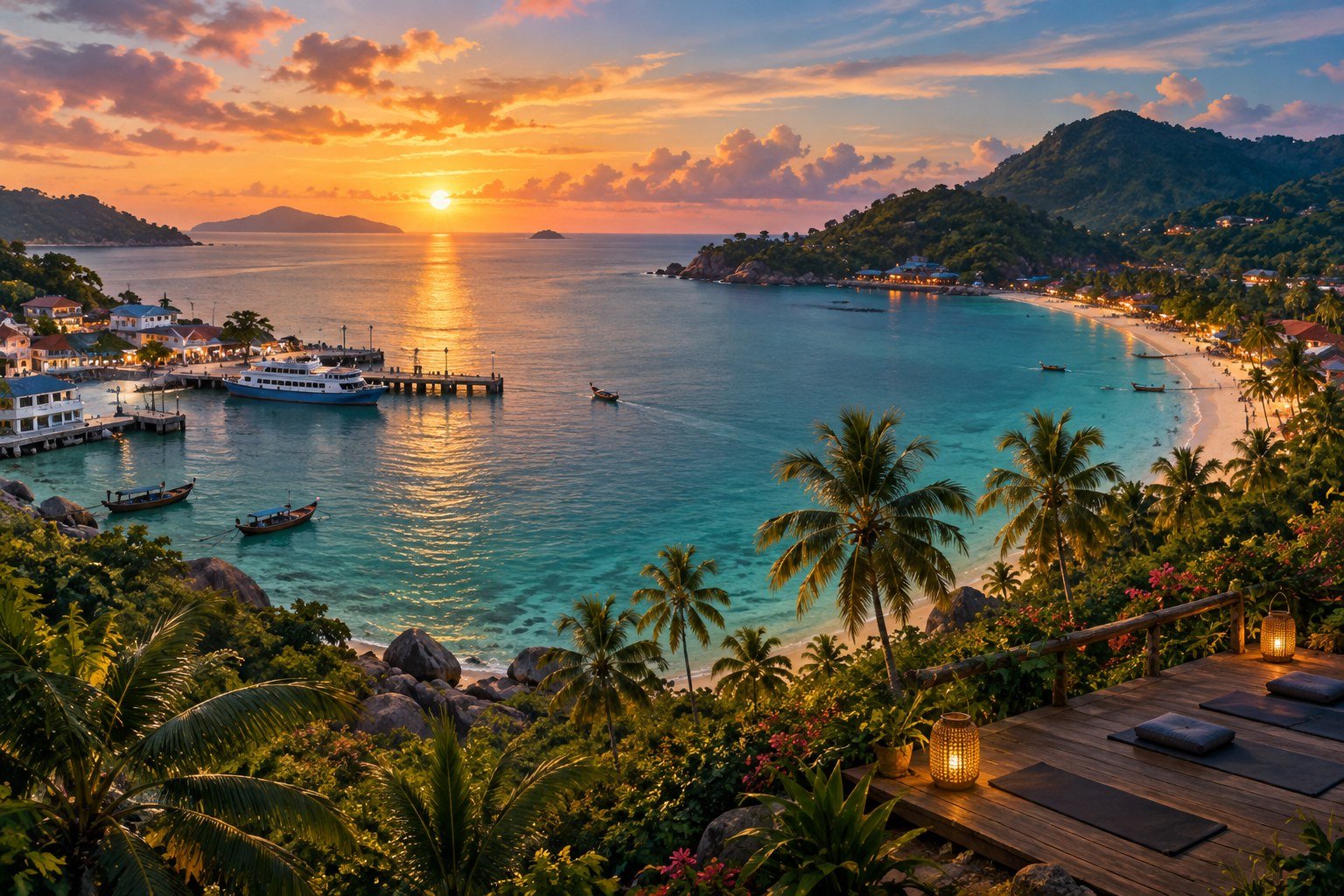
KOH PHANGAN • WHERE TO STAY
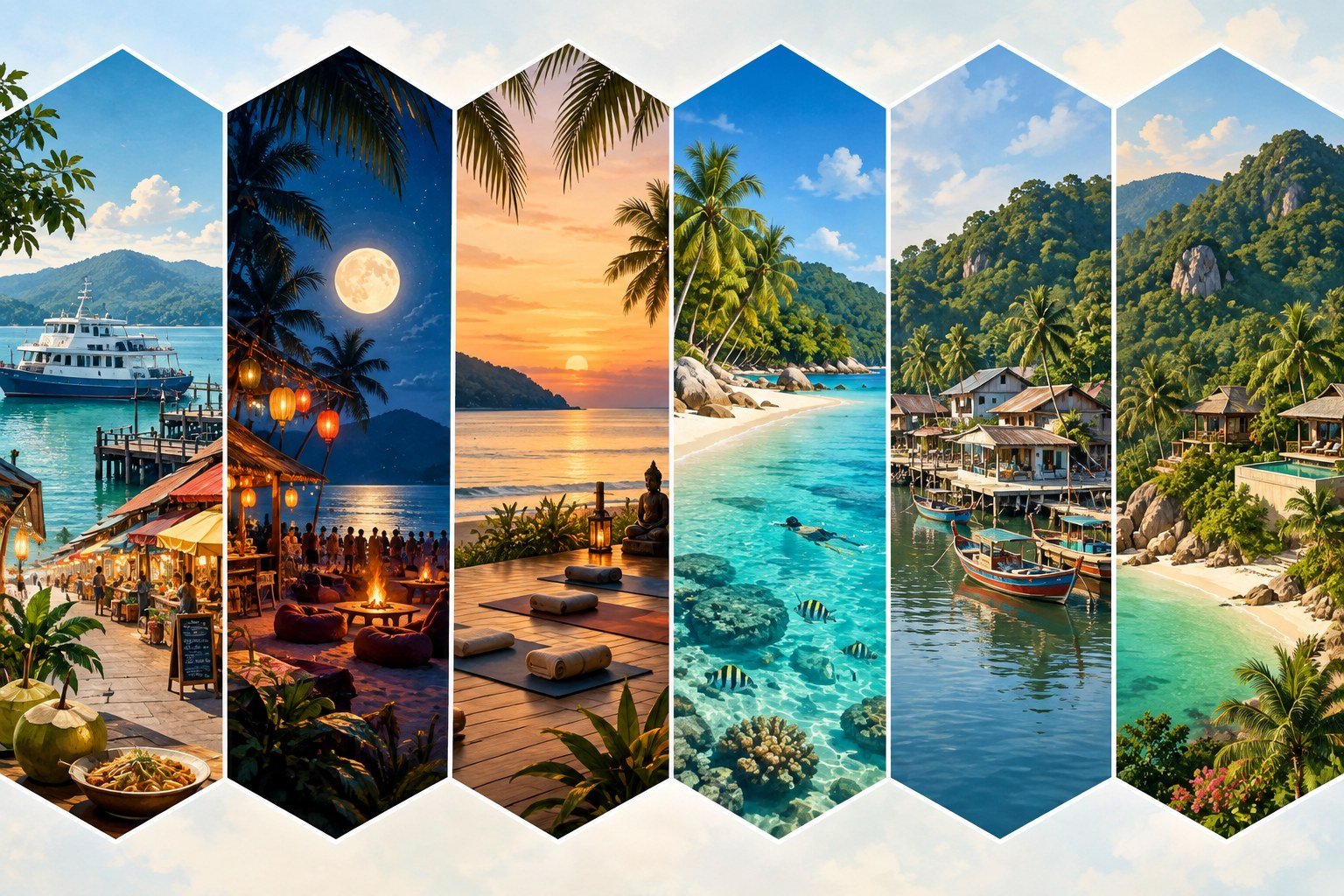
Choose between ferry convenience, Full Moon access, wellness cafés, sunset beaches, fishing villages and self-contained resort bays.
Koh Phangan changes character from one coast to the next, so the right hotel area matters as much as the room itself.
The best areas to stay in Koh Phangan are not interchangeable. Thong Sala makes ferries, food and short stays easy; Haad Rin revolves around the Full Moon calendar; Srithanu suits yoga, cafés and longer stays; while the northeast feels more like a self-contained resort holiday. A room that looks inexpensive can become poor value when every meal, class or evening requires a cross-island taxi.
That difference is easy to underestimate because Koh Phangan is often marketed as one beach destination. In reality, forested hills separate several small coastal communities, and the last road journey can take longer than the ferry from Koh Samui. The island also serves very different travellers: party groups, families, wellness visitors, remote workers, couples and people who mainly want a quiet bay.
This guide compares the practical experience rather than ranking beaches by appearance alone. It covers transfer time, walkability, swimming conditions, nightlife, likely room costs and the amount of transport each base creates. Ferry information and live accommodation examples were checked in September 2026, although operators, event organisers and hotels remain the final authority for an exact date.
Some links in this guide are affiliate links. If you book or buy through them, Taylor’s Trailblazing Travels may earn a commission at no extra cost to you. Recommendations remain based on practical fit, not commission.
Best overall beach base
Haad Yao or Haad Salad for sunsets, a holiday atmosphere and enough nearby food without Haad Rin’s event-night intensity.
Best for ferries
Thong Sala for a late arrival, early departure, short stay or traveller who values markets, services and easier taxi supply.
Best for wellness
Srithanu and Hin Kong for yoga, cafés, coworking and a social scene that is active without being centred on one monthly party.
Biggest practical difference
Daily transport. The wrong coast can add two taxi journeys, 60–120 minutes and a meaningful extra cost to an otherwise cheap room.
The most useful comparison begins with the trip you will actually take. A traveller arriving on the last afternoon ferry, leaving at 08:00 two days later and carrying a large suitcase has a different best base from someone spending ten nights on a scooter with yoga classes booked every morning.
Eight areas compared
| Area | Best for | Main advantage | Main trade-off | Transport dependence |
|---|---|---|---|---|
| Thong Sala | Short stays, ferry convenience, food and services | Best taxi supply and widest everyday choice | Town atmosphere; beach is not the island’s strongest | Low |
| Baan Tai / Ban Kai | Social travellers, groups and party access without sleeping in Haad Rin | Central south-coast position | Road noise and shallow sections of beach | Low–medium |
| Haad Rin | Full Moon Party, nightlife and travellers who want to walk home | Event access and two contrasting beaches | Price spikes, noise and crowds around party dates | Medium |
| Srithanu / Hin Kong | Yoga, cafés, remote work and longer stays | Strong wellness community and sunset social scene | Swimming is limited at parts of Hin Kong, especially at low tide | Medium |
| Haad Yao / Haad Salad | First-time beach holidays, couples and families | Balanced beach, food and sunset appeal | Hilly properties and fewer late-night choices | Medium |
| Chaloklum / Mae Haad | Quiet stays, village atmosphere and snorkelling access | North-coast character and calmer pace | Longer transfer to Haad Rin and fewer evening taxis | Medium–high |
| Thong Nai Pan Noi / Yai | Resort stays, couples and families who want a self-contained bay | Beautiful northeast beaches and polished resorts | Longer, hillier road transfer; limited island-wide spontaneity | High |
| Than Sadet / east coast | Seclusion, nature and travellers content to stay locally | Remote scenery and a strong escape-from-everything feeling | Least convenient for ferries, nightlife and frequent dining changes | High |
The answer for most first-time visitors
Haad Yao or Haad Salad is the strongest general recommendation when the priority is a proper beach, sunset, a choice of restaurants and a calmer evening. Srithanu becomes the better option when classes, cafés, coworking and meeting people matter more than having the best swimming beach immediately outside the room.
Thong Sala is less romantic but far more forgiving. It works especially well for one or two nights, uncertain ferry connections, travellers who do not ride scooters and anyone who wants a town rather than a resort enclave. By contrast, Thong Nai Pan is worth the longer transfer when the hotel, bay and slow routine are the main reasons for visiting.
Research-led planning rule
Choose the coast from the fixed parts of the trip: ferry time, Full Moon date, booked classes, mobility needs and whether you will drive. Then compare hotels. A beautiful bargain on the wrong side of the island can cost more in taxis than the room saving.
Koh Phangan sits north of Koh Samui in the Gulf of Thailand. Most scheduled passenger services arrive at Thong Sala on the west side, although route and pier details vary by operator. The Tourism Authority of Thailand describes the island as a mix of beaches, natural areas and the internationally known Full Moon Party rather than a single resort strip.[1]
The hills divide the holiday into zones
The flatter south and west are easiest for frequent movement. Thong Sala, Baan Tai, Srithanu and the west-coast beaches connect through the island’s most useful road corridor. Consequently, these bases make it simpler to change restaurants, reach markets or return to the pier without building the whole day around one transfer.
The northeast and east feel more isolated. Thong Nai Pan is reached by a paved but hilly cross-island road, while smaller east-coast bays can involve steep approaches or limited transport. A map may show only a short straight-line distance; the real journey follows the mountain road.
West coast, south coast or northeast?
| Zone | Typical experience | Choose it when | Think twice when |
|---|---|---|---|
| West coast | Sunsets, beach bars, wellness, mixed budgets and relatively easy access to Thong Sala | You want variety and expect to explore | You need a deep swimming beach at every tide; individual bays differ |
| South coast | Ferries, markets, social hostels, parties and the easiest route to Haad Rin | The stay is short or event access matters | You want complete quiet or a picture-postcard swimming beach |
| North coast | Fishing-village feel, quieter beaches and Koh Ma snorkelling access | You prefer local rhythm and earlier evenings | You plan several late nights in Haad Rin |
| Northeast and east | Resort bays, jungle scenery and a stay-put holiday | The hotel and beach are the main plan | You dislike long taxi transfers or need frequent town services |
The hotel pin matters inside every area
Area names cover hillsides as well as beachfront roads. In Haad Yao, Srithanu and Thong Nai Pan, a hotel described as “near the beach” may sit above it. Before paying, inspect the exact map pin, recent access comments and the final 300 metres. A steep lane feels very different after dark, in rain or with a pushchair.
Do not judge distance by island width
A ten-kilometre road journey can include steep gradients, bends, ferry traffic and event congestion. Build the final transfer into the booking decision, especially for an early boat or a same-day flight connection.
Thong Sala is the island’s practical centre and the normal arrival point for scheduled ferries. It has supermarkets, pharmacies, banks, cafés, markets, travel offices and the broadest choice of everyday services. The area is therefore the easiest introduction after a long flight-and-ferry journey.
Who Thong Sala suits
Choose it for a one- or two-night stop, an early departure, uncertain weather or a trip without a scooter. It also suits travellers who prefer local food choice and errands within a compact area. Night-market dining can keep costs lower than relying on one resort restaurant, while taxi sharing is easiest when boats arrive and depart.
Where to stay within the area
The blocks close to the pier are best for pure convenience. A room farther north towards Nai Wok or Wok Tum feels calmer and can add a sunset outlook, although walking back with luggage becomes less attractive. South of town, properties blend gradually into Baan Tai and offer easier beach access without losing the town completely.
What you give up
Thong Sala does not provide the island’s strongest classic beach holiday. The shoreline is useful for sunsets and views, but travellers who want to swim outside the hotel each morning should compare a west-coast or northeast bay. Town noise and traffic also vary sharply by street.
Why stay here
- Minimal final transfer after the ferry.
- Best concentration of practical services.
- Good base for short stays and poor-weather days.
- Easier to find food at different price points.
Reasons to stay elsewhere
- Less of a secluded island atmosphere.
- Swimming beach quality is not the main draw.
- Traffic and port activity can affect some rooms.
- Repeated taxi journeys are still needed for the best beaches.
Baan Tai and neighbouring Ban Kai stretch along the south coast between Thong Sala and Haad Rin. This is the strategic compromise for travellers who want social accommodation, beach bars and access to party venues without placing the whole trip inside Haad Rin.
A central base for groups
The location works particularly well when friends want different things. One person can attend a party, another can book a yoga class on the west side, and the group can still reach Thong Sala without crossing the entire island. Accommodation ranges from hostels and simple bungalows to villas and small resorts.
Check the road, not only the beach
Some rooms sit close to the main coastal road. That is convenient for taxis but can bring traffic noise. Meanwhile, parts of the south-coast beach are shallow and tidal, so a beachfront label does not guarantee effortless swimming throughout the day. Recent guest photographs often reveal more than the hotel’s hero image.
Best use of Baan Tai
It is strongest for a mixed social trip, a Full Moon visit where walking home is not essential, or a first island night before moving to a quieter coast. It is weaker for honeymoon-style seclusion and for travellers who expect to spend every day on one outstanding beach.
Practical room check
Ask whether the room faces the road, beach, pool or an event space. In Baan Tai, two rooms at the same property can have completely different noise profiles.
Haad Rin occupies the island’s southeastern peninsula and is the correct base when the Full Moon Party is a fixed part of the trip. Staying locally removes the hardest post-party problem: finding safe transport across the island at a time when demand is highest.
Sunrise Beach and Sunset Beach are different
Haad Rin Nok, usually called Sunrise Beach, is the Full Moon Party beach. Music, stages and event setup can affect the area before and after the official night. Haad Rin Nai, or Sunset Beach, is on the opposite side of the peninsula and generally feels calmer, although sound can still travel and the entire town becomes busier around major dates.
Who should stay here
Choose Haad Rin for one to three nights when nightlife is the priority, the group wants to walk home, or an early speedboat connection uses the peninsula. Outside event periods, prices and atmosphere can be more relaxed, but visitors expecting constant nightlife should still check the calendar because the town changes markedly between party weeks.
Who should not
Families seeking quiet evenings, travellers with an early ferry from Thong Sala and couples wanting a peaceful week may find the peninsula too intense or inconvenient. A short Haad Rin stay followed by Haad Yao, Srithanu or Thong Nai Pan often works better than forcing one base to serve two incompatible holidays.
Full Moon safety is part of the hotel choice
The FCDO advises extra care around full-moon events, including pre-arranging transport, guarding drinks and avoiding unlicensed lifts.[6] A walkable room is therefore a practical risk-control measure, not merely a nightlife luxury.
Compare Haad Rin accommodation
Check the exact beach side, cancellation terms, minimum stay and recent noise comments. Event-week pricing can change sharply even within the same property.
Srithanu and Hin Kong form the island’s best-known wellness and long-stay zone. Yoga studios, cafés, vegetarian food, workshops and coworking-friendly venues create a community that feels more lived-in than a conventional resort strip.
Srithanu for walkable daily routine
Srithanu village is the more practical choice when classes, food and social contact matter every day. The exact level of walkability depends on the property, but the central area offers a cluster of cafés and services that can reduce taxi use. Travellers staying for a week or more often value that routine more than a single dramatic beachfront view.
Hin Kong for sunsets and space
Hin Kong stretches south along a shallow west-coast bay. It is appealing for sunset bars, villas and a quieter outlook, yet the water can recede a long way at low tide. Anyone booking specifically for swimming should verify the beach outside the property rather than assuming west-facing means all-day bathing.
Remote work and longer stays
The area is a sensible remote-work base because cafés, longer-term rentals and social networks are easier to find. Even so, internet quality is building-specific. Ask for a recent speed test, confirm power-backup arrangements when deadlines matter and carry mobile data rather than depending on one router.
The trade-off
Srithanu is not the closest base for Haad Rin nightlife or the northeast beaches. Taxis add up, and scooter-free travellers should place the hotel close to their main studio or coworking venue. The best-value room is the one that lets you walk to the activity repeated most often.
Compare Srithanu and Hin Kong stays
Use the map view, then inspect the final approach, beach depth and distance to the exact studio or coworking space you plan to use.
Search Srithanu on Booking.com Search west-coast stays on Agoda
Haad Yao and Haad Salad are the safest all-round recommendations for a first beach-focused visit. Both sit on the northwest coast, combine attractive bays with sunset orientation and retain enough restaurants and small shops for a relaxed holiday without complete isolation.
Haad Yao for choice and social ease
Haad Yao has the broader spread of accommodation and dining. It suits couples, friends and families who want a classic beach base but still appreciate several places to eat. Current accommodation listings show options from simple rooms to larger villas, although the exact rate changes with date, cancellation terms and occupancy.[9]
Haad Salad for a smaller bay
Haad Salad feels more compact and can be calmer, particularly for travellers content with a smaller evening circuit. The bay can suit families when sea conditions are gentle, but access, reef depth and seasonal swimming should be checked locally. A beachfront family room with safe access is worth more than a cheaper hillside room that requires repeated taxis.
Hillside value can be deceptive
Some properties sit above the coast and trade a steep approach for a view. That can be excellent for a couple with transport and light luggage. By contrast, it may be unsuitable for a pushchair, reduced mobility or anyone who expects to walk back after dinner.
Why this area wins overall
The northwest gives a convincing sense of island holiday without making every practical need difficult. It is far enough from Haad Rin to feel separate from the party, yet close enough to Srithanu, Chaloklum and Thong Sala for occasional trips. For four to seven nights, that balance usually matters more than being the absolute best at one niche.
Compare Haad Yao and Haad Salad hotels
Compare the room position as carefully as the resort name. A sea-view room may be several flights or a steep lane above the beach.
Chaloklum, Malibu Beach and Mae Haad suit travellers who want the north coast’s quieter rhythm. Fishing boats, low-key restaurants and a more village-like setting make this part of Koh Phangan feel distinct from both Haad Rin and the wellness corridor.
Chaloklum for local routine
Chaloklum is the practical northern centre. It has places to eat, small shops and boat activity, while the surrounding hills create a sheltered feel. The village works well for a slower week, a repeat visit or travellers who prefer an early dinner and morning beach to nightlife.
Mae Haad and Koh Ma
Mae Haad is known for the sandbar and access towards Koh Ma. Snorkelling conditions depend on tide, visibility and sea state, so treat any reef claim as conditional rather than guaranteed. Reef-safe behaviour matters: do not stand on coral, feed fish or chase marine life for photographs.
Transport reality
The north coast is not difficult to reach, but spontaneous late-night transport is less dependable than in Thong Sala or Baan Tai. A traveller planning several Haad Rin nights will spend a large part of the budget and energy crossing the island. Conversely, someone who mainly wants the north, west and daytime trips may barely notice the distance.
Best for
Choose this zone for quiet couples, divers or snorkellers who will check current conditions, families wanting a calmer village and travellers who enjoy a small local circuit. Skip it when the holiday depends on nightlife, daily yoga in Srithanu or an early departure after a late final evening.
Environmental note
Koh Phangan’s marine setting is part of the reason to stay here. Use mooring-aware operators, keep fins clear of shallow coral and follow local closures or warnings. Conditions can change after storms even when older photographs look perfect.
Thong Nai Pan Noi and Thong Nai Pan Yai form two northeast bays with a stronger resort-holiday identity than most of Koh Phangan. The road from Thong Sala is paved but crosses the island’s hills, so the longer transfer buys seclusion rather than convenience.
Noi for polished resort atmosphere
Thong Nai Pan Noi generally has the more refined boutique and upscale feel. Resorts, restaurants and a compact village make it possible to stay locally for several days. It is a strong choice for couples, honeymoons and travellers who want the room, pool and beach to carry the holiday.
Yai for more space and mixed budgets
Thong Nai Pan Yai is the larger bay and can offer a broader spread of room styles. It suits families and travellers who want a beautiful northeast base without committing to the highest resort tier. As elsewhere, beach conditions and room access vary, so inspect the exact property rather than treating both bays as one product.
When the long transfer is worthwhile
Choose Thong Nai Pan for four or more nights when most days will stay in the northeast, perhaps with one organised island tour. The transfer feels less sensible for a two-night stop, a Full Moon-focused trip or a traveller who wants several evenings in Thong Sala and Srithanu.
Make the resort earn the location
A remote hotel should solve meals, transport, bad-weather time and beach access. Check restaurant prices, shuttle policy, nearby alternatives and whether the room remains enjoyable when the sea is rough.
Compare Thong Nai Pan accommodation
Look for current transfer options, family-room layout, breakfast terms and the walking route between the room, beach and village.
Search Thong Nai Pan on Booking.com Search northeast resorts on Agoda
Than Sadet and the smaller east-coast bays offer the island’s strongest feeling of remoteness. The coast is associated with steep forest, beaches and Than Sadet–Koh Phangan National Park, so the setting appeals to travellers who genuinely want to disconnect.[8]
What seclusion actually means
Fewer restaurants, limited evening transport and a longer final road journey are part of the experience. A secluded bungalow can be perfect when the plan is reading, swimming when conditions allow and eating locally. It becomes frustrating when the traveller expects daily café choice, effortless nightlife or quick access to a pharmacy.
Weather changes the value
On a clear day, the east coast can feel like the reward for the difficult approach. During heavy rain or rough sea conditions, however, steep roads and exposed beaches require more caution. The Thai Meteorological Department should be checked for warnings, particularly when the stay includes a fixed ferry or flight connection.[7]
National-park access is not guaranteed by the hotel
Park areas, waterfalls, roads and fees can change. Ask the accommodation what is currently open, then verify locally rather than relying on a years-old review. Waterfalls are seasonal; a dramatic wet-period flow and a safe swimming pool are not the same promise.
Who should book it
This is a good fit for experienced independent travellers, couples seeking genuine quiet and anyone content to organise transfers in advance. First-time visitors with four nights, no transport and a long list of island-wide restaurants will usually enjoy a west-coast base more.
Protect the departure day
Do not combine a remote east-coast checkout with the final possible ferry before an international flight. Move closer to Thong Sala for the last night or build a generous mainland or Samui buffer.
Traveller type is a better filter than a universal “best beach” list. The correct area reduces the journeys repeated every day and makes the hotel’s weaknesses less important.
Best match by trip style
| Traveller | Best first choice | Why it fits | Useful alternative |
|---|---|---|---|
| First-time couple | Haad Yao or Haad Salad | Best balance of beach, restaurants and sunsets | Thong Nai Pan for a stay-put resort |
| Family with young children | Haad Salad or Thong Nai Pan Yai | Calmer holiday rhythm and family-room potential | Thong Sala for a one-night ferry buffer |
| Solo social traveller | Srithanu or Baan Tai | Easy to meet people without relying only on Full Moon nightlife | Haad Rin during the event |
| Full Moon group | Haad Rin | Walking home removes the hardest transport problem | Baan Tai if quiet sleep matters more |
| Remote worker | Srithanu / Hin Kong | Cafés, community and longer-stay supply | Thong Sala for services and errands |
| No scooter | Thong Sala or central Srithanu | More daily needs within a smaller radius | A resort with shuttle in Thong Nai Pan |
| Quiet repeat visitor | Chaloklum or Mae Haad | North-coast routine and fewer party crowds | Than Sadet for deeper seclusion |
| Luxury escape | Thong Nai Pan Noi | Resort quality and a self-contained bay | Private villa on the west coast |
Couples
Haad Yao and Haad Salad give most couples the best blend of beach time, sunset and places to eat. Thong Nai Pan Noi is stronger when privacy and resort quality justify a larger budget. Haad Rin can still work for a nightlife-focused pair, but the party calendar should be an active choice rather than a surprise.
Families
Families need more than a shallow-looking bay. Check road access, room layout, cot policy, pool barriers, medical access and the swimming conditions for the actual month. A slightly less dramatic beach with a flat walk to food can be the better family holiday.
Solo travellers and remote workers
Srithanu offers the easiest community without committing to clubbing. Baan Tai suits hostel-style social travel and access to events, while Thong Sala helps anyone who values practical errands and transport. Remote workers should confirm internet at the specific room level and keep mobile data as backup.
Travellers with reduced mobility
Do not assume “beachfront” means step-free. Many island hotels use steep lanes, garden stairs or hillside bungalows. Ask for the number of steps from vehicle drop-off to room, restaurant and beach, then request written confirmation of the allocated room category.
A hotel can be beside the sea without offering effortless swimming. Tide, reef, wind, rain and local drainage all affect the experience, while conditions may change between morning and afternoon.
Beach expectations by area
| Area | Swimming expectation | Main strength | Planning adjustment |
|---|---|---|---|
| Thong Sala | Limited as a pure swimming base | Sunset walks and convenience | Choose a hotel pool or travel to another bay |
| Baan Tai / Hin Kong | Often shallow and tide-sensitive | Views, beach bars and long shoreline | Do not book solely for all-day swimming |
| Haad Rin Nok | Broad party beach; conditions vary | Event access and daytime sand | Check flags and avoid swimming during crowded intoxicated nights |
| Haad Yao / Haad Salad | Generally stronger beach-holiday choice | Swimming, sunsets and family time | Reef and depth still change with tide and season |
| Mae Haad / Koh Ma | Snorkelling potential in suitable conditions | Shallow reef exploration | Never stand on coral; visibility is not guaranteed |
| Thong Nai Pan | Strong resort-beach appeal | Stay-put swimming and beach days | Rough weather can still close the water |
| East coast | Scenic but more exposed and remote | Seclusion and natural setting | Follow local warnings; alternative beaches require a long transfer |
Read the flags and the water, not the brochure
The FCDO warns that strong riptides and rough monsoon seas cause drownings in Thailand and advises following beach flags and local instructions.[6] Red flags are not a challenge to find a quieter entry point. When the sea looks poor, use the pool, move the beach day or choose a land-based activity.
Gulf weather differs from the Andaman coast
Koh Phangan follows the southeast Gulf pattern rather than Phuket or Krabi’s calendar. The FCDO notes that Koh Samui and southeast Thailand often experience their wetter pattern from November into March, while also warning that weather has become less predictable.[6] Consequently, a national “Thailand rainy season” graphic is too simple for choosing this island.
Tides matter most on shallow west and south bays
Hin Kong and parts of Baan Tai can look radically different at low tide. That does not make them bad bases; it changes what the beach is for. Sunset, paddleboarding in suitable water and a spacious outlook may be the strengths, while daily swimming happens elsewhere.
A better hotel question
Ask, “Can an average adult swim directly in front of the property at both high and low tide during my month?” That produces more useful information than “Is the hotel beachfront?”
Koh Phangan can still suit several budgets, but the same room may price very differently by season, cancellation terms and party calendar. Current Booking.com results show simple rooms and mid-range hotels alongside villas costing several times more, while Agoda’s Haad Rin overview illustrates how wide the event-area spread can become.[9][10]
Realistic 2026 planning ranges
| Room type | Working nightly range | Where it is easiest to find | What changes the price |
|---|---|---|---|
| Hostel bed | 300–800 THB | Thong Sala, Baan Tai and Haad Rin usually have the broadest choice | Event dates can multiply the rate or impose minimum stays |
| Simple private room | 900–2,000 THB | Town rooms and inland bungalows | Air-conditioning, hot water and quiet position are not automatic |
| Comfortable mid-range double | 2,000–4,500 THB | Useful target for Haad Yao, Srithanu, Chaloklum and Baan Tai | Beachfront, breakfast and flexible cancellation can move the total |
| Polished beach resort | 4,500–9,000 THB | Thong Nai Pan, west-coast boutiques and larger resorts | Transfers and resort dining may sit outside the room rate |
| Luxury villa or premium suite | 9,000–25,000+ THB | Private pools, larger groups and special trips | Check access, deposits, electricity and staff/service inclusions |
Planning ranges are for one room or bed unless stated, checked against live listings in September 2026. They are not quoted rates for a particular date and may exclude taxes, meals, transfers or event supplements.
Compare the final total, not the first card
Two apparently similar rooms can differ through taxes, breakfast, payment timing, cancellation, pier transfer and a mandatory minimum stay. A refundable rate may be worth the premium when ferry schedules or weather are uncertain. Conversely, a non-refundable bargain is poor value when the flight connection has not been secured.
Event dates distort Haad Rin first
Demand rises around the Full Moon Party and New Year. The effect spreads into Baan Tai and other areas as nearby rooms fill. Book the event nights first, then place quieter nights around them. If the Haad Rin rate is excessive, compare Baan Tai only after pricing the late-night transport and agreeing how the group will return.
Budget for the area’s hidden costs
A remote resort may add taxi transfers and higher meal prices. Town accommodation may require daily beach transport. Meanwhile, a hillside villa may require a vehicle that every guest can legally and safely use. Add those costs before declaring one area cheaper.
Compare current Koh Phangan room prices
Use identical dates, guest numbers and cancellation terms on both platforms. Then open the map and read the access comments before paying.
Search Koh Phangan on Booking.com Search Koh Phangan on Agoda
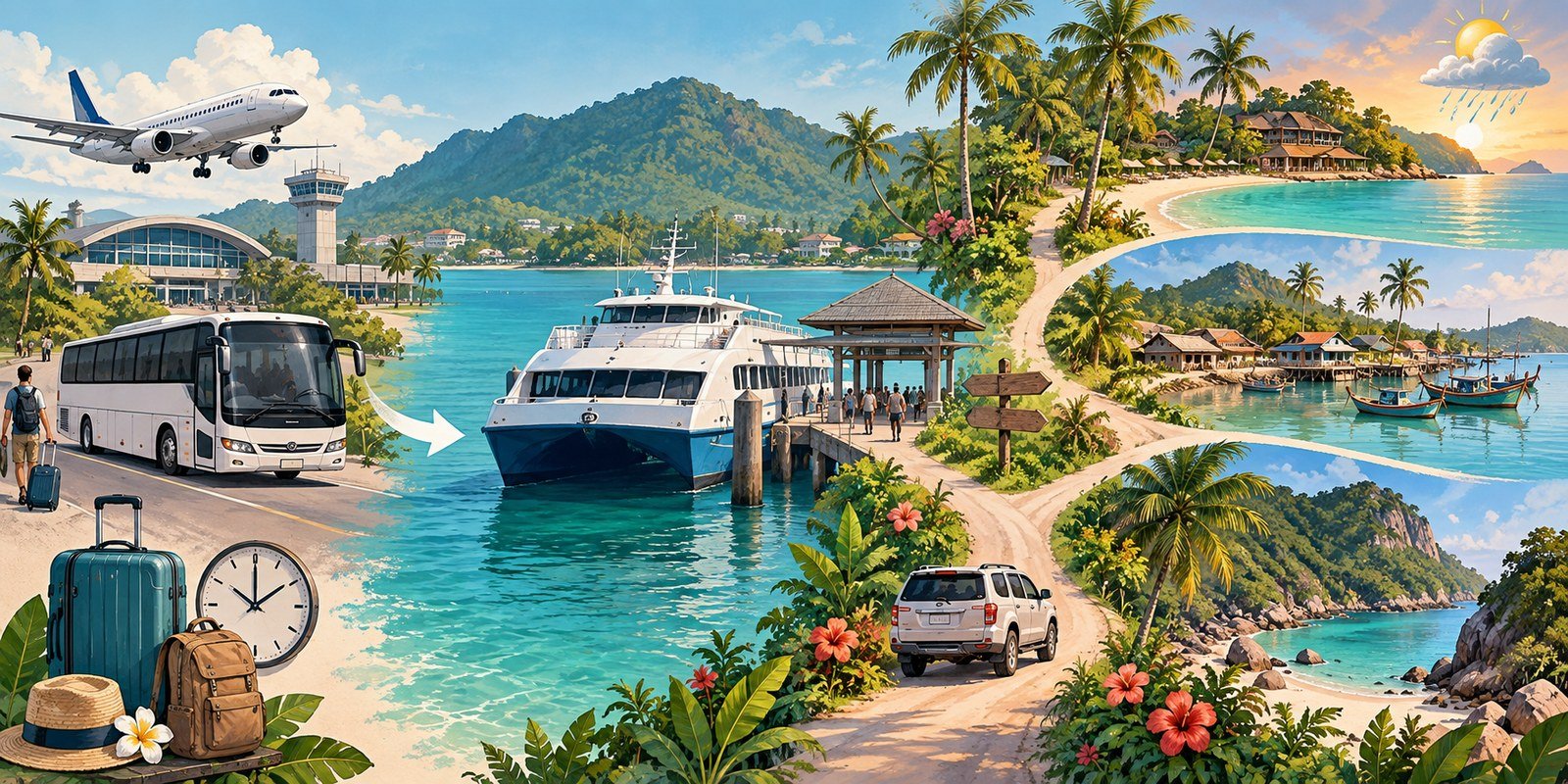
Where you stay begins with how you arrive. Most visitors reach Koh Phangan by ferry, commonly through Koh Samui, Donsak or Koh Tao. Lomprayah publishes a 2026 timetable across the Gulf network, while Raja Ferry lists direct Donsak–Thong Sala sailings and Seatran provides Gulf ferry and island-transfer services.[2][3][4]
Main arrival routes
| Starting point | Typical route | Working journey range | Critical check |
|---|---|---|---|
| Koh Samui | Passenger ferry or speedboat from the operator’s stated Samui pier | Often about 20–90 minutes on the water | Samui has several piers; match the transfer to the exact departure point |
| Surat Thani Airport / town | Bus or van plus Donsak ferry | Roughly 4–7 hours door to door | Do not treat the flight arrival as the pier arrival; buy a protected connection |
| Donsak | Vehicle ferry or passenger service to Thong Sala | Raja’s published direct example is about 2 hours 30 minutes | Check whether the ticket is direct or changes vessel at Samui |
| Koh Tao | Inter-island catamaran or ferry | Often about 1–2 hours depending on service | Rough seas and loading can affect the connection |
| Chumphon | Bus or pier transfer plus ferry via Koh Tao | Usually a large part of the day | Useful from the upper Gulf, but not a short transfer |
Choose the exact pier before the hotel transfer
“Koh Samui ferry” is not a complete plan. Samui services can use Bangrak, Maenam, Nathon or another operator-specific pier. A hotel near Samui Airport may be convenient for one pier and awkward for another. Read the ticket from top to bottom, including check-in point and required arrival time.
Protect a combined ticket
A bus-and-ferry ticket sold as one protected itinerary is usually safer than separate tickets with a narrow self-transfer. If the legs are separate, allow for baggage delivery, road traffic, ticket collection and the operator’s check-in deadline. The final afternoon boat should not be paired with a same-evening international flight.
Arrival area strategy
After a long route, Thong Sala is the low-friction first night. Travellers continuing to Haad Yao, Srithanu or Baan Tai can normally transfer the same day. For Thong Nai Pan or the remote east coast, an early arrival and pre-arranged driver are more comfortable than negotiating the longest road leg after dark.
Compare ferry and transfer options
12Go is useful for seeing operators, departure points and combined journeys together. Recheck the operating carrier, pier and baggage terms before payment.
Samui to Koh Phangan Surat Thani to Koh Phangan Koh Tao to Koh Phangan
The final transfer is the most overlooked cost in a Koh Phangan hotel search. Shared songthaews collect passengers around ferry arrivals, while private taxis and hotel drivers are more useful for families, bulky luggage, late boats and remote properties.
Planning times from Thong Sala
| Destination area | Normal planning time | Most practical transport | What can extend it |
|---|---|---|---|
| Thong Sala centre | 0–10 min | Walk, short taxi or hotel pickup | Best for late arrival and early ferry |
| Baan Tai / Ban Kai | 10–25 min | Shared songthaew or private pickup | Roadside properties are easiest |
| Srithanu / Hin Kong | 20–35 min | Shared or private taxi; hotel pickup | Confirm the exact village or hillside |
| Haad Yao / Haad Salad | 30–45 min | Taxi or pre-arranged transfer | Final lane can be steep |
| Haad Rin | 30–45 min | Shared songthaew, taxi or event transfer | Allow longer around Full Moon traffic |
| Chaloklum / Mae Haad | 35–55 min | Taxi or hotel pickup | Late-night supply is thinner |
| Thong Nai Pan | 45–70 min | Pre-arranged taxi strongly preferred | Hilly cross-island road |
| Than Sadet / remote east | 50–80+ min | Pre-arranged suitable vehicle | Weather and final access matter |
Times are broad planning ranges, not timetables. Rain, ferry queues, road works, night travel and Full Moon traffic can add substantially.
Working taxi budget
For ordinary daytime planning, allow roughly 150–300 THB per person for a shared songthaew to many established areas and more for the longest northeast or east-coast trips. Private vehicles commonly cost several hundred baht and can exceed 1,000 THB for remote, late or event journeys. Agree whether the quote is per person or per vehicle before luggage is loaded.
Hotel pickup can be worth more than a cheaper room
A confirmed driver who knows the property’s final lane reduces arrival friction. This is especially valuable for Thong Nai Pan, Than Sadet, hillside villas and groups needing child seats or unusual luggage. Ask where the driver will meet the ferry and what happens if the boat is delayed.
Build backwards for departure
Start with the operator’s check-in time, then add the road journey and a buffer. The first taxi of the morning should be booked the previous day. From remote coasts, consider a final Thong Sala night when the ferry connects to a flight you cannot afford to miss.
Do not use a scooter as a luggage transfer
A suitcase, wet road and unfamiliar hills are a dangerous combination. Use a taxi for arrival and departure even if a properly licensed rider later hires a scooter for local journeys.
The Full Moon Party is held at Haad Rin Nok and changes accommodation, ferry and taxi demand across the island. The 2026 calendar currently lists 26 September, 27 October, 24 November and 24 December, plus the 31 December countdown event after this guide’s September fact check.[5]
Remaining published 2026 dates
| Published date | Day | Planning context | What to do |
|---|---|---|---|
| 26 September 2026 | Saturday | Next scheduled party after this guide’s fact check | Book ferry and Haad Rin/Baan Tai room immediately |
| 27 October 2026 | Tuesday | Moved around a Buddhist observance in published calendars | Reconfirm before the cancellation deadline |
| 24 November 2026 | Tuesday | Falls in the Gulf’s wetter-risk period | Keep sea and road plans flexible |
| 24 December 2026 | Thursday | Christmas Eve demand | Expect high accommodation pressure |
| 31 December 2026 | Thursday | New Year countdown event | Treat as peak-season logistics, not an ordinary monthly party |
Dates can move for Buddhist holidays, local decisions or safety reasons. Confirm with the current event calendar and accommodation before relying on a non-refundable booking.
Stay in Haad Rin when walking home matters
For a first Full Moon Party, one or two nights in Haad Rin is the cleanest arrangement. It removes the late cross-island journey and lets the group return independently. A room on the Sunset Beach side may be calmer, but no property on the peninsula should be sold as guaranteed silent during the event.
Use Baan Tai for a compromise
Baan Tai suits groups who want party access without spending the full stay in Haad Rin. Pre-arrange the return and set a meeting point before phones, batteries or mobile signal become unreliable. Do not assume a taxi will appear immediately at the preferred departure time.
Split the island rather than compromise the whole week
A practical seven-night pattern is two nights in Haad Rin around the event, then five nights in Haad Yao, Srithanu or Thong Nai Pan. The move costs time once but avoids paying event-area prices and tolerating event noise for the entire holiday.
Party safety
Keep control of drinks, avoid unknown alcohol, stay away from fire activities, agree how the group will leave and do not ride a scooter after drinking. FCDO guidance notes assault and drink-spiking risks around full-moon events and advises pre-arranged transport.[6]
Koh Phangan’s freedom is often illustrated with a scooter, but a rental is not a compulsory part of the island. The safest transport plan is the one the traveller is legally qualified and genuinely experienced to use.
Compare the real options
| Mode | Best use | Advantage | Limitation |
|---|---|---|---|
| Walk | Thong Sala, central Srithanu, Haad Rin peninsula and compact resort villages | Free and low stress | Heat, hills, poor lighting and roads without comfortable pavements |
| Shared songthaew | Pier arrivals and common routes | No driving responsibility; useful for solo travellers | May wait for passengers; price and route must be agreed |
| Private taxi / hotel car | Families, luggage, remote coasts and night travel | Door-to-door and predictable when pre-booked | Higher cost, especially for repeated cross-island trips |
| Hire car | Experienced licensed drivers, families and longer stays | Weather protection and luggage space | Parking, steep roads, deposit and insurance terms |
| Scooter / motorcycle | Properly licensed and experienced riders only | Flexible and relatively inexpensive | High injury risk; licence, helmet and insurance must all be valid |
| Organised tour | One-day island circuit or remote sights | Transport and routing handled together | Fixed pace; pickup zones and inclusions vary |
Licence and insurance rules matter
For British visitors, current FCDO guidance says drivers should carry their UK licence and the 1968 International Driving Permit. It also warns that insurance may not cover a motorcycle or scooter unless the rider holds the correct licence category, and confirms that helmets are required by law.[6]
An International Driving Permit does not create a motorcycle entitlement that the home licence lacks. Likewise, a rental shop handing over a key is not proof that the rider is legal, insured or competent. Read the policy’s engine-size and activity exclusions before travel.
Road conditions change quickly
Steep gradients, sand, rain, potholes, dogs, poor night lighting and inexperienced riders can combine on the same route. Northeast and east-coast roads require particular respect. Avoid learning to ride on holiday, and never use a scooter after alcohol or drugs.
Taxi-first can be the cheaper decision
A traveller who needs only four cross-island journeys may spend less on taxis than on rental, fuel, deposit risk and insurance excess. Stay near the repeated activity, then use a driver for the occasional distant day. This is especially sensible for a first visit of three to five nights.
Helmet quality is part of the rental
Reject a damaged, loose or poorly fitting helmet. Photograph the vehicle, test lights and brakes, note existing marks and never leave a passport as security. FCDO guidance specifically warns against handing a passport to rental businesses.[6]
The island rewards slower planning. Hotel changes are only worthwhile when they solve a real conflict, such as Full Moon access followed by quiet beach time. Moving from Haad Yao to Haad Salad for a similar mood usually loses more time than it adds variety.
Three, five and seven-night patterns
| Length | Base strategy | Good pattern | Why |
|---|---|---|---|
| 3 nights | One base only | Thong Sala for logistics, Haad Yao for beach, Haad Rin for a fixed party | Changing hotels consumes too much of the usable trip |
| 5 nights | One base, with one optional area move | Haad Yao/Srithanu throughout or 2 Haad Rin + 3 west coast | Move only when the event or hotel style genuinely changes |
| 7 nights | One strong base or a deliberate 2 + 5 split | 2 Haad Rin + 5 Haad Yao; or 3 Thong Nai Pan + 4 west coast | Keep a flexible weather day and protect the departure |
| 10+ nights | Two areas can add value | West coast plus north/northeast | Use the second area to change rhythm, not merely scenery |
Three nights: remove friction
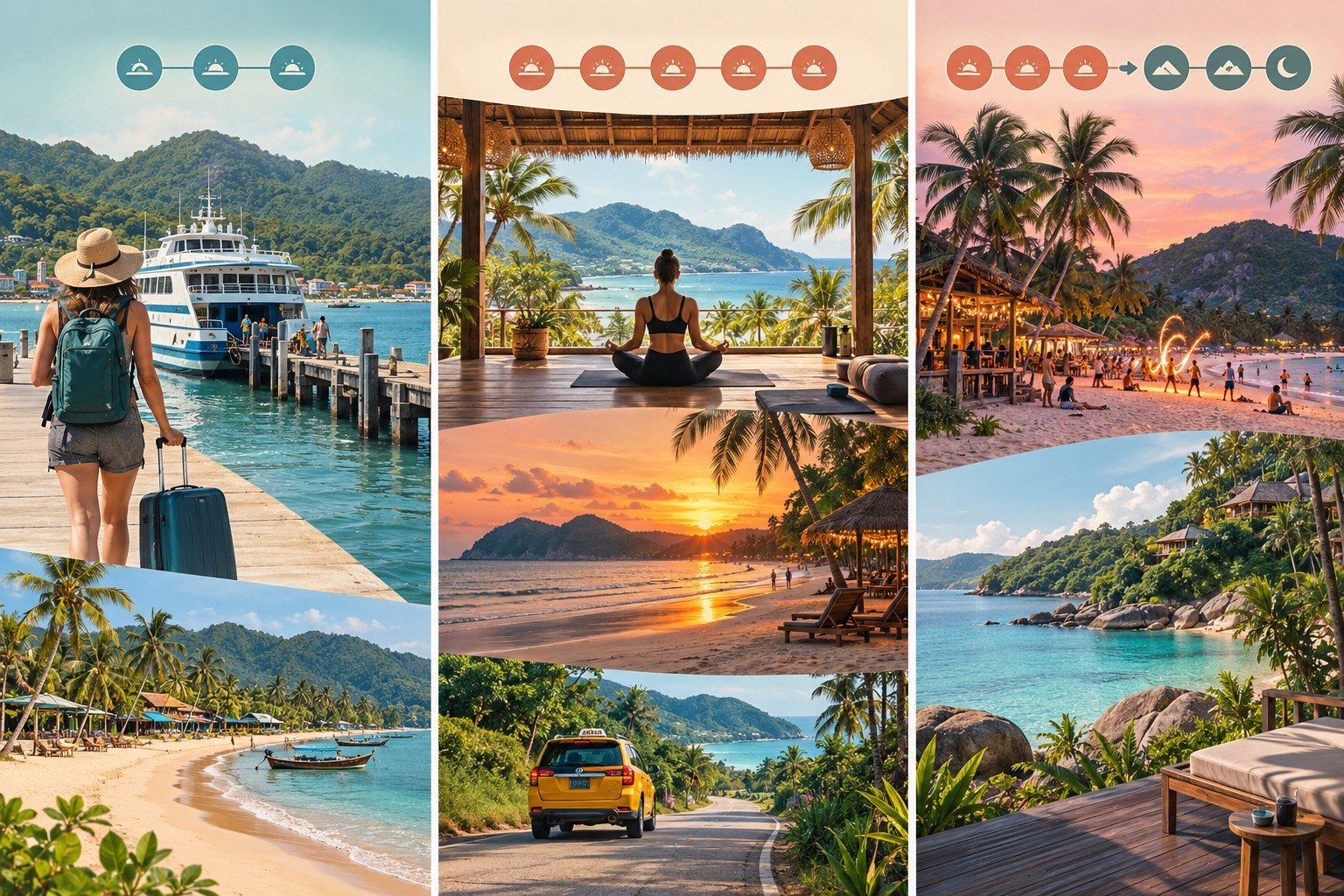
Choose one area and stay there. Haad Yao gives the strongest short beach break, Thong Sala protects awkward ferry times, and Haad Rin serves an event-focused visit. One day can explore another coast, but a hotel move would turn two of the three days into check-in days.
Five nights: choose one identity
A five-night visit works well in Haad Yao, Haad Salad or Srithanu. Add a day trip to the north or northeast rather than moving rooms. The exception is a fixed Full Moon Party: two Haad Rin nights and three quieter nights can justify the transfer.
Seven nights: a purposeful split can work
With a week, combine complementary areas. Haad Rin plus the west coast separates party and rest. Thong Nai Pan plus Srithanu pairs resort seclusion with cafés and classes. Keep the last night on the easier side of the island when the onward ferry connects to a flight.
Ten nights or longer
Longer trips can support two bases without rushing. Spend the first half around Srithanu or Haad Yao for services and social choice, then move to Chaloklum or Thong Nai Pan for quieter days. The change should reduce transport, not create a checklist of beaches.
A disciplined booking order prevents most area mistakes. The ferry and fixed event come before the hotel, while the exact map pin comes before the room photograph.
Booking sequence
| Step | Action | Reason |
|---|---|---|
| 1 | Fix the ferry route and arrival time | The hotel area cannot be judged without the final transfer |
| 2 | Check the Full Moon calendar | It changes room supply, minimum stays, noise and transport |
| 3 | Choose the area | Base it on repeated daily needs, not one photograph |
| 4 | Compare exact room totals | Match taxes, cancellation, meals, transfers and guest numbers |
| 5 | Inspect the map pin and access | Look for hills, steps, road noise and the final lane |
| 6 | Read recent low-scoring reviews | They reveal construction, access, noise and maintenance patterns |
| 7 | Message the property | Confirm transfer, bed layout, swimming access and current facilities |
| 8 | Recheck before free cancellation ends | Verify ferry, event date, weather risk and any construction |
Use two accommodation platforms as a comparison, not a verdict
Booking.com and Agoda can show different room names, meal terms and cancellation windows for the same property. Match the room category line by line. After finding a strong option, compare the hotel’s direct site as well and save screenshots of the inclusions actually purchased.
Book activities after the area is fixed
Island tours may collect only from specified zones or add a remote transfer charge. Compare group size, boat type, park-fee treatment, cancellation and the actual pickup point. A cheap tour that requires a pre-dawn cross-island taxi is not necessarily the best value.
Compare Koh Phangan activities
Use a marketplace to compare the itinerary and cancellation terms, then check weather suitability and operator credentials before the day.
Arrange data before the final transfer
Mobile data is useful for the pier meeting point, hotel messages and offline-map updates. A local Thai SIM often gives the best value, while an advance travel eSIM can reduce arrival-day friction when the handset is compatible.
Arrival-day connectivity
Check handset compatibility, activation timing, data allowance and whether the plan is data-only before purchase.
Pack for ferries rather than photographs
A small waterproof pouch or dry bag protects a phone, passport copy and electronics during spray or rain. It does not replace operator baggage rules or travel insurance, but it solves a specific transfer problem.
Useful ferry-day kit
Compare capacity, closure type and independent reviews. Keep the original passport in a secure, genuinely waterproof arrangement rather than trusting a thin beach pouch.
Koh Phangan’s range is its main advantage and the source of its planning difficulty. The same island can deliver a ferry-town stop, a social wellness month, a major beach party or a quiet resort week.
Advantages
- Distinct areas suit very different travel styles.
- Accommodation ranges from hostels to private-pool villas.
- West, north and northeast coasts create several beach moods.
- Samui, Koh Tao and mainland ferry links support wider Gulf routes.
- Longer stays can combine social life, wellness and quiet beaches.
- A scooter is optional when the area and transfer plan are chosen carefully.
Trade-offs
- Hills and limited late transport make the wrong base expensive.
- Full Moon demand changes prices, noise and ferry pressure.
- Beach depth and swimming quality vary by tide and season.
- Remote resorts can restrict dining and spontaneous exploration.
- Road risk is significant for inexperienced or unlicensed riders.
- Weather can disrupt ferries, beaches and east-coast access.
Who will enjoy the island most
Koh Phangan suits travellers prepared to choose a specific rhythm. It works well for a beach-and-wellness week, an event followed by recovery, a quiet couple’s stay or a longer remote-work base. It is less forgiving for a two-night traveller who expects to sample every coast.
When another island may be easier
Koh Samui usually offers the broader airport, road and resort infrastructure. By comparison, Koh Tao places diving and a smaller island circuit at the centre. Koh Phangan is strongest when its variety is the reason for choosing it, not when it is treated as an interchangeable stop between the two.
Most disappointing stays begin with a planning mismatch rather than a bad hotel. These are the errors that create the largest practical cost.
Booking the room before checking the ferry
A late arrival can turn a remote bargain into an expensive night transfer. Fix the arrival pier and time first, then decide how far to continue.
Treating every beachfront hotel as a swimming hotel
Hin Kong, Baan Tai and other shallow stretches can be excellent for sunsets but poor for all-tide swimming. Check month, tide and recent guest evidence.
Ignoring the Full Moon calendar
The event affects more than Haad Rin. Ferries, taxis and rooms across the south can tighten, while noise and minimum stays change.
Choosing a hillside view without checking access
A steep lane may be fine with a car and difficult with a suitcase, pushchair or reduced mobility. Ask for steps and vehicle drop-off in writing.
Planning to learn to ride a scooter
Rental availability is not proof of competence, legality or insurance. Choose a walkable area and taxis instead.
Staying in the northeast for island-wide nightlife
Thong Nai Pan is strongest as a stay-put resort base. Repeated evening journeys to the west or south waste time and money.
Staying in Haad Rin for a quiet week by accident
Outside party dates it can be calmer, but the peninsula still has a nightlife identity. Check the calendar and recent reviews.
Assuming ride-hailing works like Bangkok
Local taxi and songthaew arrangements are more important than app-based expectations. Save a driver or hotel number and agree the fare.
Connecting a remote checkout to the final ferry
Rain, road delays and taxi availability can consume the buffer. Move closer to Thong Sala or leave a later travel day.
Comparing headline rates with different inclusions
Match taxes, breakfast, room type, cancellation, transfer and minimum-stay conditions before deciding which platform is cheaper.
These answers bring the main planning decisions together. Prices, conditions and schedules remain subject to live checks for the exact travel date.
What is the best area to stay in Koh Phangan for a first visit?
Haad Yao or Haad Salad is the best starting point for most first-time visitors who want a beach holiday. Both offer sunset orientation, places to eat and a calmer atmosphere than Haad Rin, while remaining within reasonable reach of Srithanu, Chaloklum and Thong Sala.
Where should I stay for the Full Moon Party?
Stay in Haad Rin when walking home safely is the priority. Book the correct dates early and expect noise, crowds and minimum stays. Baan Tai is the main compromise, but the return transport should be arranged before the event rather than improvised after it.
Where can I stay without hiring a scooter?
Thong Sala is the easiest all-round scooter-free base because ferries, food and services are concentrated nearby. Central Srithanu can work for a wellness-focused stay, and Haad Rin works for an event trip. A self-contained Thong Nai Pan resort is another option when the hotel provides transfers.
Is Thong Sala a good place to stay?
Yes, particularly for a late arrival, early departure, one- or two-night stay or traveller who values markets and practical services. It is not the strongest choice for a classic swimming-beach holiday, so longer visitors often use it as a buffer night rather than the whole stay.
Is Haad Yao or Srithanu better?
Choose Haad Yao for a more conventional beach holiday with sunset, swimming potential and a resort-bungalow feel. Choose Srithanu for yoga, cafés, coworking and a longer-stay community. The better area is the one containing the activity you will repeat most often.
What is the difference between Thong Nai Pan Noi and Thong Nai Pan Yai?
Thong Nai Pan Noi generally feels more polished and boutique, with higher-end resort appeal. Thong Nai Pan Yai is the broader bay and can offer a wider mix of accommodation. Both are remote from Thong Sala and Haad Rin, so they work best as self-contained beach bases.
How many nights do I need in Koh Phangan?
Five to seven nights is a useful first stay. Five nights supports one relaxed base and one or two island days. Seven nights allows a purposeful split, such as Haad Rin for an event followed by Haad Yao for recovery, without turning the trip into constant check-ins.
Can I stay on another coast and take a taxi to the Full Moon Party?
Yes, but it is less predictable and can be expensive. Baan Tai is the easiest alternative. From the west, north or northeast, pre-arrange both directions, set a meeting point and do not rely on finding an immediate late-night taxi after the beach becomes busy.
How much do taxis cost on Koh Phangan?
For rough planning, shared songthaews commonly cost around 150–300 THB per person on established routes, while private, remote, late-night or event journeys can cost several hundred to more than 1,000 THB. Confirm whether the quote is per person or per vehicle before travelling.
Do I need a scooter in Koh Phangan?
No. Choose accommodation close to the daily priority, use taxis for the occasional long journey and book tours with pickup. A scooter adds flexibility only for a properly licensed, insured and experienced rider; it should not be treated as the default.
Can a British visitor legally ride a scooter in Thailand?
Only when the rider has the correct motorcycle entitlement, carries the UK licence and the 1968 International Driving Permit, complies with Thai law and meets the insurer’s conditions. A car-only licence and an IDP do not create motorcycle entitlement. A helmet is legally required.
What is the best part of Koh Phangan for families?
Haad Salad and Thong Nai Pan Yai are strong starting points, although the exact hotel matters more than the area label. Check room layout, steps, pool barriers, road access, nearby food and current swimming conditions. Thong Sala is useful for a final ferry-buffer night.
What is the quietest area in Koh Phangan?
Than Sadet and remote east-coast bays offer the deepest seclusion, but they also have the fewest services. Chaloklum provides a quieter village with more daily practicality, while Haad Salad offers a calm beach-holiday compromise on the west coast.
Which Koh Phangan beaches are best for swimming?
Haad Yao, Haad Salad and the Thong Nai Pan bays are commonly chosen for swimming-focused stays, but no beach is guaranteed every day. Tide, wind, rain, currents and local flags decide what is safe. Shallow Hin Kong and parts of Baan Tai are less reliable for all-tide swimming.
Where should a remote worker stay?
Srithanu and Hin Kong have the strongest combination of cafés, wellness community and longer-stay accommodation. Confirm internet with the exact property, ask for a recent speed test and carry mobile data as backup. Thong Sala is the practical alternative for errands and ferry access.
Should I split my stay between two Koh Phangan areas?
Split only when the second area changes the holiday or removes a transport problem. A seven-night Full Moon trip can justify two nights in Haad Rin and five on the west coast. For three to five nights without an event, one well-chosen base is usually better.
Which ferry route should I take to Koh Phangan?
Use the route that fits the wider itinerary: Koh Samui for the fastest air-to-island approach, Donsak or Surat Thani for mainland connections, and Koh Tao for an island-hopping route. Check the exact pier, operator, check-in point and protected connection rather than choosing by crossing time alone.
How far ahead should I book Koh Phangan accommodation?
For ordinary dates, two to six weeks can provide useful choice, while peak winter, Christmas, New Year and Full Moon dates often deserve one to three months or more. Use sensible cancellation terms and recheck event dates, ferries and construction before the free-cancellation deadline.
For a first visit centred on beaches, the best overall choice is Haad Yao or Haad Salad. They provide the clearest balance of island atmosphere, sunsets, places to eat and manageable access to the west and north. Choose Haad Yao for more choice; choose Haad Salad for a smaller, calmer bay.
Choose a different area when one priority dominates
Stay in Haad Rin when the Full Moon Party is fixed and walking home matters. Choose Srithanu when yoga, cafés and a longer-stay community shape each day. Use Thong Sala for ferry logistics, no-scooter convenience or a short stop. Pick Chaloklum for quiet village life, and Thong Nai Pan for a resort holiday that does not need frequent cross-island evenings.
The final decision test
Write down the three journeys that will happen most often: beach to room, room to dinner, and room to the main activity. Price those journeys in time and money. The area that makes two of the three easy is usually the right answer, even when another hotel has the more dramatic photograph.
A research-led recommendation
For five nights without the Full Moon Party, base entirely in Haad Yao or Haad Salad and visit another coast by day. With seven nights and the event, use two Haad Rin nights followed by five west-coast nights. A quiet couple’s resort trip suits Thong Nai Pan when the long transfer is accepted as part of buying seclusion.
This guide was checked against current official transport, government, tourism and marketplace sources on 11 September 2026. The recommendation is planning judgement based on geography, access, current service information and published visitor evidence; it does not claim a personal stay.
How changing information is handled
Ferry times, hotel rates, party dates, park access, weather and taxi quotes can change. For that reason, the article uses dated examples and planning ranges rather than presenting a search result as a permanent price. The operator, hotel, event organiser and local authority remain the final source for a specific day.
Sources
- Tourism Authority of Thailand — Ko Phangan. Official destination overview used to check Koh Phangan’s tourism context and principal visitor appeal.
- Lomprayah — 2026 timetable. Official 2026 operator timetable used to verify the current Gulf ferry network and the need to check live departures.
- Raja Ferry Port — Donsak to Koh Phangan sailing schedule. Official sailing schedule used for the Donsak–Thong Sala vehicle-ferry planning example.
- Seatran Ferry — Gulf routes and Koh Phangan services. Official operator site used to confirm Koh Phangan, Thong Sala, baggage and island-transfer services.
- Full Moon Party Koh Phangan — 2026 dates. Published 2026 event calendar used for remaining Full Moon and New Year dates; dates should still be reconfirmed.
- UK Foreign, Commonwealth & Development Office — Thailand safety and security. Current UK travel advice used for party safety, swimming, sea travel, motorcycle licensing, helmets and insurance caveats.
- Thai Meteorological Department — weather and climate. Official meteorological source used for current-warning and weather-check advice.
- Department of National Parks — Than Sadet–Koh Phangan National Park. Official national-park source used for Than Sadet–Koh Phangan context; access and fees must be checked live.
- Booking.com — Koh Phangan accommodation search. Live accommodation search used only to sense-check broad 2026 room ranges; displayed rates are date-specific.
- Agoda — Haad Rin accommodation overview. Live Haad Rin listings used to check the spread between hostel, hotel and event-area pricing.
- GetYourGuide — Ko Phangan activities. Current activity marketplace checked for available Koh Phangan categories and pickup-dependent tours.
- Viator — Ko Pha Ngan tours. Current activity marketplace checked for Koh Phangan land, snorkelling and marine-tour availability.
- Tourist Police Thailand. Official Tourist Police resource included for traveller support information.
- Taylor’s Trailblazing Travels — research approach. Site methodology page supporting the article’s transparent research-led approach and absence of invented first-hand claims.
Last checks before travel
Reconfirm the ferry pier and check-in point, the Full Moon date, the hotel’s transfer arrangement, the marine forecast, swimming flags and any national-park closure. British travellers should also review the complete current FCDO Thailand advice rather than relying on a single safety paragraph.
Illustrations in this article were created for Taylor’s Trailblazing Travels. Third-party photographs, where used, are credited beside the image or in the source list.