A practical rainy-season system for humid heat, sudden downpours, temple visits, ferries and current 2026 baggage rules.
A lighter bag, a drier journey
Pack for tropical heat, then organise for sudden rain
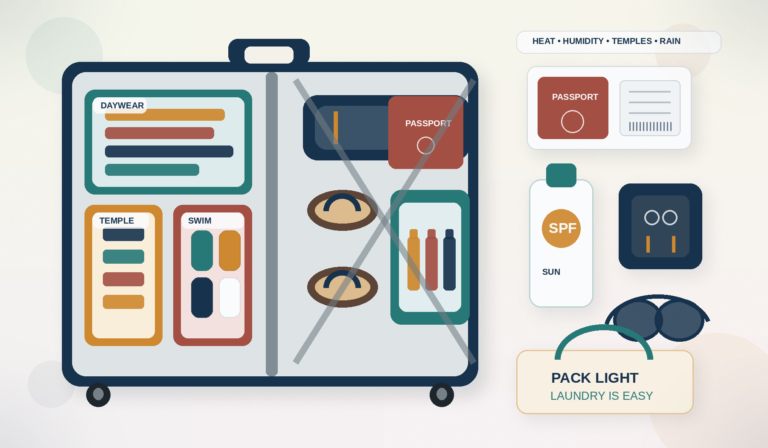
A Thailand monsoon packing list should not look like a cold-weather expedition kit. The useful difference is organisation: breathable clothes for humid days, a small rain layer that stays reachable, and separate inner protection for the passport, medicine, phone and one dry outfit.
Routes matter as much as dates. Bangkok street flooding, a wet transfer on the Andaman coast and a later-season Gulf downpour create different problems, yet the same compact system handles all three. Pack light enough to carry comfortably, then build in a dry core that does not depend on one zip, one bag cover or one optimistic forecast.
The recommendations below are research-led planning judgements based on current official guidance, practical luggage limits and common transfer friction. They do not claim first-hand testing of every product, ferry, hotel or route.
In This Guide
Best clothing rule
Pack for humid heat first: four to six breathable tops, three lightweight bottoms and a laundry plan beat a heavy waterproof wardrobe.
Best rain combination
A compact umbrella plus a small poncho suits most trips. Add a light shell only when hiking, cycling or prolonged exposure justifies it.
Most useful protection
Use an outer bag cover, a roll-top dry bag and separate inner pouches. No single closure should protect every essential item.
Key 2026 rule
Power banks belong in cabin baggage. Carry no more than two, keep the Wh marking readable, protect terminals and keep each unit accessible.
The packing rule that solves most monsoon problems
In practice, a Thailand monsoon packing list should not resemble an expedition inventory. Many wet-season days still contain long dry periods, bright sun and high humidity. Instead, the real challenge is moving through a short, intense downpour without soaking the passport, medicine, phone and the only clean outfit you planned to wear that evening.
Therefore, the most reliable strategy is to pack an ordinary tropical wardrobe, then add targeted water protection. That means fewer heavy items, faster laundry and less frustration on stairs, piers and station platforms.
Pack for heat first and rain second
First, start with breathable tops, loose bottoms and underwear that dries overnight. However, a thick waterproof shell may keep rain out, yet it can trap enough body heat to leave the inside damp from sweat. For ordinary city and island travel, a light umbrella or poncho often handles the shower more comfortably. A thin shell earns its place when the itinerary includes hiking, cycling, cool northern mornings or repeated outdoor activity.
Use three layers of water protection
First, layer one is the item you can reach quickly: umbrella, poncho or shell. Next, layer two is the main bag cover or water-resistant day bag. Finally, layer three protects the non-negotiable contents inside: a document pouch, roll-top dry sack or sealed packing pouch. This final layer matters because rain reaches bags through zips, shoulder straps and the moment someone opens the lid under a shelter that is not quite deep enough.
The wet-transfer rule
Before a ferry, longtail boat, open pickup or exposed station transfer, I would move the passport, phone, medication and one clean top into a small roll-top bag inside the main bag. That five-minute reset is more valuable than carrying a second pair of smart shoes for the whole holiday.
Separate wet from dry immediately
In addition, a thin reusable wet bag prevents swimwear, a poncho or damp sandals from spreading moisture through the suitcase. However, do not seal genuinely wet clothing for several days. Instead, rinse it if necessary, squeeze out excess water, hang it with airflow and repack only when moving on. Consequently, in humid rooms, the difference between folded and hanging fabric is significant.
When is monsoon season in Thailand?
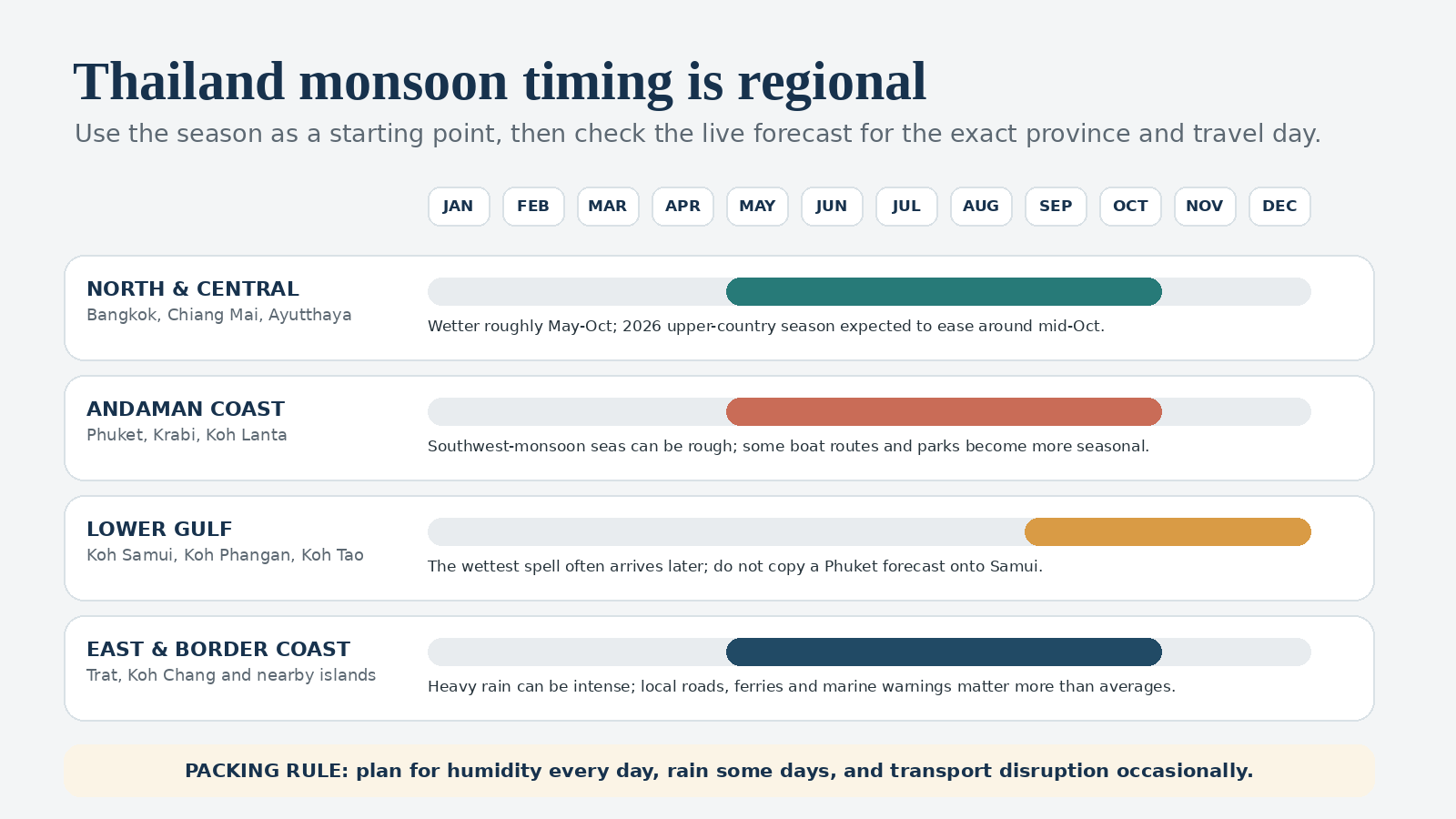
Thailand does not follow one single wet-season calendar. For 2026, the Thai Meteorological Department declared the start of the rainy season for upper Thailand from 15 May. Its August-to-October outlook, issued on 23 July 2026, expected widespread rain in August, the densest and most abundant rainfall across many areas in September, and a transition towards cooler conditions in upper Thailand during October while the South and Gulf of Thailand remained rainy. These are broad planning signals rather than promises for an individual destination or travel day. [1], [2]
Regional patterns remain useful for choosing clothes and waterproof storage. However, they cannot tell you whether a particular ferry, hike or road transfer will operate. Use the seasonal pattern to build the bag, then use the provincial forecast, marine warning and operator messages to plan the next 24 to 48 hours.
Regional pattern at a glance
| Region | Useful planning pattern | What changes in the bag | Main itinerary risk |
|---|---|---|---|
| Bangkok, central and northern Thailand | The main upper-country rainy season commonly runs from around May into October, with year-to-year variation. | Compact umbrella, breathable clothes, secure city footwear and a dry temple outfit. | Flooded streets, slower road transfers and outdoor plans moving at short notice. |
| Andaman coast: Phuket, Krabi, Khao Lak and Koh Lanta | South-west monsoon conditions often make May to October the rougher and wetter planning period. | Dry bag, secure sandals, stronger inner protection and a land-day alternative. | Choppy seas, seasonal marine closures and cancelled or rerouted boats. |
| Lower Gulf: Koh Samui, Koh Phangan and Koh Tao | The wetter spell can arrive later than on the Andaman coast, so do not copy a Phuket forecast onto a Gulf itinerary. | The same waterproof organisation, timed to the lower-Gulf forecast. | Choosing the wrong coast or assuming every island shares the same pattern. |
| Eastern seaboard and Trat islands | Heavy rain can overlap the south-west monsoon, with substantial local variation. | Light rain layer, insect protection and transport flexibility. | Local flooding, ferry disruption and slippery island roads. |
The 48-hour forecast matters more than a monthly icon
Forty-eight hours before a boat day or long road transfer, check the Thai Meteorological Department forecast and relevant marine warnings. Check again on the morning of travel. A monthly weather symbol cannot show whether a local thunderstorm line, strong wind or rough sea is affecting the exact route.
How to read a seasonal forecast
TMD’s August-to-October 2026 document describes broad rainfall and temperature tendencies. It is useful for deciding whether flexibility and waterproof storage deserve extra priority, but it is not a substitute for a live warning or an operator’s safety decision.
Rain does not remove sun or heat
Cloud can make the temperature feel less fierce, yet ultraviolet exposure continues. The NHS notes that sunburn can happen when it is cloudy and recommends at least SPF 30, protective clothing and reapplication after swimming, sweating or towel drying. [8] A monsoon packing list that omits sunscreen, a hat and a refillable water bottle is therefore incomplete.
For a month-by-month route comparison, use the best time to visit Thailand guide.
Complete Thailand monsoon packing list
The quantities below suit most adults travelling for one to three weeks with access to laundry every five to seven days. Therefore, increase clothing only when the route includes remote stays, specialist activities or accommodation without practical drying space.
Master checklist by category
| Category | Practical quantity | Why it earns space |
|---|---|---|
| Tops | 4-6 breathable or quick-dry tops | Enough rotation for sweat and rain without carrying fourteen shirts |
| Bottoms | 2-3 shorts, skirts or lightweight trousers | Choose pieces that mix with every top and dry faster than denim |
| Temple set | 1 opaque sleeved top plus loose long trousers or below-knee skirt | Keeps shoulders and knees covered without relying on a wet beach cover-up |
| Underwear and socks | 5-7 days of underwear; 3-5 pairs of socks if wearing trainers | Creates a realistic laundry cycle and avoids overpacking |
| Light layer | 1 thin shirt, cardigan or fleece | Useful on cold buses, trains, flights and heavily air-conditioned malls |
| Rain gear | Compact umbrella or poncho; optional thin shell | Choose according to city, transfer or activity needs rather than buying all three |
| Waterproof organisation | 5-10 L dry bag, document pouch and 2-3 reusable zip pouches | Protects valuables and separates wet items from dry clothing |
| Footwear | 1 secure walking pair plus slides or flip-flops | One dependable pair handles wet streets; the second is for beaches and showers |
| Sun and insects | SPF 30+, hat, sunglasses and effective insect repellent | Cloud, rain and humidity do not remove UV or mosquito exposure |
| Health | Essential medicine, copies of prescriptions, small first-aid kit and oral rehydration sachets | Covers personal needs and the first response to minor problems |
| Electronics | Phone, labelled power bank, adaptor, short cables and waterproof pouch | Keeps travel messages, maps and bookings available without unsafe battery packing |
| Cabin essentials | Passport, insurance, medicine, one dry outfit and arrival details | Protects the first 24 hours if checked baggage is delayed or soaked |
Printable-style checklist
Useful shopping searches
Compare dimensions, packed weight, materials and return terms rather than choosing the first item labelled “travel”. The lightest option is not useful when it fails on the first transfer.
Clothing that works in tropical rain
In practice, the best wet-season wardrobe is repeatable. Every top should work with every bottom, every layer should fit inside a small laundry cycle, and the temple outfit should remain acceptable after a sudden shower.
How many clothes for seven, fourteen or twenty-one days?
| Trip length | Tops | Bottoms | Underwear | Laundry plan |
|---|---|---|---|---|
| 7 days | 4-5 | 2-3 | 5-7 pairs | One optional wash near the end |
| 14 days | 5-6 | 3 | 5-7 pairs | Wash around days 5 and 10 |
| 21 days | 6 | 3-4 | 6-8 pairs | Three or four small washes rather than a larger suitcase |
However, the number of travel days matters more than the total holiday length. For example, a two-week trip with six hotel changes may require slightly more underwear than a two-week beach stay with easy laundry. Conversely, a serviced apartment with a washer can reduce the wardrobe further.
Quick-dry does not have to mean shiny sportswear
Light synthetic blends, thin merino, airy woven trousers and modern travel fabrics can dry faster than heavy cotton while still looking ordinary. Cotton is comfortable when dry, so there is no need to ban it. Instead, avoid building the entire wardrobe around thick cotton T-shirts, denim and lined garments that hold water.
For example, test one outfit at home. Then, wash it in a sink, press it in a towel and hang it overnight. That simple trial tells you more than a marketing label about whether the fabric belongs in a moving itinerary.
Choose trousers that solve three problems
In practice, one pair of loose lightweight trousers can cover knees at temples, protect legs from sun and insects, and make a cold bus more comfortable. Darker neutral colours also hide splash marks. By contrast, jeans may be fine for a city-only trip if you love wearing them, but a soaked pair is heavy, awkward to pack and slow to dry.
Carry an opaque temple outfit
However, rain can turn pale or thin fabric transparent. Keep a sleeved top and loose long bottom in a dry pouch, then change before visiting a stricter temple or royal site. The Grand Palace’s official prohibited list includes sleeveless shirts, short tops, see-through tops, short trousers, torn or tight trousers, cycling trousers and miniskirts. [7]
A sarong is useful, but it is not a universal dress-code guarantee
A sarong can cover swimwear, separate damp clothes and provide modesty at many casual stops. However, a strict site can require properly fitted clothing rather than an improvised wrap. Carry one actual outfit that meets the rules instead of assuming a scarf will solve every entrance.
Plan for chafing and slow drying
Meanwhile, humidity, wet hems and repeated walking can irritate skin. Therefore, pack underwear that fits well when damp, avoid rough seams, and consider a small anti-chafe product if this is already a problem for you. Change out of soaked clothes promptly. For children, include one extra dry set in the day bag because a puddle, boat spray or food spill can end the usefulness of an outfit before the rain begins.
Use laundry instead of spare outfits
Fortunately, most tourist centres have hotel laundry, local wash-and-fold services or self-service machines. Before booking a remote stay, check whether clothes can be washed and dried. The Thailand travel budget guide can help you leave a small allowance for laundry instead of paying for extra checked baggage.
Umbrella, poncho or rain jacket?
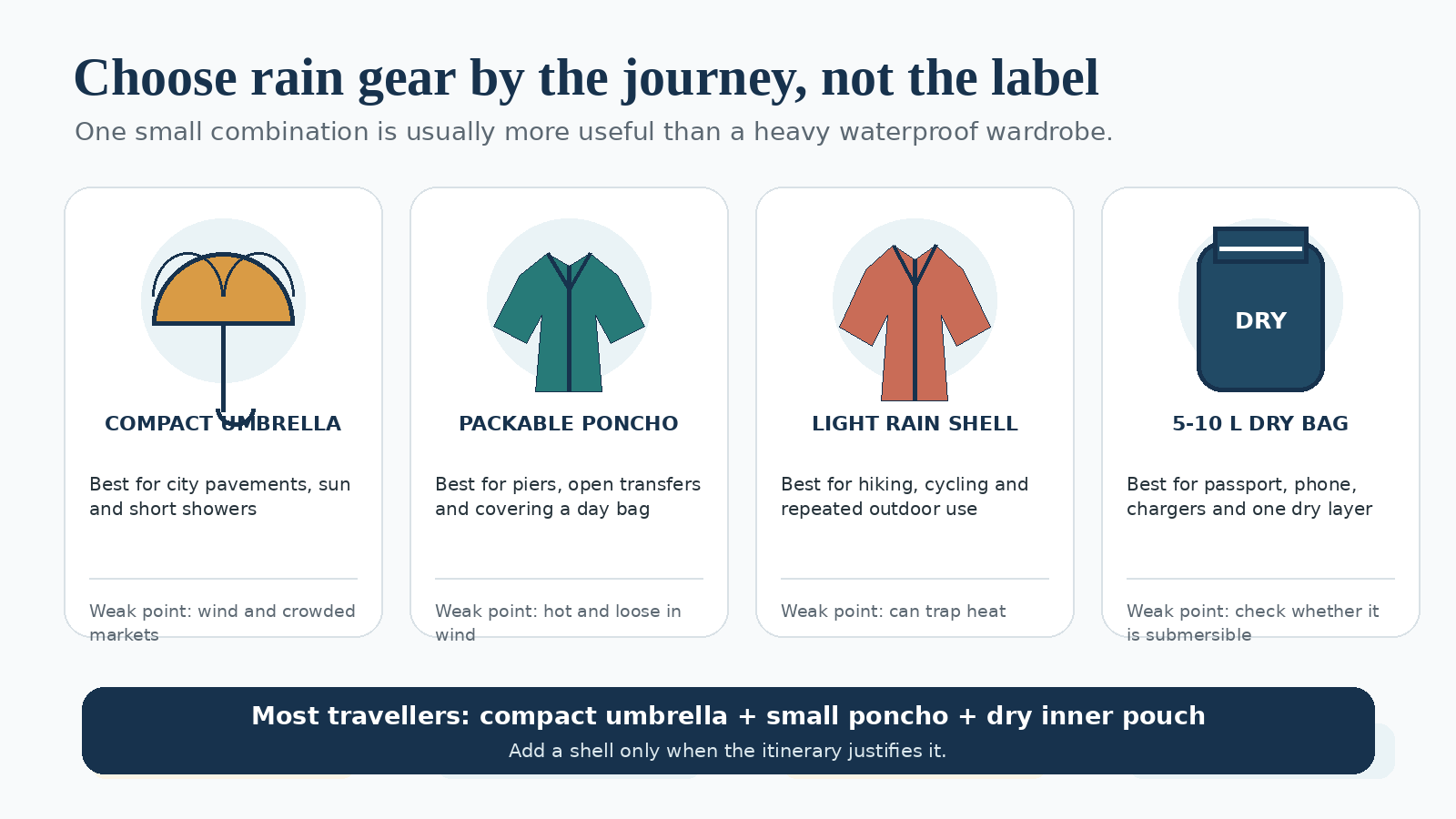
There is no single best rain layer for every Thailand trip. Instead, the right answer depends on whether you are walking through Bangkok, waiting at a ferry pier, riding in an open vehicle or hiking in the north.
| Option | Best for | Advantages | Limitations | Broad UK planning range |
|---|---|---|---|---|
| Compact umbrella | Bangkok, Chiang Mai, markets and short urban walks | Fast to deploy, ventilated and useful for sun | Awkward in wind, crowds and hands-busy transfers | About GBP 8-25 |
| Packable poncho | Piers, open pickups, queues and sudden downpours | Very light and can cover a small backpack | Can feel hot and catch wind; poor fit around traffic is a concern | About GBP 6-25 |
| Light rain shell | Hiking, cycling, cooler north and repeated outdoor days | Hands free and more stable in sustained rain | May trap heat and does not protect the bag | About GBP 30-120 |
| 5-10 L dry bag | Passport, phone, chargers and one dry layer | Creates reliable inner organisation | Water resistance varies; many light sacks are not submersible | About GBP 10-35 |
| Bag cover | Outer backpack or suitcase protection | Quick first defence for the whole bag | Water can still enter through straps, back panel and opened zips | About GBP 8-25 |
Planning ranges are broad 2026 UK shopping allowances, not live quotations. Check current prices, packed size, warranty and the manufacturer’s water-resistance claims before buying.
Best combination for a city-heavy trip
Take a compact umbrella and a small inner dry pouch. In addition, add a thin overshirt for air-conditioning. However, a jacket is optional unless you expect long outdoor walks regardless of the forecast.
Best combination for islands and ferries
For exposed island transfers, use a packable poncho, a 5-10 litre dry bag and a waterproof phone pouch. However, the dry bag should live inside the main day bag, not replace secure luggage. On a speedboat, follow crew instructions and keep loose poncho fabric packed away while moving around.
Best combination for hiking or cycling
A breathable shell with a hood is more practical than an umbrella when both hands are needed. In addition, secure footwear and a dry change of shirt matter just as much. Therefore, stop or reroute when local warnings, lightning or trail conditions make the activity unsafe; equipment does not turn a poor-weather day into a sensible one.
Compare rain gear without buying duplicates
Choose one primary rain layer, then add inner waterproof storage. Read the packed dimensions and user reports about heat, seams and zips.
Bags and waterproof organisation
The phrase “waterproof bag” covers products with very different construction. For example, a coated daypack, a rain cover, a roll-top dry sack and a submersible case are not interchangeable. For ordinary travel, the goal is not to float the entire suitcase. Instead, the aim is to make one mistake survivable.
Choose the dry-bag size by what must stay dry
| Size | What it comfortably protects | Best use | Common mistake |
|---|---|---|---|
| 2-3 litres | Phone, passport, wallet, cables and medication | City day bag and document protection | Expecting it to hold a dry outfit as well |
| 5-10 litres | Valuables plus one lightweight outfit | Ferries, island trips and exposed transfers | Overfilling until the roll-top cannot close correctly |
| 15-20 litres | Towel, clothing and larger electronics pouch | Boat day or family day bag | Using it as unchecked loose luggage rather than securing it inside another bag |
| 30 litres and above | Specialist water activities or bulky group equipment | Kayaking or organised marine use when appropriate | Buying unnecessary volume that becomes awkward on normal sightseeing days |
Do not trust one closure
First, keep the passport in a small document sleeve inside the dry bag. Next, put medicine in its own labelled pouch. Finally, store a phone pouch separately from wet swimwear. This sounds repetitive until a bottle leaks or someone opens the roll-top in rain. Redundancy should protect essentials, not multiply every item.
Use packing cubes for categories, not waterproofing
Similarly, ordinary fabric cubes are useful for tops, underwear and temple clothing, but they are not automatically water-resistant. However, place the one dry backup outfit in a sealed or roll-top pouch. Then, let the remaining wardrobe breathe when you reach the hotel.
Check hotel drying space
However, a balcony does not guarantee dry clothing during a humid storm. Therefore, ask whether the room has hangers, a covered rack, laundry service or a washer. When comparing stays on Booking.com or Agoda, use the facilities list and recent guest comments to confirm laundry arrangements rather than assuming every apartment includes a dryer.
Best footwear for Thailand in rainy season
In practice, wet-season footwear needs grip, comfort, airflow and a realistic drying time. Waterproof boots sound reassuring, yet they can trap heat, fill from the top and become difficult to dry in a hotel room.
Secure walking sandals
Walking sandals suit beach towns, island transfers and casual sightseeing when they already fit your feet. Look for heel security, adjustable straps and a sole that does not become slippery when wet. Break them in before departure. A sandal that rubs after ten minutes at home will not improve in humidity.
Breathable trainers
Mesh or lightly constructed trainers are comfortable for long city days and provide more protection than open sandals. However, their weakness is drying time. Therefore, pack thin socks, remove insoles overnight and alternate with slides when the trainers are wet. Also, avoid sealing damp shoes in a plastic bag for days.
Trail shoes
A low trail shoe can be useful for northern hikes, national parks and rough paths, provided the tread is suitable and the operator considers conditions safe. However, heavy hiking boots are rarely necessary for an ordinary mixed Thailand itinerary.
Flip-flops and slides
These are secondary shoes for pools, showers and short beach walks. They offer little support and can be slippery on polished temple steps or wet pavement. Do not make them the only pair unless you already know you can walk long distances comfortably in them.
| Footwear | Best for | Main advantage | Main drawback |
|---|---|---|---|
| Walking sandals | Islands, transfers and mixed casual days | Fast drainage and easy cleaning | Open toes and fit-related rubbing |
| Breathable trainers | Long city days and general sightseeing | Support and foot protection | Can stay wet overnight |
| Low trail shoes | Hikes and uneven park paths | Grip and protection | Warmer and heavier |
| Slides or flip-flops | Beach, pool and shower | Very light and easy to rinse | Poor grip and support for long walks |
Footwear buying advice
Fit matters more than a waterproof claim. Try footwear with the socks you will actually use and test it on a wet surface before packing.
Toiletries, sun, mosquitoes and humidity
Monsoon packing is still tropical packing. The practical health items are sunscreen, insect repellent, personal medication, hydration support and products you know your skin tolerates.
Sunscreen belongs near the top of the bag
However, cloud and rain can disguise UV exposure. NHS guidance recommends at least SPF 30, suitable clothing and regular reapplication, including after swimming, sweating and towel drying. [10] Keep a usable amount in the day bag rather than a full bottle buried in checked luggage.
Pack effective insect repellent
In addition, Thailand has dengue risk, and the mosquitoes that spread dengue often bite during daylight. TravelHealthPro advises bite prevention, including long sleeves or trousers and regular use of an effective repellent. It also recommends keeping repellent in hand luggage so it is available during transit, arrival and the wait for checked bags. [8], [9]
Hot, humid conditions and swimming can reduce how long repellent remains effective. Therefore, follow the product instructions and reapply when required. When using DEET and sunscreen together, TravelHealthPro advises applying sunscreen first and DEET afterwards. [9]
Bring specific products; buy ordinary replacements locally
Major Thai destinations have pharmacies, supermarkets and convenience stores. Pack prescription skin treatments, contact-lens products, allergy-safe toiletries and anything difficult to substitute. By contrast, ordinary shampoo, soap and basic hygiene products usually do not justify full-size bottles unless a particular formula matters to you.
Keep the first-aid kit small and personal
Useful items may include plasters, blister treatment, antiseptic wipes, oral rehydration sachets, a thermometer, pain relief you can safely take and any clinician-recommended allergy treatment. However, do not build a portable pharmacy around problems you are unqualified to diagnose. Instead, seek local medical advice when symptoms are severe, persistent or unusual.
Health-related travel searches
Choose repellent by active ingredient and age suitability, not by fragrance. Check airline liquid rules before placing sprays or gels in cabin baggage.
Medication rules and medical paperwork
Keep medicine in original labelled packaging and carry a copy of the prescription or a doctor letter. The brand name used in the UK may not identify the active ingredient clearly enough for Thai rules, so write down the generic name, dosage and quantity.
Controlled narcotic medicine
Thai FDA guidance says travellers carrying medicines containing Schedule II or III narcotic drugs for personal treatment may carry up to a 90-day prescribed supply, but they must obtain a permit and apply at least 15 days before arrival or departure. The online process and category rules should be checked directly because classifications and individual circumstances matter. [6]
Controlled psychotropic medicine
For Schedule II, III or IV psychotropic medicines, the same guidance distinguishes a supply of up to 30 days from a supply of 31 to 90 days. Up to 30 days may be carried with a prescription or medical certificate; 31 to 90 days requires a permit requested at least 15 days in advance. [6]
Do not make assumptions from a familiar prescription
However, a medicine that feels routine at home can fall within a controlled category elsewhere. Therefore, check the exact active ingredient using the Thai FDA service. If the guidance is unclear, contact the Thai FDA or the relevant Thai diplomatic mission before travel. Do not rely on an online packing list as legal clearance.
Divide essential medicine sensibly
Keep the main supply in cabin baggage, within airline and security rules. When appropriate and legally permitted, a small backup can be separated from the main pouch so one lost bag does not remove the entire supply. Never remove labels merely to save space. Carry enough for delays, but stay within the authorised quantity.
Medical planning is not a last-night task
Check the medicine category at least several weeks before departure. A permit with a 15-day application requirement cannot be fixed at the airport after check-in opens.
Electronics, chargers and the 2026 power-bank rules
A phone now works as map, ticket wallet, weather alert and contact book. Protecting it matters, but so does carrying the battery safely and in the correct bag.
Power banks belong in cabin baggage
CAAT Requirement No. 122, issued on 22 May 2026, permits power banks only in carry-on baggage and prohibits them in checked baggage. A power bank up to 100 Wh falls within the standard limit. A unit above 100 Wh and up to 160 Wh needs operator approval, and a passenger may carry no more than two power banks. The airline can still apply its own procedures, so check the operating carrier before departure. [3]
Keep each unit protected and accessible
Protect exposed terminals against short circuit, keep each power bank separate from loose metal objects and do not place it in the overhead compartment. CAAT requires the device to remain accessible so abnormal heat, swelling or smoke can be noticed quickly. A damaged, swollen or unlabelled unit should not travel.
Do not use or charge a power bank on the aircraft
The 2026 requirements prohibit charging a power bank from aircraft power and prohibit using it to charge a phone or another device during the flight. Pack the bank where cabin crew can reach it rather than underneath a dense pile of luggage. [3]
Check Wh, not only mAh
Aviation limits are expressed in watt-hours. When a manufacturer shows milliamp-hours and nominal voltage, use the calculation below only as a sense-check. The printed, readable manufacturer marking is what staff need to inspect.
Wh = mAh × voltage ÷ 1,000
For example, 20,000 mAh at 3.7 V equals 74 Wh. Another battery with the same mAh but a different nominal voltage can have a different Wh rating, so do not treat “20,000 mAh” as a universal aviation limit.
Use a short-cable system
One multi-port charger and two short cables create less clutter in a damp room than several loose plugs. Keep electronics in a separate pouch, never connect power to a wet port and let a damp device dry fully before charging. A universal adaptor should fit firmly and remain within its rated load.
Download essentials before the transfer
Save the hotel address, insurance details, tickets, passport copy and useful forecast pages offline. Mobile data still helps when a ferry time changes. The Thailand SIM card and eSIM guide compares the main options. Travellers arranging data before departure can also review Airalo Thailand eSIM options.
Electronic travel essentials
Look for a clearly printed Wh rating, reputable safety information, sensible cable length and a warranty. Do not buy or carry a swollen, damaged or unlabelled battery.
What belongs in your cabin bag?
The cabin bag should keep you functional for the first 24 hours even when checked luggage is delayed, left in rain or sent to the wrong airport. Place critical items in the same part of the bag every time so security checks do not dismantle the system.
UK liquid rules can differ by airport
GOV.UK says the cabin-liquid rules depend on the airport. At most UK airports, containers larger than 100 ml cannot pass through security, even when partly empty. Some airports may permit containers up to two litres, and travellers are told to check the departure airport, transit airports and return journey. [11] Pack to the strictest airport on the itinerary unless every stage has been confirmed.
Keep the rain layer reachable
For example, an umbrella under the suitcase divider is useless when the aircraft door opens onto a bus transfer in heavy rain. Put it in an outside pocket or at the top, while respecting airline dimensions. The same applies to the dry outfit: it should not be packed inside checked baggage.
Use the cabin bag as the document hub
Finally, store the passport, insurance, prescription copy, hotel address and entry paperwork together. Review the Thailand entry requirements guide shortly before departure because immigration and arrival processes can change independently of the packing list.
Adjust the list for your Thailand route
Although the route changes, the core bag can stay the same, but one or two items should change with the geography and activities.
Bangkok and central Thailand
Prioritise a compact umbrella, breathable city clothes, secure footwear and a thin layer for air-conditioning. Keep temple clothing in a dry pouch. During intense rain, road journeys can slow while rail becomes busier, so allow spare transfer time. The Bangkok travel guide includes weather-aware route planning.
Chiang Mai and the north
Add a thin shell for outdoor days and a slightly warmer layer for high ground, early starts or strong air-conditioning. Footwear with grip matters for steps, trails and wet paths. For trekking, confirm what the operator supplies before buying specialist gear.
Phuket, Krabi and the Andaman coast
Add a 5-10 litre dry bag, secure sandals, a phone pouch and a realistic land-day backup. Strong wind and waves can affect boats even when rain is intermittent. Follow TMD warnings and operator safety decisions rather than treating a paid booking as a reason to sail.
Koh Lanta and smaller Andaman islands
Seasonal closures and reduced transport make flexibility more important than extra clothing. The Thailand islands guide helps compare island routes where a dry bag, flexible transfer and backup land day become useful. Pack any specialist medicine or footwear before reaching a quieter island.
Koh Samui, Koh Phangan and Koh Tao
Use the lower-Gulf forecast rather than Phuket’s weather. A waterproof phone pouch and small dry bag are valuable on piers throughout the year. For a route centred on Samui, open the Thailand islands guide while deciding whether a boat-heavy week justifies extra marine gear.
A multi-region itinerary
Therefore, do not pack separate wardrobes for north, city and coast. Use a breathable capsule wardrobe, then add one thin warm layer, one temple set and the rain tool required by the wettest transfer. The two-week Thailand itinerary helps identify when laundry and long journeys occur.
Check bookings before buying equipment
For example, tour inclusions may already cover towels, dry storage, snorkelling equipment or hotel pickup. Compare the actual inclusions before buying duplicates.
Adjustments for different travellers
Carry-on-only travellers
Choose four tops, two or three bottoms and one temple set. Use solid toiletries where suitable, confirm cabin-liquid rules and wear the bulkiest shoe. A 5-litre inner dry bag is usually enough. Leave space for laundry rather than compressing every corner.
Families with children
Carry one extra child outfit, a wet bag, familiar snacks allowed by the airline, essential medicine and a lightweight layer for cold transport. However, do not distribute all documents or medicine into one adult’s bag. For younger children, pack sun protection and repellent appropriate for their age, following medical and product advice.
Solo travellers
Keep a phone backup plan, offline address and small emergency cash reserve. A whistle or bulky “survival” gadget is less useful than reliable data, a charged phone and a day bag that closes properly. In addition, share major travel days with a trusted contact.
Digital nomads and photographers
Use separate dry pouches for laptop, camera and power cables. However, do not assume a backpack rain cover protects the back panel. Carry a compact silica-gel or humidity-management solution only according to equipment guidance, and give electronics time to acclimatise before opening them in heavy condensation.
Boat, snorkelling and diving travellers
Before buying, confirm whether the operator provides towels, masks, fins and dry storage. Pack rash protection, a secure swimsuit and a dry change. Also, avoid loose accessories on deck. Expensive underwater housings need their own manufacturer checks; a basic phone pouch is not a diving case.
Travellers with mobility needs
Prioritise footwear with secure grip, a hands-free rain layer and medication organisation. In addition, ask accommodation about covered entrances, lift access and laundry. A pre-booked vehicle may be more useful than a lightweight umbrella when walking surfaces are difficult.
What to buy before leaving and what can wait
Thailand has excellent shops, but arrival day is the wrong time to discover that a shoe does not fit or a prescription item is unavailable. Buy fit-critical, medical and safety-sensitive items before departure. By contrast, ordinary replaceable items can wait.
| Buy or confirm before travel | Often easy to replace in major Thai destinations | Reason |
|---|---|---|
| Prescription medicine, permits and doctor letter | Basic non-prescription toiletries | Medical and legal checks need time and exact products |
| Broken-in walking footwear | Simple flip-flops or slides | Fit problems can ruin a walking itinerary |
| Clearly labelled compliant power bank | Basic charging cable | Battery acceptance depends on markings and airline rules |
| Specific sunscreen or repellent for sensitive skin | Ordinary shampoo, soap and tissues | Personal tolerance matters more than carrying full-size basics |
| Reliable dry bag or phone pouch for an immediate boat transfer | Cheap emergency poncho or umbrella | A first-day marine transfer leaves no time to test poor waterproofing |
| Temple outfit that fits and stays opaque | Casual T-shirts and simple clothing | Strict sites require suitable coverage, not a last-minute improvisation |
Set a gear budget before opening shopping tabs
A traveller who already owns secure shoes, a small umbrella and packing pouches may need almost nothing. A first trip can be prepared with a modest top-up rather than a complete “monsoon kit”. Broad planning allowances might be GBP 30-70 for a basic top-up, GBP 80-180 when buying footwear and a better dry-bag system, or more when specialist electronics and outdoor activities are involved.
However, spending more does not automatically reduce risk. Correct sizing, familiar footwear, clear battery labelling and sensible organisation matter more than a premium logo.
Check return terms and test at home
Fill the dry bag with paper, close it according to the instructions and expose it to shower spray; do not submerge it unless the manufacturer rates it for that use. Next, walk in the footwear. Then, open the umbrella in wind only within safe limits. Confirm that the packed rain layer fits the day bag without occupying half of it.
Three realistic monsoon packing plans
Plan A: seven days in Bangkok and Chiang Mai
- Four tops, two shorts or skirts and one light trouser.
- One temple-appropriate top and the light trouser as the temple set.
- Breathable trainers plus slides.
- Compact umbrella, document pouch and a 3-5 litre dry bag.
- Thin overshirt for air-conditioning.
- One small laundry wash around day four or five.
This route does not justify a large marine dry bag or several pairs of sandals. The umbrella earns more use than a poncho, although a tiny emergency poncho can be useful during an exposed transfer.
Plan B: fourteen days across Bangkok, Chiang Mai and Krabi
- Five or six tops, three bottoms, one temple set and one thin warm layer.
- Secure sandals or breathable trainers plus slides.
- Compact umbrella, packable poncho, 5-10 litre dry bag and phone pouch.
- SPF 30+, insect repellent and personal first-aid items.
- One dry cabin-bag outfit and one separate boat-day change.
- Laundry around days five and ten.
This is the most balanced all-round list. It handles city storms, cold transport and an Andaman boat day without turning the suitcase into outdoor equipment storage.
Plan C: two adults and two children on an island holiday
- Four or five tops and three bottoms per person, not fourteen full outfits.
- One additional dry child outfit in each day bag.
- One family 15-20 litre dry bag plus individual document and medicine pouches.
- Secure walking footwear and washable beach footwear.
- Age-appropriate sun and insect protection.
- Two small laundry cycles and a dedicated wet bag.
However, the family dry bag should not contain every passport, every phone and every medicine pouch without inner separation. Split critical items between responsible adults so one misplaced bag does not stop the trip.
Pros and cons of travelling in monsoon season
Potential advantages
- Greener landscapes and dramatic skies.
- Lower accommodation prices in some destinations.
- Fewer visitors outside school holidays and major events.
- Short showers can cool the day.
- A flexible itinerary can still include long dry periods.
Real limitations
- Flooded streets and slower road journeys.
- Rough seas, cancellations and seasonal closures.
- Humidity makes clothing and shoes slow to dry.
- Outdoor plans need backup options.
- Heavy rain can be dangerous, not merely inconvenient.
The sensible response is not to pack for every disaster. Carry the small items that preserve flexibility, then accept official warnings and change the plan when conditions are poor. The Thailand islands guide is useful when choosing a coast or building a weather-resistant island route.
What not to pack and common mistakes
| Mistake or unnecessary item | Why it causes trouble | Better approach |
|---|---|---|
| Several pairs of jeans | Hot, heavy and very slow to dry | One lightweight long trouser plus quick-dry bottoms |
| Bulky expedition jacket for ordinary sightseeing | Traps heat and occupies valuable space | Umbrella or poncho; add a thin shell only for active days |
| Only flip-flops | Poor support and unreliable grip | One secure walking pair plus simple slides |
| One unprotected bag for every valuable | A single leak or open zip affects everything | Separate document, medicine and electronics pouches |
| Fourteen complete outfits for a two-week trip | Adds weight and still does not solve wet clothing | Five-to-seven-day wardrobe plus laundry |
| Unlabelled or damaged power bank | Can be refused and creates a safety risk | Clearly marked compliant unit in cabin baggage |
| Medicine removed from original packaging | Harder to identify and document | Original labelled packs plus prescription or letter |
| Pale thin temple outfit | May become transparent in rain | Opaque dry set kept in a separate pouch |
| Large quantities of easy-to-buy toiletries | Consumes liquid allowance and luggage weight | Travel sizes plus only specific personal products |
| A fixed boat itinerary with no backup | Weather may make it unsafe or impossible | Land-day alternative and flexible reservations |
Mistake 1: treating “water-resistant” as “submersible”
First, read the product description. A dry sack designed for splash protection may not survive being dropped into the sea. Then, close roll tops correctly and keep valuable electronics in their own pouch.
Mistake 2: packing the rain layer too deeply
The fastest way to soak the bag is to open the entire suitcase in a downpour while searching for the poncho. Therefore, keep the primary rain item reachable from outside.
Mistake 3: forgetting cold transport
After a storm, wet skin and powerful air-conditioning can feel genuinely cold. Therefore, a thin dry layer belongs in the cabin bag even when every forecast shows tropical temperatures.
Mistake 4: buying new footwear immediately before flying
Moreover, rain amplifies rubbing. Break shoes in at home and pack blister care suitable for you.
Mistake 5: using a monthly forecast as a guarantee
Climate patterns help choose a coast; live warnings decide whether today’s boat or hike should proceed. Therefore, keep bookings and expectations flexible.
Frequently asked questions
What should I pack for Thailand in rainy season?
Pack breathable quick-dry clothes, one opaque temple outfit, secure footwear, a compact umbrella or poncho, a small dry bag, waterproof pouches, sunscreen, insect repellent, essential medicine, a labelled power bank and one dry cabin-bag outfit.
Does it rain all day during Thailand monsoon season?
Not necessarily. Many days have dry periods and short intense showers, but prolonged rain and severe weather can occur. Patterns vary by region, so check the provincial forecast and warnings. [1], [2], [3]
Do I need a waterproof jacket in Thailand?
Most city and beach travellers can manage with an umbrella or poncho. However, a thin shell is more useful for hiking, cycling, cooler northern areas or repeated outdoor activity.
Is an umbrella or poncho better for Thailand?
An umbrella is usually better for cities and sun. By contrast, a poncho works well at piers and exposed transfers and can cover a small day bag. Some travellers carry compact versions of both.
What shoes should I wear during monsoon season?
Choose secure walking sandals or breathable trainers with reasonable wet grip, then add slides for beaches and showers. Avoid relying only on loose flip-flops for long days.
How many clothes do I need for two weeks?
Five or six tops, three bottoms, one temple outfit, one light layer and five to seven days of underwear are enough for most travellers using laundry twice.
Can I wear shorts in Thailand?
Shorts are normal for casual travel, but temples and royal sites require more coverage. Therefore, carry lightweight long trousers or a below-knee skirt and a top that covers the shoulders.
What should I wear to the Grand Palace?
Use opaque clothing that covers shoulders and knees. The official prohibited list includes sleeveless and short tops, see-through clothing, short, torn or tight trousers, cycling trousers and miniskirts. [7]
Can a sarong replace temple clothing?
Sometimes it helps, but it is not a universal guarantee at strict sites. Instead, pack one properly fitted opaque outfit that meets the stated rules.
Can I put a power bank in checked luggage?
No. CAAT requires power banks in carry-on baggage. Current 2026 rules also cover capacity, quantity, terminal protection, accessibility and onboard use. [3]
How many power banks can I take on a Thai flight?
CAAT limits passengers to no more than two. Units up to 100 Wh are within the standard limit; units above 100 Wh and up to 160 Wh need operator approval. Each unit must be protected, accessible and clearly labelled. Always check the operating airline. [3]
Can I use a power bank during the flight?
Current CAAT rules prohibit using a power bank to charge devices on the aircraft and prohibit charging the power bank from aircraft power. [5]
Can I bring prescription medicine into Thailand?
Many medicines can be carried for personal treatment, but controlled narcotic or psychotropic substances may require a prescription, medical certificate or Thai FDA permit. Check the active ingredient and quantity. [6]
Do I need a dry bag?
A small dry bag is highly useful for ferries, boat days and exposed transfers. Therefore, choose the size and water-resistance rating for the contents, and keep the bag inside secure luggage.
Should I bring mosquito repellent in monsoon season?
Yes. Thailand has mosquito-borne disease risk, and dengue mosquitoes can bite during the day. Pack effective repellent and follow current travel-health advice. [8], [9]
Can I buy rain gear in Thailand?
Fortunately, basic umbrellas and ponchos are widely available in major destinations. Buy fit-critical footwear, prescription items and reliable waterproof protection before travel when an early boat or remote stay leaves no testing time.
What belongs in hand luggage for a wet-season trip?
Keep passport, insurance, essential medicine, power bank, phone, one dry outfit, rain layer, arrival details and the items needed for the first 24 hours in cabin baggage.
Final 10-minute monsoon packing check
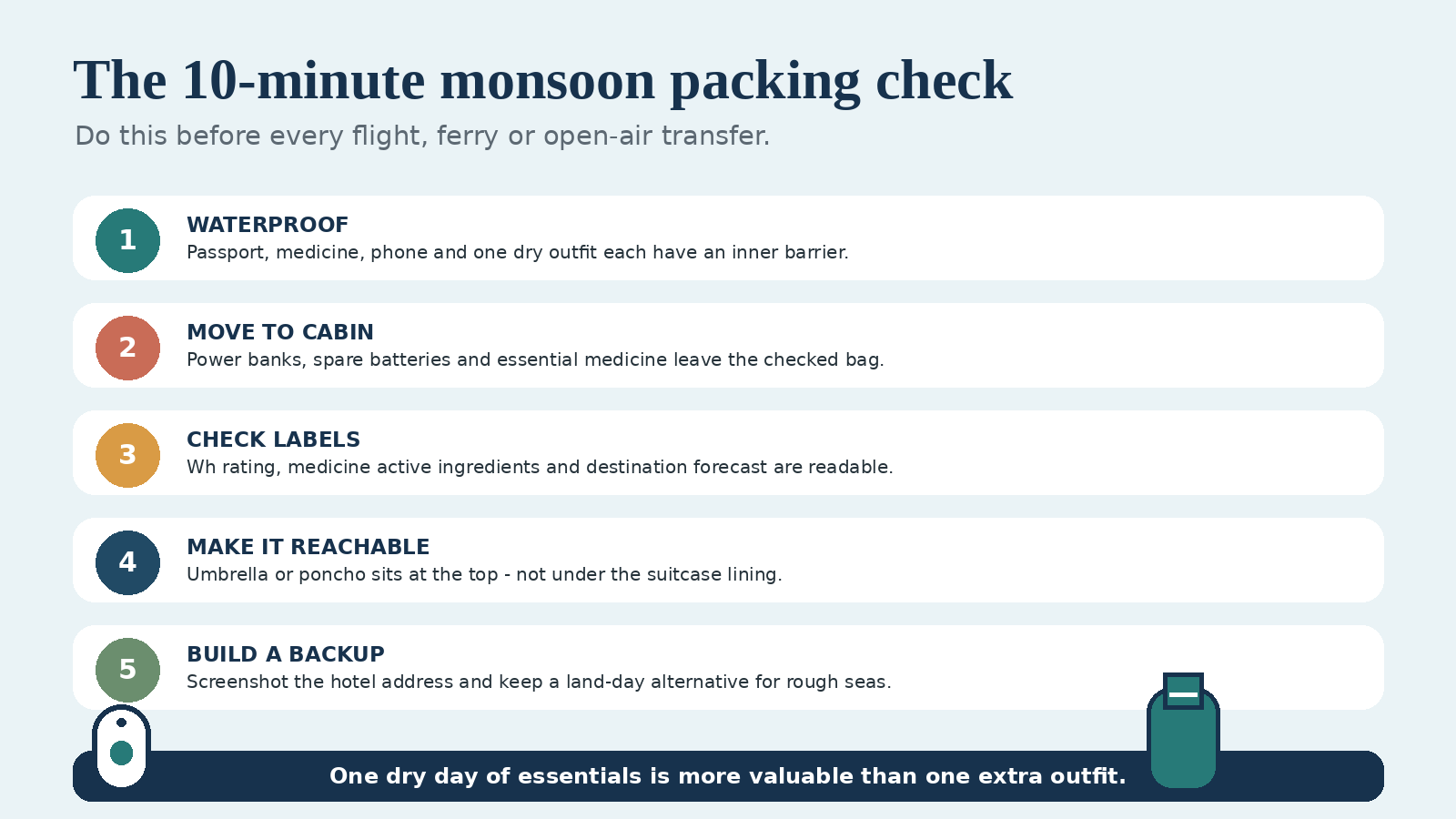
- Move the passport, medicine, phone and one dry outfit into separate waterproof inner pouches.
- Place no more than two power banks in cabin baggage; protect the terminals and confirm each Wh label is readable.
- Check controlled medicine by active ingredient, quantity and permit requirement.
- Put the umbrella or poncho where it can be reached without opening the whole suitcase.
- Confirm the temple outfit is opaque and covers shoulders and knees.
- Download insurance, hotel and transport information for offline use.
- Check the destination forecast, marine warning and operator messages.
- Leave enough space to separate wet clothing from dry clothing.
- Remove duplicate shoes, toiletries and “just in case” outfits.
- Keep a land-day alternative for every weather-sensitive boat or hike.
The final recommendation
The best Thailand monsoon packing list is an ordinary lightweight tropical wardrobe with better organisation. In practice, a secure walking shoe, a compact rain layer, one dry temple outfit and separate inner protection solve more real problems than a suitcase filled with technical gear.
As a research-led planning priority, the most useful trio is a clearly labelled power bank in cabin baggage, a 5–10 litre roll-top dry bag for valuables and one dry change of clothes that stays reachable throughout the journey. Once medicine and aviation rules are checked, the rest of the bag can remain simple.
Sources and fact-checking notes
Weather, aviation, medicine, dress, travel-health and cabin-liquid information was checked against the following official or authoritative sources on 7 September 2026. Seasonal conditions, warnings and rules can change, so use the linked source for a final check close to travel.
- Thai Meteorological Department — start of Thailand’s 2026 rainy season.
- Thai Meteorological Department — August to October 2026 climate outlook.
- Civil Aviation Authority of Thailand — 2026 power-bank requirements.
- Thai Food and Drug Administration — controlled medicines carried by travellers.
- The Grand Palace — practical information and prohibited clothing.
- TravelHealthPro — Thailand health information.
- TravelHealthPro — insect and tick bite avoidance.
- NHS — sunscreen and sun safety.
- GOV.UK — hand-luggage liquid restrictions.
- GOV.UK — Thailand travel advice and insurance context.
Research approach
This guide combines current official rules with practical packing judgement. Product links are examples for comparing dimensions and features; they are not evidence that a particular item is legally suitable for every airline, traveller or itinerary.
Illustrations in this article were created for Taylor’s Trailblazing Travels. Third-party photographs, where used, are credited beside the image or in the source list.