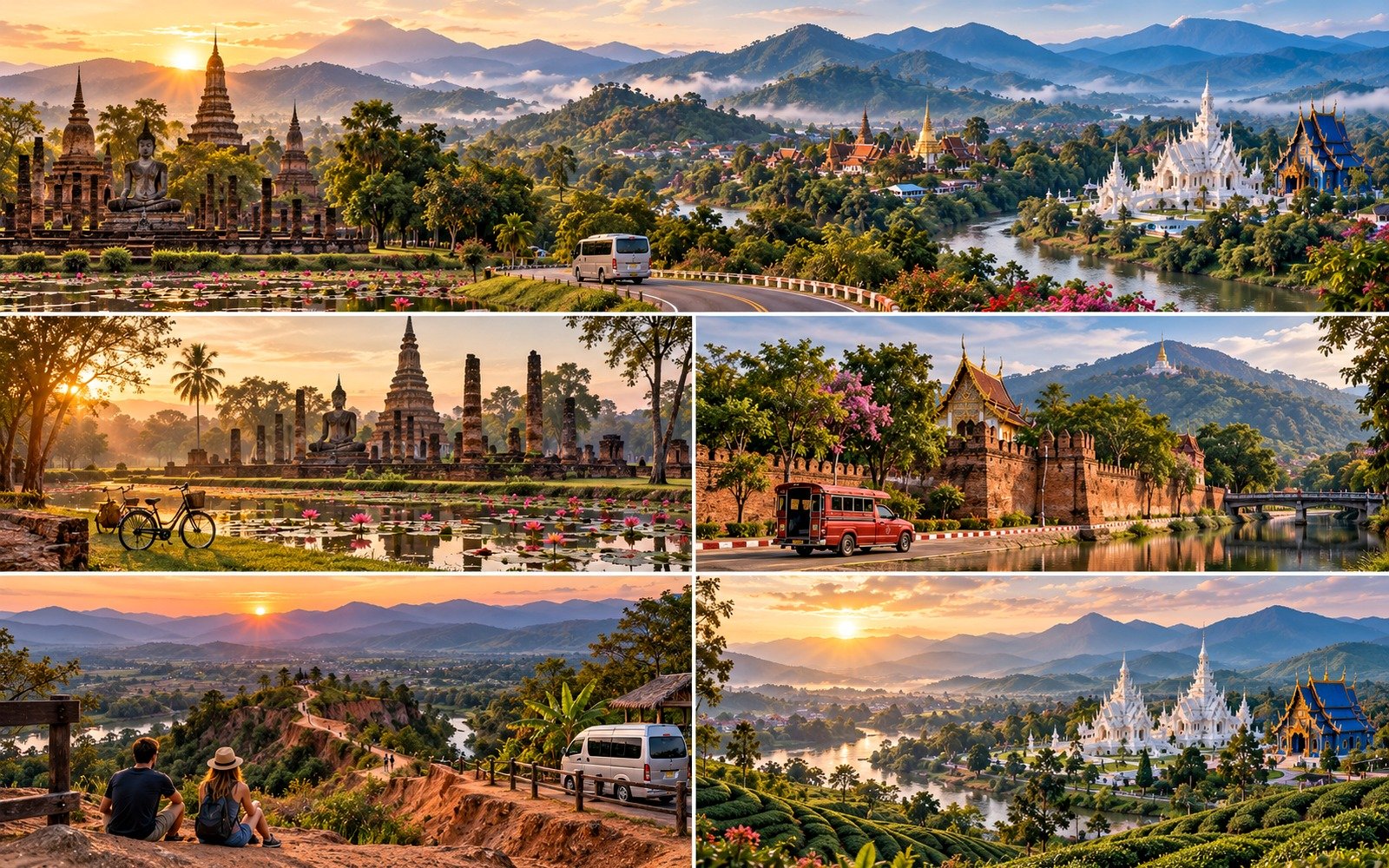
Northern Thailand 2-Week Itinerary
A realistic 14-night route through Sukhothai, Chiang Mai, Pai and Chiang Rai, with enough time for ruins, mountains and slower evenings.
A Northern Thailand 2-week itinerary has enough room to include history, mountain scenery and two very different northern cities, yet it can still become exhausting when every famous place is added in the wrong order. The route below begins in Sukhothai, continues to Chiang Mai and Pai, and finishes in Chiang Rai so the trip moves broadly north rather than returning south after every stop.
The plan uses three nights in Sukhothai, four in Chiang Mai, three in Pai and four in Chiang Rai. It was created by comparing hotel-to-hotel travel time, attraction clusters, road difficulty, useful evenings after transfers, seasonal flexibility and the value gained from each additional night. Affiliate commission was not part of the route ranking.
The itinerary assumes fourteen hotel nights and departure on Day 15. Travellers with only thirteen nights should remove either the Si Satchanalai day or the final Doi Tung day rather than compressing every transfer and turning the entire trip into a sequence of early alarms.
Sukhothai to Chiang Rai
Four bases move broadly north and finish at an airport city instead of doubling back.
Doi Inthanon and Pai
High mountain weather, canyon views and green valleys provide the strongest contrast.
Sukhothai
Two full days protect sunrise cycling and a separate Si Satchanalai excursion.
Count fourteen nights
Day 15 is the departure day; otherwise the plan quietly loses one of its four bases.
Fourteen nights are long enough to connect several northern clusters, but only when the route has a clear direction. Sukhothai sits south of Chiang Mai, Pai lies west of Chiang Mai and Chiang Rai is farther north-east. Beginning in Sukhothai and ending in Chiang Rai therefore reduces the worst backtracking, although the Pai–Chiang Rai leg remains a long mountain-road transfer.
Why Sukhothai comes first
Sukhothai is easier to reach from Bangkok than it is to add after Chiang Rai. Flights, direct buses and the train-plus-Phitsanulok option all support a southern starting point, while the direct road north to Chiang Mai takes roughly six hours on current scheduled services. UNESCO treats Sukhothai and Si Satchanalai as linked historic towns, so three nights create more value than a hurried one-night stop. [1] [2] [5] [6]
Why Pai sits between Chiang Mai and Chiang Rai
Chiang Mai is the natural gateway to Pai, and the scheduled minivan route is frequent. From Pai, travellers can book a through-service to Chiang Rai or pay more for a private transfer. Some services marketed as direct still involve a vehicle change or an operational handover near Chiang Mai, so Day 11 is deliberately empty of sightseeing commitments. [10] [14]
How the route was judged
The comparison used six criteria: useful hours after each transfer, the number of hotel changes, the range of experiences, recovery after winding roads, weather resilience and the ease of leaving the region. The main route won because it provides four distinct bases while limiting major transfers to three days. It was not selected because one operator or hotel platform paid more.
This schedule assumes fourteen hotel nights and departure from Chiang Rai on Day 15. It also assumes that Day 1 begins in Sukhothai rather than using the same day for a long international connection. When the incoming journey is uncertain, arrive the previous evening or treat Day 1 as recovery.
| Day | Main plan | Typical time block | Planning purpose | Sleep |
|---|---|---|---|---|
| 1 | Arrive in Sukhothai; check in near the Old City | Arrival dependent | No fixed attraction | Sukhothai |
| 2 | Sukhothai Historical Park central, north and west zones | 06:30–18:30 | Cycling and major ruins | Sukhothai |
| 3 | Si Satchanalai Historical Park and a slow evening | 08:00–18:30 | Second World Heritage town | Sukhothai |
| 4 | Direct bus or private transfer to Chiang Mai | About 6–8h hotel to hotel | Transfer day | Chiang Mai |
| 5 | Chiang Mai Old City and evening market | 08:00–21:00 | Temples, food and orientation | Chiang Mai |
| 6 | Doi Inthanon full-day excursion | 07:00–18:30 | Mountains and waterfalls | Chiang Mai |
| 7 | Doi Suthep, Wat Pha Lat and Nimman | 08:00–21:00 | Temple mountain plus modern city | Chiang Mai |
| 8 | Minivan or private car to Pai | About 4–6h hotel to hotel | Curved-road transfer | Pai |
| 9 | Pai town, river, White Buddha side and walking street | 09:00–21:00 | Gentle valley day | Pai |
| 10 | Tham Lod or a local countryside circuit | 07:30–19:00 | Cave or slower landscape day | Pai |
| 11 | Pai to Chiang Rai through-service or private car | About 7–10h hotel to hotel | Longest transfer | Chiang Rai |
| 12 | White Temple, Baan Dam, Blue Temple and Huay Pla Kang | 08:00–20:30 | Temple-art circuit | Chiang Rai |
| 13 | Chiang Saen, Hall of Opium and Golden Triangle | 08:00–19:00 | Mekong history day | Chiang Rai |
| 14 | Doi Tung and garden day, or a slow alternative | 08:00–19:00 | Highlands or recovery | Chiang Rai |
The three days that must stay light
Days 4, 8 and 11 are transfers. The first two can still support a quiet dinner or short walk, but Day 11 should remain almost completely empty. Pai to Chiang Rai involves long bends, possible changes and an arrival point that may not be the central bus terminal.
The two days that should remain movable
Swap Day 6 and Day 7 when the Doi Inthanon forecast is poor. In Chiang Rai, swap Days 13 and 14 when the Hall of Opium is closed, when visibility is better at Doi Tung on the other day or when the group needs a shorter road day.
Confirm that this is a fourteen-night trip
Many “14-day” itineraries actually contain thirteen hotel nights because the arrival and departure dates are both counted as full days. This version begins with Night 1 in Sukhothai and ends with Night 14 in Chiang Rai. The final flight, bus or onward journey happens on Day 15.
Decide how you will reach Sukhothai
From Bangkok, current 12Go listings show direct buses, flights and private transfers, while train users change at Phitsanulok because Sukhothai has no railway station. The cheapest live bus examples were around 420–550 baht and commonly took seven to nine hours; flights were much faster but varied sharply by date. These are dated planning examples checked on 18 September 2026 rather than fixed fares. [5]
Choose the Pai–Chiang Rai comfort level now
This is the route-defining decision. A shared through-ticket can be good value, yet it may include a handover and limited luggage space. A private car is more expensive but allows door-to-door travel, easier breaks and greater control over the pace. Travellers who become unwell on winding roads should price the private option before committing to non-refundable hotels.
Keep one route-change option
Smoke, heavy rain, road disruption or a health issue can make the mountain segment poor value. Therefore, know in advance whether you would replace Pai with additional Chiang Mai nights or replace the final Doi Tung day with a slower Chiang Rai city day.
Compare the four route-defining journeys
Check the actual terminal, luggage policy, cancellation terms and arrival point before paying. Prices and availability change, so use the live page for the final decision.
Arrival goal: reach the correct Sukhothai base
Stay in or close to Old Sukhothai when sunrise cycling, Wat Mahathat and Wat Si Chum are the priority. New Sukhothai offers more ordinary city services, yet it creates a daily transfer of roughly 12 kilometres to the ruins. For this itinerary, the Old City is usually the stronger three-night base.
Do not attach a timed attraction to the arrival
Use the afternoon for check-in, cash, bicycle inspection and a short orientation walk. When arriving early, enter the central zone only if the heat and energy level are comfortable. Otherwise, save the ticket and the best light for Day 2.
Set up the next two mornings
Ask the hotel where bicycles are collected, whether breakfast can begin early and how to arrange transport to Si Satchanalai. A private driver, shared tour or rental car normally needs more planning than the historical-park bicycle day.
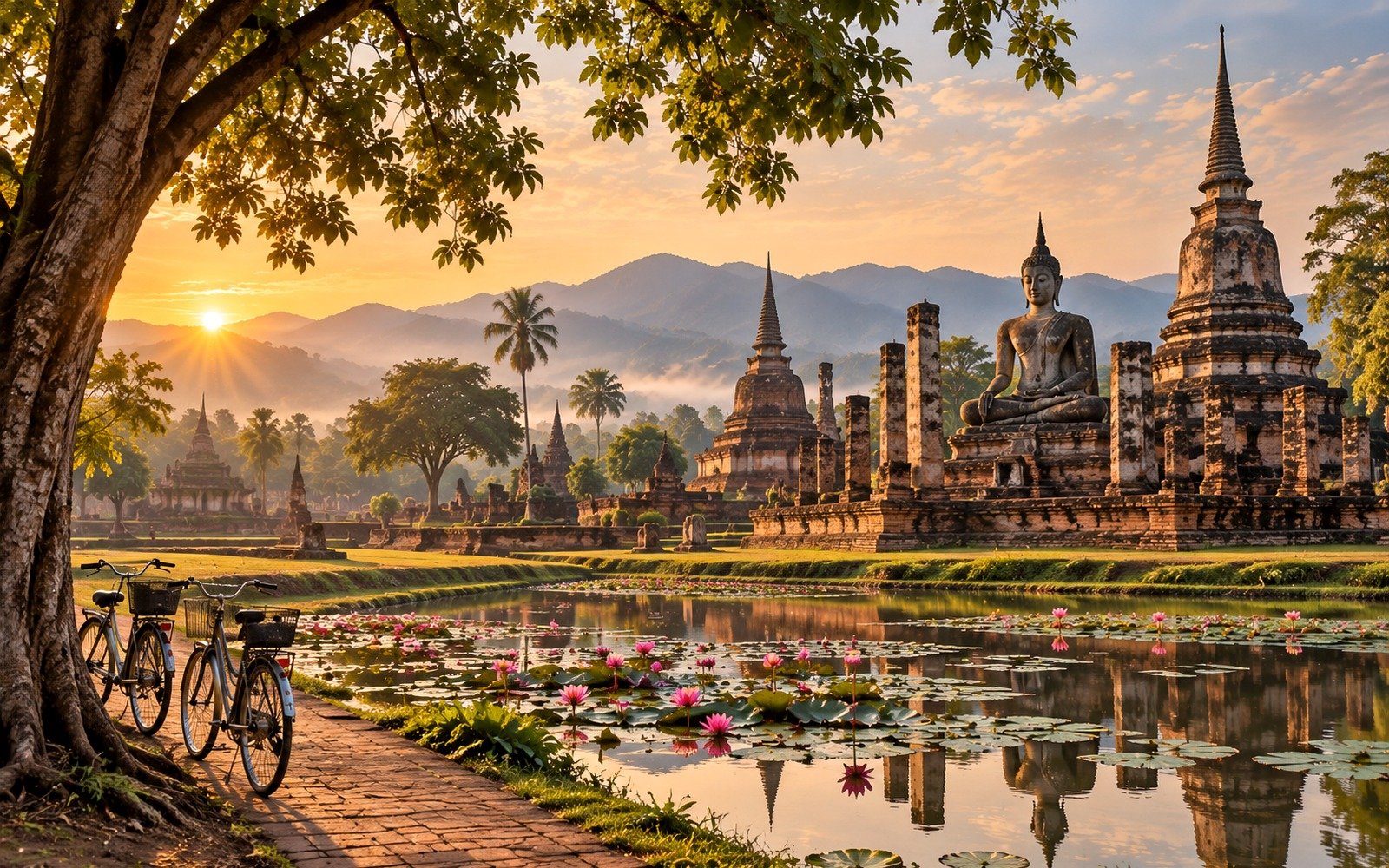
06:30–10:30: central zone in the cool light
The Fine Arts Department currently publishes 06:30 opening for the central zone. Foreign adult admission is listed at 200 baht, while a combined foreign ticket for the three paid zones is listed at 400 baht; bicycle entry costs 10 baht per zone. Saturday central-zone hours extend to 21:00 with illuminated monuments. Prices and hours were checked on 18 September 2026 and should still be reconfirmed at the gate. [3]
Start with Wat Mahathat, Wat Sa Si and Wat Si Sawai before the heat builds. A bicycle is useful because the flat roads and spaced ruins suit a slow loop, although travellers with balance or mobility concerns can use a tram, tuk-tuk or car.
10:30–15:30: lunch and a real midday break
The central plain has limited shade once the sun rises. Instead of forcing another zone at noon, return for lunch, water and a rest. This pause also protects the late-afternoon light.
15:30–18:30: north or west zone
Use the northern zone for Wat Si Chum and its large Phra Achana Buddha, or choose the western Aranyik area for quieter forested ruins. The Fine Arts Department lists 07:30–17:30 for Wat Si Chum and Wat Phra Phai Luang, while the western zone is listed at 08:00–16:30, so confirm the closing time before leaving the central zone. [3]
Why Si Satchanalai deserves a separate day
UNESCO’s World Heritage property includes Sukhothai, Si Satchanalai and Kamphaeng Phet rather than one isolated park. Si Satchanalai sits about 55 kilometres from Sukhothai and gives the itinerary a different landscape of forest, kiln history and quieter ruins. The official park page lists daily opening from 08:00 to 17:00 and foreign admission of 200 baht. [2] [4]
08:00–14:30: ruins, bicycles and kiln context
Leave early enough to reach the park near opening. Focus on the main temple cluster, then add a bicycle or tram only if the heat and mobility level suit the group. A driver should be given a clear return time because public transport back to Old Sukhothai is less straightforward than transport between the two main cities.
15:30 onwards: choose a calm finish
Return to Old Sukhothai for a pool, café or second sunset around the central ruins. When Day 3 is a Saturday, the later illumination can justify another short visit, although the day should not be extended simply to collect more photographs.
Alternative for travellers who dislike another ruin day
Use the day for a slower old-city morning, a local craft or museum stop and a long lunch. The route remains coherent because the third night still protects the Day 4 transfer.
Book a morning or late-morning direct bus
Current live listings show direct Sukhothai Historical Park–Chiang Mai services taking about 5 hours 45 minutes, with dated bus examples around 650–800 baht. Private cars were roughly 3–5 hours and commonly priced above 3,000 baht per vehicle. Exact departures, operators and terminals change, so confirm the route for the chosen date. [6]
Allow for terminal and hotel time
A 09:45 departure can still create a late-afternoon hotel check-in after breakfast, waiting, meal stops and the final ride from Chiang Mai Bus Terminal. Therefore, the evening plan should be limited to dinner near the hotel, a short market visit or an easy walk.
Choose the Chiang Mai area before arriving
The Old City edge is easiest for first-time temple days. Nimman suits cafés and modern dining, while the Night Bazaar or riverside works for evening convenience. Because Day 5 is a heritage day, a hotel close to the moat usually reduces the most local transport.
Compare Sukhothai to Chiang Mai transport
Use the live page to verify whether the bus departs from Old Sukhothai, New Sukhothai or another station, and whether the arrival is Terminal 2 or Terminal 3.
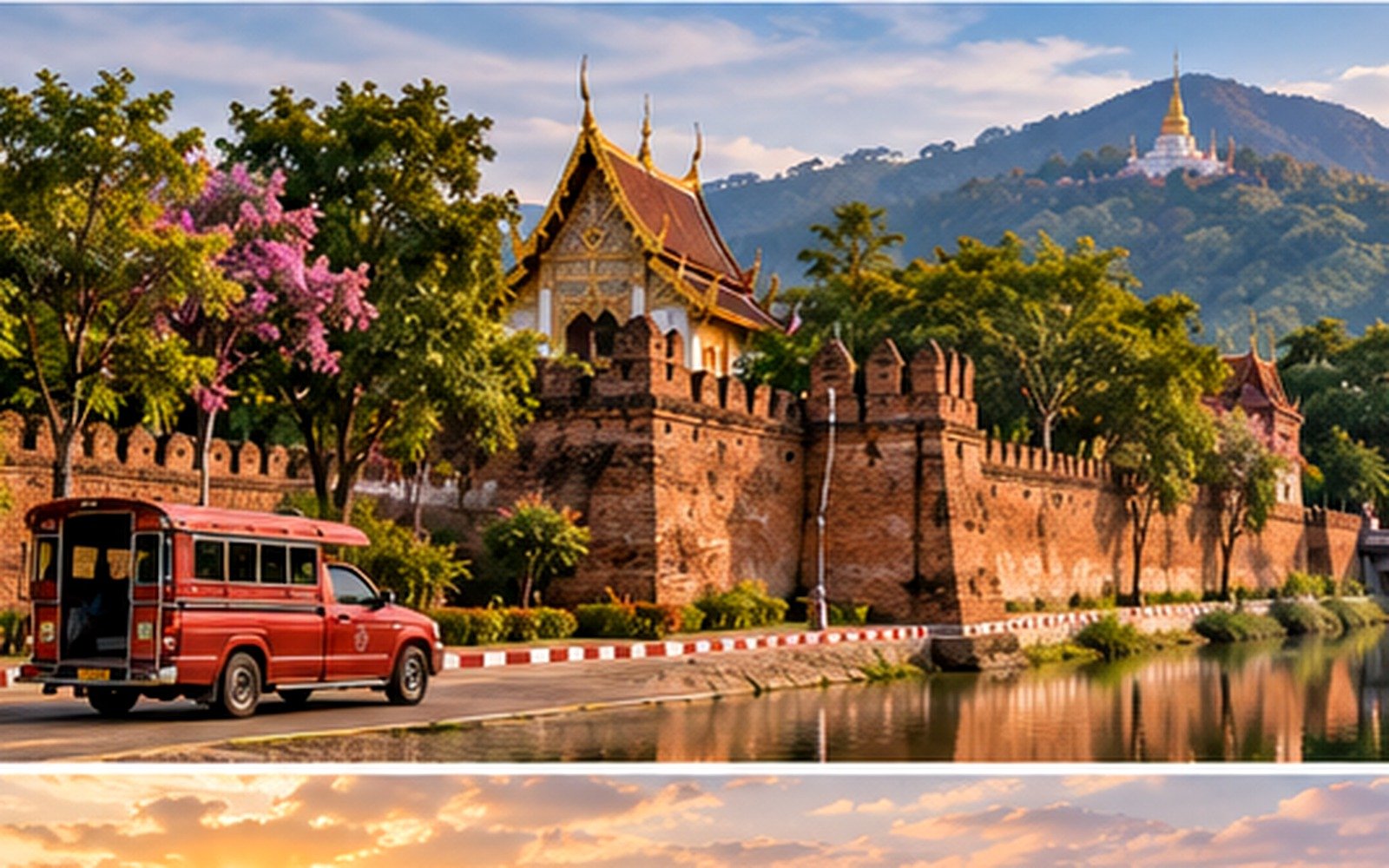
08:00–11:30: two major Old City temples
Begin with Wat Phra Singh and Wat Chedi Luang, then stop rather than turning the morning into a ten-temple checklist. TAT identifies Chiang Mai’s Old City, walking streets, Doi Suthep and wider mountain attractions as separate experiences, which supports using a full city day before the highland excursions. [7]
11:30–15:00: northern food and heat management
Choose one northern dish, sit down properly and use the hottest hours for lunch, a museum, café or hotel break. Khao soi, sai ua, nam prik ong and gaeng hung lay are useful starting points, but the best meal is the one that suits the traveller’s spice tolerance and energy.
15:00–17:30: one optional third stop
Wat Chiang Man, the Lanna Folklife Museum area or a craft district can fill the afternoon. However, skipping the third stop is often better than arriving at the evening market already tired.
Match the evening to the day of the week
Saturday favours Wua Lai; Sunday favours the Tha Phae and Ratchadamnoen walking street; other nights can use the Night Bazaar, a food market or a relaxed neighbourhood dinner. Agree a pickup point away from road closures before entering a busy walking street.
Treat Doi Inthanon as a full-day mountain excursion
TAT currently lists park access from 05:00 to 18:00, foreign adult admission of 300 baht, foreign child admission of 150 baht and a 30-baht car fee. The summit, cloud forest, waterfalls, pagodas and road time mean this is not a short viewpoint visit. Fees and access were checked on 18 September 2026. [8]
Compare inclusions before comparing prices
A useful tour listing should state whether park entry, pagoda access, lunch, guide, hotel pickup and a nature trail are included. A low headline price can become expensive after mandatory fees, while a longer trail may be unsuitable for a traveller expecting only short walks.
Pack for a different climate
The summit can be cold, wet and windy when Chiang Mai city is hot. Carry a proper light layer, rain protection and shoes with grip. During the wet season, waterfalls may be fuller but trails and steps can be slippery.
Keep the evening empty
Return times vary with traffic and the number of stops. A quiet dinner near the hotel is a stronger plan than a timed show or a cross-city restaurant reservation.
Compare Doi Inthanon tours by inclusions
Check walking level, park fees, lunch, pickup area and the cancellation policy for poor weather before booking.
08:00–11:30: Doi Suthep before the busiest period
TAT lists foreign temple admission at 30 baht and the electric tram at 50 baht for foreign visitors. Small buses run from the Chiang Mai University area, while private drivers and tours offer easier control over stops. The temple is 11 kilometres from the city centre, yet traffic and pickup waiting can make the half-day longer than the map suggests. [9]
Optional Wat Pha Lat or Doi Pui layer
Add Wat Pha Lat only when the transport plan and footwear are suitable. Doi Pui can also extend the mountain half-day, although combining every hillside stop often leaves too little time at each place.
14:00 onwards: Nimman or a slower afternoon
Use the modern side of Chiang Mai for cafés, galleries, shopping, a massage or a hotel pool. This contrast matters after two days of temples and mountain roads.
Prepare for Pai
Buy motion-sickness medication if appropriate, keep water and a light snack accessible, and confirm the exact Day 8 pickup. Place valuables in a small day bag because large luggage may be stored separately.
Use a daytime departure
Current 12Go listings show Prem Pracha minivans from 06:30 through 17:30, with scheduled journey times around 4 hours 20 minutes and online examples near 260 baht. Actual driving time can be shorter, yet hotel-to-hotel planning should still allow four to six hours. [10]
Do not plan Pai Canyon on a late arrival
After a winding transfer, the most useful plan is check-in, food and a gentle walk through town. The canyon is seven kilometres from Pai and includes narrow, exposed, unfenced ridges; it should not become a rushed sunset stop after a delayed van. [12]
Stay within easy reach of the evening
Walking Street or the river edge works well for a first stay without a scooter. A countryside resort can be beautiful, but daily drivers and after-dark access may cost more than the cheaper room saves.
Compare Chiang Mai to Pai transport
Check whether the service starts at Arcade Bus Station, a hotel pickup point or an agency office, and confirm the luggage rules before paying.
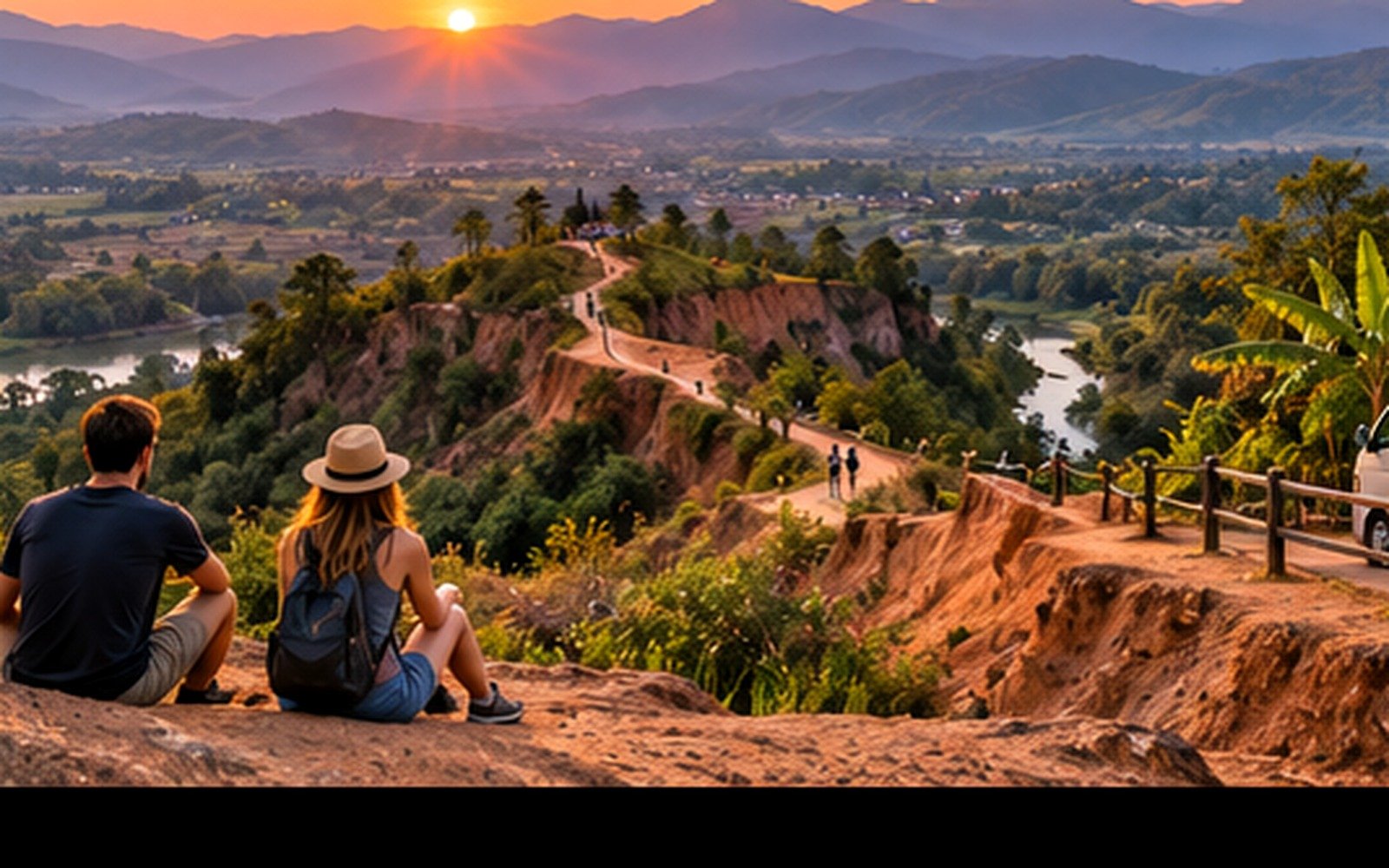
Start with Pai town rather than hiring a scooter immediately
Walk the central streets, cross the river and learn the distances before choosing transport. TAT describes Pai as a small town that combines local life, rivers and outdoor activities, but the surrounding sights are spread across roads with very different conditions. [11]
Late morning: White Buddha side or a calm riverside loop
Wat Phra That Mae Yen provides a hillside viewpoint, although the stair climb and exposed sun should be considered. Travellers who prefer a softer day can remain near the river, cafés and local temples.
Afternoon: hot springs or rest
Tha Pai Hot Spring is listed by TAT as open 08:00–18:00 and sits off Route 1095. The site and bathing arrangements can change, so confirm the current entry and whether the temperature suits the activity rather than assuming every pool is designed for bathing. [11]
Sunset: Pai Canyon only in safe conditions
The ridges are narrow, steep and unfenced. Go before the last light, wear shoes with grip and stop at the broad viewpoint if the exposed paths feel unsafe. Sunset popularity also makes the parking and exit busier.
Option A: Tham Lod and Pang Mapha
Tham Lod is the stronger choice for travellers who want a substantial nature day and can accept more road time. TAT describes three main cave chambers and states that visitors cannot enter independently because a local lantern guide is required. Its current page lists 150 baht per guide, although raft access, route availability and total visitor charges should be checked on the day. [13]
Leave early, carry cash and ask what sections are open after rain. Cave water levels, lighting and local operating decisions can change the experience, so an itinerary sold months earlier is not a guarantee.
Option B: a slower Pai countryside day
Choose local viewpoints, a hot spring, a village or a long lunch rather than spending another full day in a vehicle. This alternative is better for families with small children, travellers with limited mobility and anyone already tired from the Route 1095 bends.
How the options were compared
The cave day ranks higher for geological interest and regional contrast, while the local day ranks higher for comfort, weather resilience and recovery. Neither is universally better; the correct choice depends on road tolerance and current conditions.
Expect the longest transfer of the itinerary
Live route pages show that Pai–Chiang Rai inventory changes by date. Recent shared-van examples ranged from roughly 650 baht upward and commonly showed 5.5–8.5 hours, while private vehicles were substantially more expensive. Some “direct” products still involve a vehicle change, route handover or stop near Chiang Mai. [14]
Book one protected itinerary where possible
A single through-ticket is preferable to separate self-booked Pai–Chiang Mai and Chiang Mai–Chiang Rai tickets when the connection is guaranteed. Separate tickets can be cheaper, but a late first van can leave the traveller stranded with no protected onward seat.
Check the Chiang Rai drop-off point
Services may finish at Bus Terminal 1, Bus Terminal 2, Central Plaza or a hotel transfer point. The cheapest ticket can therefore create an extra taxi and a confusing arrival after dark.
Plan only dinner and sleep
Even when the vehicle arrives on time, the body has completed two mountain-road sections. Keep the evening flexible and move the Clock Tower or Night Bazaar to another night.
Compare Pai to Chiang Rai carefully
Look for guaranteed connection wording, the actual arrival point, luggage charges and recent operator reviews. Availability can disappear on a specific day.
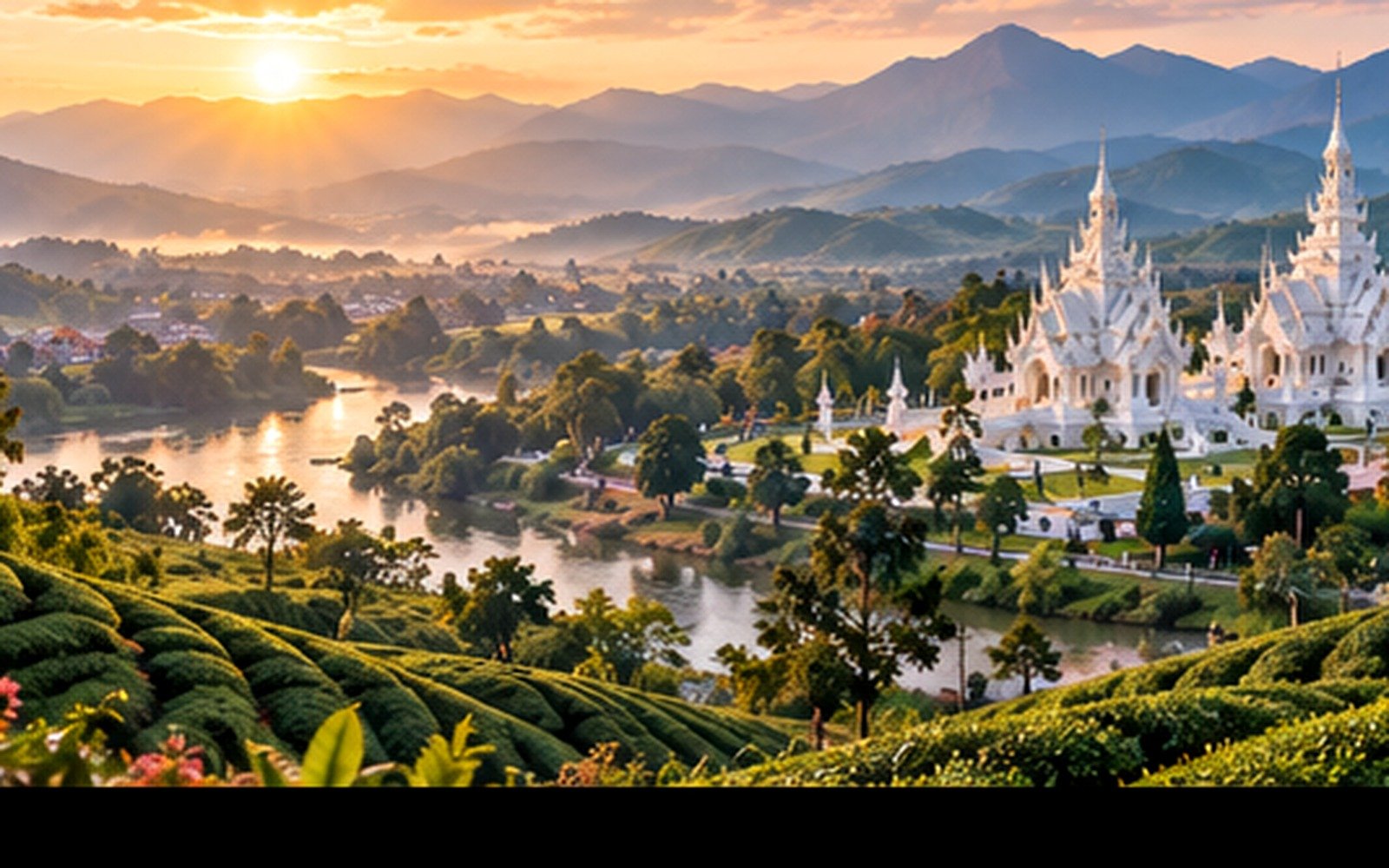
08:00–11:00: Wat Rong Khun
The White Temple sits south of the city, so it makes sense as the first road stop. Foreign admission increased to 200 baht from 1 January 2026 according to the announced change. Dress respectfully, arrive near opening and allow more time than a quick roadside photograph. [16] [17]
11:30–14:00: Baan Dam and lunch
Baan Dam lies north of the city, which means the route crosses town. A private driver or organised circuit reduces repeated negotiation, although the day still needs a proper lunch and rest.
14:30–17:30: Blue Temple and Wat Huay Pla Kang
Wat Rong Suea Ten is closer to the city, while Wat Huay Pla Kang adds a larger hillside complex. The order can change with traffic, light and closing times. Remove one stop when the group prefers depth over a four-attraction circuit.
Evening: central Chiang Rai
Use the Clock Tower and Night Bazaar on foot when staying centrally. A riverside or countryside hotel may need a taxi, so build that cost into the room decision.
Pair the Golden Triangle with history
The viewpoint alone is rarely enough to justify the long road. Combine Chiang Saen’s older temple landscape with the Hall of Opium or another substantial museum stop, then use the Mekong viewpoint as the final geographical context rather than the entire purpose of the day.
Confirm the Hall of Opium opening before departure
The Mae Fah Luang Foundation operates the site and provides direct contact information. English-language opening details can be less consistent across public pages, so call or message before building a non-refundable tour around a Monday or holiday. [19]
Keep border language precise
Viewing Myanmar and Laos from Thailand is not the same as completing an international border crossing. Do not add a casual border hop unless current visa, passport, entry and insurance requirements have been checked for every traveller.
Return before an early final-day start
The road back to Chiang Rai can be tiring. If Day 14 will use Doi Tung or Mae Salong, keep the evening quiet and prepare the day bag before sleep.
Option A: Doi Tung Royal Villa and Mae Fah Luang Garden
The foundation’s published opening time is 08:00–17:00. Gardens, mountain roads and the villa create a gentler final full day than another long border circuit. Visibility can still vary, so check the forecast before choosing a viewpoint-heavy add-on. [18]
Option B: Doi Mae Salong and tea country
This is the more scenic road option when the group has a driver and still enjoys mountain travel. It adds bends and distance, so do not combine it with Doi Tung, Mae Sai and several temples simply because a tour listing does.
Option C: Singha Park or a slow Chiang Rai day
Singha Park publishes daily opening from 09:00 to 18:00, while its farm-tour page lists a 150-baht shuttle plus a 50-baht admission charge for adults at the time of checking. Alternatively, stay in town for cafés, the river, a massage, laundry and an unhurried final dinner. [20]
Choose by energy, not guilt
The final day should make the trip feel complete rather than prove that every hour was used. After thirteen days, the slower city option can be the most valuable choice.
The table uses dated live examples checked on 18 September 2026. Roadworks, weather, service type and hotel location can alter every estimate, so add a buffer rather than treating the shortest advertised time as a promise.
| Leg | Option | Planning time | Best advantage | Main caution |
|---|---|---|---|---|
| Bangkok → Sukhothai | Flight | About 3–5h door to door | Fast start | Fare and schedule variation |
| Bangkok → Sukhothai | Direct bus | About 7–9h | Lowest common cost | Uses most of a day |
| Sukhothai → Chiang Mai | Direct bus | About 5h45 plus transfers | Simple scheduled option | Limited daily departures |
| Sukhothai → Chiang Mai | Private car | About 3–5h | Door to door | High vehicle price |
| Chiang Mai → Pai | Prem Pracha minivan | About 4h20 scheduled | Frequent and affordable | Motion sickness, tight luggage |
| Chiang Mai → Pai | Private car | About 3–4h | Breaks and comfort | Higher cost |
| Pai → Chiang Rai | Through van / combo | About 5.5–8.5h | One booking | May involve change or remote drop-off |
| Pai → Chiang Rai | Private transfer | About 5–7h | Door to door | Most expensive leg |
Why the route does not use trains
Sukhothai and Chiang Rai do not have direct passenger rail links for this circuit, and Pai has no practical rail connection. The nearest train strategy for Sukhothai uses Phitsanulok, while Chiang Mai is the main rail city. Consequently, buses, vans and cars are the coherent ground options between the four bases.
Driving the route yourself
Self-driving can work for experienced, properly licensed travellers with valid insurance. UK guidance lists the 1968 International Driving Permit for Thailand, while road safety, weather, fatigue and mountain bends still require judgement. A scooter should not be treated as a shortcut around licensing or insurance rules. [24] [25]
The accommodation areas were compared by morning access, evening convenience, dependence on drivers, tour pickup practicality and the cost created by distance. They were not ranked by room commission or social-media popularity.
| Base | Best for | Transport reality | Main trade-off |
|---|---|---|---|
| Old Sukhothai | Sunrise ruins and cycling | Walk/bicycle to central zone | Quieter evenings and fewer city services |
| Chiang Mai Old City edge | First visit and temples | Walking plus songthaew/ride app | Tourist traffic around main gates |
| Pai town or river edge | No-scooter first stay | Walkable evenings; driver for countryside | Noise varies by street and bridge |
| Chiang Rai Clock Tower / Night Bazaar | Short stay and evening food | Walkable centre; driver for outlying sights | Busy roads and tour pickups |
| Chiang Rai riverside | Couples and calmer hotels | Taxi or hotel shuttle | Fewer restaurants directly outside some properties |
Planning price ranges
Sampled live listings on 18 September 2026 suggested roughly 700–1,800 baht per room for simple Sukhothai stays, 900–2,800 in central Chiang Mai, 700–2,200 in Pai and 800–2,500 in central Chiang Rai. Boutique and resort properties commonly exceeded these bands. Treat them as planning ranges, not quoted future rates.
Cancellation matters more than a small saving
Mountain weather, haze and transport changes can reshape this route. A slightly higher flexible rate can be better value than a cheaper non-refundable room that forces the group to remain in a poor-air or disrupted destination.
The budget below is a planning framework checked on 18 September 2026. It assumes two people sharing rooms, a mix of local meals and ordinary cafés, and at least some organised road days. Domestic flights to Sukhothai or from Chiang Rai can sit outside the range depending on date.
| Category | Budget traveller (THB) | Mid-range traveller (THB) | What changes the figure |
|---|---|---|---|
| Accommodation per person sharing | 6,500–12,000 | 15,000–28,000 | Fourteen nights; city and mountain demand vary |
| Food and drinks | 8,500–14,000 | 15,000–25,000 | Street food to regular restaurant mix |
| Intercity transport | 2,500–5,500 | 8,000–18,000 | Private Pai transfer changes the total most |
| Local transport | 2,000–4,500 | 6,000–12,000 | Drivers for rural days create the main swing |
| Attractions and tours | 4,500–9,000 | 12,000–25,000 | Doi Inthanon, caves and Chiang Rai road days |
| Contingency | 2,000–4,000 | 4,000–8,000 | Weather, baggage and replacement transfers |
| Estimated total | 26,000–49,000 | 60,000–116,000 | Excludes international travel and major shopping |
Where spending improves the route most
Spend more on the Pai–Chiang Rai transfer when comfort, luggage or motion sickness matters. A well-located room also reduces repeated taxis. By contrast, paying for a private car inside walkable Old Sukhothai or central Chiang Mai often adds little value.
Where apparent savings can become expensive
A remote resort, separate unprotected transfer tickets and a bargain tour that excludes mandatory fees can all cost more after the missing parts are added. Compare the whole day rather than the headline price.
The following sequence is ordered by scarcity and dependency rather than by the order in which items appear in the itinerary.
- Confirm the international or Bangkok gateway dates and the Day 15 departure from Chiang Rai.
- Book the fourteen hotel nights, starting with Pai and any peak-season mountain properties.
- Secure Bangkok–Sukhothai or the chosen arrival route.
- Book the Sukhothai–Chiang Mai, Chiang Mai–Pai and Pai–Chiang Rai legs.
- Reserve Doi Inthanon and any private Chiang Rai road days.
- Leave central temples, markets, cafés and ordinary city transport flexible.
- Recheck weather, Air4Thai, park access and operator messages during the final week.
Do not lock every day at once
Only the scarce transport and full-day excursions need early commitment. Keeping one free-cancellation day at each city base allows the route to respond to rain, smoke and energy.
Arrange maps and messages before the first transfer
An eSIM can be useful for tickets, driver messages and route changes when the phone is compatible. Keep offline copies of every essential booking as well.
Sukhothai: noodles and an early dinner rhythm
Sukhothai noodles are the obvious local starting point, while Old Sukhothai evenings are calmer than Chiang Mai or Pai. Eat early enough that the kitchen choice does not disappear after a late park sunset.
Chiang Mai: northern dishes and market choice
Khao soi, gaeng hung lay, sai ua and chilli dips give the city a clear regional identity. However, pace the food days: one market, one sit-down meal and one café are more enjoyable than crossing the city for every viral recommendation.
Pai: mixed traveller food with local limits
Walking Street provides variety, although its most visible stalls are not the whole food culture. Use one evening for the market and another for a quieter restaurant or local breakfast.
Chiang Rai: central food and road-day planning
The Night Bazaar is convenient after a temple day. On Golden Triangle or Doi Tung days, carry water and a small snack because lunch timing depends on the route and the driver.
Price expectations
A practical 2026 planning range is about 60–120 baht for a simple local meal, 120–300 baht for an ordinary restaurant dish and 80–180 baht for many café drinks. Tourist locations, premium ingredients and alcohol can move well beyond those figures.
November to January: easiest broad window
Cooler mornings and generally clearer mountain views make this the simplest period for many first trips. Peak demand is the trade-off, particularly in Pai and around New Year. Book scarce rooms and transfers early.
February to April: air-quality risk can dominate
Northern Thailand can experience serious seasonal smoke and PM2.5. Historical averages do not tell you whether a particular valley will be clear on a specific week, so use Air4Thai and current local advice every day. Reduce outdoor exertion when conditions deteriorate and keep a route-change option. [21]
May to October: green scenery and road uncertainty
Rain produces fuller waterfalls and vivid fields, yet it can also close trails, change cave access and slow mountain roads. Keep the Doi Inthanon, Pai Canyon and Tham Lod decisions flexible, and follow TMD warnings rather than a generic rain icon. [22] [23]
Altitude changes packing
Doi Inthanon can be genuinely cold and wet compared with Chiang Mai city. Pai and Doi Tung can also have cool mornings. A light warm layer is more useful than assuming every northern day will feel tropical.
The alternatives were compared by road time, number of hotel changes, distinctiveness and the ease of changing plans. The main route remains the most varied first itinerary, but it is not the correct choice for every traveller.
| Travel priority | Alternative route | Why choose it |
|---|---|---|
| History-led, fewer bends | Sukhothai 3 → Chiang Mai 5 → Chiang Rai 6 | Removes Pai and adds slower city/highland days |
| Mountain-led | Chiang Mai 4 → Pai 4 → Pang Mapha 2 → Chiang Rai 4 | More road focus; no Sukhothai |
| No long Pai–Chiang Rai transfer | Sukhothai 3 → Chiang Mai 5 → Chiang Rai 6 | Use GreenBus between the cities |
| Returning visitor | Lampang 2 → Chiang Mai 4 → Chiang Dao 2 → Chiang Rai 4 → Nan 2 | More complex and better for experienced planners |
| Poor air in the north | Bangkok or southern replacement route | Do not force the itinerary through unsafe conditions |
When to remove Pai
Remove Pai first when motion sickness, limited mobility, large luggage, rain or smoke makes the mountain road poor value. Add the nights to Chiang Mai and Chiang Rai rather than replacing Pai with another distant stop.
When to remove Sukhothai
Remove Sukhothai when the international flight structure makes the southern start expensive or when archaeology is not a priority. Begin in Chiang Mai and use the saved nights for a slower Pai and Chiang Rai route.
For couples
Choose one riverside or countryside hotel, but keep the other bases central. Private transport on Day 11 can be a meaningful comfort upgrade when shared between two people.
For solo travellers
Central hotels and scheduled transport reduce the cost of rural taxis. Keep driver details, tickets and hotel addresses offline, especially on the Pai–Chiang Rai transfer.
For families
Remove exposed Pai Canyon ridges and reconsider the long Tham Lod day for very young children. A pool, early dinner and shorter Chiang Rai day can be more valuable than another attraction.
For older travellers or limited mobility
Use a driver at Sukhothai and Chiang Rai, confirm steps and toilet access, and avoid assuming every temple or cave has lifts or smooth paths. Doi Suthep’s tram reduces the staircase but does not remove every uneven surface.
For remote workers
Add work only in Chiang Mai or central Chiang Rai, where connectivity and backup cafés are stronger. Transfer days and rural Pai stays should be treated as unreliable workdays.
The packing list is ordered by route-specific risk rather than by product price. It assumes laundry during the two weeks, so carrying fourteen complete outfits is unnecessary.
| Item | Why it matters | Practical approach |
|---|---|---|
| Light warm layer | Doi Inthanon, Pai and Doi Tung mornings | One packable fleece or insulated layer |
| Rain shell or compact umbrella | Green season and sudden mountain rain | Breathable and easy to reach |
| Shoes with grip | Ruins, canyon, caves and waterfalls | Avoid smooth fashion soles |
| Small day bag | Every excursion and transfer | Keep medication, water and documents with you |
| Motion-sickness plan | Chiang Mai–Pai and Pai–Chiang Rai | Use appropriate medicine only as directed |
| Temple clothing | City and mountain temples | Shoulders and knees covered |
| Offline records | All transfers | Tickets, hotel addresses, insurance and emergency contacts |
Luggage size matters on vans
A medium case or backpack is easier than an oversized suitcase on shared mountain transport. When travelling with large hard-shell luggage, confirm space or buy the required extra allowance before arriving at the station.
Do not hide essential medication in the boot
Keep prescribed medication, motion-sickness supplies, water and a warm layer inside the day bag. A vehicle change can separate passengers from large luggage temporarily.
Advantages
- Four distinct bases create strong cultural and landscape variety.
- Sukhothai and Chiang Rai receive enough nights to avoid day-trip treatment.
- Only three days are dominated by intercity transport.
- The route finishes at a useful airport city.
- Each major outdoor day has a slower replacement.
Trade-offs
- Pai to Chiang Rai is a long, winding and operationally variable journey.
- Four hotel bases still require repeated packing.
- Peak-season Pai rooms and vans can sell out.
- Smoke or heavy rain can reduce the value of several outdoor days at once.
- Some rural days need a driver, increasing the budget.
Who should choose this itinerary
It suits first-time or early-repeat visitors who want history, cities and mountain scenery and are comfortable with three substantial road days. It is less suitable for travellers who dislike frequent checkouts or winding roads.
- Counting fourteen calendar days as fourteen hotel nights.
- Booking Pai before checking motion sickness, luggage and the Day 11 transfer.
- Staying in New Sukhothai when sunrise access to the park is the main reason for visiting.
- Planning a full Chiang Mai evening after the Sukhothai bus.
- Booking Doi Inthanon without checking whether park fees and pagoda entry are included.
- Treating Pai Canyon as an ordinary paved viewpoint.
- Buying separate Pai and Chiang Rai tickets with no protected connection.
- Assuming every Chiang Rai van drops at the central terminal.
- Booking rural hotels without pricing daily transport.
- Ignoring Air4Thai because the trip falls in the “dry season”.
- Renting a scooter without the correct licence, insurance and road experience.
- Publishing or travelling with old prices and opening hours without a final check.
The list is ordered from itinerary-breaking errors to smaller value losses. The first three can reshape the entire route, while the later mistakes usually cost time, money or comfort.
These answers address the planning questions most likely to change the route, cost or comfort.
Is two weeks enough for Northern Thailand?
Yes. Fourteen nights are enough for Sukhothai, Chiang Mai, Pai and Chiang Rai when the trip protects three transfer days. It is not enough for a relaxed version that also adds Mae Hong Son, Nan and Lampang.
How many nights should I spend in each place?
Use three nights in Sukhothai, four in Chiang Mai, three in Pai and four in Chiang Rai. This gives two full Sukhothai days, three Chiang Mai days, two Pai days and three Chiang Rai days.
Should I start in Sukhothai or Chiang Mai?
Start in Sukhothai when arriving from Bangkok and finishing in Chiang Rai is practical. Start in Chiang Mai when flight structure or personal priorities make the southern detour poor value.
Can I take a train to Sukhothai?
Sukhothai has no passenger railway station. Travel by train to Phitsanulok, then continue by bus, van or taxi, or use a direct bus or flight from Bangkok.
What is the best way from Sukhothai to Chiang Mai?
A direct daytime bus is the default budget choice. A private car is faster door to door and may suit a group, large luggage or mobility needs.
How difficult is the Chiang Mai to Pai road?
The road is highly curved and can cause motion sickness. Scheduled minivans are frequent, but travellers who need more space or breaks may prefer a private car.
Is Pai to Chiang Rai direct?
Some through services are sold as direct, yet a vehicle change or operational handover may still occur. Confirm guaranteed-connection wording, the drop-off point and luggage rules before booking.
Can I skip Pai?
Yes. Add the nights to Chiang Mai and Chiang Rai and travel between those cities by GreenBus. This is the easiest lower-bend alternative.
Is Sukhothai Historical Park expensive?
The Fine Arts Department currently lists 200 baht for the central zone, 120 baht for the north, 120 baht for the west or 400 baht for a combined foreign ticket, plus small vehicle fees.
Do I need a guide at Tham Lod?
Yes. TAT states that independent entry is not allowed and a local lantern guide is required. Check which cave sections and raft routes are open on the day.
How much should I budget?
A practical planning range is about 26,000–49,000 baht per person on a budget or 60,000–116,000 baht mid-range, excluding international travel. Private transfers and premium hotels create the largest changes.
What is the best season?
November to January is the easiest broad window. February to April needs live smoke checks, while May to October requires flexible mountain and cave plans because of rain.
What should I do if air quality is poor?
Check Air4Thai, follow local health advice, reduce outdoor exertion and change the route when necessary. Travellers with health conditions should obtain appropriate medical advice.
Can I drive the whole route myself?
Yes, with the correct licence, valid insurance, the appropriate IDP where required and suitable mountain-road experience. Fatigue and wet-season conditions remain important.
Do I need to pre-book every attraction?
No. Pre-book scarce transfers, Pai rooms, Doi Inthanon and private road days. Keep central temples, markets and ordinary city time flexible.
Where should I depart after Day 14?
Chiang Rai airport is the cleanest endpoint when fares and onward connections work. Otherwise use GreenBus to Chiang Mai or continue overland with a generous buffer.
Can I do this itinerary with a large suitcase?
Yes, but confirm van space and possible luggage charges. A medium case is easier for the Chiang Mai–Pai and Pai–Chiang Rai legs.
Which day should remain most flexible?
Day 10 and Day 14 are the easiest to swap or simplify. Keep Day 11 fixed as a transfer day and avoid attaching a non-refundable evening activity to it.
For a first two-week northern journey, I recommend three nights in Sukhothai, four in Chiang Mai, three in Pai and four in Chiang Rai. Begin with the historical parks, keep Chiang Mai’s Old City, Doi Inthanon and Doi Suthep on separate days, then give Pai two usable days before accepting the long transfer to Chiang Rai.
The route works because it does not pretend every place is a day trip from Chiang Mai. Sukhothai becomes a real historical stop, Pai receives recovery time after the mountain road and Chiang Rai has separate temple, Mekong and highland days.
When one part must be removed, drop Pai first for road comfort or drop Si Satchanalai first for a shorter trip. Do not compress the three transfer days and hope that every vehicle runs at the fastest advertised time.
Confirm the four journeys before paying for non-refundable rooms
Open each live page in the correct direction and date, then compare terminals, luggage, cancellation and arrival time. Availability, prices and booking terms can change.
This guide was reviewed on 18 September 2026. Official tourism, heritage, government, park and operator sources were preferred. Live booking pages were used only for dated inventory, journey-time and price examples, not as guarantees of future service.
- Tourism Authority of Thailand — Sukhothai province — Historic-park context, Wat Si Chum, Wat Mahathat and Si Satchanalai planning.
- UNESCO — Historic Town of Sukhothai and Associated Historic Towns — World Heritage status and the linked Sukhothai, Si Satchanalai and Kamphaeng Phet property.
- Fine Arts Department — Sukhothai Historical Park visitor information — Current published hours, zone prices and bicycle/vehicle fees.
- Fine Arts Department — Si Satchanalai Historical Park — Current published daily hours, admission and distance from Sukhothai.
- 12Go — Bangkok to Sukhothai live listings — Dated transport inventory, journey-time and fare examples checked 18 September 2026.
- 12Go — Sukhothai to Chiang Mai live listings — Dated direct-bus and private-transfer examples checked 18 September 2026.
- Tourism Authority of Thailand — Chiang Mai province — Chiang Mai highlights, Doi Suthep, Doi Inthanon, walking streets and neighbourhood context.
- Tourism Authority of Thailand — Doi Inthanon National Park — Published park hours, foreign entry, child and vehicle fees, summit conditions and contact details.
- Tourism Authority of Thailand — Wat Phra That Doi Suthep — Published foreign entry, tram fee and access information.
- 12Go — Chiang Mai to Pai live listings — Prem Pracha timetable, live fares and journey examples checked 18 September 2026.
- Tourism Authority of Thailand — Mae Hong Son and Pai — Mountain-road, motion-sickness and Pai destination context.
- Tourism Authority of Thailand — Pai Canyon — Location, terrain, unfenced ridges and safety context.
- Tourism Authority of Thailand — Tham Lod Nature and Wildlife Education Centre — Cave layout, compulsory lantern guide and current contact details.
- 12Go — Pai to Chiang Rai live route — Dated through-service and transfer availability evidence; exact inventory varies by day.
- GreenBus — official bus schedule — Official Chiang Mai–Chiang Rai schedule, page marked latest update 15 August 2026.
- Tourism Authority of Thailand — Chiang Rai province — White Temple, Blue Temple, Baan Dam, Doi Tung and Golden Triangle context.
- Khaosod English — White Temple foreign admission change — Foreign admission reported as 200 baht from 1 January 2026.
- Mae Fah Luang Foundation — Doi Tung published opening time — Published 08:00–17:00 opening for Doi Tung Royal Villa and Mae Fah Luang Garden.
- Mae Fah Luang Foundation — contact — Direct operator contact route for Hall of Opium and foundation sites.
- Singha Park Chiang Rai — official visitor information — Published daily opening hours and contact details.
- Air4Thai — Pollution Control Department — Official live air-quality readings for route decisions.
- Thai Meteorological Department — Chiang Mai — Live provincial forecast and warnings.
- Thai Meteorological Department — Chiang Rai — Live provincial forecast and warnings.
- GOV.UK — Thailand travel advice — Current safety, health, road and national travel guidance.
- GOV.UK — International Driving Permit country table — Current UK guidance listing the 1968 IDP for Thailand.
Illustrations in this article were created for Taylor’s Trailblazing Travels. Third-party photographs, where used, are credited beside the image or in the source list.