Thailand itineraries
Thailand 3-Week Itinerary 2026: A Realistic 21-Day Route
Bangkok, Chiang Mai, Khao Sok, Krabi and Koh Lanta—with honest transfer days, seasonal alternatives and a protected flight-home buffer.
Five main destinations
Two flexible coast days
A Thailand 3-week itinerary looks generous until the real journey appears: long-haul recovery, airport transfers, hotel check-ins, shared-van loops, lake boats and ferries. This route therefore avoids collecting destinations. Instead, it gives Bangkok, Chiang Mai, Khao Sok, Krabi and Koh Lanta enough time to feel different from one another.
The practical structure matters more than a perfect list of attractions. Five days are visibly labelled as major moves, two southern days remain flexible for weather, and the final night sits within safe reach of the international departure. The result is broad without becoming brittle.
Every recommendation below is research-led. Current entry information, rail booking, weather, air quality, national-park details and 2026 transport listings were checked, while prices and schedules are labelled as dated examples or planning ranges because they can change.
This guide contains selected affiliate links. Taylor’s Trailblazing Travels may earn a commission when you book or buy through them, at no extra cost to you. Links appear only where transport, activities, connectivity or a practical travel item solves a specific planning problem.
Best overall route
Capital to quiet island
Bangkok → Chiang Mai → Khao Sok → Krabi → Koh Lanta creates real contrast with only five major moves.
Easiest broad season
November to February
The route is usually simplest as written, although peak rates rise and the live forecast still decides boat days.
Best pace decision
Keep two days movable
One flexible Krabi day and one flexible Koh Lanta day protect the coast from rough-sea or fatigue changes.
Most important difference
Moving time is not transfer time
A short flight or ferry can use half a day once hotels, airports, piers, baggage and waiting are counted.
Thailand 3-week itinerary: the 21-day route at a glance
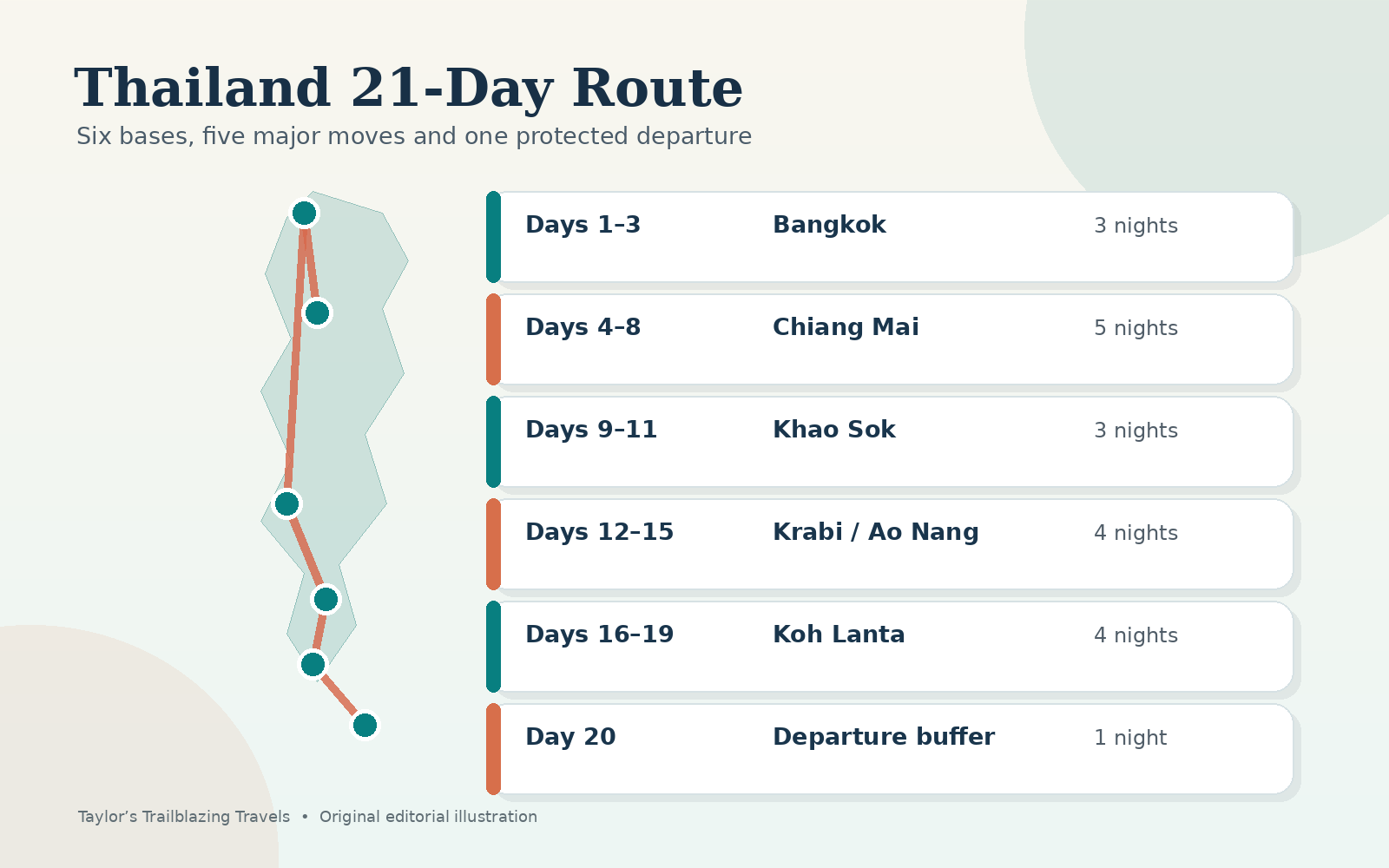
This plan uses twenty nights in Thailand. Day 1 is the international arrival and Day 21 is the flight home, so the route contains nineteen nights of ordinary travel plus one final protection night. That distinction matters because an annual-leave calendar can make a three-week holiday look more spacious than it feels after two long-haul journeys.
Day-by-day plan
| Day | Sleep in | Main plan | Travel reality |
|---|---|---|---|
| 1 | Bangkok | Arrive, reach the hotel, eat nearby and sleep. | International-arrival day; no fixed evening. |
| 2 | Bangkok | Grand Palace, Wat Pho, Wat Arun and a river route. | Keep the old-city sights together. |
| 3 | Bangkok | Choose Chinatown, a market, museum or food-focused neighbourhood. | One main interest is enough. |
| 4 | Chiang Mai | Fly north or arrive after the sleeper; easy afternoon. | Major transfer day. |
| 5 | Chiang Mai | Old City temples, food and a walking-street evening when dates align. | Walkable city day. |
| 6 | Chiang Mai | Doi Suthep early, then Nimman or a relaxed western-city afternoon. | Half mountain, half city. |
| 7 | Chiang Mai | Doi Inthanon, Mae Kampong, a cooking class or countryside day. | Choose one long outing. |
| 8 | Chiang Mai | Slow day, laundry, massage, craft, café or second day trip. | The first deliberate recovery day. |
| 9 | Khao Sok | Fly south, transfer to Khao Sok and stay near the village. | Full north-to-south move. |
| 10 | Khao Sok | Cheow Lan Lake day trip or begin a lake overnight. | Boat and weather day. |
| 11 | Khao Sok | Village trail, guided nature activity or return from the lake. | Keep luggage and pickup timing clear. |
| 12 | Krabi / Ao Nang | Shared van or private transfer; leave the evening free. | Three to four hours can become longer. |
| 13 | Krabi / Ao Nang | Railay and Phra Nang with tide and return boats checked. | Compact peninsula day. |
| 14 | Krabi / Ao Nang | Hong Islands, Four Islands or a mainland alternative. | Marine forecast decides. |
| 15 | Krabi / Ao Nang | Beach, pool, climbing, Krabi Town or the moved weather day. | Protected flexible day. |
| 16 | Koh Lanta | Transfer to the island and settle near the chosen beach. | Road, vehicle ferry or seasonal boat. |
| 17 | Koh Lanta | Explore the west coast, Old Town or a quiet resort day. | Do not tour the whole island at once. |
| 18 | Koh Lanta | Snorkelling, mangroves, national-park area or a slow beach day. | Weather and sea conditions first. |
| 19 | Koh Lanta | Unplanned day for rest, repeat favourites or a moved excursion. | The second weather buffer. |
| 20 | Mainland or Bangkok | Leave the island and sleep before the long-haul flight. | Protected departure buffer. |
| 21 | Departure | Airport transfer and flight home. | No ferry connection today. |
Why the sequence works
Bangkok provides a practical landing point before the north. Chiang Mai then receives five nights because one day is the arrival, one is a full-day outing and one is deliberately slow. From there, the route makes its hardest jump south only once. Khao Sok breaks that journey with rainforest and lake scenery before the final eight nights are divided between a useful mainland base and a slower island.
Most importantly, Koh Lanta comes after Krabi. You therefore move towards a quieter finish rather than returning to a busier hub, while Day 20 removes the risk of connecting a ferry or island transfer directly to the international flight.
Is three weeks enough for Thailand?
Three weeks is enough when the route has a shape
Yes. A first-time traveller can experience Bangkok, northern culture, rainforest and the Andaman coast in three weeks without treating every day as a race. The route becomes uncomfortable only when the extra week is interpreted as permission to add Phuket, Phi Phi, Samui, Pai and Chiang Rai without removing anything.
A useful test is to count major travel days. This itinerary has five: Bangkok to Chiang Mai, Chiang Mai to Khao Sok, Khao Sok to Krabi, Krabi to Koh Lanta and Koh Lanta to the final mainland or Bangkok night. That leaves enough full days in each base for weather, energy and ordinary holiday time.
Who should simplify it further
Families with young children, travellers managing pain or fatigue, and anyone who dislikes early departures may prefer four nights in Khao Sok and six in one beach base instead of splitting Krabi and Koh Lanta. Likewise, a traveller using a large rigid case can remove Railay overnights and stay entirely road-connected.
Who can add one more stop
A confident repeat visitor could insert two nights in Ayutthaya or Sukhothai by removing one Chiang Mai night and one Krabi night. However, that change creates another check-in and at least one transport link. It is a cultural choice, not a free upgrade.
The practical rule
Add a destination only when it replaces another destination or solves a transport problem. Never pay for it by deleting the departure buffer.
Entry rules and checks before booking
A 21-day holiday fits the announced 30-day exemption for eligible UK travellers
For British and Irish ordinary passport holders, the Royal Thai Embassy in London says the tourist visa-exemption period changes to up to 30 days from 15 September 2026, with a limit of two visa-exempt entries per calendar year. A 21-day route fits inside that announced period, but the immigration stamp actually granted controls the lawful stay. Travellers of every nationality should check the rule that applies to their passport and purpose immediately before departure.
The UK government advises that passports should have at least six months remaining on arrival and at least one blank page. Airlines and immigration authorities can refuse travel when documents do not meet the current requirement, so do not rely on an old forum answer.
Complete the free Thailand Digital Arrival Card
Foreign visitors must complete the Thailand Digital Arrival Card through the official Immigration Bureau site within three days before arrival. The form asks for passport, journey and first-accommodation information. It is not a visa and the official form is free, so avoid third-party websites that charge for completion.
Check insurance and regional warnings before paying
The route in this guide does not enter the land-border areas covered by current UK travel warnings. Nevertheless, an altered itinerary, excursion or overland journey can change that position. Read the full country advice, confirm that insurance covers every planned activity, and review medical declarations rather than choosing a policy only by price.
Official checks: Royal Thai Embassy London visa-exemption scheme; Thailand Digital Arrival Card; UK entry requirements for Thailand; and current UK travel advice. Checked 8 September 2026.
Days 1–3: Bangkok without wasting time in traffic
Day 1: build a soft landing
Airport, immigration, baggage, cash or data setup and the hotel transfer are enough for the first day. Choose dinner within walking distance, identify the nearest convenience shop and pharmacy, and protect the first proper morning. A rooftop reservation attached to a long-haul arrival looks appealing until a late bag or traffic jam makes it expensive.
Day 2: keep the classic sights around the river
Start early with the Grand Palace and Wat Phra Kaew, then continue to Wat Pho and cross the Chao Phraya for Wat Arun. The geography creates a coherent day; adding a floating market or Chatuchak between them does not. Carry a light shoulder-and-knee covering layer, drink regularly and use the hottest period for lunch or an indoor break.
Finish in Chinatown when energy allows. However, returning to the hotel first can be the better decision after several hours outdoors. The aim is a memorable city day, not proof that every landmark was entered.
Day 3: choose one version of Bangkok
Food travellers can use a market and a small-group tasting route. Design and history travellers might pair Jim Thompson House with Siam. Weekend visitors could choose Chatuchak, while a slower day around Talat Noi, Bang Rak or Ari is useful when jet lag lingers. One paid activity plus one neighbourhood is a realistic limit.
Optional Bangkok planning help
Compare meeting points, included entrance tickets, walking time and group size. A compact half-day can be useful; a twelve-hour checklist is not automatically better value.
Destination context: Tourism Authority of Thailand: Bangkok. For a fuller city plan, read Bangkok Travel Guide 2026.
Days 4–8: Chiang Mai at a sustainable pace
Day 4: flight or sleeper, then a light arrival day
A morning flight is the time-efficient choice. The sleeper train is slower but turns a necessary journey into part of the experience and can replace a hotel night. State Railway of Thailand’s D-Ticket system currently permits reservations up to 180 days ahead for eligible services, although exact train times and rolling stock should be checked for the travel date.
Whichever mode you choose, keep the first afternoon local. Old City guests can walk to a gate and temple courtyard; Nimman guests can explore nearby lanes and cafés. Doi Inthanon does not belong after a same-day airport or railway transfer.
Days 5 and 6: heritage first, mountain second
Use Day 5 for two or three Old City temples, a long lunch and a market or massage. On Day 6, reach Doi Suthep earlier, then return through the western side for Nimman or the university area. This pairing reduces repeated cross-city travel.
Day 7: choose one full-day outing
Doi Inthanon suits waterfalls, forest and highland scenery, but it is a long road day and cloud can hide viewpoints. Mae Kampong offers a gentler village-led outing. A cooking class gives food context with less driving, while a carefully screened ethical elephant programme needs close inspection of animal-contact claims, group size and welfare practices.
Day 8: use the day the route usually forgets
Day 8 can hold laundry, a second market, craft, café time, a massage or the outing moved because of rain. It is also the day that stops five Chiang Mai nights feeling like five consecutive pre-dawn pickups.
Compare the northbound journey
Use one page to compare broad train, bus and flight choices, then read the operator, station, baggage and cancellation terms before payment. For rail, also check the official SRT channel.
Official transport booking: State Railway of Thailand D-Ticket. Destination context: Tourism Authority of Thailand: Chiang Mai. Detailed pacing: Chiang Mai four-day itinerary.
Day 9: the difficult Chiang Mai-to-Khao Sok connection
There is no single transport choice that works every day
Khao Sok has no airport or mainline railway station. The practical southern gateways are usually Surat Thani Airport, Surat Thani town, Krabi Airport or Phuket Airport. A direct Chiang Mai–Surat Thani or Chiang Mai–Phuket service can simplify the day when it operates; otherwise a Bangkok connection may be necessary.
A September 2026 route search showed Chiang Mai–Surat Thani flight options from roughly 3,800 baht on the selected snapshot, but availability varied by date and some results involved long connections. Treat that figure only as evidence that this leg needs early comparison, not as a fare promise.
Book the flight and ground transfer as one planning problem
Before paying for the air ticket, confirm the destination airport, scheduled arrival, baggage allowance and whether a shared transfer can still collect. A cheap late flight can force a private car or an airport night. Conversely, an early connection through Bangkok may create a very long day with little saving.
Where to sleep on Day 9
Stay near Khao Sok village when the next day begins with a village pickup or rainforest activity. Stay nearer Ratchaprapha Dam only when the confirmed lake operator requires it. The two areas are not interchangeable, so the phrase “Khao Sok hotel transfer” needs an exact address.
Do not book a lake departure before the flight is fixed
The lake pier may be one to two hours from a village hotel, and shared vehicles work to particular pickup zones. Confirm the meeting point, latest arrival, luggage arrangement and missed-connection policy in writing.
Days 10–11: Khao Sok village and Cheow Lan Lake
Choose between a day trip and a lake overnight
A Cheow Lan Lake day trip keeps the same hotel, avoids repacking and suits travellers who value a proper shower, air-conditioning and straightforward luggage. An overnight raft-house programme creates a stronger sense of place, but comfort, electricity, bathrooms, mobile signal and boat-transfer arrangements vary considerably.
The correct choice depends on the accommodation standard you can accept and the amount of uncertainty you enjoy. Do not assume every “floating bungalow” is a private en-suite resort room, and do not assume a premium price includes national-park fees, pier transfers, meals and every boat outing.
A practical three-night pattern
Option one uses all three nights near the village: arrive on Day 9, take a lake day trip on Day 10 and use Day 11 for a guided trail, canoeing or a slow nature day. Option two uses the village on Day 9, a lake overnight on Day 10 and returns to the village on Day 11. The second pattern needs a clear bag-storage and return-transfer plan.
Weather changes the activity, not the value of the stop
Rain is part of a rainforest experience, yet heavy rain can affect trails, caves, boat conditions and visibility. Follow ranger and operator decisions rather than pressuring a guide to preserve an itinerary. Carry a dry layer and protect electronics, but keep footwear suitable for wet, uneven ground.
Research-led judgement
Khao Sok works in this itinerary because it breaks the longest geographic jump and adds a landscape unlike either city or beach. The recommendation is based on route logic, official park information and current transport research, not a claim of a personal stay.
Official park information: Department of National Parks: Khao Sok. The DNP page separates park zones and lists accommodation and contact information; confirm current fees and closures directly before travel.
Days 12–15: Krabi and Ao Nang with one flexible day
Day 12: Khao Sok to Ao Nang
Shared vans and private transfers commonly connect Khao Sok with Krabi and Ao Nang. Live searches checked in 2026 showed headline shared-van prices from about 400 baht and journey listings around two hours forty minutes to three hours. Hotel collections, passenger loops and traffic can extend that considerably, so do not attach a non-refundable evening boat or dinner to the arrival.
Day 13: Railay and Phra Nang
Check wind, rain, tide and return arrangements before boarding. Walk between Railay West, Railay East and Phra Nang, then allow time to stay still. The lagoon and viewpoint approach can be steep, muddy and unsuitable after rain; decide on the ground rather than from an edited video.
Day 14: one island day, not every island
Hong Islands and Four Islands are common choices. Compare group size, boat type, pickup zone, park-fee treatment, meal, snorkelling equipment and the weather-cancellation policy. A private long-tail can buy flexibility for a couple or family, while a shared speedboat covers distance quickly but may feel busier and bumpier.
Day 15: the day that makes the section reliable
Use the final Krabi day for the pool, beach, climbing, Krabi Town, a cooking class or the boat outing moved from Day 14. The plan is not incomplete because a day is unbooked; it is resilient because one day can absorb marine weather and normal fatigue.
Compare the Khao Sok–Krabi transfer
Enter the exact pickup and drop-off. “Khao Sok” can mean a village hotel, the dam area or a transfer point, while “Krabi” can mean town, airport or Ao Nang.
Destination context: Tourism Authority of Thailand: Krabi. Base comparison: Ao Nang vs Railay 2026.
Days 16–19: slow the route down on Koh Lanta
Day 16: allow the transfer to be the plan
Krabi to Koh Lanta can involve a shared van using the vehicle ferry, a private car or a seasonal passenger boat. Live 2026 searches showed shared options from roughly 350 baht and many door-to-door journeys in the two- to four-hour range. The exact beach and hotel drop-off matter because the island is long.
Choose the west-coast base before choosing activities
Klong Dao suits first-time visitors, families and easy access to Saladan. Long Beach offers a broad accommodation and restaurant mix. Klong Nin feels slower and more central for exploring both north and south, while Kantiang Bay suits travellers happy with a longer transfer in exchange for a quieter setting.
Days 17 and 18: one island day and one outward day
Use one day for the west coast, Lanta Old Town, viewpoints and a relaxed meal. Use the other for snorkelling, mangroves, a national-park-area trip or a carefully chosen boat outing. Avoid spending the entire first full day racing from the northern pier to the southern tip and back.
Day 19: leave it undecided
The final full day can repeat a favourite beach, hold a moved boat trip or simply protect the end of the holiday from exhaustion. A slow morning is particularly valuable before Day 20’s island departure.
Compare Krabi–Koh Lanta transport
Filter by the exact Krabi starting point and the precise Koh Lanta hotel zone. A pier-only fare can look cheaper than door-to-door transport but create a second payment and wait.
Destination context: Tourism Authority of Thailand: Ko Lanta. Further island context: Koh Lanta guide.
Days 20–21: protect the flight home
Choose the buffer location from the international ticket
For an early Krabi departure, sleep on the mainland near Krabi Town, Ao Nang or the airport according to the transfer plan. For a Bangkok long-haul flight, fly from Krabi to the correct Bangkok airport on Day 20 and stay centrally or near the airport rail corridor. The right answer follows the ticket, not a generic recommendation.
BKK and DMK are not interchangeable
Suvarnabhumi uses the code BKK; Don Mueang uses DMK. A domestic flight that arrives at one while the long-haul departs from the other creates a cross-city transfer, baggage collection and a fresh check-in. A self-transfer can be reasonable only when the layover is deliberately long and the saving compensates for the risk.
Day 21 contains no island movement
The final buffer has already done its job. Do not give it back to gain one more beach sunset. A cancelled ferry, vehicle queue or delayed domestic flight should inconvenience Day 20, not destroy the international ticket on Day 21.
The protected-departure rule
Sleep on the same land mass as the departure airport, or complete the separate domestic flight, before the final night. The rule is deliberately conservative because separate tickets rarely protect one another.
Transport reality: calculate door to door
Headline moving time is not the journey
For a flight, add hotel pickup, airport check-in, security, baggage delivery and destination transport. For a ferry, add road travel to the pier, check-in, loading, waiting, weather and the final island road leg. The total is what controls the itinerary.
| Route | Mode | Planning allowance | Best for | Main risk |
|---|---|---|---|---|
| Bangkok → Chiang Mai | Flight | About 4–5 hours door to door | Time-first travellers | Baggage and airport choice |
| Bangkok → Chiang Mai | Sleeper train | Roughly 11–14 hours overnight | Experience and one saved hotel night | Sleep quality and berth availability |
| Chiang Mai → Khao Sok | Flight plus road transfer | Usually most of a day | Almost everyone on this route | Direct service may not run; shared pickups have cut-offs |
| Khao Sok → Ao Nang | Shared van | About 3–5 hours door to door | Budget and solo travellers | Collection loops, limited luggage space |
| Khao Sok → Ao Nang | Private car | About 2.5–4 hours | Families and tight logistics | Higher price |
| Krabi → Koh Lanta | Shared van / vehicle ferry | About 2–4 hours | Most travellers | Exact hotel zone and ferry queue |
| Koh Lanta → Krabi mainland | Van / ferry / seasonal boat | Allow a generous half day | Day 20 buffer | Marine and road delay |
Dated 2026 fare snapshots
Search results checked around September 2026 displayed Bangkok–Chiang Mai trains from 278 baht, Chiang Mai–Surat Thani flight options from roughly 3,800 baht on a selected date, Khao Sok–Krabi vans from about 400 baht and Krabi–Koh Lanta transfers from about 350 baht. Those numbers demonstrate the spread between headline fares and practical totals. They do not include every baggage fee, hotel pickup, private transfer or date-specific surge.
Compare, then verify the operator
A comparison site is useful for seeing modes and departure points together. Nevertheless, read the operating company, ticket-collection instruction, baggage limit, cancellation policy and exact destination before paying. For Thai railway tickets, check the official SRT D-Ticket system as well.
Planning snapshots: Bangkok–Chiang Mai train listings, Chiang Mai–Surat Thani flight listings, Khao Sok–Krabi transfer listings and Krabi–Koh Lanta transfer listings. Prices and schedules were checked in 2026 and must be refreshed for the traveller’s date.
Where to stay at each stage
Micro-location matters more than a generic star rating
A centrally located three-star room can improve this itinerary more than a remote five-star resort. Check the actual walking route, road gradient, pickup zone, room configuration and evening noise. In Khao Sok and Koh Lanta, the broad destination name can hide a significant road journey.
| Stop | Useful area | Why it works | Trade-off |
|---|---|---|---|
| Bangkok | Asok / Phrom Phong | Rail access, food and simple first-time logistics | Old-city sights need a longer journey |
| Bangkok | Silom / Sathorn | Balanced river, food and rail access | Street atmosphere changes by exact block |
| Chiang Mai | Old City edge | Walkable temples and easy pickups | Weekend traffic and room noise vary |
| Chiang Mai | Nimman | Cafés, restaurants and modern neighbourhood life | More rides to the historic core |
| Khao Sok | Village / park entrance | Restaurants, trail access and ordinary hotel comfort | Cheow Lan Lake pier is not next door |
| Khao Sok | Ratchaprapha Dam area | Useful for an early lake departure | Fewer village amenities; check operator pickup |
| Krabi | Central Ao Nang | Best overall logistics, dining and tour choice | Busy rather than secluded |
| Krabi | Railay | Cliffs, beaches and slower evenings | Boat-only arrival with luggage |
| Koh Lanta | Klong Dao | Families, easy swimming and shorter Saladan transfer | Less remote atmosphere |
| Koh Lanta | Long Beach | Broad choice and an easy first stay | The beach is long; map the exact hotel |
| Koh Lanta | Klong Nin / Kantiang | Quieter finish and access to the south | Longer transfer and fewer alternatives |
Use the same booking test at every hotel
Enter the real number and ages of travellers, then compare the total after taxes, breakfast, extra beds and cancellation terms. Open the map and identify the railway station, airport pickup, pier or tour collection point that the stay must serve. Finally, ask about construction, accessibility or late arrival directly when any of those could decide the booking.
Do not move within a destination without a reason
A two-night Railay split can add atmosphere when Krabi receives five or more nights. However, switching between two similar Ao Nang hotels wastes time. Likewise, changing beaches on Koh Lanta makes sense only when the second area creates a genuinely different holiday and the transfer burden is acceptable.
Best time for this Thailand 3-week itinerary
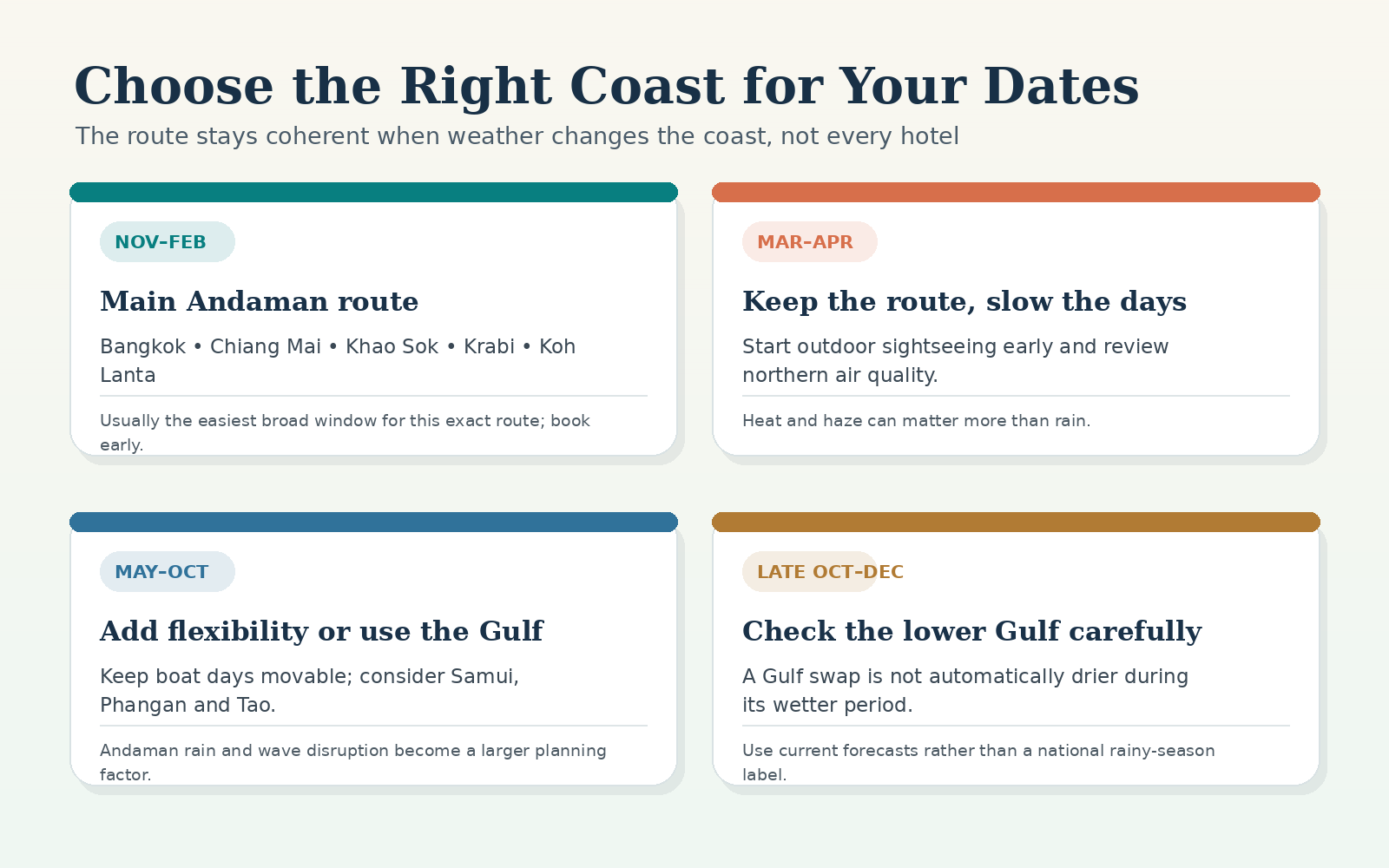
November to February is the easiest broad window
The route is most straightforward when Bangkok walking conditions are less oppressive, Chiang Mai is cooler and the Andaman coast is generally in its drier travel pattern. Peak demand is the trade-off, especially around Christmas, New Year, school holidays and major events.
March and April need two separate checks
Heat changes the pace nationwide, while northern haze and PM2.5 can change whether Chiang Mai is a sensible part of the route. Keep northern bookings cancellable when possible and review official Air4Thai readings before the free-cancellation deadline. A particulate mask may reduce exposure in some situations, but it cannot restore a mountain view or make poor air a desirable holiday condition.
May to October does not make the route impossible
Rain can arrive in intense bursts rather than continuous days. Nevertheless, marine warnings, rougher seas and reduced seasonal services matter more than a weather-app icon. Keep at least two southern days flexible, stay road-connected when risk tolerance is low and move the beach section to the Gulf only after checking the Gulf’s own pattern for the exact month.
Live checks: Thai Meteorological Department seven-day forecast and Air4Thai official air-quality monitoring. The TMD forecast published 8 September 2026 illustrates why heavy rain and marine conditions must be checked close to travel rather than inferred from a monthly average.
Alternative three-week Thailand routes
Change the route for a clear priority
The main itinerary is not a universal ranking. A traveller who wants archaeological sites should not force two islands into the schedule, while a family whose best days happen around one pool may gain little from changing beaches. Start with the trip’s purpose, then protect the same principles: visible transfer days, meaningful stays and a final buffer.
| Route style | Night split | Best reason to choose it | What changes |
|---|---|---|---|
| Classic first trip | Bangkok 3 • Chiang Mai 5 • Khao Sok 3 • Krabi 4 • Koh Lanta 4 • buffer 1 | Broad contrast without constant moving | Main route in this guide |
| Culture-heavy | Bangkok 4 • Ayutthaya 2 • Sukhothai 2 • Chiang Mai 6 • one coast 5 • buffer 1 | More history, fewer beach changes | Removes either Khao Sok or the second beach base |
| Gulf-coast version | Bangkok 3 • Chiang Mai 5 • Khao Sok 3 • Samui 4 • Phangan or Tao 4 • buffer 1 | Useful when current weather favours the Gulf | More ferry dependency |
| One-beach slow route | Bangkok 4 • Chiang Mai 5 • Khao Sok 3 • one southern base 7 • buffer 1 | Easiest for families and reduced mobility | Less destination variety |
| Low-flight route | Bangkok 3 • sleeper north • Chiang Mai 5 • train/bus south • Khao Sok 3 • one coast 6 • buffer 1 | The journey is part of the trip | Several long overland sectors |
When to switch Krabi and Koh Lanta for the Gulf
Use current forecasts, marine warnings and seasonal service information. Koh Samui offers the easiest airport access, Koh Phangan balances beaches and event-driven demand, and Koh Tao makes most sense when diving or snorkelling is a genuine priority. Do not choose the Gulf solely because a generic article calls May to October “better”; late-year Gulf rain can be significant.
When to remove Khao Sok
Remove it when the lake accommodation, wet-weather uncertainty or extra transfer does not appeal. Add those three nights to Chiang Mai and one coast rather than inserting another equally complicated stop. By contrast, keep Khao Sok when nature is central and you are willing to plan the flight, road transfer and lake zone as one package.
Realistic budget for three weeks in Thailand
Use a planning model, not one misleading daily number
The ranges below are per person, exclude international flights, insurance and shopping, and assume two adults share rooms. They are September 2026 planning bands rather than live quotes. Solo travellers should raise the accommodation allowance, while families must price the actual room and bed configuration.
| Category | Budget style | Mid-range | Comfortable |
|---|---|---|---|
| Accommodation share | 15,000–26,000 THB | 30,000–60,000 THB | 70,000–150,000 THB |
| Intercity transport | 8,000–16,000 THB | 13,000–28,000 THB | 28,000–55,000 THB |
| Food and non-alcoholic drinks | 10,500–18,000 THB | 21,000–40,000 THB | 42,000–80,000 THB |
| Activities and admissions | 7,000–15,000 THB | 15,000–35,000 THB | 35,000–80,000 THB |
| Local transport and practical extras | 4,000–8,000 THB | 7,000–15,000 THB | 14,000–30,000 THB |
| Working total per person | 44,500–83,000 THB | 86,000–178,000 THB | 189,000–395,000 THB |
Why the south often costs more
Khao Sok lake programmes can bundle boats, guides and meals, while popular beach rooms rise sharply in the driest months. Island transfers, national-park fees and private boats also make a beach day more expensive than a simple city day. Therefore, compare the southern section as a package rather than judging only the nightly room rate.
The contingency belongs in the budget
Hold at least 10–15 per cent outside the planned spend. It can cover a private transfer after a changed flight, an extra mainland night, medical care, replacement transport or a weather-driven change. A holiday becomes less stressful when the solution already has money attached to it.
A simple mid-range target
For many couples sharing comfortable rooms, 90,000–150,000 baht per person is a workable starting range before international flights. Peak festive dates, luxury resorts, diving and private touring can move the result well above it.
Use the site’s Thailand Travel Budget 2026 to rebuild the calculation for your dates and travel style.
The booking order that protects flexibility
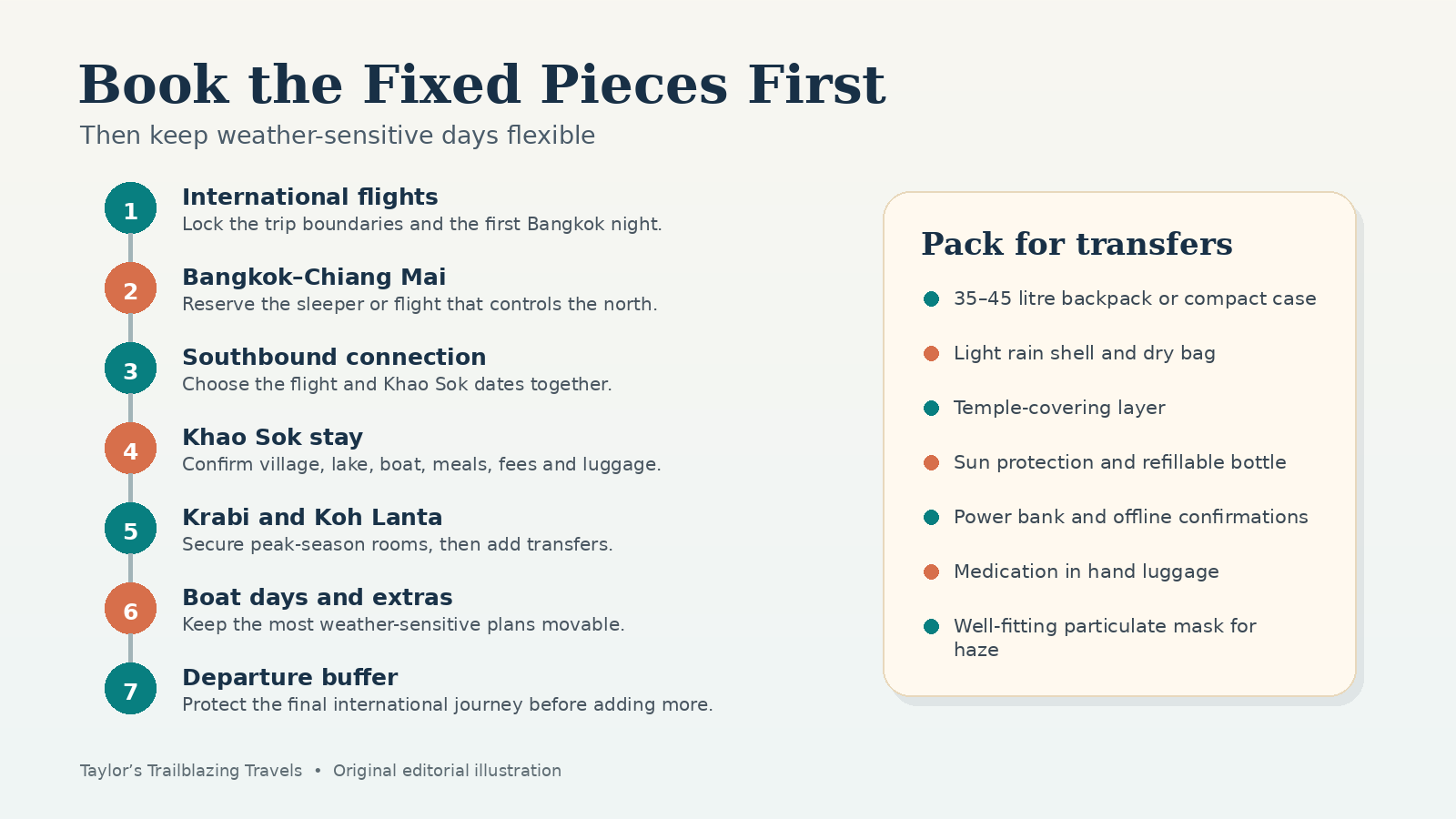
Book the scarce or route-controlling item first
- International flights and the exact arrival and departure airports.
- The first Bangkok night and Day 20 protection night.
- Bangkok–Chiang Mai sleeper berths or flights.
- The Chiang Mai–south flight and Khao Sok dates together.
- Khao Sok village or lake accommodation with transfer details.
- Peak-season Krabi and Koh Lanta accommodation.
- Intercity vans, ferries and fixed high-demand activities.
- Ordinary weather-sensitive boat days after the forecast is useful.
Flexible does not mean unplanned
A flexible day still needs two or three viable alternatives, a decision deadline and knowledge of cancellation terms. For example, Day 14 can hold Hong Islands when the sea is suitable, then move to Day 15 if the operator postpones. The backup might be Railay, Krabi Town, a cooking class or a genuine rest day.
Save confirmations in two places
Keep offline copies of tickets, hotel addresses, pickup instructions and insurance details on the phone and in a second accessible location. Record the booking name exactly as it appears on the passport. Shared-transfer drivers often identify passengers by booking name rather than a detailed itinerary.
Tours and affiliate links: when a booking solves a problem
Use a tour for access, context or scarce capacity
A Bangkok guide can add historical context and simplify a compact temple route. In Chiang Mai, a tour may solve the long mountain drive. At Khao Sok, lake transport and ranger-led activities often require an organised arrangement. In Krabi, a boat is the activity itself. Each booking should therefore solve a specific logistical or interpretive problem.
Compare the details that change the experience
Read the pickup zone, group size, actual operator, included fees, meal, equipment, physical difficulty and cancellation policy. A product with more stops is not automatically better. Likewise, “hotel pickup” may exclude Railay, southern Koh Lanta or a remote Chiang Mai address.
Connectivity can remove small frictions
Mobile data helps with pickup messages, weather checks, translation and ride-hailing. A local SIM can offer strong value; an eSIM can be simpler when the handset supports it and you want data before leaving the airport. Keep the QR code and setup instructions offline, and confirm that the phone is unlocked.
Useful trip-planning links
These links are optional and commercially influenced. Compare inclusions, operator terms and direct prices before purchasing.
What to pack for cities, rainforest and islands
Pack for repeated transfers
A 35–45 litre backpack or compact wheeled case is easier than a large rigid suitcase on shared vans, hotel stairs and island transfers. Each traveller should be able to control their own main bag and day bag. Compression cubes can organise clothing, but they do not make an overweight bag easier to lift.
Build one weather-ready day bag
- Light rain shell or poncho that can be reached without unpacking.
- Small dry bag or waterproof pouch for boat days and Khao Sok.
- Refillable bottle, sun protection and insect repellent.
- Temple-covering layer for shoulders and knees.
- Power bank, charging cable and offline confirmations.
- Medication, basic first aid and travel-insurance details.
- Well-fitting particulate mask when northern air quality may be poor.
Footwear needs range, not quantity
One comfortable walking shoe and one secure sandal cover most travellers. Flip-flops are useful around a pool but poor on a muddy trail or wet boat steps. A technical hike requires footwear matched to the route, not a fashion purchase made at the airport.
A small dry bag can solve a real problem
For Khao Sok and boat days, choose a roll-top dry bag sized for a phone, power bank, documents and a light layer. Read dimensions and closure instructions rather than buying by litre number alone.
For a fuller list, use the live Thailand Packing List.
Families, accessibility and different energy levels
The route is adaptable, not automatically accessible
Bangkok rail stations can involve lifts, long walks and crowded platforms. Temple compounds have heat, thresholds and dress rules. Khao Sok introduces boats, wet surfaces and variable accommodation, while Railay and Koh Lanta add sand, piers and uneven ground. A destination label therefore cannot confirm access.
| Traveller | Best adjustment | Main issue to solve | Practical response |
|---|---|---|---|
| Young children | Remove one move or use one beach base for seven nights | Heat, car seats, naps and boat boarding | Private transfers and a central Ao Nang base |
| Teenagers | Keep the full route but involve them in choosing Day 7 and Day 18 | Early starts and repeated temples | One activity-led day in each region |
| Reduced mobility | Use road-connected hotels and verify room-to-vehicle route | Railay boats, sand, steps and uneven park paths | Ao Nang instead of Railay; lake day trip only after direct assessment |
| Older relatives | Protect recovery days and avoid consecutive dawn departures | Heat, long vans and luggage handling | Private car on the longest road segments |
| Food allergies | Choose larger bases and contact hotels before remote stays | Cross-contact and limited lake/island alternatives | Written Thai explanation and medication |
| Neurodivergent travellers | Make transfer steps visible and reserve quiet recovery time | Crowds, noise, uncertainty and group tours | Private or small-group options with exact schedules |
Ask route-specific questions
Instead of asking whether a hotel is “wheelchair friendly”, ask whether there is a step-free route from vehicle drop-off to room, the door width, shower type, lift dimensions and distance to breakfast. For a boat, ask how passengers board, whether a fixed pier is used and what physical assistance is actually available.
One private transfer can be better than upgrading every room
Families and mixed-age groups may gain more from a private Chiang Mai airport pickup or Khao Sok–Krabi car than from paying for higher room categories throughout. Spend on the point of friction. However, request a suitable child restraint in advance and confirm what the provider can supply rather than assuming.
Solo travellers, couples and small groups
Solo travellers should price the single supplement honestly
The transport side of this route is straightforward for one person, and shared tours can provide company without committing to a group itinerary. Accommodation costs are the main difference because the room is not split. Hostels, simple private rooms and small-group activities can control the budget, while late-night arrivals deserve a pre-planned transfer.
Couples need agreement on pace more than identical interests
Five Chiang Mai nights and two southern flexible days make it possible to separate briefly. One person can take a cooking class while the other rests; one can climb in Railay while the other uses a spa or beach. A good shared itinerary does not require every hour to be shared.
Groups should avoid the cheapest shared vehicle by default
Three or four people can sometimes price a private car close to multiple van seats, especially after hotel pickup and baggage are considered. A private transfer can also reduce collection loops. Nevertheless, confirm the vehicle size; four adults with four large cases need more than four nominal seats.
Share the decision deadlines
Put flights, cancellation cut-offs, pickup instructions and the Day 14 weather decision in one shared document. Group holidays fail more often through hidden assumptions than through a shortage of attractions.
Safety, health and responsible travel
Use current advice, not a destination’s reputation
Review the UK government’s Thailand travel advice before booking, again before departure and after any significant route change. The current regional warnings do not cover the main stops in this itinerary, but they can affect extensions towards certain land borders. Insurance may be invalid where official advice warns against travel.
Road and scooter risk needs a deliberate decision
Do not hire a scooter because it looks like the normal way to explore an island. Confirm licence and International Driving Permit requirements, helmet use, insurance exclusions and your actual riding competence. Taxis, shared vehicles and private drivers are valid alternatives, particularly in rain or at night.
Marine and rainforest decisions belong to the operator and authorities
A boat cancellation is disappointing, not a negotiation. Follow marine warnings and local instructions. In Khao Sok, caves, trails and boats may close or change after heavy rain. Carry water, use sun and insect protection, and seek medical advice before travel for vaccinations, health conditions and medication.
Travel gently in places under pressure
Do not feed wildlife, remove shells or coral, touch marine life or pressure an elephant programme into contact that prioritises photographs over welfare. Refill water where safe, carry rubbish back from remote areas and follow national-park rules. Responsible travel is often a series of small, unglamorous choices.
Current weather can override a polished itinerary
The Thai Meteorological Department’s forecast on 8 September 2026 included heavy-rain and marine cautions across parts of the country. That does not describe every travel date; it demonstrates why the live forecast must be checked near departure.
Safety sources: UK foreign travel advice for Thailand, Thai Meteorological Department forecast and Air4Thai.
Pros and cons of this three-week route
Advantages
| What works | Why it helps |
|---|---|
| Strong geographic progression | The route moves capital → north → rainforest → mainland coast → quieter island. |
| Meaningful stays | Each base receives at least three nights, so arrival does not consume the entire visit. |
| Two flexible southern days | Boat weather can move without dismantling the route. |
| Khao Sok breaks the long north–south jump | The rainforest section adds contrast and makes the coast feel like a new chapter. |
| Protected Day 20 | Separate-ticket and island risk is removed from the international departure day. |
Trade-offs
| What requires care | Why it matters |
|---|---|
| Five major transfers | A third week does not remove the physical cost of travel. |
| Chiang Mai to Khao Sok is awkward | Flight schedules and ground pickups must be planned together. |
| Khao Sok comfort varies | Lake stays, village hotels and tour packages are not equivalent. |
| The Andaman section is weather-sensitive | Marine conditions can move or cancel boat plans. |
| The route is not step-free by default | Boats, sand, stairs and uneven paths need direct accessibility checks. |
The deciding question
Choose this route when contrast matters more than staying in one resort. Choose a simpler Bangkok–Chiang Mai–one-coast route when transfers drain your energy or when accessibility and young children make boat logistics disproportionately difficult.
Common mistakes that make three weeks feel rushed
Most bad three-week itineraries fail through hidden transfer time rather than a lack of days. These are the errors worth correcting before payment.
1. Counting arrival day as a full Bangkok day
Long-haul delay, immigration and traffic can remove the evening. Put only food and sleep on Day 1.
2. Adding Pai or Chiang Rai without removing nights
Each creates another road or air link. Replace part of Chiang Mai rather than borrowing from recovery time.
3. Booking Chiang Mai and Khao Sok separately
The flight, airport, road transfer and first pickup are one chain. Confirm all before making the weakest part non-refundable.
4. Treating Khao Sok village and the lake as one location
They use different roads, piers and pickup expectations. Record exact addresses.
5. Booking every southern day in advance
Marine weather can make the perfect calendar unusable. Keep at least two days movable.
6. Choosing Railay with the wrong luggage
Boat boarding, sand and walks can turn a large case into the main event. Use Ao Nang or pack smaller.
7. Connecting Koh Lanta directly to the flight home
Road, ferry and marine delays do not respect airline check-in. Keep Day 20.
8. Comparing only headline fares
Baggage, airport transfers, hotel drop-off and payment fees can reverse the apparent saving.
Frequently asked questions
Is 21 days enough for Thailand?
Yes. Twenty nights is enough for Bangkok, Chiang Mai, Khao Sok, Krabi and Koh Lanta when transfer days are visible and at least two southern days remain flexible. It is not enough for every major island and northern side trip.
How many nights should I spend in each place?
A balanced split is 3 nights Bangkok, 5 Chiang Mai, 3 Khao Sok, 4 Krabi or Ao Nang, 4 Koh Lanta and 1 final mainland or Bangkok buffer night.
Does a three-week trip fit Thailand’s visa exemption?
For eligible British and Irish ordinary passport holders, the Royal Thai Embassy in London says the exemption becomes up to 30 days from 15 September 2026. A 21-day visit fits that announced period, but travellers must check the rule for their nationality and the entry stamp actually granted.
Do I need the Thailand Digital Arrival Card?
Foreign travellers must complete the official TDAC online within three days before arrival. It is separate from a visa and the official form is free.
What is the best month for this exact route?
November to February is the easiest broad window for the route as written, although peak demand rises. March and April need a northern air-quality check; May to October needs flexible Andaman planning or a carefully researched Gulf swap.
Should I fly or take the sleeper train to Chiang Mai?
Fly when preserving time and sleep matters most. Take the sleeper when the rail journey is part of the holiday and you can tolerate variable sleep. Compare the complete price, station or airport transfers and exact arrival time.
How do I travel from Chiang Mai to Khao Sok?
Usually by flying to Surat Thani, Phuket or another suitable southern gateway and continuing by road. Direct services vary by date, so compare the flight and Khao Sok pickup together.
Should I stay in Khao Sok village or on Cheow Lan Lake?
Stay in the village for simpler luggage, ordinary hotel comfort and flexible activities. Choose a lake overnight for immersion when the raft-house standard, bathroom, electricity, meals, fees and transfer plan are clearly understood.
Is Ao Nang or Railay better for this itinerary?
Ao Nang is the practical default because it has road access, broad accommodation and easy tour pickup. Railay is stronger for scenery and a two-night escape when boat arrival and luggage are not barriers.
Is Koh Lanta worth four nights?
Yes for a slower finish, beaches and a less hurried island rhythm. Travellers wanting nightlife, many tours or an airport-connected resort may prefer to add the nights to Krabi or choose a different island.
Can I use a suitcase?
Yes, especially when staying in road-connected Bangkok, Chiang Mai, Khao Sok village, Ao Nang and Koh Lanta. Keep it compact and manageable. A backpack or smaller soft case is noticeably easier for lake stays, boats and Railay.
How much should I budget for three weeks?
A broad starting range is about 45,000–83,000 baht per person for a careful budget trip, 86,000–178,000 baht for mid-range travel and more for private touring or luxury. These September 2026 planning bands exclude international flights, insurance and shopping.
How far ahead should I book?
Book international flights, peak-season rooms, sleeper berths and the Khao Sok chain first. Ordinary boat days can remain flexible until a useful forecast is available. SRT’s current D-Ticket terms allow eligible reservations up to 180 days ahead.
Can families follow this itinerary?
Yes, but many families will enjoy it more with one fewer move, private transfers on the hardest legs and one road-connected beach base. Check room occupancy, child restraints, boat boarding and heat management before booking.
Is this route suitable for solo travellers?
Yes. Shared transport and group activities make the route sociable, but single-room costs are higher. Pre-plan late arrivals and keep offline copies of hotel addresses and pickup instructions.
Do I need to return to Bangkok before flying home?
Only when the international ticket departs Bangkok. If the long-haul flight leaves from Phuket, Krabi or another airport, Day 20 should still place you on the same land mass and near that airport.
Can I add Phuket or Phi Phi?
Only by replacing part of Krabi or Koh Lanta. Adding another island without removing nights creates more transfers and weaker stays. Choose the coast experience you most want rather than collecting names.
What should remain flexible?
Keep at least one Krabi day and one Koh Lanta day movable. The decision should follow the live marine forecast, operator guidance, energy and any change to transport.
The final recommendation
Choose the classic route when this is your first broad Thailand trip
Three Bangkok nights, five Chiang Mai nights, three Khao Sok nights, four Krabi nights, four Koh Lanta nights and one protected final night create a varied holiday without turning accommodation into a daily task. The sequence also improves as it goes: urban intensity gives way to the north, rainforest interrupts the long geographic move, and the final week slows across the coast.
Make three decisions before booking
First, decide whether the sleeper train is an experience you want or simply a slower flight substitute. Second, choose a Khao Sok day trip or lake overnight only after understanding the transfer and comfort standard. Third, match the coast to the month and keep weather-sensitive days movable.
Protect the ending
The best version of this itinerary does not use Day 20 for another island. It uses the day to move within safe reach of the international flight. That single night is less photogenic than a beach extension, yet it is the part most likely to save the whole journey from an expensive failure.
Recommended night split
Bangkok 3 • Chiang Mai 5 • Khao Sok 3 • Krabi or Ao Nang 4 • Koh Lanta 4 • final mainland or Bangkok buffer 1. Keep Days 4, 9, 12, 16 and 20 visibly labelled as transfer days.
Sources and fact-checking notes
This guide was researched as a planning document rather than a first-hand travel diary. Official government and operator sources were used for entry rules, TDAC, rail booking, weather, air quality and Khao Sok. Tourism and booking sources were used for destination context and dated transport comparisons. Prices and schedules are examples or planning ranges, not guarantees.
- Royal Thai Embassy London: Tourist Visa Exemption Scheme, including the announced change to up to 30 days from 15 September 2026 and the two-entry annual limit for eligible British and Irish ordinary passports.
- Thailand Immigration Bureau: Official Thailand Digital Arrival Card portal.
- UK Foreign, Commonwealth & Development Office: Thailand entry requirements, regional warnings, health, driving and insurance context.
- State Railway of Thailand: Official D-Ticket search and booking terms, including the current 180-day maximum advance window for eligible trains.
- Thai Meteorological Department: Seven-day forecast and marine cautions; checked 8 September 2026.
- Pollution Control Department: Air4Thai live official air-quality monitoring.
- Department of National Parks: Khao Sok National Park overview, zones, facilities and official contact details.
- Tourism Authority of Thailand: Bangkok, Chiang Mai, Surat Thani, Krabi and Ko Lanta destination context.
- 12Go: Dated 2026 transport listings used as planning snapshots for Bangkok–Chiang Mai, Chiang Mai–Surat Thani, Khao Sok–Krabi and Krabi–Koh Lanta. Live fares and schedules require fresh checking.
- Taylor’s Trailblazing Travels: Live supporting guides for Bangkok, Chiang Mai, transport, budget, packing, seasons, Ao Nang versus Railay and Koh Lanta.
What to recheck before publication and again before travel
- Nationality-specific visa or visa-exemption rules and the passport validity requirement.
- TDAC process and the first hotel address.
- Flight numbers, baggage, Bangkok airport codes and transfer cut-offs.
- Khao Sok park fees, activity access, lake accommodation and closures.
- Ferry, van and boat schedules for the exact month.
- TMD marine forecasts and Air4Thai readings close to travel.
- Activity inclusions, cancellation terms and every affiliate destination page.
Research checked 8 September 2026. Where a source publishes live data, the traveller’s own date takes precedence over this article.
Illustrations in this article were created for Taylor’s Trailblazing Travels. Third-party photographs, where used, are credited beside the image or in the source list.