

Island route planner · 2026
Thailand Island Hopping Itinerary 2026: Three Routes That Work
Choose the right coast, keep ferry days realistic and build a beach route that still feels like a holiday.
10-day Gulf plan
Weather and ferry buffers
A strong island-hopping route is built around one coast, useful nights in each base and a protected final connection.
A practical Thailand island hopping itinerary can look effortless on a map, yet the map hides the tiring parts. A ferry shown as ninety minutes can become a five-hour hotel-to-hotel move once checkout, pier transfer, check-in, loading, stops and the final taxi are included. Consequently, the best route is rarely the one with the most island names.
For a first trip, choose either the Andaman chain around Phuket, Phi Phi, Koh Lanta and Krabi, or the Lower Gulf chain around Koh Samui, Koh Phangan and Koh Tao. Both are logical. However, they have different weather patterns, gateways, boat types and final-flight risks.
This guide uses official tourism, immigration, weather and operator information checked on 6 September 2026. Ferry fares, hotel prices and journey times are dated planning ranges rather than promises, because sea conditions, season, pier choice and ticket inclusions can change the result.
Some booking and product links may earn Taylor’s Trailblazing Travels a commission at no extra cost to you. They appear only where a transport, hotel, tour, data or luggage comparison solves a specific planning problem.
Best first route
One coast, three bases at most and one protected night near the departure airport or mainland gateway.
Strongest scenery
The Andaman chain, particularly when limestone cliffs, Phi Phi and a slower Koh Lanta stay matter most.
Best July shortlist
The Lower Gulf usually deserves the first look, with Samui, Phangan and Tao forming a practical chain.
Most important difference
A sailing time is not a door-to-door time. Budget a substantial block for every hotel change.
Thailand island hopping route comparison
Start with the route that protects your time rather than the island that dominates social media. The table below compares the practical shapes of the three itineraries in this guide.
Which route fits your trip?
| Route | Useful length | Best for | Main compromise | Best gateway |
|---|---|---|---|---|
| Andaman: Phuket, Phi Phi, Koh Lanta, Krabi | 9-12 nights | Limestone scenery, varied beaches, a lively-to-slow progression | More seasonal boat variation from May to October | Phuket in, Krabi out |
| Lower Gulf: Samui, Phangan, Tao, Samui buffer | 9-12 nights | Easy island chain, diving, wellness, nightlife and quiet bays | Samui flights can cost more; every onward stop still needs a boat | Samui or Chumphon/Surat Thani |
| Mixed coasts: Andaman plus Gulf | 14-21 nights | Long trips, repeat visitors and travellers happy to use a domestic flight | One day is largely transport and disruption exposure increases | Open-jaw flights where possible |
| Slow pair: Lanta plus Krabi or Samui plus Phangan | 7-10 nights | Families, couples and anyone who dislikes constant repacking | Fewer island names, but more usable holiday time | Nearest regional airport |
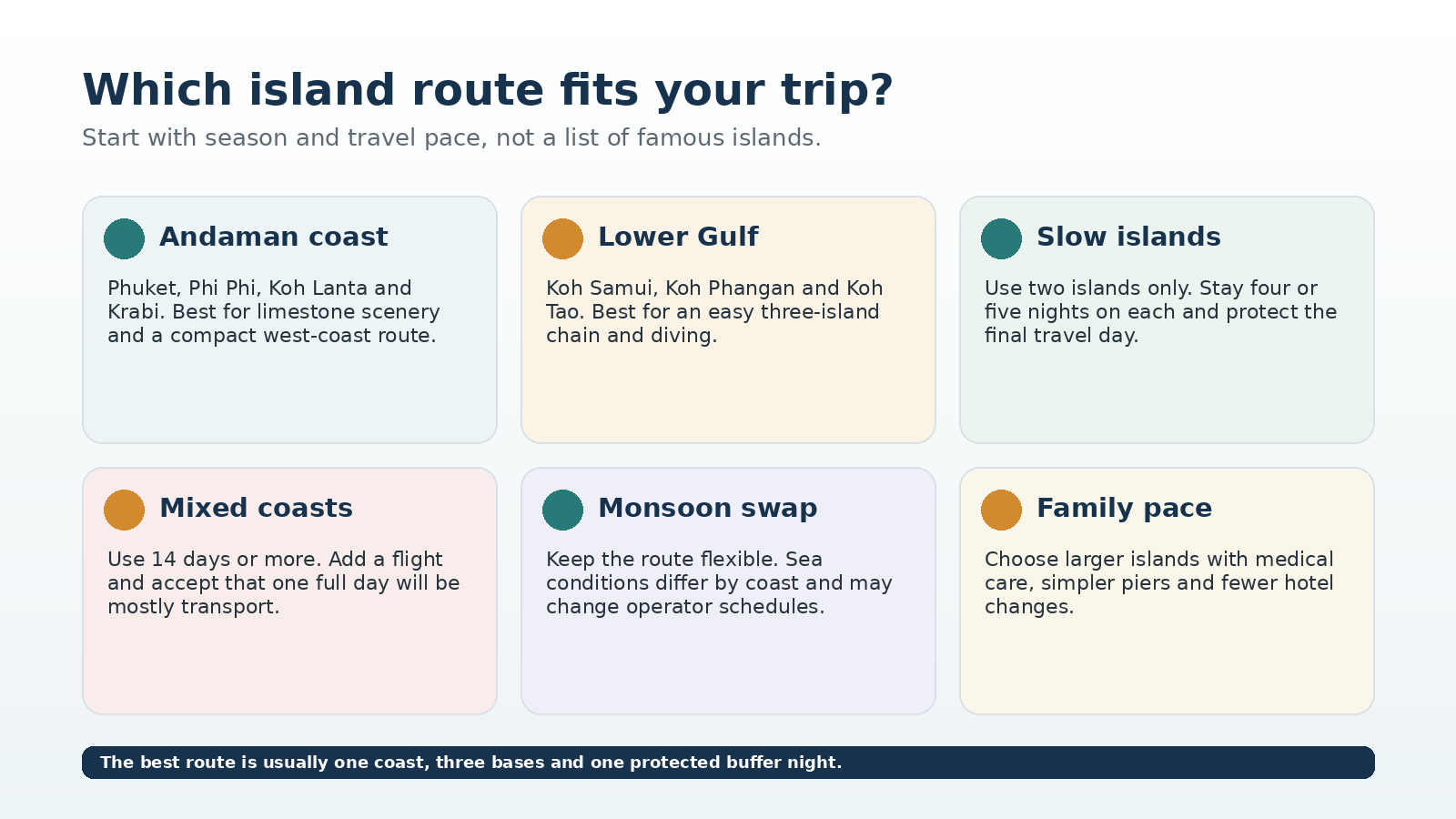
The result for most first-time travellers
Ten days is enough for three bases only when they form a clean chain. For the Andaman, that means Phuket to Phi Phi to Koh Lanta, then a mainland buffer. For the Gulf, it means Samui to Phangan to Tao, then back towards the flight. By contrast, Phuket, Samui and Koh Tao in one short trip creates two major transfers and weakens every stay.
Karen’s three-number rule
Use two bases in seven nights, three bases in ten to fourteen nights, and add a fourth only when the holiday reaches roughly three weeks. Count the gateway night as a base because it still requires a check-in, checkout and transfer.
Choose the coast before choosing the islands
Thailand’s island regions do not share one perfect calendar. Phuket, Phi Phi, Koh Lanta and Krabi sit on the Andaman side. Samui, Phangan and Tao sit in the Lower Gulf. Moving between them requires a domestic flight or a long road-and-ferry day, so the coast is the first route decision.
Andaman coast: the classic limestone route
The Andaman chain is strongest when dramatic scenery, varied hotels and an easy Phuket or Krabi flight are priorities. Tourism Authority of Thailand describes Phi Phi as part of Hat Noppharat Thara-Mu Ko Phi Phi National Park and highlights its limestone setting, while its Koh Lanta guidance emphasises the island’s long west coast, road access and slower atmosphere.[1][2]
November to April is usually the easiest first planning window. However, peak Christmas and New Year dates raise room prices and can fill preferred boats. During the southwest-monsoon period, larger bases such as Phuket, Krabi and Koh Lanta remain usable, yet some smaller-island trips and direct routes reduce or pause.
Lower Gulf: the stronger summer shortlist
Koh Samui provides the airport and broadest services; Koh Phangan adds everything from Haad Rin energy to quiet northern and eastern beaches; Koh Tao focuses the route on diving, snorkelling and compact bays.[3][4][5] April to September often gives the Gulf the stronger seasonal case when the Andaman is wetter, although a favourable month never guarantees a calm sailing.
The month is a filter, not a promise
Tourism Authority of Thailand gives a broad national pattern of rainy, cool and hot periods, but coastal conditions are more local than that summary.[6] Check the Thai Meteorological Department shipping forecast close to each boat day. Its live forecast reports wind, wave height and thunderstorm risk separately for the Gulf and Andaman Sea.[7]
Do not switch coasts because of one weather-app icon
A seven-day rain symbol may represent short downpours, while a sunny icon can hide rough offshore conditions. Use the route’s usual seasonal fit for the first choice, then use the marine forecast and operator instructions for the final decision.
How many islands and nights do you need?
Island hopping becomes tiring when every destination receives only the arrival afternoon, one full day and a checkout morning. The number of useful full days matters more than the number of nights printed on the booking.
Seven nights: choose two nearby bases
Use seven nights for one large island plus one contrasting stop. Phuket and Koh Lanta work when an Andaman holiday needs services first and a slower finish. Samui and Phangan work when airport access, a resort base and a second island are enough. Splitting seven nights across three islands normally creates two ferry days and only four genuinely flexible days.
Ten days: three bases plus a buffer
A ten-day route can hold three island experiences when the chain is efficient. Keep the first base near the arrival gateway, make the middle stop the most distinctive and finish near the departure side. The final night should not depend on the first boat of the morning.
Fourteen nights: three substantial stays
Fourteen nights can support three islands on one coast with four or five nights in the slowest base. Alternatively, it can support a mixed-coast route if one domestic flight is treated as a full transport day. The best version still avoids one-night stops.
Twenty-one nights: add depth before distance
Three weeks allow a fourth base, but the extra destination should change the trip. Adding Koh Yao Noi to an Andaman route can create a quieter Phang Nga Bay stay. Adding Ang Thong or a diving course to a Gulf route may be more valuable than crossing the country solely to collect another famous island.
Research-led planning judgement
Subtract the international arrival day, departure day and each major transfer day from the holiday. Divide what remains by the number of island bases. When the result is fewer than two full days per base, remove an island.
Ten-day Andaman island hopping itinerary
This route uses Phuket as the arrival gateway, Phi Phi for the dramatic compact stop, Koh Lanta for the slowest stay and Ao Nang or Krabi for a protected departure. It is strongest from roughly November to April, subject to the live forecast and operator schedule.
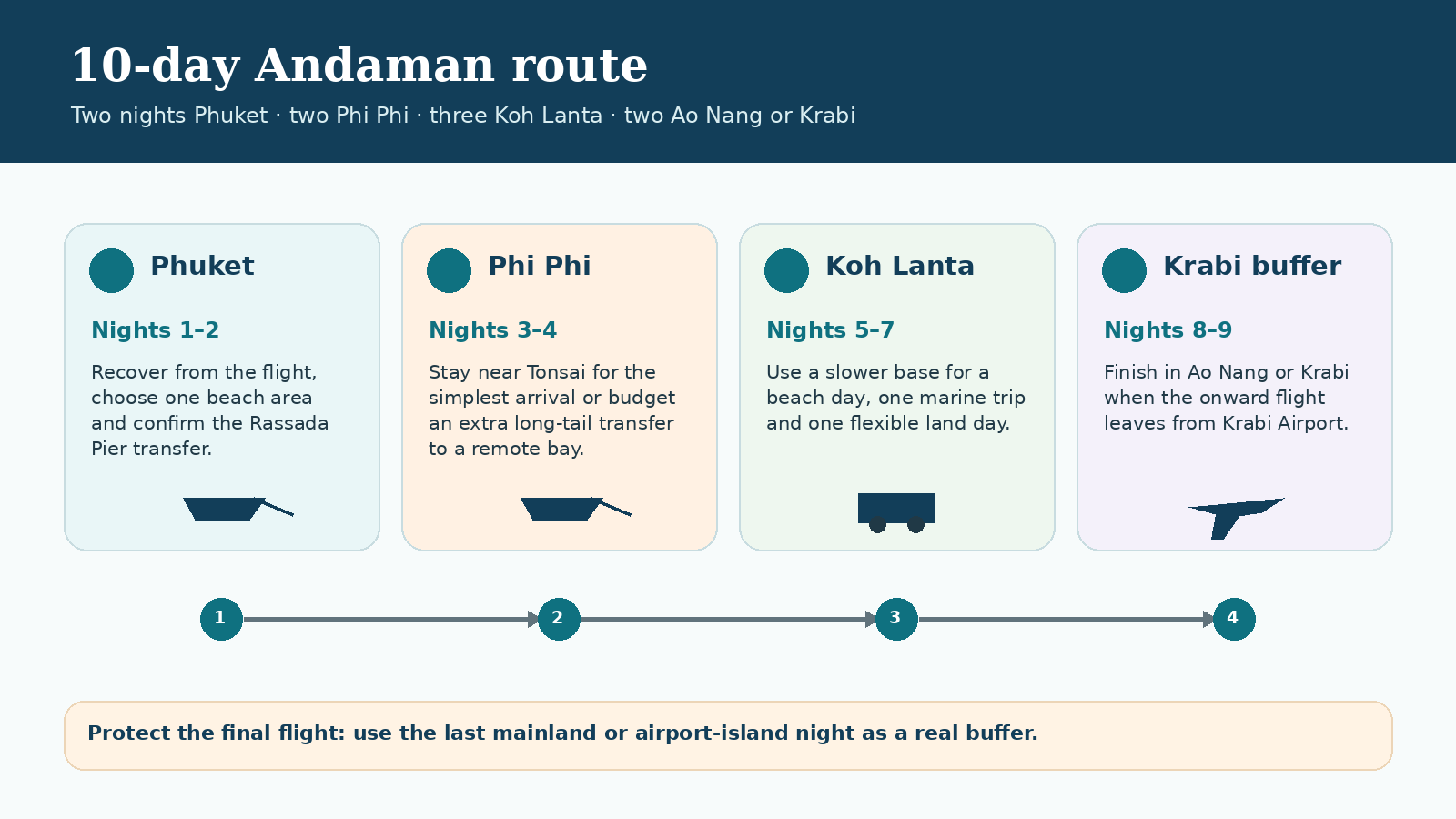
Days 1-2: arrive in Phuket
Use Phuket to absorb the international flight. A late arrival may justify an airport-area night, while two useful days suit Kata, Karon, Kamala or Phuket Old Town depending on whether beach time, food or easy road access matters. Avoid booking a non-refundable Phi Phi boat on the same day as a separate arriving flight.
On the first full day, keep the plan land-based. Recover, buy a local SIM if needed, withdraw cash from a secure ATM and confirm the transfer to Rassada Pier. Phuket is large, so a beach hotel can be more than an hour from the pier in traffic.
Days 3-4: stay on Phi Phi
Choose accommodation near Tonsai for the simplest arrival, or accept an additional long-tail or resort transfer for a quieter bay. Two nights allow one early or late boat experience without turning Phi Phi into a rushed day trip. Nevertheless, the central village is lively and compact; travellers seeking quiet should inspect the exact map position and recent noise comments.
A Maya Bay-related trip needs current park and landing rules rather than an old itinerary. Operators can change the order of stops around tide, crowd management and weather. Treat the operator briefing as more important than the route shown in a marketing photo.
Days 5-7: slow down on Koh Lanta
Koh Lanta changes the rhythm. The west coast has multiple beach areas, while a road runs along much of the island and makes land days possible.[2] Three nights is the minimum useful stay; four or five is better for families and travellers who want one marine day, one beach day and one land-based day without sacrificing rest.
Long Beach and Klong Dao are practical first checks. Farther south feels quieter, but transfer time, restaurant choice and road distance increase. During wetter months, do not build the stay around a smaller-island tour that may not operate.
Days 8-9: finish in Ao Nang or Krabi
Move to Ao Nang when the final flight leaves from Krabi Airport or when you want a road-connected base with restaurants, tours and a possible Railay day trip. Krabi Town is useful for an early flight or a more local final night. Railay is scenic, yet it leaves a boat between the hotel and airport, so it is a weaker final buffer.
Day 10: depart without a ferry gamble
A road transfer protects the flight. Book enough margin for traffic, airport check-in and any separate-ticket risk. The final day should feel deliberately unexciting; its purpose is to stop one cancelled boat from breaking the international journey.
Compare the Andaman route
Use the exact island, pier and hotel area. A ticket ending at Tonsai Pier or Saladan Pier is not automatically a hotel transfer.
Check Phuket to Phi PhiCheck Phi Phi to Koh LantaCheck Koh Lanta to Krabi
Ten-day Lower Gulf island hopping itinerary
This route uses Samui as the arrival island, Koh Phangan for a varied middle stop, Koh Tao for diving or snorkelling and Samui again for the final flight buffer. It often deserves the first look from April to September, but the marine forecast remains decisive.
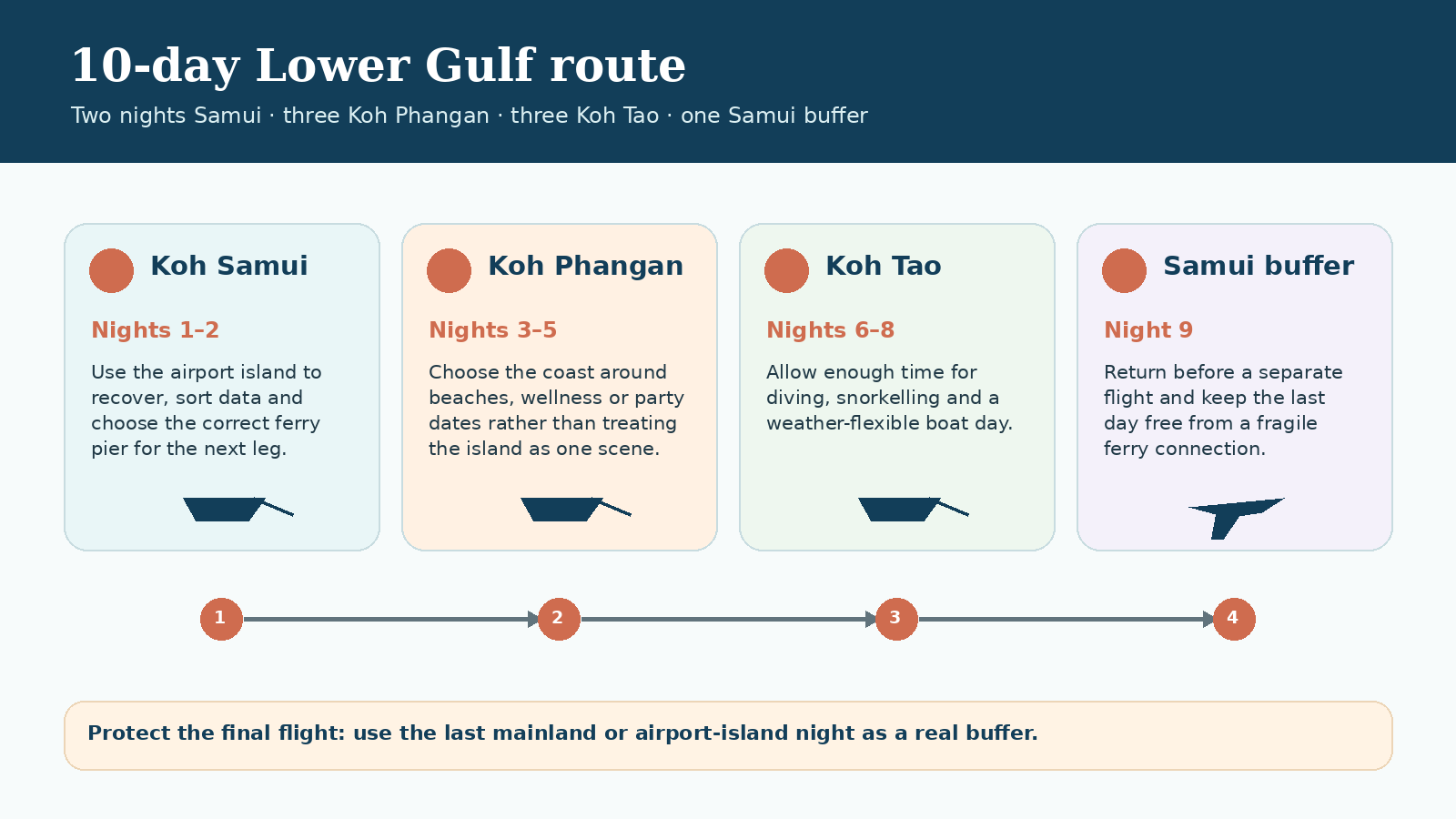
Days 1-2: arrive on Koh Samui
Samui is the most forgiving Gulf arrival because it has an airport, broad hotel choice and several ferry piers. Choose the first hotel around the next transfer as well as the beach. A cheap room at the opposite end of the island can create an expensive and stressful dawn taxi.
Use the first full day for a beach, an island loop or a quiet recovery day. Do not treat Samui purely as a pier. Tourism Authority of Thailand highlights distinct areas including Chaweng, Lamai and Taling Ngam, which create very different holidays.[3]
Days 3-5: choose the right side of Koh Phangan
Koh Phangan is not one party town. Thong Sala is the practical ferry and market hub, Haad Rin changes character around Full Moon events, while northern and eastern beaches can be much quieter. Tourism Authority of Thailand also highlights waterfalls, mountains and coconut-farming landscapes beyond the beaches.[4]
Check the event calendar even when you have no interest in a party. Room prices, minimum stays, road traffic and ferry demand can change. A calm beach chosen on the map may still require a long taxi from Thong Sala.
Days 6-8: Koh Tao for water time
Koh Tao is the route’s diving and snorkelling base. Four nights is ideal for a course; three can work for introductory diving, one boat day and a flexible land day. Non-divers should choose the hotel carefully because steep roads and bay access can make a short distance awkward.
Mae Haad is simplest for ferry logistics, Sairee provides the broadest social and dining choice, and quieter bays trade convenience for atmosphere. The island has a fragile marine environment, so choose operators that brief guests on reef contact, waste and wildlife behaviour.[5]
Day 9: return to Samui
Return one day before a separate flight. Confirm the Samui arrival pier because it changes the taxi distance to the airport and hotel. A final night near the airport or the relevant pier may be less romantic than another Tao sunset, but it is much more useful when weather or operational delays appear.
Day 10: fly or continue by road and rail
Samui Airport provides the simplest flight departure. Budget travellers can instead use a ferry and combined vehicle to Surat Thani, or travel from Koh Tao towards Chumphon. Those options are practical, although they require a larger time block than the map suggests.
Compare the Gulf route
Read the pier names, hotel-pickup area, baggage allowance and final arrival point before paying.
Check Samui to PhanganCheck Phangan to TaoCheck Tao to Samui
Fourteen-night mixed-coast itinerary
A mixed-coast route makes sense only when the trip is long enough to treat the cross-country move as transport rather than sightseeing. Fourteen nights is the minimum comfortable version; sixteen to twenty-one nights is better.
A realistic fourteen-night shape
| Nights | Base | Purpose | Planning note |
|---|---|---|---|
| 1-3 | Phuket | Arrival recovery, one beach area and one land or boat day | Stay where the airport and next transfer remain manageable |
| 4-7 | Koh Lanta | Slower beach stay, land exploration and a seasonal marine day | Four nights justify the transfer and protect a poor-weather day |
| 8 | Cross-coast travel | Road to Krabi or Phuket, flight where practical, Samui arrival | Treat the day as transport; do not add a fixed evening tour |
| 9-11 | Koh Samui | Gulf reset, beach choice and a flexible island day | Use three nights because the previous day may finish late |
| 12-13 | Koh Phangan | Second Gulf atmosphere and beach area | Two nights is short; use three if the holiday can stretch |
| 14 | Samui buffer | Protect the onward flight | Confirm the ferry and keep the final evening simple |
Why Koh Tao is omitted
A fourteen-night mixed route already contains four hotel changes and a domestic-flight day. Adding Koh Tao would create another two ferries for one or two nights. Divers should remove Koh Phangan, stay longer on Tao and keep the Samui buffer. Non-divers usually gain more from a deeper Samui or Phangan stay.
When to reverse the route
Start in the Gulf when the month favours Samui and the available flight arrives there cleanly. Finish on the Andaman only when the international departure is protected by Phuket or Krabi rather than a last-morning island boat. Open-jaw domestic tickets can reduce backtracking, although baggage terms and airport transfers still need comparison.
Mixed coasts are not a weather guarantee
Crossing the country does not ensure perfect conditions. It increases cost and introduces another flight or long road day. Choose it for variety, not as an attempt to outrun every rain cloud.
Seven-night low-stress island routes
A shorter trip improves when it removes a transfer rather than compressing the ten-day itinerary. Two bases can still feel varied when their roles are different.
Andaman: Phuket plus Koh Lanta
Use three nights in Phuket and four in Koh Lanta. Phuket handles the flight, services and one organised day, while Lanta provides the slower beach stay. Travel by seasonal direct boat when it suits the date or use a road-and-vehicle-ferry route when that is more reliable. Skip Phi Phi overnight and visit only as a day trip if conditions, route and crowd tolerance align.
Andaman: Ao Nang plus Railay
Use five nights in Ao Nang and two in Railay when a short scenic finish matters. Ao Nang protects the airport and provides island-tour choice; Railay changes the atmosphere without a long sea crossing. However, finish in Ao Nang when the flight is early.
Gulf: Samui plus Phangan
Use four nights on Samui and three on Phangan. This pairing suits families, couples and travellers who want a clear island contrast without travelling as far as Koh Tao. Choose the Phangan beach around the ferry pier and event calendar.
Gulf: Samui plus Tao
Use three nights on Samui and four on Tao when diving or snorkelling is the purpose of the trip. Return to Samui on the seventh night only when the flight leaves the following day. Otherwise, keep the final night on Samui and reduce Tao by one.
Best value does not mean the cheapest ferry
Removing one island often saves two pier taxis, one boat, one lost afternoon and one set of hotel-change costs. The slower itinerary can therefore cost less while delivering more usable beach time.
Andaman ferry and transfer reality
The Andaman route mixes ferries, speedboats, long-tail boats, vans and vehicle ferries. A booking title may show only the island names, while the actual product begins at a hotel, a pier or a roadside office.
Phuket to Phi Phi
Most scheduled passenger services use Rassada Pier on Phuket and Tonsai Pier on Phi Phi Don, although some products serve Laemtong or include hotel collection. Live early-September 2026 listings showed standard ferries and speedboats, with advertised sailing times commonly around one to two hours. Door to door, allow roughly four to five hours from a west-coast Phuket hotel.
Phi Phi to Koh Lanta
Direct passenger boats are usually most useful in the drier season. Live 2026 searches showed options from roughly 620 baht, while journey times varied from fast speedboat sectors to slower products with additional handling. A remote Phi Phi hotel can require a separate transfer to Tonsai before the ticketed leg begins.
Koh Lanta to Krabi or Ao Nang
A combined van route may use the vehicle ferry and continue to the hotel, while a seasonal passenger boat may finish at a pier. Typical planning ranges are about two to four hours and roughly 500 to 1,200 baht, depending on pickup, destination and season. Krabi Airport is a different endpoint from Krabi Town or Ao Nang.
Speedboat or ferry?
Speedboats protect time but can feel harsher in chop and often provide less space to move. Larger ferries are slower and may be more comfortable, although they are not immune to rough conditions. Choose by weather, traveller mobility, luggage and operator rather than treating speed as the only quality measure.
Operator information changes by season
Bundhaya advertises Phuket, Phi Phi, Lanta, Krabi and other Andaman routes, while its live booking tool changes with date and origin.[9] Recheck the official operator or booking page after selecting the actual travel day.
Lower Gulf ferry and pier reality
The Gulf chain looks simpler because the islands line up neatly. The practical complication is that Samui has several piers and a ticket can begin at a hotel, airport, pier office or mainland bus terminal.
Samui to Koh Phangan
Some direct pier-to-pier sailings take around twenty to forty minutes, yet the complete move commonly needs two to three hours once hotel collection, check-in and the Phangan taxi are included. Check whether the boat leaves from Bangrak, Maenam, Nathon or another point because the road transfer can exceed the sea journey.
Koh Phangan to Koh Tao
Live September 2026 searches showed tickets from about 450 baht and fastest advertised journeys around one hour, with other products taking longer or including hotel transfers. Thong Sala is the usual Phangan hub, while Mae Haad is the main Tao arrival. Arrive early because the check-in desk may not sit directly beside the gangway.
Koh Tao to Samui or Chumphon
Return towards Samui for a Samui flight, or use Chumphon when the route continues by train or road towards Bangkok. These are not interchangeable. A cheap Tao-to-Chumphon ticket does not solve a flight from Samui, while a Samui arrival can be poor value for a northbound rail journey.
Use the official timetable as a current check
Lomprayah publishes a 2026 timetable for its Gulf routes and directs passengers to its live booking system.[8] Treat that page as current operator evidence, then confirm the ticket email, pier and check-in instructions. A timetable copied into a blog cannot outrank the operator’s live date-specific result.
The final Gulf ferry is not a flight connection
Even a thirty-minute sea crossing can be delayed by weather, loading or pier changes. Return to Samui one night before a separate flight unless the airline has sold and protected the connection as one ticket.
A ferry-day routine that prevents most problems
Most island-hopping stress comes from missing information rather than the boat itself. A repeatable routine turns the travel day into a controlled sequence.
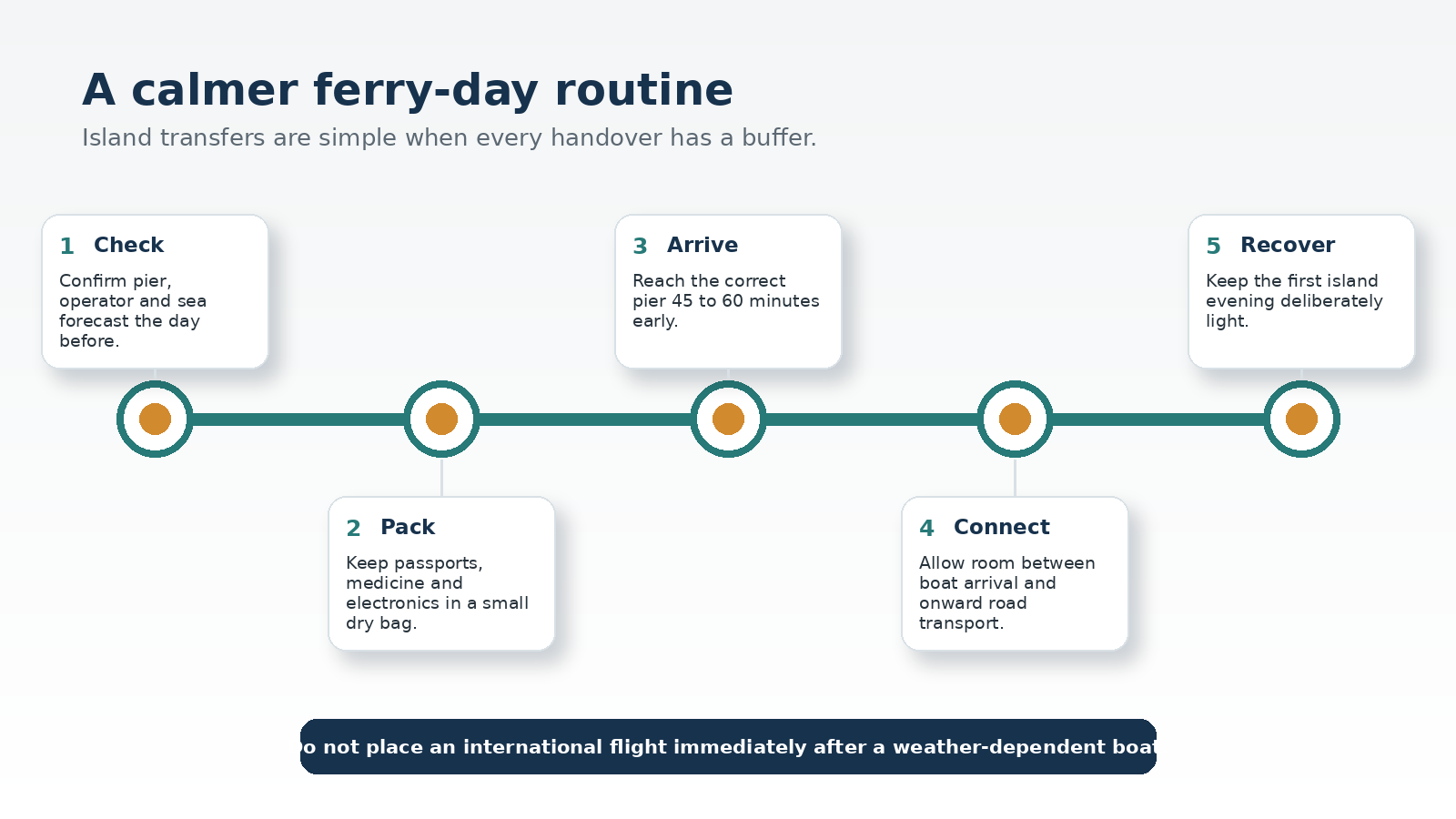
The evening before
- Check the operator message, exact pier, collection point and collection time.
- Read the Thai Meteorological Department shipping forecast and any local warning.
- Ask the hotel to confirm the realistic drive to the pier and arrange a vehicle where needed.
- Screenshot the ticket, map pin and accommodation address for offline use.
- Separate passport, medication, phone, power bank and one dry layer from the checked bag.
At the pier
Arrive 45 to 60 minutes early unless the operator requests more. Find the correct desk rather than joining the longest queue. Show the passport or booking reference, keep the baggage tag and listen for a boat name, colour or destination change.
During loading
Control one personal bag yourself. Photograph larger luggage before it leaves your sight and keep electronics protected from spray. Travellers with reduced mobility, young children or rigid cases should ask about boarding steps and assistance before the queue moves.
After arrival
Do not assume the first driver offering a ride belongs to the booked transfer. Find the named sign or desk, confirm the hotel and agree the fare when the final leg is separate. Message the accommodation if the boat is late, because reception or a resort boat may operate within a limited window.
The personal-bag test
Every traveller should be able to carry one small bag containing the items needed for 24 hours. If the main case is delayed, wet or placed under other luggage, the route should still be manageable.
Where to stay on each island
The island name is too broad for a useful hotel decision. The correct micro-location reduces taxis, difficult luggage transfers and early departures.
Phuket
Kata and Karon suit a balanced beach-town stay; Kamala is a calmer first check for families; Phuket Old Town suits food and architecture rather than swimming. For a one-night airport buffer, stay near the airport instead of crossing the island for a famous beach. The site’s Phuket area guide compares the main bases in more detail.
Phi Phi
Tonsai and the central village are easiest for a two-night itinerary because the main ferry arrives there. Long Beach can feel more relaxed while remaining comparatively accessible. Laemtong and remote bays create a stronger resort escape, but the extra resort boat should be part of the arrival and departure plan.
Koh Lanta and Krabi
Klong Dao and Long Beach are practical for a first Lanta stay because they balance restaurants, road access and beach time. Southern beaches become quieter and farther from Saladan. In Krabi, Ao Nang is the easiest all-round buffer; Krabi Town is useful for the airport; Railay is a scenic stay rather than the safest flight buffer.
Koh Samui
Chaweng gives maximum services and nightlife, Lamai provides a broad resort-town alternative, Bophut suits restaurants and a more polished evening routine, while quieter west and south-coast areas increase road time. Match the first hotel to both the beach and the next ferry pier.
Koh Phangan and Koh Tao
Thong Sala is practical on Phangan, Haad Rin is event-led, and northern or eastern bays suit quieter stays with more taxi planning. On Tao, Mae Haad simplifies ferry days, Sairee provides the broadest social choice and remote bays reward travellers who accept steep roads or resort transfers.
Compare hotels by route stage
Enter the exact island and dates, then compare map position, room occupancy, cancellation terms, transfer information and the total after taxes.
Phuket hotelsPhi Phi hotelsKoh Lanta hotelsKoh Samui hotelsKoh Phangan hotelsKoh Tao hotels
Hotel booking checks that matter on islands
A beautiful room can be poor value when it adds an unplanned boat, steep road or expensive taxi to every day. Check the logistics before the view.
Read the arrival instructions
Look for the named pier, collection window, final boat, luggage assistance and resort-transfer price. A property shown as “Phi Phi” or “Railay” may require a second boat after the public ferry. A Koh Tao bay may require a four-wheel-drive pickup rather than a normal taxi.
Enter every traveller correctly
Family rooms can mean one double bed plus a small sofa bed. Add every child’s age, read the occupancy line and ask whether connecting rooms are guaranteed. On islands, changing rooms at the last minute can be difficult when alternatives are full or located on another beach.
Compare cancellation and disruption terms
Flexible terms are most valuable for the first island after an international flight and for weather-sensitive small-island stays. Read whether the hotel refunds when the ferry is cancelled, because “non-refundable” can remain non-refundable even when the guest cannot reach the island.
Check the total rather than the first price
Breakfast, taxes, compulsory festive dinners, airport transfer, pier transfer and extra beds can change the ranking. A slightly dearer room beside the pier may beat a cheaper resort that needs two private vehicles and an early checkout.
Use two platforms for comparison
Search the same room and cancellation plan on more than one platform, then check the hotel’s own transfer information. Agoda can be useful for Asian inventory, while Booking.com often makes cancellation and occupancy details easy to compare. The winning option is the one with the clearest complete terms, not a familiar logo.
Cross-check island accommodation
Use the map before the price filter, especially for Lanta’s long west coast and Samui’s multiple ferry areas.
Thailand island hopping budget for 2026
Island routes cost more than mainland-only travel because each change adds a boat, pier taxi, transfer premium or baggage risk. The ranges below are editorial planning estimates per person for ten days, excluding international flights and assuming two people share a room.
Ten-day working budget
| Style | Rooms | Food and local movement | Ferries, regional travel and activities | Working total |
|---|---|---|---|---|
| Budget | Hostels or simple rooms, mostly shared or basic | Local meals, walking and shared taxis | Shared ferries, one or two paid activities | 30,000-48,000 THB |
| Mid-range | Well-reviewed private rooms, shared by two | Mixed local and hotel meals, taxis where useful | Shared transfers, two or three tours, checked baggage | 55,000-90,000 THB |
| Comfortable | Beach resorts or larger rooms | Restaurant choice, private taxis and more drinks | Premium boats, private transfers and several activities | 100,000-180,000+ THB |
Where the Andaman route costs rise
Phuket road transfers, peak-season Phi Phi rooms, remote-bay boats and private Lanta vehicles are the main pressure points. A central Phi Phi room can be cheaper overall than a lower room rate requiring repeated long-tail transfers. December and January can sit far above ordinary planning bands.
Where the Gulf route costs rise
Samui flights and taxis can dominate the total. Full Moon periods affect Phangan rooms and ferry demand, while diving adds equipment, instruction and boat costs on Tao. A mainland flight to Surat Thani plus ferry may save money but uses more time than flying directly to Samui.
The hidden cost of an extra island
One additional stop creates a departure taxi, boat, arrival taxi, baggage handling and at least half a day with limited flexibility. Before adding it, compare that complete cost with a high-quality day trip or one better hotel night.
For a countrywide framework, use the Thailand travel budget guide. Replace every estimate with live room, transport and activity prices before paying.
Weather, marine forecasts and seasonal closures
Island weather should change the route and the booking terms, not create panic over every shower. Seasonal patterns are useful; the live marine forecast decides the boat day.
Andaman planning window
November through April is usually the easier Andaman period. From May into October, southwest-monsoon conditions can bring heavier rain, larger waves and fewer direct small-island services. Tourism Authority of Thailand says smaller islands around Mu Ko Lanta National Park are typically closed during the monsoon season from May through October.[2]
Lower Gulf planning window
April through September often provides the stronger first shortlist for Samui, Phangan and Tao. Later in the year, the northeast monsoon can make the Lower Gulf wetter even when Bangkok and the Andaman are improving. December is not automatically poor, but the route needs a closer rainfall and sea check than a Phuket itinerary in the same month.
Why the shipping forecast matters
The Thai Meteorological Department separates the Gulf from the Andaman and reports wave height, wind and thunderstorm conditions.[7] On 6 September 2026, for example, its live forecast described about two-metre waves in the upper Andaman Sea and higher conditions in thundershowers. That example shows why a daily forecast must replace a generic climate chart when a small boat is involved.
Build a route swap, not a perfect forecast
Keep one land-based day on Phuket, Lanta or Samui. When the sea is poor, move the boat day, extend the larger island or choose a road-based activity. Do not pressure a captain to operate because the hotel is non-refundable.
Closures can be ecological as well as weather-related
Marine parks can close areas for habitat recovery, visitor management or safety. Check the national-park or operator notice for the exact date rather than assuming last year’s opening day will repeat.
Tours and activities worth building around
An activity earns a fixed place when it changes the destination, needs scarce capacity or benefits from an early start. Avoid filling every island with a nearly identical speedboat day.
On the Andaman route
Phi Phi rewards an early or late boat with a small group when the route and park rules are clear. Koh Lanta can support a seasonal Koh Rok or Koh Haa trip, although closures and sea conditions matter. Phuket offers land alternatives, Old Town food, viewpoints and organised day trips, while Ao Nang provides Railay, Four Islands and Hong Islands choices.
On the Gulf route
Samui offers Ang Thong Marine Park, island loops and resort-based days. Phangan combines beaches, wellness and hiking, while Tao justifies a longer stay for diving or snorkelling. A beginner dive course should be chosen by instructor standards, medical screening, group size and environmental practice rather than the lowest price.
Shared or private boat?
A shared tour is usually better value and can provide a more predictable programme. A private boat allows earlier starts and flexible pacing, yet it does not control weather, park restrictions or tide. Families should check shade, toilet access, life jackets and child-size equipment before booking.
What to read before paying
Confirm the departure pier, hotel pickup zone, group size, boat type, park fees, meal, snorkelling equipment, insurance statement and cancellation policy. “Includes pickup” may exclude remote beaches or require a central meeting point.
Compare island activities
Use the operator name and pickup details to compare equivalent products. More stops do not automatically create a better day.
Best island route by traveller type
The same itinerary can feel effortless to one traveller and exhausting to another. Let the hardest practical requirement choose the route, then use scenery as the tie-breaker.
Families with young children
Choose two bases, larger islands and road-connected hotels. Phuket plus Koh Lanta or Samui plus Phangan are stronger than a rapid three-island chain. Ask about child life jackets, cot confirmation, buggy handling and the exact boarding surface. A lightweight carrier is more useful than a large pushchair on small boats and sand.
Couples and honeymoons
Use one lively gateway and one quieter resort stay. Phuket plus southern Lanta, or Samui plus a secluded Phangan bay, provides contrast without constant packing. A remote resort becomes worthwhile when the room and setting are part of the holiday rather than merely a base for daily tours.
Solo travellers
Phi Phi, Sairee on Tao and parts of Phangan provide social accommodation and group activities. Nevertheless, a solo traveller carries the full cost of private taxis and remote-bay transfers. Stay near a walkable centre for at least the first night and keep working mobile data.
Divers and snorkellers
Use four nights on Tao for a course or several dive days. On the Andaman, Lanta can provide access to southern sites in season, while Phi Phi offers a different limestone setting. Do not plan a flight immediately after diving; follow the dive operator’s no-fly interval based on the actual dive profile.
Travellers with reduced mobility
Start with Samui, Phuket or road-accessible parts of Lanta. Ask hotels and operators specific questions about steps, floating pontoons, beach boarding, gangways, vehicle access and bathroom layout. A generic accessibility filter cannot describe a tide-dependent long-tail transfer.
Motion-sensitive travellers
Reduce speedboats, choose larger vessels where practical and keep crossings shorter. Discuss medication with a pharmacist or clinician before travel. Sit where the crew recommends and avoid a route that requires a boat every other day.
What to pack for Thailand island hopping
The best luggage is the one you can control on a wet pier. A conventional suitcase works on larger ferries and managed resort transfers, but every extra kilogram becomes more awkward on sand, steps and long-tail boats.
Soft bag, backpack or suitcase?
| Option | Best use | Advantage | Main caution |
|---|---|---|---|
| 35-45L travel backpack | Repeated ferries and independent transfers | Hands free on steps and easier to lift | Do not overpack or rely on water resistance |
| Small soft-sided wheeled case | Moderate route with hotel transfers | Easy in airports and ordinary hotels | Wheels struggle on sand and rough jetties |
| Large hard-shell suitcase | One or two resort bases with managed transfer | Structured protection and familiar packing | Heavy and awkward on long-tails or remote piers |
| Packable day bag | Island walks and boat excursions | Small, light and easy to store | Usually not waterproof |
Dry protection
Use a small roll-top dry bag for passport, wallet, electronics and one dry layer. Treat it as splash protection unless the manufacturer explicitly supports submersion. A waterproof phone pouch adds a second barrier, but leak-test it with tissue before the trip.
Footwear
Secure sandals or water-friendly shoes suit wet boarding. Trainers with grip are useful for viewpoints and rough paths. Flip-flops are convenient on sand but weak on wet rock, steep lanes and slippery boat steps.
Travel-day essentials
Carry sunscreen, a hat, refillable bottle, light rain layer, medication, power bank, motion-sickness plan and a small amount of cash. Keep the power bank in cabin baggage and follow the airline’s current battery rules.
Compare practical island-hopping gear
Buy for fit, closure quality and realistic capacity. Test waterproof items at home rather than beside the pier.
Compare travel dry bagsCompare phone pouchesCompare packable day bags
Entry checks, tickets and mobile data
Island logistics become much easier when the first address, transport confirmations and mobile connection are ready before the airport exit.
Complete the Thailand Digital Arrival Card
All non-Thai nationals entering Thailand must complete the Thailand Digital Arrival Card before arrival, and the official FAQ says it can be submitted within 72 hours of entry.[10] The form asks for passport, flight, Thai address, travel-purpose, health and email details. Use the official Immigration Bureau site and keep the confirmation accessible offline.
Check passport and visa rules for your nationality
Entry rules can change, and different passports receive different treatment. UK guidance currently tells British citizens to use a passport valid for at least six months after arrival and to check the current visa position before travel.[11] Other nationalities should use their own government advice and a Thai embassy or official consular source.
Store tickets twice
Keep ferry, flight and hotel confirmations in the booking app and as offline screenshots or PDFs. Save the exact map pin, hotel phone number and pier name. An email subject saying “Koh Samui to Koh Phangan” is not enough when the driver needs a specific pier.
Arrange data before the first transfer
A local Thai SIM normally provides a Thai number and strong value, while an advance eSIM can place maps and messages online immediately after landing. Coverage varies by exact bay and hotel, so ask the accommodation when a remote location is central to the route.
Set up arrival-day data
Check that the phone is unlocked and eSIM compatible. Many travel eSIMs are data-only, so ordinary Thai calls may not be included.
Safety and responsible island travel
Most island journeys are straightforward, but boats, roads, heat, alcohol and tropical weather need practical respect. The aim is to remove avoidable pressure rather than make the route sound dangerous.
Boat safety
Use a reputable operator, follow crew instructions and locate the life jackets. Do not pressure an operator to sail in conditions it considers unsafe. Keep aisles clear and supervise children actively during boarding. UK travel advice recommends care with sea activities and reputable providers.[12]
Swimming and snorkelling
Check flags, currents, boat lanes and local advice at the actual beach. Red flags should end the swimming plan. Do not stand on coral, chase wildlife or touch marine animals for a photograph. Reef-safe behaviour matters more than a marketing label on sunscreen.
Scooters and island roads
Samui, Phangan, Tao, Phuket and Lanta all tempt travellers to rent scooters. Roads can be steep, wet, sandy or poorly lit, while travel insurance and licence requirements matter after a crash. Hire only when properly licensed and experienced, wear a helmet and never ride after drinking.
Heat and hydration
Boat decks, queues and exposed piers can create more heat than a beach day. Carry water, use shade and avoid scheduling a strenuous viewpoint immediately after a rough crossing. Seek medical help for confusion, fainting or worsening heat symptoms.
Waste and local communities
Refill water where practical, refuse unnecessary single-use items and take batteries or specialist waste back to a larger island. Dress respectfully away from beaches, follow temple rules and avoid treating local fishing areas or shrines as photo props.
Emergency planning
Save Tourist Police 1155, police 191 and medical emergency 1669. Keep insurer details and one payment method separate from the daily wallet. Remote islands may require a boat or road transfer before higher-level medical care.
Pros and cons of the three routes
Each route is strong when its compromises match the traveller. Use the cards below to decide which disadvantages are acceptable rather than searching for a route with none.
Andaman route
Pros
- Dramatic limestone scenery
- Easy Phuket or Krabi gateway
- Strong contrast between lively and slow bases
Cons
- More seasonal direct-boat changes
- Phi Phi can feel crowded
- Phuket road transfers can be long
Lower Gulf route
Pros
- Clean Samui-Phangan-Tao chain
- Strong diving and snorkelling case
- Useful option in European summer
Cons
- Samui flights and taxis can cost more
- Multiple pier choices create confusion
- The return ferry must protect the flight
Mixed coasts
Pros
- Two distinct island regions
- Excellent for a long one-off trip
- Flexible activity mix
Cons
- One day largely lost to transport
- Higher cost and more luggage handling
- Too rushed below fourteen nights
The decision that matters most
Choose the route whose worst day remains manageable. Couples happy with a domestic flight can enjoy mixed coasts. Families with a pushchair may prefer two large islands. Divers may accept a longer Tao transfer because the destination justifies it.
Common Thailand island hopping mistakes
Most poor itineraries fail in the same predictable ways. Each mistake below has a simple correction.
Counting sailing time instead of door-to-door time
Fix: block half a day for ordinary island changes and most of a day for cross-coast travel. Add hotel pickup, check-in, waiting and the final taxi.
Mixing coasts into ten days
Fix: choose Andaman or Gulf. Use fourteen nights as the minimum mixed-coast threshold and reduce the number of islands.
Connecting a ferry to a separate international flight
Fix: sleep on the mainland or airport island the night before. Travel insurance is not a substitute for a realistic buffer.
Booking the cheapest room without mapping it
Fix: compare the total transfer cost, slope, pier and restaurant access. A remote room can be excellent, but only when the isolation is intentional.
Taking a large rigid case to a boat-access hotel
Fix: ask about the landing and staff assistance, reduce the weight and keep one essential bag under personal control.
Assuming every direct route operates year-round
Fix: check the exact date on the operator’s live system. Keep a road-and-ferry alternative where one exists.
Scheduling a boat tour after a late arrival
Fix: use the first full day for recovery or a land activity. Jet lag and delayed baggage are poor preparation for a 06:00 speedboat pickup.
Ignoring party and festive dates
Fix: check Koh Phangan event periods, Christmas, New Year, Songkran and Thai public holidays before choosing flexible versus fixed bookings.
The simplest correction
Add nights, not islands. A fourth sunset in the same place is often more memorable than another pier queue.
Thailand island hopping itinerary FAQs
How many days do you need for island hopping in Thailand?
Seven nights works for two nearby islands. Ten days suits three bases on one coast when the final connection is protected. Use fourteen nights or more for mixed coasts, and sixteen to twenty-one nights for a calmer version.
Which coast is best for a first island hopping trip?
Choose the Andaman for Phuket, Phi Phi, Koh Lanta, Krabi and limestone scenery, usually with the strongest first planning window from November to April. Choose the Lower Gulf for Samui, Phangan and Tao, often a better first shortlist from April to September.
Can you island hop Thailand without flying?
Yes. Stay on one coast and use boats plus road transfers. Crossing from the Andaman to the Gulf without flying is possible, but it uses a long transport day and is poor value in a short holiday.
Should Thailand ferries be booked in advance?
Book important legs early for Christmas, New Year, Full Moon periods and any sailing linked to a flight. Ordinary off-peak routes can remain flexible, but never arrive after the last practical service.
Is Phi Phi worth an overnight stay?
Yes when early or late access, nightlife or a particular resort matters. Two nights is enough for many travellers. A day trip suits those who prefer a quieter hotel and accept a busier daytime visit.
Is Koh Lanta good for families?
Koh Lanta is a strong family choice because it has road access, multiple beaches and a slower atmosphere. Klong Dao and Long Beach are practical first checks. Choose the hotel around room layout, pool safety and transfer time.
How long is the ferry from Koh Samui to Koh Phangan?
Some pier-to-pier services advertise around twenty to forty minutes. The complete hotel-to-hotel move commonly takes much longer because Samui has several piers and Phangan needs a final taxi.
How long is Koh Phangan to Koh Tao?
Fast services can advertise roughly one hour, while other products take longer or include transfers. Allow a substantial door-to-door block and confirm Thong Sala, Mae Haad, check-in and hotel collection.
What happens if a ferry is cancelled?
Follow the operator’s instructions, retain written evidence and ask about rebooking or refund terms. Contact the next hotel and protect the following flight. Do not improvise with an unsafe boat.
Can you take a suitcase on Thailand ferries?
Usually, but baggage limits and handling differ. A small soft case or travel backpack is easier on piers and long-tails. Keep documents, medication, electronics and one dry outfit in a personal bag.
How much cash is useful on transfer days?
Carry enough Thai baht for taxis, snacks, small pier charges and an emergency ride, while keeping the majority secured separately. Do not assume every small pier or driver accepts a card.
What is the best route for July?
Samui, Phangan and Tao usually deserve the first look in July. Keep the plan flexible, check the live Gulf shipping forecast and avoid treating the seasonal pattern as a guarantee.
What is the best route for January?
Phuket, Phi Phi, Koh Lanta and Krabi form a strong January route. Book early around New Year, expect peak prices and protect the final flight with a mainland or Phuket night.
Is a mixed-coast itinerary worth it?
Yes for a long trip when two distinct regions matter and one domestic-flight day is acceptable. It is not worth the cost and disruption in a ten-day holiday.
The Thailand island route I would choose first
For a first Thailand island hopping itinerary, my research-led choice is one coast and three bases at most. From November to April, I would normally start with Phuket for two nights, Phi Phi for two, Koh Lanta for three or four and a final Ao Nang or Krabi buffer. The route moves from practical arrival to dramatic scenery, then slows down before the flight.
From April to September, I would first compare Samui, Phangan and Tao. Samui protects the arrival, Phangan adds the widest lifestyle contrast and Tao gives the water-focused finish. Return to Samui one day before a separate flight.
Choose the slower version when uncertain
Use Phuket plus Koh Lanta or Samui plus Phangan when young children, mobility, motion sensitivity or a genuine wish to rest matters more than route variety. Two well-chosen bases create more freedom than three bookings held together by perfect weather.
The final planning test
Read the itinerary without the island names. If it contains a flight, four boats, five hotels and no movable day, it is too fragile. If each destination has a clear purpose and the last connection is protected, the route is ready to price.
Fact-check before payment
Recheck the official marine forecast, live operator timetable, park notice, exact pier, hotel transfer and entry rules for the actual date. The planning framework can stay the same; the operational details must be current.
Sources and fact-checking notes
Destination geography and travel-style descriptions were checked against official Tourism Authority of Thailand pages. Weather and sea guidance uses the Thai Meteorological Department. Entry information uses the official Thailand Digital Arrival Card system and current UK guidance for British-passport examples. Operator pages are cited for route availability rather than treated as permanent timetables.
Destination, weather and operator sources
- Tourism Authority of Thailand: Ko Phi Phi. Island geography, national-park context, accommodation variety and seasonal planning.
- Tourism Authority of Thailand: Ko Lanta. West-coast beaches, road access, facilities and typical May-October smaller-island closures.
- Tourism Authority of Thailand: Ko Samui. Beach areas, activities and island scale.
- Tourism Authority of Thailand: Ko Pha-ngan. Beaches, natural attractions and links with Samui and Tao.
- Tourism Authority of Thailand: Ko Tao. Diving, snorkelling, island access and environmental travel guidance. The official page currently uses this URL despite the province path.
- Tourism Authority of Thailand: climate and weather. Broad national seasonal context.
- Thai Meteorological Department: shipping weather forecast. Live Gulf and Andaman wind, wave and thunderstorm information.
- Lomprayah: 2026 timetable. Current Gulf route and operator-contact information.
- Bundhaya Speed Boat. Current Andaman route search and seasonal booking information.
Entry, safety and supporting sources
- Thailand Immigration Bureau: TDAC FAQ. Eligibility, required details and 72-hour submission window.
- UK Foreign, Commonwealth & Development Office: Thailand entry requirements. British-passport and TDAC examples checked 6 September 2026.
- UK Foreign, Commonwealth & Development Office: Thailand safety and security. Sea, road and activity safety context.
- Thailand Department of National Parks: E-National Park development. Official park-ticketing and visitor-management context.
- Tourism Authority of Thailand: Krabi. Krabi, Ao Nang and island-region context. The live TAT page currently uses this province-path URL.
- Taylor’s Trailblazing Travels: best islands in Thailand. Internal comparison of island regions, gateways and travel styles.
Research was checked on 6 September 2026. Prices and schedules in this article are planning ranges or dated examples. Confirm the exact operator, pier, baggage terms, marine forecast, park access and entry requirements for the travel date.
Illustrations in this article were created for Taylor’s Trailblazing Travels. Third-party photographs, where used, are credited beside the image or in the source list.