Phi Phi Islands Travel Guide
Match your hotel, boat journey and Maya Bay visit to the holiday you actually want.
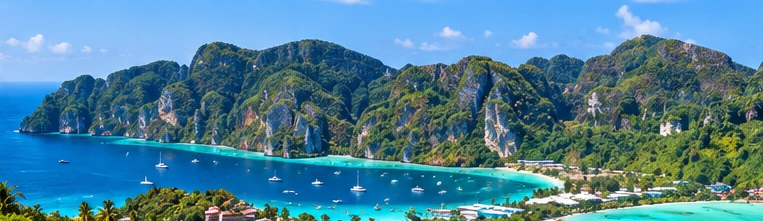
Original illustration inspired by Phi Phi-inspired twin bays, limestone hills and an inhabited island shoreline; not a photograph or a navigational map.
The Phi Phi Islands are not one interchangeable beach stop. A room beside the lanes of Tonsai, a bungalow reached by a second boat and an excursion to Maya Bay create three very different holidays. This Phi Phi Islands travel guide helps you separate those choices before comparing photographs, prices or the number of stops on a tour.
Phi Phi Don is the inhabited visitor base, while the neighbouring islands and marine sights are generally places you visit by boat. The Tourism Authority of Thailand describes an archipelago within the Hat Noppharat Thara-Mu Ko Phi Phi National Park landscape. The practical consequence is simple: accommodation, arrival pier and excursion departure point should be planned together, not booked as unrelated bargains. [1][5]
For a first stay, my research-led preference is three nights with one main boat outing and one day on Phi Phi Don. Choose a town-side base for independent meals and convenient departures, or a more secluded beach when the resort itself is central to your holiday. A day trip makes sense when seeing the seascape matters more than experiencing the island at your own pace.
The comparisons below are editorial planning judgements based on location, transfer complexity, published operator information and the activities a visitor can realistically combine. They are not a claim of a recent personal visit or a numerical ranking of every hotel. Published prices are dated reference points; the sample budget is a separate, explicitly hypothetical calculation.
This article contains affiliate links. When you book or buy through one, Taylor’s Trailblazing Travels may earn a commission at no extra cost to you. The comparisons focus on practical suitability, not the commission available.
Three nights
Two useful full days: one marine day and one more relaxed island day.
Central Don
Compare the precise room location and evening sound near the visitor lanes.
Long Beach or a resort
Treat the onward boat and dinner arrangements as part of the booking.
Maya Bay
A managed visit with current access rules, not an unrestricted swimming stop.
Phi Phi Islands travel guide: choose the right kind of visit
Staying overnight changes the rhythm
An overnight stay lets you separate arrival from sightseeing. You can put your luggage away, find a comfortable place for dinner and leave a full morning for the activity that matters most. By contrast, a mainland excursion must fit its island stops around the outward and return crossings. Neither model is automatically better: the question is whether you want a boat-based sightseeing day or an island holiday.
For an overnight visit, resist spending the first afternoon rushing to every landmark. A late boat, a hot walk or a room that is not immediately ready can easily consume the energy you expected to use. Keep the first evening simple. The next morning will be more useful when you have slept, eaten and worked out how to reach your departure point.
A day trip is not a hotel inspection tour
When comparing mainland excursions, look beyond the word Phi Phi in the title. Check which island the itinerary actually visits, how much time is spent ashore and whether the lunch stop includes time to explore. A trip designed around snorkelling and Maya Bay may reveal very little about daily life around your potential hotel on Phi Phi Don.
Similarly, do not book a room on Don assuming that every departure advertised from Phuket will collect you there. Mainland tours, island-based trips and hotel excursions are separate products. Choose the correct starting point before comparing the price or the photographs. That one check prevents a surprisingly expensive misunderstanding.
Day trip or overnight stay?
Editorial pacing comparison, not a promise about any tour's running time.
Swipe this table sideways to read every column.
| Choice | What it prioritises | Main compromise |
|---|---|---|
| Mainland day trip | A scheduled day of marine sightseeing | Less control over timing and time on Don. |
| Two nights | One focused full day | Little spare time if arrival or an excursion changes. |
| Three nights | A sea day plus an island day | Requires an accommodation and transfer decision. |
| Four or more nights | A slower pace or more water activities | Choose a base you will enjoy beyond the first evening. |
Understanding the main accommodation areas
Tonsai and Loh Dalum: convenience with compromises
The central isthmus gives you convenient access to the main visitor lanes, eating choices and boat services. Tonsai is associated with the arrival side, while Loh Dalum faces the other bay. TAT identifies the central area as a concentration of shops, accommodation and nightlife. This is useful for sociable visitors, but proximity to evening activity should be checked at the level of the actual building. [1]
A room described as central may face a busy lane, a beach venue or a quieter internal courtyard. Ask what can be heard at the time you expect to sleep. Read recent comments about the specific room category and avoid assuming that a high overall review score guarantees silence. A short walk to dinner can be worth more than a decorative room upgrade, provided the noise trade-off suits you.
Long Beach and quieter resort shores
Long Beach is a different proposition from staying beside the main pier. Phi Phi The Beach Resort describes an onward longtail transfer from Tonsai, with weather-dependent services between the resort and town. Treat the boat connection as part of the accommodation decision, especially when you imagine returning late after dinner. [3]
Farther from the central lanes, properties such as SAii Phi Phi Island Village have their own arrival arrangements and a more resort-led experience. That can suit a restful stay, but spontaneous evenings in town may be less straightforward. Compare the complete pattern of your days: beach access, meals, excursions, transfer availability and the cost of changing plans. [4]
The location decision on Phi Phi Don
Examples are compared by access and daily routine, not commission or a universal best-to-worst order.
Swipe this table sideways to read every column.
| Base | Practical advantage | Investigate carefully |
|---|---|---|
| Central Tonsai / Loh Dalum | Convenient meals and visitor services | Noise at the actual building and room. [1] |
| Long Beach | A different beach-led stay | Onward boat, tides and evening return. [3] |
| A secluded resort shore | A more self-contained holiday | Meal options, access and the cost of leaving the property. [4] |
Reaching Phi Phi from Phuket or Krabi
Read the pier name as carefully as the destination
Phuket is a large enough starting area that an island ticket and an airport arrival are not the same thing. A departure from Rassada Pier, a resort transfer from Royal Phuket Marina and an excursion collecting from selected hotels should not be treated as equivalent. Your booking must identify the land transfer, check-in point and final island landing. [2][4]
From Krabi, confirm whether the boat uses Klong Jilad or another advertised departure location. Phi Phi The Beach Resort's instructions identify Klong Jilad for the conventional Krabi approach, but that does not make every product on a booking platform identical. Check the operator's own confirmation and ask about the final leg to your accommodation. [3]
Published boat times are only part of the journey
Bundhaya's published timetable lists Phuket-Phi Phi speedboat examples taking about one hour, with an adult fare of THB 600. These are operator-page examples checked on 3 October 2026, not a confirmed seat or fare for your travel date. Other services can use different boats, piers, stops and journey times. Compare the actual product rather than treating the shortest headline duration as a promise. [2]
Allow separately for reaching the pier, checking in and collecting bags on arrival. A flight delay can undermine a tight connection even when the sea crossing itself is punctual. My preference after an evening arrival in Phuket or Krabi is to stay on the mainland and travel in daylight the next day. That is a planning buffer, not an official minimum connection time.
The final transfer to your hotel
A booked island crossing may end before your journey does
Before paying for transport, send the hotel your boat details and ask where it expects you to meet its representative. Some guests can walk from Tonsai; others need an onward boat. Explain how many bags you have and whether anyone has difficulty with steps, sand or balance. A picture of a jetty is not a guarantee that every landing uses that jetty.
Phi Phi The Beach Resort publishes a representative meeting arrangement at Tonsai for its own guests. SAii instead offers a private resort-route option from Royal Phuket Marina, with published timings around 75 minutes for the sea leg. These examples show why a generic instruction to take the ferry can be incomplete. Confirm the current arrangement directly with the property. [3][4]
Tides and weather affect convenience
SAii's transfer information discusses low-tide arrival arrangements, illustrating how the final approach can vary even at an established resort. Ask about the route at your expected arrival time and how luggage is handled. Someone travelling with a pushchair or a mobility aid needs a practical description, not reassurance based only on a hotel's star category. [4]
Keep a small dry bag with the items needed during the transfer, but avoid filling it until it is awkward to carry. Your phone, medication, booking details and a spare layer should remain accessible. Large suitcases are a luggage-handling question to resolve, not a reason to assume that the trip is impossible. The useful detail is who helps, where and under what conditions.
Where to stay: room details that change the holiday
Convenience, quiet and views do not always coincide
Choose your preferred area before sorting rooms by price. Then compare breakfast, cancellation conditions, room access and the final transfer cost. A cheap room can become a poor fit if every dinner requires an extra boat, while a higher room price may simplify a stay that is mainly about the beach and the resort facilities.
Hillside photographs deserve a second look. A lovely view may involve steps between the room and reception, or a route that feels different in midday heat. Ask for the exact room category and whether transport within the property is offered. Do not infer step-free access from a beachfront photograph or from a map that compresses the hillside into one pin.
Use named hotels as examples, not automatic endorsements
Phi Phi The Beach Resort is a useful Long Beach example because its own website explains the Tonsai connection. SAii Phi Phi Island Village illustrates a more self-contained resort stay with its own mainland transfer process. Neither example removes the need to check current reviews, room availability and the total price for your dates. [3][4]
For a central stay, use a map-based search and then contact the shortlisted property about evening sound and the walk from the pier. For a quiet stay, ask about restaurant choices beyond the resort and the last practical return connection. These questions reveal whether a location genuinely suits you better than a generic list of the most photographed hotels.
Maya Bay: a protected visit, not a normal swimming beach
Check current access before building the day around it
Maya Bay access changes with conservation measures and seasonal closures. An October 2026 reopening report places the reopening on 1 October following the August-September closure, while an operator notice describes the same seasonal pattern. Both were reviewed on 3 October 2026. Confirm access with the park or the operating company for your actual day rather than relying on the month alone. [6][7]
The important distinction is between visiting the beach and swimming freely in the bay. Published visitor information describes access through Loh Samah and restrictions on swimming. Follow the current ranger instructions even when older pictures show people doing something else. Treat the site as a managed landscape, not as a place where a tour purchase guarantees unrestricted activity. [6][7]
Ask what the tour includes and what the park controls
The operator and reopening report list a foreign-visitor park fee of THB 400 for adults and THB 200 for children, checked on 3 October 2026. Ask whether that fee is included in your particular ticket and what child age rules apply. Do not add the charge twice, but do not assume that an attractive headline tour price includes it. [6][7]
A good comparison asks how long is allocated to the visit, what happens when access is restricted and whether the route changes in poor conditions. Avoid paying a premium solely for a promise of an empty beach. Other departures, ranger decisions and weather are outside one guide's control. A responsible itinerary should explain its alternatives rather than guarantee a photograph.
Snorkelling trips without an overloaded itinerary
Fewer meaningful stops can be better than a long list
Start with your comfort in the water. A confident snorkeller interested in marine life may value longer sessions, while a beginner may prefer a smaller group, clear supervision and a guide who explains the entry and exit. The number of named bays is a weak substitute for those practical details. Ask whether non-swimmers can remain comfortably on the boat.
Check equipment fit before departure where possible. A mask that leaks or fins that rub can spoil an otherwise well-organised outing. Ask how buoyancy aids are provided and how the guide manages boats, currents and changes of site. Never stand on coral to adjust equipment. Choose a trip that treats wildlife encounters as possibilities, not guaranteed performances.
Protect the day from avoidable discomfort
Bring water, appropriate sun protection and a dry layer for the return. Keep essential belongings in one secure bag instead of scattering them over the boat. Anyone concerned about seasickness should seek suitable personal advice from a pharmacist or clinician before travelling; this guide does not prescribe medication or doses.
Confirm whether lunch, drinking water, masks, fins, fees and mainland or hotel transfers are included. A cheaper ticket can be perfectly sensible when you do not need the extras, but only when the exclusions are clear. For private trips, ask about maximum passengers, the proposed duration and the conditions under which the route will change.
Beaches and a day spent on Phi Phi Don
Leave one day without a boat departure
After an excursion day, keep the following morning local. Have breakfast without a check-in deadline and choose a beach based on the day's conditions and your accommodation. This simple rhythm helps a short stay feel like a holiday rather than a series of transfers. It also leaves room for a postponed activity without immediately sacrificing the return journey.
For a Long Beach stay, find out when local connections operate and what the beach is like at different tides. For a town-side stay, separate beach time from the working boat areas. Watch the shoreline before entering the water and obey local instructions. The Foreign Office's Thailand guidance highlights water-safety and boat-safety considerations that remain relevant in attractive, familiar-looking bays. [3][8]
A viewpoint is optional, not a test of commitment
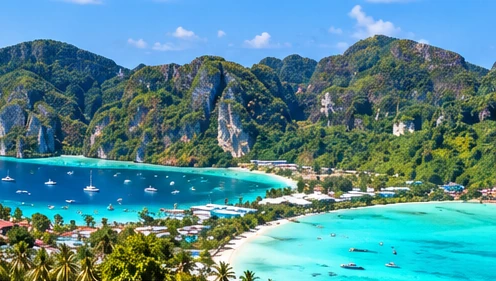
The island's elevated viewpoints are often the source of the familiar twin-bay photographs. Signposted routes involve a climb rather than a level stroll. Confirm the current entrance arrangements locally, bring water and use footwear suitable for steps. The route is described by Thailandee as a sequence of viewpoints reached from the village; its published timings should not be treated as a personal fitness target. [9]
Choose a cooler part of the day and leave enough daylight for the descent. Skip the climb when conditions, fitness or fatigue make it unsuitable. A beach-level view is still a valid way to enjoy Phi Phi. Travelling well does not require completing the same photograph checklist as everyone else.
A realistic three-night Phi Phi itinerary
Arrival day: settle into the actual location
Use the first afternoon to complete the hotel transfer, eat and work out your immediate surroundings. Confirm tomorrow's meeting point in person or with a clear map pin. A short walk near your base is enough sightseeing for the day. Plan dinner somewhere that does not require a complicated late return when you are still learning the area.
For a secluded resort, check the evening meal options before deciding to go into town. For a central room, identify a quieter breakfast option and the route to the pier. These are small tasks, but they reduce the number of decisions competing for attention the next morning. Keep valuables and documents organised before you go to sleep.
Full days: one sea day and one island day
Dedicate one full day to the marine excursion that best fits your interests. Keep the evening relaxed, particularly after a long or bumpy crossing. Use the other full day for the beach, an optional viewpoint and time around your accommodation. This arrangement provides variety without requiring every traveller to enjoy two consecutive boat-heavy days.
Swap the order when weather or operator advice suggests it. On departure day, avoid an activity that could overrun into the return crossing. Check out with enough time to collect luggage and reach the correct meeting point. A three-night booking usually creates two genuinely usable full days, not four interchangeable sightseeing days.
Three nights, two distinct full days
Suggested first-visit rhythm; operator schedules and park access must be checked separately.
Swipe this table sideways to read every column.
| Day | Main idea | Practical note |
|---|---|---|
| Arrival | Hotel transfer and a simple evening | Confirm the next meeting point before bedtime. |
| Full day 1 | One suitable marine excursion | Switch days if conditions make that preferable. |
| Full day 2 | Beach time and an optional viewpoint | Do not make another boat departure compulsory. |
| Departure | Checkout and the correct return boat | Keep any onward airport buffer intact. |
Two nights, four nights or a mainland day trip?
Match the stay to the travel overhead
Two nights can work when the island is one carefully chosen stop between Phuket and Krabi and your connections are straightforward. However, it normally leaves only one full day. Decide whether that day belongs to a boat excursion or to Phi Phi Don itself. Attempting both in detail is where a compact plan becomes rushed.
Four nights allow a gentler pace, an additional beach day or more flexibility around marine conditions. They are most useful when you genuinely like the chosen base. Extra nights do not solve a room beside unwanted nightlife or an isolated hotel when you want independent evenings. Fix the location decision before extending the booking.
Avoid treating the island as a transit lounge
Changing hotels within a very short Phi Phi stay adds another packing and transfer cycle. Unless two locations offer experiences you specifically want, choose one base and enjoy it properly. A three-night split between central and remote accommodation can leave surprisingly little uninterrupted time at either. Longer stays have more room for that kind of experiment.
A mainland day trip is a reasonable alternative for travellers who dislike moving luggage or whose main interest is the marine scenery. Compare the duration in the vehicle and boat as well as the advertised island stops. Be honest about your tolerance for group schedules. A convenient hotel base on the mainland can be more valuable than an extra destination on a list.
Connecting Phi Phi with the rest of the Andaman coast
A through-route can avoid unnecessary backtracking
Phi Phi can be one stop between two mainland bases rather than an out-and-back journey, but only when suitable services operate on your dates. Compare the actual origin and destination piers and the land transport at each end. A booking labelled Krabi may still require a road transfer to the beach area where you intend to sleep. Do not count the entire mainland region as one interchangeable arrival point.
For a Phuket-Phi Phi-Krabi sequence, identify the final flight airport before choosing the order. Then compare the first island departure with your arrival flight and the final mainland transfer with your hotel. The route should reduce duplicated travel, not introduce a fragile connection solely to make a neat line on a map. Keep each operator's confirmation available independently, even when a platform presents the journey together.
Lanta connections need a date-specific check
Bundhaya also publishes a Lanta-Phi Phi service, illustrating a potential link for a wider island itinerary. Its appearance in a general timetable does not establish that every reverse direction, departure point or date is available. Check the live service, seasonal operation and baggage conditions. Do not build a non-refundable hotel sequence around a remembered departure from another season. [2]
For a longer route, count the number of full days rather than only the nights. Three two-night island stops can create more packing and boat time than the holiday you imagined. Choosing two bases with an extra full day at each may be more satisfying. This is particularly relevant when one person enjoys boats and another mainly wants to arrive and settle.
Keep essential travel information separate from the itinerary
Store a simple version containing only dates, operators, piers, meeting times and contact details. Keep restaurant ideas and optional attractions elsewhere. When plans change, the critical information remains easy to find. Share that version with your travel companion rather than leaving all confirmations on one phone. A carefully planned route is more useful when both travellers can understand it during a busy arrival.
Budgeting for the complete stay
Separate published prices from your own allowance
A transport tariff is evidence about one product; a holiday budget is a set of assumptions about your choices. Keep those categories distinct. Record the room total, breakfast, mainland transfer, island boat, onward hotel connection, outings and park fees. This prevents the same transfer being overlooked in one quote and counted twice in another.
For an illustrative calculation prepared on 3 October 2026, consider two adults sharing for three nights: THB 4,000 per room per night, THB 1,800 per day for meals and drinks across three days, THB 3,000 total for transfers and THB 5,000 for one outing and its required fees. The total is THB 25,400. This is a worked planning model, not a current average or a bookable package.
Spend first on the decisions you cannot easily change
Room location and transfer arrangements are harder to fix than an undecided lunch. Put the comparison effort into those items first. Then decide whether a private outing, a particular meal or a room upgrade adds enough value for your group. Avoid spending the entire contingency on extras before you know the weather and your own energy levels.
Read cancellation conditions separately for the hotel and each transport operator. A weather-related boat cancellation does not automatically mean an unrelated room booking is refundable. Ask who to contact if the itinerary changes and keep written answers. Comprehensive travel insurance and appropriate activity cover should be considered against your circumstances rather than assumed from a booking platform badge. [8]
Two adults, three nights: an illustrative budget
Planning example prepared 3 October 2026. Not a live quote or market average; excludes flights.
Swipe this table sideways to read every column.
| Item | Calculation | Allowance (THB) |
|---|---|---|
| Shared room | 4,000 x 3 nights | 12,000 |
| Meals and drinks | 1,800 x 3 days | 5,400 |
| Transfers | Chosen total allowance | 3,000 |
| Outing and required fees | Chosen total allowance | 5,000 |
| Worked total | Sum of the four allowances | 25,400 |
Food, nightlife and everyday essentials
Choose the evening you actually enjoy
A central base makes it easier to sample different restaurants, but it can also place you closer to music and late-night activity. A quiet resort offers a different rhythm, with fewer spontaneous changes of venue. Neither pattern is inherently more authentic. Select the one that suits your sleep, budget and preferred end to the day.
For dietary needs, speak directly to the venue about ingredients and preparation. Do not rely only on the translated name of a dish or a menu symbol. Carry a clear explanation of serious allergies and follow your own medical plan. Keep drinking water available and allow a relaxed meal before an early boat start rather than treating breakfast as an optional extra.
Keep the useful kit compact
A dry bag, a charged phone, suitable footwear and sun protection solve more everyday problems than a large collection of specialist gadgets. Save your accommodation address and transport confirmations offline. A data plan is useful for messages and maps, but a flat battery or weak signal should not erase every piece of arrival information.
Carry enough suitable payment options for smaller purchases and keep a reserve separate from your main wallet. Ask before assuming that a particular business accepts cards or that a domestic Thai payment method will work for a visitor. Take care with valuables on beaches and boats without turning the entire holiday into a security exercise.
Weather, families and access needs
The season does not promise a particular sea state
The drier-season pattern makes some months more attractive for island travel, but it is not a guarantee of calm water on a particular day. Use the Thai Meteorological Department's southern west-coast forecast and the operator's advice close to departure. A published timetable can change when conditions make the planned crossing unsuitable. [10]
Build the final return around the consequence of a delay. For a valuable international flight on a separate booking, a mainland night is my conservative choice. For a flexible onward journey, you may accept a different level of risk. The point is to decide deliberately rather than discovering that the last boat is the only thing standing between you and a missed flight.
Describe specific needs before paying
Families should ask about child-sized life jackets, room stairs and the practical boarding process. Someone with limited mobility should request an explanation of the complete route from pier to room, including any beach landing. Accessibility is not established by a resort's price or a broad platform label. Obtain confirmation for the arrangements you actually need.
For travellers who prefer to avoid extended boat time, reconsider whether Phi Phi is the right overnight destination rather than trying to remove every sea journey from the plan. A mainland base with optional outings may be more comfortable. Choosing a different destination is sometimes better than forcing an unsuitable itinerary to match a famous photograph.
Pros, cons and common mistakes
What works well
Dramatic marine scenery, several styles of accommodation and the option to balance a sea day with time on Phi Phi Don.
The trade-offs
Busy famous sights, a sharp difference between central and secluded bases and weather-sensitive boat connections.
What Phi Phi does particularly well
The combination of dramatic marine scenery, an inhabited island base and several ways to structure a stay gives Phi Phi broad appeal. Its strongest fit is a visitor who actively wants time on and around the water and is willing to plan the transfers properly. A well-chosen location can support either a sociable trip or a more self-contained resort break.
The compromises are crowding at famous sights, transport dependence and the sharp difference between central and secluded accommodation. Common mistakes include booking the wrong departure island, assuming a Tonsai ticket reaches every hotel, expecting unrestricted swimming at Maya Bay and treating a weather-sensitive boat as a guaranteed flight connection. These are preventable planning errors, not reasons to dismiss the islands altogether.
Detailed questions before you book
Can I stay overnight at Maya Bay?
Plan accommodation on Phi Phi Don or another established accommodation base, not on the assumption that Maya Bay is a normal resort beach. Maya Bay is a managed excursion destination with access rules and seasonal restrictions. Choose a tour that explains where it starts, what the visit includes and what happens if access changes. Staying on Don can make an island-based excursion convenient, but it does not grant special permission to ignore park rules or guarantee an empty beach. [1][5][6]
What is the difference between a Phi Phi transfer and a Phi Phi tour?
A transfer primarily moves you between named departure and arrival points. A tour adds an itinerary of visits or activities, often returning to its starting base. The same destination words can appear in both titles, so read the endpoint and luggage arrangements. A mainland day tour may not be a suitable way to reach an overnight hotel with suitcases. Conversely, a ferry ticket does not include Maya Bay sightseeing simply because its route passes through attractive water. Book the product that matches the purpose.
Can I choose a quiet hotel and still eat in Tonsai every evening?
Possibly, but check the transport before assuming that the combination is effortless. A secluded hotel may require a local boat, have weather-dependent services or make late returns impractical. Ask about the last return, the price basis and the alternative if conditions change. A central room away from the busiest evening venues may be a better compromise when independent dinners are a priority. The right hotel is the one that supports the evening you actually want, not only the quiet daytime photograph. [3][4]
Is Long Beach a reasonable alternative to the main town?
It is worth investigating when you want a different beach base and accept the onward connection from Tonsai. Check the particular hotel's arrival meeting arrangements, room terrain and current boat access. Some properties describe alternative approaches at lower tide, so do not assume every arrival looks like the promotional image. Long Beach can be a good fit without being universally superior to a central stay. The trade-off is the balance between your preferred setting and the convenience of repeated trips into town. [3]
Can I visit Phi Phi comfortably without snorkelling?
Yes, provided the itinerary is not built around activities you will merely tolerate. A stay can focus on the hotel, beaches where conditions permit, local meals and an optional viewpoint. For any boat outing, ask how a non-snorkeller spends the water sessions and whether there is shade and comfortable seating. Do not assume that remaining aboard makes a long excursion enjoyable for everyone. A mainland base with a carefully selected sightseeing trip may be a better choice for someone who dislikes extended boat time.
Are park fees included in every Maya Bay ticket?
No universal inclusion should be assumed. Read the specific operator's terms and ask whether the advertised amount covers the applicable park entry, along with the relevant child category. Keep any locally issued receipt as instructed. A lower advertised price can be legitimate when fees are excluded, but compare the final payable total. Also ask how the operator handles a closure or changed route: the rules for an attraction and the refund terms of your tour are related questions, not necessarily identical ones. [6][7]
Should I book the earliest tour to avoid all crowds?
An early departure can change the timing of the visit, but it cannot guarantee an empty site. Other operators may use a similar strategy, and access depends on current rules and conditions. Compare the quality of the itinerary, supervision and realistic time at the places you care about. A very early start is less useful if it leaves the group exhausted for the rest of a short stay. Choose it when the overall schedule suits you, not solely because of an absolute crowd-free promise.
What should I check when a hotel advertises a sea-view hillside room?
Ask about the number and character of steps, the route to breakfast and the beach, and any assistance or internal transport. A view can be worth the climb for some guests and a daily inconvenience for others. Request details for the exact room category rather than the resort as a whole. Families and travellers with limited mobility should discuss their needs explicitly. A beachfront resort can still contain rooms high above its facilities, so the property label does not settle the access question.
Is a same-day ferry and international flight a good plan?
The answer depends on the complete connection, but my conservative recommendation is a mainland overnight before a costly separately booked international flight. The sea crossing, pier disembarkation and road transfer all precede airport formalities, and a delay in any stage can affect the rest. Ask the operator for its guidance and understand the booking protections. Do not calculate the margin using only the shortest advertised sea time. A successful tight connection reported by another traveller is not a guarantee for your day.
How do I avoid spending most of a short stay packing and travelling?
Choose one Phi Phi base and give it at least one genuinely unhurried full day. Avoid splitting two or three nights between central and secluded hotels unless the move itself serves a clear purpose. When linking several islands, count the arrival and departure work at every stop. A route with fewer bases and an extra full day can offer more variety in practice because you have time to use it. Keep optional ideas separate from the essential transport plan so the schedule can remain flexible.
My recommended first visit to Phi Phi
Choose a base, then protect two full days
Book three nights in one location that matches your evenings. Arrange the complete arrival through to reception and choose one marine outing with clearly explained inclusions. Leave the other full day local, with an optional viewpoint rather than a compulsory list. This is the most balanced starting plan for a traveller who wants both the scenery and a little control over the pace.
Add a night when you want more rest or a larger weather buffer; choose a mainland day trip when you do not want the hotel move. Above all, compare the holiday you will actually experience rather than the most attractive individual photographs. Phi Phi works best when its boats, beaches and accommodation form one coherent plan.
Sources and fact-checking notes
Editorial review: 3 October 2026. Tourism-authority pages establish destination context; operator and hotel pages describe their own services. Timetables, fees, access rules and room arrangements can change. Confirm time-sensitive details for your travel date. Suggested pacing, location fit and worked budgets are research-led planning judgements, not guaranteed outcomes.
- Tourism Authority of Thailand: Ko Phi PhiArchipelago background and the inhabited visitor base. Reviewed 3 October 2026.
- Bundhaya Speed Boat: published schedulesOperator-page route, time and fare examples; not a date-specific reservation. Reviewed 3 October 2026.
- Phi Phi The Beach Resort: how to get hereIts Tonsai meeting and Long Beach transfer arrangements; reconfirm current operation. Reviewed 3 October 2026.
- SAii Phi Phi Island Village: getting hereResort-specific marina, arrival and low-tide arrangements. Reviewed 3 October 2026.
- Tourism Authority of Thailand: Phi Phi national parkProtected-area context. Reviewed 3 October 2026.
- Phuket Now: October 2026 Maya Bay reopening reportA dated reopening report, not a guarantee of access on a later travel day. Reviewed 3 October 2026.
- Simba Sea Trips: Maya Bay access noticeOperator information on the seasonal closure pattern, restrictions and published park charges. Reviewed 3 October 2026.
- FCDO: Thailand safety and securityWater, activity and travel-safety considerations. Reviewed 3 October 2026.
- Thailandee: Phi Phi viewpoint routeRoute background only; current entrance arrangements and personal walking pace need a separate check. Reviewed 3 October 2026.
- Thai Meteorological Department: southern west coastCurrent weather context for a boat-dependent stay. Reviewed 3 October 2026.
Illustrations in this article were created for Taylor’s Trailblazing Travels. Third-party photographs, where used, are credited beside the image or in the source list.