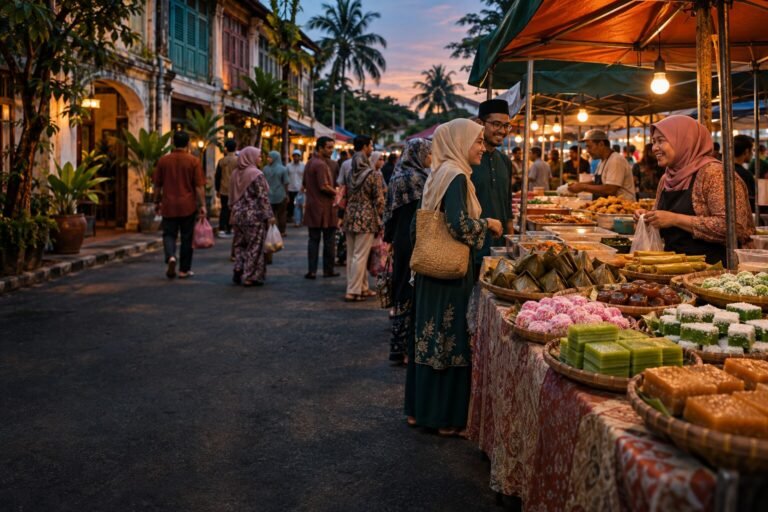
Penang Hawker Food Areas: Where to Eat Around George Town
Choose a compact eating area before you choose a famous stall—and make the evening easier for everyone.
Original editorial illustration; not a photograph of a named restaurant or an exact street view.
The most useful Penang food decision is often where to spend a meal, not which stall has the loudest recommendation. This guide compares hawker-food areas around George Town so you can match the setting to your route, appetite and need for seating or shelter.
Some links are affiliate links. If you book or buy through them, Taylor’s Trailblazing Travels may earn a commission at no extra cost to you.
One area is enough
Choose a main meal and one optional extra without chasing several districts.
Check the trader
A street can be active even when the particular stall you want is closed.
Ask how service works
Food, drinks, tables and payment may have separate arrangements.
Keep the return easy
Your accommodation and the weather matter as much as a famous dish.
Choose the area that fits this meal
Penang Global Tourism identifies New Lane, Chulia Street, the Gurney Drive area, Air Itam and Pulau Tikus among the island’s established hawker-food locations. The heritage organisation’s map also lists Kimberley Street as a streetside-food location. These are useful orientation sources, not evidence that every trader opens every day. [1][2]
| Area | Best reason to consider it | Main trade-off | Planning approach |
|---|---|---|---|
| Chulia Street / Lebuh Chulia | You are already in the central heritage area | The street contains different businesses, not one coordinated food court | Choose a specific cluster after looking at today’s trading |
| Kimberley Street / Lebuh Kimberley | You want a food-focused lane and time to browse | A dish-specific recommendation may depend on one trader | Select a meal first, with a nearby alternative |
| New Lane / Lorong Baru | The Macalister Road side is convenient for your base | It may add unnecessary walking from another part of town | Use it as the evening’s main food destination |
| Cecil Street / Lebuh Cecil | A market setting is part of the attraction | Market and individual-stall hours need checking | Make a deliberate market visit, not a guaranteed late supper |
| Gurney area | You are staying or spending time on that side of George Town | It is not the same compact outing as the central heritage streets | Include the journey and a comfortable return |
| Air Itam or Pulau Tikus | Another planned visit already takes you there | Adding an extra district can consume the time saved on food | Combine food with that district, not an island-wide tasting race |
The “best reason” column is editorial judgement based on convenience and the kind of outing, not a claim about hygiene or a ranking of cooking. A close, suitable counter can be a better choice than a celebrated one across town when your group is tired.

Chulia and Kimberley: choose one central focus
Chulia Street: convenient does not mean one single venue
Use Chulia Street as a starting area rather than treating the entire road as a restaurant. Walk a small section, look at the menus and find somewhere whose food and seating work together. Tourism-board material identifies its hawker tradition, but that does not guarantee a particular bowl or a fixed nightly set of stalls. [1]
For a group, agree the important constraint first. It may be a seat for an older traveller, a simple meal for a child, an ingredient question or a place out of the rain. Once that is settled, choose dishes available in that immediate cluster. Do not make one person carry hot plates through traffic because everyone bookmarked a different counter.
Kimberley Street: make room for browsing
The heritage map lists Kimberley Street for streetside hawker food, while older local reporting describes its noodle and dessert traditions. Use that as background to the area, not a current list of guaranteed vendors. [2][3]
A useful approach is to identify the main meal before buying a dessert or a second snack. Ask what the seller calls the dish and what is in it, then decide whether you still want another stop. This is more satisfying than ordering a sequence because an old blog named four things that “must” be eaten together.
Both areas suit a flexible plan. Neither requires you to prove that you found the single best plate in Penang. Avoid claims that one entire street is vegetarian, halal or suitable for an allergy: the decision belongs at the actual establishment and, where necessary, with the person preparing the food.
New Lane: useful when the location suits your base
New Lane is Lorong Baru, off Macalister Road. That geographic detail matters more to planning than another superlative about its food: it can be a straightforward choice when you are already on that side of George Town. [4]
Before settling in, check where the food you want is served and which tables are available to its customers. Ask about drinks and payment rather than assuming one bill covers everything. If a counter is busy, agree a meeting point with companions instead of forming a group across the working space.
Plan for one proper meal here. An optional extra makes sense only when appetite, seating and the return journey still work. Moving onwards to Chulia and Kimberley because all three appear in a list can turn a relaxed dinner into repeated queues and partially eaten plates.
This area-based recommendation is deliberately not a stall endorsement. Without reliable current confirmation of a trader’s exact opening and location, a familiar name is a lead to investigate, not a promise that dinner will be waiting. Check the current business listing or contact the trader before making a special journey for one dish.
Cecil Street, Gurney and other districts
Cecil Street combines a market with a cooked-food area. Time Out’s older description mentions dishes such as noodle soup, chee cheong fun, asam laksa and kuih; it is useful context, but cannot establish today’s stall line-up or hours. [5]
Make the market itself part of the outing: arrive with enough time to look around, then choose a meal from traders actually serving. Do not arrive late with a fixed list and assume the whole market runs on restaurant-style evening hours. Check access, seating and the route back when the group includes a pushchair or someone who cannot manage lengthy standing.
Gurney, Air Itam and Pulau Tikus appear in the tourism board’s food overview, but they are not interchangeable with the central heritage streets. [1] Their strongest planning case is when your accommodation, sightseeing or another visit already brings you nearby. Otherwise, add the transport cost and door-to-door time before deciding that a cheaper dish makes the trip worthwhile.
You do not need to exclude these places; give them their own space. A meal in Air Itam after another planned activity can be sensible. A last-minute detour there after already eating in two central areas may be less so. The distinction is the shape of your day, not a claim that one district is more authentic than another.
Choose dishes with different roles
Penang’s tourism material highlights char koay teow, asam laksa, Hokkien mee, curry mee and other local favourites. Its food brochure describes important distinctions: asam laksa has a sour fish-based broth, while Penang Hokkien mee uses a prawn-and-pork-stock tradition. A familiar name from another city is therefore not enough to establish the ingredients. [1][4]
For two adults who can eat the dishes offered, a practical sequence is one main each, followed by one shared extra only if wanted. Choose contrasting formats—a soup and a dry dish, for example—rather than several large portions of similar noodles. This is a portion-planning suggestion, not a fixed menu or an instruction to share food when allergies make that inappropriate.
At a nasi kandar or other rice counter, ask what the complete plate will cost after selecting sides. At a noodle stall, clarify the size and any optional additions. A dessert decision comes later: do not buy it automatically while someone else is still negotiating the main meal.
A vegetarian version should be established with the seller, including sauces and cooking base. Removing meat from a finished dish is not the same as changing its stock. Travellers with allergies need a separate preparation conversation and should not rely on an area guide to identify a safe meal.
An original 90-minute one-area plan
Choose one area and use this allowance inside it. The numbers are editorial planning assumptions, not measured queue times, advertised service times or walking guarantees.
| Part of the outing | Allowance | What to do |
|---|---|---|
| Browse and choose | 10 minutes | Look at menus, seats, shelter and payment arrangements |
| Ask, order and wait | 20 minutes | Check ingredients and agree the total |
| Main meal | 35 minutes | Sit down and eat without planning the next queue |
| Optional nearby extra and departure | 25 minutes | Add a small second stop only if comfortable, then pay and leave |
| Total within the chosen area | 90 minutes | Add journeys to and from the area separately |
If ordering takes 35 rather than 20 minutes, keeping the main meal relaxed leaves 10 rather than 25 minutes for the optional part: 10 + 35 + 35 + 10 = 90. Drop the extra rather than squeezing the meal or rushing a crossing. If the delay exceeds that allowance, extend the outing or choose another available venue.

With children, the optional part might be a quiet drink rather than another food queue. With limited mobility, it may be better to remain at one seated venue throughout. A good plan is one you can shorten without losing its purpose.
Let your accommodation and the complete bill guide the choice
For a food-focused stay, compare the actual hotel entrance with your intended eating area, not just the “George Town” label. Ask about the route after dark, possible steps and noise at the room you are booking. Being above an active food street may suit one traveller and frustrate another who wants an early night.
These are destination searches, not a vetted hotel shortlist or a live price comparison. Booking.com’s George Town page is a city search; Agoda’s Penang search covers a broader destination, so use the map to keep the results near your chosen area. [7]
Search George Town stays on Booking.com Compare Penang stays on Agoda
For the meal itself, add dishes, drinks and transport rather than comparing only headline dish prices. In a purely illustrative example, RM24 of mains, RM10 of drinks and RM8 of optional food total RM42; an RM18 return journey would make the outing RM60. These are arithmetic inputs, not current prices. Replace each with the actual quote before choosing a farther area to save money.
When a guided food walk is worth considering
A guide can help organise the sequence and explain why similar-looking dishes differ. That is useful when you want context and are comfortable following a fixed route. Independent eating is better when you want one seated meal, an early finish or control over every ingredient discussion.
GetYourGuide’s George Town food page offers a starting point for comparing experiences. Check the actual walk, meeting point, number of seated stops and dietary exclusions rather than buying on tasting count alone. [6]
Compare George Town food walks
Ask what happens in heavy rain and whether the tour finishes near convenient transport. A statement that a guide can discuss allergies does not mean a mixed hawker itinerary can accommodate them. Obtain a clear answer about the specific requirement before paying, and choose a different format when the answer is uncertain.
Before you set out
Can I cover the main food areas in one evening?
You can choose to move between areas, but it is not necessary for a good meal. For most short visits, one main area with an optional nearby extra is the more comfortable starting plan. Add another district only when you have a specific reason and enough time.
Are all the named stalls open every night?
An area guide cannot establish that. Individual traders may have separate rest days, sell out or change location. Check the specific trader rather than treating an active street as proof that a particular recommendation is available.
Is an outdoor stall automatically cheaper or better?
No useful choice follows from the setting alone. Compare the actual portion, ingredients, seating and total cost. A sheltered meal that everyone can eat may be better value for your group than a cheaper plate followed by another journey.
Which area should I choose first?
Choose the area that fits the part of George Town you will already be in, then verify one suitable meal and one backup. Keep food within the day’s wider destination planning, rather than letting a list of names dictate every movement.
Sources and research notes
This is a research-led guide, not an account of personal restaurant visits. Sources were reviewed on 7 November 2026; recipe examples show possible ingredients, not every vendor’s formulation. Older tourism material is used for background and location, not current prices or opening hours. Worked plans and budgets are explicitly illustrative.
- Penang Global Tourism: FoodTourism-board overview of dishes and hawker districts, not an individual-stall timetable.
- George Town World Heritage Incorporated: Historic City of George Town mapText listing of Kimberley Street and heritage-area eating places; not a live trading directory.
- iNPENANG: Never Enough of Kimberley StreetHistoric food-street context; does not establish current individual traders.
- Penang Global Tourism: Penang Street Food brochureOlder brochure used for dish descriptions and geographic orientation only; not current hours, prices or certification.
- Time Out Penang: Cecil Street MarketOlder editorial description of the market and cooked-food area; no historical prices or hours reproduced.
- GetYourGuide: George Town food and drink experiencesComparison page only; no live reservation or dietary accommodation is implied.
- Booking.com: George Town accommodation searchDestination search, not a specific hotel recommendation or live rate quotation.
Illustrations in this article were created for Taylor’s Trailblazing Travels. Third-party photographs, where used, are credited beside the image or in the source list.