Getting Around Malaysia: When to Use Trains, Buses, Flights, Ferries or a Car
Match the mode to the journey, including the time and cost at both ends.
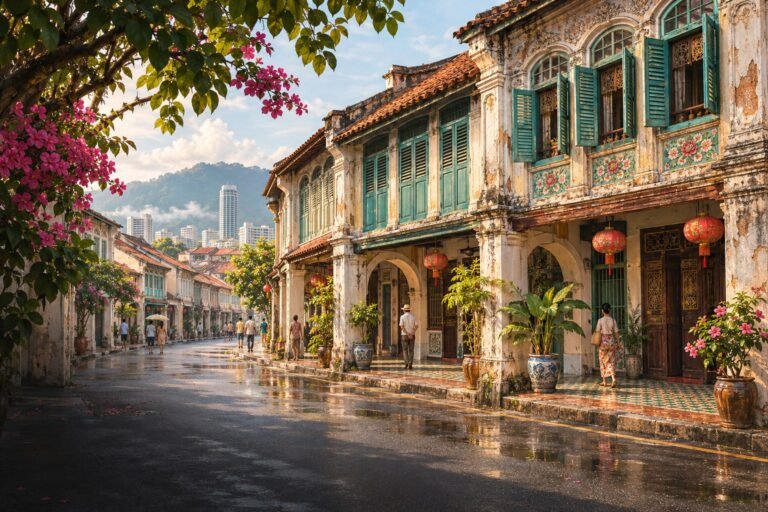
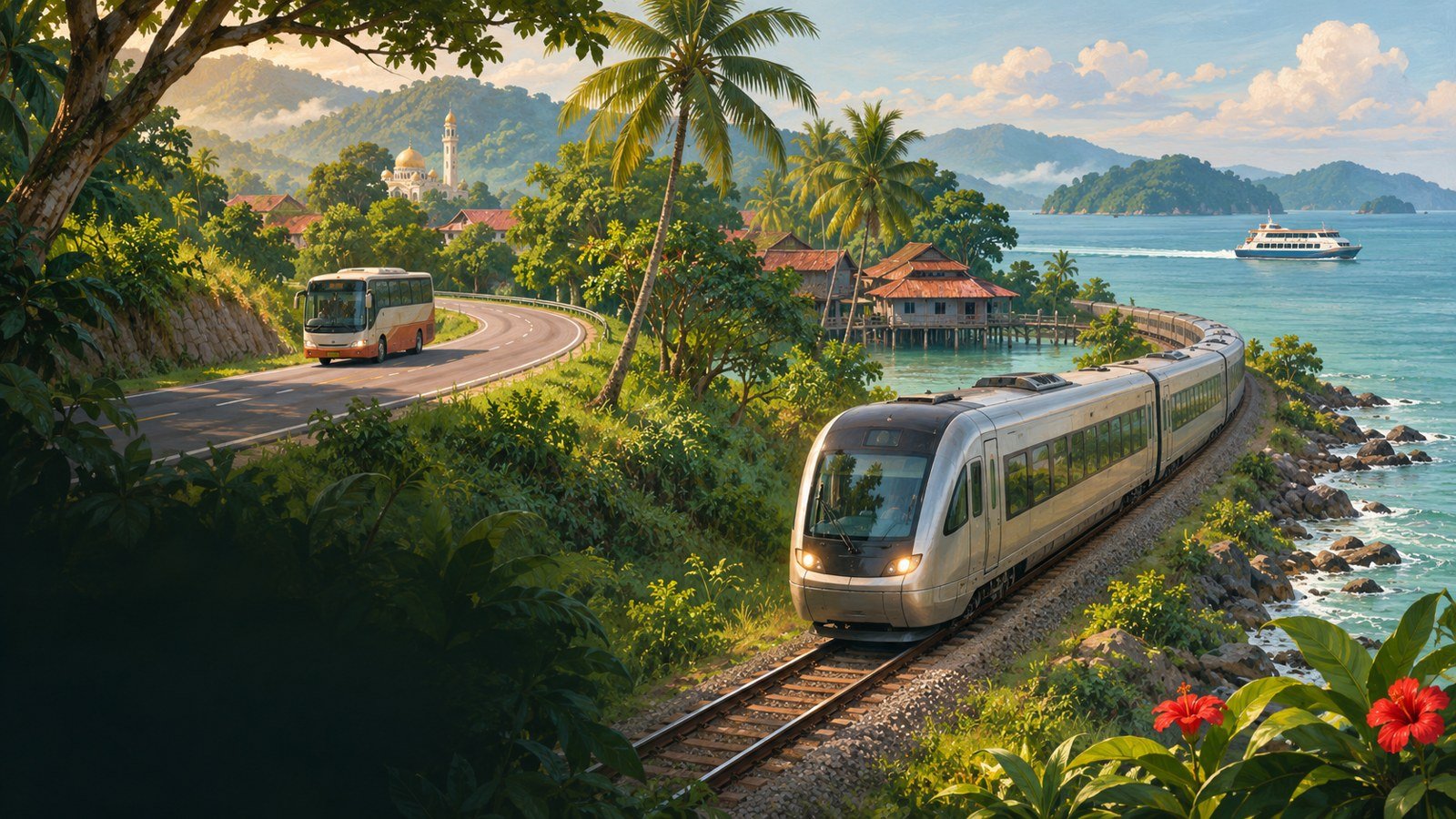
AI-generated conceptual transport illustration; it does not depict a verified route or operator.
Getting around Malaysia works best when you choose transport for each leg. Start with trains for useful western Peninsula city pairs, coaches where rail is inconvenient, flights for the jump to Borneo, ferries for island access and a car or driver when several scattered stops justify one.
The shortest advertised journey is not always the quickest hotel-to-hotel trip. Stations, airport terminals, ferry check-in and the final transfer can change the answer. Decide those details before fixing a tight itinerary.
Some links in this guide are affiliate links. Taylor’s Trailblazing Travels may earn a commission if you book or buy through them.
Compare the whole journey
Add terminal access, waiting, baggage and the final ride to the advertised journey time.
Check the actual stop
A ticket to a city or island may leave a substantial transfer to your accommodation.
Book the awkward leg first
Build hotel dates around a limited connection or an essential ferry, after checking current operations.
Mix modes
A train-and-driver combination can suit a trip better than keeping a rental car throughout.
Getting around Malaysia: choose a mode for the job
| Mode | Start here when… | Main trade-off | Cost items to compare |
|---|---|---|---|
| Train | Your stops fit the western Peninsula rail corridor.[1] | Fixed stations and departure times; the hotel may need another transfer. | Ticket for each traveller, station access and onward transport. |
| Coach | The route or terminal is more useful than the available rail option. | Road traffic, stops and operator-specific boarding procedures. | Ticket, booking fees where charged, luggage terms and terminal transfers. |
| Flight | You are crossing between the Peninsula and Borneo, or avoiding a lengthy journey within Borneo. | Airport access, check-in, baggage and the consequences of separate tickets. | Final fare including the bags and changes you need. |
| Ferry or boat | Your island or riverside destination needs a water transfer. | Correct jetty, weather, operating dates and onward arrangements. | Crossing, terminal transfer, relevant fees and island-side transport. |
| Car or driver | You need several rural stops, flexible departures or door-to-door travel for a group. | Parking, responsibility, road conditions and one-way arrangements. | Hire or driver quote, fuel, tolls, parking, insurance and drop-off charges. |
Make a short list of viable options before comparing price. A cheap ticket that arrives after the final onward boat is not the cheapest complete journey. Similarly, a car may be good value for four people making several stops but poor value when it sits in a city car park.

Use trains where the route matches the railway
KTMB’s ETS timetable provides useful links between Kuala Lumpur, Ipoh and Butterworth, alongside other western Peninsula stations. The timetable effective 1 June 2026 also includes JB Sentral: advice that presents Gemas as the fixed southern limit of every ETS journey is outdated. Individual trains have different stops, so check the service you intend to book.[1]
The train is a strong first comparison if both hotels are convenient for the stations and you want a predictable structure to the day. It is less persuasive when reaching the station, waiting for the only useful departure and making a long onward transfer outweigh the rail journey itself.
“Penang” is not a railway platform in George Town
Butterworth is the mainland rail stop for a Penang trip. Check how you will continue to your particular hotel, including the ferry or road option and its operating arrangements. The Penang tourism authority describes road, rail, air and sea access; the best combination depends on which part of Penang you are staying in.[2]
Book against the station names shown on the official timetable. Check the date, passenger details and service type, and retain the final ticket offline. Leave enough time for finding the platform with your luggage; a connection that works on paper may be uncomfortable with children or limited mobility.
Do not transfer the Peninsula rail model to Borneo. Sabah’s railway runs through its western and interior corridor, including Tanjung Aru, Beaufort and Tenom. It does not provide a railway between the major Sabah and Sarawak gateways or a train to Sandakan.[3]
Back to top ↑Choose a coach for useful coverage and a sensible arrival
A coach can be the straightforward option when the train does not serve your intended town conveniently, or its departure and arrival points fit your accommodation better. Compare operators and endpoints before looking at the lowest fare.
Kuala Lumpur does not have just one interchangeable bus stop. For example, Plusliner’s Kuala Lumpur–Penang information lists departures involving TBS, KL Sentral and Hentian Duta, with Penang arrivals at Sungai Nibong or Penang Sentral depending on the service.[4] These names change the journey at both ends.
Check the ticket instructions, not an old screenshot
TBS’s booking guidance says confirmation and tickets are sent by email, and passengers should carry identity evidence with their booking.[5] Read your current ticket for gate access, any boarding-pass step and arrival requirements. The procedure for one terminal or booking channel does not establish the procedure for every coach.
A daytime service is often the more comfortable planning choice if you want to see where you arrive and avoid relying on sleep in transit. An overnight coach may save a room night, but consider the practical cost: early arrival, luggage storage, tiredness and an uncertain check-in time. Compare the named operator as well as the departure time.
Compare an actual route
Use 12Go’s Kuala Lumpur–Penang search to compare the options advertised for that journey, then check the named operator and exact terminals. Compare the final payable amount and change conditions with booking direct. A route search is not a promise that every mode has seats on your date.
Fly for the big geographical jumps, then add the airport time
Plan a flight when moving between Peninsular Malaysia and Sabah or Sarawak. Within Borneo, compare the full road journey with available flights instead of assuming nearby-looking names on a small map will make an easy transfer. Keep the destination airport and the final lodge or hotel transfer in the same plan.
Even on a domestic journey from the Peninsula to East Malaysia, carry your passport for immigration control and entry and exit stamps.[6] Keep it accessible rather than in checked baggage.
A shorter flight does not remove the rest of the journey
The example below explains the method. It is hypothetical: replace every input with the service, terminal, hotel and airline requirements you will actually use.
| Part of the journey | Train example | Flight example |
|---|---|---|
| Hotel to departure terminal | 30 minutes | 60 minutes |
| Before departure | 30 minutes | 120 minutes |
| Main journey | 240 minutes | 60 minutes |
| Arrival and baggage allowance | Included in onward allowance below | 30 minutes |
| Onward journey to hotel | 45 minutes | 45 minutes |
| Total | 345 minutes: 5 hours 45 minutes | 315 minutes: 5 hours 15 minutes |
Here, a three-hour difference in the main journey becomes a thirty-minute difference overall. Different inputs can favour either option. Add the transport cost at both ends before deciding whether that time saving is worth the final flight price.
- Match the airport and terminal to the booking, particularly when connecting.
- Price the checked baggage you need, not just the first fare shown.
- Check check-in, bag-drop and gate-closing rules with the operating airline.
- Establish whether connections are protected on one booking or separate journeys for which you carry the missed-connection risk.
If an international departure is expensive or hard to replace, work backwards from that flight and allow a recovery margin. The correct buffer depends on the actual services; a universal two-hour or overnight rule cannot guarantee protection.

Build the land and water legs together
A ferry ticket is only one part of an island transfer. Confirm the mainland departure jetty, island arrival point, boarding time and how the accommodation will meet you. Check the return sailing before booking a mainland train or flight.
For Langkawi, Langkawi Ferry Line lists passenger services from Kuala Kedah and Kuala Perlis. Its guidance requires passengers to be inside the terminal at least sixty minutes before departure, with more time sensible when additional checks or queues apply.[7] Reconfirm the instructions on your ticket.
Do not build an itinerary around an assumed direct Penang–Langkawi ferry: the former operator’s website says that service has ended and points passengers towards Kuala Kedah or Kuala Perlis.[8] Compare a currently operating alternative for your travel date.
Seasonal availability needs a destination-specific check
METMalaysia explains that the northeast monsoon, generally November to March, can bring heavy rain and rough seas affecting the Peninsula’s east coast and parts of Borneo.[10] This is not a fixed closure calendar for every ferry. Confirm the actual service and accommodation operation, then recheck nearer departure.
For a boat transfer, ask about boarding steps, luggage handling, lifejackets and the arrangements if the crossing is cancelled. Decide your fallback before paying for the onward journey, so a missed crossing does not force an improvised connection.
Back to top ↑Hire a car for the days that benefit from one
A car or private driver earns its place when you want several dispersed stops, need a door-to-door transfer or would otherwise buy multiple taxis for a group. Start with the specific day or region that needs that flexibility; you may not need a car for the whole holiday.
A city-to-city railway trip followed by a day with a driver can remove parking and rental-return complications. Conversely, a rural stay with little convenient onward transport may justify keeping a car. Price both versions using the same itinerary.
UK drivers need their UK driving licence and a 1949 International Driving Permit for Malaysia; obtain the permit before departure.[9] Check the rental firm’s own age, licence, deposit and insurance conditions before booking.
Compare the full hire or driver quote
- Does the vehicle fit everyone and their luggage without improvisation?
- Are tolls, fuel, parking, waiting time and any one-way charge included?
- What insurance excess, exclusions and deposit apply?
- Can the vehicle go on the intended road or ferry, and is permission required?
- For a driver, which stops and hours are included, and what happens if you run late?
Be conservative with unfamiliar rural routes after a long flight. Treat a mountain or rainforest transfer as its own journey, with time for conditions and stops. A route planner’s duration is an input, not an obligation to reach the hotel by that time.
Back to top ↑Finish the journey: airports, cities and local rides
In Kuala Lumpur, the airport train can remove the road-traffic part of the airport transfer, but it still ends at a station. KLIA Ekspres connects the airport terminals with KL Sentral; the operator’s planning information gives twenty-eight minutes between Terminal 1 and KL Sentral. That does not include waiting, baggage collection or reaching your hotel.[11]
Compare the train plus onward transport with a direct car for your whole party. A hotel beside a useful rail connection can change the calculation; so can heavy luggage, a late arrival or difficulty using stairs. Check current accessibility and assistance for the exact service rather than relying on the word “accessible”.
For local rides, use a clearly identified booking, verify the vehicle and driver, and check the pick-up point in the app or confirmation. Arrange a return ride for a remote outing instead of assuming an urban service will be available there.
Keep tickets and directions available
Save confirmations and destination addresses offline. If you want mobile data, browse Airalo’s eSIM store and select Malaysia. Check device compatibility, activation and the package’s network coverage before buying. Airalo offers Malaysia data plans, but mobile coverage should not be assumed in every remote location.[12]
A booking order that leaves room for problems
- Mark your fixed arrival and departure flights, then count the nights between them.
- Find the least flexible leg: perhaps an island boat, a flight to a smaller gateway or a lodge transfer.
- Check that leg’s operation and accommodation together before paying for surrounding nights.
- Compare the complete door-to-door journey and final price for the remaining legs.
- Save tickets, addresses, terminal names and operator contact details offline.
- Check service notices and weather before travel. Know whether the fallback is a later departure, another mode or an extra night.
Record each leg in the Trip Itinerary Planner, with the access journey and contingency in your notes. It is an organiser; the operator remains the source for live departures and booking conditions.
Can you travel without hiring a car?
Yes, when you choose bases and accommodation around workable public transport and arrange any awkward final transfers. A trip becomes harder without a car when it assumes spontaneous access to several remote stops. Change the route or book a driver for those days.
Should you book everything in advance?
Secure the constrained connections and any dates you cannot move. Keep flexibility where it has value and where alternative departures genuinely exist. An empty search result can mean sold out, not yet released or not operating; check with the operator before changing the whole itinerary.
Is a through-ticket always better?
It can simplify a connection, but read the actual protection and conditions. Two tickets bought on the same website are not automatically one protected journey. Ask who is responsible if the first leg is late.
Choose the mode that fits the route, the party and the consequences of delay. A practical Malaysia trip can use a train, a flight, a ferry and a short driver transfer without needing one mode to do every job. Continue through the Malaysia transport hub for the country transport collection.
Back to top ↑Sources and research notes
Research reviewed on 6 November 2026. The mode selector and door-to-door calculation are original planning tools. Live fares, seat availability and individual connections need checking for your dates.
- KTMB: ETS timetable effective 1 June 2026 — stations and service coverage.
- Penang Global Tourism: Getting to Penang — mainland rail arrival and onward access options.
- Sabah State Railway: Routes and Stations — western Sabah and interior railway coverage.
- Plusliner: Kuala Lumpur–Penang route information — examples of differing departure and arrival terminals.
- Terminal Bersepadu Selatan: booking FAQs — confirmation, tickets and identification.
- FCDO: Malaysia entry requirements — domestic travel into East Malaysia.
- Langkawi Ferry Line: routes and passenger FAQs — Kuala Kedah, Kuala Perlis and boarding guidance.
- Langkawi Ferry Services: Penang–Langkawi service notice — discontinuation of that operator’s direct service.
- FCDO: Malaysia safety and security — UK driving licence and International Driving Permit.
- METMalaysia: Weather Phenomena — northeast monsoon and marine disruption context.
- KLIA Ekspres: airport transfer planning FAQs — airport rail and onward city transport.
- Airalo: Malaysia eSIM plans — product destination and compatibility considerations.
Illustrations in this article were created for Taylor’s Trailblazing Travels. Third-party photographs, where used, are credited beside the image or in the source list.