Kuala Lumpur Street Food: Jalan Alor, Kampung Baru and Other Areas
Choose between a lively food street, a Malay-food neighbourhood and other city eating areas without cramming them into one evening.
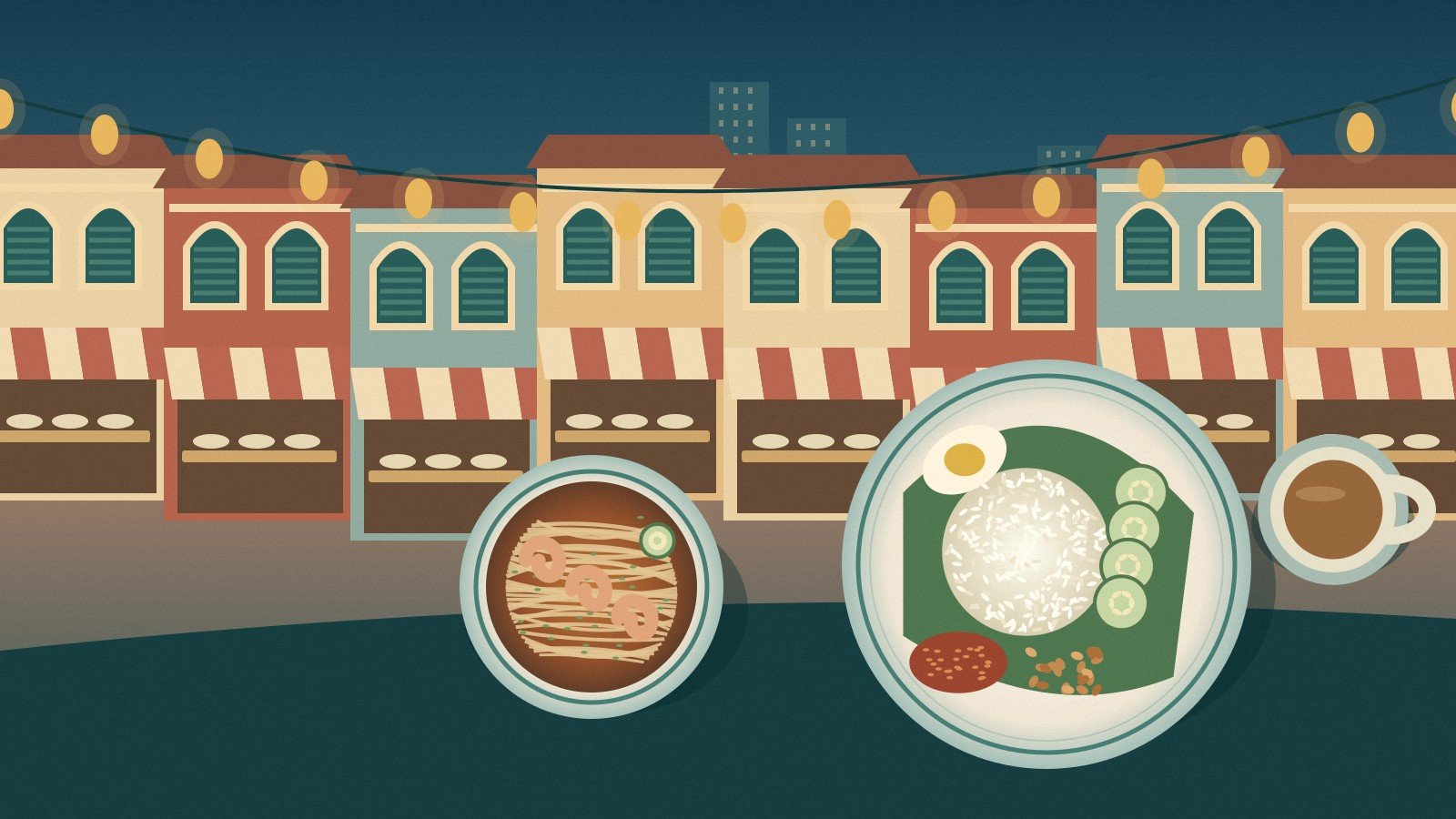
Original editorial illustration; not a photograph of a named restaurant or an exact street view.
Jalan Alor is an approachable place to begin, but it is only one way to eat in Kuala Lumpur. The better choice depends on the food you want, the part of the city you are already in and how much walking or uncertainty you are comfortable with. Start with an area and a workable meal, then add variety on another day.
Some links are affiliate links. If you book or buy through them, Taylor’s Trailblazing Travels may earn a commission at no extra cost to you.
Choose the food first
A famous street is not automatically the right place for your dietary needs.
Keep one main area
Cross-city transfers can swallow a short evening.
Ask for the full price
Confirm portions, additions and seafood pricing before ordering.
Use an honest fallback
An indoor food court is useful shelter, but not the same experience as a street meal.
Compare the areas before choosing a dish
Tourism Malaysia places Jalan Alor in the Bukit Bintang area and describes its variety of hawker and restaurant food. Prasarana identifies Kampung Baru with traditional Malay food and local neighbourhood life. Those are different reasons to visit, not competing claims to be the only “real” Kuala Lumpur. [1][2]
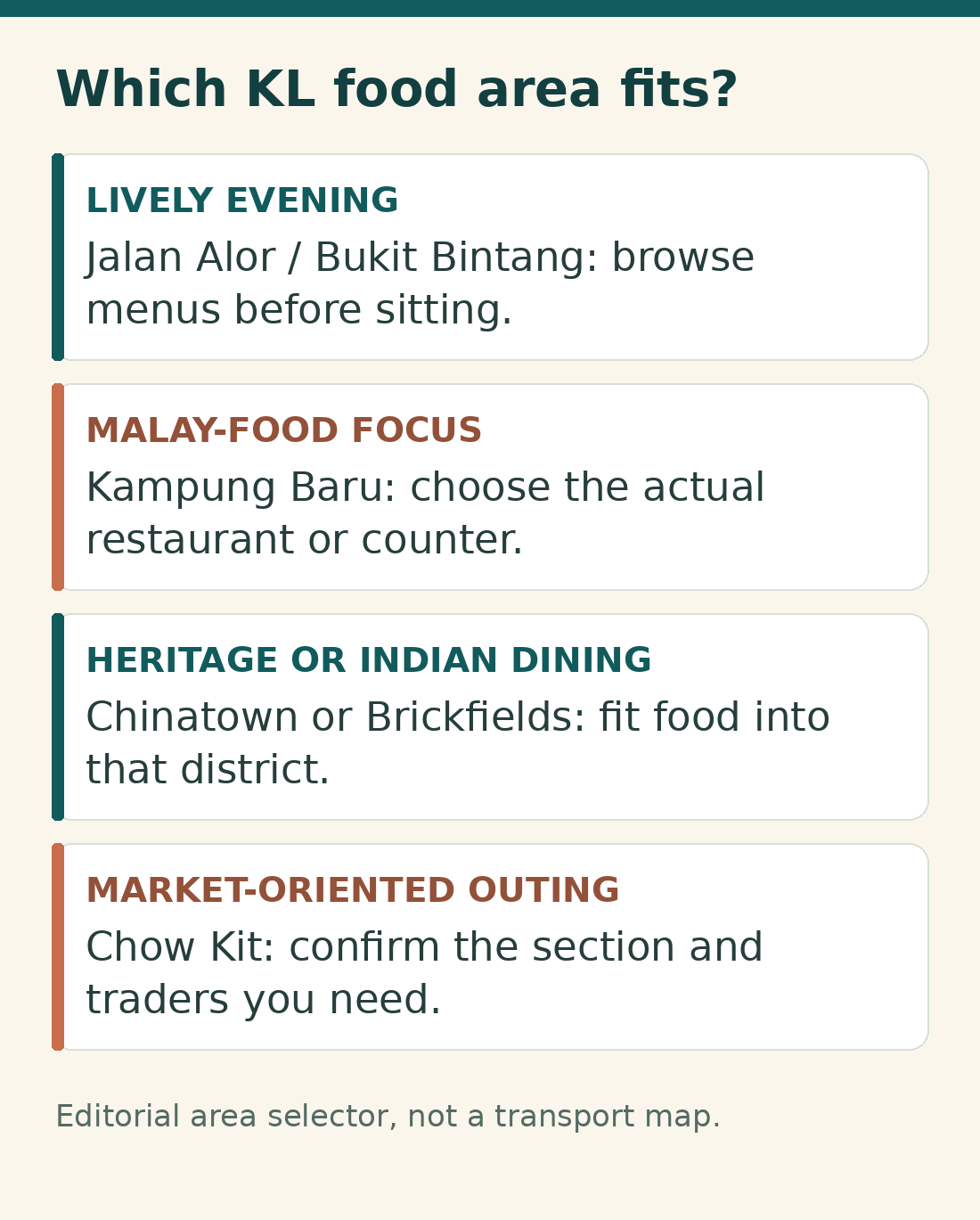
| Area | Strongest reason to choose it | Main limitation | A sensible starting plan |
|---|---|---|---|
| Jalan Alor | A lively evening with visible menus and several choices | Busy outdoor conditions may not suit everyone | Browse, choose one venue, then decide on an optional extra |
| Kampung Baru | A Malay-food-focused meal within a living neighbourhood | One restaurant’s menu or hours do not represent the whole area | Identify a suitable counter or restaurant before setting out |
| Chinatown / Petaling Street surroundings | Food alongside an existing heritage-area visit | Different lanes and venues operate independently | Match one meal to the part you will actually explore |
| Brickfields | Indian dining as part of a Little India visit | “Vegetarian” does not establish dairy-free or vegan cooking | Choose a restaurant that can answer ingredient questions |
| Chow Kit | A market-oriented food outing | Market sections and cooked-food traders have separate rhythms | Check the exact destination and current trading information |
Tourism Malaysia’s older Chow Kit feature also identifies food in Kampung Baru, Chinatown and the Jalan Masjid India area; federal-territory material places Little India dining in Brickfields. Use those sources for orientation, not a current timetable. [3][4]
No score is assigned for “authenticity”. The decision criteria here are a clear food preference, a convenient journey, comfortable seating and the ability to confirm what you are ordering. The right area for a quick arrival-night meal may be different from the one you choose for a dedicated food walk.
Jalan Alor: an easy introduction, with a few checks
Jalan Alor is near Bukit Bintang. Tourism Malaysia lists grilled food, noodle dishes and seafood among its offerings and identifies Bukit Bintang MRT and Monorail as useful access points. Check the current station exit and route for your destination rather than treating “nearby” as an accessibility guarantee. [1]
Look along a manageable stretch before accepting a table. Read the menu, check the dish size and make sure the people in your group can all find something suitable. Picture menus help identify dishes, but the picture is not an ingredient list. Ask about a sauce, broth or marinade when it matters.
For seafood, establish what the quoted price buys. Is it a portion, a whole item, a particular size or a weight-based price? Ask for the expected total before preparation. This is ordinary price clarity, not an assumption that sellers are trying to mislead you.
A good first visit can consist of one main meal. Staying longer is worthwhile when you enjoy the atmosphere, not because a guide insists you try every stall. For quieter conversation, easier ingredients or a child who has had enough, choose a suitable seated venue and stop moving between counters.
Do not infer halal, vegetarian or allergy suitability from the street name or from other customers. Establish the specific venue’s status and ingredients. A varied food street is precisely the place where blanket dietary assumptions are least useful.
Kampung Baru: make the meal the centre of the visit
Kampung Baru combines traditional Malay-food interest with residential streets and surviving older houses. Prasarana’s neighbourhood guide identifies Kampung Baru station on the Kelana Jaya LRT line as an arrival option and describes the Saloma Bridge connection towards KLCC. [2]
Choose the meal first, then decide whether a neighbourhood walk is comfortable. A rice-based meal can work well when each person can select a clear plate, but confirm the complete cost after additions. Ask which sauces are already part of the preparation and which can be served separately.
Respect the residential setting. Stay on public routes, keep noise reasonable and ask before photographing people or looking into a home. A skyline view does not make a private doorway part of a visitor attraction. Include the return route before adding a bridge visit after dinner.
Treat a specific restaurant recommendation as something to verify. The fact that a neighbourhood is known for food does not prove a chosen business serves continuously or will have the dish you want. Older tourism features mention night-market activity; this guide does not reuse their historical schedules as current opening information. [3]
Kampung Baru is the stronger choice when your actual preference is a Malay-food-focused meal and the journey fits your day. Jalan Alor may be simpler when you are already in Bukit Bintang and want a broad choice close to your accommodation. Neither answer requires dismissing the other neighbourhood.
Chinatown, Brickfields and Chow Kit: different purposes
Chinatown and Petaling Street surroundings
Use a Chinatown food stop to support the heritage-area visit you already want to make. Tourism Malaysia identifies Petaling Street within the city’s market and food landscape. [3] Choose an actual eating place rather than expecting every retail lane to offer the same meal options.
For a plant-based alternative, The Hungry Tapir’s own menu describes dishes including mushroom satay and a tempeh-and-mushroom nasi lemak. Its published address is on the first floor at 135 Jalan Petaling, so confirm access directly when stairs would matter. These are provider-described options, not a personal restaurant review or a promise of today’s availability. [6]
Brickfields / Little India
Brickfields makes sense when Indian food is the aim and you are already visiting that part of the city. Federal-territory visitor material identifies the district as Little India. [4] Decide whether you want a proper seated meal, a bread-based order or a small snack, then look for a venue that can explain its preparation.
Vegetarian cooking can still involve dairy. Ask separately about ghee, butter, milk and yogurt when eating vegan. Do not assume a dish has no animal ingredients because its name mentions vegetables or lentils. The most useful recommendation is often a clear answer from the kitchen, not a longer walk to a better-known name.
Chow Kit
Chow Kit is useful for travellers interested in a market-oriented outing. Tourism Malaysia describes the market and surrounding food areas, but its older feature is not a reliable guide to current individual trading hours. [3] Verify which section you intend to visit and whether cooked food is being served at the time you plan to go.
For a short first visit, do not combine all three districts with Jalan Alor and Kampung Baru. Give each a different role on separate days: a meal near the station, food during a heritage visit or a deliberate market morning. That offers variety without spending the evening in transit.
A wet-weather alternative near Bukit Bintang
Lot 10 Hutong lists its address on the lower-ground level of Lot 10 Shopping Center, at 50 Jalan Sultan Ismail. Its own menu includes Chinese hawker dishes such as pork wonton noodles and porridge with pork. It is an indoor alternative, not an open-air food street and not an automatically suitable halal or vegetarian fallback. [5]
Keep it in mind when shelter matters, but check the current food options for everyone before moving there. A backup should solve your actual problem: rain, a need to sit, simpler ingredients or less walking. It is not useful merely because it is famous or indoors.
During a downpour, do not turn an optional food stop into a forced walk. Pause somewhere appropriate, shorten the plan or choose a closer suitable venue. Leave time for the journey back and confirm the transport option rather than assuming a short map distance will be pleasant on foot.
Build a two-hour evening around one meal
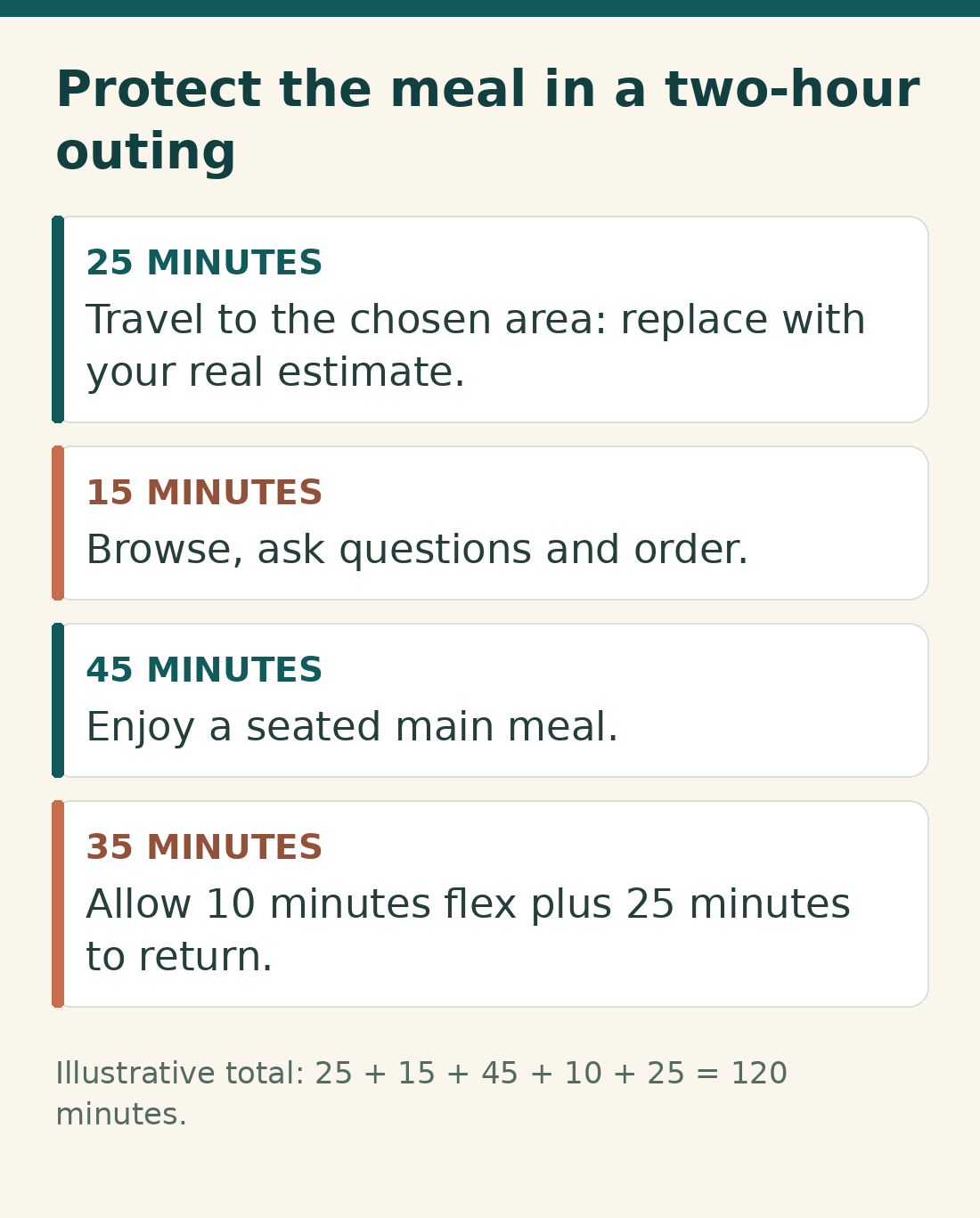
The following is a worked planning model, not a measured journey or restaurant timetable. It starts and finishes at your accommodation or other starting point; replace the travel allowances with your actual route estimate.
| Component | Illustrative allowance | Decision it protects |
|---|---|---|
| Outward journey | 25 minutes | Choose a food area within the evening you have |
| Browsing and ordering | 15 minutes | Check ingredients, portions and prices before committing |
| Seated main meal | 45 minutes | Avoid rushing the reason you came |
| Flexible time | 10 minutes | Optional extra, a short delay or simply leaving calmly |
| Return journey | 25 minutes | Keep the trip home inside the available time |
| Total | 120 minutes | One area, not a multi-district tour |
If each journey actually takes 40 minutes, the same plan requires 150 minutes. Removing the 10-minute optional allowance still leaves 140 minutes; it does not magically fit into two hours. Choose a nearer area or deliberately allow longer instead of cutting the meal to an uncomfortable length.
For a family, the protected meal might include a pause after ordering before anyone explores another counter. For a solo traveller, it can mean choosing a table where you can keep your belongings beside you rather than repeatedly leaving them to collect food. Adapt the shape of the plan, not just the list of dishes.
Choose a guide or an independent meal
A guided food walk is most valuable when explanation and a planned tasting sequence are the purpose. It is less attractive when your main need is one dinner, a quiet seat or complete freedom to leave early. Compare the distance, duration, meeting point, drinks and dietary exclusions before looking at the headline number of tastings.
The linked page is a Kuala Lumpur street-food comparison page; no individual tour is endorsed here as suitable for every diet. Obtain the operator’s answer to your specific needs before booking. [7]
Compare Kuala Lumpur street-food tours
For accommodation, compare the actual entrance-to-dinner route and room noise rather than booking solely because the hotel appears in a fashionable district. These links are city searches, not a list of inspected hotels. [8]
Search Kuala Lumpur stays on Booking.com Compare Kuala Lumpur stays on Agoda
Keep meals, drinks and transport in the same budget. A cheaper dinner across town may not be cheaper after two journeys. No live menu prices or room availability have been assumed in this guide.
Useful questions before dinner
Is Jalan Alor only for tourists?
That label does not answer whether it suits you. Its practical strengths are its Bukit Bintang location and visible range of choices; the relevant question is whether a particular venue fits your appetite, budget and dietary requirements. [1]
Can I walk between all the areas?
Do not plan a multi-area food outing from names on a list alone. Check the complete route, crossings, weather, current access and everyone’s walking tolerance. A short rail or road journey can be more sensible than insisting every food stop belongs on one walk.
Should I reserve a food tour for my arrival night?
Only when you can comfortably meet its start time and terms. A delayed arrival can make a fixed meeting point stressful. An independent meal near your accommodation is a more flexible first-night choice; leave a guided experience for a day you can protect.
What is the best first decision?
Choose one area for a clear reason, identify a suitable main meal and save the route home. Add other neighbourhoods to later days through the wider destination guides, rather than trying to eat the entire city in one sitting.
Sources and research notes
This is a research-led guide, not an account of personal restaurant visits. Sources were reviewed on 7 November 2026; recipe examples show possible ingredients, not every vendor’s formulation. Older tourism material is used for background and location, not current prices or opening hours. Worked plans and budgets are explicitly illustrative.
- Tourism Malaysia: Jalan Alor: A Taste of Malaysian Street FoodLocation and Bukit Bintang rail access; indexed text consulted.
- Prasarana Malaysia: Timeless and Enduring: The Unique Charm of Kampung BaruNeighbourhood context and Kampung Baru station on the Kelana Jaya LRT line; no service timetable reproduced.
- Tourism Malaysia: Discover Kuala Lumpur from the Heart of Chow Kit2018 trade feature used for established food-neighbourhood context only, not current night-market schedules.
- Department of Federal Territories, River of Life: Shopping & DiningBrickfields/Little India and city dining-area context.
- Lot 10 Hutong: Official food court website and menuAddress and examples of Chinese hawker dishes; individual menus and service times can change.
- The Hungry Tapir: Official restaurant website and menuPlant-based local dishes and first-floor Jalan Petaling address; contact the restaurant for current access and service.
- GetYourGuide: Kuala Lumpur street-food experiencesComparison page only; dietary suitability, itinerary, dates and price need checking with the selected provider.
- Booking.com: Kuala Lumpur accommodation searchDestination search, not a specific hotel recommendation or live rate quotation.
Illustrations in this article were created for Taylor’s Trailblazing Travels. Third-party photographs, where used, are credited beside the image or in the source list.