Travelling in Malaysia During Ramadan: Food, Etiquette and Trip Logistics
Arrange the practical details around local meals, worship and the festival travel calendar.
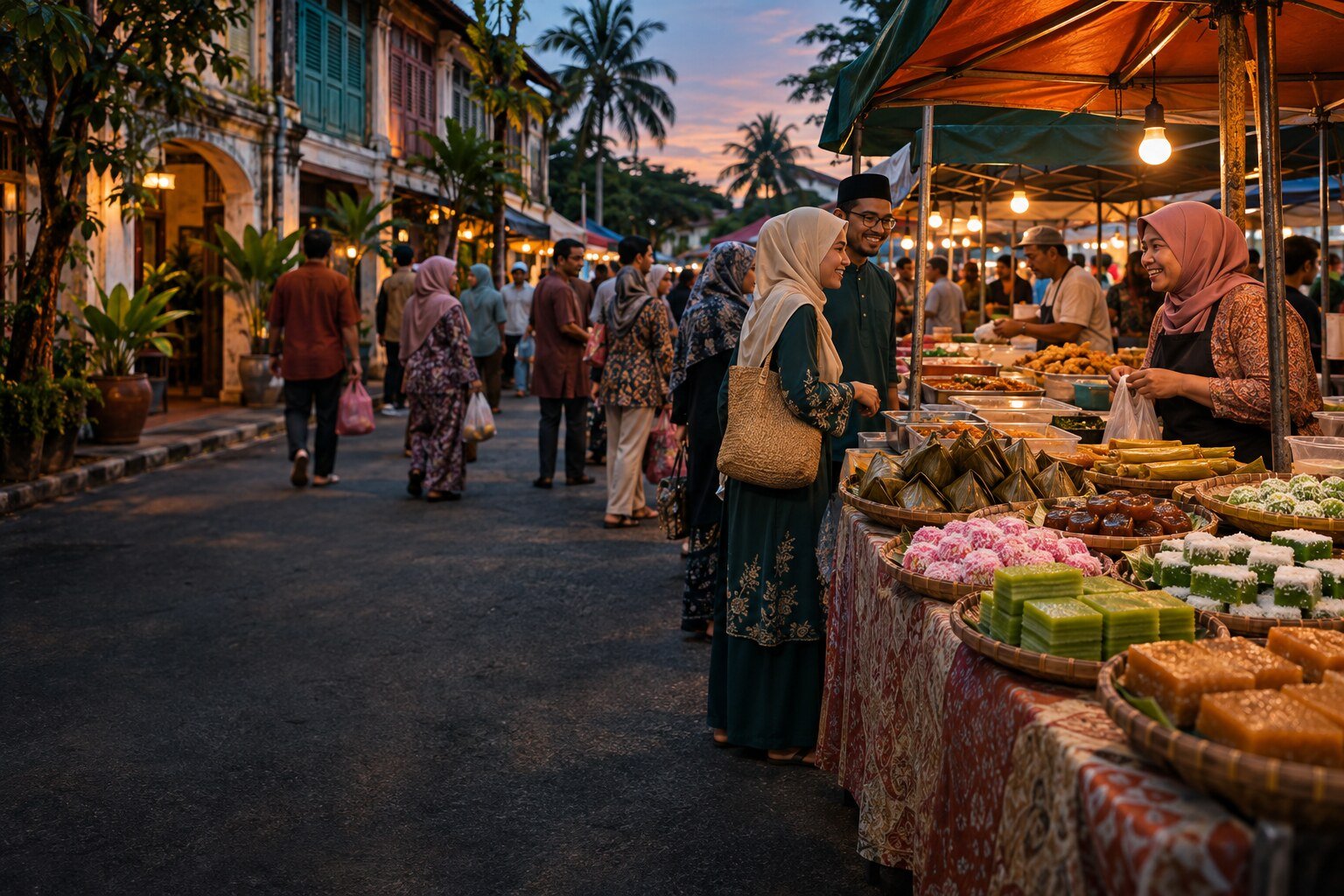
AI-created editorial illustration of a Malaysian Ramadan bazaar.
Affiliate disclosure: Taylor’s Trailblazing Travels may earn a commission if you book or buy through links in this guide, at no extra cost to you. Recommendations are selected for their usefulness to the trip.
Travelling in Malaysia during Ramadan works well when you plan around the rhythm of the place you are visiting. Penang’s tourism authority says businesses and tourism generally continue, while some eateries adjust their hours. Non-Muslim visitors are not obliged to fast. That leaves room for a normal sightseeing trip alongside the evening food and community traditions of the month. [1] [2]
The most useful preparation is specific: find your daytime meals, decide where you want to be around sunset and check whether your intercity journeys coincide with Hari Raya Aidilfitri. A convenient hotel and one well-planned evening can be more valuable than a packed list of markets across the city.
Choose a practical base
A confirmed daytime meal option matters more than a generic promise that the neighbourhood has restaurants.
Keep sunset local
Choose one bazaar or dinner venue and allow time to get there without rushing.
Separate the calendars
Ramadan meal timings and Hari Raya travel demand need different preparations.
Check the actual venue
Mosque access, meals and attraction hours depend on the place and date.
Plan Ramadan and Hari Raya as different parts of the trip
Ramadan is the fasting month; Hari Raya Aidilfitri marks its end. The distinction matters because a day spent sightseeing during Ramadan is a different planning problem from a long road journey during the festival holiday. Tourism Malaysia describes Hari Raya as a celebration involving visits and open houses; PLUS’s 2026 advisory warned of an expected surge in return traffic after the holiday. [12] [9]
| Part of the visit | What to check first | A useful adjustment |
|---|---|---|
| Ordinary days in Ramadan | Daytime food and the evening plan | Keep lunch reliable and leave one evening free for a bazaar or iftar. |
| The approach to Hari Raya | Availability on the journeys you cannot easily move | Choose transport before committing to a sequence of non-refundable stays. |
| Hari Raya itself | Holiday opening hours and confirmed meal arrangements | Consider staying in one base rather than relying on several small businesses in one day. |
| The holiday return period | Current traffic advice and the next fixed departure | Return to your departure city before the day of an important flight. |
Use Malaysia’s announcement and your destination’s time
Confirm the dates for the year you are travelling through official Malaysian announcements. JAKIM coordinates the timetable and the announcement process with the relevant authorities; a calendar prediction should not be treated as the final announcement. Its published guidance also distinguishes fasting and breaking-fast times by zone. [3]
For the daily sunset meal, use JAKIM’s e-Solat service for your actual destination and date. It covers zones in Peninsular Malaysia, Sabah and Sarawak. An iftar time saved for Kuala Lumpur is not a countrywide time. [4]
Ramadan is also not a weather forecast. Assess the climate and transport conditions for the month and region in your itinerary separately. There is no sound basis for assuming the whole holiday will be cheaper: compare the actual flights, rooms and journeys you need, especially when other holidays overlap.

Choose accommodation around reliable daytime meals
A blanket rule about Malaysian restaurants will be less useful than a check of the places beside your hotel. Penang’s official visitor guidance explicitly welcomes normal dining and travel during Ramadan while warning that some opening hours change. The FCDO similarly advises checking shops and restaurants. [1] [6]
| Your base | What makes it workable | Question to ask before booking |
|---|---|---|
| A city stay in Kuala Lumpur or George Town | Two confirmed daytime options within a comfortable walk or short transfer | Which nearby places will serve lunch on our exact dates? |
| A small town or rural homestay | An agreed meal arrangement when there are few convenient alternatives | Can lunch be provided or collected, and what should we arrange ourselves? |
| An island resort or remote lodge | Clear on-site meal hours and a plan for excursion days | Are breakfast, lunch and takeaway meals available during Ramadan and Hari Raya? |
| A stay involving fasting travellers | Confirmed pre-dawn food and an achievable evening return | Is sahur available, and how do we arrange it? |
This is a planning framework, not a claim that rural restaurants close or every city hotel serves food all day. The fewer alternatives within easy reach, the more useful it is to settle the details in advance. Apply the same test to Sabah and Sarawak instead of treating either as having one uniform Ramadan routine.
Ask for details that change your booking
Request the dates and hours of breakfast and lunch, whether the advertised room rate includes them, and whether an evening buffet needs a separate reservation. If you have an early departure, ask about a packed meal the previous day. A photograph of a restaurant or the words “breakfast available” do not answer those questions.
For a Kuala Lumpur base, compare the location and meal terms of the same stay on Agoda’s Kuala Lumpur accommodation search and Booking.com’s Kuala Lumpur hotel search. These are city searches, so confirm Ramadan dining arrangements directly with the shortlisted property before paying.
For a family or anyone who needs a predictable meal routine, choose the reliable breakfast and lunch first. Treat the evening bazaar as an enjoyable extra, rather than the only plan for feeding everyone.
Enjoy a bazaar without turning dinner into a race
Ramadan bazaars are part of Malaysia’s established food culture, with stalls offering regional dishes to Muslim and non-Muslim customers. Tourism Malaysia’s account of the tradition describes this shared appeal; it is background on the custom, not a list of markets operating on your travel dates. [5]
Ask your accommodation or the local council for the current bazaar location, operating days and hours. Check the year of any list you find. A past event at Dataran Merdeka, Kampung Baru or another familiar place does not prove the same event will run there on your evening.
Make four decisions before setting off
- Choose one market that fits the rest of the day. A smaller convenient bazaar may be more enjoyable than crossing the city to reach a famous one just before dinner.
- Decide where you will eat. Check whether the market has suitable seating or whether you should take food back to your accommodation.
- Bring a practical payment backup. Carry manageable small-denomination cash rather than depending on every stall accepting your card or payment app.
- Agree how to leave. Locate the station, meeting point or permitted vehicle pick-up area before joining the food queues.
If the market opens before sunset, browsing earlier gives you time to compare dishes and ask questions. Arriving late may limit your choices; arriving extremely early may mean stalls are not ready. The venue’s published hours and advice on the day should take precedence over a generic “best time”.
Start with a small selection you can eat comfortably. Bubur lambuk, a savoury rice porridge associated with Ramadan, is one dish worth asking about; its preparation and community distribution are described by Tourism Malaysia. Availability and ingredients will vary. [5] Ask what a dish contains if you have dietary requirements, and do not assume that a vegetarian-looking snack has no meat or seafood ingredients.
Choose the dinner experience you actually want
A takeaway bazaar visit suits flexible travellers. A reserved restaurant or hotel iftar may suit a group that values seating, toilets and an agreed meeting place. Compare the total price, child policy, service period and cancellation terms before booking; a buffet is not an essential part of experiencing Ramadan.
For a communal iftar, ask the organiser whether visitors are welcome, whether registration is needed and where to sit. Malaysia’s Federal Territories Mufti guidance explicitly permits non-Muslim participation in suitable public breaking-fast gatherings while observing the host’s rules. Join on those terms, and wait for the host’s cue before eating. [2]
Back to top ↑Follow local etiquette and each mosque’s visitor rules
Non-Muslim visitors do not have a religious obligation to fast. Courtesy still matters: choose an appropriate dining place and be considerate around people who are fasting, especially in shared spaces. Do not assume somebody else’s faith, health or fasting status from their appearance. [1] [2]
Dress modestly, particularly in conservative settings and at religious sites. The FCDO advises checking entrance rules and notes that Muslim visitors may be subject to local Sharia law. Personal religious questions or uncertainty about rules that apply to you should be taken to an appropriate local authority, rather than resolved through a general holiday guide. [6]
Ask before entering or photographing
Check the mosque’s own visitor arrangements for your date, including Ramadan changes. Wear the required clothing, follow footwear instructions, keep to visitor areas and avoid disturbing worshippers. The Perlis religious authority’s published guidance for non-Muslim visits specifically emphasises appropriate dress, cleanliness and not interrupting worship. [7] Ask before taking close photographs of people, and put the camera away when requested.
Visitor access is not identical at every mosque. For example, Masjid Wilayah Persekutuan in Kuala Lumpur publishes a guided visitor programme and says some visitors can observe congregational prayer. That is a reason to check with the mosque, rather than repeating a blanket rule that non-Muslims can never visit at prayer time. Its ordinary programme details are not a guarantee of Ramadan availability. [8]
Leave flexibility around an arranged driver’s or guide’s meal and prayer breaks. Discuss the day’s timing when making the booking. A clear meeting time and a realistic return are more considerate than adding an unplanned stop shortly before the agreed finish.
Back to top ↑Build the day backwards from local iftar
Use the local Maghrib or published breaking-fast time as an anchor, then work backwards from where you want to eat. JAKIM provides zone-specific prayer times; the example below deliberately uses relative timings instead of giving one sunset time for the whole country. [4]
| When | Suggested plan | Why leave the space? |
|---|---|---|
| Morning to early afternoon | Complete the main attraction and eat a confirmed lunch if you are not fasting. | You avoid making the whole day depend on evening food. |
| About two hours before iftar | Finish the main sightseeing and start moving towards the evening area. | There is time for a slower transfer or a change of plan. |
| About 90 minutes before iftar | Browse your chosen bazaar, provided it is open. | You can select food without trying to fit in another attraction. |
| About 45 minutes before iftar | Head to your agreed dining place or return with your purchases. | You are not searching for seating at the last moment. |
| At the locally confirmed iftar time | If joining a shared meal, follow the host’s cue. | The actual local time takes priority over this example. |
| Later in the evening | Choose a short walk or return to your accommodation. | The evening stays flexible if dinner takes longer. |
For example, if the official local time on your particular day were 7.20 pm, the three preparation points would be 5.20 pm, 5.50 pm and 6.35 pm. This is arithmetic to explain the plan, not a quoted prayer timetable. Replace 7.20 pm with the correct time and allow more travel time if the bazaar is far away.
The trade-off is deliberate: you give up a second late-afternoon attraction to make the evening comfortable. If your main excursion must finish late, skip the bazaar that day and arrange a meal close to your hotel. For fasting travellers, build the day around your own needs and agreed breaks rather than copying the pace of a non-fasting group.

Protect the important journeys around Hari Raya
For a trip that crosses Hari Raya, prioritise the journeys that would be hard to replace: an intercity train, an onward flight or the return to your international departure airport. In its March 2026 return-travel advisory, PLUS warned of heavier traffic and directed motorists to its MyPLUS-TTA travel advice. This is evidence of the holiday travel pattern, not a prediction of the busiest dates in a future year. [9]
Compare the full journey before buying
Check the current KTMB timetable and its linked official booking service for rail travel. Select the timetable that applies to your journey date; the operator publishes effective dates, and a timetable page by itself does not confirm seat availability. [10]
If Kuala Lumpur–Penang is part of your route, compare Kuala Lumpur–Penang transport on 12Go alongside the operator. Check the precise departure and arrival points, luggage terms and total cost for your date. The comparison page lists different transport types; it is not a promise of seats during your holiday. [11]
For driving, look for the current year’s PLUS traffic advice and use the live information available before departure. Avoid a plan that depends on a long intercity drive arriving just in time for an international flight. Staying in the departure city the previous night gives you more options if the road journey overruns.
Choose how much movement your holiday needs
- If Ramadan food and city sightseeing are the priority, spend several nights in one well-chosen base and use day trips only when their return timing works.
- If the holiday includes several regions, secure the least flexible transport leg first, then shape the surrounding nights around it.
- If the route includes Hari Raya, consider keeping the festival days in one base and moving when your chosen services and accommodation arrangements suit you.
Record the fixed journeys and meal arrangements in the Trip Itinerary Planner. Add a reminder to recheck the official holiday announcement and each operator before departure; a written itinerary does not confirm that a service is running.
Back to top ↑Make the final checks specific to your dates
The same five questions work for a short city break or a longer Malaysian itinerary. Save the answers with the booking so you are not trying to reconstruct them after arrival.
- Do our dates cover Ramadan, Hari Raya or the holiday return period? Use the correct year’s Malaysian information and check state holidays where they affect the itinerary.
- Where will we eat breakfast and lunch? Confirm at least one dependable option for each overnight stop, plus meals on transfer days.
- What is the evening plan? Check the bazaar or iftar venue, seating, booking conditions and a practical way back.
- Which attraction or mosque needs a fresh opening-hours check? Verify the particular day, not just its usual weekly schedule.
- Which journey cannot slip? Protect that connection with enough flexibility in the previous day’s plan.
The common planning mistake is to treat a cultural calendar as an opening-hours calendar. A published Ramadan date tells you when the month falls; it does not tell you whether a particular restaurant serves lunch, a mosque accepts visitors or a train has available seats.
State holiday calendars can differ, as Penang Global Tourism notes, so check the places you will actually visit. Reconfirm direct with the relevant accommodation or operator where a meal, collection or opening time is essential to the day. [1]
Back to top ↑Questions travellers ask
Is Ramadan practical for a trip with young children?
It can be, if normal meals, rest breaks and an easy return are built into the day. Confirm daytime food before booking the accommodation, keep a bazaar visit short enough for your family and choose a place to sit before everyone is hungry. A reserved meal may be more useful than a crowded market evening if seating and toilets are priorities.
Will a hotel’s Ramadan buffet replace my included breakfast?
Check the terms of your particular booking. A buffet advertisement does not tell you what your room rate includes or whether breakfast hours change. Ask separately about breakfast, sahur if needed, lunch and the evening buffet, including any additional charges or reservations.
Can visitors attend a Hari Raya open house?
Accept a personal invitation or check the entry details of an advertised public event. Tourism Malaysia describes open houses as occasions when hosts invite friends from different communities. The term does not mean every family home is open to passing visitors. Follow the host’s timing, dress and photography preferences. [12]
Your next decision
Choose Ramadan if you are happy to give the evenings some attention and check meals locally. A comfortable base, one thoughtfully planned bazaar or shared meal, and unhurried transfers can make the month a rewarding part of the trip. If your dates also include Hari Raya, make the important transport bookings the first decision and fit the sightseeing around them.
Sources and editorial checks
This guide combines Malaysian tourism and religious-authority guidance with published transport information, checked on 6 November 2026. The meal-planning matrix and relative-time example are editorial planning tools. Historical festival and traffic notices are used only to explain established customs or travel patterns; they are not future event listings or operating timetables.
- Penang Global Tourism — Traveller Essentials: Ramadan and public holidaysChecked 6 November 2026
- Federal Territories Mufti — Non-Muslim fasting and participation in communal iftar (18 March 2026)Checked 6 November 2026
- JAKIM — Coordination of Ramadan and Syawal dates and zonal timings (January 2026)Checked 6 November 2026
- JAKIM — e-Solat prayer-time serviceChecked 6 November 2026
- Tourism Malaysia — Ramadan bazaar tradition and bubur lambuk (2012 background)Checked 6 November 2026
- UK FCDO — Malaysia: local customs, dress and Ramadan opening-hours adviceChecked 6 November 2026
- Perlis religious authority — Guidelines for non-Muslims entering mosquesChecked 6 November 2026
- Masjid Wilayah Persekutuan — Mosque Tour ProgrammeChecked 6 November 2026
- PLUS — Hari Raya return-journey traffic advisory, 26 March 2026Checked 6 November 2026
- KTMB — Official train timetablesChecked 6 November 2026
- 12Go — Kuala Lumpur–Penang transport comparisonChecked 6 November 2026
- Tourism Malaysia — Hari Raya and open-house customs (2013 background)Checked 6 November 2026
Illustrations in this article were created for Taylor’s Trailblazing Travels. Third-party photographs, where used, are credited beside the image or in the source list.