Malaysia • Your first journey
Malaysia Travel Guide for First-Time Visitors: Regions, Routes and Realistic Pacing
Choose a few places that belong together, then give the journeys between them room to breathe.
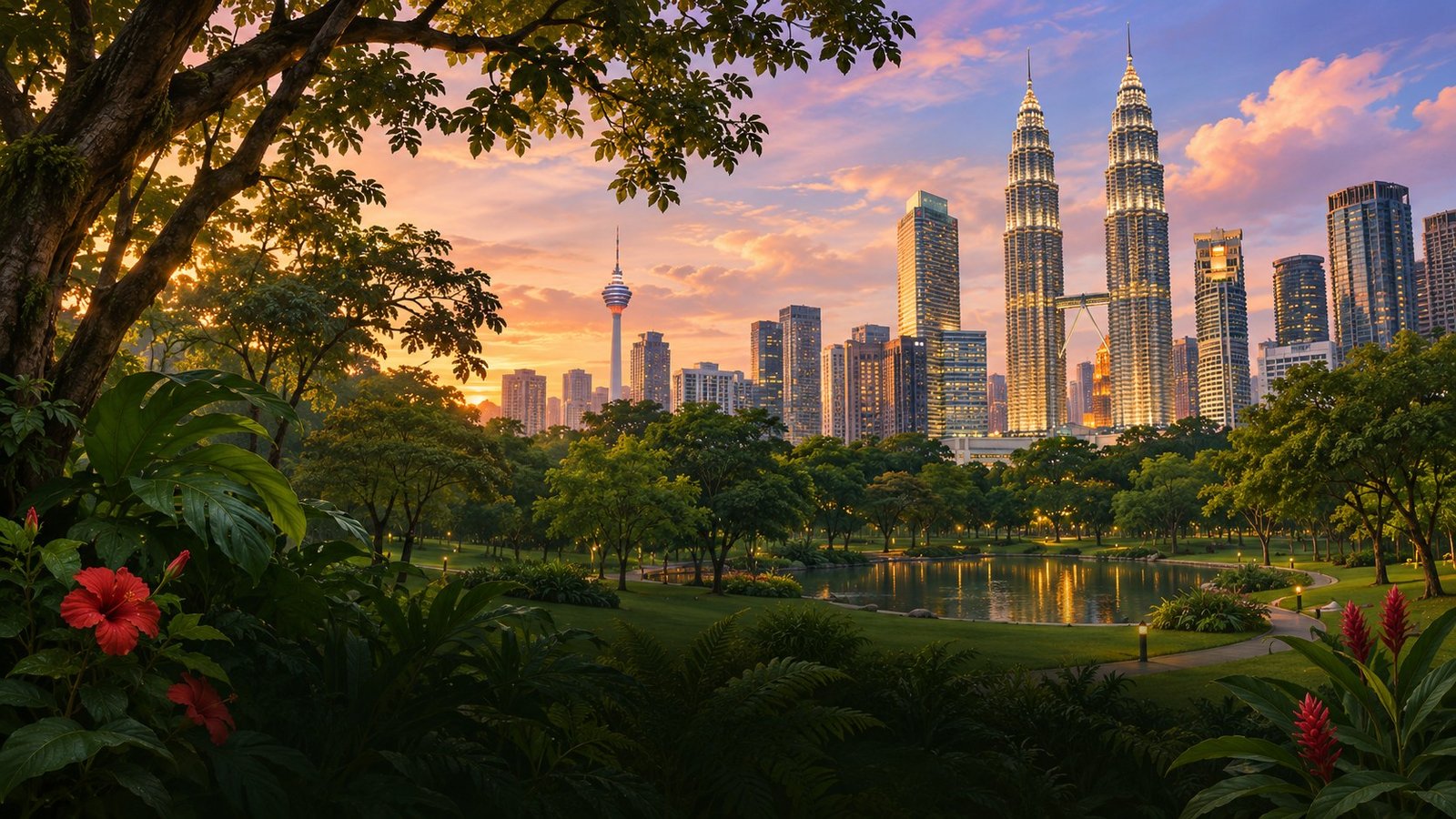
An original illustration inspired by Kuala Lumpur; not a documentary photograph.
A first Malaysia trip is easier to plan once you stop treating the country as one continuous route. A city-and-food holiday on the peninsula, a beach break and a Borneo wildlife journey can all be rewarding, but they need different amounts of time and different transport decisions.
This Malaysia travel guide for first-time visitors starts with those choices. The region selector and sample night allocations below are editorial planning judgements, built around a simple aim: enough time to enjoy each base after arriving and before packing again.
This article contains affiliate links. Taylor’s Trailblazing Travels may earn a commission on qualifying bookings or purchases through those links, at no extra cost to you.
A Malaysia travel guide starts with the right region
Malaysia has two main geographical parts: Peninsular Malaysia and East Malaysia on Borneo, including Sabah and Sarawak. They are separated by sea. For an ordinary holiday combining them, plan a flight and treat that change of region as a travel day. [1]
| Your priority | Start with | Allow as a useful first block | The trade-off |
|---|---|---|---|
| Food, heritage and an easy urban introduction | Kuala Lumpur + George Town | 6–8 nights combined | Little dedicated beach time |
| City experiences with an unhurried beach finish | Kuala Lumpur + Langkawi | 7–10 nights combined | Skip Penang if extra transfers would dominate |
| Tea landscapes and cooler highlands | Kuala Lumpur + Cameron Highlands, with Penang if time allows | 2–3 nights for the highland stop | A road detour and winding journeys |
| A Kuching base with rainforest outings | Sarawak | 5–7 nights for a focused first visit | Remote parks require a separate route, not a casual add-on |
| Wildlife as the central purpose | Sabah, choosing specific bases around your priorities | 7–10 nights as a starting allowance | Longer transfers, specialist bookings and regional checks |
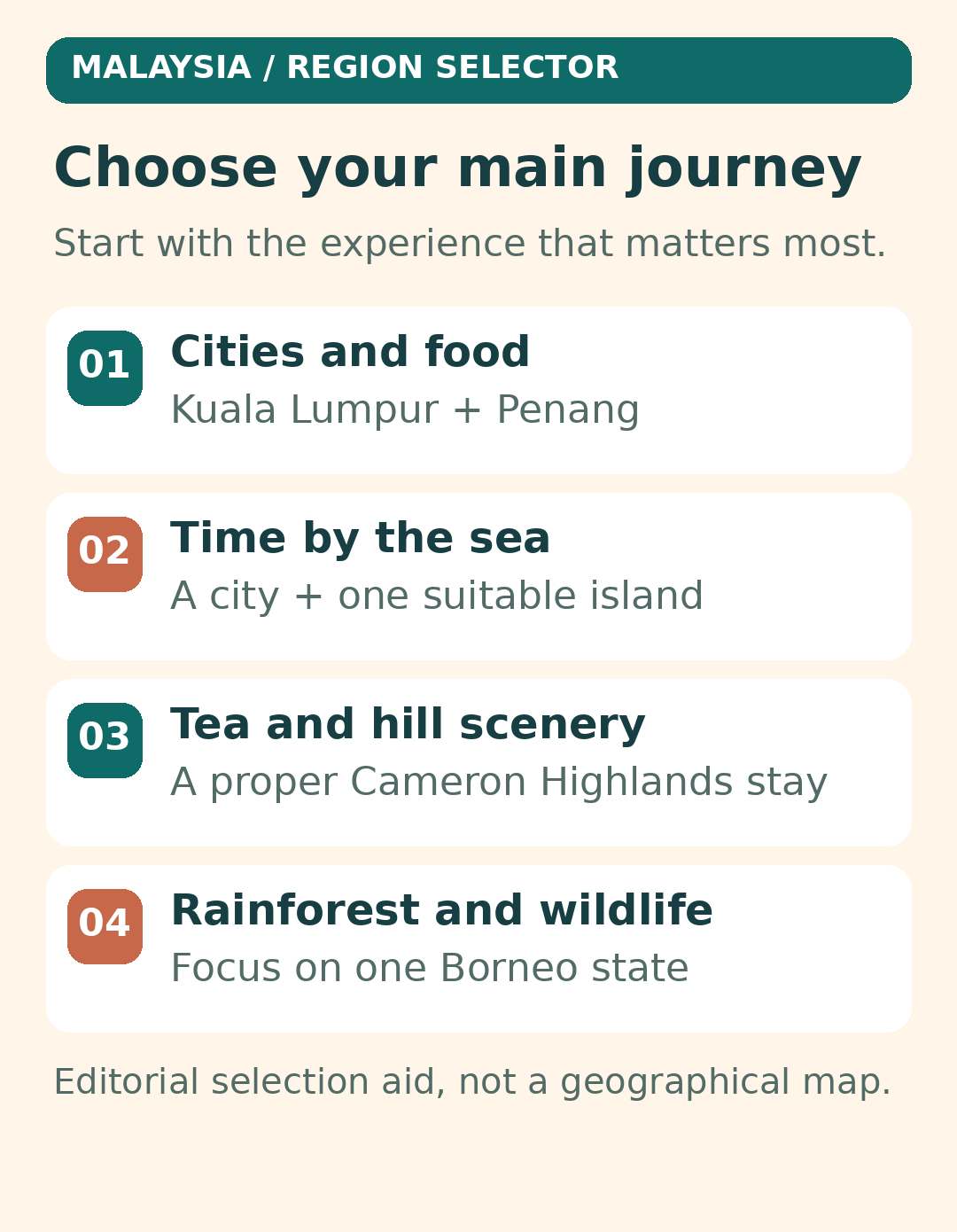
The choices reflect different experiences, not a ranking of regions. Tourism Malaysia identifies the northern peninsula with heritage, islands and varied landscapes; Cameron Highlands is a tea-growing hill destination reached by road. Sabah Tourism describes Sandakan as a gateway to wildlife attractions and the Lower Kinabatangan. [2][3][4]
Make one interest the organising principle
Write down the experience you would be most disappointed to miss. If that is evenings eating in George Town, protect several Penang nights. If it is a river wildlife stay, reserve the wildlife block first and let the city stop fit around it. If it is reading beside the sea, a fourth city will rarely improve the holiday.
A useful first-trip filter is: one anchor experience, one contrasting base and one optional extension. That keeps an appealing extra from becoming another suitcase-moving day.
Back to guide contents ↑Choose bases for what you want to do
Kuala Lumpur: a practical opening chapter
Use the capital for an urban introduction rather than an exhaustive attraction list. Tourism Malaysia groups its sights around parks, museums, food districts and historic places, including KLCC, Bukit Bintang and the older city centre. [5] A three-night stay gives two clear days between arrival and departure; organise those days geographically instead of crossing the city for each attraction.
Pick a hotel by the journeys you will make. A lower room rate can lose its advantage if every meal and sightseeing stop requires a longer paid ride. Check the actual walk to a useful station, the room type, noise comments and late-arrival arrangements.
For the opening stay, compare Kuala Lumpur accommodation on Agoda with Kuala Lumpur stays on Booking.com. These are city searches; enter your dates and compare the same occupancy, taxes and cancellation terms.
George Town, Penang: stay for the evenings
George Town and Melaka share a UNESCO listing for their historic, multicultural townscapes. [6] For a first visit, choose one as the main heritage stay unless history is your particular interest. Three or four nights in George Town leave space for neighbourhood walks, unhurried meals and a separate outing without requiring a hotel change.
The state of Penang includes Penang Island and Seberang Perai on the mainland; George Town is its capital. [13] Read the property map and arrival point carefully. A transfer labelled “Penang” does not, by itself, establish that it finishes near your hotel.
Langkawi or the highlands: choose the contrast
Langkawi suits the beach-and-island part of a route; the northern-region tourism material also highlights its geopark landscapes. [2] Choose a coastal base for the beach you actually want to use, then decide whether paid rides or a properly insured hire car suit your plans. A quiet resort can be a good choice even when it is inconvenient for frequent restaurant hopping.
Cameron Highlands offers tea scenery and a cooler change of setting. Its road access is part of the decision: do not insert it simply because it seems to sit between two points on a map. [3] Allow a genuine stay if you want a landscape break; skip it if winding roads or another relocation would reduce the enjoyment.
Kuching or Sabah: choose a focused Borneo journey
Semenggoh near Kuching supports semi-wild orangutans, while Bako is known for rainforest and coastal habitats. [7][8] Use that as a reason to investigate specific outings, not as a promise of sightings. In Sabah, a Sandakan-based wildlife route serves a different purpose from staying mainly around Kota Kinabalu. [4] Decide which experience matters before comparing flights.
Back to guide contents ↑Match the month to the coast
There is no single dry season that describes every Malaysian holiday. METMalaysia identifies the northeast monsoon broadly with November–March; exposed eastern areas receive heavier rain, while regional patterns differ elsewhere. East-coast Peninsular rainfall is generally highest in November–January. [9][10]
For a beach-led trip, check the particular island, boat route and accommodation opening dates before paying for flights. “Malaysia is good in this month” is too broad to settle those decisions. An island may be technically reachable while the boat conditions or reduced services make it a poor fit for your holiday.
The useful response to uncertain weather is spare capacity. Keep one movable day in a nature-focused block, avoid putting the only boat outing immediately before a flight and choose a city base with indoor alternatives. A climate pattern helps choose a region; it cannot promise the weather on your dates.
For a November–February beach break, investigate a west-coast plan first, then check the actual local forecast and services. November can still be wet; the northwest is generally drier in January–February. [10] For an east-coast island, confirm the operator’s seasonal arrangements directly. This is a route-selection approach, not a guarantee of sunny conditions.
Build a route from nights, not a long wish list
These are illustrative night allocations, not bookable packages. “Days in Malaysia” includes arrival and departure days; a 10-day visit normally contains nine hotel nights. International travel days outside Malaysia need to be added when calculating time away from the UK.
| Time in Malaysia | A workable starting shape | Why it works | What to leave out |
|---|---|---|---|
| 7 days / 6 nights | Kuala Lumpur 3 + Penang 3 | Two proper stays; one main relocation | A third sightseeing base |
| 10 days / 9 nights | Kuala Lumpur 3 + Penang 3 + Langkawi 3 | City, heritage and beach, with modest depth | Borneo and a highland detour |
| 14 days / 13 nights | Kuala Lumpur 3 + Penang 4 + Langkawi 5 + Kuala Lumpur 1 | A longer coast stay and an overnight return buffer | An extra region just to fill the map |
| Wildlife-led 10 days / 9 nights | Kuala Lumpur 2 + one Borneo state 6 + Kuala Lumpur 1 | Protects time for the main interest | Both Sabah and Sarawak in a brief visit |
The seven- and ten-day shapes assume you can depart from the last region on a suitable itinerary. If your long-haul flight leaves Kuala Lumpur on a separate ticket, move a night from an earlier stop to a return stay; do not quietly add it beyond the number of nights available. For the wildlife shape, the six-night block is a planning envelope to divide between appropriate bases after checking transfers.
Give the first and final days different jobs
Arrival day is for reaching the hotel, eating and adjusting. Book a time-sensitive attraction only when the arrival plan makes the risk reasonable. On the final day, work backwards from the airport and airline check-in requirements. A spare afternoon is a benefit; it does not have to become another organised outing.
Use the Trip Itinerary Planner to allocate your own stops and nights. Enter real travel dates and check each transport leg separately; a neat itinerary is not evidence that the connection is bookable.
Back to guide contents ↑Compare the whole transfer, not just the ticket
KTMB publishes ETS and other train timetables separately, with different effective dates. Use the timetable valid for your journey and confirm the selected service in its booking system. [11] For a Kuala Lumpur–Penang comparison, start with the exact arrival station or terminal, then add the onward transfer to your accommodation.
A useful journey calculation is: hotel checkout and first mile + operator reporting time + main journey + arrival formalities or luggage + last mile. When comparing a train with a flight, apply that same calculation to both. A short flight can still take much of a holiday day.
Compare Kuala Lumpur–Penang options on 12Go alongside KTMB’s own train booking service. Check the actual service, terminal, baggage allowance and refund terms before choosing; a comparison page is not a guarantee of every listed departure.
For islands and Borneo, check the complete dated sequence before paying for a non-refundable room. Do not rely on an old route map as proof that a particular ferry or direct flight operates. If a journey needs a connection, allow for the connection in both the budget and the night allocation.
A worked planning allowance
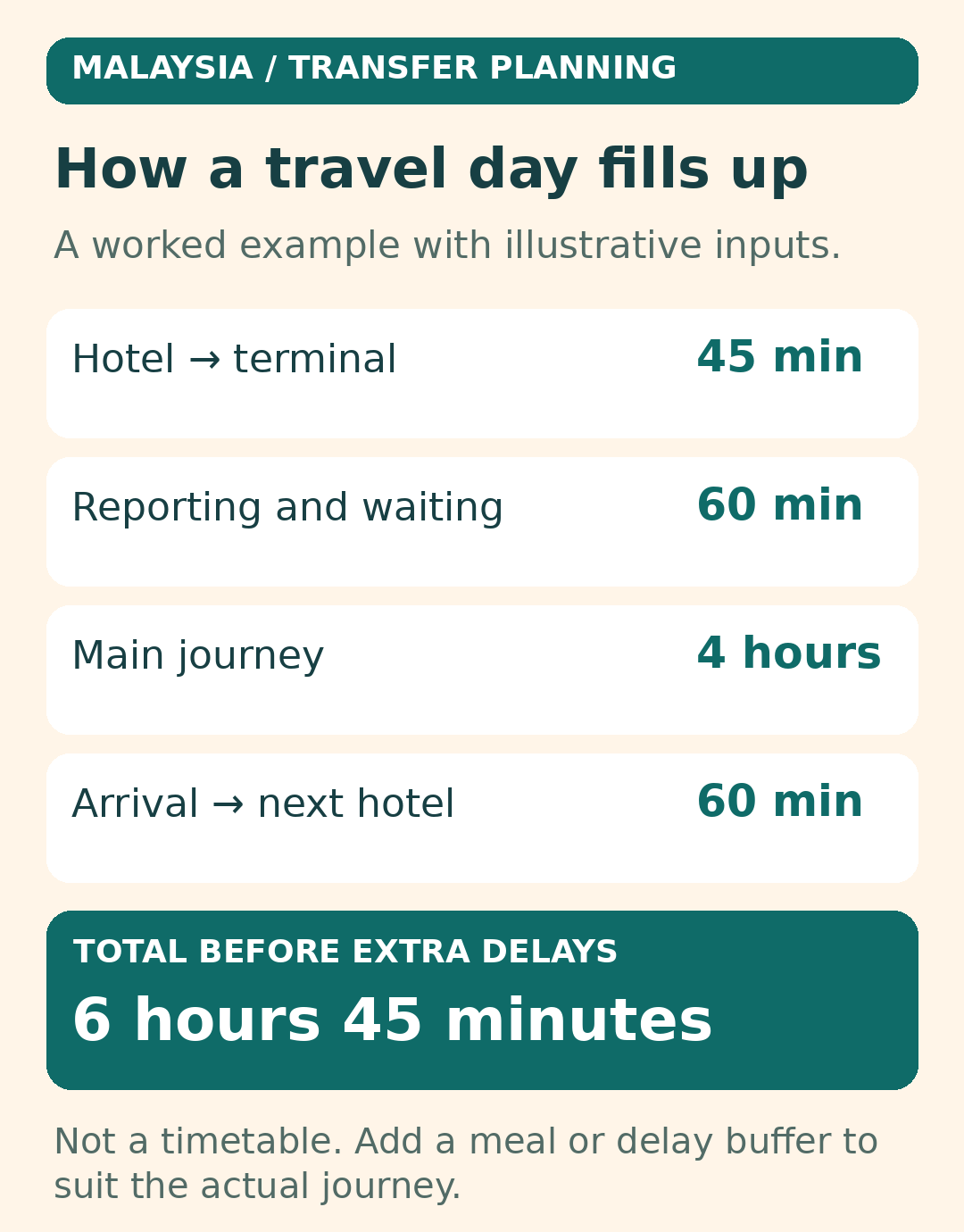
Suppose a transfer needs 45 minutes from the hotel, 60 minutes before departure, four hours for the main journey and 60 minutes to reach the next hotel. That is 6 hours 45 minutes before a meal or delay buffer. These are hypothetical inputs, not a timetable: they show why that day should not also carry two major sightseeing bookings.
Price the shape of the holiday before choosing upgrades
Build the cost in layers: international flights; hotel rooms multiplied by nights; food and local travel multiplied by travellers and days; intercity journeys; activities; insurance and other home-side costs; then a reserve. Keep room prices separate from per-person spending. A couple sharing a room should not double the same accommodation bill.
Test the largest uncertain items first. A wildlife lodge package, several internal flights or a resort stay can change the total more than small savings on meals. Check what a package includes so you do not add its transfers or meals twice.
The site’s Travel Budget Calculator can organise your own room rates and spending assumptions. Enter current quotes; its editable allowances are not a live quotation for Malaysia.
Book the constraint, then the flexible pieces
First establish international dates and entry eligibility. Next check any scarce experience or fixed departure that is central to the trip. Fit the nights and transport around that, then choose the remaining hotels. Keep the first arrival and final departure arrangements clear before adding optional activities.
If you want a guided city experience, compare Kuala Lumpur activities on GetYourGuide. Read the actual duration, meeting point, inclusions and cancellation deadline, and compare with booking the attraction directly. A paid tour is useful when its organisation or interpretation solves a need.
Back to guide contents ↑Settle the practical details that can change the route
Before committing, read the current British-passport entry guidance and the official Malaysian arrival requirements. Your passport type, purpose of travel and route matter; do not assume a short holiday summary covers work, study or every nationality.
As checked on 6 November 2026, the FCDO advises against all but essential travel to islands and dive sites off eastern Sabah between Sandakan and Tawau, including Lankayan. That advice does not cover the Sabah mainland. Check the current map and your insurance before selecting an offshore trip. [12]
For connectivity, compare your existing UK roaming option, a local SIM and an eSIM. If considering Airalo’s eSIM store, select Malaysia and check device compatibility, coverage, validity and whether the plan supplies the calls or data you need. Keep an offline copy of hotel details and onward arrangements regardless.
Pack for the activities you have actually chosen: light layers for city heat, rain protection, footwear with appropriate grip and clothing suitable for religious sites. A relaxed city-and-beach holiday needs a different bag from a guided forest trek. Check the trek operator’s equipment list before buying specialist items.
Back to guide contents ↑The decisions most likely to make the trip feel rushed
- Adding both a highland stop and an island to a short city route without removing anything.
- Giving a place two nights, then assuming it provides two full sightseeing days.
- Booking a remote nature stay before confirming how to get there and back.
- Comparing a room-only price with a package including meals and transfers.
- Treating every coast as having the same seasonal pattern.
- Saving all flexibility for the end, when the international departure is fixed.
A focused route may leave famous places unseen. That is a reasonable trade when it creates better mornings, easier evenings and time to change your mind. The least suitable plan for a first visit is often the one that tries to represent the whole country.
Back to guide contents ↑Useful questions
Can I visit Malaysia without hiring a car?
Yes, a route built around major cities and booked intercity transfers can be planned without one. Rural stays, some island outings and highland trips need a more deliberate last-mile plan. Compare the full transport cost before deciding whether a hire car would improve your particular route.
Should a first Malaysia trip include Singapore?
Only if it is a genuine priority with its own nights and border checks. Treat it as another country block, not a free extra attached to a Malaysian itinerary. For a short first visit, protect the time already allocated to your main destinations.
Is a Borneo wildlife sighting guaranteed?
No. Build a wildlife holiday around suitable habitat, responsible operators and time, not a promised encounter. Ask the provider what happens if weather or park conditions affect the outing, and choose a stay you would still value without a particular sighting.
Back to guide contents ↑Choose the journey you want
For a first broad introduction, choose Kuala Lumpur and Penang, then add the coast or highlands only when the calendar supports a proper stay. For a wildlife-led holiday, make one Borneo state the centre of the trip. Once that choice is made, use the Malaysia travel hub to organise the next planning questions, and check dates, transfers and quotes before committing.
Back to guide contents ↑Sources and checks
Official and primary sources consulted for the factual details below. Route allocations, checklists and worked planning models are editorial analysis. Recheck changing rules, prices and services before booking or travelling.
- Tourism Malaysia — About Malaysia: geography. Checked 6 November 2026.
- Tourism Malaysia — Malaysia Travel Guide: Northern Region. Checked 6 November 2026.
- Tourism Malaysia — Cameron Highlands. Checked 6 November 2026.
- Sabah Tourism Board — Sandakan. Checked 6 November 2026.
- Tourism Malaysia — Top places to visit in Kuala Lumpur. Checked 6 November 2026.
- UNESCO — Melaka and George Town, Historic Cities of the Straits of Malacca. Checked 6 November 2026.
- Sarawak Forestry Corporation — Semenggoh Wildlife Centre. Checked 6 November 2026.
- Sarawak Tourism Board — Bako National Park. Checked 6 November 2026.
- METMalaysia — Weather phenomena: monsoons. Checked 6 November 2026.
- METMalaysia — Malaysia's climate. Checked 6 November 2026.
- KTMB — Train schedules and effective dates. Checked 6 November 2026.
- FCDO — Malaysia: regional risks. Checked 6 November 2026.
- Tourism Malaysia — Penang. Checked 6 November 2026.
Illustrations in this article were created for Taylor’s Trailblazing Travels. Third-party photographs, where used, are credited beside the image or in the source list.