Pai Travel Guide
A realistic 2026 guide to the mountain road, three-night pacing, walkable stays, canyon safety, hot springs, smoke season and the attractions that are genuinely worth leaving town for.
Best no-scooter base: town centre
Main route: Chiang Mai by road
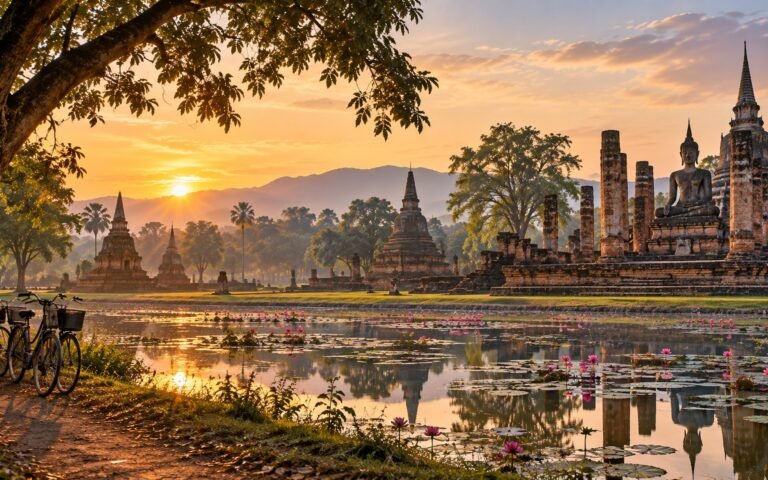
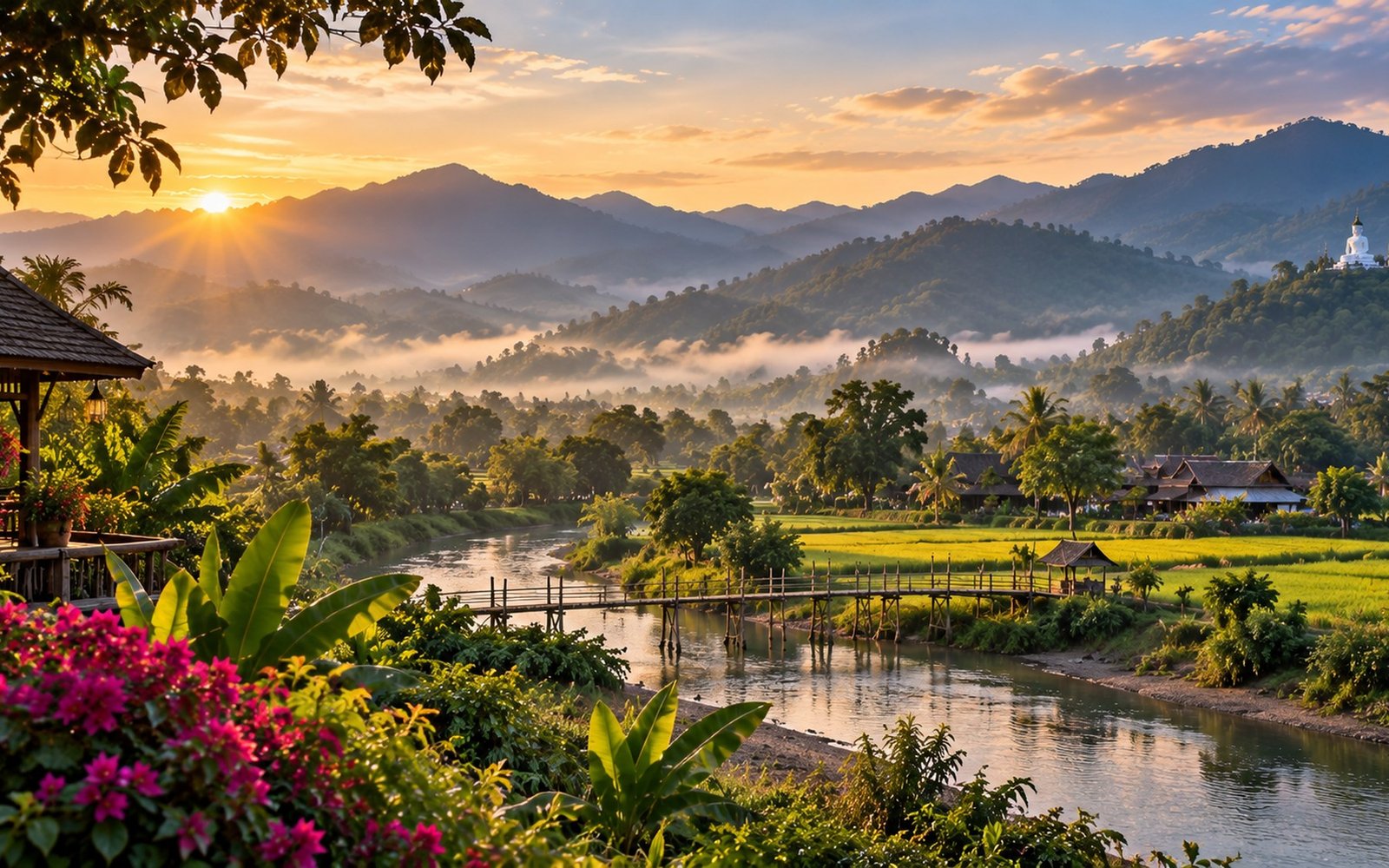
Pai looks effortless in photographs: a compact town, green valley, mountain viewpoints and slow evenings around Walking Street. The planning is less effortless. Almost every arrival comes over a winding mountain road, many celebrated sights sit beyond walking distance, and the same valley can feel cool and clear in December, smoky in March or intensely green and wet in August.
This Pai travel guide is built around those practical differences. It explains how long to stay, how to travel from Chiang Mai, where to sleep without depending on a scooter, how to group the canyon, hot springs and villages into sensible loops, and when the weather or air quality should change the plan.
This guide contains a small number of affiliate links. Taylor’s Trailblazing Travels may receive a commission when a qualifying booking is made, at no extra cost to you. A link appears only where a transport, hotel, activity or connectivity comparison solves a genuine planning problem.
Three nights, two full days
Enough time for one south loop, one flexible wider day and a calm arrival evening.
Stay near Walking Street
Walk to dinner and use a driver or shared trip for sights outside town.
Pai Canyon or Yun Lai
Canyon for sunset; Yun Lai for an early valley view when fog and visibility cooperate.
Treating a scooter as compulsory
Licence, insurance, skill and weather matter more than a cheap daily rental.
Pai travel guide at a glance
Pai is a small town in Mae Hong Son Province with a walkable centre and a much larger rural sightseeing area. Tourism Authority of Thailand material highlights Pai Canyon, Sai Ngam Hot Spring and the nightly Walking Street, while Tham Lod sits farther north in Pang Mapha and needs a separate road day.[1]
| Planning point | Useful first answer | Why it matters |
|---|---|---|
| Ideal first stay | Three nights | Creates two usable full days without treating the mountain transfer as sightseeing time. |
| Best base without riding | Town centre or the near riverside | Dinner, Walking Street and the bus station remain reachable on foot. |
| Main gateway | Chiang Mai by road | There is no practical rail connection and current route listings do not show a useful scheduled flight option. |
| Best first outer loop | Tha Pai Hot Spring, Memorial Bridge and Pai Canyon | The sights lie on the same side of town and finish naturally at sunset. |
| Best slow day | Town, riverside, cafes and one nearby viewpoint | Pai’s appeal is weakened when every hour is assigned to a vehicle. |
| Main risk | Road and scooter decisions | A cheap rental does not replace the correct licence, insurance or experience. |
Who will enjoy Pai most?
Pai suits travellers who value mountain scenery, small guesthouses, relaxed evenings and short nature outings. It works especially well after Chiang Mai because the two places provide different rhythms: Chiang Mai has deeper culture, food and city infrastructure; Pai provides a quieter valley base and easier access to rural landscapes.
Who may prefer a shorter stay?
Travellers who dislike winding roads, require step-free access at every sight, want strong public transport or expect a large historic town may find two nights sufficient. Pai is also less rewarding when smoke hides the mountains or heavy rain makes waterfalls, unlit roads and exposed paths unsuitable.
How many days do first-time visitors need?
Three nights is the strongest default. A morning departure from Chiang Mai can still place you in Pai around lunchtime, but delays, motion sickness and hotel check-in make the arrival day unreliable. Therefore, count two full days rather than pretending every hotel night equals a sightseeing day.
| Stay | What fits comfortably | Trade-off |
|---|---|---|
| One night | Town, Walking Street and one nearby sunset or sunrise stop | Most of the visit becomes two road journeys. Not worthwhile for many travellers. |
| Two nights | One full loop plus the town | Works for a focused trip, but weather has little room to disrupt the plan. |
| Three nights | South loop, one flexible outer day and relaxed evenings | Best balance for a first visit. |
| Four or five nights | Tham Lod, slow cafes, wellness, hiking or a genuine rest day | Useful only when Pai is meant to be a base rather than another quick stop. |
Do not make Pai a same-day trip from Chiang Mai
The road takes roughly three to four hours each way, so a day trip spends most of its useful hours in a vehicle. A one-day tour may be the only option for someone with a fixed itinerary, yet it is the least convincing version of Pai. Stay overnight or leave it for another trip.
The pacing rule that protects the trip
Choose one outer cluster per day. For example, pair the hot spring, Memorial Bridge and canyon; alternatively, group Yun Lai, Santichon and a north-west stop. Crossing from one side of the valley to another repeatedly adds road time without improving the experience.
Best time to visit Pai
November to January usually provides the most comfortable first-visit conditions: cooler mornings, lower rain risk and clearer mountain outings. However, it is also the busiest period, so central rooms and popular minivan times deserve earlier booking. The Tourism Authority of Thailand and the site’s month-by-month guide both treat the cooler northern season as the easiest period for Pai.[1][16]
February to April: heat and smoke can change the destination
Northern air quality varies by year and day, but the late dry season can bring PM2.5 and poor visibility. A scenic trip loses much of its value when the ridges disappear behind haze. Check Air4Thai before the hotel’s free-cancellation deadline and again before exposed outdoor activity.[5]
May to October: greener, wetter and more changeable
Rain makes the valley lush and improves rice-field colour, yet it also raises practical risks. The Thai Meteorological Department publishes Mae Hong Son forecasts, while UK travel advice warns that the general rainy season can bring strong water currents and road disruption.[4][6] A short shower is manageable; persistent rain, flood alerts or a slippery canyon ridge need a changed plan.
| Period | Best for | Watch | Planning response |
|---|---|---|---|
| Nov–Jan | Cooler mornings, views and first visits | Peak demand and cold early starts | Book central rooms and useful van times earlier. |
| Feb–Apr | Travellers whose dates are fixed and air remains acceptable | Heat, smoke and reduced visibility | Keep bookings flexible and check Air4Thai. |
| May–Jun | Greener scenery with fewer visitors | Showers and changing paths | Carry rain protection and leave one flexible day. |
| Jul–Oct | Rice fields, fuller waterfalls and slow stays | Heavy rain, slippery bamboo and road disruption | Avoid exposed rides in poor weather and verify site access. |
Sunrise and sunset are not guarantees
Yun Lai can be cloudy, Pai Canyon can lose the sunset and wet-season mornings can remain grey. Book accommodation for the wider trip, not around one photograph. Then treat a clear view as a reward rather than a contractual part of the day.
Getting to Pai from Chiang Mai and elsewhere
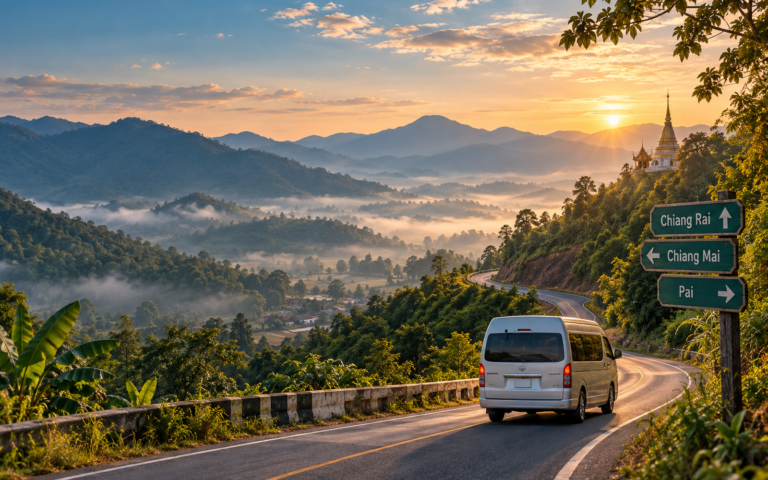
Most visitors reach Pai from Chiang Mai on Route 1095. Current Prempracha information reviewed in August 2026 listed frequent departures, a journey of about three hours and fares of 220 baht for a van or 260 baht for a minibus. Online platforms may show different operators, pickup arrangements and booking fees, so compare the final journey rather than only the headline fare.[2][3]
| Option | Planning cost | Typical time | Best for and trade-off |
|---|---|---|---|
| Prempracha van or minibus | About 220–260 THB one way | About 3–4 hours | Best-value default. Limited luggage space and little control over stops or driving pace. |
| Other shared van | Often about 260–360 THB online | About 3.5–4.5 hours | Hotel pickup can help, but collection rounds and operator quality vary. |
| Private car | Roughly 2,200–3,500 THB per vehicle | About 3–4 hours | Useful for groups, luggage, children and people who need a slower pace or stops. |
| Self-drive car | Rental, fuel and insurance vary | About 3–5 hours | Flexible, but the driver needs confidence on mountain bends, in rain and after dark. |
| Motorcycle | Rental and fuel vary | Often 4–6 hours with stops | Only for legally entitled, insured and genuinely experienced riders in suitable weather. |
16 September 2026. Operator fares, online fees, luggage rules and private-transfer quotes change; confirm the total for the exact date.
How to reduce motion sickness
Choose a morning service, eat lightly, request a forward seat where possible and speak to a pharmacist or clinician about appropriate medication before travel. Looking ahead is usually easier than reading a phone. Most importantly, leave enough time after arrival that feeling unwell does not destroy a fixed tour or sunset booking.
Where the van leaves and arrives
Prempracha services use Chiang Mai’s Arcade bus-terminal area and arrive at Pai’s small central bus station. Other companies may use private offices or hotel collection. Confirm the exact boarding point, check-in time and luggage treatment on the ticket rather than assuming every “Chiang Mai to Pai” product is identical.
Compare the whole journey before paying
Use the route page to compare operator, departure point, arrival time and luggage conditions. Then read the individual ticket terms, especially when a hotel pickup or large-bag charge is mentioned.
Arriving from Mae Hong Son or the loop
Road transport also links Pai with Mae Hong Son town and Pang Mapha. However, those journeys still depend on mountain roads and seasonal conditions. When driving the Mae Hong Son Loop, avoid stacking a long riding day with a sunset viewpoint or an evening return after rain.
Where to stay in Pai
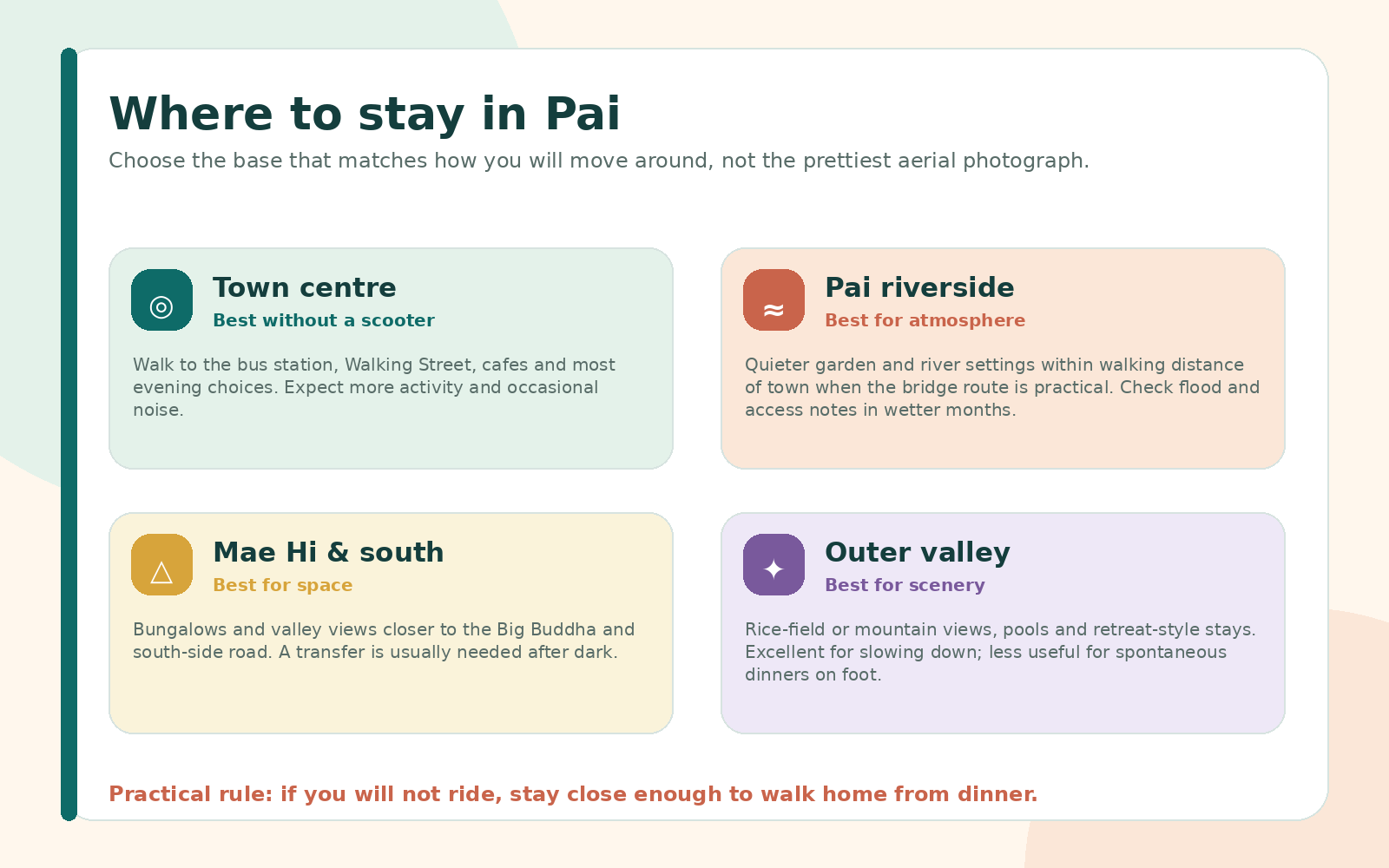
The best area depends on whether you will ride. Central Pai is not the most secluded option, but it is the most forgiving for first-time visitors who want to walk to the bus station, dinner and Walking Street. Riverside and outer-valley stays can be beautiful, yet a room with a view is poor value when every meal requires an uncertain night transfer.
| Area | Best for | Advantages | Trade-offs |
|---|---|---|---|
| Town centre | No-scooter visitors, solo travellers, short stays | Walkable food, market, station and tour pickup | Noise varies; garden space can be limited. |
| Near riverside | Couples and atmosphere | Calmer setting while still potentially walkable | Check bridge, lighting and wet-season access. |
| Mae Hi and south | Space, views and a quieter resort | Closer to the Big Buddha and south-side road | Usually needs transport for evening meals. |
| Outer valley | Retreats, pools and slow stays | Rice-field or mountain scenery | Weakest choice for spontaneous evenings without a vehicle. |
What to check before booking
Open the map and test the walking route to the centre, not the straight-line distance. Read recent comments about road noise, barking dogs, seasonal insects, access after rain, water pressure, heating or air-conditioning and whether reception can arrange a safe late transfer. A “Pai” address can still be several kilometres from town.
How the accommodation suggestions were compared
The areas were compared by walkability, evening convenience, vehicle dependence, quiet, scenery and resilience in wet weather. No individual hotel is ranked because standards, ownership and prices change. Use current reviews and cancellation terms for the exact dates.
Compare location before room style
Filter for free cancellation, then inspect the map and recent access comments. Booking.com and Agoda are provided as comparison tools rather than endorsements of a particular property.
Getting around Pai without making a risky decision
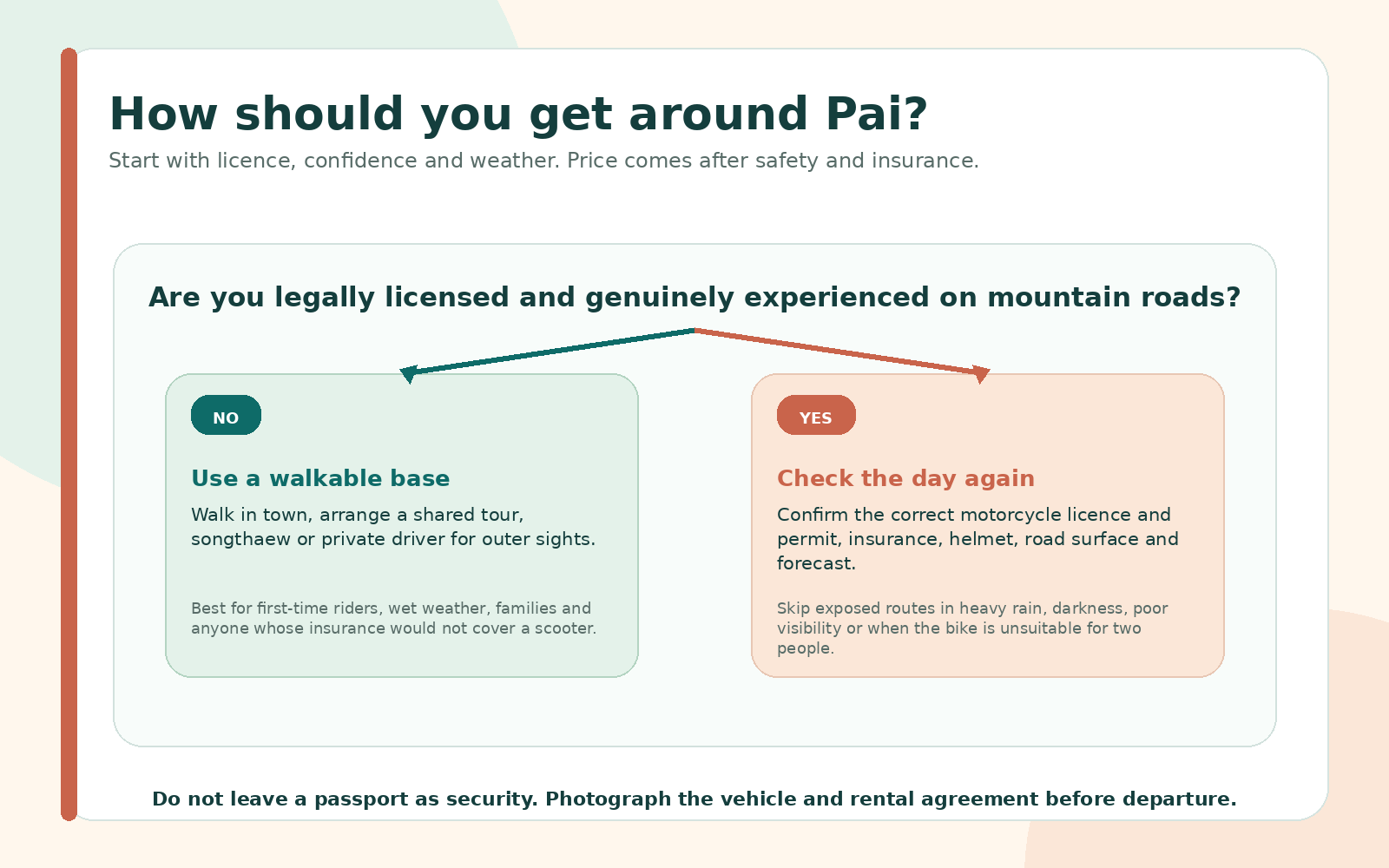
Central Pai is easy on foot; the valley is not. The canyon, hot springs, waterfalls, bamboo bridge and viewpoints require road transport. A scooter is common, but common does not mean appropriate for every traveller. UK travel advice notes Thailand’s high level of road traffic accidents, particularly involving motorcycles, and states that a valid licence and helmet are legal and insurance issues, not optional extras.[6]
Walking
Walking works for the bus station, town restaurants, Walking Street and some near-river accommodation. It does not work for the outer attractions. Pavements are inconsistent, lighting becomes weaker outside the centre and dogs or fast traffic can make a short map distance uncomfortable after dark.
Driver, songthaew or small-group trip
This is the best answer for travellers without motorcycle experience. Ask the hotel to price a clear route, waiting time and return, or choose a shared sightseeing trip whose stops genuinely match the plan. A driver is especially valuable for sunrise, wet conditions, families and a one-way transfer to a remote property.
Scooter or motorcycle
Only ride when the licence covers motorcycles in Thailand, the travel insurance remains valid, the helmet fits correctly and the rider already has meaningful road experience. Photograph the vehicle, note existing damage, keep the contract and refuse to leave a passport as security. Do not use Pai as the place to learn.
Weather changes the transport choice
Heavy rain, mud, wet leaves, low cloud and darkness increase risk on steep or narrow roads. A pre-booked rental is not a reason to ride. Change to a driver, stay close to town or move the outer loop.
Best things to do in Pai for a first visit
The following attractions were ordered by their usefulness in a three-night first trip. The comparison considered distinctiveness, travel time, seasonal value, safety and whether each stop fits naturally into a wider route. The list is not a claim that every traveller should visit every place.
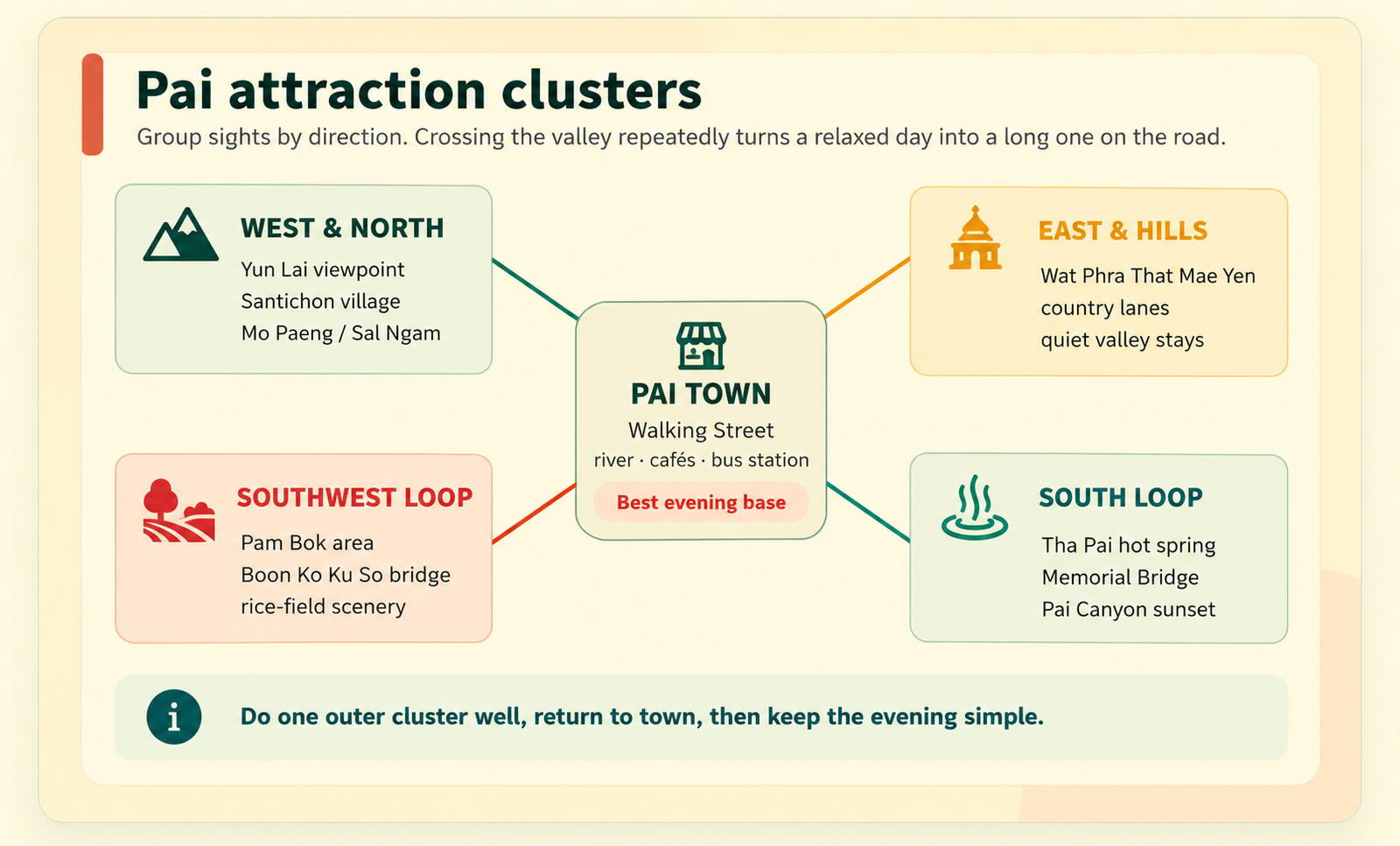
| Place | Best for | Useful time | Planning note |
|---|---|---|---|
| Pai Canyon | Sunset and unusual terrain | 45–90 minutes | The first viewpoint is easy; narrow ridges beyond it are exposed. |
| Walking Street | First evening, food and atmosphere | 1–2 hours | TAT describes it as an evening market beginning around 18:00. |
| Tha Pai Hot Spring | Morning soak and south loop | 1–2 hours | Protected-area fee applies and the hottest source is unsafe for bathing. |
| Wat Phra That Mae Yen | Town and valley views | 45–75 minutes | Long staircase; temple dress and respectful behaviour apply. |
| Yun Lai and Santichon | Sunrise, tea and a west-side route | 2–3 hours combined | Steep final approach and no guarantee of valley fog. |
| Boon Ko Ku So Bridge | Rice-field scenery | 45–90 minutes | Strongest when fields are green or golden; bamboo can be slippery. |
| Tham Lod | Cave scale and a full road day | Most of a day from Pai | Guide required; water level can change raft access. |
What can be skipped?
Photo stops built mainly around a sign, themed cafe or oversized prop are optional. They can be enjoyable, but they should not displace the canyon, a meaningful rural route or rest. Waterfalls also vary dramatically by season, so a dry-season trickle should not be treated as compulsory.
When a guided circuit earns its price
A shared or private trip is useful when it removes scooter risk, reaches Tham Lod or combines distant stops without negotiation. Compare the exact route, attraction time, entry fees, group size and sunset return rather than choosing the tour with the longest stop list.
Pai Canyon: what the photographs do not show
Pai Canyon is the most distinctive easy-to-reach landscape near town. TAT describes a short approach through teak forest, wide valley views and eroded sandstone passages with drops that can reach about 50 metres.[1] The first open viewpoint provides the sunset atmosphere without requiring anyone to continue along a narrow ridge.
How to visit safely
Wear closed shoes with grip, arrive with daylight and stay within personal confidence. The outer paths have loose soil, exposed edges and limited protection. After rain, the risk rises. Children, anyone uncomfortable with heights and travellers wearing unsuitable footwear should remain around the broad first viewpoint.
Best time
Late afternoon produces the warmest colour but also the largest crowd. Arrive well before sunset so parking, the climb and a safe position do not become a race. Morning is quieter and can be a better choice for travellers who value space over golden light.
Cost and opening approach
Recent 2026 practical guides continue to report no admission fee and no formal gated schedule, although the site should be treated as daylight-only because paths are unlit.[10] Checked 16 September 2026
Do not copy the most dramatic photograph
A social-media pose on a narrow spine can hide the drop, loose surface and queue behind the camera. The broad viewpoint gives the same valley without requiring an exposed crossing. Turn around before discomfort becomes panic.
Hot springs and waterfalls near Pai
Pai’s water attractions are highly seasonal and serve different purposes. Tha Pai Hot Spring is the simplest fit with the south loop. Sai Ngam provides a more natural-looking forest soak to the north, while waterfalls are strongest during and after the rainy season. A dry-month photograph from several years ago is not reliable evidence of current flow.
| Place | Planning cost | Choose it for | Watch |
|---|---|---|---|
| Tha Pai Hot Spring | Allow about 300 THB foreign adult park entry | Convenient south loop and warm soaking pools | The source is scalding; use designated cooler pools only. |
| Sai Ngam Hot Spring | Protected-area and local charges vary | Forest setting and a north-side route | Confirm the full gate total before driving out. |
| Boon Ko Ku So Bridge | About 30 THB | Rice fields and a gentle walk | Best colour is seasonal; little shade. |
| Waterfalls | Fees vary by site and protected area | Fuller wet-season scenery | Current strength and safe access change quickly. |
16 September 2026. Protected-area fees can change. The DNP fee catalogue and current gate information should take priority over an old blog or screenshot.[9][11][12]
Tha Pai Hot Spring
Go earlier for cooler air and a calmer atmosphere. The hottest source is for viewing and the egg-boiling ritual, not swimming. Move only into clearly designated lower pools and follow on-site signs. People with cardiovascular conditions, pregnancy-related concerns or heat sensitivity should seek medical guidance before a hot soak.
Waterfalls after rain
More water can improve the view but also increases current, slippery rock and flash-flood risk. FCDO guidance specifically warns about strong currents in rivers and near waterfalls during the rainy season.[6] Never treat a rope, worn path or other swimmers as proof that conditions are safe.
Villages, temples and rice-field scenery
Wat Phra That Mae Yen
The large white Buddha above Mae Hi is a useful orientation point and a popular place for late-afternoon views. The staircase is long and exposed, so go outside the hottest part of the day, cover shoulders and knees, and avoid climbing onto religious structures for photographs. A donation may be welcome, but respectful behaviour is the main requirement.
Santichon and Yun Lai
Santichon reflects Yunnanese Chinese heritage, food and migration history, yet some areas also operate as tourist photo attractions. Spend money with local businesses, ask before photographing people and look beyond costumes or props. Yun Lai above the village is strongest at sunrise, but the final road is steep and dark before dawn. A local transfer is safer than an inexperienced scooter ride.
Recent 2026 visitor information commonly lists a 20-baht viewpoint fee. Checked 16 September 2026 Treat the amount as a planning example and carry small cash because the tea and snacks may be separate.[13]
Boon Ko Ku So Bamboo Bridge
The bridge crosses rice fields towards a forest temple and is most photogenic when crops are green or turning gold. Current 2026 guides report a 30-baht maintenance fee. Checked 16 September 2026 The bridge remains a working local and religious landscape, so walk quietly, give way and avoid turning fields or monks into props.[12]
How these cultural stops were selected
They were included because they add valley geography, living religious practice or community history to a trip dominated by scenery. They are not ranked against one another. The better choice depends on mobility, sunrise willingness, rice season and whether transport is safe.
Photograph places without treating people as exhibits
Ask permission for close portraits, accept a refusal and avoid paid “village” experiences that market residents mainly by appearance. Community benefit and agency matter more than a staged photograph.
A realistic three-day Pai itinerary
This itinerary is designed for three nights, usually with a morning or midday arrival from Chiang Mai. It keeps the evening market, south loop and one wider day separate, while leaving room to change the third day for rain, haze or energy.
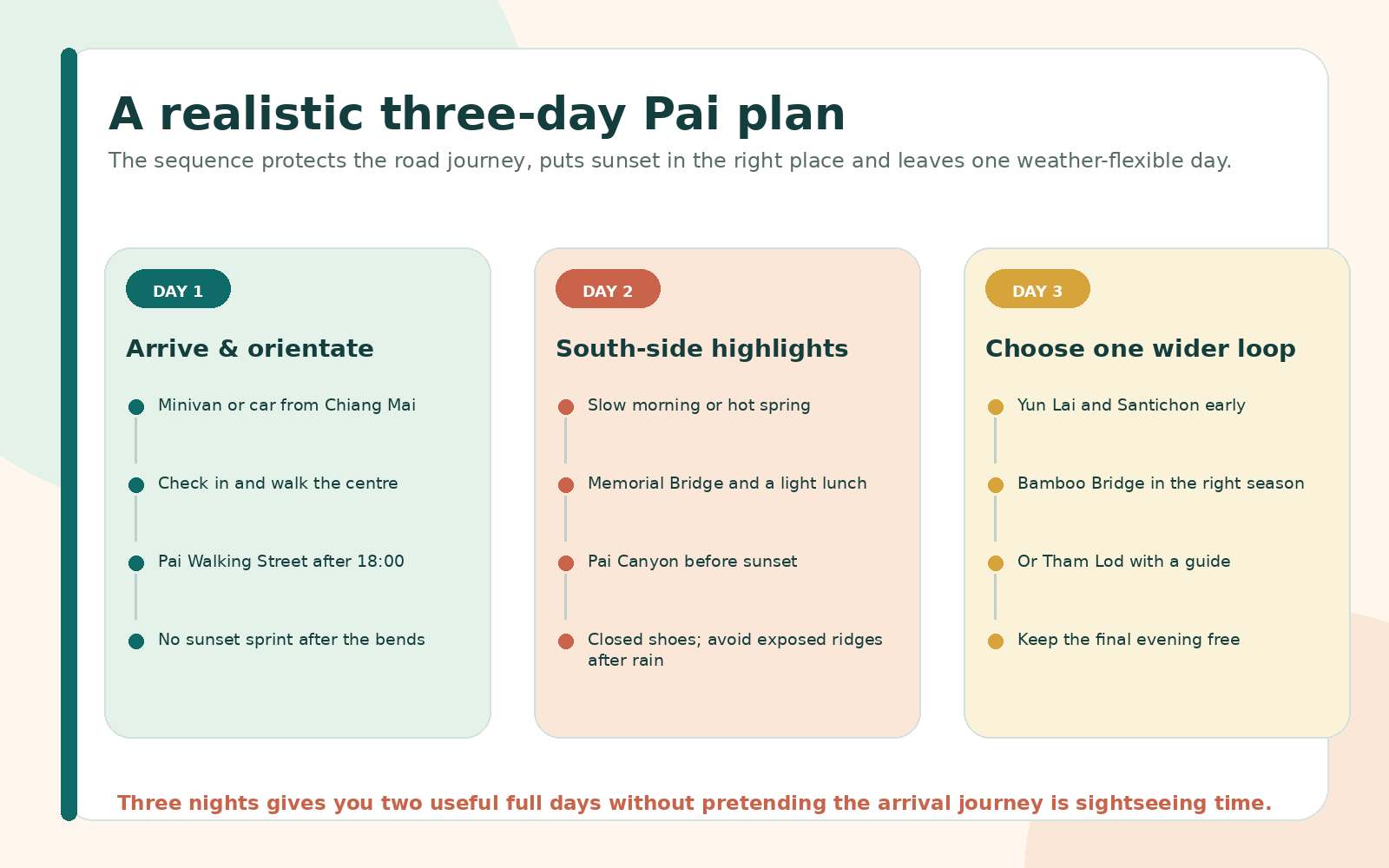
Day 1: arrive, settle and walk the centre
Travel from Chiang Mai, check in and avoid a fixed attraction immediately after the bends. Walk to the river, identify the bus station or return pickup point and eat close to the hotel. TAT describes Walking Street as coming alive around 18:00, so the market gives the arrival day a natural finish without another vehicle.[1]
Day 2: south loop and Pai Canyon
Begin with Tha Pai Hot Spring if soaking appeals, then pause around the Memorial Bridge or a south-side lunch. Return to the hotel if the afternoon heat is strong. Reach Pai Canyon with enough daylight to choose the broad viewpoint safely, stay for sunset only when conditions are dry, then return to town before fatigue encourages a poor road decision.
Day 3: choose one wider experience
Option one is an early Yun Lai and Santichon route, possibly followed by a seasonal rice-field stop. Option two is a guided Tham Lod day. Option three is deliberately slower: late breakfast, a massage, a riverside walk and one nearby temple or cafe. The right choice depends on weather and the amount of road time already used.
Day 4: leave with a buffer
Book a departure that protects any same-day flight or sleeper connection from Chiang Mai. The Pai road can run late in rain, traffic or vehicle disruption. A tight connection saves no meaningful holiday time when the consequence is a missed flight.
Use the weather-flexible day properly
Do not reserve every outer sight before arrival. Check visibility and rain, then choose the route whose main value still exists that morning.
Food, Walking Street and nightlife
Pai’s evening centre is compact and social. Walking Street mixes Thai snacks, northern dishes, vegetarian food, sweets, crafts and bars, while side streets hold cafes and restaurants at different price points. TAT places the nightly market around Chaisongkran and Rungsiyanon Roads from roughly 18:00.[1]
What to try
Look for khao soi, sai ua, grilled meats, sticky rice, seasonal fruit, Thai desserts and simple Burmese-influenced snacks, then use busy stalls with clear turnover. Pai also caters heavily to international travellers, so pizza, bakery food and vegetarian dishes are easy to find. That choice can be useful after a long road journey, but it should not replace every local meal.
How this food list was built
The dishes were selected for regional relevance and realistic availability, not because a single stall is claimed to be “best”. Food businesses change quickly. Current hygiene, ingredient communication, recent reviews and visible turnover matter more than an old award or viral queue.
Allergies and dietary needs
Carry a translated allergy card and ask about fish sauce, shrimp paste, peanuts, soy and shared oil rather than relying on the word “vegetarian”. Night markets are noisy and may not suit complex allergy conversations. When the answer is uncertain, choose another vendor.
Nightlife without losing the next day
Pai has live music, small bars and party-oriented hostels, but the valley sights reward early mornings. Choose accommodation from the evening you actually want. A quiet riverside room and a party street are both legitimate choices; the mistake is booking one while expecting the other.
River activities need sober judgement
Tubing and rafting products vary by water level, supervision and party emphasis. Read the operator’s safety details, life-jacket rules, insurance and alcohol policy before booking, then skip the activity when river conditions are poor.
Best day trips and onward routes from Pai
The options below were compared by road time, distinctiveness, seasonality and how much they add beyond the sights close to Pai. Tham Lod is the strongest first day trip. Mae Hong Son town and Ban Rak Thai fit a longer Mae Hong Son route better than a rushed out-and-back from Pai.
| Trip | Best for | Road reality | Planning advice |
|---|---|---|---|
| Tham Lod Cave | Cave scale, archaeology and guided exploration | Roughly 1.5–2 hours each way depending on route and stops | Use a local guide; raft access varies with water level. |
| Huai Nam Dang | Mountain viewpoints and cool-season scenery | Road-based and weather-sensitive | Check national-park access and visibility before leaving. |
| Mae Hong Son town | Temples, lake and a wider province route | A long day return from Pai | Better as an overnight or part of the loop. |
| Ban Rak Thai | Lake, tea and Yunnanese heritage | Too far for a relaxed first Pai day trip | Combine with Mae Hong Son accommodation. |
Tham Lod
TAT describes a limestone cave system extending about 600 metres, with a river passing through it and a required guide.[1] The visit may include walking and a bamboo raft, but high or low water can change which chambers are accessible. Wear footwear with grip and accept on-site safety decisions.
Do not turn Ban Rak Thai into a photo commute
The lake can look close on a provincial map, yet the return journey from Pai is long and winding. Stay around Mae Hong Son or Ban Rak Thai instead. That creates morning and evening atmosphere without spending the day chasing a single viewpoint.
When to book a day tour
Book when the trip needs a guide, several road transfers or a safe return after dark. Verify pickup zone, cave guide and raft inclusions, meals, park fees, maximum group size and the cancellation policy for high water or road disruption.
Realistic Pai budget and what to book first
Pai can be inexpensive, but the final cost is shaped by the base and transport. A central room may cost more than a remote bungalow yet save several paid transfers. Conversely, a group can make a private driver reasonable once the cost is divided.
| Daily item | Budget approach | Mid-range approach | What creates the difference |
|---|---|---|---|
| Room per night | 500–1,200 THB | 1,500–3,500 THB | Season, air-conditioning, pool, central walkability and view. |
| Food and drinks per person | 500–900 THB | 1,000–2,000 THB | Markets and local meals versus cafes, cocktails and resort dining. |
| Local transport per person | 150–500 THB | 600–1,500 THB | Walking or shared vehicle versus private driver and sunrise transfer. |
| Activities per person | 100–500 THB | 700–2,000 THB | Free viewpoints versus hot springs, cave trip and organised activities. |
| Working daily total per person | 1,200–2,500 THB | 3,000–6,500 THB | Assumes shared accommodation; excludes the intercity transfer. |
16 September 2026. These are planning ranges, not quoted tariffs. Price the exact room, transfer and activity for the travel dates.
Book in this order
- Choose the season and keep late-dry-season accommodation cancellable.
- Reserve a useful Pai base, especially for December, January and Thai holiday periods.
- Book the Chiang Mai–Pai seat and the return that protects onward travel.
- Arrange a driver or guided cave day when the plan depends on it.
- Leave ordinary viewpoints, cafes and weather-sensitive local loops flexible.
Where not to economise
Do not choose an unsuitable scooter because it is cheaper than a driver. Likewise, do not save on a room by moving so far out of town that every dinner becomes an unplanned transfer. The useful comparison is total trip cost and risk, not the cheapest line item.
Practical planning, entry rules and connectivity
Thailand Digital Arrival Card
Foreign travellers must complete the official Thailand Digital Arrival Card before arrival. The Immigration Bureau states that information can be submitted within the three days before the arrival date and that the official form has no fee. Checked 16 September 2026[7] Use the government site rather than a paid imitation.
British passport and visa rules
For readers travelling on a full British citizen passport, FCDO guidance changed on 15 September 2026 and now describes up to 30 days under the visa-exemption scheme for eligible tourist arrivals. Rules depend on nationality and can change, so check the official source close to travel rather than copying a social-media answer.[8]
Cash, mobile data and power
Carry small baht notes for viewpoints, local food and places that do not accept cards. Mobile coverage is usually useful in town but may weaken in the hills. Download the hotel location, return ticket and offline map before a long outer route. A power bank helps on sunrise and cave days.
Arrange data before the mountain transfer when useful
An eSIM can help with pickup messages, maps and accommodation contact, although coverage still varies outside town. Check device compatibility and compare the package with a Thai physical SIM.
Medical and emergency planning
Use travel insurance that covers the planned transport and activities. Save the insurer’s assistance number and keep proof of licence entitlement when driving. Pai has pharmacies and clinics, but more complex care may require transfer to a larger hospital. Carry personal medication and do not rely on a remote viewpoint to have a signal.
Temple and community etiquette
Cover shoulders and knees, remove shoes where requested, keep feet away from Buddha images and avoid loud photography during worship. In villages, ask before close portraits and spend locally without treating residents as a display.
Pai with children, limited mobility or no scooter
Families
Families benefit from a central or resort base, private road transfer and one substantial outing per day. The mountain journey, heat and early starts can matter more than the attraction list. Carry child-appropriate motion-sickness advice from a clinician, confirm child seats in writing and avoid exposed canyon ridges.
Limited mobility
Pai’s centre has uneven surfaces and inconsistent pavements. Pai Canyon begins with steps and continues to rough exposed paths; Wat Phra That Mae Yen has a long staircase; bamboo paths and cave floors can be uneven. Ask each venue and operator about current step-free access, toilets, vehicle proximity and assistance rather than relying on a broad “accessible” label.
No scooter
A no-scooter visit is entirely workable when the accommodation is walkable and outer days are arranged in advance. Central Pai, Walking Street, cafes and the river provide a useful slow day, while a driver or shared tour can cover the south loop or Tham Lod. The trip may cost more than renting a bike, but it can be far safer and less stressful.
Heat, smoke and respiratory conditions
Keep a late-dry-season booking flexible, monitor Air4Thai and reduce outdoor exertion when readings or health guidance are poor. Anyone with asthma or another respiratory condition should discuss a travel plan with a clinician and carry the prescribed medication. A mountain destination is not automatically clean-air travel.
Ask four access questions
How close can the vehicle stop? How many steps are unavoidable? What is the surface after rain? Is an accessible toilet available? Those answers are more useful than a single wheelchair symbol.
Pros and cons of adding Pai to a Thailand trip
Reasons Pai works
- Compact, sociable centre with relaxed evenings.
- Distinctive canyon, valley and rice-field scenery.
- Easy to combine with a longer Chiang Mai stay.
- Accommodation ranges from hostels to quiet retreats.
- Three nights can feel restorative rather than rushed.
Reasons to reconsider
- The mountain road causes motion sickness for many travellers.
- Outer sights need a driver, tour or legally ridden vehicle.
- Smoke can remove the views in the late dry season.
- Rain makes roads, bamboo and canyon paths slippery.
- Mobility access is inconsistent at nature and hilltop sights.
Who should add Pai?
Add it when the northern part of the trip has at least six or seven nights, mountain scenery matters and a slower small-town atmosphere sounds appealing. Four Chiang Mai nights plus three Pai nights is far stronger than two rushed nights in each.
Who should skip it?
Skip it when the route already has too many transfers, the traveller is highly vulnerable to motion sickness, the only available dates fall in severe smoke, or the holiday depends on step-free attractions. Thailand has many alternatives; leaving out Pai is better than forcing it into the wrong trip.
Common Pai mistakes
These mistakes were selected from recurring transport, seasonal, safety and pacing problems rather than ranked by severity. Any one of them can weaken the trip; several together usually produce a rushed or risky visit.
Booking a same-day return from Chiang Mai
Six to eight hours of road time leaves very little Pai. Stay overnight or use the day elsewhere.
Learning to ride a scooter here
Mountain roads, rain and unfamiliar traffic create a poor classroom. Use a driver when experience or licensing is missing.
Choosing a remote room without a night plan
A scenic bungalow can create repeated transfers for food, market visits and an early departure.
Walking Pai Canyon in flip-flops
Loose soil and exposed ridges require grip. The broad first viewpoint is enough when footwear or confidence is poor.
Ignoring smoke because Pai is rural
Regional PM2.5 can affect the whole valley. Check Air4Thai and keep plans flexible.
Chasing every viewpoint in one day
Sunrise, hot springs, waterfalls, bamboo bridge and canyon sunset create a long, tiring road circuit.
Assuming waterfall photos are current
Flow changes by season and weather. Ask locally before using half a day for a weak or unsafe stop.
Leaving Pai before a tight flight
Rain, traffic or a late van can break the connection. Build a Chiang Mai buffer.
Pai travel guide FAQs
Is Pai worth visiting?
Pai is worth visiting for travellers who want mountain scenery, a small social centre and two or three slower days after Chiang Mai. It is less suitable for people who dislike winding roads, need strong public transport or travel during severe smoke.
How many nights should I stay in Pai?
Three nights is the best first-visit default. It gives two full days for one south loop and one weather-flexible wider day without turning the arrival journey into a sightseeing race.
How long is the journey from Chiang Mai to Pai?
Allow roughly three to four hours by scheduled van or private car, plus check-in and local transfers. Heavy rain, traffic, pickups and rest stops can extend the journey.
Is there a train to Pai?
No. Pai has no railway station. Most rail travellers reach Chiang Mai first, then continue by road.
Can I visit Pai without renting a scooter?
Yes. Stay near the centre, walk to meals and Walking Street, then arrange a driver, songthaew or shared tour for outer sights. It may cost more but avoids an unsuitable motorcycle decision.
Is the road to Pai dangerous?
Route 1095 is paved but winding. Risk depends on speed, weather, driver, vehicle and rider experience. Shared vans can cause motion sickness, while self-driving requires the correct licence, insurance and mountain-road confidence.
When is smoke season in Pai?
Risk usually rises in the late dry season, especially around February to April, but exact conditions vary. Check Air4Thai close to travel and keep accommodation flexible.
What is the best area to stay in Pai?
The town centre is the best first base without a scooter. Near-riverside stays can balance atmosphere and walkability. Outer-valley resorts suit travellers who already have transport and prioritise scenery.
Is Pai Canyon suitable for children?
The broad first viewpoint can work with close supervision, but the narrow ridges are exposed and unsuitable for many children. Avoid wet conditions and unsuitable footwear.
What is the best day trip from Pai?
Tham Lod is the strongest first day trip because the cave is genuinely different from the valley sights. Use a guide and confirm current raft access and road conditions.
Can I do Pai as a day trip from Chiang Mai?
It is possible through an organised tour, but not recommended. The return road journey dominates the day and leaves little time to experience the town.
How much cash should I carry in Pai?
Carry enough small baht notes for food stalls, viewpoint fees, local transport and a backup meal. Keep the main travel funds secure and use an ATM in town rather than relying on remote attractions.
The clearest first-time Pai recommendation
Plan Pai as a three-night pause, not a one-day collection
Travel from Chiang Mai in the morning, sleep within walking reach of town when you will not ride, and keep the first evening for orientation and Walking Street. Use the next day for the south loop and Pai Canyon, then choose one wider experience according to weather: Yun Lai and Santichon, the bamboo bridge in the right season, a guided Tham Lod trip or a deliberate slow day.
The strongest decision is often what to leave out. Do not learn to ride here, do not cross the valley for every photograph, and do not keep a scenic booking when smoke or rain removes the reason for it. Pai rewards margin: time after the road, space between outings and permission to enjoy the town without turning it into a checklist.
Final planning checklist
- Keep at least three nights when the route allows.
- Choose the hotel area from the transport plan.
- Reserve the Chiang Mai–Pai seat and protect the onward connection.
- Check Air4Thai, Mae Hong Son weather and road conditions.
- Use a driver or tour when motorcycle licence, insurance or experience is missing.
- Carry closed shoes, a light layer, rain protection and small cash.
- Reconfirm protected-area fees and cave access close to the visit.
Sources and fact-checking notes
Research was reviewed on 16 September 2026. Official tourism, government, operator and weather sources were prioritised. Recent specialist visitor sources were used only where an official page did not publish a practical fee or access detail. Prices and schedules remain dated examples; the live operator, ticket window, park notice and weather warning take priority.
- Tourism Authority of Thailand Mae Hong Son overview: Pai Canyon, Sai Ngam Hot Spring, Walking Street and Tham Lod. Open source
- Prempracha Transport Current timetables and fares for Chiang Mai–Pai road services. Open source
- 12Go Current Chiang Mai–Pai route listings and operator comparisons. Open source
- Thai Meteorological Department Mae Hong Son weather and forecast information. Open source
- Pollution Control Department Air4Thai current air-quality reporting. Open source
- UK Foreign, Commonwealth & Development Office Thailand safety and security: road, motorcycle and rainy-season guidance. Open source
- Thailand Immigration Bureau Official Thailand Digital Arrival Card. Open source
- UK Foreign, Commonwealth & Development Office Thailand entry requirements for British citizens. Open source
- Department of National Parks, Wildlife and Plant Conservation Official national-park entrance-fee dataset and update record. Open source
- Out Thailand Pai Canyon 2026 practical access, fee and safety check. Open source
- Thai Holiday Guide Tha Pai Hot Spring 2026 hours and visitor-fee check. Open source
- Out Thailand Boon Ko Ku So Bamboo Bridge 2026 visitor check. Open source
- Thailand Addict Yun Lai Viewpoint 2026 practical visitor check. Open source
- GetYourGuide Current Pai activity inventory used only for planning comparisons. Open source
- Taylor’s Trailblazing Travels Chiang Mai itinerary 2026. Open source
- Taylor’s Trailblazing Travels Best time to visit Thailand 2026. Open source
- Taylor’s Trailblazing Travels Thailand two-week itinerary 2026. Open source
How uncertain details are handled
Where current fee reports conflict, the guide gives a planning allowance or instructs the reader to verify at the gate rather than presenting an unsupported exact figure. No first-hand visit is claimed.
Illustrations in this article were created for Taylor’s Trailblazing Travels. Third-party photographs, where used, are credited beside the image or in the source list.