Chiang Rai Travel Guide
A realistic 2026 guide to the White Temple, central stays, road-based sightseeing, mountain day trips and the difference between seeing Chiang Rai and merely rushing through it.
Best first base: city centre
One long provincial loop per day
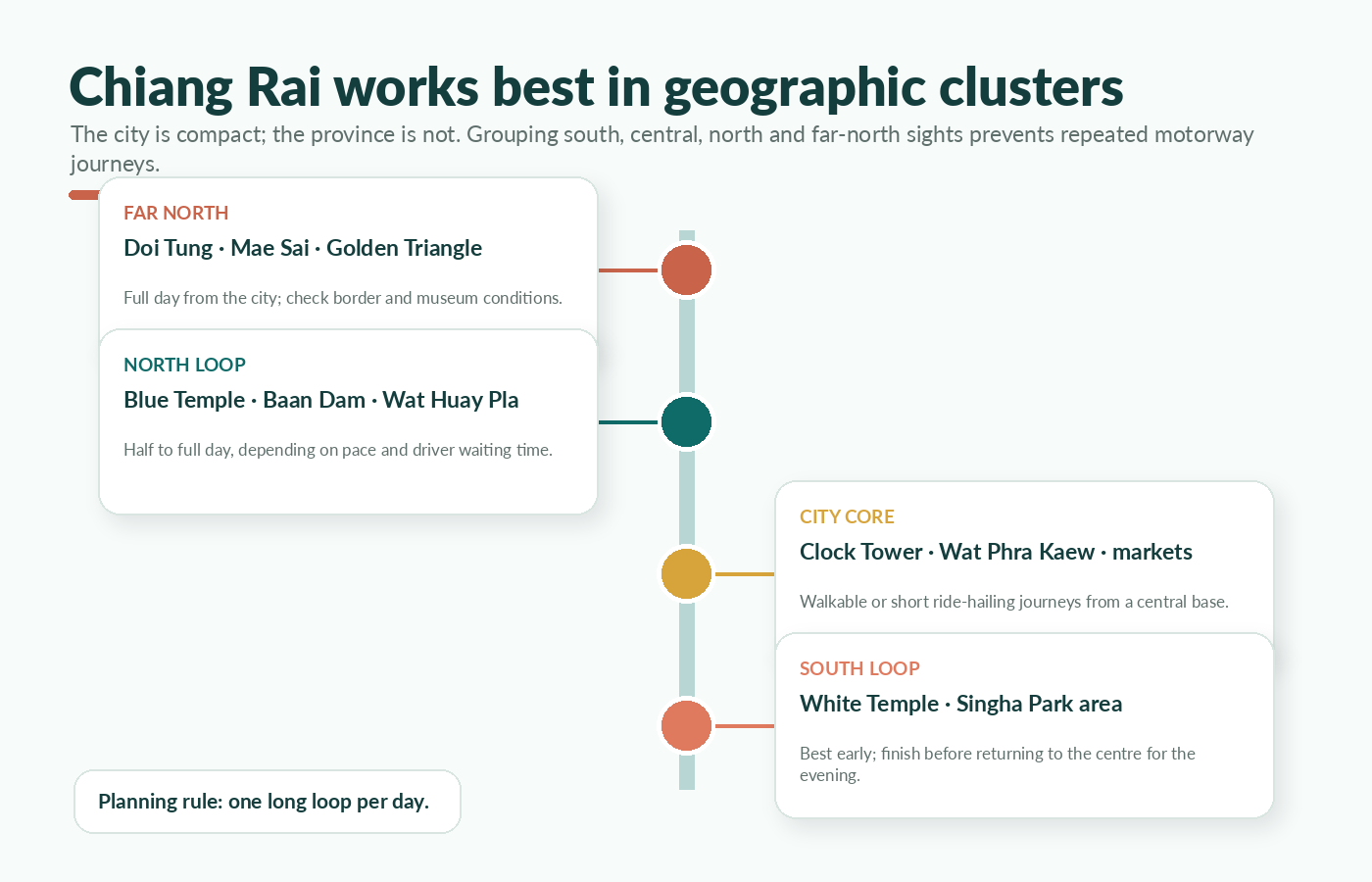
Chiang Rai is easy to underestimate. The city centre feels calm and manageable, yet the province’s headline sights stretch south to Wat Rong Khun, north towards Baan Dam and Doi Tung, east to mountain viewpoints and far beyond the walkable centre. A successful first visit therefore depends less on collecting attractions and more on grouping the right places into sensible road days.
This Chiang Rai travel guide treats the city as a base rather than a single attraction. It explains where to stay, how many nights to allow, which temple and museum combinations work, when smoke or rain should change the plan, and why a one-day dash from Chiang Mai is possible but rarely the most rewarding version.
This guide contains a small number of affiliate links. Taylor’s Trailblazing Travels may receive a commission when a qualifying booking is made, at no extra cost to you. A link appears only where a transport, hotel, activity or connectivity comparison solves a genuine planning problem.
Clock Tower or Night Bazaar area
Central food, evening atmosphere and easier pickups without relying on a car for every meal.
Three nights
Enough for the city, the White Temple and one long northern or mountain day.
Doi Tung or Phu Chi Fa
Doi Tung is simpler; Phu Chi Fa is more weather-sensitive and stronger with an overnight.
Small city, large province
The centre is easy. The famous sights outside it require a route, driver or carefully chosen tour.
Chiang Rai travel guide at a glance
Chiang Rai suits travellers who want contemporary temple art, quieter evenings, mountain landscapes and a slower northern base. It is not a second Chiang Mai. Chiang Rai has less urban choice and less public transport, yet it places the White Temple, Blue Temple, Baan Dam, Doi Tung and the Golden Triangle within reach of a compact provincial capital.[1][2]
| Planning point | Useful first answer | Why it matters |
|---|---|---|
| Ideal first stay | Three nights | Separates the city, the south loop and one longer provincial day. |
| Best central base | Clock Tower, Night Bazaar or Bus Terminal 1 area | Food and evenings stay easy even when daytime sightseeing needs a vehicle. |
| Airport | Mae Fah Luang–Chiang Rai International Airport (CEI) | A short road transfer from the city and useful for direct domestic arrivals. |
| Train station | None in Chiang Rai | Rail travellers normally connect by road from Chiang Mai, Lampang or another rail-served city. |
| Best first route | City and art sights before a long mountain loop | It gives the trip context before the more tiring road days. |
| Main planning risk | Trying to join distant sights because they look close on a province map | Mountain roads, attraction hours and driver waiting time decide the real day. |
Who will enjoy Chiang Rai most?
It works particularly well for couples, solo travellers, photographers, art-focused visitors and anyone building a slower northern route. Families can also enjoy it when long drives are limited and hotel pool or rest time is protected. Travellers seeking dense nightlife, endless shopping or door-to-door rail transport may prefer to keep the stay shorter.
What Chiang Rai is not
It is not a single temple stop, and it is not an efficient sightseeing city without some transport planning. The city centre can be explored gently, but the celebrated landmarks sit in different directions. Treat the province as several clusters rather than one continuous attraction zone.
How many days do first-time visitors need?
Three nights is the strongest starting point. It provides two or three useful sightseeing days without forcing the White Temple, Baan Dam, Doi Tung and the Golden Triangle into one exhausting circuit.
| Stay | What fits comfortably | Trade-off |
|---|---|---|
| One day | White Temple, Blue Temple and one additional stop with a fixed tour | Most of the day is dictated by the vehicle. City evenings and slower interpretation disappear. |
| Two nights | Core temple-art circuit plus a central evening | Little room for Doi Tung, Phu Chi Fa or a weather change. |
| Three nights | City and north art loop, White Temple and one long regional day | Best balance for a first visit. |
| Four or five nights | Same core plan with a rest day, Doi Mae Salong or an overnight mountain sunrise | Worthwhile for slower travel, but only when Chiang Rai is a priority rather than a checklist stop. |
Why the Chiang Mai day trip feels longer than the brochure
The official GreenBus timetable shows frequent Chiang Mai–Chiang Rai services, while current bookable journeys commonly take roughly three to four hours each way.[4] A guided day trip removes the ticketing problem, although it cannot remove the road time. When the itinerary includes several attractions and a return to Chiang Mai, the day commonly begins early and finishes late.
Practical pacing test
If the plan includes more than two major out-of-town clusters, read the driving time aloud. White Temple south, Baan Dam north and Golden Triangle far north are not a compact city route. Remove one cluster before removing meal or rest time.
Best time to visit Chiang Rai: cool season, rain and smoke
November to February is the simplest period for a first trip. Mornings can be cool, mountain views are often clearer and the heaviest monsoon rain has usually eased. It is also the busiest northern travel season, so central hotels and New Year dates deserve earlier booking.[5][16]
| Period | What works | What to watch |
|---|---|---|
| November–February | City walking, temple loops, Doi Tung and mountain mornings | Peak domestic demand, cool early starts and holiday crowds. |
| March–April | City attractions when air quality remains acceptable | Heat, agricultural smoke and reduced mountain visibility can undermine the reason for travelling north. |
| May–June | Greener landscapes and lighter crowds | Storms build; flexible road days and cancellable bookings matter. |
| July–September | City temples, cafés and museums between showers | Flash-flood, landslide and park-closure risk rises on mountain routes. Local 2026 reporting listed seasonal restrictions at several nature sites.[18] |
| October | Transitional month with improving scenery | Do not assume the wet season has ended on a fixed date. |
Smoke season is a booking decision
Air quality should be checked before paying for a non-refundable mountain itinerary, not only on the morning of departure. Air4Thai is the official monitoring system; look at the current reading and recent pattern for the relevant district rather than relying on one photograph or a generic seasonal claim.[6]
Replace the route when the view has gone
When PM2.5 is elevated or visibility is poor, move the trip towards city art, food and museums, or reconsider the northern leg entirely. A mountain tour does not become good value simply because it remains technically open.
Rainy season needs a second plan
Heavy rain is not constant every day, yet steep roads, waterfall access and sunrise viewpoints are more vulnerable than central temples. Check the Thai Meteorological Department forecast, ask the driver about road conditions and confirm the attraction is open before leaving the city.[5]
Getting to Chiang Rai from Bangkok, Chiang Mai and elsewhere
Fly when Chiang Rai is the northern entry point
Mae Fah Luang–Chiang Rai International Airport is the simplest arrival for travellers coming from Bangkok or connecting through a domestic hub. Flight schedules change by season, so compare the whole journey—including airport transfer and baggage—rather than only the airborne time.[3]
Use GreenBus for the practical Chiang Mai connection
GreenBus published multiple daily departures in both directions in its timetable updated on 15 August 2026.[4] The route is the clearest public-transport link between the two cities. Book earlier for weekends and popular cool-season dates, and confirm which Chiang Rai terminal appears on the ticket.
Compare the complete route
Use a live booking page to compare departure point, terminal, luggage conditions and journey duration before paying. A slightly later bus to Terminal 1 can be more useful than the first departure to an outer terminal.
There is no direct train to Chiang Rai
Chiang Rai does not have a passenger railway station. A rail-led itinerary therefore needs a road connection from Chiang Mai, Lampang, Phitsanulok or another rail-served point. That can still work, but it should be described as train plus bus or car rather than a direct railway journey.
Chiang Rai Airport to the city centre
The airport is close enough to central Chiang Rai that the arrival transfer is usually straightforward. Airports of Thailand lists taxi or airport-shuttle access and car-rental desks, while hotel transfers and ride-hailing may also be available.[3]
| Option | Best for | Check before accepting |
|---|---|---|
| Airport taxi or arranged shuttle | First arrival, luggage and a central hotel | Destination, total fare, payment method and whether the quoted vehicle fits all bags. |
| Ride-hailing | Travellers with working data and a clear pickup point | Airport pickup restrictions, surge pricing and the correct terminal door. |
| Hotel transfer | Late arrival, families and remote riverside stays | Written price, meeting sign, waiting policy and emergency contact. |
| Rental car | Confident drivers continuing to Doi Tung or countryside accommodation | Licence validity, insurance excess, night-driving comfort and mountain-road experience. |
Choose simplicity on arrival day
A central hotel and a direct transfer normally beat collecting a car after a late flight. Add the vehicle on the morning you actually need the province, when you are rested and can inspect it in daylight.
Where to stay in Chiang Rai for a first visit
The Clock Tower, Night Bazaar and Bus Terminal 1 zone is the best all-round base for most first-time visitors. It keeps restaurants, evening markets and local transport within a manageable area, while day-trip operators can usually collect from central hotels. Riverside resorts are quieter and more spacious, but they turn an ordinary dinner into another vehicle journey.
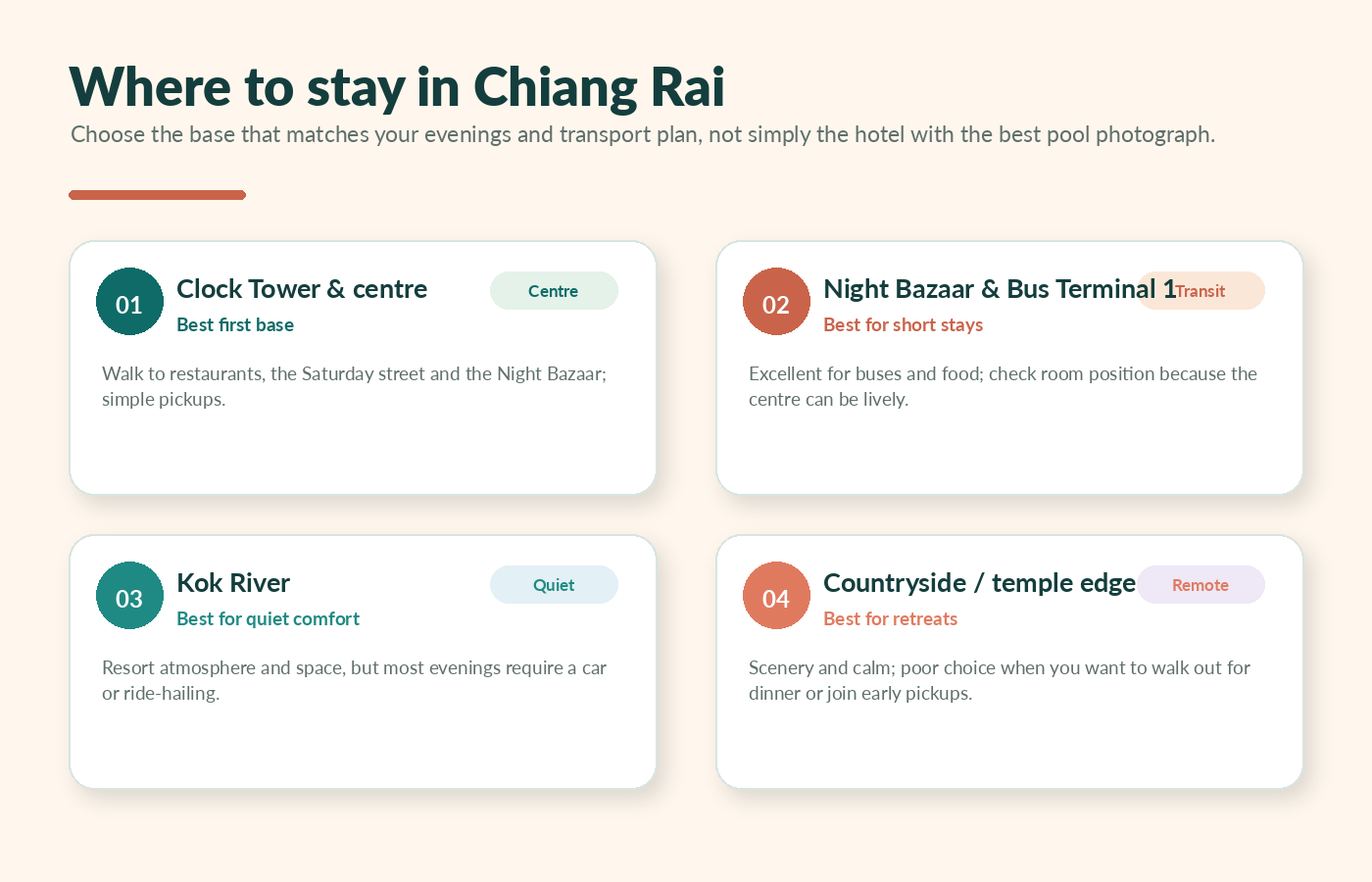
| Area | Best for | Why it works | Main trade-off |
|---|---|---|---|
| Clock Tower / central streets | Most first visits | Walkable food, central temples and simple evening plans. | Street noise varies; inspect the room position, not just the postcode. |
| Night Bazaar / Bus Terminal 1 | Short stays and bus connections | Practical transport, food and easy orientation. | Less retreat-like and livelier around market hours. |
| Kok River | Couples, families and resort time | Space, gardens and a calmer atmosphere. | Frequent ride-hailing or hotel transport for central evenings. |
| Ban Du / airport side | Very early flight or northern road start | Useful for the airport and northbound routes. | Weak base for a first central visit. |
| White Temple or countryside | Retreat-style stay with its own transport | Scenery and a slower pace. | Limited walk-out dining and inconvenient for spontaneous city plans. |
Five checks matter more than a headline hotel score
- Walking route after dark, not straight-line map distance.
- Room position relative to roads, bars, lifts and service areas.
- Early breakfast or packed-breakfast policy for day tours.
- Driver access and pickup instructions.
- Cancellation terms during smoke or monsoon-sensitive months.
Live accommodation searches in September 2026 showed a wide spread from simple central rooms to riverside resorts, so the area decision should come before the brand decision.[11][12]
Compare the same dates, room type and cancellation rules
Getting around Chiang Rai without wasting the day
Central Chiang Rai is manageable on foot for meals, the Clock Tower, Wat Phra Kaew and nearby streets. The province is road-based. Ride-hailing, tuk-tuks and songthaews solve short urban journeys; a driver, rental car or carefully selected tour solves the wider loops.
| Mode | Best use | Practical limitation |
|---|---|---|
| Walking | Central temples, Clock Tower and markets | Heat, uneven pavements and major-road crossings reduce the useful walking radius. |
| Ride-hailing | Short city hops and one-way attraction journeys | Return availability is less certain outside the centre; agree a backup plan. |
| Tuk-tuk or songthaew | Short negotiated trips and simple local routes | Confirm destination, total price, waiting time and whether the vehicle is private or shared. |
| Private driver | Doi Tung, Golden Triangle, Doi Mae Salong or multi-stop loops | Clarify hours, kilometres, parking, attraction waiting and overtime before departure. |
| Organised tour | Travellers who want transport, guiding and a fixed route | Read every inclusion. A long list can hide brief stops and limited freedom. |
| Rental car | Confident drivers with mountain-road experience | Insurance, licence rules, steep wet roads and fatigue remain the driver’s responsibility. |
| Scooter | Experienced, correctly licensed riders on suitable days | Not a sensible first lesson. Mountain weather and night riding increase risk sharply. |
Driver questions that prevent awkward surprises
- Which exact attractions are included and in what order?
- How many hours and kilometres does the price cover?
- Does the driver wait during every visit?
- Are tolls, parking and fuel included?
- What happens if weather closes the planned mountain stop?
Chiang Rai city essentials without rushing
The centre works best as a gentle first or final day. Wat Phra Kaew provides historical context, the Golden Clock Tower gives the city an unmistakable visual centre, and the Night Bazaar or Saturday Walking Street supplies an easy evening. TAT also highlights central temples and the Clock Tower’s evening light presentation, although event timings should be checked locally because schedules can change.[2]
A practical central route
Begin at Wat Phra Kaew before the heat builds, then continue through the centre towards the Clock Tower and a café or museum stop. Return to the hotel during the hottest part of the afternoon. In the evening, choose the Night Bazaar on an ordinary night or the Saturday Walking Street when the calendar aligns.
Choose depth
Read the interpretation at one important temple, notice how contemporary art differs from older Lanna forms and leave space for food or conversation.
Avoid temple fatigue
The White, Blue and central temples are visually distinct. They lose impact when treated as five-minute photograph stops in a single van circuit.
Temple etiquette
Cover shoulders and knees, remove shoes where directed, keep feet away from Buddha images and avoid blocking worshippers for photographs. Ask before photographing monks or ceremonies. A working temple is not a studio set, even when its architecture is extraordinary.
White Temple and the south-side art route
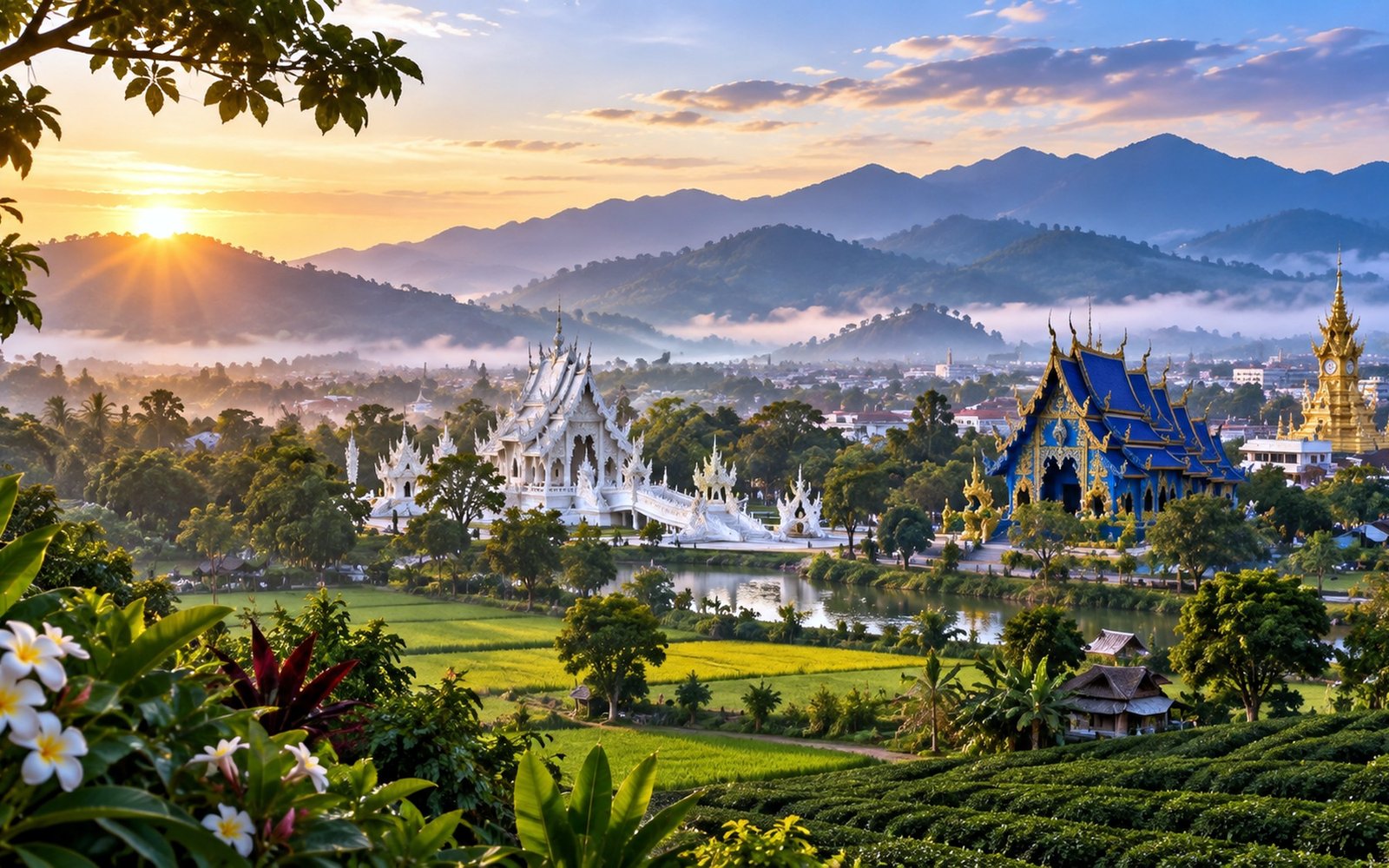
Wat Rong Khun, widely known as the White Temple, is the visual headline of Chiang Rai. It is also an active religious site and a continuing art project associated with artist Chalermchai Kositpipat. Its symbolism and detail reward a slower visit more than a rushed exterior photograph.[2]
Current visitor information
Foreign adult admission was reported as 200 THB, with opening commonly listed from 08:00 until late afternoon. Checked 16 September 2026 Older guides still quote the former price, so confirm the ticket-board information on arrival. Photography is not permitted inside the main hall, and modest dress is required.[7]
Go near opening
Early arrival gives softer light, a cooler walk and a better chance of moving through the symbolic bridge without a dense tour group. It also protects the rest of the day: after the White Temple, the south side can include lunch or one nearby stop rather than a frantic drive north.
What to pair with it
Singha Park or another south-side attraction can work when it matches the traveller’s interests and live opening information. Do not automatically add Baan Dam, Doi Tung and the Golden Triangle simply because they appear in the same search results. Those lie in a different direction and turn a focused half-day into a vehicle marathon.
Dress and photography are part of the plan
Carry clothing that covers shoulders and knees, allow time to remove footwear where required and keep the camera away inside restricted spaces. A scarf is useful, but arriving dressed appropriately is simpler.
Blue Temple, Baan Dam and the north art loop
The north-side route works because its major stops contrast with one another. Wat Rong Suea Ten uses saturated blue and gold in a contemporary Buddhist setting; Baan Dam is a private art-museum complex rather than a temple; Wat Huay Pla Kang combines expansive grounds, large religious imagery and city views. The value comes from the differences, not from collecting three colours.
| Place | Current planning cost | Useful time | Key note |
|---|---|---|---|
| Blue Temple | Free; donations welcome | About 45–60 minutes | Working temple. Go early or late and dress respectfully. |
| Baan Dam Museum | 80 THB | About 1–2 hours | Art complex, not a “Black Temple”. Current visitor information reports a midday ticketing closure. |
| Wat Huay Pla Kang | Grounds free; lift 40 THB | About 60–90 minutes | Large site; shade and step-free access vary by area. |
16 September 2026. Recheck the entrance board and same-day opening information before travel.[7][8]
Use Baan Dam for interpretation, not a label
Animal materials, dark timber, sculpture and architecture can be confronting. Describe it as the life’s work and collection associated with National Artist Thawan Duchanee, then let the visitor decide whether the imagery suits them. Families with sensitive children may prefer to review current photographs before buying tickets.
Best order
Start with Baan Dam before its reported midday break, then move back towards the Blue Temple and Wat Huay Pla Kang. The order may change with hotel location, but the principle is to avoid driving north, south and north again.
Northern food, coffee and markets worth planning around
Chiang Rai’s food value lies in northern dishes, market variety, tea and coffee from the surrounding highlands, and the chance to eat without the pace of a larger tourist city. Seek khao soi, nam ngiao, sai ua, gaeng hung lay, sticky rice, seasonal fruit and simple local breakfasts, while remembering that recipe and spice level vary by kitchen.
How this food list was selected
The dishes were chosen because they are regionally relevant, commonly available and practical for first-time visitors to recognise. The list is not a ranking of restaurants. Openings, ownership and standards can change quickly, so current hygiene, allergy communication and recent reviews matter more than an old “best of” badge.
Market timing changes the evening
The Night Bazaar is the reliable central fallback, while the Saturday Walking Street is a stronger calendar-led experience when dates align. Arrive hungry but not desperate, carry small cash, and agree a meeting point before mobile data or crowds become a problem.
Keep one evening unbooked
Chiang Rai is at its best when one night can follow energy and weather. A market, a slow riverside dinner or a simple bowl near the hotel may be a better choice than another fixed pickup.
Food allergies and dietary needs
Do not assume “vegetarian” excludes fish sauce, shrimp paste or shared cookware. Carry a translated allergy card, ask about the specific ingredient and choose another kitchen when the answer is uncertain. Night markets are atmospheric, but they are not the easiest setting for complex allergy discussions.
Best Chiang Rai day trips for first-time visitors
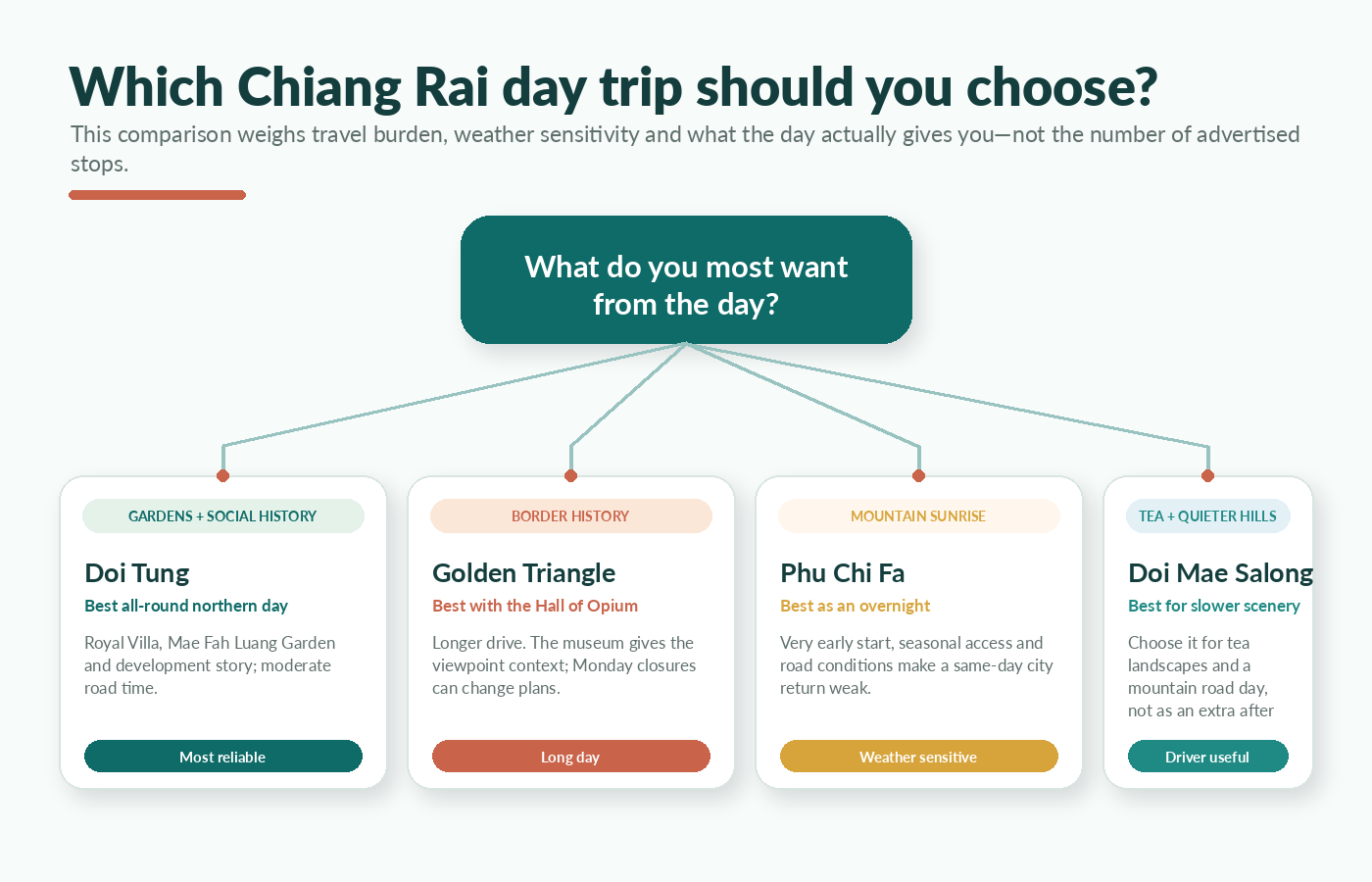
The day trips below are compared by total road burden, distinctiveness, weather sensitivity and how much context the destination provides. Doi Tung is the strongest all-round first choice; the Golden Triangle becomes more meaningful with historical interpretation; Phu Chi Fa is best treated as an overnight sunrise plan; Doi Mae Salong suits travellers who prefer tea landscapes and a slower mountain road.
Doi Tung: the best balanced first regional day
The official DoiTung tourism site links the Royal Villa, Mae Fah Luang Garden, Hall of Inspiration and Arboretum to the wider development story of restored landscapes and livelihoods.[9] That context makes Doi Tung more than a flower-garden stop. Published visitor information in 2026 commonly listed 90 THB for individual sites and 220 THB for a combined ticket. Checked 16 September 2026 Reconfirm the current ticket bundle and opening hours before travel.
Golden Triangle: worthwhile when the history is included
The river viewpoint alone is brief. The area becomes more substantial when paired with Chiang Saen or the Hall of Opium, where the regional history of trade, conflict and narcotics is explained. Monday closures are repeatedly reported for the museum, while published admission details vary; contact the venue or check official local information before committing a driver.[19]
Phu Chi Fa: a sunrise that deserves an overnight
Phu Chi Fa is far enough from the city that a same-day sunrise journey creates a punishing start and a long return. Road, weather and park access can also change during the wet season. Local 2026 reporting described seasonal closures and weather-related road risks, so verify directly before travelling and avoid treating the viewpoint as guaranteed.[18]
Doi Mae Salong: tea and a slower highland day
Choose Doi Mae Salong for mountain scenery, tea-growing landscapes and a different cultural history. It fits travellers who enjoy the road journey itself. It does not combine neatly with every far-north attraction, so a private driver should confirm the actual route and time rather than accepting a vague “full loop”.
Be selective with village tourism
Do not book a community stop merely because a tour advertises people as an attraction. Look for community-led experiences, clear consent, respectful photography rules and a transparent benefit to residents. When the marketing focuses on appearance rather than culture or agency, leave it out.
When a guided day solves a real problem
A guided tour can make sense for a long northern loop, historical interpretation or travellers who do not want to negotiate a driver. Compare hotel pickup area, group size, actual stop duration, entrance-fee inclusions and whether a border or village stop is optional.
A realistic three-day Chiang Rai itinerary
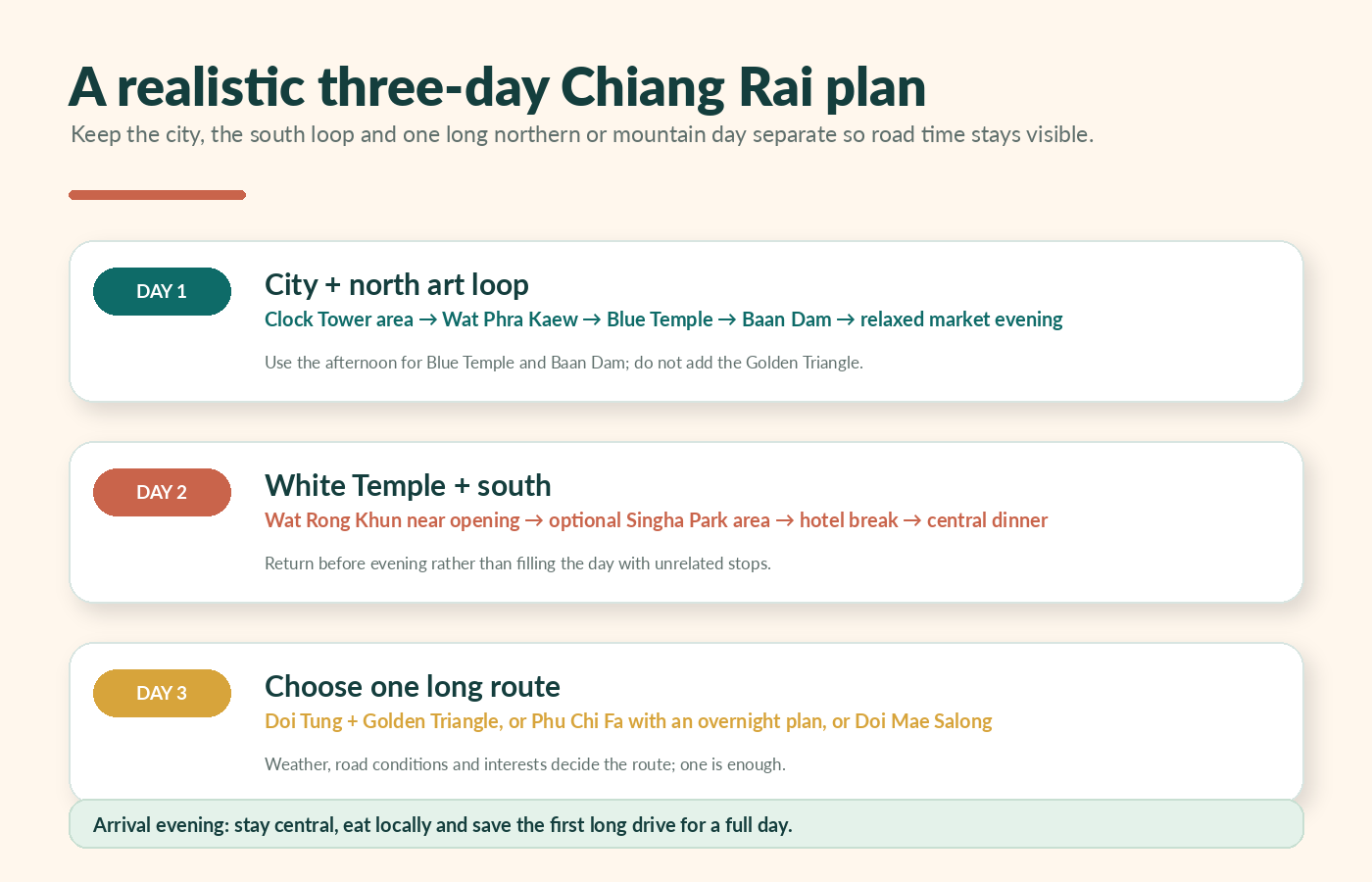
Arrival evening: make the city easy
Check in centrally, confirm the next day’s transport and eat near the hotel. The Clock Tower or Night Bazaar provides orientation without turning arrival into a sightseeing test.
Day 1: city context and the north art loop
Start at Wat Phra Kaew and the central streets, then use the afternoon for Baan Dam, the Blue Temple and—if energy remains—Wat Huay Pla Kang. Put Baan Dam before its reported midday break. Return for a relaxed market or central dinner rather than adding the Golden Triangle.
Day 2: White Temple and the south side
Reach Wat Rong Khun near opening, allow enough time to understand the symbolism and then choose one south-side addition. Return to the hotel during the late afternoon. This leaves the evening useful and prevents Day 2 from becoming a cross-province transfer.
Day 3: choose one long route
Select Doi Tung with the Golden Triangle for a full far-north day, Doi Mae Salong for tea and highland scenery, or Phu Chi Fa with an overnight arrangement. Do not combine all three. The third day should reflect the forecast and what the traveller values, not the longest list of pins.
What changes with two days?
Keep Day 1 and Day 2. Remove the far-north route rather than squeezing it into the White Temple day. A short Chiang Rai visit is still worthwhile when the plan is honest about geography.
What changes with four or five days?
Add a rest day, a slower Doi Tung day, Doi Mae Salong or a genuine overnight near Phu Chi Fa. The extra time should reduce intensity, not create two more twelve-hour van days.
Realistic Chiang Rai budget for three days
Chiang Rai can be good value in the centre, but a private driver or long guided day quickly becomes the largest cost. The ranges below are editorial planning bands checked against live September 2026 accommodation and activity markets. They are not quotes and exclude international flights, insurance and onward travel.[11][12][13][14]
All planning ranges in this table were checked on 16 September 2026.
| Cost area | Lean plan | Balanced plan | Comfort plan |
|---|---|---|---|
| Hotel per room, per night | 700–1,500 THB | 1,800–3,500 THB | 4,500 THB and above |
| Food per person, per day | 400–700 THB | 800–1,500 THB | 2,000 THB and above |
| Local city transport per person, per day | 100–250 THB | 250–600 THB | Private transfers as required |
| One long regional day | Shared local transport where practical | Group tour or shared driver | Private car and guide |
| Practical daily total excluding hotel | 900–1,500 THB | 1,800–3,500 THB | 4,000 THB and above |
16 September 2026. Attraction fees, hotel rates, fuel and tours can change without notice.
Where spending more improves the trip
Pay for location, safe transport and a well-briefed driver. A central hotel removes repeated evening transfers, while a driver who understands attraction hours can protect a full day. A guide is most valuable when the traveller wants cultural or historical interpretation rather than simple transport.
Where saving money is sensible
Eat locally for some meals, walk within the central zone, book only one long excursion and use public intercity transport between Chiang Mai and Chiang Rai. Saving money by overloading a scooter, skipping insurance or accepting an unlicensed vehicle creates the wrong kind of economy.
Practical advice before a first Chiang Rai visit
Data and navigation
Working mobile data makes airport pickup, translation and driver communication much easier. Download offline maps before a mountain day because coverage can weaken away from the city.
Set up connectivity before the first transfer
Check phone compatibility, data allowance, activation timing and whether tethering is permitted. An eSIM is optional; a physical Thai SIM remains a valid alternative.
Cash and payment
Carry small Thai-baht notes for markets, donations, local transport and smaller ticket windows. Card acceptance at a hotel does not guarantee card acceptance at a temple or rural attraction.
Clothing
Pack breathable temple-appropriate clothing, easy-to-remove footwear, sun protection and a light layer for cool-season mornings. Mountain temperatures and strong air-conditioning can feel surprisingly cool after a hot afternoon.
Health and air
Use the official weather and air-quality sources before long outdoor days. Stay hydrated, schedule shade and carry any medication required for respiratory conditions. A mask can reduce exposure to particles, but it does not turn poor air into a good sightseeing day.
Road and insurance checks
Confirm that the policy covers the vehicle and activities you actually plan to use. A rental-company promise is not a substitute for a valid licence, the correct driving entitlement and suitable insurance.
Entry rules and border areas
Check passport-specific Thai entry rules and government travel advice close to departure. As of 16 September 2026, the UK FCDO’s principal advised-against areas were elsewhere in Thailand, not Chiang Rai, but remote border access and local routes can change independently.[10] Never assume a Myanmar or Laos crossing is open because an old itinerary includes it.
Families, older travellers, solo visitors and limited mobility
Families with young children
Choose one major out-of-town cluster a day and protect a pool or rest period. Baan Dam’s imagery may not suit every child, while long Golden Triangle days can be harder than the attractions themselves. A central hotel reduces the number of compulsory transfers.
Older travellers
A private driver can turn a difficult route into a comfortable day when vehicle access, shade and realistic stop length are agreed. Avoid accepting an itinerary that uses every minute simply because the vehicle is available.
Travellers with limited mobility
Access varies widely. Temple thresholds, stairs, gravel, garden slopes and uneven pavements can interrupt an apparently simple visit. Contact attractions and the hotel with precise questions: step-free entrance, accessible toilet, lift dimensions, drop-off distance and seating. “Wheelchair friendly” is too vague for planning.
Solo travellers
Central Chiang Rai is a practical solo base. Group tours can reduce the cost of a long regional day, but check the return time, pickup zone and whether the advertised language is actually provided throughout.
Travellers who dislike long drives
Keep the visit to the city, White Temple and north art loop. Chiang Rai remains worthwhile without the Golden Triangle. A shorter, well-paced trip is better than spending the majority of a holiday facing the back of a seat.
Pros and cons of adding Chiang Rai to a first Thailand trip
Pros
- Distinctive contemporary art and architecture.
- Quieter, easier evenings than a larger northern city.
- Strong access to mountain scenery, tea areas and regional history.
- Compact central base with good-value food and accommodation choices.
- Pairs naturally with Chiang Mai when enough nights are available.
Cons
- Headline sights are spread across the province.
- Public transport is less useful for a multi-stop sightseeing day.
- Smoke season can remove the mountain views that justify the journey.
- Rain and road conditions can disrupt remote routes.
- A day trip from Chiang Mai creates a very long day.
Who should prioritise it?
Choose Chiang Rai when northern art, quieter cities and one mountain or historical road day are central to the trip. Keep it optional when the itinerary already contains several long transfers or when late-dry-season air quality is uncertain.
Common Chiang Rai mistakes
These mistakes were selected because they repeatedly create wasted driving, weak value or avoidable safety problems. They are ordered by the impact on the whole itinerary rather than by how often they appear in online discussions.
Treating Chiang Rai as a temple on the way back to Chiang Mai
A province with far-apart attractions cannot be understood in one photograph stop. Stay at least two nights when the wider area matters.
Booking the White Temple for midday
Heat, hard light and tour groups are usually stronger. Early arrival improves the visit and protects the rest of the day.
Calling Baan Dam a working temple
It is an art-museum complex. The wrong label creates the wrong expectations, especially for families.
Combining south, far north and east in one day
Map distance hides mountain roads and attraction time. Use geographic clusters.
Assuming city transport covers the province
Ride-hailing works best centrally. Agree the return or waiting plan before travelling to an outlying site.
Ignoring smoke until the hotel is non-refundable
Air quality can affect both comfort and the reason for a mountain trip. Check before locking the route.
Treating Phu Chi Fa as a casual city day trip
The sunrise, access road and seasonal conditions make an overnight plan much stronger.
Choosing a village stop by appearance
Community agency, consent and benefit matter more than a tour brochure’s photograph.
Staying remotely without evening transport
A beautiful resort can create repeated taxi journeys and limited meal choice.
Using an old ticket price
The White Temple fee changed in 2026. Date every planning figure and recheck the entrance board.
Learning to ride a scooter on holiday
Mountain roads, rain and unfamiliar traffic are not a beginner lesson.
Filling every evening
Leave room for a market, early night or weather-led change after a long road day.
Frequently asked questions
Is Chiang Rai worth visiting?
Yes, when you can give it at least two nights and care about northern art, quieter evenings or mountain scenery. It is less rewarding as a rushed photograph stop between long drives.
How many days are enough for Chiang Rai?
Three nights is the best first plan. Two nights covers the city and core art circuit; four or five nights suits a slower mountain or tea-country extension.
Can I visit Chiang Rai as a day trip from Chiang Mai?
Yes, but expect a long road day. A tour simplifies transport, yet it cannot remove roughly three to four hours of travel each way on many current services.
Is there a train from Chiang Mai to Chiang Rai?
No. Chiang Rai has no passenger railway station. The practical direct connection is by bus, van, car or tour.
What is the best area to stay in Chiang Rai?
For a first short visit, choose the Clock Tower, Night Bazaar or Bus Terminal 1 area. The Kok River is better for resort atmosphere when you accept more vehicle journeys.
How much is the White Temple?
Foreign adult admission was reported as 200 THB when checked on 16 September 2026. Confirm the entrance board because prices and exemptions can change.
Is the Blue Temple free?
Visitor information checked on 16 September 2026 reports free entry with donations welcome. Dress as you would for any working Buddhist temple.
Is the Golden Triangle worth the drive?
It can be, especially when combined with the Hall of Opium or Chiang Saen. The river viewpoint alone is brief and does not justify every traveller’s full day.
Do I need a car in Chiang Rai?
Not for a central stay, but wider sightseeing needs a driver, tour, rental car or carefully planned local transport. A car becomes more useful when accommodation is remote.
When is Chiang Rai smoke season?
Risk is commonly highest in the late dry season, especially March and April, but exact timing varies. Check Air4Thai and visibility before booking a mountain day.
Is Phu Chi Fa a day trip from Chiang Rai?
It is possible, but the strongest version is usually an overnight near the mountain for sunrise. Seasonal closures, weather and road conditions must be checked directly.
Is Chiang Rai suitable for families?
Yes, with a central hotel and fewer long road days. Review Baan Dam imagery, protect rest time and ask precise accessibility questions before mountain or garden visits.
My practical recommendation
Book three central nights, keep arrival evening simple and separate the province into three decisions: city and north art, White Temple and south, then one long regional route. Choose Doi Tung for the most balanced first day trip, add the Golden Triangle when the history genuinely interests you, and treat Phu Chi Fa as an overnight sunrise plan rather than another box.
Most importantly, let air quality, rain and road access change the plan. Chiang Rai rewards travellers who leave space between the landmarks. It is the slower interpretation, mountain context and calm central evenings—not the number of temple colours—that makes the destination worth adding.
Sources and fact-checking notes
This guide was researched and editorially reviewed on 16 September 2026. Official tourism, airport, bus, weather, pollution and government-advice sources were prioritised. Where an attraction did not provide clear current English-language pricing, dated local visitor information was compared and the article tells the reader to recheck. Hotel and tour marketplaces were used only to understand live availability, price bands and common inclusions; they were not treated as independent proof that an attraction is safe, ethical or worthwhile.
- Tourism Authority of Thailand: Chiang Rai province — Destination context and official tourism information.
- TAT Newsroom: contemporary Lanna art and culture in Chiang Rai — White Temple, Blue Temple, Baan Dam, central temples and the Clock Tower.
- Airports of Thailand: Mae Fah Luang–Chiang Rai International Airport — Airport facilities, taxi or shuttle access and car-rental information.
- GreenBus: official monthly bus schedule — Chiang Mai–Chiang Rai departures; page updated 15 August 2026.
- Thai Meteorological Department: Chiang Rai weather — Current observations, forecasts and provincial weather data.
- Pollution Control Department: Air4Thai — Official air-quality monitoring for Thailand.
- JTTT Travel Thailand: Chiang Rai entrance fees 2026 — Local operator’s dated on-the-ground checks for major attraction fees and hours.
- Thai Holiday Guide: Baan Dam Museum — Current visitor information for Baan Dam, reviewed July 2026.
- DoiTung Corporate: tourism at Doi Tung — Official descriptions of the Royal Villa, Mae Fah Luang Garden, Arboretum and Hall of Inspiration.
- UK Foreign, Commonwealth & Development Office: Thailand travel advice — Current entry, legal, insurance and regional-risk advice; checked 16 September 2026.
- Booking.com: Chiang Rai accommodation search — Live accommodation market used as one input for planning ranges.
- Agoda: Chiang Rai accommodation search — Second live accommodation market used to cross-check location and price bands.
- GetYourGuide: Chiang Rai activities — Live activity marketplace used to check common tour formats and inclusions.
- Viator: Chiang Rai activities — Second activity marketplace used to compare common day-tour structures.
- Taylor’s Trailblazing Travels: Chiang Mai itinerary — Live internal guide for joining Chiang Rai to a northern Thailand route.
- Taylor’s Trailblazing Travels: Best time to visit Thailand — Live internal seasonal planning guide.
- Taylor’s Trailblazing Travels: Bangkok travel guide — Live internal guide for a common first stop before northern Thailand.
- Chiang Rai Times: 2026 Phu Chi Fa access and rainy-season reporting — Local reporting used for the caution about seasonal park closures and road risk.
- Mae Fah Luang Foundation: contact information — Official contact details for Doi Tung and the Hall of Opium.
Illustrations in this article were created for Taylor’s Trailblazing Travels. Third-party photographs, where used, are credited beside the image or in the source list.