Sukhothai Travel Guide
A practical 2026 guide to park zones, current fees, transport from Bangkok and Chiang Mai, Old versus New Sukhothai, Si Satchanalai and a realistic three-day plan.
Sukhothai is often reduced to a photograph of brick chedis at sunrise. The real planning problem is wider: the historical park has separate zones and ticket windows, Old and New Sukhothai are different bases, the airport is outside both, and the nearest railway gateway is Phitsanulok.
This Sukhothai travel guide turns those distances into a workable first trip. It explains how long to stay, which ruins deserve the cool hours, how current official fees are structured, when Si Satchanalai earns an extra day and how to connect the stop naturally between Bangkok and Chiang Mai.
This guide contains a small number of affiliate links. Taylor’s Trailblazing Travels may receive a commission when a qualifying booking is made, at no extra cost to you. A link appears only where a transport, hotel, activity or connectivity comparison solves a genuine planning problem.
Three nights
Enough time for the central ruins, one wider heritage day and a safe transfer margin.
Old Sukhothai
Protects sunrise, sunset and an easy bicycle start.
Si Satchanalai
A quieter associated historic town when a full road day is available.
Zones and distance
The park is not one gate, while the modern town and airport sit elsewhere.
Sukhothai travel guide at a glance
Sukhothai is not a single compact attraction. The modern town, the UNESCO-listed historical park, the northern and western ruin zones, the airport and Si Satchanalai all sit far enough apart to punish casual planning. The reward for organising those distances is one of Thailand’s calmest heritage stops: lotus ponds, brick chedis, broad lawns and early light that can be enjoyed without the pressure of a capital-city sightseeing day.
| Planning point | Useful first answer | Why it matters |
|---|---|---|
| Ideal first stay | Three nights | Creates two full heritage days plus an arrival or departure buffer. |
| Best first base | Old Sukhothai | Makes sunrise, sunset and the central ruins much easier. |
| Main gateway | Bangkok, Chiang Mai or Phitsanulok | The best route depends on the direction of the wider Thailand itinerary. |
| Best park transport | Bicycle, tram or tuk-tuk | Walking alone is possible in the centre but inefficient across all zones. |
| Best added day | Si Satchanalai | Adds a quieter associated historic town rather than repeating the same central ruins. |
| Main planning risk | Underestimating heat and distance | Midday cycling and zone-hopping can turn a reflective visit into an endurance test. |
Who will value Sukhothai most?
Sukhothai suits travellers who enjoy architecture, history, photography, gentle cycling and slow mornings. It is particularly useful between Bangkok and Chiang Mai because it breaks the overland journey with a destination that feels different from both. The site also rewards visitors who prefer open space and visual context to a checklist of indoor attractions.
Who may prefer a shorter stop?
One or two nights can work for travellers who want only the central zone, dislike moving between scattered sites or are following a tight flight-based itinerary. Anyone expecting lively nightlife, dense restaurant choice or a late-opening urban centre should treat Sukhothai as a heritage stop rather than a city break.
How many days do first-time visitors need?
Three nights is the strongest default for a first visit. It allows one arrival afternoon or evening, one full day for Sukhothai Historical Park and one day for the outer zones, Ramkhamhaeng National Museum or Si Satchanalai. Two nights can still work when the traveller arrives before lunch and leaves after the second morning, but that plan becomes vulnerable to bus delays, rain and the temptation to cycle at the hottest time.
| Stay | What fits comfortably | Trade-off |
|---|---|---|
| One night | Central zone near sunset and one early-morning loop | Most of the stop becomes transport; outer zones and museum context are lost. |
| Two nights | Central zone plus Wat Si Chum or the museum | Good for a route break, but little margin for heat, rain or delays. |
| Three nights | Central zone, outer zones and a flexible heritage day | Best balance for most first visits. |
| Four nights | Add Si Satchanalai, countryside cycling or a slow recovery day | Useful for photographers and history-focused travellers; unnecessary for a rushed first trip. |
Do not count a late arrival as a sightseeing day
A flight landing at Sukhothai Airport still needs a road transfer. A long-distance bus may arrive in New Sukhothai rather than by the park. Train users must change at Phitsanulok. Therefore, an itinerary that says “arrive and see everything” hides the exact transfer that usually consumes the remaining daylight.
The pacing rule that protects the visit
Use the first cool morning for the central zone, then stop before the strongest heat. Return later for sunset or visit the museum during the middle of the day. The ruins do not become more meaningful because every outer temple is collected in one continuous cycle.
Best time to visit Sukhothai
November to February is generally the easiest period for Sukhothai because mornings can be more comfortable and heavy rain is less frequent. It is also the popular season, so well-located rooms around Old Sukhothai can fill first. March and April bring stronger heat, while smoke and agricultural burning can reduce visibility across upper Thailand. The wet season usually makes the landscape greener, but showers, flooded paths and slippery brick change how a cycling day should be organised.
| Period | Likely advantage | Planning adjustment |
|---|---|---|
| November-February | Cooler mornings and clearer heritage days | Reserve a good Old Sukhothai base and begin before tour groups. |
| March-April | Lower crowd pressure outside holiday dates | Cycle early, rest at midday and check Air4Thai before committing to long outdoor days. |
| May-June | Green scenery with some value | Carry rain protection and keep the outer-zone order flexible. |
| July-October | Lush ponds and rice fields | Expect heavier showers, wet surfaces and occasional transport disruption. |
| Loi Krathong period | Major cultural atmosphere around the historical park | Book far ahead and verify the official programme, closures and ticket arrangements. |
Heat changes the correct itinerary
Sukhothai’s wide lawns and exposed roads provide less shade than the photographs suggest. The Thai Meteorological Department publishes a provincial forecast, and official heat advice recommends reducing prolonged outdoor exertion during the hottest hours. Start at opening, carry more water than a city walk would require and build an indoor or shaded pause into the middle of the day.[14]
Smoke is not only a Chiang Mai issue
Lower northern Thailand can also experience poor particulate pollution. Check the official Air4Thai map shortly before travel rather than assuming Sukhothai will be clear because it sits south of Chiang Mai.[13] A hazy day can still support a museum visit and close ruins, but it weakens sunrise views and long cycling plans.
Use the season as a decision tree
Cool and clear: cycle early and return for sunset. Hot but clear: split the park into morning and late afternoon. Wet: prioritise the central zone and museum, then assess outer roads. Smoky: shorten outdoor exposure and keep accommodation flexible.
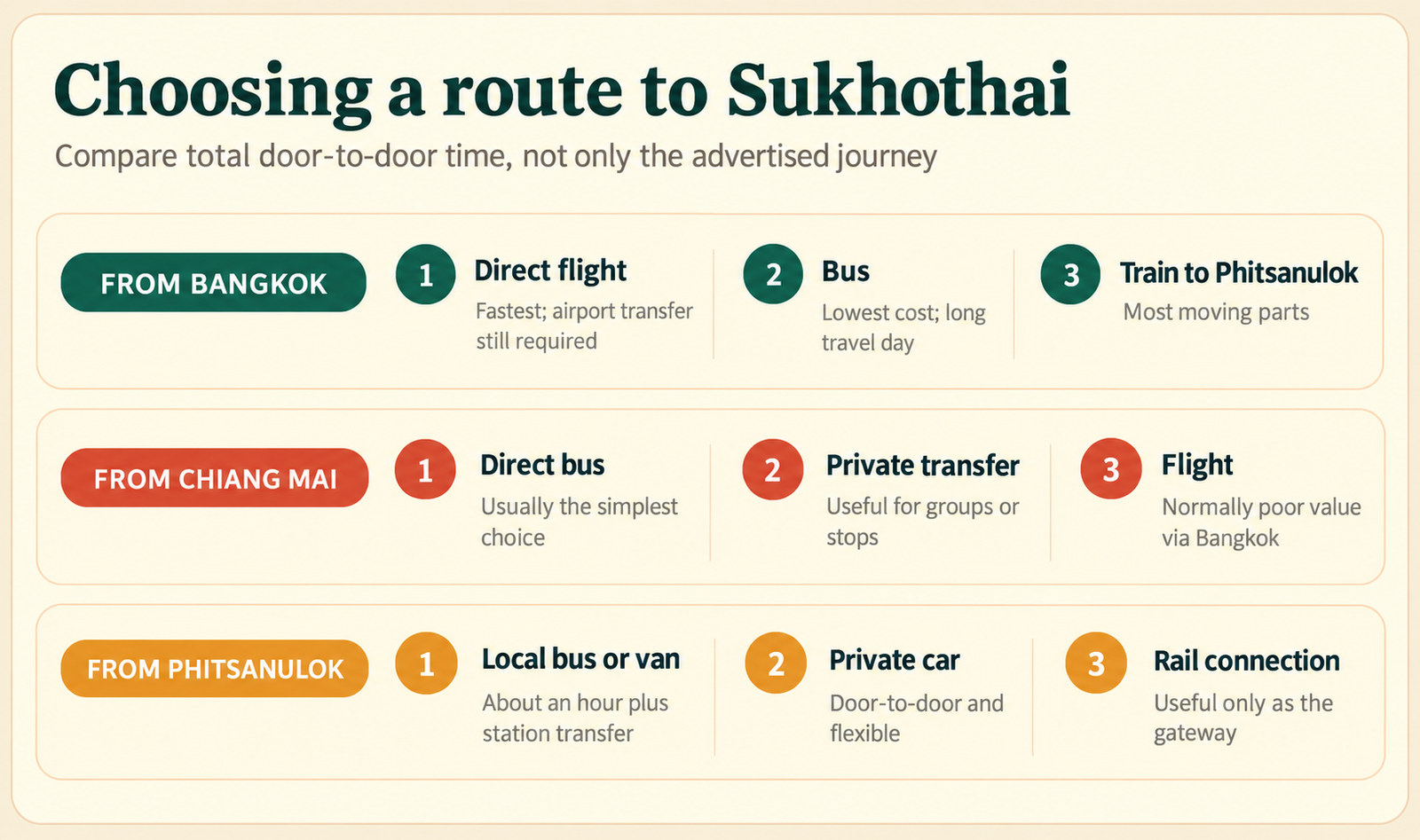
Getting to Sukhothai from Bangkok, Chiang Mai and Phitsanulok
Sukhothai has no rail station in the historic town. The practical gateways are a direct bus, Sukhothai Airport, or a train to Phitsanulok followed by road transport. The best choice depends on the direction of the wider itinerary and where the accommodation is located.
From Bangkok
A direct bus is usually the simplest low-cost choice and turns the journey into one booking. Current 12Go inventory shows bus, flight, train-combination and private-transfer options, with listed bus prices starting around THB 467 and the fastest direct flight taking about 1 hour 20 minutes. Checked 16 September 2026 These are live examples, not guarantees; luggage rules, departure terminal and the final Old Sukhothai transfer must be checked before payment.[8]
Bangkok Airways operates Sukhothai Airport and includes Sukhothai in its live schedule search.[6][7] Flying saves line-haul time, but the airport sits outside both New Sukhothai and the historical park. A flight is strongest when the fare is reasonable and the airport-to-hotel transfer is confirmed.
From Chiang Mai
Direct buses are normally more useful than flights because an air journey generally requires a connection through Bangkok. Current 12Go listings show direct buses taking roughly five to six hours, with examples from about THB 408 and some services listing the historical park as a stop. Checked 16 September 2026 Verify the exact drop-off because New Sukhothai bus terminal and Old Sukhothai are not interchangeable.[9]
By train through Phitsanulok
The train makes sense for travellers who prefer rail or are already passing through Phitsanulok. Use the State Railway of Thailand timetable for the intended date, then add the transfer from Phitsanulok station to its bus terminal and the onward road journey to Sukhothai.[10] This is not the fastest option, but it can break a long route into manageable stages.
Compare the complete route before paying
Search the exact date, then compare departure terminal, arrival point, luggage, cancellation terms and the final transfer to the hotel. The cheapest line item can become the most complicated door-to-door plan.
Where to stay in Sukhothai
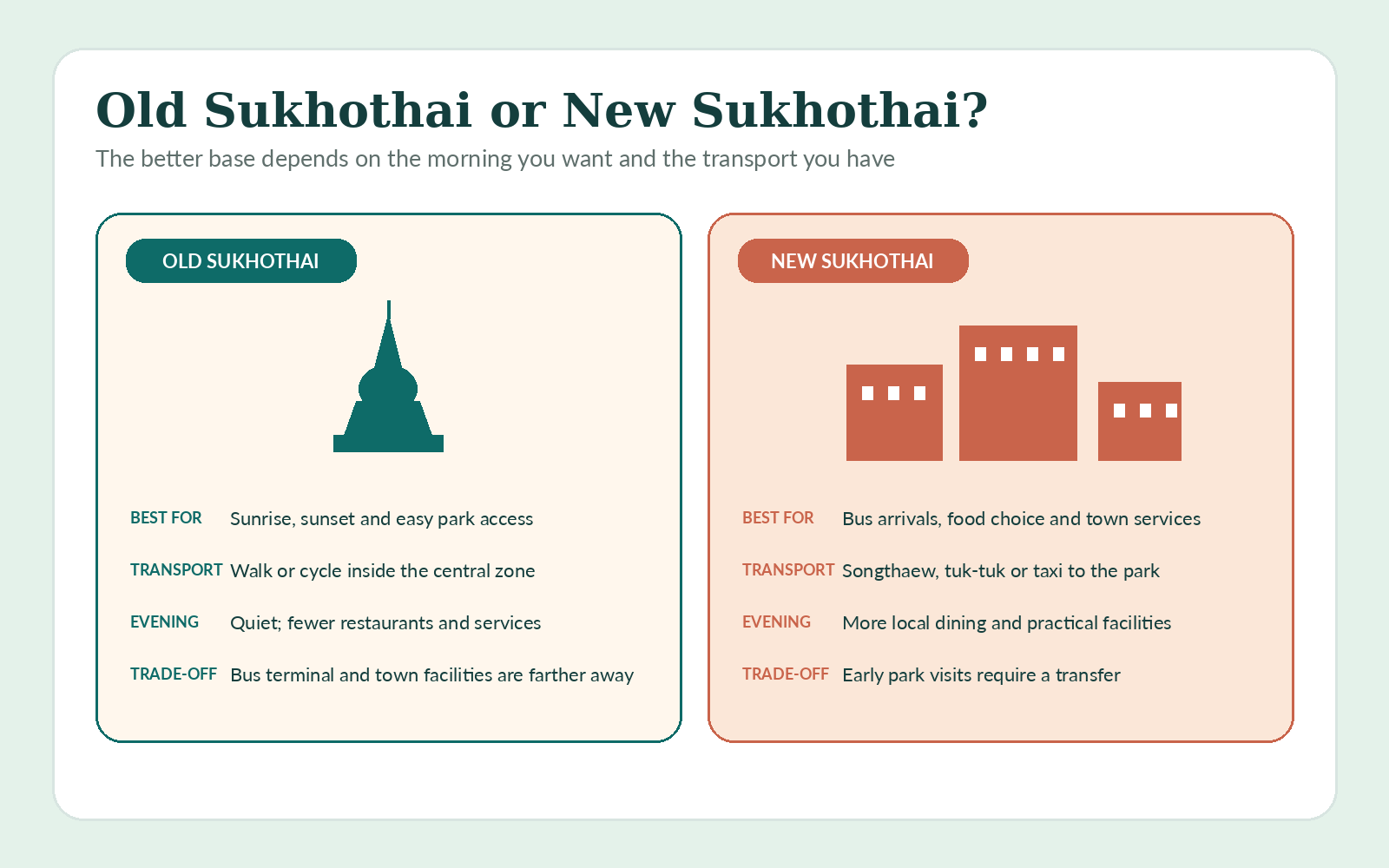
The accommodation decision is really a transport decision. Old Sukhothai sits by the historical park and is the better base for dawn, sunset and cycling. New Sukhothai has the bus terminal, a larger local town, more practical services and a broader evening food scene. The two areas are separated by roughly 12 kilometres, so choosing the wrong one creates repeated transfers.
| Area | Best for | Why it works | Watch |
|---|---|---|---|
| Old Sukhothai | First-time heritage trips, photographers, cyclists | Walk or cycle to the central zone; easy early starts and sunset returns. | Quieter evenings and fewer late services. |
| Between park and town | Travellers with a driver or resort stay | Can provide space and pools while retaining access to both areas. | Not walkable to either centre; transport must be planned. |
| New Sukhothai | Bus arrivals, local food, longer practical stays | More town services, markets and transport connections. | Every park morning starts with a road transfer. |
How the accommodation areas were compared
The areas were assessed by distance to the park, ease of early-morning access, evening food choice, arrival convenience, dependence on private transport and usefulness for a three-night first visit. The order is not a quality ranking of individual hotels.
What to check before booking
- Exact map position rather than the word “Sukhothai” in the property name.
- Whether breakfast starts early enough for the historical park.
- Bike hire quality, helmet availability and after-dark road conditions.
- Airport or bus-station transfer price and operating hours.
- Pool, shade or air-conditioned common space for the midday break.
Compare location before room style
Open the map and measure the journey to the central-zone gate. A beautifully photographed room can be a poor first-trip choice when every sunrise and dinner requires a negotiated transfer.
Getting around Sukhothai without wasting the cool hours
The central zone is designed well for bicycles, but the complete historical park is too spread out for casual walking. The correct method changes with heat, mobility, confidence and the number of zones being visited.
| Method | Best for | Advantages | Limitations |
|---|---|---|---|
| Walking | Central-zone details and slow photography | No rental, easy to pause and read signs. | Too slow for outer zones; heat exposure increases quickly. |
| Bicycle | Most able first-time visitors | Flexible, quiet and well matched to the central landscape. | Sun, road crossings and uneven surfaces still matter. |
| Tram or electric cart | Limited stamina, families and hot afternoons | Reduces distance and provides a simple central loop. | Fixed route and less freedom for long photo stops. |
| Tuk-tuk or driver | Outer zones and mixed-mobility groups | Door-to-door, shade between sites and flexible pacing. | Agree route, waiting time and total price before departure. |
| Car | Si Satchanalai and wider province | Useful for luggage, remote ruins and onward travel. | Parking and heat can still interrupt the day. |
Bicycle costs and park vehicle fees
Private bicycle hire near Old Sukhothai is commonly offered as a low-cost day rental; allow roughly THB 50-100 as a planning range. Checked 16 September 2026 The current official park page lists a THB 10 bicycle entry charge for each zone. Checked 16 September 2026 Rental price and bicycle condition should be confirmed on the day, while the official gate notice takes priority for the park charge.[2]
Do not turn a flat park into a road-safety blind spot
The central lawns feel calm, but outer-zone routes use ordinary roads. Check brakes, tyre pressure and lights before leaving. Wear a helmet where available, avoid headphones and return before dark unless the route is familiar and lit. FCDO guidance notes Thailand’s high road-accident burden and warns that driving or riding without the correct licence can invalidate insurance.[15]
Scooter hire is not necessary
A scooter can reduce travel time, but it should not be the default solution for an inexperienced rider. A bicycle in the central zone and a driver for the north, west or Si Satchanalai is a safer and often more informative first-trip combination.
Sukhothai Historical Park: how the zones actually work
Sukhothai Historical Park is part of the UNESCO serial property “Historic Town of Sukhothai and Associated Historic Towns”, inscribed in 1991 under criteria (i) and (iii). The listing connects Sukhothai with Si Satchanalai and Kamphaeng Phet rather than treating the central ruins as an isolated theme park.[1]
Current official opening hours
| Area | Official hours | Foreign visitor fee | Planning note |
|---|---|---|---|
| Central / inner zone | 06:30-19:30 Monday-Friday and Sunday; 06:30-21:00 Saturday | THB 200 | Saturday lighting may operate, but confirm locally. |
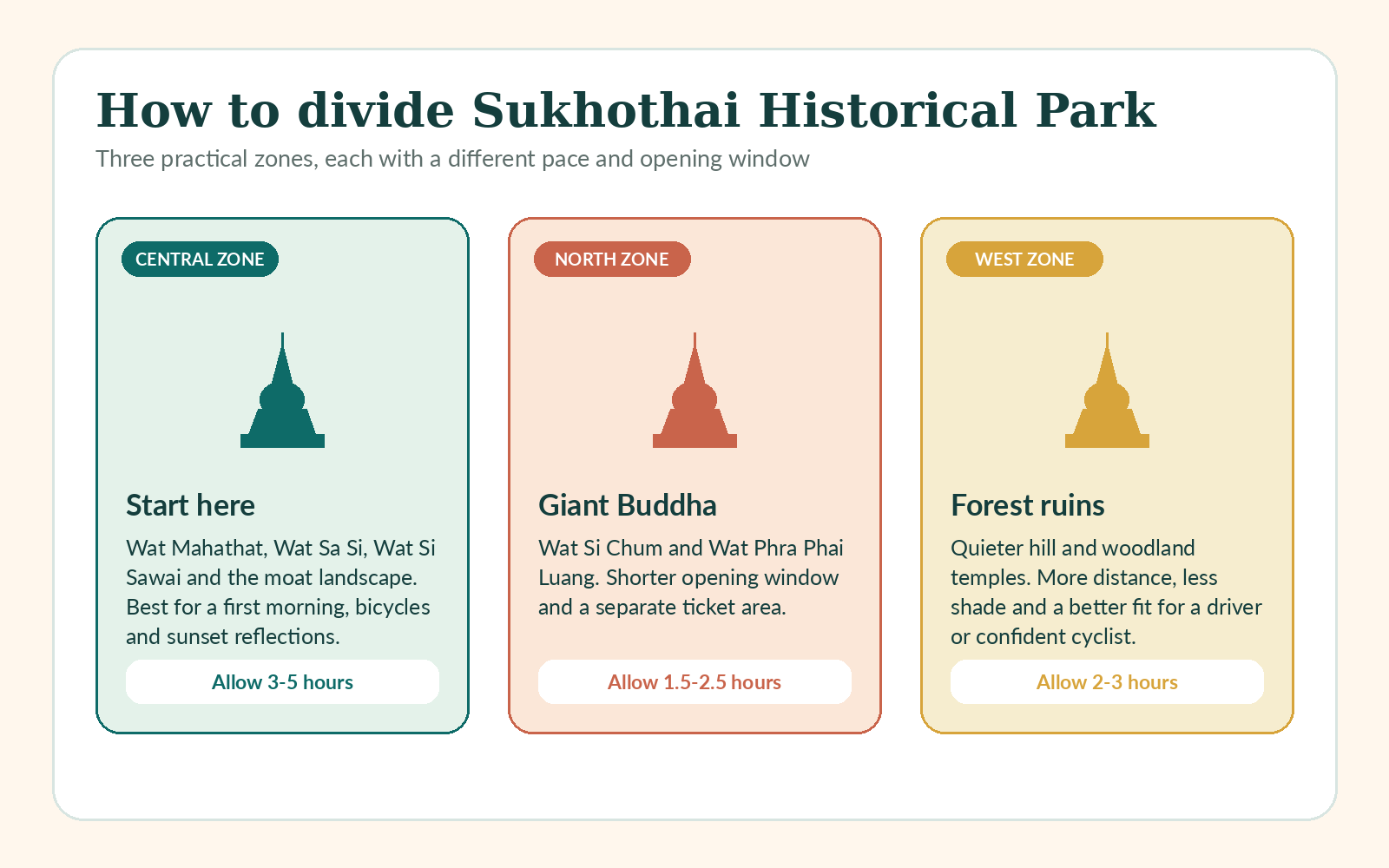
| Northern outer zone | 07:30-17:30 daily | THB 120 | Includes Wat Si Chum and Wat Phra Phai Luang. |
| Western outer zone | 08:00-16:30 daily | THB 120 | Wooded ruins and longer distances. |
| Combined ticket | Use each zone within its current ticket conditions | THB 400 | Ask how long the combined ticket remains valid before purchase. |
16 September 2026. The current English Fine Arts Department page lists these amounts and hours. A separate official QR page still shows an older THB 100 zone rate, so the staffed gate notice should take priority over screenshots or old articles.
The conflict between two official pages is precisely why this guide records the check date rather than presenting a fee as permanent. The newer virtual historical park contact page lists THB 200 for the central zone, THB 120 for the north, THB 120 for the west and THB 400 for a combined ticket.[2] The older QR service page still displays THB 100 per zone.[3]
Which ticket should a first visitor buy?
Start with the central zone when time or weather is uncertain. Buy the combined ticket only when the plan genuinely includes all three zones and the validity terms are clear. A traveller who reaches the western zone after closing has not saved money by buying access that cannot be used.
Source discipline
Opening hours and fees are linked to the Fine Arts Department, not copied from a hotel blog. Nevertheless, special events, restoration work and public holidays can change access. Recheck the official page and the gate board close to the visit.
Central-zone temples worth prioritising
The central zone gives the clearest first impression because water, lawns and major monuments sit within an easy cycle. The following order was created by comparing historical significance, visual distinctiveness, walking or cycling efficiency, shade and how much each stop adds to a first visit. It is a planning sequence, not a claim that one sacred site is objectively better than another.
| Stop | Why include it | Time to allow | Best pairing |
|---|---|---|---|
| Wat Mahathat | Core royal temple complex and the strongest overview of Sukhothai form | 45-75 minutes | Begin here when the light is soft. |
| Wat Sa Si | Island setting, lotus pond and a compact walking loop | 25-40 minutes | Pair with the central monuments or sunset. |
| Wat Si Sawai | Distinctive Khmer-influenced towers and an earlier cultural layer | 25-40 minutes | Useful after Wat Mahathat for contrast. |
| Wat Traphang Ngoen | Reflections and a quieter pond-edge composition | 20-35 minutes | Late afternoon or an unhurried cycle. |
| King Ramkhamhaeng Monument area | Orientation and modern commemorative context | 15-25 minutes | Combine with the museum rather than treating it as the whole history. |
Wat Mahathat deserves more than a photograph
Pause long enough to understand the axial layout, seated Buddha images, chedis and surviving columns. The site is most effective when approached as an urban religious centre rather than a single monument. A guide, museum visit or reliable historical map can turn a beautiful ruin into a coherent place.
Use Wat Si Sawai for contrast
Its three prangs differ sharply from the lotus-bud chedis associated with the mature Sukhothai style. That contrast helps a first-time visitor see that the city developed through earlier Khmer and regional influences rather than appearing in one finished architectural moment.
Sunset without the last-minute race
Choose one pond-side area before the light changes, then stay there. Cycling between five “best sunset” locations usually produces more road time and less observation. Saturday lighting can extend the central-zone atmosphere, but the official schedule should be confirmed locally.[2]
Wat Si Chum and the quieter outer zones
The north and west zones add scale, solitude and context, but they should not be squeezed into the same hot block as the central area. Use the north early, then decide whether the west suits the weather and transport available.
Wat Si Chum
Wat Si Chum is the defining northern-zone stop because the monumental seated Buddha is framed by a narrow mandapa opening. The effect is architectural, not only photographic. Visit near opening for cooler conditions and a calmer interior, then step back to notice how the enclosure controls the view.
Wat Phra Phai Luang
This complex helps explain the area’s longer history and earlier Khmer influence. It is less immediately dramatic than Wat Si Chum, yet more useful for travellers who want chronology rather than only iconic images. Allow time for uneven ground and limited shade.
The western Aranyik area
The west contains forest and hillside ruins associated with monastic practice. Distances are greater, signage can feel more dispersed and the official opening window is shorter than the central zone. A driver or confident cyclist is more practical than an unplanned walk. Carry water and do not assume food will be available at every stop.
| Zone | Choose it for | Skip or shorten when | Transport judgment |
|---|---|---|---|
| North | Wat Si Chum, early history and a compact extension | Time is short or midday heat is already high | Bicycle or tuk-tuk from Old Sukhothai. |
| West | Quieter forest ruins and a fuller archaeological picture | Rain, heat, limited mobility or late start reduce the value | Driver is easiest; experienced cyclists can combine selected sites. |
Quality beats zone count
A first visit with the central zone, Wat Si Chum and the museum can be stronger than a rushed combined-ticket circuit. Add the west because its landscape and monastic context interest you, not because the ticket exists.
Ramkhamhaeng National Museum and historical context
Ramkhamhaeng National Museum sits beside the historical park and provides the context that open ruins cannot. It is especially useful before or after the central zone, during the hottest hours, or on a day when rain makes cycling unpleasant.
Official hours and admission
The Fine Arts Department museum page lists daily opening from 09:00 to 16:00 and a foreign visitor fee of THB 200. Checked 16 September 2026 Confirm holiday closures and the final admission time locally because the public page can be updated separately from the park page.[4]
What to look for
Use the displays to connect inscriptions, sculpture, ceramics, religious imagery and the regional network behind the monuments. The museum also helps distinguish archaeological evidence from simplified national stories. Labels may vary in English depth, so a guidebook, audio resource or local guide can still add value.
When a guide is worth paying for
A guide is most useful when history is the main reason for visiting, when the traveller wants to distinguish architectural periods, or when cycling logistics and interpretation should be combined. Compare whether a tour includes park tickets, museum entry, hotel pickup, bicycle quality, group size and a midday plan.
Use a tour to add context, not merely transport
Current activity listings include cycling, countryside and private historical-park options. Read the route carefully: a long list of temple names is less useful than clear guiding time, safe equipment and a realistic pace.
A realistic three-day Sukhothai itinerary
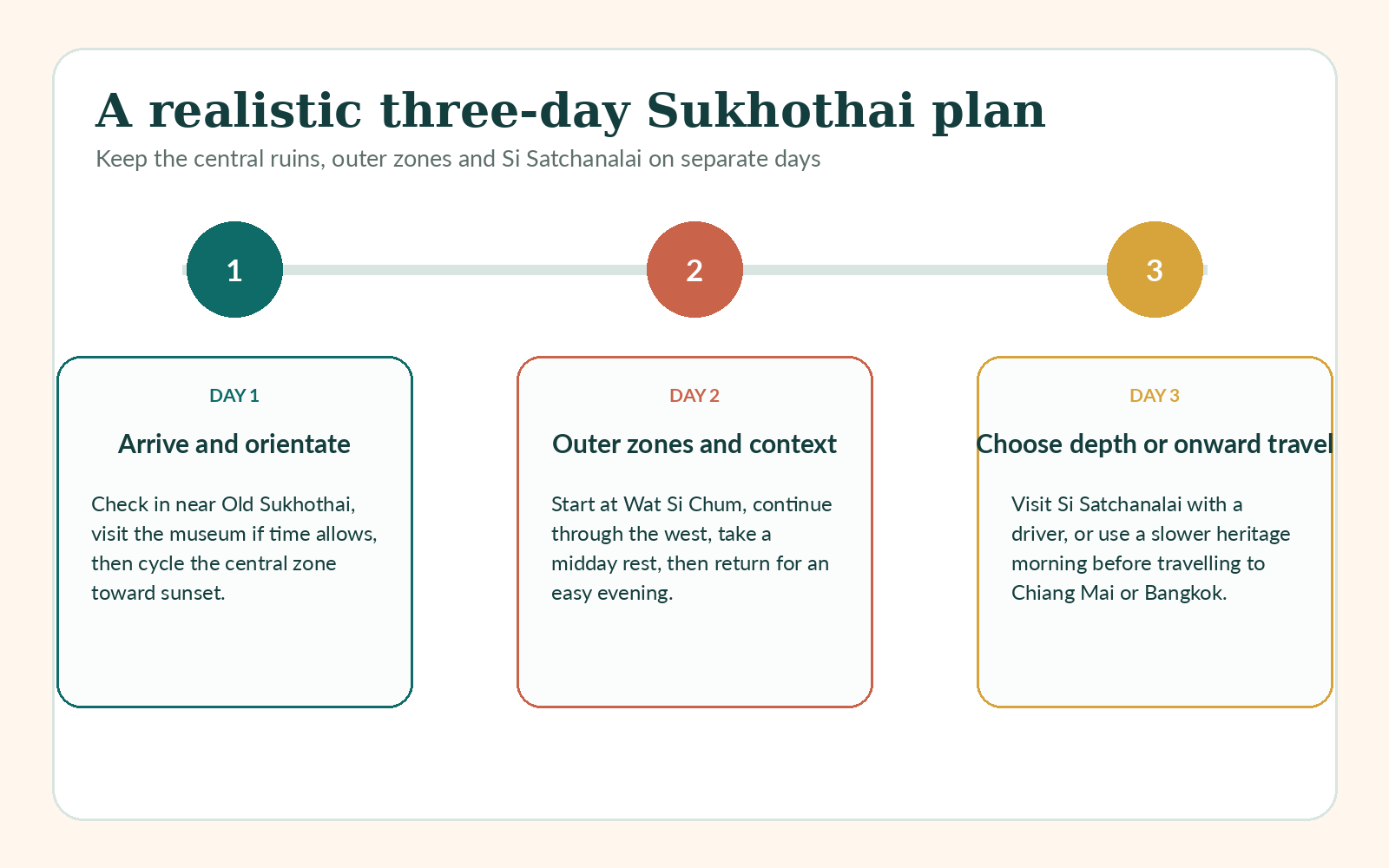
This plan assumes three nights, an Old Sukhothai base and enough flexibility to move the outer-zone day when rain or heat makes it sensible. It does not pretend that arrival time is guaranteed.
Day 1: arrive, orientate and protect the evening
Check in, confirm the next morning’s bicycle or tuk-tuk, and keep the first outing close. When arrival is early enough, visit Ramkhamhaeng National Museum before it closes. Otherwise, walk around Old Sukhothai, buy water and use the central zone only for a gentle late-afternoon orientation if the ticket timing and energy make sense.
Day 2: central zone early, museum or rest at midday, sunset later
Enter near opening and begin with Wat Mahathat before moving to Wat Si Sawai, Wat Sa Si and selected pond-side ruins. Stop before the heat becomes the main memory. Use the middle of the day for lunch, the museum, a pool or air-conditioned rest, then return for one chosen sunset location.
Day 3: north and west, or Si Satchanalai
Choose depth rather than pretending both options fit easily. The north and west zones provide a fuller picture of Sukhothai and keep the day local. Si Satchanalai requires a longer road commitment but adds an associated historic town with a different landscape and fewer visitors. The correct choice depends on onward transport and enthusiasm for archaeology.
Departure morning
Keep a final short cycle, breakfast or market stop only when the bus, flight or Phitsanulok connection has a safe margin. Do not place a non-refundable flight after a tight road transfer from the park.
Si Satchanalai as a day trip
Si Satchanalai is not simply “more Sukhothai”. It formed part of the same UNESCO serial property, yet its setting by the Yom River, forested hills and later temple landscape produce a quieter and more spatially dramatic day.[1] The Fine Arts Department places it about 55 kilometres from Sukhothai and lists daily opening from 08:00 to 17:00 with a foreign visitor fee of THB 200. Checked 16 September 2026[5]
What to prioritise
- Wat Chang Lom for the elephant-supported chedi.
- Wat Chedi Chet Thaeo for the dense group of chedis and varied forms.
- Wat Nang Phaya for surviving decorative stucco.
- Chaliang-area remains when the route and guide provide historical context.
This list was created by comparing distinctiveness, site condition, route efficiency and how much each stop adds beyond the central Sukhothai experience. It is not a sacred-site ranking.
How to make the day practical
A private driver, small-group trip or rental car is more reliable than trying to improvise multiple local connections. Agree the waiting time, lunch plan, ticket inclusions and return destination before leaving. Start early enough to avoid doing the most exposed cycling or walking after midday.
When to skip it
Skip Si Satchanalai when the visit is only two nights, when the traveller is already saturated with ruins, or when the onward bus or flight makes the return margin uncomfortable. A slower second morning in Sukhothai can be more rewarding than an anxious 110-kilometre return day.
Food and evenings in Old and New Sukhothai
Sukhothai’s food planning is simpler than Bangkok’s but still benefits from choosing the right base. New Sukhothai has the wider everyday market and restaurant choice. Old Sukhothai provides enough visitor-focused meals for a short stay, although kitchens may close earlier and choices can thin outside busy periods.
What to try
Sukhothai noodles are the obvious local reference point: rice noodles with a sweet-sour balance, pork, green beans, peanuts and lime, with recipes varying by shop. Beyond that, use busy local restaurants for rice dishes, grilled meats, curries, som tam and seasonal fruit rather than crossing town for one viral bowl.
How the food suggestions were chosen
The list is based on regional distinctiveness, ease of ordering, broad availability and usefulness to a first-time traveller. It is not a ranking of restaurants, and no personal tasting claim is made. Current opening hours and hygiene standards should be judged on the day.
Working meal budget
| Meal type | Planning range per person | What changes the total |
|---|---|---|
| Simple local breakfast or noodle meal | THB 50-120 | Drinks, tourist-zone location and portion size. |
| Casual sit-down lunch or dinner | THB 120-350 | Air conditioning, western dishes and alcohol. |
| Hotel or special dinner | THB 350-900+ | Property level, imported ingredients and drinks. |
16 September 2026. These are editorial planning allowances checked against current visitor-area menu and accommodation listings, not guaranteed menu prices.
Allergies and dietary needs
Peanuts, fish sauce, oyster sauce, shrimp paste and shared woks are common. A translated allergy card is more dependable than assuming “vegetarian” also means no fish sauce. Travellers with severe allergies should choose places able to explain ingredients and cross-contact clearly.
Realistic Sukhothai budget and what to book first
Sukhothai can be a moderate-cost stop because the principal experience is the historical landscape rather than expensive nightlife. The largest variables are the hotel, long-distance transport, private driver and whether Si Satchanalai is added.
| Category | Budget planning range | Comfort planning range | Notes |
|---|---|---|---|
| Accommodation per room | THB 700-1,400 | THB 1,400-3,500+ | Location near the park often matters more than star category. |
| Food per person per day | THB 350-700 | THB 700-1,500 | Alcohol, western food and hotel dining create the swing. |
| Local transport per day | THB 100-500 | THB 500-1,500+ | Bicycle versus tuk-tuk, driver or private transfer. |
| Historical park and museum | THB 200-800+ | THB 200-800+ | Depends on zones, museum and current ticket validity. |
| Si Satchanalai day | THB 200 entry plus transport | Private driver or tour quote | Transport is the dominant cost. |
16 September 2026. These are working planning ranges reviewed on 16 September 2026. Hotel and commercial transport prices change by date; official attraction fees and live quotes take priority.
Book in this order
- Long-distance transport that fixes the arrival point and time.
- Accommodation in the correct Sukhothai area.
- Airport or station transfer when the arrival is late or luggage is heavy.
- Si Satchanalai driver or guided cycling only when the date is fixed.
- Flexible local bicycle or tuk-tuk arrangements close to the visit.
Where not to economise
Do not save a small amount by accepting an unroadworthy bicycle, an uninsured motorcycle plan or a transfer that leaves no connection margin. Location can also be worth paying for: one well-placed Old Sukhothai room may remove four paid transfers and protect the best light of the day.
Practical planning before the Sukhothai trip
Thailand Digital Arrival Card
Foreign visitors must complete the official Thailand Digital Arrival Card within the three days before arrival. The official service is free, so avoid lookalike websites that charge an unnecessary processing fee.[11]
British passport and visa rules
For full British citizen passport holders, FCDO guidance states that from 15 September 2026 the visa-exemption period is up to 30 days for tourism. It also states that the passport should expire at least six months after arrival and contain at least one blank page. Rules are enforced by Thai authorities and can change, so check the official advice again before travel.[12]
Cash, cards and mobile data
Carry small baht notes for park vehicle charges, bicycle hire, local food and drivers. Cards are useful at larger hotels but should not be the only payment plan around the ruins. An eSIM can make transport coordination easier when arriving by bus or airport shuttle, although coverage and device compatibility should be checked before purchase.
Arrange data before the transfer when useful
Compare coverage, data allowance, activation instructions and hotspot rules. Keep the QR code available offline and do not remove a working home SIM until the eSIM is confirmed.
Temple and ruin etiquette
Dress respectfully around active shrines, remove shoes where signs require it and do not climb Buddha images, chedis or fragile masonry. Drones, tripods and commercial photography may require permission. The absence of a barrier is not permission to stand on archaeological remains.
Emergency and health planning
Carry insurance details, prescribed medication and a heat plan. For emergencies in Thailand, the general police number is 191, medical emergency 1669 and Tourist Police 1155. Save accommodation details in Thai and share the day’s route when cycling alone.
Sukhothai with children, limited mobility or no bicycle
Sukhothai is visually open and relatively flat in the central zone, but that does not make every visit easy. Heat, uneven paving, steps, gravel, road crossings and long distances can be more limiting than the ruins themselves.
Families
Use a short early-morning cycle or tram loop, then stop before children become overheated. Choose one or two memorable monuments rather than asking a child to distinguish ten similar chedis. A pool and an Old Sukhothai base can reduce the number of vehicle transfers.
Limited mobility
A driver, tram or electric cart is usually more practical than a rental bicycle. Ask the hotel or tour operator four precise questions: distance from vehicle to site, surface type, steps, and accessible toilet location. “Wheelchair friendly” without those details is not enough.
Older travellers and heat-sensitive visitors
Begin at opening, use the museum or hotel during midday and return only when conditions improve. The western zone may be less rewarding when every stop requires uneven access and a long walk from the vehicle.
Cycling confidence
The central zone can suit casual riders, but road sections to the north and west demand more awareness. Choose a step-through frame when helpful, test the brakes, adjust the saddle and avoid carrying a loose bag on the handlebar. A driver is not a lesser experience when it preserves energy for the actual monuments.
Ask for access details before paying
Request photographs of the hotel entrance, room steps and bathroom when mobility is a concern. For tours, confirm whether the vehicle waits close to each ruin and whether the itinerary can shorten without penalty.
Pros and cons of adding Sukhothai to a Thailand itinerary
Reasons Sukhothai works
- UNESCO heritage in an unusually calm, green setting.
- Easy to combine with an overland Bangkok-Chiang Mai route.
- Central ruins are well suited to a gentle cycle.
- Three nights provide meaningful depth without a long city stay.
- Si Satchanalai adds a quieter associated site.
- Sunrise and sunset can be enjoyed close to Old Sukhothai hotels.
Reasons to reconsider
- No railway station in Sukhothai itself.
- Old and New Sukhothai create repeated transfers when the base is wrong.
- Heat and smoke can undermine an outdoor-heavy plan.
- Outer zones are less convenient without a bicycle or driver.
- Evening entertainment and restaurant choice are limited near the park.
- Official fee information can conflict across older and newer pages.
Who should add Sukhothai?
Add it when the route already moves between Bangkok and Chiang Mai, when heritage matters more than nightlife, or when a slower three-night break will improve a busy Thailand itinerary. It is also a strong alternative to treating every historical experience as a rushed day trip from Bangkok.
Who may skip it?
Skip it when the trip is very short, when archaeology has little appeal, or when adding the stop creates two awkward flight changes. Travellers already visiting Ayutthaya should not assume the sites are interchangeable, but they should decide whether two major ruin-focused stops match their interests.
Common Sukhothai mistakes
Booking New Sukhothai while imagining a park-side hotel
The map may place the room 12 kilometres from the ruins. Check the exact pin before paying.
Trying to walk every zone
Walking is pleasant inside the centre but inefficient across the north and west. Use a bicycle, tram or driver.
Cycling through midday heat
The park is exposed. Start early, stop for lunch and use the museum or hotel until the light softens.
Treating the combined ticket as an obligation
Buy it only when all zones fit the opening hours, weather and energy.
Ignoring the airport transfer
A short flight does not end at the hotel. Confirm the airport-to-Old-Sukhothai leg before booking.
Using an old screenshot for fees
Official pages currently conflict. The staffed gate notice and current Fine Arts page take priority.
Skipping the museum because the ruins look self-explanatory
The museum provides chronology and object context that open brick cannot.
Forcing Si Satchanalai into a departure day
The return distance deserves a full margin. Keep it separate from a tight bus or flight connection.
Riding after dark without lights
Outer roads are ordinary roads. Return early or use a driver.
Climbing ruins for a photograph
Fragile masonry and sacred imagery should be respected even when no barrier is visible.
Sukhothai travel guide FAQs
Is Sukhothai worth visiting?
Yes for travellers interested in Thai history, architecture, cycling and quieter heritage landscapes. Three nights make more sense than a rushed detour because transport and the outer zones require time.
How many days do I need in Sukhothai?
Allow three nights for most first visits: one arrival period, one full central and outer-zone day, and one flexible day for the museum, Si Satchanalai or slower exploration.
Should I stay in Old or New Sukhothai?
Stay in Old Sukhothai when the historical park is the priority. Choose New Sukhothai for bus-terminal convenience, more local services and a broader evening food scene.
Can I visit Sukhothai as a day trip from Chiang Mai?
It is possible by private vehicle, but the long return day reduces time in the park. An overnight stay gives the ruins, sunset and museum much more space.
Is there a train to Sukhothai?
No. The nearest practical rail gateway is Phitsanulok, followed by a bus, van or car to Sukhothai.
What is the current Sukhothai Historical Park entrance fee?
The current English Fine Arts Department page lists THB 200 for the central zone, THB 120 for the northern zone, THB 120 for the western zone and THB 400 for a combined ticket. Checked 16 September 2026. A legacy official page still shows an older rate, so verify at the gate.
Can I walk around Sukhothai Historical Park?
You can walk the central area, but a bicycle or tram is more efficient. The outer zones are too dispersed for a comfortable all-day walk in hot weather.
Is Sukhothai suitable for children?
Yes when the day is shortened, transport is easy and midday heat is avoided. A tram, driver, pool and one or two memorable temples work better than a full archaeological checklist.
What is the best time to visit Sukhothai?
November to February is usually the easiest period. March and April can be very hot and smoky; the wet season is greener but requires rain flexibility.
Is Si Satchanalai worth the extra day?
Yes for travellers who want a quieter associated historic town and deeper archaeological context. Skip it when the Sukhothai stay is only two nights or an onward connection is tight.
Do I need a guide?
Not for basic navigation, but a knowledgeable guide or museum visit adds substantial historical context and can combine safe cycling with interpretation.
What should I wear?
Light, breathable clothing, sun protection and secure footwear are practical. Cover shoulders and knees around active religious areas and avoid climbing monuments.
The clearest first-time Sukhothai recommendation
Plan Sukhothai as a three-night heritage stop
Stay near the historical park when the ruins are the reason for the visit. Use the first cool morning for the central zone, reserve the north or west for a separate block, and let the museum provide the context that photographs cannot. Add Si Satchanalai only when the route has a full day and a safe return margin.
The strongest Sukhothai itinerary is not the one with the most temple names. It is the one that protects early light, avoids exhausting midday cycling and leaves enough attention to understand why the UNESCO serial property matters.
Final planning checklist
- Keep three nights when the wider Thailand route allows.
- Choose Old or New Sukhothai from the transport plan, not the hotel photograph.
- Confirm the exact long-distance arrival point.
- Check the current Fine Arts Department fee and gate notice.
- Start outdoor exploration early and build a midday break.
- Use the museum for context and bad-weather flexibility.
- Book Si Satchanalai transport only when a full day is protected.
- Recheck Air4Thai, the TMD forecast and onward connections before departure.
Sources and fact-checking notes
Research was reviewed on 16 September 2026. Official heritage, government, transport, immigration, weather and safety sources were prioritised. Commercial inventory was used only for dated route and activity comparisons. Prices and schedules remain examples; the live operator, staffed ticket window, gate notice and local weather warning take priority.
- UNESCO World Heritage Centre Historic Town of Sukhothai and Associated Historic Towns: inscription, criteria and serial property context. Open source
- Fine Arts Department – Sukhothai Historical Park Current English visitor page for opening hours, zone admission fees, combined ticket and vehicle charges. Open source
- Fine Arts Department – QR visitor service Legacy visitor page that still displays an older zone fee, included to document the official-source conflict and the need to check the gate notice. Open source
- Ramkhamhaeng National Museum Official opening time and foreign visitor admission fee. Open source
- Fine Arts Department – Si Satchanalai Official opening hours, foreign visitor admission fee and route from Sukhothai. Open source
- Bangkok Airways Official Sukhothai Airport information and location. Open source
- Bangkok Airways Live flight schedule search, which should be checked for the intended date. Open source
- 12Go Asia Current Bangkok to Sukhothai transport inventory and dated route pricing. Open source
- 12Go Asia Current Chiang Mai to Sukhothai transport inventory and dated route pricing. Open source
- State Railway of Thailand Official 2026 timetable tool for Bangkok and Phitsanulok rail services. Open source
- Thailand Immigration Bureau Official Thailand Digital Arrival Card and three-day submission window. Open source
- UK Foreign, Commonwealth and Development Office Thailand entry requirements for British citizens, including the visa-exemption change effective 15 September 2026. Open source
- Pollution Control Department Air4Thai official current air-quality reporting. Open source
- Thai Meteorological Department Official Sukhothai provincial weather and forecast page. Open source
- UK Foreign, Commonwealth and Development Office Road safety, licence, helmet and insurance guidance for Thailand. Open source
- GetYourGuide Current Sukhothai activity inventory used only for live planning comparisons. Open source
- Taylor’s Trailblazing Travels Chiang Mai itinerary 2026, used for connecting-route planning. Open source
- Taylor’s Trailblazing Travels Best time to visit Thailand 2026, used for regional season comparisons. Open source
- Taylor’s Trailblazing Travels Bangkok travel guide 2026, used for the southern gateway and onward-route context. Open source
- Tourism Authority of Thailand Sukhothai heritage and cultural overview. Open source
How uncertain details are handled
Where official fee pages conflict, the guide identifies the conflict and tells the reader which current source was used. Hotel, food and local transport figures are planning allowances rather than guaranteed quotes. No first-hand visit is claimed.
Illustrations in this article were created for Taylor’s Trailblazing Travels. Third-party photographs, where used, are credited beside the image or in the source list.