
Money in Indonesia: Cash, Cards, ATMs and Tipping Decisions
Carry enough rupiah for the next stage, without turning your entire holiday budget into cash.
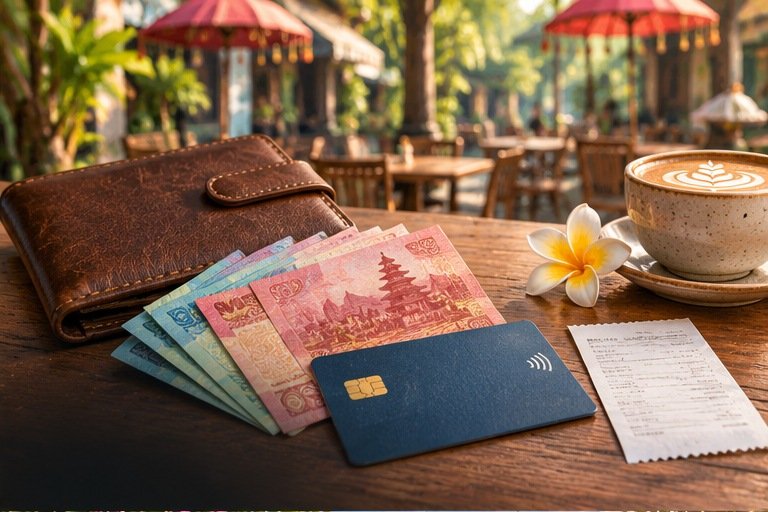
Original conceptual illustration; the notes are not a banknote-identification reference.
Money in Indonesia is a logistics question before it is an exchange-rate question. A working card in a major hotel does not solve a cash-only payment on the next island. Conversely, withdrawing the whole holiday budget at the airport creates an unnecessary loss risk.
The practical approach is to separate your total trip budget from the cash you need until the next reliable access point. Indonesia’s tourism guidance recommends carrying rupiah for smaller towns, markets and remote areas, even though international cards are commonly accepted in major destinations. [1][2]
Currency
Rupiah: IDR in prices and Rp on signs.
Cash reserve
Calculate to the next dependable cash point, not the trip end.
Card payments
Check the currency, fees and final amount before approval.
Tipping
A discretionary thank-you is different from a compulsory charge.
Money in Indonesia: choose the payment mix first
The national tourism board identifies Visa and Mastercard as widely accepted card networks, especially in major cities and tourist areas. It also advises checking acceptance before relying on a particular card. Treat those as broad patterns, not a promise about an individual shop or guesthouse. [2]
| Setting | Sensible starting plan | Confirm in advance |
|---|---|---|
| Larger hotel or established restaurant | Card plus a little rupiah | Accepted network, deposit arrangements and the total bill. |
| Market, small food stall or local payment | Small rupiah notes | The price and whether change is available. |
| Island or rural stay | Cash for the confirmed cash-only costs | The nearest usable ATM and what happens if it is out of service. |
| Online booking | Your normal secure payment method | Currency, cancellation terms and payment timing. |
Before leaving home, inspect your own card’s overseas purchase fee, cash withdrawal fee, daily limit and exchange-rate terms. A card that is attractive for purchases may be expensive for cash advances. No single card recommendation is made here because the right choice depends on your account and issuer, not simply on Indonesia.
Bring a physical backup stored separately from the main wallet. Two cards tied to one unavailable account are less resilient than genuinely separate payment access. Likewise, a second card kept inside the same lost bag provides little practical backup. Decide which small payment you would use to test the primary card after arrival.
Calculate a cash runway, not an arbitrary daily allowance
A cash runway is the period until your next reasonably dependable cash withdrawal or exchange opportunity. Start with confirmed cash-only obligations, add your own estimate of smaller daily cash spending and then add a contingency. Subtract rupiah already available and payments already made.
The following is an arithmetic illustration for a travelling party, not researched Indonesian meal prices or a suggested total holiday budget. Accommodation and other prepaid bookings are excluded.
| Input | Explicit assumption | Cash required |
|---|---|---|
| Smaller daily payments | 4 days at Rp300,000 for the party | Rp1,200,000 |
| Confirmed cash-only transfer | One payment not yet made | Rp450,000 |
| Contingency | Chosen reserve, not a quoted cost | Rp350,000 |
| Target before departure | Sum of the three lines | Rp2,000,000 |

Already holding Rp1,200,000 would reduce the additional cash needed to Rp800,000. An extra day at the assumed spending level adds Rp300,000 before any new contingency. This sensitivity matters more than copying another traveller’s withdrawal amount: a longer cash-dependent stay changes the requirement immediately.
Ask the accommodation three concrete questions
Can the balance be paid with your card network? Which nearby ATM has recently been usable for visitors? What costs must be paid in cash before you return to a larger centre? Ask for amounts and conditions in writing when they affect the calculation. A general answer that there is an ATM on the island is not confirmation that it will work when needed.
Build the overall holiday plan with the Travel Budget Calculator, using your own quoted costs converted into GBP: the calculator accepts pounds and does not convert currencies. Then perform this separate rupiah cash calculation. The tool’s planning estimates are not live prices, and a holiday budget does not tell you which payments are cash-only.
Read rupiah amounts slowly and organise useful denominations
Indonesia’s currency is the rupiah, with the code IDR and symbol Rp. The tourism board lists banknotes up to Rp100,000 and notes that ATMs commonly dispense Rp50,000 or Rp100,000 notes. Larger notes can be awkward to use for small purchases. [1]
Write substantial agreed prices in full. When a spoken amount or a shortened menu label is ambiguous, ask the seller to show the complete rupiah total before paying. It is better to spend a few seconds confirming zeros than to have a disagreement afterwards.
A Rp100,000 note is not interchangeable with Rp10,000. Read the printed denomination rather than identifying notes only by colour, especially in poor light. Keep a modest supply of smaller notes for ordinary purchases, without displaying a large cash reserve at a busy counter.
Use three separate money functions
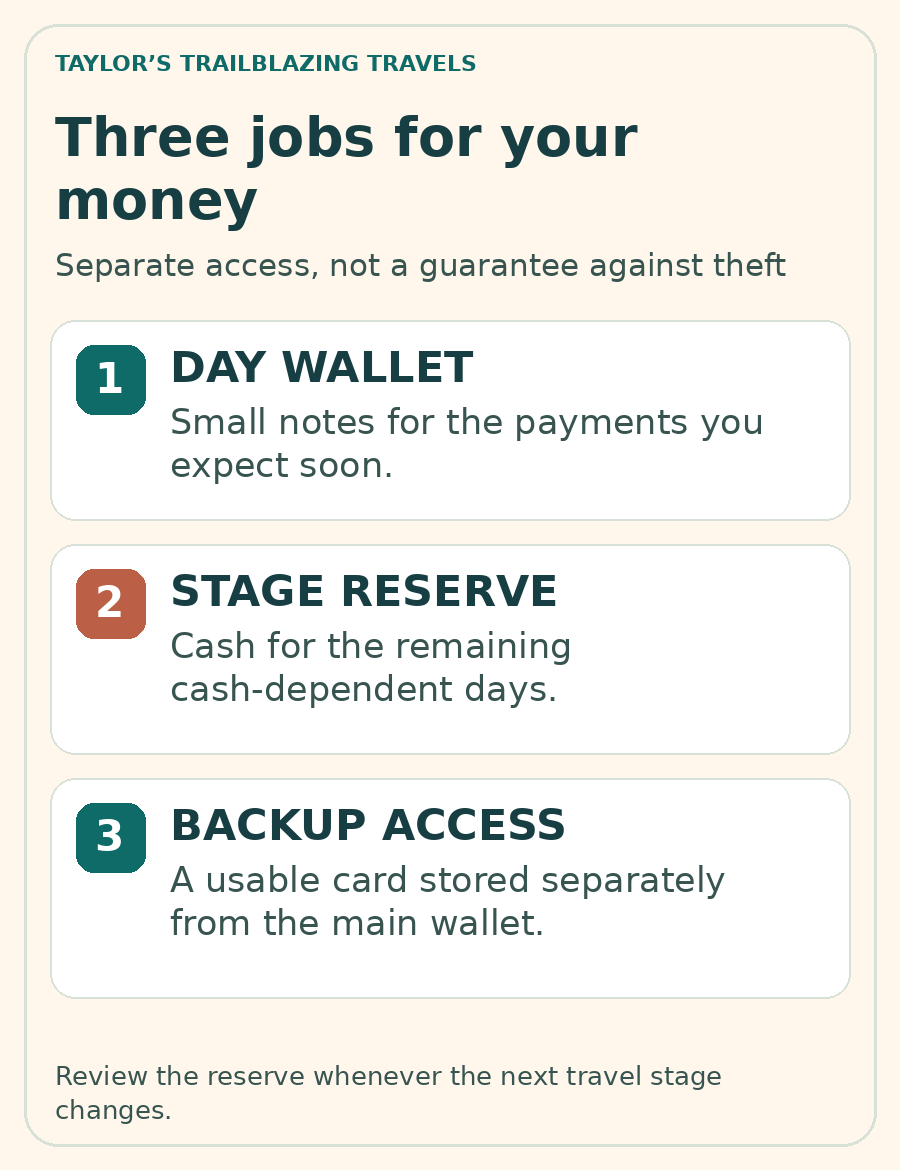
The day wallet holds what you expect to use soon. The stage reserve covers the remaining cash-dependent days. The backup payment method stays separately accessible. This is an organisational suggestion, not a claim that any hotel safe, bag or hiding place is theft-proof.
For a couple or group, nominate who holds shared cash and record what it pays for. Reconcile the balance after a few transactions rather than reconstructing a week of small payments at the airport. The Group Holiday Cost Splitter can help organise expenses using amounts you enter; use one currency consistently, converting other payments with your actual transaction rates. It does not transfer funds or fetch exchange rates.
ATM withdrawals: compare the complete cost
Match the ATM’s supported network to the symbol on your card. Major-city and tourist-area availability is better than assuming access in a remote stop; the national tourism board explicitly recommends arranging cash before travelling to secluded places. [1][2]
Prefer a machine in a staffed banking location when practical. Inspect the card slot and keypad, shield the PIN and cancel if anything feels wrong. Collect the card, cash and any receipt before walking away; machines may present them in a different sequence from the one you are used to.
FCDO warns that criminals sometimes attach false help numbers to ATMs. If a card is retained or a transaction fails, contact the issuer using a trusted number or app, and speak to genuine bank staff when available. Do not give a PIN to someone offering to fix the problem. [3]
Separate three possible costs
An ATM operator’s charge, your own issuer’s withdrawal fee and the currency-conversion cost are different things. An apparently fee-free machine does not establish that your account makes the withdrawal free. Read both the screen and your card terms.
For illustration only, a fixed charge of Rp40,000 would equal 5% of an Rp800,000 withdrawal but 2% of Rp2,000,000. That is arithmetic, not a quoted Indonesian ATM tariff. Larger withdrawals can dilute a fixed charge, but should not be used to justify carrying more cash than your next stage reasonably needs.
If a withdrawal fails, check your account before repeatedly trying different amounts. A pending entry may need clarification from the issuer. Preserve the time, location and receipt, but never share a full card photograph, PIN or one-time security code with an unsolicited contact.
Rupiah or pounds? Understand the conversion choice
Dynamic currency conversion, or DCC, is the offer to bill a foreign purchase or withdrawal in your home currency. Visa says the offer must show the relevant amounts, exchange rate and additional markup or fees, and that the choice must not be made for you. [4]
Selecting rupiah normally leaves conversion to your card provider under its terms; accepting a pounds quote uses the offered conversion. Compare the complete costs. Seeing a familiar pound amount is not evidence that it is the better rate. Visa advises declining an unclear or pressured conversion offer. [4]
| Screen or receipt shows… | What to do |
|---|---|
| A choice between IDR and GBP | Read the exchange rate and markup before choosing. |
| A GBP total with no clear choice | Ask whether DCC was applied and request the local-currency option. |
| A separate ATM access charge | Assess that independently of the conversion decision. |
| A transaction different from the agreed amount | Stop and resolve it before authorising payment. |
This guide does not freeze a sterling exchange rate into an evergreen table. Use the rate and fees offered at the time of payment. For your own planning conversion, divide the rupiah amount by the number of rupiah per pound, then account for any applicable fees. Check that the rate is quoted in that direction before calculating.
A simple habit helps: say that you wish to be charged in rupiah before a card payment, watch the terminal and retain the receipt for larger purchases. If an unwanted conversion is applied, ask the merchant and your issuer about correcting it rather than approving a second payment without understanding the first.
QRIS and money changers: verify compatibility and identity
QRIS is Indonesia’s standard for merchant QR payments. Bank Indonesia’s cross-border service works through participating payment applications and partner-country arrangements. A QRIS sign does not mean any camera app, UK bank account or contactless wallet can pay it. Verify support in your actual payment app before treating it as a backup. [5]
Do not transfer money to a stranger so they can scan a code on your behalf merely because you cannot use it. Ask the merchant for another accepted method. Where your app does support the payment, check the recipient name and amount before approval and confirm completion with the merchant. [5]
Exchanging cash without a performance
Bank Indonesia’s rules require licensed non-bank money changers to display the authorised logo, business licence and identifying signage. Match the business you are standing in to those details. FCDO also advises scanning the official QR code to check the business name and operating licence; do not mistake a random payment QR code for a licensing check. Ask what you will receive for the exact foreign-currency amount you hand over. [6][3]
Keep the transaction simple: agree the total, watch the counting, count the rupiah yourself and obtain a receipt. Decline unexplained interruptions, a switch to a different counter or a last-minute change to the amount. Avoid making a larger exchange simply to obtain a marginally better advertised rate.
GBP cash can be a secondary option, but do not assume every small branch or money changer can handle every denomination at any time. Ask the business directly. The goal is reliable access to usable rupiah, not winning a competition for the most favourable rate displayed on a street sign.
Tipping: distinguish a bill, a fee and a thank-you
Intrepid’s Indonesia guidance describes tipping as discretionary rather than compulsory, while noting that a small amount may be appreciated for good service. Expectations can differ within tourism businesses, so read the bill and any tour-specific information rather than applying one national percentage. [7]
A service charge printed on a bill is not the same as a voluntary cash tip. Tax is a separate item again. Ask for an explanation of unclear charges before payment. You can still leave an additional thank-you after a service charge, but it should be a deliberate choice rather than an automatic second payment.
| Situation | A practical decision |
|---|---|
| Restaurant bill includes a service charge | Decide whether any additional thanks are warranted; do not assume another percentage is mandatory. |
| Small purchase with change due | Accept the change, or voluntarily round up when you genuinely wish to. |
| Guide or driver gives particularly useful service | Choose an affordable amount reflecting the work, duration and your satisfaction. |
| A group tour proposes a shared tipping fund | Ask what it covers, whether participation is optional and how it is administered. |
| Someone demands a previously undisclosed payment | Clarify whether this is a fee, included service or optional tip before handing over money. |
No rupiah tipping tariff is prescribed here. A fixed figure can look authoritative while ignoring whether the service lasted ten minutes or several days. Set aside small notes when you expect to tip and give them directly and discreetly where appropriate.
A promised extra payment is different from a spontaneous tip: agree any additional driver time, waiting or extra stop before the work is done. Do not use a potential tip as a substitute for paying the agreed fare fairly.
Protect access to your money, not only the money itself
Turn on account alerts and make sure you can reach your bank securely while abroad. The UK’s National Cyber Security Centre recommends two-step verification for important accounts, including banking and email. Check how your own issuer’s verification will work if your usual phone number is unavailable. [8]
Save the bank’s overseas contact route separately from the phone that holds your banking app. A backup card does little good if every way to unlock it depends on the same lost device. Keep recovery arrangements secure rather than writing passwords and PINs beside the card.
Common mistakes worth avoiding
Do not combine all cash, cards and identity documents in a single day bag. Do not approve a pounds conversion simply because the terminal presents it prominently. Avoid arriving at a cash-dependent stay with only a promise that the nearby ATM is usually fine. Finally, distinguish the amount remaining in a holiday budget from the amount immediately accessible for a payment.
Does an airport withdrawal have to fund the whole trip?
No. A smaller arrival amount can cover immediate needs while you establish your next reliable cash-access point. Compare the actual fees, but do not spend your first evening chasing a theoretical saving without considering transport costs and convenience.
Can two travellers share one cash reserve?
Yes, provided both understand what it covers and can access an alternative if separated. Track shared spending consistently. An uneven split may be appropriate when one person has prepaid accommodation; agree the principle rather than assuming that every expense should be halved.
Should I keep withdrawing to avoid returning with spare rupiah?
Recalculate near the end instead. Include airport transport and any confirmed cash-only final payments, then reduce discretionary withdrawals. Converting a small leftover amount back may be inconvenient, but deliberately running out of usable money is not a better strategy.
A sensible final arrangement
Use cards where they work on acceptable terms, carry cash for the next genuinely cash-dependent stage and keep a separate recovery option. That arrangement is more useful than either a cashless promise or a wallet containing the entire holiday budget.
Sources and editorial approach
Payment guidance is drawn from Indonesia’s tourism ministry, Bank Indonesia, Visa and the sources below. The cash-runway and fee calculations are explicitly chosen arithmetic scenarios, not quoted market prices or personalised financial advice.
Independent editorial review: 2 November 2026. Selected official and operator information was rechecked; prices, conditions and links can change, so confirm key details with the provider before travel.
- Indonesia Ministry of Tourism – Currency
- Indonesia Ministry of Tourism – Payment system
- FCDO – ATM and card-fraud precautions
- Visa – Dynamic currency conversion
- Bank Indonesia – QRIS cross-border payments
- Bank Indonesia – Non-bank money changer requirements
- Intrepid Travel – Indonesia practical information and tipping
- National Cyber Security Centre – Two-step verification
Illustrations in this article were created for Taylor’s Trailblazing Travels. Third-party photographs, where used, are credited beside the image or in the source list.