Nasi Lemak, Laksa and Roti Canai in Malaysia: What to Order and Where
Three familiar names, many different plates: a flavour-first guide to choosing the version you actually want.
Original editorial illustration; not a photograph of a named restaurant or an exact street view.
Nasi lemak, laksa and roti canai offer three very different meal formats: rice with accompaniments, noodles with a regional broth or sauce, and layered bread with dips. Knowing the name is a start; knowing which version is being served helps you order a meal you will enjoy.
Some links are affiliate links. If you book or buy through them, Taylor’s Trailblazing Travels may earn a commission at no extra cost to you.
Nasi lemak
Ask what the basic set includes before adding extra meat or seafood.
Laksa
Choose the regional style before deciding whether its flavour suits you.
Roti canai
Plain describes the order, not a guarantee about the dough ingredients.
One meal at a time
Compare the dishes over different meals instead of ordering three full mains.
Which of the three should you order first?
Choose for appetite and flavour rather than prestige. Nasi lemak puts several components beside coconut rice; laksa changes substantially by region; roti canai centres the meal on layered bread. These formats are distinct even when they appear on the same menu. [1][2][7]
| Your preference | Start with | Clarify before ordering |
|---|---|---|
| Rice with different textures and separate components | Nasi lemak | Which sides come with the basic plate? |
| A sour, fish-based noodle bowl | Penang-style asam laksa | What fish and shrimp ingredients are in the base? |
| A coconut-rich noodle meal | A clearly identified curry or Nyonya laksa | Which stock, paste and toppings are used? |
| A Sarawak-style noodle bowl | Sarawak laksa | Which broth, meat, seafood and egg components are included? |
| Bread that you tear and dip | Roti canai | What is in the dough, and which dips are supplied? |
The flavour descriptions are orientation, not guarantees. One stall’s chilli level, richness or portion can differ from another’s. Ask about the actual preparation; requesting “the normal one” may still leave the cook guessing about which size, topping or sauce you want.

Nasi lemak: order the whole plate, not just the rice
A recipe published by Ajinomoto Malaysia cooks the rice with coconut milk and pandan, makes sambal with belacan, and serves the meal with cucumber, peanuts, egg and fried anchovies. It is a useful example of the components to check, not a compulsory recipe followed by every vendor. [1]
The practical first question is “What comes with the basic portion?” Then decide whether you want an additional main item. Without that sequence, it is easy to turn a modest rice meal into a much larger order through several unpriced additions.
A clear first order
Ask for one portion, establish the included accompaniments and request the sambal separately where the kitchen can do that. Ask what the finished plate costs before adding chicken, squid or another side. If you want to taste the rice without overwhelming it, begin with a small amount of sauce rather than mixing everything immediately.
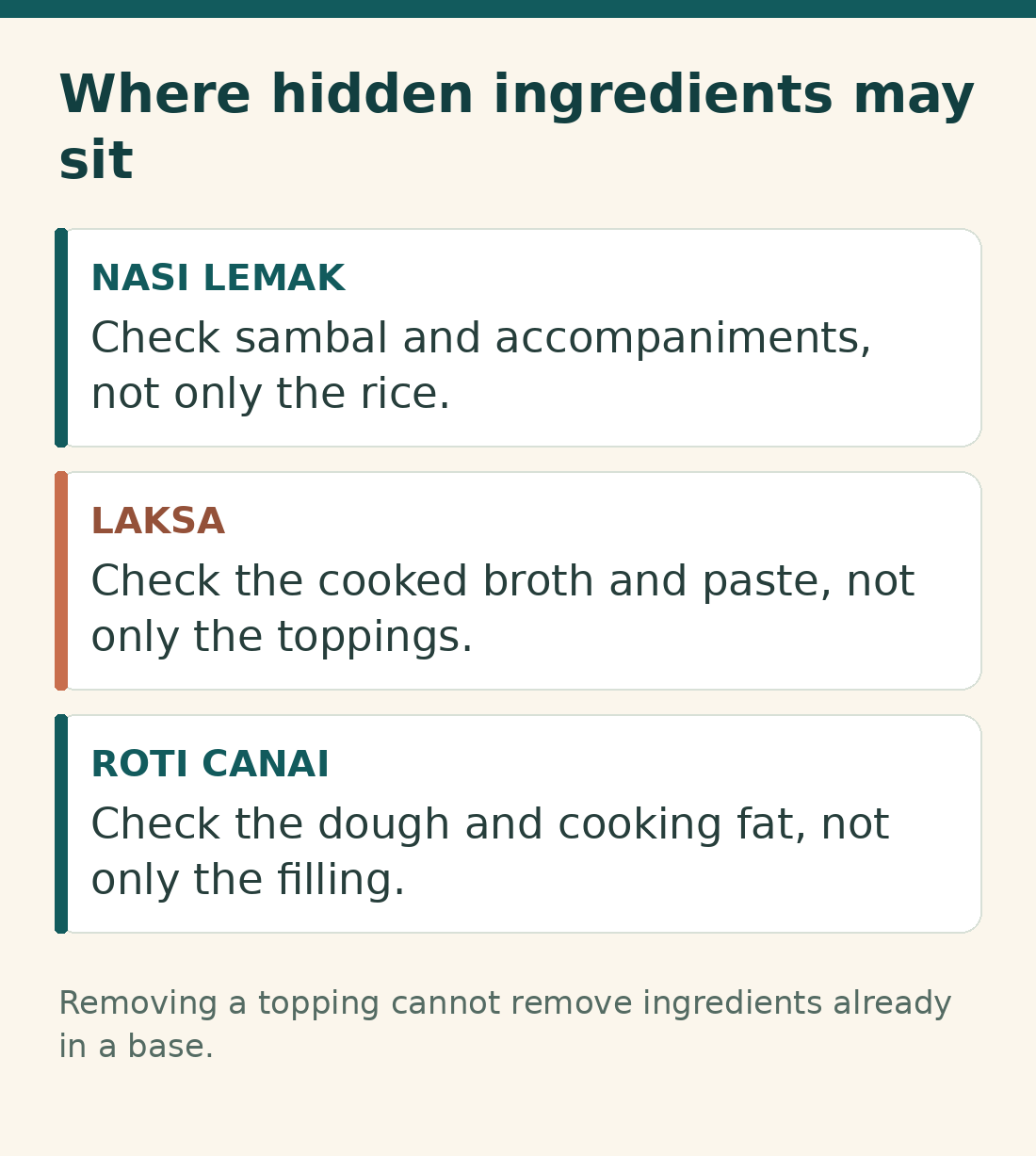
That is a flavour preference, not a way to remove allergens or animal ingredients. A separately served sambal still has its own recipe, and the rice itself should be checked when you have a dietary restriction. Taking visible anchovies off the plate does not establish what is in the sauce.
Where to look
Tourism Malaysia includes nasi lemak among ordinary Malaysian breakfast choices, so you do not need to design an entire journey around one celebrated address. [8] Look for a vendor on your existing route who can explain the plate, its serving time and the price. A dedicated breakfast stop is useful when the dish is your priority; otherwise, allow the meal to fit the day.
For a deliberately plant-based interpretation, The Hungry Tapir’s own menu lists a version with mushroom rendang and tempeh sambal. Treat that as an alternative recipe to check with the restaurant, not evidence that standard nasi lemak is vegan. [10]
Laksa: the regional name is the important part
“Laksa” does not identify one fixed broth. Before ordering, ask which regional version is on the menu and whether the description matches the flavour you want. Avoid assuming that a bowl encountered in Penang will resemble one in Kuching or Johor.
| Style | Useful flavour and format distinction | Ingredient questions |
|---|---|---|
| Penang asam laksa | A sour fish-based noodle broth | Fish in the broth, shrimp paste and optional prawn-paste accompaniment [3] |
| Curry / Nyonya laksa | A richer coconut-based curry direction; names and recipes vary | Stock, curry paste, seafood and other toppings [5] |
| Sarawak laksa | A distinctive spiced broth, commonly with coconut milk and several toppings | Chicken or prawn stock, seafood paste, chicken, prawns and egg [4] |
| Johor laksa | A thicker fish-based gravy; Tourism Malaysia describes a spaghetti-based version | Fish gravy, sambal belacan and the particular accompaniments [2][6] |
Penang asam laksa: sour is the point
Ajinomoto’s recipe uses fish, tamarind, shrimp paste and a prawn-paste component. That makes it a useful illustration of why a bowl can contain seafood even without a visible prawn on top. [3] Choose this direction because you enjoy a pronounced sour-savoury profile, not because every famous dish must suit every diner.
Ask before adding condiments. A concentrated paste or a large squeeze of citrus can change the bowl significantly; taste first when the ingredients are suitable for you. This is a way of exploring flavour, not an instruction to taste something whose allergen status is uncertain.
Coconut-rich and Sarawak versions: similar richness, different dishes
Tourism Malaysia describes Nyonya laksa with coconut-based curry gravy and seafood toppings. Sarawak Tourism Board describes a different preparation involving laksa paste and chicken- and prawn-derived stock. [4][5] Coconut richness does not make these the same dish, and it does not make either vegetarian.
A traveller who enjoyed one version can use that as a question rather than an assumption: “Is this a coconut-rich laksa, or a different style?” Ask to see the bowl and learn its local name. You will get a better comparison than ordering an unspecified laksa and judging it against a different regional recipe.
Where to look for laksa
Use the regional version as a search term within the place you are visiting. Penang’s tourism brochure is a useful starting point for its asam laksa tradition; Sarawak Tourism Board provides context for Kuching’s food; Tourism Malaysia identifies laksa Johor as a state speciality. [9][4][6] Confirm current businesses and hours separately, and do not treat an old address list as a live recommendation.
Roti canai: the dough and the dips both matter
Roti canai is about layered bread, but “plain” is not an ingredient certificate. Ping Coombes’ published recipe includes egg and condensed milk in the dough. Other versions may differ; the lesson is to ask about the actual dough rather than assuming that leaving out a filling removes egg or dairy. [7]
Choose the bread before the extras
For a straightforward first order, ask for the plain bread and confirm which dips are included. Decide how many pieces you want, and ask whether a second order can follow if needed. A bread-based breakfast can become unexpectedly large when several filled or sweet versions are added at once.
When considering a version with a filling or topping, ask whether it is cooked inside the bread, added afterwards or served alongside. That matters to both portion size and the possibility of changing it. The presence of a lentil dip also does not tell you what fat was used or whether another accompanying curry contains meat stock.
Fresh preparation may be part of the appeal, but do not stand in the cook’s working area to photograph it. Ask permission, keep clear of hot surfaces and allow service to continue. Watching a technique is enjoyable; interrupting a busy counter is not necessary to understand the meal.
Where to look
Tourism Malaysia presents roti canai as a familiar breakfast option. [8] Look for a venue currently making it at the time you intend to eat, rather than assuming that a restaurant serving rice later in the day also prepares every bread to order throughout its opening hours. Ask before sitting down if the bread is the main reason for the visit.
Compare the dishes across three meal opportunities
Use three separate opportunities rather than three full mains at one sitting. This original tasting framework is intended to make the differences memorable; it is not a nutritional plan or a compulsory daily schedule.
| Opportunity | Your question | What to notice |
|---|---|---|
| A bread-based breakfast | Do I enjoy this bread and these dips together? | Texture, the balance of dips, and the portion you actually need |
| A rice-based meal | Which components make this nasi lemak work for me? | Rice, sauce, crunchy sides and whether the extras add value |
| A regional noodle meal | Which laksa style is this, and what do I like about its base? | Sourness, richness, broth or gravy, and the relationship to toppings |
Keep a short note of the dish name, regional version and something you would order differently next time. “Less sauce” is more useful than “good”, while “ask whether the stock contains prawns” is more useful than relying on a photograph. Do not record a venue as suitable for a dietary need merely because one meal happened to fit it.
If you are travelling with someone whose preferences differ, choose two compatible dishes rather than persuading both people to order the same “essential” bowl. The comparison is still valuable even when you do not share plates. For allergies, follow your established approach to avoiding cross-contact rather than using tasting as a test.
Compare value using the finished order
For all three dishes, ask about the complete serving. A basic portion and a plate with several additions are different purchases. For roti, establish the number of pieces and whether additions change the price; for laksa, clarify size and toppings; for nasi lemak, price the actual sides selected.
A simple example shows the comparison. Suppose the displayed base price is RM10 and you choose RM7 of additions plus an RM5 drink: the meal is RM22, not RM10. A different RM17 complete meal with the same RM5 drink would also total RM22. These are hypothetical numbers for arithmetic, not quoted Malaysian menu prices.
Do not convert an old published price into a current sterling bargain. Check the menu you will use, then apply your own current payment rate and fees. Good value can also mean an understandable order, a comfortable seat and food everyone can eat without another journey.
Use a food walk for explanation, not a promised checklist
A guided experience can help when you want to understand the differences rather than only buy a meal. Before booking, ask which dishes and regional styles the route actually includes; a generic “Malaysian food tour” need not serve all three subjects of this guide.
This Kuala Lumpur comparison page is a starting point for researching options, not a guarantee of a particular tasting. Check dietary exclusions, walking, seating and portion sizes with the operator. [11]
Compare food walks in Kuala Lumpur
For independent eating, choose the dish you most want today and leave the others for another meal. That avoids buying a tour merely to find a bread stall or paying for a sequence whose fixed ingredients do not work for you.
Questions that prevent a disappointing order
Is asam laksa vegetarian when there is no meat on top?
The fish can be part of the broth itself, and shrimp or prawn pastes can be part of the preparation. Ask about a specifically plant-based recipe rather than requesting that visible toppings be removed. [3]
Does roti kosong mean vegan?
A plain order does not establish the dough recipe. Check egg, milk and cooking fat, then check the dips independently. A published roti canai recipe demonstrates why the dough question matters. [7]
Is nasi lemak only a breakfast dish?
Breakfast is a useful time to look for it, but the individual business decides when it is served. Ask the venue rather than making a universal rule from the dish name. [8]
What should I order next?
Choose the format you have not tried, provided the ingredients suit you: bread after a rice meal, a regional noodle bowl on another day, or a different nasi lemak plate without unnecessary extras. Fit that choice into the wider destination plan, not the other way round.
Sources and research notes
This is a research-led guide, not an account of personal restaurant visits. Sources were reviewed on 7 November 2026; recipe examples show possible ingredients, not every vendor’s formulation. Older tourism material is used for background and location, not current prices or opening hours. Worked plans and budgets are explicitly illustrative.
- Ajinomoto Malaysia: Nasi LemakAn example recipe showing coconut rice, sambal with belacan, and accompaniments; not every vendor’s recipe.
- Tourism Malaysia: Malaysian Food: 52 Top Picks You Shouldn’t MissDish descriptions and regional variation; indexed text consulted.
- Ajinomoto Malaysia: Asam LaksaIngredient list and method show fish, tamarind and shrimp/prawn paste; recipe example, not a universal formulation.
- Sarawak Tourism Board: Sarawak is more than just Kolo meeBroth and toppings in Sarawak laksa; recipe variation remains possible.
- Tourism Malaysia: Must-Try Local Food in MelakaNyonya laksa and regional cooking; indexed text consulted.
- Tourism Malaysia: Malaysia Travel Guide: JohorJohor dishes and fish-based laksa gravy.
- Ping Coombes / TASTE: Roti CanaiA second recipe example using egg and condensed milk; not a claim about every stall.
- Tourism Malaysia: 20 Awesome and True Malaysian BreakfastRegional breakfast descriptions; indexed text consulted, not live stall hours.
- Penang Global Tourism: Penang Street Food brochureOlder brochure used for dish descriptions and geographic orientation only; not current hours, prices or certification.
- The Hungry Tapir: Official restaurant website and menuPlant-based local dishes and first-floor Jalan Petaling address; contact the restaurant for current access and service.
- GetYourGuide: Kuala Lumpur street-food experiencesComparison page only; dietary suitability, itinerary, dates and price need checking with the selected provider.
Illustrations in this article were created for Taylor’s Trailblazing Travels. Third-party photographs, where used, are credited beside the image or in the source list.