Japan Travel Scams, Safety and Emergency Planning
Prepare for the situations that matter without letting unlikely problems take over the holiday.
- Police 110 · Fire or ambulance 119
- Scam checks without scare stories
- A usable offline backup
Original editorial illustration of travel preparation beside an imagined Japanese city view; no real documents, venue or incident are depicted.
Good safety planning is specific. It tells you how to leave an uncomfortable situation, verify a payment request, get urgent help and find essential information when your phone stops working. It does not require treating every unfamiliar custom or unexpected fee as a scam.
This Japan travel scams and safety guide separates prevention, urgent response and practical recovery. The contact details and official guidance were checked on 17 October 2026. The checklists and scenarios are original planning tools, not accounts of incidents personally experienced by Karen.
This guide contains affiliate links. If you book or buy through them, Taylor’s Trailblazing Travels may earn a commission at no extra cost to you.
110
Police emergencies in Japan.
119
Ambulance or fire service in Japan.
Check independently
Open the provider’s own app or site rather than an unexpected payment link.
Prepare offline
A charged phone helps; it should not be your only source of information.
Know which kind of help you need
| Situation | Contact or next action | Important distinction |
|---|---|---|
| Crime or immediate danger | 110 — police.[1] | Use emergency help for danger, not a routine refund question. |
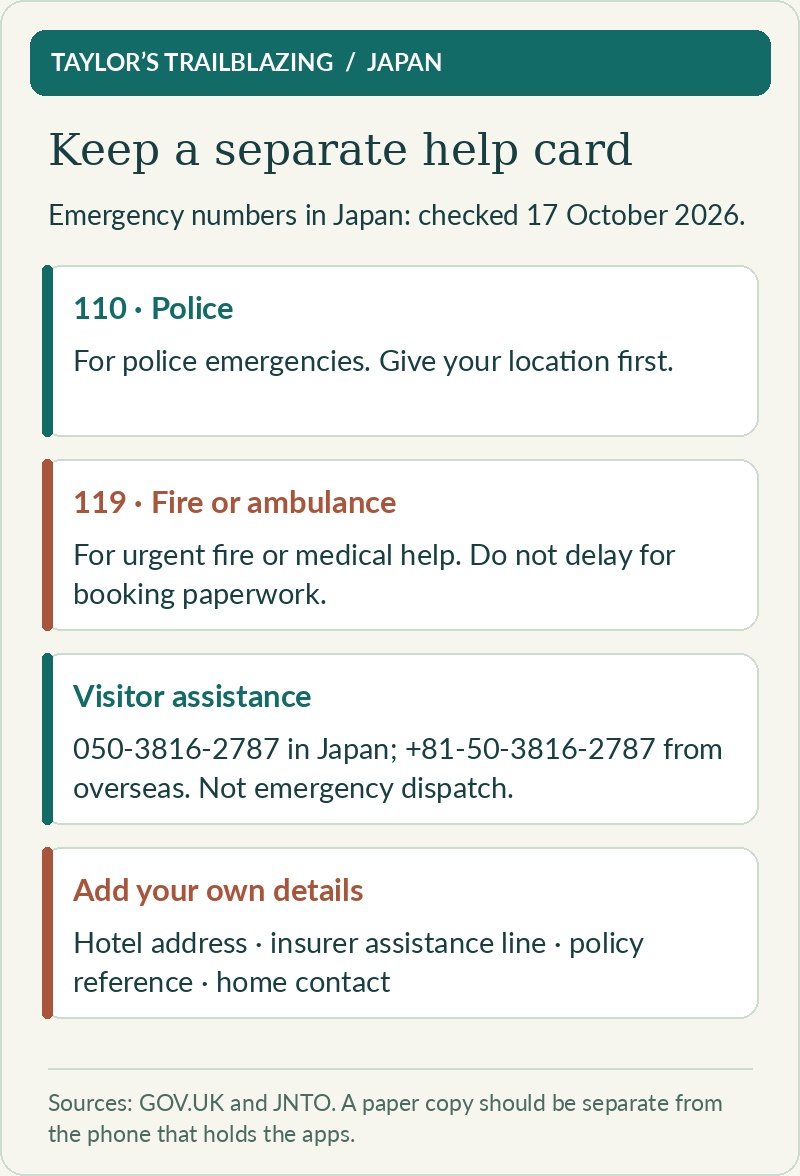
| Fire, serious injury or urgent illness | 119 — fire or ambulance.[1] | Explain your location first. Get emergency help before dealing with paperwork. |
| Visitor assistance | +81-50-3816-2787; within Japan, 050-3816-2787.[2] | The Japan Visitor Hotline provides assistance; it is not the police or ambulance dispatch service. |
| Treatment arrangements or disrupted bookings | Your own insurer’s assistance line and the relevant provider. | Save policy and booking references separately from the phone that holds the apps. |
| Passport or serious consular problem | Use the British Embassy Tokyo’s official support route.[3] | Consular assistance does not replace Japanese emergency services. |
Before leaving each accommodation, know its name and address in Japanese as well as in English. When requesting help, use a street address, station exit, shop name or visible landmark rather than “near the hotel”. If you are travelling together, agree who contacts help and who stays with the person who needs support.
Recognise pressure selling and nightlife risks
The FCDO warns about drink spiking and credit-card fraud in nightlife areas, including parts of Tokyo. Its advice specifically says not to follow touts into bars. This is a warning about particular situations, not a reason to regard an entire district or everyone working there as unsafe.[4]
Choose a venue deliberately rather than accepting an unsolicited invitation. Before ordering, ask for the complete price basis: drinks, time limits, cover or table charges and anything required as part of the order. A clearly stated cover charge is not automatically a scam; a price you cannot understand is a reason to pause before agreeing.
Keep your drink in sight and leave with your companions when a situation feels wrong. Decide the journey back before the evening starts. If someone prevents you leaving, threatens you or you need urgent help, prioritise your safety and contact police. Do not escalate an argument to recover a small amount of money.
If an incident occurs, record what you can safely remember afterwards and obtain appropriate help. The US State Department advises reporting crimes to local police before leaving Japan; keep the report details for your insurer or bank.[5]
Verify booking and payment messages outside the message itself
A message can be suspicious even when it contains genuine reservation details. Booking.com warns that fraudsters may use convincing information and urgent requests for payment or card verification. Compare any request with the original payment conditions and contact the property or platform through independently opened official channels.[6]
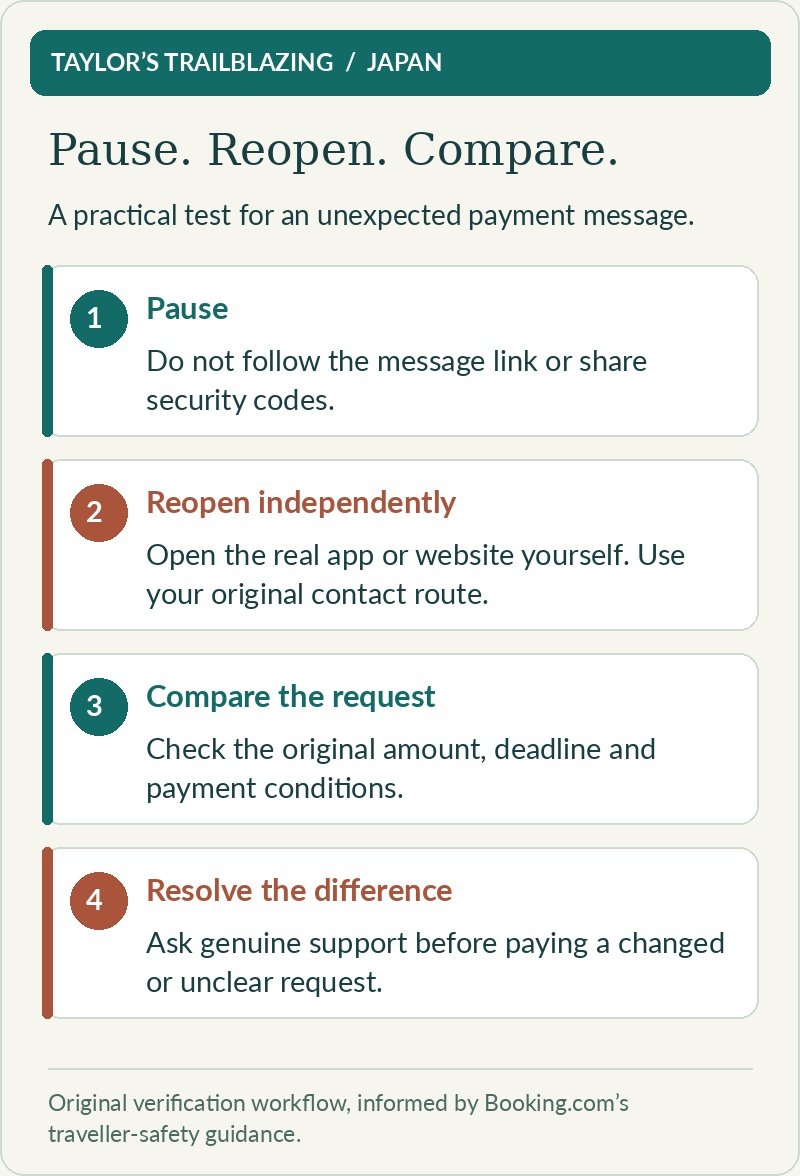
Our practical test is “pause, reopen, compare”. Pause before following the link. Reopen the app or website yourself. Compare the amount, deadline and payment method against the original confirmation, then ask support through that channel if something has changed. Do not use a telephone number supplied only in the questionable message.
Do not assume every prepayment request is fraudulent: the agreed room conditions may include a deposit or advance payment. The problem is a new or changed request that you have not authenticated, especially when it demands secrecy, unusual payment methods or immediate action.
If you have entered card details or account credentials, contact the card issuer or account provider promptly, explain what you disclosed and follow its security advice. Booking.com recommends reporting the suspicious contact and securing the affected account.[6]
Make a backup that survives a lost phone
Design the backup around failure rather than around your usual routine. A screenshot stored only on the lost phone is not a backup. A cloud account that requires a code sent only to that phone can also be difficult to recover when you need it most.
| Layer | What to prepare | What it protects against |
|---|---|---|
| On the phone | Offline maps where supported, hotel address, booking instructions, insurer number and an official warning app. | Weak data service or an unexpected language barrier. |
| Separate access | A travelling companion’s copy or a secure account accessible by a recovery method you have checked. | Losing one handset or being locked out of one account. |
| Paper essentials | Hotel name and address, emergency contacts, insurer assistance number and policy reference. | A dead battery, device failure or inability to log in. |
Keep a second payment method separate from the main wallet when practical. Record the bank’s genuine lost-card contact route in your backup. Do not put passwords, full card details and all identity documents together in a single easily lost folder.
If a phone is lost, get somewhere safe, use the device provider’s official lost-device controls through a trusted device, and contact the relevant mobile and payment providers. With a stolen passport, use the local police and British consular support process rather than relying on a booking agent to resolve travel documents.[3]
Install the official Safety tips app before you need it and check its permissions and notification settings. The app provides disaster-related alerts and useful emergency information; it is a support tool, not a guarantee that your device will receive every warning.[7]
Prepare for natural hazards without trying to predict them
Check official warnings for the exact place and activity you intend to visit. The Japan Tourism Agency links to Japan Meteorological Agency information for weather, earthquakes, tsunami and volcanic activity. A general regional forecast does not overrule a local closure or evacuation instruction.[9]
When shaking starts
Protect yourself from falling objects and follow the instructions appropriate to your surroundings. Do not rush from a building into the street during shaking. The official safety guidance advises staying inside until it is safe to leave. Learn the accommodation’s exit and assembly arrangements when you arrive.[9]
Near the coast
Strong shaking, or weaker shaking that continues for a long time, can mean you need to evacuate to higher ground. Follow designated routes and local instructions; do not approach the shore to look. Remain away until the relevant warning is lifted because tsunami waves can arrive repeatedly.[9]
When weather or transport changes
Check the operator’s notices before setting off for the station or port. Leave a remote viewpoint or mountain outing off the schedule when authorities advise against it. During heat, heavy rain or severe weather, change the activity rather than treating a paid booking as an instruction to continue.[4]
Use a simple disruption record: where you are safe tonight, what the operator has announced, the next confirmed transport option, and who must be told. Contact the accommodation and insurer before committing to replacement arrangements where their conditions require it. Keep receipts and screenshots of official cancellations; do not assume every extra cost will be reimbursed.
Resolve medical and activity questions before departure
Japan has good medical facilities, but treatment can be expensive. The FCDO advises suitable travel insurance and contacting the insurer promptly when referred for treatment. Save the emergency assistance number, not just the sales or general customer-service line.[10]
Declare medical circumstances as your insurer requires and check the actual activities you plan: hiking, winter sports or other specialist activities may have specific conditions. This guide does not select a policy or promise a claim will be paid. Ask the insurer to clarify uncertain cover in writing.
Check medicines separately against Japan’s official import guidance. A medicine being prescribed or sold in the UK does not settle whether it can be brought into Japan. Start that enquiry early and involve your prescriber if you need an alternative or documentation.[10]
For a remote day, leave your intended destination and return plan with someone appropriate. Research the conditions, legal access and local warnings before setting out. A phone signal, tour booking or previous visit is not evidence that the route is safe today.
Finish a practical pre-departure safety check
- Save 110 and 119, plus the visitor hotline and your own insurer’s assistance details.
- Keep the first hotel address readable without mobile data and on a separate paper copy.
- Set up account recovery and a payment backup that do not depend on one lost device.
- Read the original cancellation and payment conditions for each major booking.
- Find the official weather, transport and local visitor-information sources for your route.
- Agree a meeting place and contact method if your group becomes separated.
On arrival at each new hotel, replace the old address in your readily accessible notes. Check the exit instructions and ask where guests should go in an evacuation. Before a remote outing or late evening, review the journey back. These small repetitions are more useful than a long safety document you never open.
Questions travellers often leave until too late
Can I rely on a data-only eSIM to call an ambulance?
Do not assume it includes ordinary calling. Check the exact plan and your phone arrangements before departure. Ask a nearby person, accommodation staff or another suitable contact to help call emergency services when needed; internet access is not itself a voice service.[8]
Does a message inside a booking conversation prove a payment request is genuine?
No. Verify a changed request independently against the original conditions. Do not supply card details or security codes simply because the message knows your stay dates.[6]
Should I contact the visitor hotline before calling 119?
Not when urgent fire or ambulance help is required. Call the appropriate emergency service first. The visitor hotline is a separate assistance service.[1][2]
What should I do about a charge I only notice later?
Contact the card issuer through its genuine support channel, provide the transaction details and explain the concern. Preserve receipts and correspondence. The outcome depends on the payment method, evidence and provider’s process; do not assume an automatic refund.
Keep the plan short enough to use
Prepare the contact card, check the original booking conditions and give yourself a way to recover when the phone or travel plan fails. In an actual incident, safety and appropriate local help come before receipts or reservations. The purpose of preparation is to make the next action clearer, not to make the holiday feel dangerous.
This is general travel information, not individual medical, legal or insurance advice. Official sources were reviewed on 17 October 2026. The verification workflow and backup layers are editorial tools; follow current local instructions and advice from the relevant emergency, medical or financial provider.
Sources
Source information reviewed on 17 October 2026. Recheck operating arrangements, prices and advice for your travel dates. Booking links do not establish live availability or guarantee a particular outcome.
- GOV.UK — Getting help in Japan
- JNTO — Japan Visitor Hotline
- GOV.UK — British Embassy Tokyo and consular support
- GOV.UK — Japan safety and security
- US Department of State — Japan travel advice and crime reporting
- Booking.com — Traveller safety and suspicious payment requests
- Japan Tourism Agency — Safety tips application
- Airalo — Calls, text messages and data-only eSIMs
- Japan Tourism Agency — Disaster information and safety tips
- GOV.UK — Japan health and medical treatment
Illustrations in this article were created for Taylor’s Trailblazing Travels. Third-party photographs, where used, are credited beside the image or in the source list.