Chiang Mai to Chiang Rai: Bus, Tour or Private Transfer?
A practical comparison of journey time, real door-to-door cost, comfort and the crucial difference between travelling to Chiang Rai and touring it in one day.
Getting from Chiang Mai to Chiang Rai looks like a simple transport decision until the word “tour” enters the search results. A direct bus and a private car move you to Chiang Rai. A day tour usually collects you before breakfast, visits several attractions on a fixed schedule and brings you back to Chiang Mai after a very long day. Those are different products, even when they use the same mountain road.
The best choice therefore depends on what happens at the end of the journey. Travellers staying in Chiang Rai usually need the bus or a one-way private transfer. Visitors who want to see the White Temple and return to the same Chiang Mai hotel may prefer an organised tour. Meanwhile, families, small groups and anyone carrying awkward luggage can find that a private vehicle closes more of the price gap than the headline fare suggests.
This guide compares the Chiang Mai to Chiang Rai bus, guided tours and private transfers using operator information, current booking examples and realistic terminal-to-hotel time. Schedules and prices were checked on 17 September 2026; they remain planning evidence rather than a promise for a future departure.
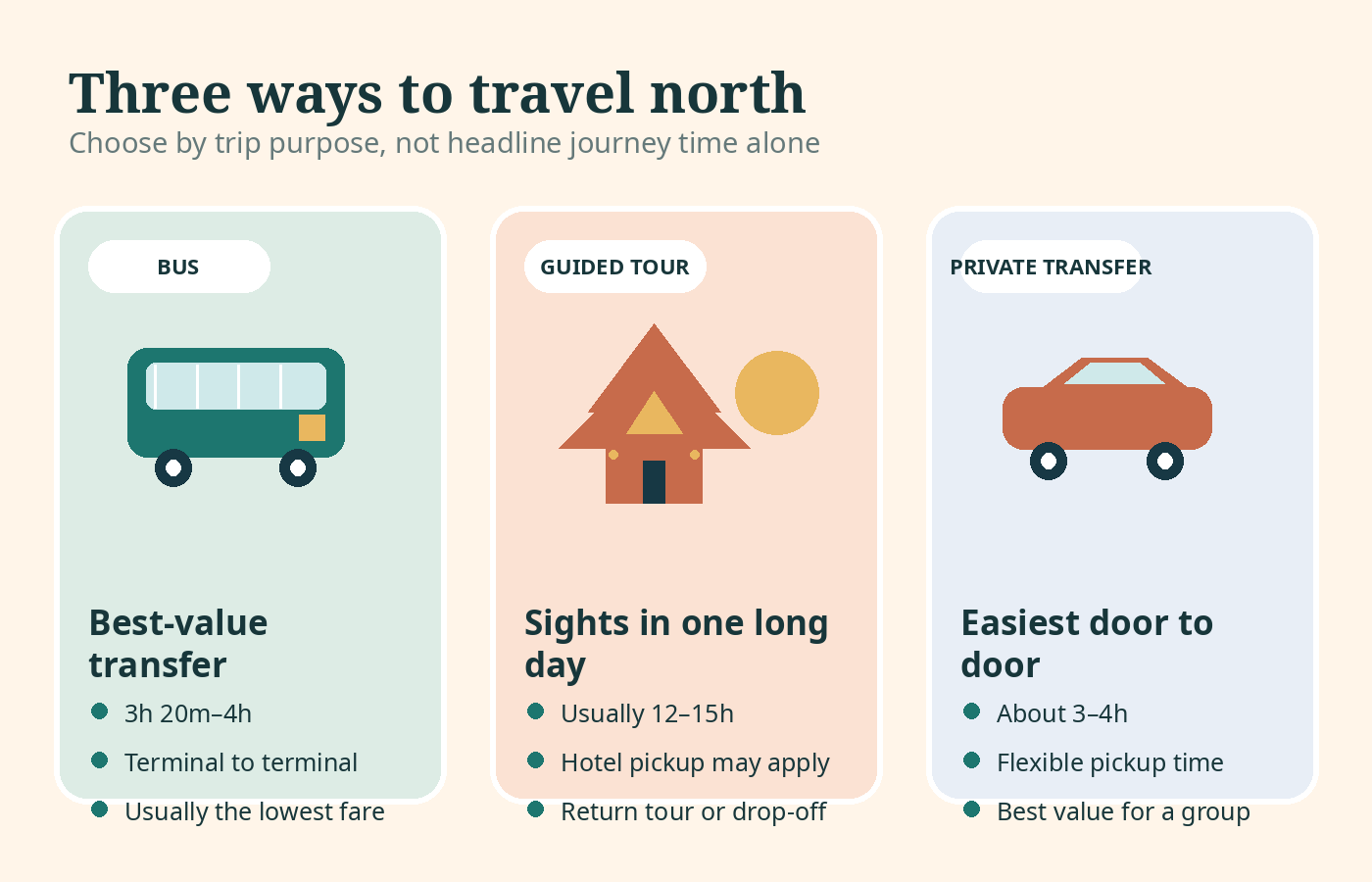
GreenBus
The sensible default for solo travellers and couples who are moving hotels and can manage two bus terminals.
Guided day tour
Useful when the temples are the destination and you want to return to Chiang Mai without arranging each stop.
Private transfer
Door-to-door travel with a chosen pickup time, especially valuable for families, groups and bulky luggage.
Transfer or excursion?
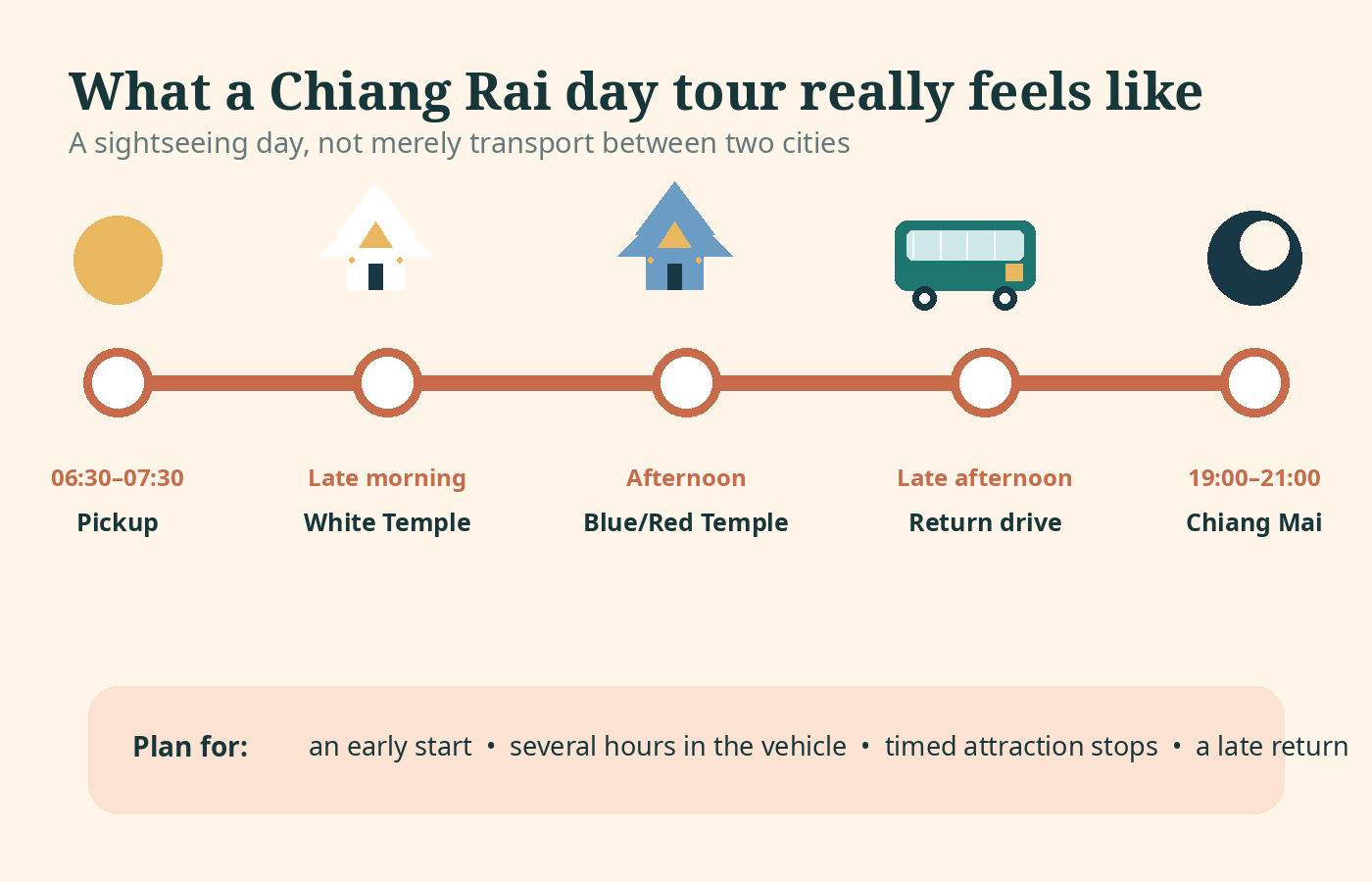
A tour is normally a long sightseeing day. Do not book one as ordinary transport unless Chiang Rai drop-off is explicitly included.
Chiang Mai to Chiang Rai options compared
The options below are ordered by the travel problem they solve: first a straightforward city transfer, then a return sightseeing day, and finally the most flexible door-to-door choice. Price ranges are dated planning examples checked on 17 September 2026, not fixed quotations.
| Option | Planning time | Planning cost | Best for | Main trade-off |
|---|---|---|---|---|
| GreenBus | 3h 20m–4h terminal to terminal | About THB 270–400 per person | Solo travellers, couples and one-way hotel moves | You still need transport to and from both terminals |
| Guided day tour | Usually 12–15h for the full excursion | About THB 1,200–2,500 per person for common group-tour examples | Seeing key attractions and returning to Chiang Mai | Long day, fixed pace and often limited time at each stop |
| Private transfer | About 3–4h door to door | About THB 2,500–4,700 per vehicle | Families, groups, luggage and flexible departures | Highest headline price, particularly for one traveller |
The bus range reflects current route listings and class variation. Tour and transfer ranges combine live examples from booking platforms and local operators checked on the review date; inclusions, vehicle size, pickup zone and attraction tickets can change the final amount.
What the Chiang Mai to Chiang Rai route is really like
Distance and road
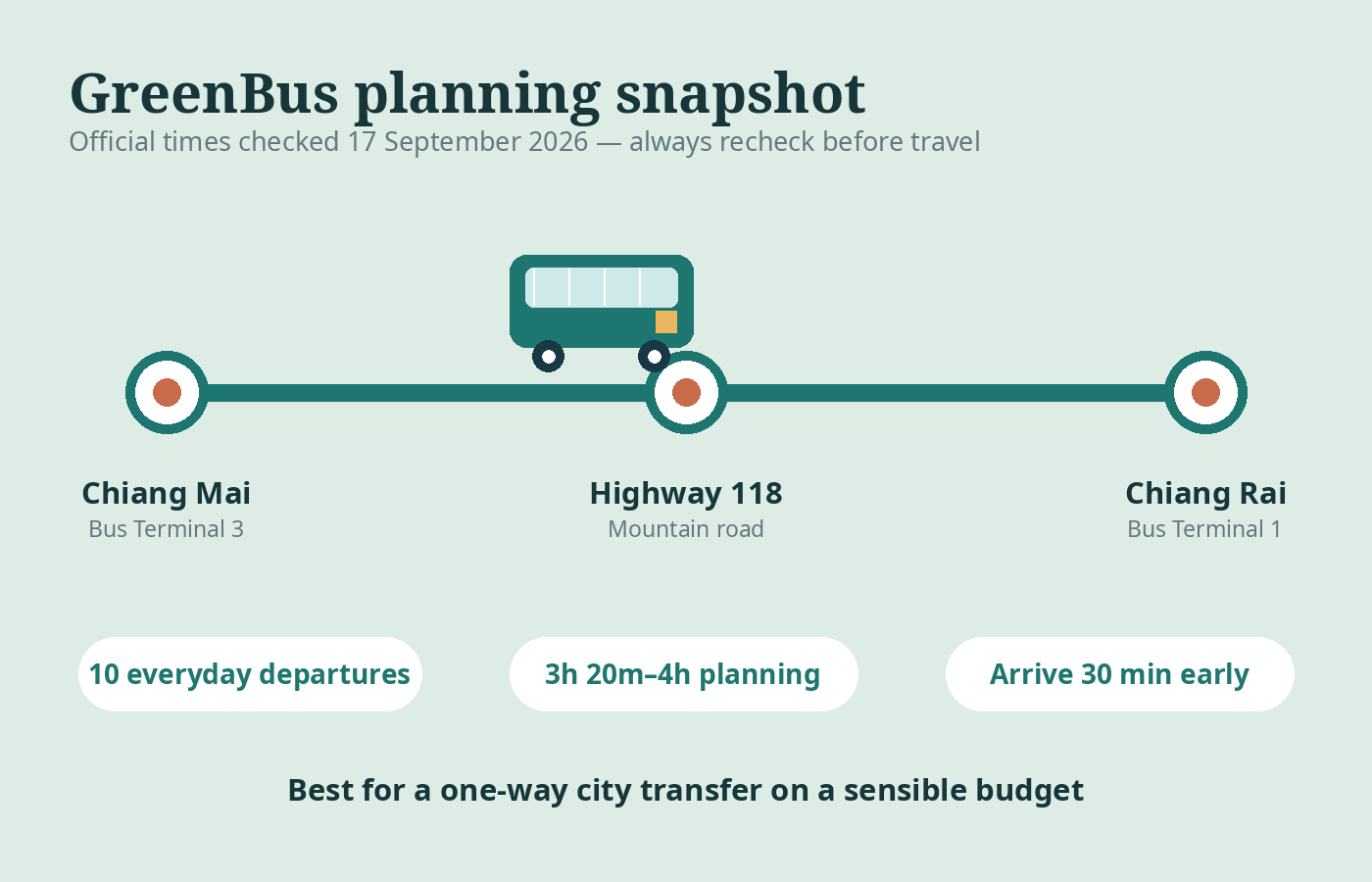
The two city centres are roughly 190 kilometres apart by the usual road route. Vehicles leave the Chiang Mai plain on Highway 118, cross hilly country and continue towards Chiang Rai. The road is paved and routinely used by coaches, vans and cars, although bends, roadworks, rain and traffic can stretch a timetable.
A headline drive time of about three hours does not describe the entire travel day. Hotel checkout, the journey to Chiang Mai Bus Terminal 3, check-in time, the intercity ride and the final transfer from Chiang Rai Bus Terminal 1 all belong in the comparison. A bus shown as 3 hours 45 minutes can become a five-hour door-to-door process, while a private car may collect you at reception and finish at the next hotel.
Chiang Rai is not a compact “one temple” stop
Wat Rong Khun, widely called the White Temple, lies south of central Chiang Rai. Wat Rong Suea Ten, the Blue Temple, is north of the centre, while Baan Dam is farther north again. The Golden Triangle is a much longer continuation towards Chiang Saen. Consequently, arriving at the bus terminal does not mean that every attraction is walkable or even close together.
This geography explains the popularity of tours. They bundle several separated sights into one vehicle day. However, that same efficiency creates a fixed pace. Independent travellers who stay at least one night can see fewer places with more breathing room, use a local driver for selected stops and enjoy central Chiang Rai after day-trippers have left.
Taking the Chiang Mai to Chiang Rai bus
For most independent travellers, the GreenBus is the practical benchmark. It is direct, frequent by regional standards and substantially cheaper than reserving a whole vehicle.
Why the bus works well
Seats are assigned on many bookable services, coaches are air-conditioned and larger luggage normally travels in the hold. The route removes the need to negotiate with a driver and gives solo travellers a predictable cost. In current online examples checked on 17 September 2026, bookable fares commonly sit around THB 270–400 per person depending on service class and platform fees. [3]
The bus also arrives in central Chiang Rai rather than at its airport. That can make the final transfer short for hotels around the Night Bazaar, Clock Tower and central district. Still, confirm the terminal shown on the actual ticket, because some through-services continue beyond Chiang Rai and platform listings can differ.
What the bus does not include
GreenBus is transport, not a sightseeing service. It does not wait while passengers tour the White Temple, and it does not ordinarily deliver travellers to a hotel. You need enough time to reach Terminal 3 before departure and a plan for the final kilometre in Chiang Rai.
Allow at least 30 minutes at the terminal for finding the correct counter and bay. During Thai public holidays, weekends and the cool-season peak, booking ahead is sensible. A same-day walk-up ticket may exist, yet relying on it can leave only an inconvenient departure or no seat in the preferred class.
GreenBus timetable snapshot for Chiang Mai to Chiang Rai
The official GreenBus page was updated on 15 August 2026 and checked for this article on 17 September 2026. [1] It listed ten Chiang Mai departures every day, plus one Monday-only service and one Friday-and-Sunday service. The list below follows the operator’s published order rather than ranking departures by convenience.
| Service pattern | Departure from Chiang Mai | Planning note |
|---|---|---|
| Every day | 07:00 | Useful early start for checking in and exploring Chiang Rai later |
| Every day | 07:30 | Another early option; availability can differ by sales channel |
| Every day | 08:45 | Allows a less rushed hotel breakfast |
| Every day | 09:30 | Likely central arrival in the early afternoon |
| Every day | 11:00 | Convenient after checkout, though it uses more daylight |
| Every day | 13:30 | Afternoon transfer; keep the evening flexible |
| Every day | 14:00 | Close to the previous service, so verify the exact ticket |
| Every day | 17:00 | Evening arrival; arrange onward transport in advance |
| Every day | 18:15 | Late arrival and limited sightseeing value that day |
| Every day | 18:30 | Latest everyday time in the operator snapshot |
| Monday only | 06:00 | Day-specific extra service |
| Friday and Sunday only | 16:00 | Day-specific extra service |
Timetables can change after an article is published. Moreover, a booking platform may display only the seats it sells rather than every operator departure. Treat the table as a planning snapshot, then confirm the exact time through GreenBus, FairFair or the booking confirmation used for the trip.
Which departure is most useful?
For an overnight stay, the 08:45 or 09:30 services often balance breakfast, hotel checkout and an afternoon arrival. Earlier departures make sense when the first Chiang Rai day matters. Conversely, the late services work for travellers protecting a final Chiang Mai morning, but they leave little margin if the bus is delayed and the accommodation desk closes early.
Choosing a Chiang Rai day tour from Chiang Mai
A tour is best understood as a long excursion with transport included. The comparison points below are ordered by the decisions most likely to change the experience: where the day ends, what is included, how many stops are attempted and how the group travels.
Return tour or one-way drop-off?
Most products are designed to return to Chiang Mai. Some current listings also offer a Chiang Rai drop-off or a separately selected ending point. Never assume that a tour can replace a one-way transfer simply because it enters Chiang Rai. The chosen option, voucher and meeting instructions must explicitly state where passengers finish.
A typical temple-focused tour can include Wat Rong Khun, Wat Rong Suea Ten and Wat Huay Pla or another red-themed temple stop. Longer itineraries may add Baan Dam, a hot spring, a Karen village or the Golden Triangle. More stops do not automatically create a better day: each addition reduces time elsewhere and can extend the return into the evening.
What the day feels like
Current tour examples checked on 17 September 2026 commonly advertise about 12 to 15 hours from pickup to return. [4] [5] That can mean an early hotel collection, several hours of road travel, timed attraction visits, a group lunch and an evening arrival in Chiang Mai. The itinerary is efficient, although travellers who enjoy slow photography, cafés or spontaneous stops may find it restrictive.
Group size matters. A small minivan can board quickly but feel tight when every seat is occupied. A coach offers more space, yet collecting passengers from several hotels can lengthen the beginning and end. Private tours provide flexibility but may cost closer to a transfer plus a driver-day than a standard group excursion.
Check inclusions before comparing prices
For current examples checked on 17 September 2026, common group-tour planning ranges are roughly THB 1,200–2,500 per person. [4] [5] A lower headline price may exclude attraction fees, lunch, a long-neck village supplement or pickup outside a central zone. A higher price may include those items, use a smaller group or allow a Chiang Rai drop-off. Compare the final basket, not the first number on the page.
| Check | Why it matters | What to look for |
|---|---|---|
| Final drop-off | Determines whether it is a return excursion or one-way move | Chiang Mai hotel, Chiang Rai centre or a selectable option |
| Pickup zone | Outer hotels may require a meeting point or surcharge | Named area, collection window and contact method |
| Attraction fees | Exclusions change the real cost | Clear wording for every ticketed stop |
| Lunch and water | A 12–15-hour day needs a realistic food plan | Meal, dietary process, drinking water and rest stops |
| Group and vehicle | Affects comfort, boarding time and guide access | Maximum group size and vehicle type |
| Cancellation terms | Weather, illness and plan changes happen | Deadline, local time zone and refund conditions |
Booking a private transfer from Chiang Mai to Chiang Rai
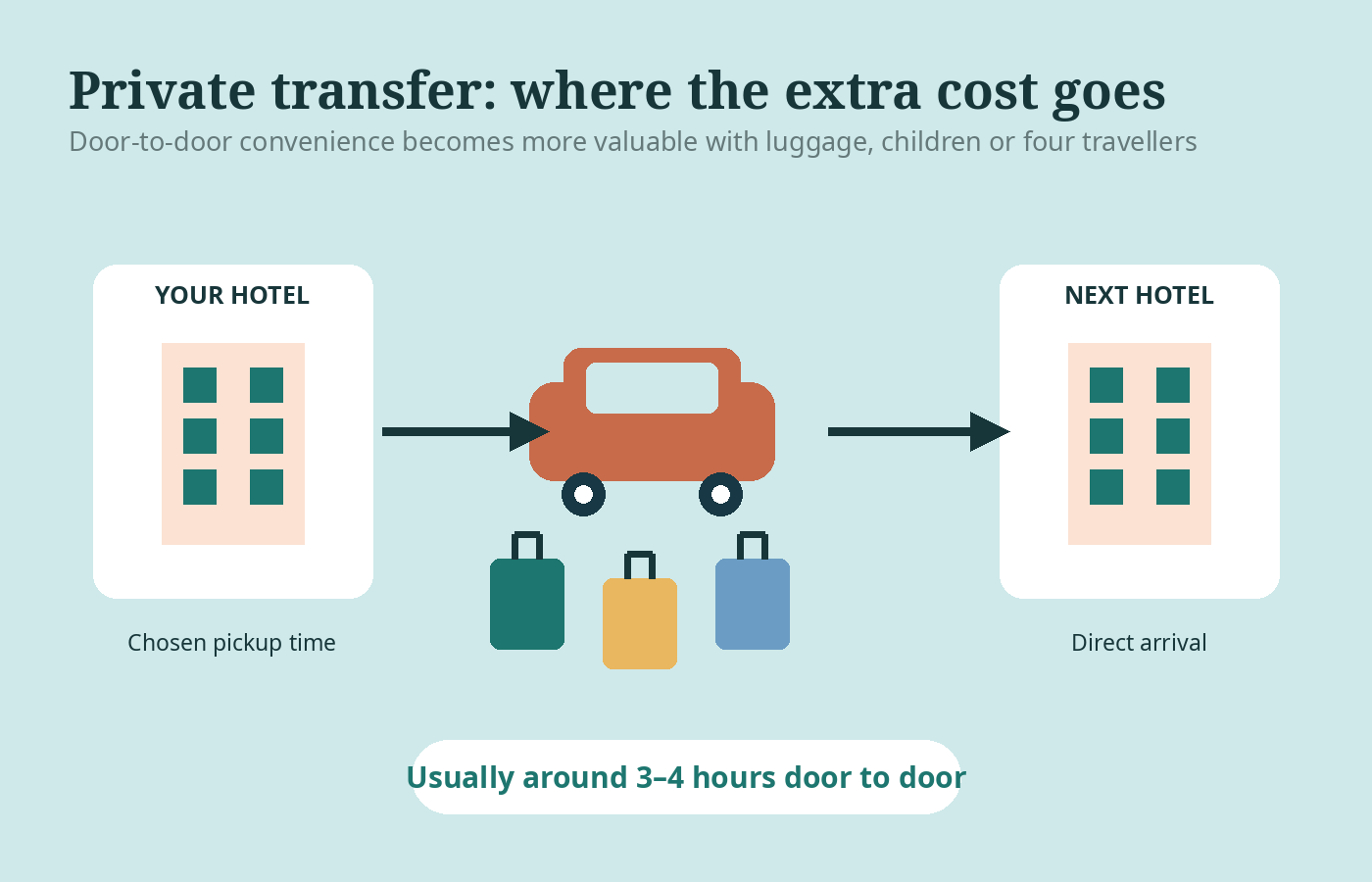
A private transfer is the lowest-friction way to move between hotels. The driver collects the party at an agreed location, handles the main luggage and travels directly to the chosen destination. It is particularly useful after a late arrival, with young children, with reduced mobility or when a group would otherwise buy several bus tickets and two separate local transfers.
Planning price and vehicle choice
Live examples checked on 17 September 2026 placed a one-way vehicle broadly around THB 2,500–4,700. [6] [7] The lower end appeared on some taxi-style listings; pre-arranged sedans and minivans from specialist operators reached the upper end. Airport pickup, a larger van, waiting time, remote hotels and sightseeing stops can change the quotation.
A sedan may be cheaper but unsuitable for four adults with large cases. A minivan can be the better-value vehicle once luggage and personal space are considered. Send the supplier an honest passenger and bag count before payment, including pushchairs, wheelchairs, golf clubs or oversized cases.
Transfer versus chauffeured sightseeing
A basic transfer normally covers one pickup, the road journey and one destination. A pause for a toilet or drink is reasonable; a two-hour temple visit is a different service. When stops are wanted, request a written quote that names each place, the waiting allowance and the total duration. This avoids a disagreement about whether the driver is providing transport or a full touring day.
For families and groups, divide the complete vehicle price by the number of passengers. A THB 4,000 minivan would equal THB 1,000 each for four people, based on the 17 September 2026 example calculation. The bus remains cheaper, but the difference may feel proportionate once two terminal transfers and several hours of luggage handling are removed.
Compare the real door-to-door time and cost
Headline fares hide different amounts of extra work. The worked examples below use planning allowances checked on 17 September 2026. They are not quoted prices; their purpose is to expose the additional steps that belong in a fair comparison.
| Traveller | Bus example | Private example | What changes the decision |
|---|---|---|---|
| One adult | THB 350 ticket + THB 250 combined local transfers = THB 600 | THB 3,000 vehicle | Bus wins strongly unless door-to-door support is essential |
| Two adults | THB 700 tickets + THB 250 local transfers = THB 950 | THB 3,000 vehicle | Bus still saves substantially; private buys time and ease |
| Four adults | THB 1,400 tickets + THB 350 larger local vehicles = THB 1,750 | THB 4,000 minivan | Private is roughly THB 1,000 each in this example |
| Family with bags | Bus fares + two suitable local vehicles + terminal handling | One correctly sized pre-booked van | Convenience can outweigh the remaining price gap |
Time is not just motion
A bus passenger may spend 20–30 minutes reaching Terminal 3, arrive 30 minutes before departure, travel for 3 hours 20 minutes to 4 hours, then wait for local transport in Chiang Rai. A private transfer may use a similar road time but start and finish at the hotels. In a realistic case, the car can save one to two hours of logistics without driving much faster.
A tour cannot be compared by kilometres alone
The tour’s high elapsed time includes attraction visits and usually a return to Chiang Mai. Comparing a 13-hour tour with a 3-hour transfer makes no sense unless the traveller genuinely wants the sightseeing programme. Conversely, paying for a transfer and then hiring local transport to visit three dispersed temples can approach the price of a tour while preserving far more control.
Best option for each type of traveller
The recommendations below are arranged by the traveller’s dominant constraint rather than by a claim that one method is universally best.
Solo traveller
Use the bus for a one-way move. A group tour can make sense for a return sightseeing day because transport and guide costs are shared.
Couple
The bus remains the value choice. Consider a private car when luggage, a late pickup or a special stop matters more than the saving.
Three or four adults
Price a suitable private vehicle before booking several tickets. The per-person premium can narrow once local transfers are included.
Family with children
A private transfer offers bathroom-stop control and simpler luggage handling. Request an appropriate child seat; do not assume one is included.
Short first visit
A day tour is efficient when the aim is to see signature sights and sleep in Chiang Mai. Accept that the pace will be structured.
Slow traveller
Take the bus, stay one or two nights and explore independently. This separates a pleasant city stay from a 12–15-hour road day.
Travellers with an onward border or Mekong plan
Chiang Rai can be a staging point for Mae Sai, Chiang Saen or Chiang Khong, but the next connection needs its own timetable. Do not build an international border crossing or slow-boat departure around a tight same-day arrival. An overnight buffer protects against road delays, sold-out seats and changes to local services.
Travellers who dislike long vehicle days
The direct bus or private transfer followed by an overnight stay is usually easier than a return tour. Although a tour provides breaks, it still places the traveller in a vehicle twice on the same day. Splitting the route creates time for dinner, a night market and a calmer second morning.
How to book without choosing the wrong product
The booking sequence below is ordered from the decisions that are hardest to correct later to the details that can still be adjusted close to travel.
- Decide whether the night will be spent in Chiang Mai or Chiang Rai.
- Choose transport only after that decision: transfer for a hotel move, tour for a return sightseeing day.
- Check the exact date, pickup point, departure terminal and final drop-off.
- Read what is included, especially attraction tickets, lunch, hotel collection, child seats and luggage.
- Compare the final payment total rather than a price before fees or optional extras.
- Save the voucher, operator contact and map pin offline.
- Recheck the departure instructions 24–48 hours before travel.
Booking the bus
GreenBus states that tickets can be purchased through FairFair and at FairFair counters in its stations and offices. A third-party platform can be convenient for English-language comparison and payment, but the selected departure should still match the ticket confirmation. Arrive early enough to locate the bay without relying on a driver to wait.
Booking a tour
Filter by date and pickup area, then open the selected option rather than relying on the product headline. A listing may combine group, private, return and one-way variants on one page. Read the cancellation deadline in local time and take a screenshot of the chosen inclusions.
Booking a private vehicle
Send the accommodation names, flight details when relevant, passenger count, luggage count and desired stops. Ask who monitors delayed arrivals and whether waiting fees apply. The safest quotation is one that identifies the vehicle and service in plain language rather than simply saying “taxi”.
Luggage, comfort and accessibility
Bus luggage
Large cases normally go into the coach hold, while a small valuables bag stays with the passenger. Operators can apply size or weight rules, so check the live booking conditions rather than treating any general allowance as permanent. Keep passports, money, medication, electronics and breakable items out of the hold.
Label the main bag and photograph it before loading. At Chiang Rai, watch where luggage is unloaded instead of walking away immediately. A soft layer is useful because strong air conditioning can make the bus feel cold even when the terminal is hot.
Children and child seats
A standard coach seat does not guarantee a child restraint. Likewise, a private vehicle listing may show a family photograph without including a suitable seat. State the child’s age and approximate size, request the correct restraint and obtain written confirmation. Families should also allow for a toilet break and snacks that do not create a mess on winding roads.
Reduced mobility
Coach steps, narrow aisles and terminal movement can be difficult. Contact the operator before booking to ask about boarding assistance and storage of mobility equipment. For a private transfer, provide the dimensions and whether the chair folds; a sedan boot may not hold a wheelchair and several suitcases together.
A private vehicle often gives the clearest door-to-door plan, yet “private” does not automatically mean accessible. Confirm step height, seating transfer needs and the accessibility of any intended stops. Temples can have uneven surfaces, stairs and shoe-removal rules that require separate planning.
Weather, smoke season and road conditions
Rainy season
Heavy rain can slow traffic, reduce visibility and make pickup timing less precise. Build margin before a flight, border connection or non-refundable activity. A private driver can adjust short comfort stops, but cannot remove road conditions; a coach timetable can also slip when traffic or weather deteriorates.
Cool season
Roughly November to February is popular in northern Thailand because mornings can be cooler and skies are often clearer. Demand around Christmas, New Year and Thai holidays can fill preferred buses and tours earlier. Book key travel days ahead while keeping enough flexibility for changing weather.
Haze and burning season
Air quality in the north can become poor during the dry-season burning period, often most concerning from February into April, although the severity and timing vary each year. Check a current air-quality source near the travel date. [8] A temple-heavy day with broad views may not justify a long return journey during severe haze, particularly for travellers with respiratory or cardiovascular conditions.
For a wider month-by-month decision, use the site’s best time to visit Thailand guide and then check the local forecast and air quality shortly before departure.
Three realistic travel plans
These sample plans are arranged from the lowest-cost independent move to the most convenient customised journey. They are planning frameworks rather than promises of specific availability.
Plan A: budget one-way move
- Stay within easy reach of Chiang Mai Bus Terminal 3 or allow 20–30 minutes from the Old City.
- Choose a morning GreenBus departure and arrive at least 30 minutes early.
- Reach Chiang Rai around lunchtime or early afternoon, depending on the booked service.
- Use local transport to the hotel, check in and keep the first evening light.
- Visit the central Clock Tower or Night Bazaar rather than forcing a distant temple into the arrival day.
Plan B: return sightseeing day
- Choose a tour with central Chiang Mai pickup and a clearly stated return.
- Confirm the temple list, entrance-fee policy, meal and group size.
- Pack temple-appropriate clothing, water and a light layer for the vehicle.
- Keep the evening after the tour free; return times can move with traffic and group pace.
- Do not plan an early flight the next morning unless a long day is acceptable.
Plan C: comfortable hotel-to-hotel transfer
- Request a private sedan or van sized for every passenger and bag.
- Choose a pickup after breakfast and ask whether one short stop is included.
- Add Wat Rong Khun only if the supplier quotes the waiting time and revised price in writing.
- Continue to the Chiang Rai hotel, check in and explore independently.
- Keep a second day for the Blue Temple, Baan Dam or countryside rather than compressing everything into the transfer.
Pros and cons of each option
The points are grouped by transport type and ordered from the most practical advantage or limitation to the more situational ones.
GreenBus
Advantages
- Usually the lowest one-way cost.
- Multiple published departures on the current operator timetable.
- Direct intercity journey without changing vehicles.
- Good fit for central Chiang Rai accommodation.
Limitations
- Requires travel to and from two terminals.
- Fixed departure time and limited control over stops.
- Coach steps and luggage handling may be difficult for some travellers.
- Does not include sightseeing or hotel delivery.
Guided day tour
Advantages
- Several dispersed attractions organised in one day.
- Guide, vehicle and route handled together.
- Useful for visitors sleeping in Chiang Mai both nights.
- Can reduce language and ticket-planning friction.
Limitations
- Usually a 12–15-hour day.
- Fixed pace and limited freedom at each stop.
- Pickup rounds and optional extras can add time or cost.
- May return to Chiang Mai when a one-way move was needed.
Private transfer
Advantages
- Door-to-door collection and drop-off.
- Chosen departure time and easier luggage handling.
- Per-person value improves for a suitable group.
- Custom stops can be quoted in advance.
Limitations
- Highest headline price.
- Vehicle size and supplier quality need checking.
- Unagreed waiting or detours can create extra charges.
- A driver is not automatically a licensed guide.
Common mistakes to avoid
The mistakes below are ordered from errors that can derail the whole journey to smaller problems that mainly reduce comfort.
- Booking a return day tour when the hotel for that night is in Chiang Rai.
- Assuming every tour offers a Chiang Rai drop-off because the itinerary enters the city.
- Looking only at the intercity fare and ignoring terminal transfers.
- Using an old timetable instead of the operator page and final ticket.
- Leaving a tight flight, border or boat connection after the expected road arrival.
- Adding the Golden Triangle to an already crowded temple day without accepting the extra road time.
- Booking a sedan before confirming that every large case will fit.
- Assuming a child seat or accessible vehicle is included without written confirmation.
- Choosing the cheapest tour without checking attraction fees, lunch and pickup zone.
- Carrying passports or medication in the coach hold.
- Expecting the bus driver to stop for sightseeing.
- Planning a demanding evening immediately after a long return tour.
Frequently asked questions
What is the best way to get from Chiang Mai to Chiang Rai?
The GreenBus is the best-value choice for most solo travellers and couples making a one-way move. A private transfer is easier for groups, families, luggage or door-to-door travel. A guided tour is best only when sightseeing is the main purpose and the traveller normally returns to Chiang Mai.
How long is the bus from Chiang Mai to Chiang Rai?
Current route listings commonly show about 3 hours 20 minutes to 4 hours between terminals. Add travel to Chiang Mai Bus Terminal 3, at least 30 minutes before departure and the final journey from Chiang Rai Bus Terminal 1. A realistic hotel-to-hotel total can therefore approach five hours.
How much is the Chiang Mai to Chiang Rai bus?
Current bookable examples checked on 17 September 2026 commonly fall around THB 270–400 per person, depending on service class and platform fees. The live operator or booking page controls the actual fare. Add local transport at both ends when comparing the bus with a private transfer.
Where does the bus leave in Chiang Mai?
Direct GreenBus services are commonly listed from Chiang Mai Bus Terminal 3, part of the Arcade terminal area east of the Old City. Check the exact terminal and bay on the ticket because nearby terminal buildings and through-services can cause confusion. Arrive at least 30 minutes early.
Where does the bus arrive in Chiang Rai?
Current direct route listings commonly show Chiang Rai Bus Terminal 1, which is useful for the central district. Nevertheless, the destination printed on the individual ticket takes priority, especially when a service continues towards Mae Sai or another northern destination.
Can I take a train from Chiang Mai to Chiang Rai?
No direct railway links the two cities. The practical land choices are bus, minivan or car. Adding rail via another city would not create a sensible route for this journey.
Is a Chiang Rai day trip from Chiang Mai worth it?
It can be worthwhile when time is limited and the priority is seeing several headline attractions with transport organised. Expect a very long day and brief, scheduled stops. Travellers who prefer a slower pace will usually get more from one or two nights in Chiang Rai.
Can a tour drop me in Chiang Rai instead of returning to Chiang Mai?
Some products offer a Chiang Rai drop-off or selectable ending point, while many return to Chiang Mai. The option chosen during checkout and the voucher must explicitly name Chiang Rai as the final drop-off. Do not rely on the route description alone.
How much is a private transfer?
Current examples checked on 17 September 2026 broadly range from about THB 2,500 to THB 4,700 per vehicle. Vehicle size, pickup point, airport waiting, remote accommodation and sightseeing stops affect the quote. Confirm the total and inclusions in writing.
Is the road between Chiang Mai and Chiang Rai safe?
It is a standard intercity route used daily by buses and cars, although it includes bends and can be affected by rain, roadworks and traffic. Use a licensed operator, wear a seat belt where provided and avoid building a tight onward connection around the scheduled arrival.
Can I visit the White Temple on the transfer day?
Yes, a private transfer can sometimes add Wat Rong Khun because it lies south of central Chiang Rai. Ask for a quotation that includes waiting time and the revised arrival estimate. A scheduled intercity bus does not provide a sightseeing stop.
Should I book the bus in advance?
Advance booking is sensible for weekends, Thai public holidays, cool-season travel and a specific preferred departure. GreenBus publishes multiple services, but that does not guarantee a seat in the desired class. Use the current operator or authorised sales channel and save the confirmation offline.
Is the bus suitable with large luggage?
Coaches normally carry larger bags in the hold, but current size and weight conditions should be checked before travel. Keep valuables and medication at the seat. Travellers with several oversized cases may find a correctly sized private van simpler.
Which option is best with children?
A private transfer offers the most control over pickup, luggage and breaks. Request the correct child seat and obtain written confirmation. A tour can work with older children who cope well with long days, while the bus is economical for families comfortable using terminals.
How many nights should I spend in Chiang Rai?
One night allows an easier city evening and one fuller sightseeing day. Two nights provide more room for temples, Baan Dam, countryside or a driver-led route without rushing. A zero-night tour suits travellers who cannot change their Chiang Mai hotel plan.
What is the latest daily bus in the current timetable?
The GreenBus timetable updated 15 August 2026 listed 18:30 as the latest everyday Chiang Mai departure when checked on 17 September 2026. Schedules can change, so confirm the live operator page and ticket before relying on that time.
Which option should you choose?
For a simple hotel move, start with the GreenBus. It offers the strongest balance of price, frequency and a manageable journey for most independent travellers. Choose a morning departure, include both terminal transfers in the day and stay at least one night if the itinerary allows.
Choose a guided tour when Chiang Rai’s headline sights are the objective and the same Chiang Mai room will be waiting that evening. Read the selected itinerary carefully, because a long list of attractions can produce more vehicle time and less meaningful time at each place.
A private transfer is the strongest practical choice for a family, a group sharing the price, travellers with mobility needs or anyone carrying awkward luggage. It also suits people who want a written, pre-priced stop at Wat Rong Khun before continuing to the hotel. The premium buys control and removes two terminal journeys; it does not make the mountain road disappear.
Book transport, not the wrong itinerary
Check the final destination first, then compare a direct bus, a return sightseeing tour or a door-to-door vehicle using the exact travel date.
Sources and fact-checking notes
Transport information was checked on 17 September 2026. Operator material was used for the timetable and ticket channels; live booking pages were used only as dated examples of journey duration, availability, inclusions and planning prices. Those commercial examples can change by date, currency, inventory and selected option.
- GreenBus: official bus schedule — page marked latest update 15 August 2026.
- GreenBus: ticket-purchase channels — FairFair website and counters.
- 12Go: Chiang Mai to Chiang Rai route listings — current bookable examples, terminals and journey durations.
- GetYourGuide: temple day-tour example — duration, pickup and selectable options.
- Viator: longer Chiang Rai tour example — itinerary and duration comparison.
- GetYourGuide: private-transfer example — vehicle and journey planning.
- Thailand Transfers: Chiang Mai–Chiang Rai private transfers — dated vehicle-price comparison.
- Thailand Pollution Control Department: Air4Thai — current air-quality checks.
Illustrations in this article were created for Taylor’s Trailblazing Travels. Third-party photographs, where used, are credited beside the image or in the source list.