Best Areas to Stay in Pai: 7 Bases Compared
Choose between Walking Street convenience, peaceful riverbanks, Mae Yen views, mountain-valley resorts and countryside retreats.
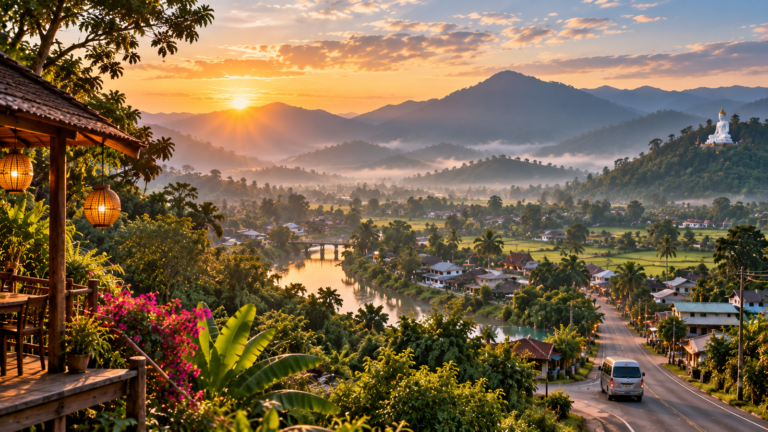
Choosing among the best areas to stay in Pai is not simply a choice between town and countryside. The centre around Walking Street is compact enough to walk, but accommodation spreads across both riverbanks, up towards Mae Yen and the white Buddha, north into the valley and west towards Nam Hu and Santichon. A hotel can therefore carry a Pai address while placing every dinner, tour and late return behind a vehicle journey.
For most first-time visitors, the answer is straightforward: stay around Walking Street, the bus station or the closest part of Pai River. That central cluster is easier after the winding road from Chiang Mai and keeps food, cafés and evening life within reach. However, couples and families may prefer Mae Yen or a riverside resort, while drivers can use the northern valley, western countryside or hot-springs corridor more effectively.
This guide compares areas rather than pretending the highest review score solves every itinerary. The list was built from six criteria: walkability, evening usefulness, transport friction, hotel choice, scenery and fit for a typical three-to-five-night visit. Prices, property locations and changeable details were checked on 18 September 2026.
Walking Street and town
The simplest choice for arrival, meals, evening market and a no-scooter trip.
Pai River east bank
Choose a property with a confirmed bridge and easy walking route into town.
Mae Yen or northern valley
Greener views and larger grounds when a shuttle or vehicle is part of the plan.
Distance changes quickly
One hotel is a five-minute walk; another “Pai” property may be ten kilometres away.
These seven bases are compared against walkability, evening usefulness, road friction, hotel choice, scenery and fit for a typical three-to-five-night visit. The ordering reflects traveller usefulness rather than commission, star rating or the most expensive room.
| Area | Best for | Walkability | Planning room range | Main trade-off |
|---|---|---|---|---|
| Walking Street and town centre | First visits, no scooter and evening convenience | Best | THB 600–3,500 | Market and music noise varies sharply by lane and room orientation. |
| Pai River east bank | Quiet but walkable couples’ stays | Good from selected properties | THB 700–4,500 | Bridge quality, flooding, luggage access and late-night lighting need checking. |
| Mae Yen and White Buddha side | Views, wellness and central-edge calm | Moderate to low | THB 800–5,500 | The area spreads out; “Mae Yen” can mean a short walk or a vehicle journey. |
| North town and Route 1095 edge | Quiet value, practical arrivals and longer stays | Moderate | THB 700–3,000 | Less atmospheric than the river; some roads are unpleasant to walk. |
| Mae Na Toeng and northern valley | Resort grounds, families and mountain scenery | Low | THB 1,500–7,000+ | A shuttle or vehicle is normally part of the stay. |
| Nam Hu, Santichon and western valley | Sunrise views, self-drive and rural space | Very low | THB 900–4,500 | Limited evening food and variable road lighting. |
| Tha Pai, hot springs and canyon corridor | Retreats, road trips and nature | Very low | THB 1,200–6,500+ | Too remote for spontaneous town evenings without planned transport. |
Planning ranges are per room per night for two adults and were checked on 18 September 2026. They are broad search anchors, not quotes. Current Pai listings span simple rooms from roughly £11 to £39 on the city results page, while premium resorts and villas can cost substantially more. [11]
For a short first trip, the compact centre is the lowest-friction answer. The bus station, Walking Street, cafés, small restaurants, laundry shops and tour desks cluster around Chaisongkram Road and the nearby lanes. TAT places Pai Walking Street in Wiang Tai and describes the pedestrian stretch running towards the Pai River. [2]
Why the centre works
Arrival is easier because a passenger can walk from the minivan stop to many central properties or arrange a very short transfer. Evenings require little planning: dinner, the market and live music are close, while an early breakfast or pharmacy is easier to find than at a remote villa. This is particularly valuable after the winding Chiang Mai road, when the best plan may be to check in, eat nearby and stop.
Where the centre can disappoint
Central does not mean quiet. A property one street from the market can feel peaceful while a room facing a bar, loading bay or late-night scooter route may not. Read the newest reviews for music, barking dogs, thin walls and construction, then use satellite and street views to judge the actual lane. Also check parking: the most walkable properties can have limited on-site space.
Hotel examples and booking checks
Pai Village states that it sits at the foot of Walking Street and close to the river, while The Quarter identifies itself as a central Pai hotel. Ai Pai and The Sylvana also demonstrate how much accommodation clusters around the market grid. [12] [13] [25] [26] These are location examples, not a universal quality ranking.
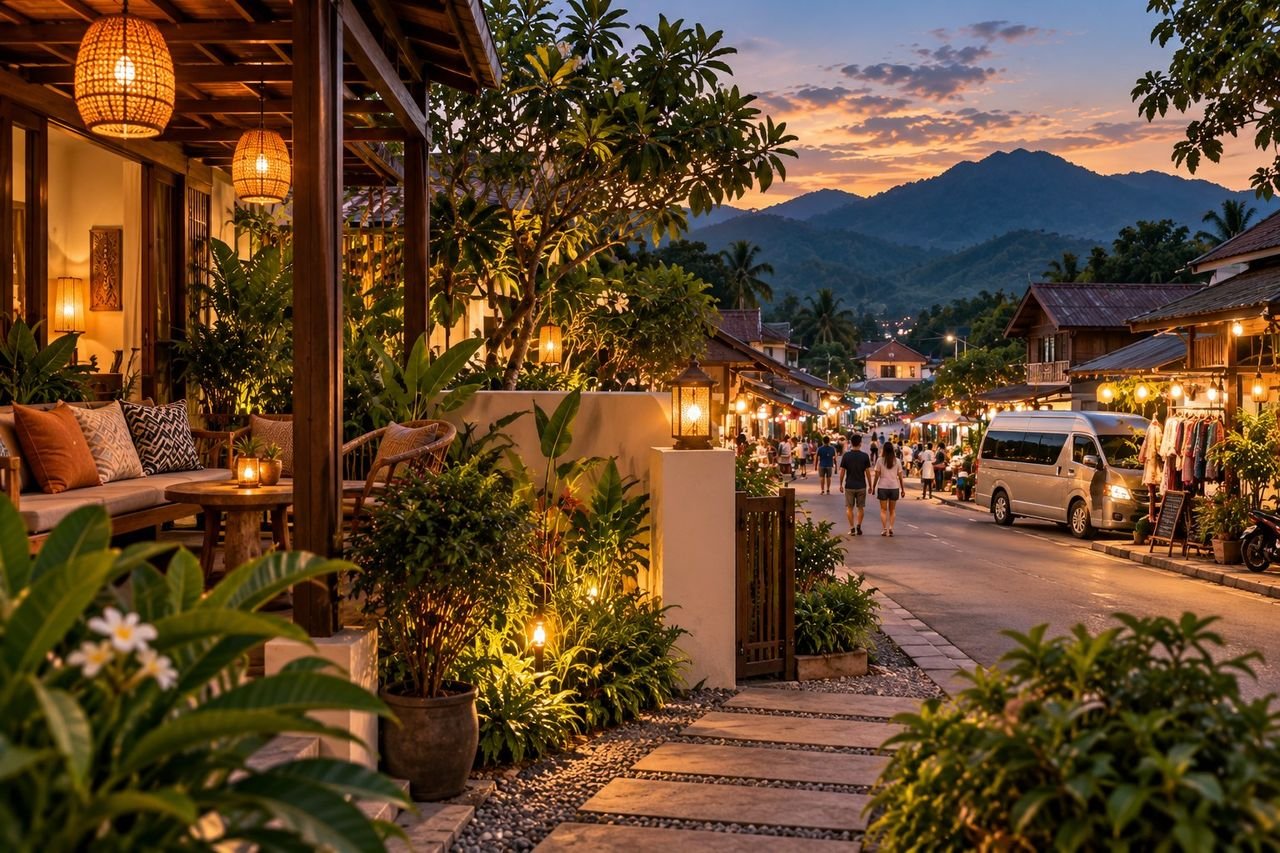
Compare central Pai stays on a map
Use Walking Street or Pai Bus Station as the map anchor, then check the room’s exact lane and newest noise reviews before choosing a rate.
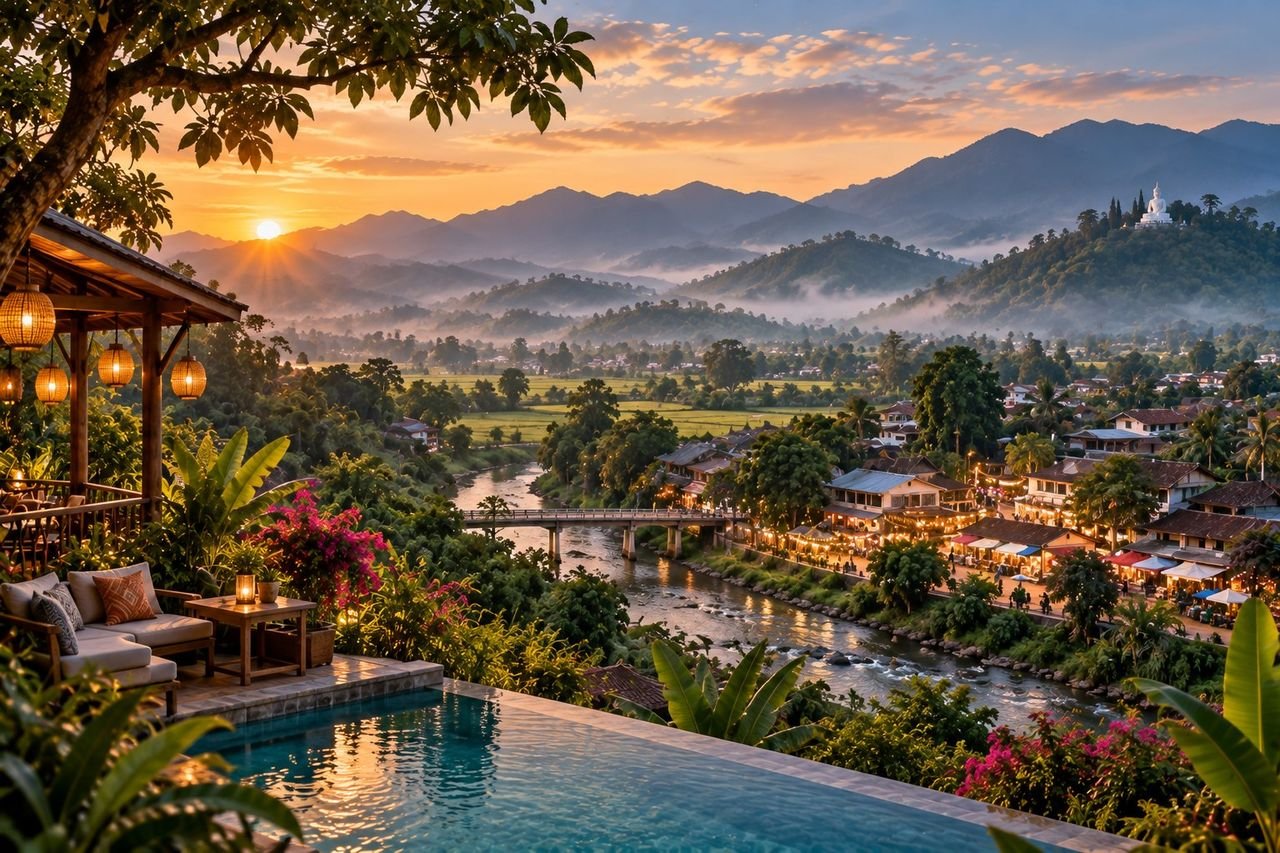
The closest riverbank accommodation can deliver the classic Pai balance: gardens, water and a quieter night, yet still a short walk from the market. However, “riverside” is a view description rather than a guarantee of access.
Check the crossing, not only the distance
Some east-bank properties use pedestrian bridges that make the centre very convenient. Others require a longer road approach, become awkward with wheeled luggage or feel poorly lit after dark. Seasonal river conditions can also affect informal crossings. Ask the property which bridge guests currently use, whether reception collects luggage and whether the route remains practical after heavy rain.
Who should choose the river
This area suits couples, solo travellers who want calm without isolation and anyone happy to trade a conventional hotel corridor for bungalows or gardens. Family House at Pai describes a position beside the river and a short walk from Walking Street; Family House Zen sits on the quieter side while remaining close to the bus station and night market. [16] [17]
Room construction matters
Basic bamboo bungalows can be charming but may also be colder in the cool season, noisier during rain and less soundproof than solid rooms. Confirm air conditioning or fan-only cooling, mosquito protection, bathroom construction, hot water and whether the river-facing category differs from the cheapest room.
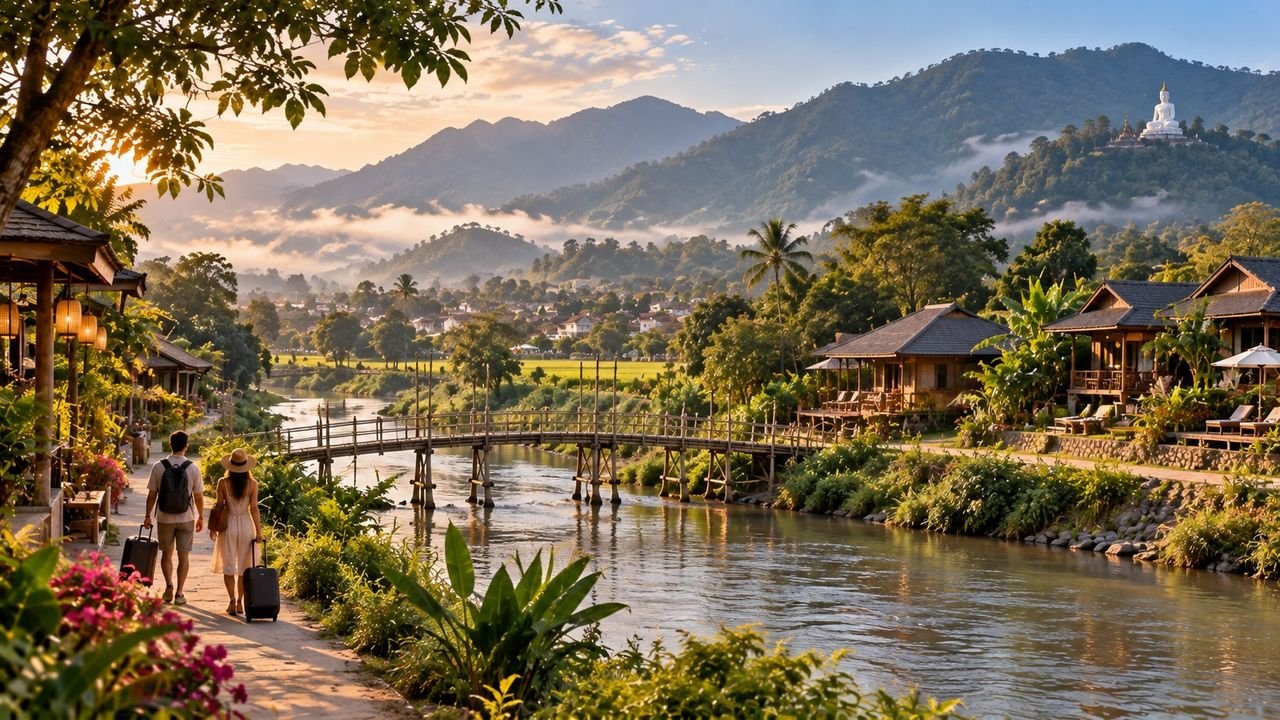
Compare accommodation beside Pai River
Use the map to confirm the exact bridge or road route, then check recent access and noise reviews rather than relying on the word “riverside”.
Mae Yen begins close to town but extends into rice fields and the hillside beneath Wat Phra That Mae Yen. Consequently, it includes genuinely walkable hotels, central-edge retreats and properties that are impractical without a shuttle.
Why Mae Yen is attractive
The area can provide mountain views, greener grounds and less market noise while keeping the centre within reach. It suits travellers who want yoga, a pool, a slower morning or a romantic setting but still expect to visit Walking Street most evenings. The Oia Pai is addressed in Ban Mae Yen, while Pai My Guest and The Countryside show the range from designed resort to rice-field bungalow. [15] [18] [19]
The map test
Measure the route from the reception entrance, not the centre of the hotel pin. Then look for the actual bridge, road shoulder, slope and lighting. A 15-minute daytime walk can feel very different after a storm or when carrying shopping. If the property advertises a shuttle, confirm its hours, reservation process and final return from town.
Best fit
Mae Yen is one of the strongest choices for couples and longer stays when a specific property has good access. It is less suitable for a two-night first visit when the hotel is deep in the countryside and the traveller does not plan to drive.
Compare Mae Yen and White Buddha-side stays
Filter by map, not only by area name. Check Walking Street travel time, shuttle hours and the route after dark.
The northern side of the centre, around Wat Luang, Pai Hospital and the Route 1095 approach, can be quieter and better value while remaining practical. It is not one tightly defined tourist district, so the exact road matters.
Why it can work well
North-town hotels often offer parking, pools or larger plots without being deep in the valley. They can also make departure towards Chiang Mai straightforward and may be an easier choice for travellers arriving with a car. Walking Street is still reachable from the closest properties, although fast roads and uneven pavements can make the map distance look kinder than the walk.
Do not book for the airport alone
Pai has an aerodrome close to town, but travellers should not choose a hotel on the assumption that a routine scheduled flight will exist. The official aerodrome information confirms the location, while actual passenger services must be checked live for the travel date. [27] In most itineraries, road transport remains the relevant arrival plan.
Who should choose it
This area suits longer stays, drivers, families who prefer a conventional hotel and light sleepers who still want central access. It is less atmospheric than the river, but that can be a sensible trade when parking, room size and a reliable road approach matter more than a postcard view.
Mae Na Toeng and the northern valley offer the broad mountain views many travellers imagine when booking Pai. Resorts and villas can have pools, gardens and family space, but the town becomes a planned outing rather than the default evening.
What the extra distance buys
Compared with a central guesthouse, a northern-valley stay can provide larger rooms, private terraces, quieter mornings and enough space for children to move around. Puripai Villa’s address places it in Mae Na Toeng, illustrating the type of property found beyond the town grid. [20] This can be excellent for a couple’s retreat or family break when the hotel itself will be used.
What it costs beyond the room rate
The hidden cost is transport. Confirm whether a shuttle is free, scheduled or request-only; whether the final evening return is early; and what a private transfer costs when the shuttle does not suit. A countryside bargain loses its value when every meal requires a separate car.
Best for a deliberate slower stay
Choose the northern valley for two or more nights of resort time, not simply because a wide-angle photograph makes it look close. Travellers planning daily canyon, hot-spring and western-valley outings may still find the location useful with their own car because it avoids some town traffic.
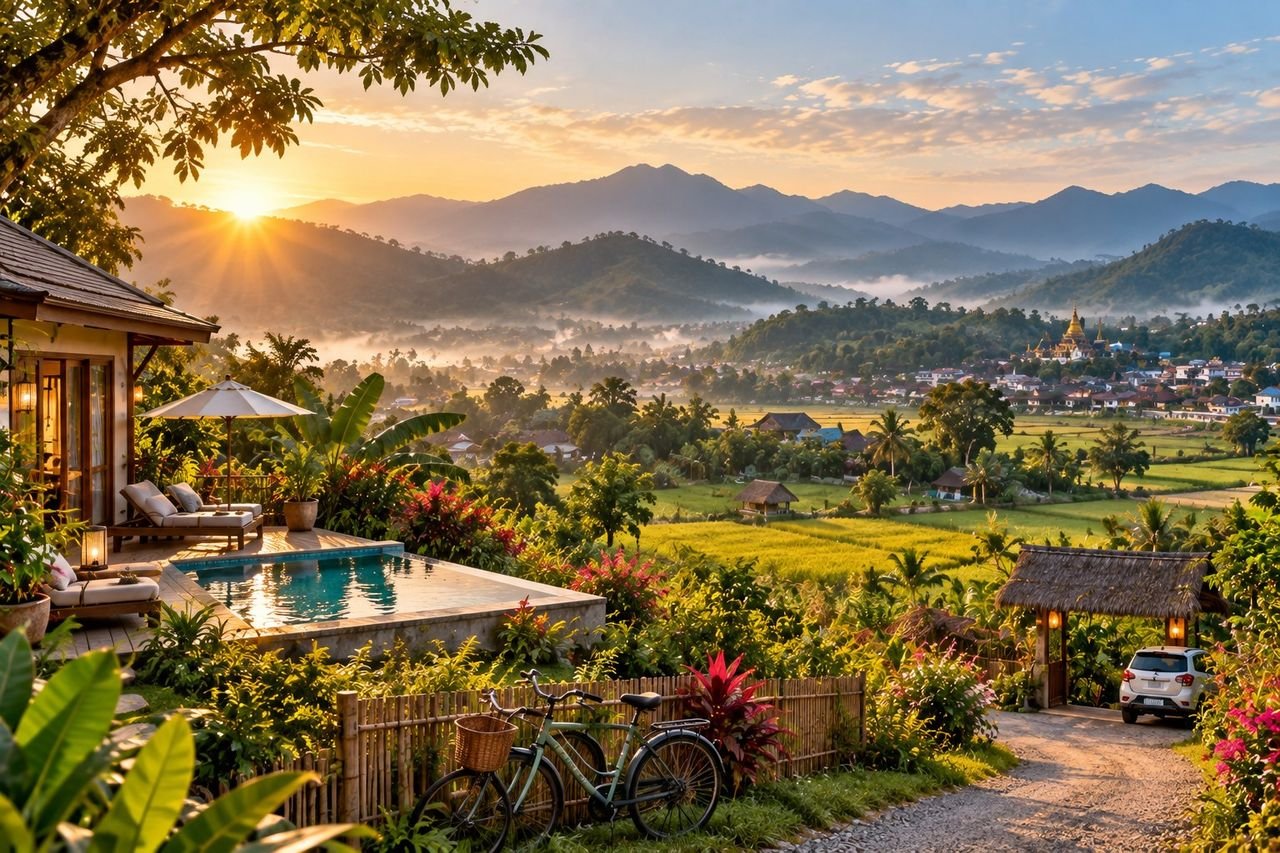
Compare northern Pai valley stays
Confirm the shuttle timetable, parking, breakfast and final approach before choosing a villa or retreat outside the centre.
The western side of Pai leads towards Wat Naam Hu, Santichon Village, Yun Lai viewpoints and rural lanes. TAT identifies Wat Naam Hu as one of Pai’s long-established temples in Wiang Tai, providing a useful official anchor for this side of the valley. [6]
Why stay west of town
Western properties can offer misty mornings, farmland and better access to sunrise viewpoints. The area fits self-drivers, photographers and travellers who want to stay outside the main backpacker circuit. It can also work for a small villa group that intends to cook, use hotel meals or arrange a driver.
Why it is not a default first base
Restaurants and shops are scattered, while a trip to Walking Street can involve a dark rural road. Ride-hailing availability is not guaranteed, and a one-way lift arranged at dinner does not solve the return. Therefore, confirm both directions before relying on a transport app.
Sunrise logistics
A western stay can shorten a very early viewpoint trip, but mist is never guaranteed. Book the area because you will enjoy the landscape and quiet even when the view is cloudy. Also consider cool-season temperatures: open-plan bungalows and unheated common areas can feel surprisingly cold before sunrise.
Compare western Pai countryside stays
Search around Nam Hu and Santichon, then confirm road access, parking and dinner options with the property.
South and south-east of town, Route 1095 passes Pai Canyon and turns towards Tha Pai Hot Spring. TAT places Pai Canyon about seven kilometres from town and describes narrow, steep ridges that require care; Tha Pai Hot Spring sits off the same wider corridor. [3] [4]
When the area makes sense
Stay here for a retreat, hot-spring property or road-trip stage where the accommodation and landscape are part of the holiday. Pai Hotsprings Spa Resort states that it is about ten kilometres from Pai town, which makes the transport difference concrete. [21] A private car, hotel shuttle or pre-arranged driver is normally more useful than hoping to negotiate every journey after dark.
Do not confuse attraction access with town access
Being near the canyon can help with sunset timing, but it does not make Walking Street convenient. Likewise, a hot-spring pool inside a resort is different from the national-park attraction, with separate access, pricing and conditions. Confirm what is included in the room rate rather than assuming all thermal-water facilities are the same.
Road and weather considerations
The route is easier by day. Heavy rain can reduce visibility and make unlit approaches less comfortable, while sunset traffic around the canyon can create a concentrated return period. Choose a property with dinner or a clear evening transport plan.
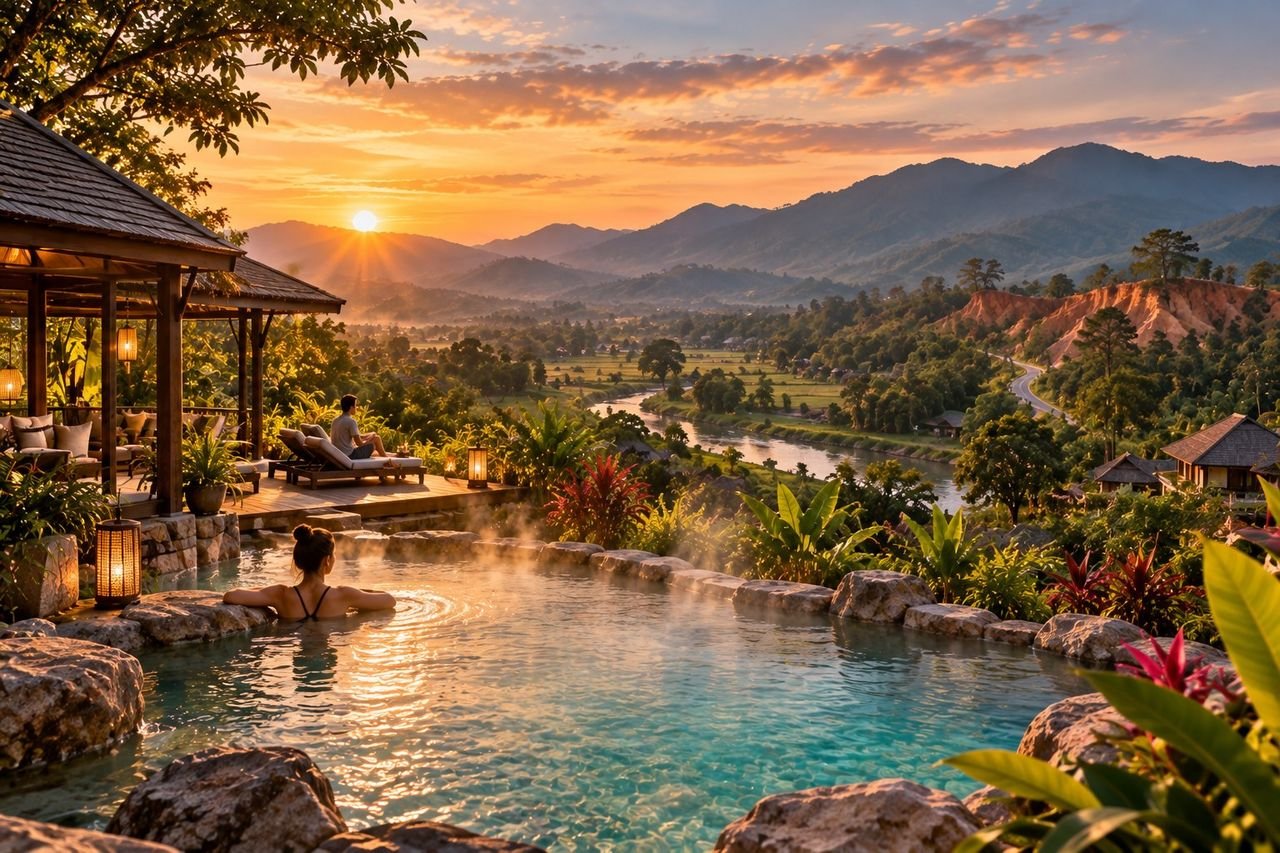
Compare stays near Tha Pai and the canyon corridor
Use the map to distinguish town hotels from true countryside resorts, then confirm meals, shuttles and late arrival.
Pai is a town base, not the whole province
Search results can mix Pai hotels with lodges farther along the Mae Hong Son loop. Those properties may be excellent, but they are not alternative Pai neighbourhoods. TAT describes Mae Hong Son as a mountainous province where winter demand can be strong and motion sickness is a real planning issue. [7]
| Second base | Choose it for | Minimum useful stay | Main caution |
|---|---|---|---|
| Pang Mapha / Soppong | Caves, trekking and a quieter mountain stop | One or two nights | Longer road journey and much smaller evening choice |
| Mae Hong Son town | Shan temples, lake evenings and a wider Mae Hong Son loop | Two nights | Several more hours of winding road from Pai |
| Ban Rak Thai / Pang Ung side | Tea-village atmosphere and misty scenery | One night | Remote roads and limited spontaneous transport |
| Huai Nam Dang area | National-park sunrise and camping | One night or organised excursion | Weather, park rules and basic services |
For four nights, remain in one Pai base unless the second hotel is a resort experience. With six or more nights and a vehicle or driver, a Pai plus Pang Mapha or Mae Hong Son combination can create a more balanced loop.
Use the trip you are taking rather than a generic hotel ranking. A bamboo river bungalow can be romantic for a couple and impractical for a family with a pushchair and four cases.
| Traveller | Best starting area | Why | Check before booking |
|---|---|---|---|
| First visit, 2–3 nights | Walking Street / town centre | Simplest arrival, meals and evenings | Choose a quiet lane and read noise reviews |
| Couple seeking atmosphere | River or Mae Yen | Gardens, views and calmer nights | Check walking route and shuttle hours |
| Solo budget traveller | Town centre / north edge | Hostels, food and transport choice | Locker, soundproofing and late-night route |
| Family with children | Mae Yen or northern valley | Pools, space and family rooms | Beds, stairs, water safety and transfers |
| No-scooter traveller | Centre or closest riverbank | Walkable evenings and simple pickups | Actual bridge or pavement route |
| Experienced self-driver | Western or northern valley | Parking and countryside flexibility | Insurance, road lighting and weather |
| Wellness / slow stay | Mae Yen or hot-springs corridor | Quiet, grounds and retreat facilities | Meals, shuttle and room comfort |
| Remote worker, one week+ | North town or central edge | Services without the busiest nightlife | Desk, Wi-Fi test, laundry and backup data |
When uncertainty favours the centre
If you cannot yet picture the daily routine, stay central. It is easier to take one arranged countryside tour from town than to discover after check-in that every meal, massage and evening requires a separate vehicle. Centrality is useful insurance on a first visit.
Two nights: stay central
Two nights normally give one complete day after accounting for the mountain road. Choose the town centre or the closest riverbank, keep arrival evening simple and book one sensible sightseeing circuit rather than changing hotels.
Three nights: the practical minimum for many first visits
Three nights allow one countryside day, one slower town or river day and two useful evenings. Walking Street remains the safest base, although Mae Yen works when the property is genuinely close and supplies transport.
Four or five nights: choose comfort over constant activity
At this length, a northern valley or riverside resort becomes easier to justify because the traveller can actually use the pool, gardens and slower mornings. A split stay can work, but only when the second property changes the experience.
One week or longer
Long stays benefit from a quieter central edge, north-town room or Mae Yen bungalow with laundry, a desk and reliable internet. Test the Wi-Fi at working hours, keep an eSIM or local data backup and avoid a non-refundable week based solely on an attractive photograph.
Planning ranges, not promises
Current Pai listings checked on 18 September 2026 show an unusually wide market: low-cost rooms, social hostels, bamboo bungalows, central boutiques, pool villas and destination retreats. [11] The same room can move sharply around cool-season weekends, Christmas, New Year and Thai holidays.
| Style | Planning range | What it can buy | Where value is often strongest |
|---|---|---|---|
| Dorm bed / very simple fan room | THB 300–700 | Shared facilities or basic bungalow; verify locker, hot water and temperature comfort | Town centre and central riverbank |
| Simple private room | THB 700–1,600 | Guesthouse or bungalow, sometimes without pool or breakfast | Town lanes, north edge and Mae Yen |
| Comfortable mid-range | THB 1,500–3,500 | Air conditioning, private bathroom, stronger grounds or pool | Centre, river and Mae Yen |
| Boutique resort | THB 3,000–5,500 | Design, shuttle, breakfast and better shared spaces | River, Mae Yen and northern valley |
| Premium villa / retreat | THB 4,500–8,000+ | Large room, view, private facilities or destination-resort setting | Northern valley and countryside |
Ranges are dated planning anchors for a standard occupancy and may exclude breakfast, taxes, an extra bed or flexible cancellation. Check the total in the payment currency.
Calculate the location cost
A remote room 600 baht cheaper per night may stop being cheaper after shuttles, taxis and meals. Conversely, a premium countryside resort can be good value when the pool, breakfast, grounds and transport replace paid activities. Compare the complete stay rather than the room headline.
The examples below were selected to illustrate location types, not to declare the best hotels. Each had a current official or booking-platform page reviewed on 18 September 2026; the shortlist covers central, river, Mae Yen, northern-valley and hot-spring settings.
| Example | Area type | Why it illustrates the area | What to verify |
|---|---|---|---|
| Pai Village Boutique Resort | Town / river edge | Walking Street convenience with resort-style grounds | Exact room wing, parking and late-evening sound |
| The Quarter Pai | North side of centre | Conventional hotel facilities within central reach | Walking route and shuttle details |
| Family House at Pai / Family House Zen | River east bank | Quiet setting with very close town access | Bridge, luggage route and seasonal river conditions |
| The Oia Pai Resort | Ban Mae Yen | Designed resort with shuttle-based access | Shuttle frequency and room category |
| The Countryside Pai / Pai My Guest | Mae Yen rice-field edge | Nature and value close to town | Insects, path lighting and exact walk |
| Reverie Siam | South-west Wiang Tai | Premium riverside resort and slower atmosphere | Town shuttle and whether resort time is planned |
| Puripai Villa | Northern valley | Mountain views, villas and retreat space | Distance, meals and evening transport |
| Pai Hotsprings Spa Resort | Tha Pai corridor | Hot-spring retreat outside town | Ten-kilometre distance, meals and transport |
How to use the examples
Open the map and compare several properties within the same area before looking at review scores. Then filter reviews by traveller type and read the newest comments about noise, shuttle reliability, room condition and access. A highly rated hotel can still be wrong for a traveller who wants to walk home after dinner.
Arrival sets the tone
Prempracha’s official route guidance tells passengers to confirm current times, stops and boarding points, then plan onward transport before arrival. [22] A central hotel simplifies this final stage. For an outlying property, send the arrival details in advance and keep the hotel’s contact method available offline.
| Transport situation | Easiest area | Why | What to confirm |
|---|---|---|---|
| Scheduled van arrival | Town centre | Walk or short pickup for many stays | Ask the hotel to confirm the exact minivan stop and collection method |
| Guided countryside day | Centre / Mae Yen | Most common pickup areas | Confirm whether outer resorts have a surcharge or meeting point |
| Private driver | Any area | Door-to-door flexibility | Agree hours, stops, waiting and final return in writing |
| Hotel shuttle | Mae Yen / countryside | Can remove daily taxi friction | Check last departure, booking notice and luggage capacity |
| Rental car | Outer areas | Best control for a wider loop | Licence, insurance, deposit, parking and mountain-road confidence |
| Scooter / motorcycle | Experienced legal riders only | Flexible on local lanes | Correct motorcycle licence, 1968 IDP where applicable, insurance, helmet and weather |
Local tours and pickup zones
Many Pai tours collect centrally, but a remote resort may require an earlier pickup, extra charge or meeting point. Do not assume “hotel pickup included” means every property in Pai district. Send the map pin and ask for written confirmation before paying.
Compare Chiang Mai to Pai transport
Check the operator, terminal, vehicle, luggage rules and arrival point before matching transport to the hotel area.
Families
Families should prioritise bed layout, pool supervision, enclosed balconies, breakfast timing and a dependable vehicle plan. A remote villa can be excellent when meals and transport are solved; otherwise, repeated rides may outweigh the extra space. Ask whether a family room has real beds or sofa beds and whether a child restraint can be arranged.
Older travellers and limited mobility
Pai’s small-town image hides uneven pavements, steps, bridges, gravel paths and sloping rural grounds. Request the route from the drop-off point to the room, not merely an “accessible room” label. Confirm lift availability, bathroom thresholds, handrails and whether reception is staffed after an evening arrival.
Pushchairs and wheeled luggage
Central paved lanes are easiest, although market crowds can still be awkward. River footbridges and bungalow paths may be attractive but difficult with wheels. Ask the property to describe luggage collection and whether a vehicle can reach the entrance during rain.
Choose services before scenery
A one-week stay needs laundry, food variety, drinking-water access, a usable desk and predictable internet. The north edge of town or Mae Yen can balance quiet with services better than an isolated villa. Meanwhile, the centre is strongest for social life but may require careful room selection to avoid night noise.
Test the connection
“Free Wi-Fi” does not describe speed, stability or power resilience. Ask for a recent speed test from the room category, read remote-work reviews and carry mobile data as backup. Airalo can be useful for immediate connectivity, although the phone must be compatible and local network conditions still vary.
Best all-round long-stay base
Food, laundry and work cafés remain close while the room can sit beyond the busiest market block.
Best slow-living compromise
Greener surroundings with town access when the exact property and walking route are right.
Best for a true retreat
Choose only with meals, transport, desk setup and backup data already solved.
Check Thailand eSIM options before travel
An eSIM can provide maps, hotel contact and backup data on arrival. Verify device compatibility and coverage before purchase.
Pai’s best-looking hotel area changes with the season. A bamboo bungalow beside the river, a misty western viewpoint and a remote hot-spring road each carry different weather exposure.
| Period | Likely pattern | Accommodation strategy | Main risk |
|---|---|---|---|
| November–February | Cooler, drier mornings; busiest period | Book central and scenic resorts earlier; bring a layer | Cold bungalows, peak prices and weekend crowds |
| March–April | Hotter with possible northern haze | Check Air4Thai before committing to view-led stays | Poor visibility and respiratory discomfort |
| May–October | Greener landscapes with rain risk | Choose good road access and flexible cancellation | Muddy paths, bridge access and reduced visibility |
| Thai holidays / New Year | Very high domestic demand | Reserve transport and hotel well ahead | Traffic, sold-out rooms and inflated rates |
Rain and access
TMD publishes Mae Hong Son forecasts and warnings that should be checked close to travel. [8] During wet weather, the safer choice may be a paved central or resort road rather than a beautiful path that becomes slippery. Keep cancellation flexible when the stay depends on viewpoints or outdoor pools.
Haze and view-led hotels
Air quality varies each year, but northern haze can reduce the value of a room booked primarily for mountain views. Use Air4Thai and health guidance rather than a fixed calendar date. [9] Travellers with respiratory conditions should seek medical advice and be ready to change the northern stage.
Road safety
Current FCDO advice emphasises suitable insurance and careful travel planning. [10] A scooter should never be the automatic solution to a remote hotel. Choose it only with the correct motorcycle entitlement, insurance, helmet and experience.
- Open the map pin and trace the real route to Walking Street, the river crossing and the minivan stop.
- Read the newest reviews for noise, room condition, shuttle reliability, insects and access after rain.
- Compare the final price with taxes, breakfast, extra beds and cancellation in the same currency.
- Confirm whether the room is bamboo, timber or solid construction and whether it has air conditioning.
- Ask for shuttle times, reservation notice, last return and any surcharge for an outer property.
- Verify parking, road surface and safe night access when self-driving.
- Check bed configuration, balcony, pool and bathroom safety for children or limited mobility.
- Reconfirm arrival transport and send the property the current ticket details.
- Keep the property phone number, Thai address and map pin offline.
- Recheck weather and air quality before the free-cancellation deadline.
Compare Pai stays after choosing the area
Use map view and exact dates, then read the latest location reviews before selecting a rate.
Central and close-in bases
- Walkable food and evening market.
- Easy minivan arrival and tour pickup.
- Best choice without a vehicle.
- Largest range of budget rooms.
Central trade-offs
- Noise varies by lane and weekend.
- Parking and resort grounds can be limited.
- Less mountain-view atmosphere.
- Some cheapest rooms are basic.
River and countryside bases
- Better scenery, gardens and pools.
- Quieter mornings and retreat atmosphere.
- More space for couples and families.
- Useful for self-drive itineraries.
Outer-area trade-offs
- Transport must be planned both ways.
- Shuttles can end early.
- Rain and darkness affect access.
- Fewer spontaneous dinner choices.
1. Booking “near Pai” without checking kilometres
Pai district is much larger than the walkable town. A countryside pin can sit ten kilometres away while still appearing in a Pai search.
2. Assuming every river property has an easy bridge
The correct crossing, seasonal condition and luggage route matter more than the straight-line distance.
3. Choosing a scooter because the hotel is remote
Transport convenience does not remove licence, insurance, road, weather or skill requirements.
4. Ignoring Walking Street noise
Central location can be ideal, but a room above music is not the same product as a garden room one lane away.
5. Trusting a shuttle without checking the final run
A free shuttle that finishes before dinner is not an evening transport plan.
6. Paying for a view during a poor-air period
Haze can remove the main reason for booking a mountain-facing villa; keep the rate flexible.
7. Underestimating cool-season bungalow comfort
Open timber rooms can feel cold at night and early morning. Check bedding, wall construction and hot water.
8. Moving hotels during a short stay
One base normally beats a split stay when the entire visit is only two or three nights.
What is the best area to stay in Pai for a first visit?
For most first-time visitors, the best area is the town centre around Walking Street, the bus station and Chaisongkram Road. It keeps dinners, cafés and the evening market walkable and avoids relying on a scooter. Choose a quieter side lane rather than a room directly above nightlife.
Where should I stay in Pai without a scooter?
Stay in the town centre or on the closest riverbank linked by a dependable pedestrian bridge. Check the actual walking route after dark and whether the bridge is suitable with luggage. Mae Yen can also work when the property is close enough and offers a shuttle.
Is Pai Walking Street noisy at night?
Some rooms near bars, live music and the market can be noisy, especially at weekends and in the cool season. Noise varies by lane and room orientation, so recent reviews matter more than the neighbourhood name alone.
Is it better to stay by Pai River or in town?
Choose the river for a quieter setting and resort atmosphere, provided the crossing and walking route remain convenient. Choose town for the simplest evening access, bus arrival and tour meeting points. A close east-bank property can provide a useful compromise.
Is Mae Yen a good area to stay?
Mae Yen is a strong choice for couples, wellness stays and travellers who want rice-field or hill views while remaining fairly close to town. However, the area spreads out quickly, so confirm the exact walk, gradient, lighting and shuttle schedule.
How far are countryside resorts from Walking Street?
Depending on the area, a countryside resort may be five minutes or more than twenty minutes away by road. Do not rely on the phrase “near Pai”; check the map pin, route, shuttle timetable and late-evening return arrangements.
Where is best for families in Pai?
Families usually do well in a central-edge hotel with a pool, a quiet Mae Yen resort with shuttle service, or a northern valley property with family rooms and controlled transport. Check bed configuration, balcony and water safety, stairs, meal options and car-seat arrangements.
Where is best for couples?
A riverside stay, Mae Yen boutique resort or a northern valley villa usually offers the strongest atmosphere. The town centre is better when the couple values food, nightlife and walking more than private grounds.
Where should budget travellers stay?
The town centre and its northern edge have the widest concentration of hostels, simple rooms and inexpensive food. Riverside bamboo bungalows can also be cheap, but check whether the room has air conditioning, hot water, sound insulation and a safe night route.
How much do hotels in Pai cost?
Planning ranges checked on 18 September 2026 run from roughly THB 300–700 for a dorm bed or very simple room, THB 700–1,600 for many private guesthouse rooms, THB 1,500–3,500 for comfortable boutique stays and THB 3,500–8,000 or more for premium resorts and villas. Exact dates can be much higher.
How many nights should I stay in Pai?
Three nights is a practical minimum for many first visits because the road journey uses a meaningful part of arrival and departure days. Four nights gives more room for a countryside day, a slow café morning and weather changes.
Should I split my stay between town and countryside?
A split stay makes sense from four or five nights when the second property is an experience in itself. For two or three nights, moving hotels normally creates more work than value.
Can I walk from Mae Yen to Walking Street?
Some Mae Yen properties are within a manageable walk, while others are not. Check the exact route, bridge, gradient, lighting and weather. A distance that looks short on a map may feel different with luggage or after rain.
Is the hot-springs area a good base?
It is a good retreat for travellers with arranged transport who want nature, mineral pools and quiet. It is a poor base for spontaneous Walking Street evenings unless the property provides a dependable shuttle or you have your own suitable vehicle.
Should I stay near Pai Canyon?
Only when sunset scenery, a countryside retreat or a road-trip itinerary matters more than town access. Pai Canyon is roughly seven kilometres from town, so staying nearby does not make central restaurants or evening markets walkable.
What should I check before booking a Pai hotel?
Verify the map pin, final price, room construction, air conditioning or heating comfort, noise, bridge or road access, shuttle hours, parking, bed layout, breakfast, cancellation and recent reviews for the exact feature that matters to you.
For a first visit of two or three nights, I would choose the town centre around Walking Street or a very close river property with a confirmed bridge and easy luggage access. That recommendation is not based on the centre being the prettiest part of Pai. It is based on protecting the limited time after a winding road journey and making evenings effortless.
For a couple who wants atmosphere, I would compare the east bank and Mae Yen, then choose the specific property whose access remains genuinely simple. Families should look at Mae Yen or the northern valley when a pool, larger room and shuttle are more valuable than walking. A self-driver can widen the search to Nam Hu, Santichon or the hot-springs corridor, provided the road and evening plan are clear.
I would not book a remote resort merely because it appears cheaper or more scenic. The right outer hotel is a destination in itself; the wrong one is a central-room budget plus repeated transfers. With four or five nights, a short central stay followed by one countryside retreat can show both sides of Pai without turning the visit into constant packing.
Compare Pai hotels after choosing the base
Switch to map view, enter the exact dates and occupancy, then verify the walking route or shuttle before paying.
Research was checked on 18 September 2026. Official tourism, weather, environmental and travel-advice sources were used for destination and seasonal context. Hotel websites were used for their own addresses and facilities. Booking platforms were used only as dated evidence of current inventory, location and planning ranges; a displayed rate is not a promise for another date.
- Tourism Authority of Thailand: Pai — Official overview of Pai as a small mountain district and visitor base.
- Tourism Authority of Thailand: Pai Walking Street — Official location and seasonal operating pattern for the pedestrian market on Chaisongkram Road.
- Tourism Authority of Thailand: Pai Canyon — Official location and safety context for Pai Canyon, about seven kilometres from town.
- Tourism Authority of Thailand: Tha Pai Hot Spring — Official location, opening information and forest hot-spring context.
- Tourism Authority of Thailand: Wat Klang — Official description placing Wat Klang by Pai town and the bus arrival area.
- Tourism Authority of Thailand: Wat Naam Hu — Official western Pai landmark and location context near Nam Hu.
- Tourism Authority of Thailand: Mae Hong Son province — Official provincial context, cool-season demand and mountain-road advice.
- Thai Meteorological Department: Mae Hong Son weather — Official weather forecasts and warnings for seasonal planning.
- Pollution Control Department: Air4Thai — Official air-quality information for northern Thailand.
- FCDO: Thailand travel advice — Current British government travel, insurance and road-safety guidance.
- Booking.com: Pai accommodation listings — Dated cross-check of active properties, reviews and current price examples.
- Pai Village Boutique Resort: location — Property-supplied distance and location information beside Walking Street and the river.
- The Quarter Pai: official website — Property-supplied central Pai address and facilities.
- Reverie Siam: contact and location — Property-supplied address in Wiang Tai and shuttle information.
- The Oia Pai Resort: Ban Mae Yen location — Address and setting in Ban Mae Yen, Mae Hi.
- Booking.com: Family House at Pai — Current location beside Pai River and very close to Walking Street.
- Booking.com: Family House Zen Boutique Resort — Current east-bank location, walkability and property details.
- Booking.com: The Countryside Pai — Current rice-field location about one kilometre from town.
- Booking.com: Pai My Guest Resort — Current Ban Mae Yen location and distance context.
- Puripai Villa: contact — Property address and northern valley setting.
- Pai Hotsprings Spa Resort: location — Property-supplied location about ten kilometres from Pai town.
- Prempracha Transport: Chiang Mai–Pai route — Official route preparation and reminder to confirm live times and boarding points.
- Taylor’s Trailblazing Travels: Chiang Mai to Pai transport — Detailed current transport comparison for reaching Pai.
- Taylor’s Trailblazing Travels: Northern Thailand guides — Live regional planning hub for Pai, Chiang Mai and wider northern routes.
- Booking.com: Ai Pai Hotel — Current town-centre location beside Walking Street.
- Booking.com: The Sylvana Pai — Current central location close to Walking Street and Pai River.
- Civil Aviation Authority of Thailand: Pai aerodrome information — Official aerodrome location information; flight availability still requires a live schedule check.
Illustrations in this article were created for Taylor’s Trailblazing Travels. Third-party photographs, where used, are credited beside the image or in the source list.