A practical neighbourhood guide for choosing where to stay in Chiang Mai, with honest trade-offs, planning prices, airport options and hotel-search links for every type of trip.
Disclosure: This article contains carefully selected affiliate links. Taylor’s Trailblazing Travels may earn a commission if you book or buy through them, at no extra cost to you. Recommendations are included only where they help with a genuine travel decision.
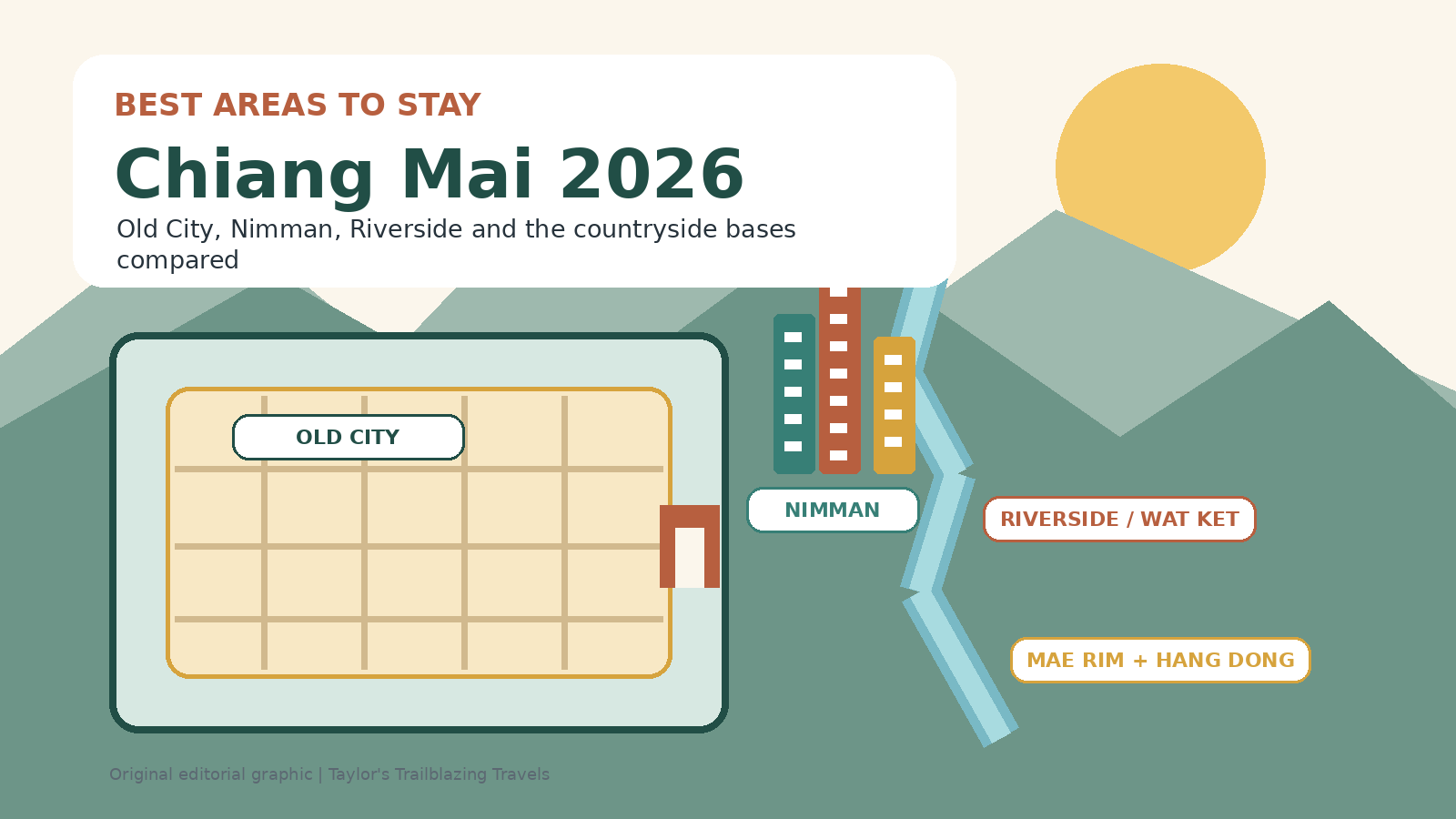
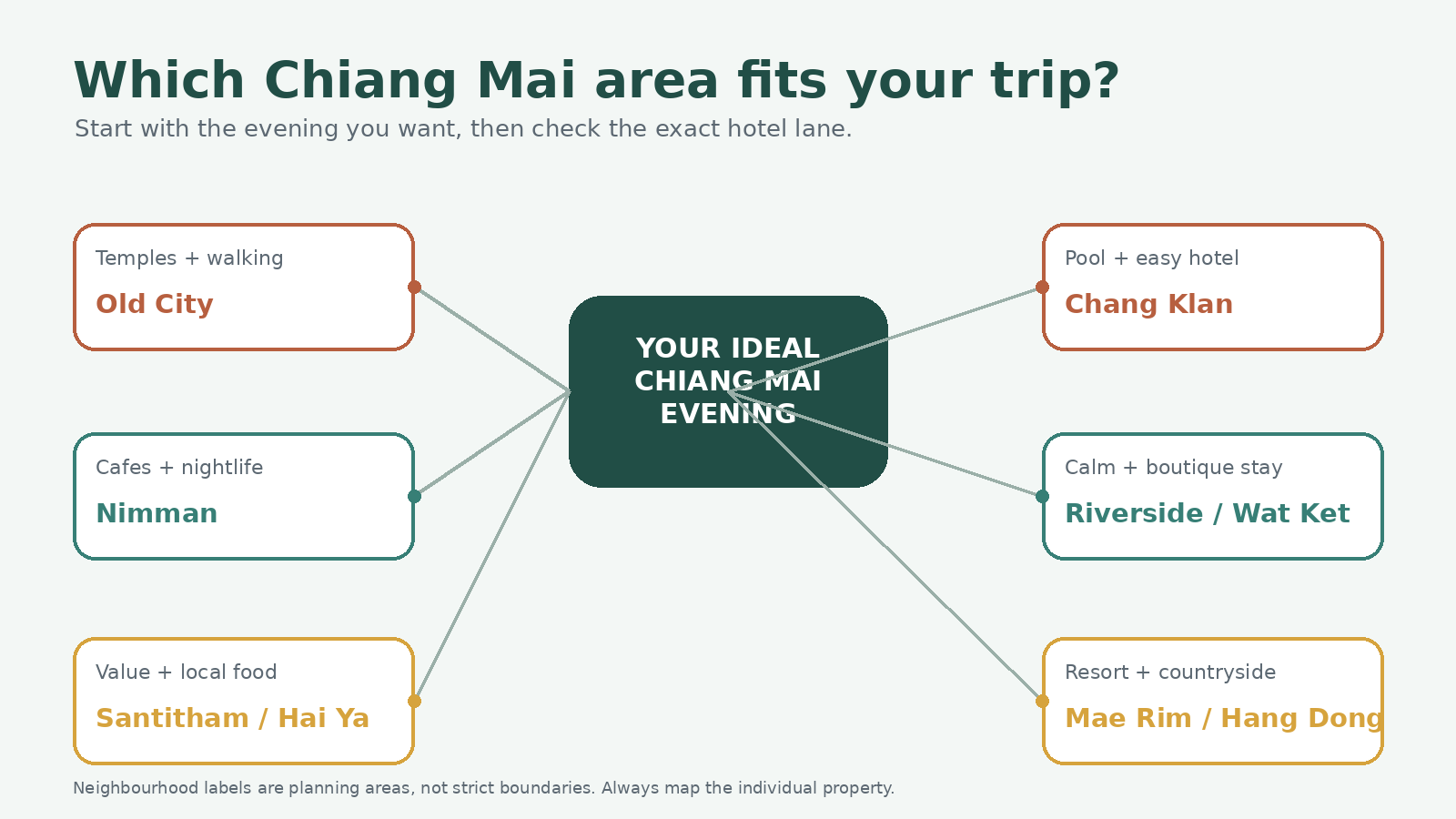
The best area to stay in Chiang Mai for a first visit is the Old City, especially for three or four nights centred on temples, markets and walking. Nimman suits cafes, nightlife and longer stays; Riverside and Wat Ket suit couples; Chang Klan works well for families; Santitham offers value; and Mae Rim is best for a dedicated countryside retreat.
Quick answer: where should you stay?
First visit
Choose the Old City, ideally near the eastern or central streets if you want temples, food and easy access to Tha Phae Gate.
Cafes and longer stays
Choose Nimman for restaurants, gyms, laundry, shopping and a repeatable day-to-day routine.
Couples and relaxed hotels
Choose Riverside or Wat Ket when the property atmosphere, pool and evening setting matter as much as sightseeing.
Families and simple evenings
Choose Chang Klan or Night Bazaar for large hotels, pools, familiar meal choices and straightforward transport.
Best value close to the centre
Compare Santitham, Chang Phueak and Hai Ya, but check the exact lane, pavement and late-evening walk.
Resort or countryside break
Choose Mae Rim or Hang Dong only when the resort is part of the holiday and daily city sightseeing is not the main goal.
In this guide
How to choose the best area in Chiang Mai
At first glance, Chiang Mai looks compact on a phone screen, which can make every central hotel seem interchangeable. In practice, the Old City, Nimman, Chang Klan and Riverside produce noticeably different trips. Your hotel area decides whether you walk to temples before breakfast, cross town for dinner, hear aircraft during the evening, or spend more time arranging cars than enjoying the property.
At the same time, the Tourism Authority of Thailand highlights both the Old City and Nimmanhaemin Road among Chiang Mai’s principal visitor areas, alongside Doi Suthep and the province’s mountain attractions.[1] That does not make either neighbourhood universally better. Instead, it shows why the most useful comparison is between different styles of stay.
Start with your evenings, not your sightseeing list
In practice, most visitors will travel to Doi Suthep, an elephant sanctuary, Doi Inthanon or a cooking class by vehicle regardless of where they sleep. The area matters more after the organised activity ends. Picture 8:30 p.m.: do you want a quiet river terrace, a lane of cafes, a market outside the hotel, or a short walk back from a temple-area restaurant?
As a result, that single question usually separates the choices. Old City and Nimman reward travellers who like to step outside and improvise. Riverside properties suit people who are happy to spend an evening at the hotel. Mae Rim and Hang Dong work when the resort itself is a destination rather than merely a base.
Count the real walk, not the straight-line distance
Even so, a kilometre in Chiang Mai can involve heat, uneven pavements, fast junctions, a moat crossing or a poorly lit lane. Therefore, open the walking route rather than relying on the distance shown beside a hotel listing. A room 350 metres from a useful street may be more convenient than a supposedly central hotel hidden behind a long access road.
For a first trip, check the route to one breakfast option, one evening restaurant, a convenience shop and the main road used by taxis or red songthaews. When those four journeys are easy, the hotel usually works better than a property chosen for a broad neighbourhood label alone.
Use the hotel facilities to break a tie
Likewise, two hotels in the same area can create very different experiences. Older guesthouses may have character but no lift, while a larger Chang Klan property may offer a pool, breakfast and luggage storage. Serviced apartments around Nimman and Santitham can be excellent for a longer stay, although daily housekeeping and breakfast may be limited.
Therefore, before paying, compare the exact room category, cancellation terms, breakfast hours, lift access, pool shade, laundry arrangements and recent noise comments. Those details matter more than a small difference in review score.
Chiang Mai areas at a glance
| Area | Best for | Planning range per night | Main advantage | Main compromise |
|---|---|---|---|---|
| Old City | First visits, temples, solo travel | 1,000-4,800 THB | Walkable heritage core | Street-by-street noise and older buildings |
| Nimman and Huay Kaew | Cafes, dining, nightlife, longer stays | 1,400-5,800 THB | Easy modern neighbourhood life | Aircraft and traffic noise in some locations |
| Night Bazaar and Chang Klan | Families, short stays, full-service hotels | 1,300-5,500 THB | Large hotel choice and simple evenings | Some blocks feel commercial |
| Riverside and Wat Ket | Couples, boutique stays, hotel atmosphere | 2,000-9,000+ THB | Calmer properties and river setting | More rides for temples and Nimman |
| Santitham and Chang Phueak | Value, local food, longer stays | 850-3,200 THB | Good value close to the centre | Less polished as a first-arrival base |
| Hai Ya and Wua Lai | Saturday market, airport access, quiet value | 950-3,600 THB | Useful south-side location | Fewer late-night options away from the market |
| Suthep and Wat Umong | University life, greenery, longer stays | 1,000-4,200 THB | Local feel near the mountain side | Not ideal for walking to Old City sights |
| Mae Rim | Resorts, gardens, countryside | 2,500-13,000+ THB | Space and mountain atmosphere | Not a practical city sightseeing base |
| Hang Dong and Mae Hia | Resorts, families, airport convenience | 1,500-8,500+ THB | Space, villas and south-side access | Car dependence for central evenings |
For context, these are editorial planning bands for a standard private room rather than live quotes. Festival dates, school holidays, room size, breakfast, cancellation terms and weekday demand can move the total sharply. Premium villas and named luxury resorts can cost far more, while long-stay agreements may reduce the nightly equivalent.
Old City: best for a first visit, temples and walking
The square inside Chiang Mai’s moat is the clearest starting point for a first trip. Temples, cafes, massage shops, guesthouses and small restaurants sit inside a compact street grid. Tourism Authority of Thailand material places Tha Phae Gate, the moat and the Sunday Walking Street at the heart of the historic visitor area.[2]
Yet the Old City is not one uniform neighbourhood. A hotel near Tha Phae Gate feels livelier and gives easy Sunday-market access. The western side around Suan Dok Gate and Wat Phra Singh is calmer in places and closer to Nimman. Northern lanes connect well with Chang Phueak and Santitham, while the southern edge works neatly with Chiang Mai Gate Market and Wua Lai.
Which part of the Old City should you choose?
| Old City section | Best for | What to check |
|---|---|---|
| Tha Phae and eastern side | Short visits, Sunday market, lively evenings | Weekend access, bars and road noise |
| Central lanes | Temple walks and balanced access | Exact lane lighting and vehicle pickup |
| Wat Phra Singh and western side | Quieter atmosphere and Nimman access | Distance from evening food choices |
| Northern side | Food, Chang Phueak and Santitham | Traffic near moat roads |
| Southern side | Chiang Mai Gate Market and Wua Lai | Saturday market closures and noise |
Old City pros and cons
Overall, choose the Old City when the trip is built around temples, food and independent exploring. It is also a comfortable choice for solo travellers because there is activity outside the hotel. However, do not assume a courtyard photo guarantees silence. Read recent reviews for temple bells, schools, music, road traffic and building work.
Nimman and Huay Kaew: best for cafes, dining and longer stays
By contrast, Nimmanhaemin Road and its surrounding lanes form Chiang Mai’s modern lifestyle district. Tourism Authority of Thailand includes Nimman among the city’s visitor highlights, specifically noting art products, local cuisine and contemporary culture.[1] Cafes, restaurants, bars, shopping centres, pharmacies, gyms and laundry services make everyday life easy.
Nimman works particularly well when the trip lasts a week or more. A traveller can settle into a useful routine without arranging transport for every meal. The Old City remains a short ride away, while the airport is geographically close. Nevertheless, the neighbourhood feels contemporary rather than historic, and some properties experience aircraft or junction noise.
Choose the right lane, not just the word Nimman
For example, staying directly on Nimmanhaemin Road gives immediate access to restaurants but can increase traffic noise. The sois on either side may be calmer, although bars and construction vary. Huay Kaew Road is useful for transport and shopping, yet large junctions can be inconvenient on foot. Around MAYA and One Nimman, the area feels busiest and most polished; farther north or west, the atmosphere becomes more residential.
However, aircraft noise is the neighbourhood’s most discussed drawback. It does not affect every building equally, and flight patterns change. Therefore, search recent reviews for the exact hotel, wing and room orientation. A high floor is not automatically quieter when the noise source is overhead.
Nimman pros and cons
In addition, remote workers should verify the desk depth, chair, Wi-Fi comments, electrical sockets and housekeeping schedule. A stylish lobby is not proof that the room works for a laptop. Similarly, long-stay travellers should compare laundry prices and storage rather than focusing only on the pool.
Night Bazaar and Chang Klan: best for families and easy evenings
Meanwhile, Chang Klan Road sits between the Old City and Ping River, with the Night Bazaar as its best-known evening attraction. The area has a large supply of full-service hotels, pools, restaurants, convenience shops and tour pickup points. It is an uncomplicated choice for a short stay, particularly when different family members want predictable facilities.
Airports of Thailand lists its A2 airport shuttle route through Mahidol Road, the Night Bazaar and hotels along Chang Klan Road, with a published route fare of 40 THB at the time of checking.[5] The airport advises travellers to verify routes and fares again before travelling, so treat the figure as a planning reference rather than a permanent promise.
Why Chang Klan is easier than it looks
Consequently, the district’s practical strength is its middle position. The Old City, river, railway station and airport are all reachable without committing to an outlying resort. Families may also prefer a larger hotel with adjoining rooms, breakfast, a pool and a staffed reception rather than a small guesthouse inside the moat.
However, the compromise is atmosphere. Some blocks around the central market strip feel designed for visitors, and the busiest roads are not especially relaxing to walk. A hotel marketed as “Night Bazaar” may also sit farther south than expected, so check the route to the section you plan to use.
Night Bazaar and Chang Klan pros and cons
Riverside and Wat Ket: best for couples and hotel atmosphere
By comparison, the Ping River gives Chiang Mai a softer, slower edge. Riverside and Wat Ket properties range from intimate boutique hotels to destination resorts with gardens, pools and restaurants. This area works best when the hotel is expected to contribute to the holiday rather than simply provide a bed.
Meanwhile, Wat Ket, on the east bank, can feel more residential and characterful than the busier Chang Klan side. Some properties are close to restaurants and galleries; others are set behind walls or along quieter stretches where every outing needs a vehicle. Consequently, the exact address matters more here than the broad word “Riverside”.
Who gains most from a river stay?
For example, couples often appreciate a calmer breakfast, a garden and an evening restaurant on site. Families may value larger grounds and pools. Travellers returning to Chiang Mai can also use the river as a deliberate contrast to a previous Old City or Nimman stay. By comparison, a first-time visitor with only two nights may feel isolated if the property is far from restaurants and temple routes.
However, during the wetter months, ask how the hotel manages heavy rain, access and river conditions. The UK government’s Thailand travel advice notes that heavy storms can cause flooding and recommends following Thai Meteorological Department warnings.[12] This does not make the whole Riverside unsuitable; it simply adds one sensible question before a wet-season booking.
Riverside and Wat Ket pros and cons
Santitham and Chang Phueak: best for value and a local routine
Meanwhile, Santitham sits north of the Old City and east of Nimman. It is close enough to both areas for short rides, yet room rates and food can be more local. Chang Phueak extends the choice northwards, with markets, residential streets and practical longer-stay accommodation.
This is not the polished answer for every first-time visitor. Street lighting, pavements and building quality vary, while some lanes feel quiet after local businesses close. However, travellers who want value, neighbourhood food and a less visitor-centred atmosphere can find an excellent base.
Why Santitham works for a week or more
In practice, daily life is the main attraction: inexpensive restaurants, laundry shops, local markets, pharmacies and quick rides to Nimman or the Old City. Serviced apartments can provide more storage and workspace than a boutique room. Nevertheless, confirm whether electricity, weekly cleaning, deposits and linen changes are included when a property advertises a monthly rate.
Santitham and Chang Phueak pros and cons
Hai Ya and Wua Lai: best for Saturday market, value and airport access
Farther south, Hai Ya lies south of the Old City, with Wua Lai Road and the Saturday Walking Street as the best-known visitor focus. The area can offer a quieter base than Tha Phae while keeping Chiang Mai Gate, local food and the moat within reach. It is also conveniently placed for the airport.
In addition, Tourism Authority of Thailand’s food material identifies Chiang Mai Gate Market as part of the city’s culinary heritage, reinforcing the south side’s practical appeal for travellers who care about local food.[3] The main caution is that a property described as Wua Lai may sit well beyond the lively market section.
Choose Hai Ya when you want central without constant bustle
A hotel near Chiang Mai Gate gives easy Old City access, while properties farther south may feel more residential. Saturday evening road closures can be a benefit for market visitors but a nuisance for vehicle pickup. Ask the hotel about arrival access when your stay begins or ends on a Saturday.
Hai Ya and Wua Lai pros and cons
Suthep, Wat Umong and the university side: best for greenery and longer stays
Meanwhile, west of Nimman, the Suthep and Chiang Mai University side of the city feels more residential and closer to the mountain. Cafes, student restaurants, apartments and quieter lanes make it attractive for repeat visitors. Wat Umong and the forested foothills add a different atmosphere from the moat or Night Bazaar.
The area is broad, so location needs careful checking. A property near the university’s eastern side may still have easy access to Nimman. Farther west or south, a scooter, taxi or app ride becomes more important. This is also not the best base for someone who wants to walk to central temples every morning.
Who should consider the university side?
As a result, longer-stay travellers, repeat visitors and people who prefer local restaurants to tourist infrastructure often enjoy it. The area can also suit hikers or cyclists who want quicker access towards Doi Suthep, although road safety and steep gradients require realistic planning. Families should check pavements and transport rather than assuming a greener district is automatically easier with children.
Suthep and Wat Umong pros and cons
Mae Rim: best for resorts, gardens and countryside
Farther north, Mae Rim is north of Chiang Mai city and should be treated as a separate countryside stay rather than a central neighbourhood. Resorts can offer mountain views, gardens, villas, spas and on-site dining. Nearby attractions and rural scenery make the area appealing when slowing down is the priority.
The mistake is booking Mae Rim because the resort looks good, then attempting a full city programme every day. Traffic and distance turn spontaneous dinners into planned journeys. A three-night Mae Rim stay can be wonderful when the hotel and nearby activities are the purpose; it can feel inconvenient when the Old City is the real goal.
Make the resort earn the location
Therefore, before booking, compare the pool, breakfast, restaurants, shuttle, spa, children’s facilities and nearby activities. If the property has one restaurant with limited hours, a car may be essential. Similarly, check whether the advertised mountain view is available from the booked room category rather than only from the highest-priced villa.
Moreover, responsible wildlife choices matter in the wider Chiang Mai countryside. Avoid selecting an animal activity solely because it is close to a resort. Research welfare practices, group sizes and visitor interaction before booking.
Mae Rim pros and cons
Hang Dong and Mae Hia: best for villas, families and south-side resorts
Meanwhile, south-west of the centre, Hang Dong and Mae Hia offer a mix of residential areas, villas, resorts, golf, gardens and airport convenience. The district suits travellers who want space, parking or a property designed for days beside the pool. It can also work for families meeting relatives or groups sharing a villa.
However, the area is too broad for a simple recommendation. Some Mae Hia properties are reasonably close to the airport and city edge, whereas hill-side Hang Dong resorts feel distinctly rural. The hotel map, access road and meal options need more attention than the district name.
When the south side makes sense
Accordingly, choose it for a retreat, a driving itinerary, a family villa or easy access to attractions south of the city. Avoid it when the plan depends on walking to restaurants, temples and markets every evening. A lower nightly rate can become poor value once every meal requires a car.
Hang Dong and Mae Hia pros and cons
Best Chiang Mai area by traveller type
| Traveller | Best starting area | Second choice | Reason |
|---|---|---|---|
| First-time visitor | Old City | Chang Klan | Simple sightseeing and an easy first morning |
| Couple | Riverside or Wat Ket | Western Old City | Hotel atmosphere with good access to the centre |
| Family | Chang Klan | Riverside or Nimman | Large hotels, pools and practical meals |
| Solo traveller | Old City | Nimman | Activity outside the hotel and easy independent days |
| Remote worker | Nimman | Santitham | Cafes, gyms, laundry and longer-stay services |
| Food-focused traveller | Old City south side | Santitham or Nimman | Markets, local meals and variety |
| Nightlife visitor | Nimman | Chang Klan | Bars and late dining without long returns |
| Budget traveller | Santitham | Hai Ya | Lower room costs without moving far outside the centre |
| Luxury resort traveller | Mae Rim | Riverside or Hang Dong | Space, spa facilities and destination properties |
| Repeat visitor | Suthep or Wat Ket | Santitham | A different local rhythm after the headline sights |
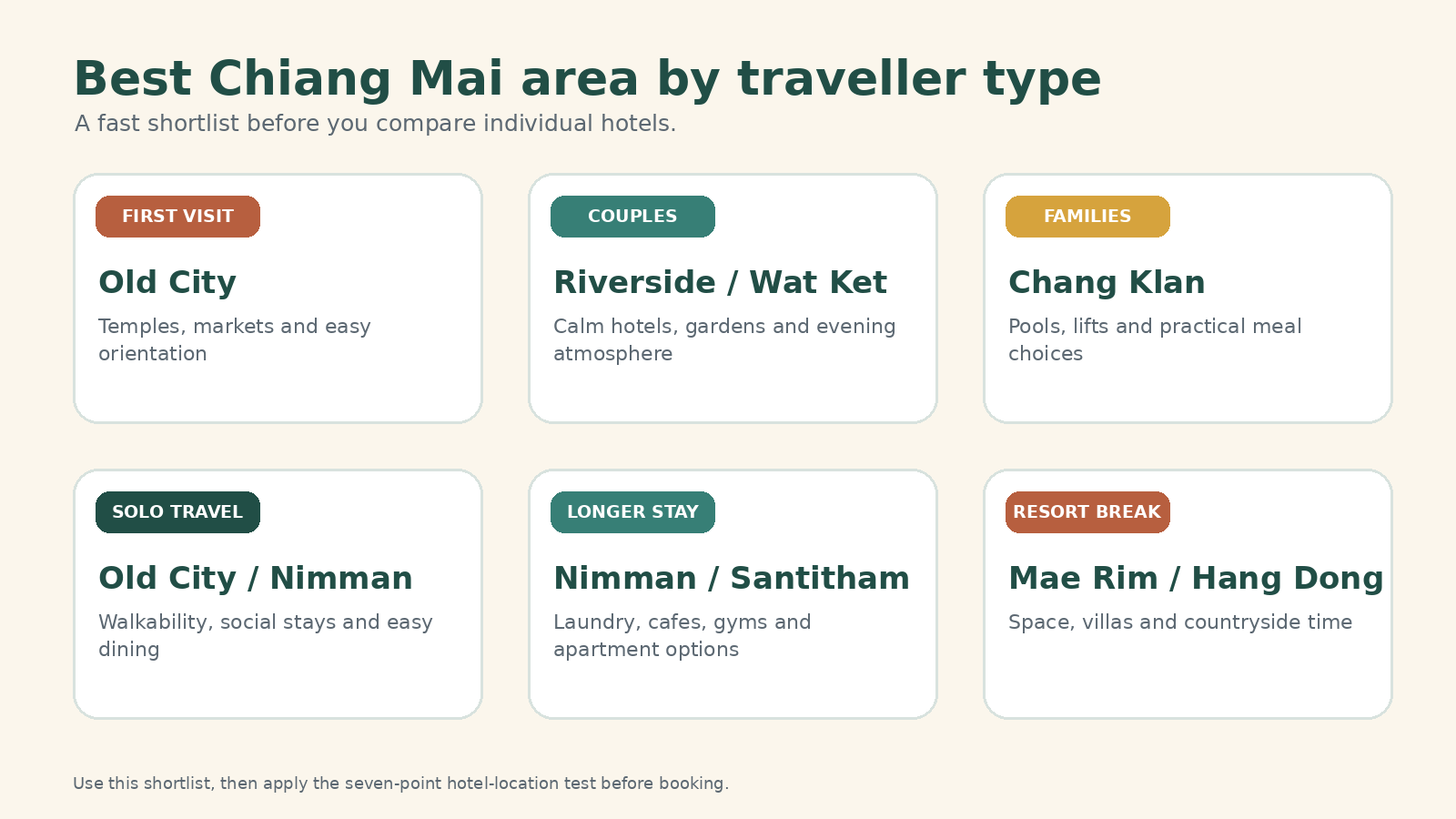
Best area for families
Chang Klan is the safest default because full-service hotels, pools, lifts and evening choices are easy to compare. Riverside works when the family will use the hotel grounds, while Nimman suits older children who enjoy cafes and shopping. Inside the Old City, verify lift access, room size and pool depth because smaller properties may be less practical than their photographs suggest.
Best area for digital nomads and remote workers
Overall, Nimman remains the simplest choice for work-friendly cafes, gyms, food and services. Santitham can offer better value a short ride away. Instead of trusting a “work desk” filter, inspect room photographs and reviews for chair comfort, natural light, electrical sockets and video-call noise.
Best area for nightlife without a party hostel
Likewise, Nimman provides the broadest choice of bars and late dining. Chang Klan offers hotel bars and tourist-oriented evening activity. The eastern Old City can also work, but noise varies dramatically by lane. In all three, ask for a quiet-side room rather than assuming a luxury category is soundproof.
Best area for food
Similarly, the Old City, Chiang Mai Gate, Santitham and Nimman all have strong arguments. Choose the Old City for a mixture of markets and visitor-friendly northern food, Santitham for local everyday eating, and Nimman for modern cafes and restaurants. A food tour can also reduce the importance of the hotel area by introducing places you would not find on the first evening.
Old City versus Nimman: the decision most visitors face
In reality, Old City versus Nimman is not a contest between authentic and modern Chiang Mai. Both are established parts of the city, and both can produce an excellent trip. The useful distinction is how you want the day to begin and end.
| Question | Old City | Nimman |
|---|---|---|
| Best morning | Walk to temples, markets and quiet lanes | Breakfast cafe, gym or work session |
| Best evening | Small restaurants and heritage atmosphere | Dining, bars and modern neighbourhood life |
| First-trip simplicity | Excellent | Good, but temple days need rides |
| Long-stay routine | Good | Excellent |
| Hotel style | Guesthouses and boutique hotels | Modern hotels and serviced apartments |
| Noise to check | Bars, roads, temples and construction | Aircraft, traffic, bars and construction |
| Airport access | Short ride; A1 serves the moat route | Very close; A1 serves Nimman |
| Best stay length | Three to five nights | Five nights or longer |
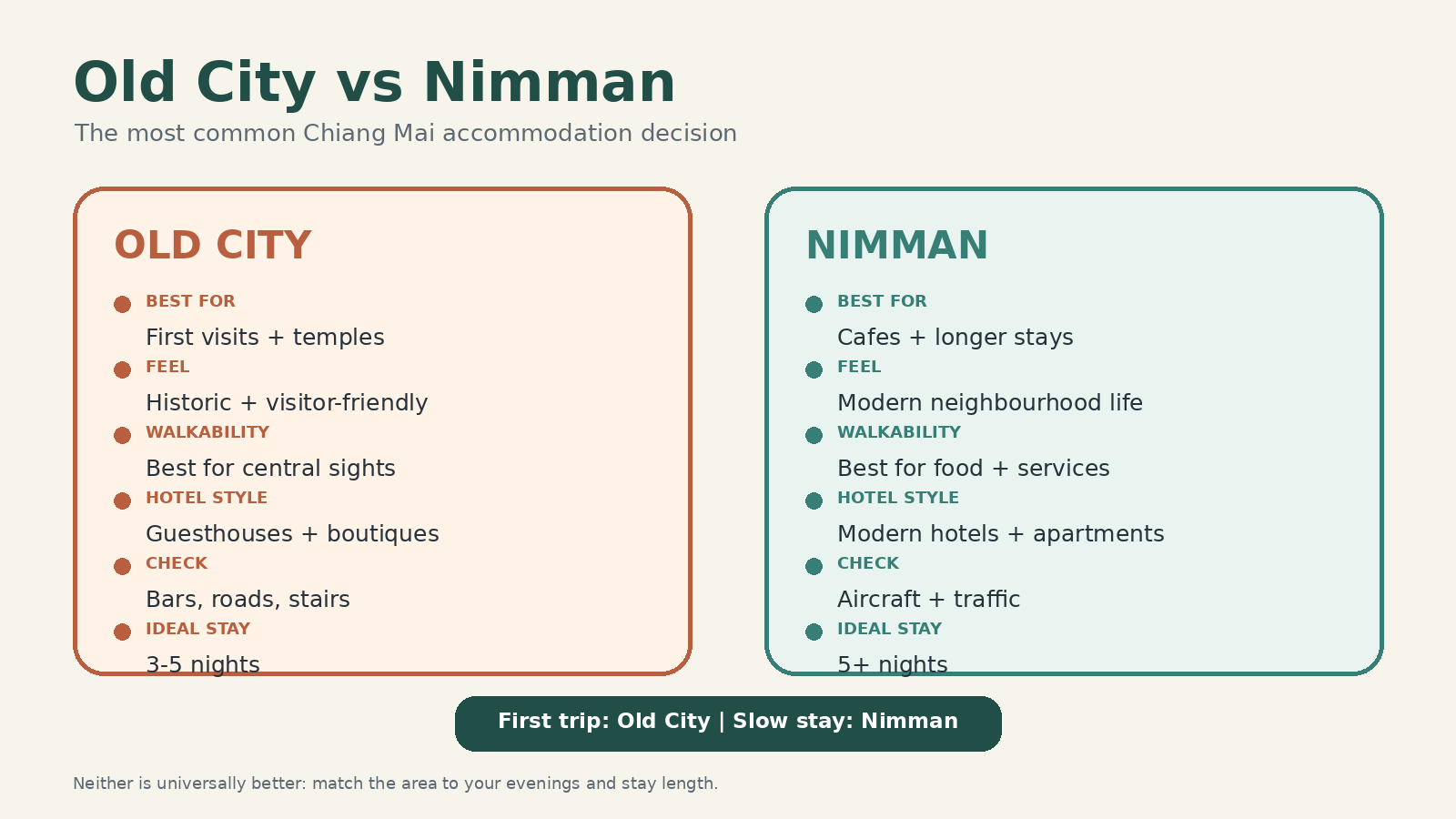
For four nights on a first trip, the Old City is the stronger default. For ten nights with work, cafes or a slower routine, Nimman usually wins. A seven-night leisure trip can split four nights in the Old City and three at Riverside or Nimman, although changing hotels is worthwhile only when the second area produces a genuinely different experience.
Chiang Mai airport and transport by area
Chiang Mai International Airport is close to the city, so travellers rarely need an airport hotel unless the flight timing, mobility needs or a very short connection makes it useful. Even so, journey time changes with traffic, road closures, festival activity and the exact entrance to the hotel.
Official airport options
| Option | Official information checked | Best for | Planning caution |
|---|---|---|---|
| A1 shuttle | 40 THB; airport, Nimman, Huay Kaew and city moat | Solo travellers with light luggage | Verify current route and operating time on arrival |
| A2 shuttle | 40 THB; airport, Mahidol Road, Night Bazaar and Chang Klan hotels | Chang Klan and Night Bazaar stays | Hotel may not sit directly beside a stop |
| A3 shuttle | 60 THB; airport, Second Ring Road and 700th Anniversary Stadium | Northern routes | Less relevant for most central first visits |
| Grab | Designated airport pickup points; service centre listed as 24 hours | Door-to-door convenience | Follow the app and airport signs to the correct pickup |
| Metered taxi | Meter plus a published 50 THB airport charge | Travellers with luggage or no local data | Confirm current service hours and charge before travel |
| Pre-booked transfer | Price varies by vehicle and provider | Late arrivals, families and groups | Check meeting point, waiting time and luggage allowance |
Airports of Thailand publishes the A1, A2 and A3 routes and fares, while its airport pages describe a designated Grab pickup and metered taxis with an additional 50 THB airport charge.[5][6][7] Because transport details can change, recheck the official pages and airport signage before relying on a specific fare or closing time.
Practical ride-time bands
| Area | Typical planning time from CNX | What can add time |
|---|---|---|
| Hai Ya and south Old City | 10-20 minutes | Market closures and airport traffic |
| Nimman | 10-20 minutes | Huay Kaew and MAYA junction traffic |
| Central or east Old City | 15-25 minutes | Moat traffic and weekend markets |
| Chang Klan and Night Bazaar | 15-30 minutes | Central traffic and hotel access |
| Riverside and Wat Ket | 20-35 minutes | Bridge traffic and exact river location |
| Santitham and Chang Phueak | 15-30 minutes | Northern moat and junction traffic |
| Mae Rim or Hang Dong resort | 30-60+ minutes | Distance, weather and rural access roads |
Again, these are generous planning bands, not guaranteed transfer times. A very early journey can be quicker, while Yi Peng, Songkran, Sunday market closures or heavy rain can make a short route much slower.
Do you need a scooter?
No. A first visit can be managed with walking, red songthaews, taxis, app rides, tours and hired drivers. The UK government’s Thailand advice highlights the country’s high number of road accidents, particularly involving motorcycles, and explains the licensing and insurance risks.[12] Choose a scooter only when you are properly licensed, insured, experienced and comfortable with local conditions.
Chiang Mai hotel costs and booking strategy
Overall, Chiang Mai can still provide strong accommodation value, but a headline price is not the same as a comparable stay. Breakfast, taxes, cancellation, room size, view, lift access and festival dates can change the real value. Compare like with like before assuming the cheapest listing is the best option.
Planning budgets by hotel style
| Hotel style | Typical planning range | What is usually realistic | Main check |
|---|---|---|---|
| Simple private room | 850-1,500 THB | Basic guesthouse or older small hotel | Air conditioning, window, lift and noise |
| Comfortable mid-range | 1,500-3,200 THB | Modern room, good location, sometimes breakfast or pool | Exact room category and cancellation |
| Boutique or upper mid-range | 3,200-6,000 THB | Design-led property, stronger facilities or prime area | Room size and whether style outweighs function |
| Luxury city or river hotel | 6,000-12,000+ THB | Resort-style facilities, spa, gardens or premium service | Breakfast, view and inclusions |
| Countryside resort or villa | 4,000-15,000+ THB | Large grounds, villas, mountain setting or private pool | Transfers, meals and isolation |
Use these ranges to set an initial filter, then verify live rates for your dates. A 2,500 THB room in a perfect location may deliver better total value than a 1,700 THB room that creates two paid rides every day.
Four-night example
| Choice | Room total | Likely extra transport | Useful interpretation |
|---|---|---|---|
| Central mid-range hotel | 8,800 THB | 600 THB | 9,400 THB combined planning total |
| Cheaper outer hotel | 6,800 THB | 1,800 THB | 8,600 THB, but with more waiting and less spontaneity |
| Riverside boutique stay | 15,200 THB | 1,200 THB | 16,400 THB, justified only when the hotel experience matters |
Even so, the cheapest option still costs less in this example, but the saving is only 800 THB after transport. That may be worthwhile for a week-long stay with a larger room; it is less compelling on a three-night first visit.
When to book earlier
Therefore, book earlier for November to January, New Year, Yi Peng and Loy Krathong periods, Songkran, family rooms and small high-demand hotels. Flexible travellers outside peak dates can compare later, although the most convenient rooms may disappear before generic inventory.
Finally, avoid publishing or relying on fixed hotel prices. Rates and availability change constantly. The strongest workflow is to use planning bands in the article, then let the reader check live dates through the hotel platform.
Weather, smoke and heavy rain: how they affect the area decision
Seasonally, weather changes what “convenient” means. In the cooler months, a ten-minute morning walk can be pleasant. During the hot season, shade and easy transport matter more. In heavy rain, a hotel with a covered entrance, restaurant and reliable vehicle access becomes noticeably easier.
Cool-season mornings can be genuinely cool
For example, Thai Meteorological Department’s January 2026 summary reported generally cool conditions across Thailand, with cold to very cold weather in parts of the north and on mountain areas.[9] Chiang Mai city is milder than the mountaintops, but an early Doi Inthanon or Doi Suthep departure may still require a light layer.
Smoke is a regional issue, not a neighbourhood problem
Air quality can deteriorate during the northern burning season, often most noticeably from late February into April, although timing and severity vary. Moving from the Old City to Nimman will not solve a regional smoke event. Instead, check current official readings through Air4Thai and choose a hotel with good seals, air conditioning and a clearly described air-purification approach when air quality is a concern.[10]
However, do not treat an old monthly average as a guarantee. Conditions can change quickly. Travellers with health concerns should seek personalised medical advice before travel rather than relying on a hotel guide.
Rain changes access more than the district ranking
Meanwhile, the rainy season can bring short intense downpours as well as longer wet periods. The UK’s Thailand travel advice notes that heavy storms can disrupt travel through flooding and landslides and recommends following TMD warnings.[12] For city accommodation, check covered pickup, drainage comments, entrance steps and whether the hotel has food on site.
The seven-point Chiang Mai hotel-location test
In practice, before booking, test the exact property rather than trusting the neighbourhood name. This takes ten minutes and prevents many of the most common disappointments.
| Test | What to check | Why it matters |
|---|---|---|
| 1. Breakfast route | Walk to a realistic breakfast or coffee option | Reveals pavement, shade and lane access |
| 2. Evening route | Check the walk after dark to dinner or the main road | Shows lighting, traffic and isolation |
| 3. Vehicle pickup | Find where taxis and tours can stop | Narrow lanes and market closures can delay pickup |
| 4. Noise scan | Search recent reviews for aircraft, bars, temples and construction | Neighbourhood labels cannot predict room noise |
| 5. Room function | Confirm lift, window, desk, storage and bathroom layout | Facilities matter more on longer stays |
| 6. Total price | Compare taxes, breakfast, cancellation and transfer costs | Headline rates can be misleading |
| 7. Weather resilience | Check covered entrance, drainage and on-site food | Useful during heat and heavy rain |
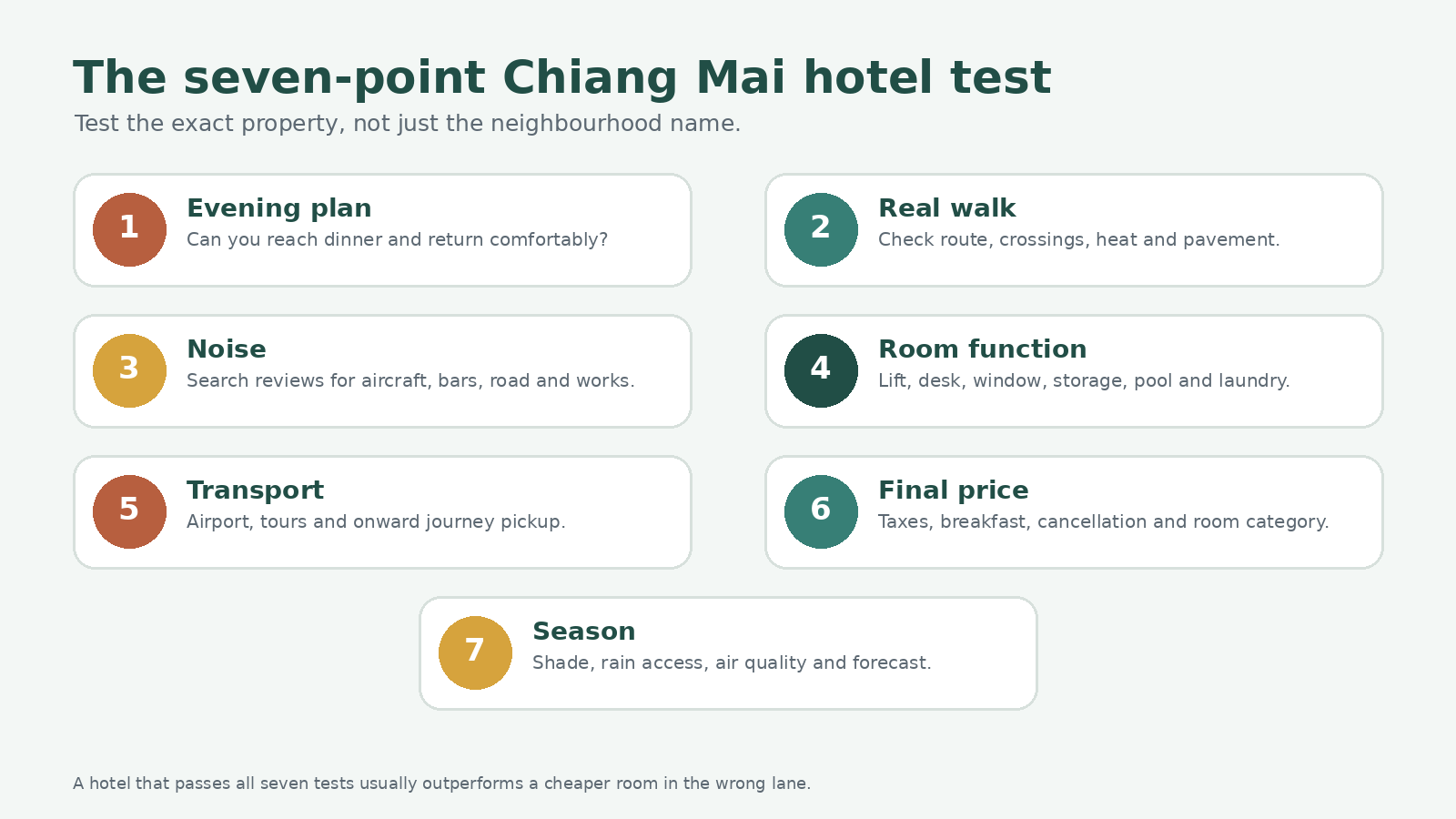
For example, for an Old City guesthouse, lift and noise may be the decisive checks. In Nimman, aircraft and construction matter more. Riverside guests should examine restaurant access and transport, while Mae Rim travellers need to price transfers and meals. The same checklist produces different answers in each district.
Useful products for a Chiang Mai stay
Overall, Chiang Mai does not require specialist equipment. A few compact items can solve predictable problems, but they should match the hotel and season rather than turn into a generic packing list.
| Item | Useful feature | Best for | Trade-off |
|---|---|---|---|
| Compact USB-C power bank | 5,000mAh with a folding connector; Anker lists 22.5W for its Nano model | Maps, ride apps and long day trips | Phone cases can affect the fit |
| Reusable soft earplugs | Loop states up to 24 dB SNR for Quiet 2 | Aircraft, street and festival noise | Fit and comfort are personal |
| Compact UPF umbrella | Decathlon lists UPF50+, 160 g and 26 cm folded length | Sun, showers and market walks | A small canopy is less useful in strong wind |
| Universal travel adaptor | Multiple plug formats and USB charging | Travellers carrying several devices | Check voltage compatibility and safety certification |
For example, the Anker manufacturer page confirms the 5,000mAh capacity, folding USB-C connector and 22.5W model description.[15] Loop states 24 dB SNR for Quiet 2, while Decathlon lists UPF50+ protection, a 160 g weight and a 26 cm folded length for its micro umbrella.[16][17]
Choose the problem first. Light sleepers may benefit more from earplugs than a premium toiletry bag. Travellers using phone navigation all day are more likely to value a power bank. During the cool dry season, neither a heavy rain jacket nor a large umbrella needs to dominate the luggage.
Mobile data before arrival
In addition, a data connection makes airport pickup, hotel messaging and map checks easier. Compare a Thailand eSIM with roaming and a local physical SIM, paying attention to phone compatibility, data allowance, validity and whether voice calls are included. Do not buy solely because the largest data figure appears cheapest.
Sample Chiang Mai stay plans
Three nights: keep one simple base
Stay in the Old City or Chang Klan. Use the first full day for temples and markets, the second for Doi Suthep plus Nimman, and the remaining time for food or a half-day activity. Do not change hotels; the move will consume too much of a short trip.
Five nights: Old City with breathing room
Choose the Old City for all five nights when sightseeing is the priority. A western or central location makes it easy to combine temple mornings with rides to Nimman and the river. Alternatively, select Riverside for the final two nights only when the hotel has facilities you genuinely plan to use.
Seven nights: city plus a contrasting second base
Spend four nights in the Old City and three in Riverside, Mae Rim or Nimman. The split works because the second area changes the pace. Moving from one Old City guesthouse to another nearby hotel adds effort without producing a new experience.
Two weeks: build a temporary routine
Nimman, Santitham, Suthep or Hai Ya can support a longer stay. Look for laundry, a desk, storage, kitchen access and weekly cleaning. Add two or three resort nights only when the budget and transfer time are justified.
City plus Pai or Chiang Rai
Keep Chiang Mai accommodation near the Old City, Chang Klan or a practical pickup road before an onward transfer. A remote resort the night before a morning coach can create unnecessary stress. Compare travel time and terminal location before selecting the final city night.
Common accommodation mistakes in Chiang Mai
Choosing the cheapest room outside the useful area
First, a low nightly rate can disappear into daily transport and lost time. Add the likely rides for the whole stay before comparing an outer hotel with a central one. On a short trip, the easier location often deserves a modest premium.
Assuming every Old City lane is quiet
Second, temple bells, bars, schools, roads and construction vary by block. Recent room-specific reviews are more useful than the phrase “quiet courtyard” in a property description.
Booking Nimman without checking aircraft comments
Likewise, some visitors barely notice flights; others find them disruptive. Search the newest reviews and ask about room orientation. Do not rely on a generic neighbourhood forum written years ago.
Treating Mae Rim as a city base
By contrast, Mae Rim is a countryside stay. Book it because you want the resort, gardens or nearby programme. When every dinner and temple visit requires a long round trip, the location has failed the itinerary.
Ignoring stairs, bathrooms and luggage access
Moreover, many attractive guesthouses occupy older buildings. Confirm lift access, floor, shower layout, handrails and luggage assistance when mobility or heavy cases matter.
Using a scooter to rescue a poor hotel location
However, a scooter is not a substitute for a sensible base. Licensing, insurance, road risk and parking still apply. Choose a hotel that works with legal, comfortable transport even when you later decide to ride.
Booking a non-refundable rate too early
Finally, a small saving can become expensive when flight times, festivals or plans change. Compare the cancellation deadline in local time and save a copy of the exact room terms.
Failing to check weather and air quality near departure
Therefore, seasonal advice is only a starting point. Use TMD for current weather and Air4Thai for current air data, then adapt outdoor plans and hotel expectations.
Frequently asked questions
What is the best area to stay in Chiang Mai for first-time visitors?
The Old City is the strongest default because major temples, food and the moat sit close together. Chang Klan is a good alternative when a larger hotel, pool and simple airport arrival matter more than heritage atmosphere.
Is it better to stay in the Old City or Nimman?
Choose the Old City for temples, walking and a traditional short break. Choose Nimman for cafes, dining, nightlife, work-friendly services and a stay of a week or more. Four-night first trips usually favour the Old City.
How many nights should I stay in Chiang Mai?
Four or five nights creates a balanced first visit: city sights, one mountain or countryside day, food and some flexibility. Seven nights supports a slower pace or split stay. Two nights is possible but leaves little room for weather or travel delays.
Is Night Bazaar a good place to stay?
Yes, particularly for families and short stays. Chang Klan has large hotels, pools, restaurants and an official A2 airport shuttle route. Some blocks feel tourist-oriented, so check the exact address and walking distance to the section you want.
Is Chiang Mai Old City walkable?
In practice, the Old City is walkable in sections, but heat, traffic and uneven pavements slow longer routes. Plan one cluster at a time and use a short ride when the next attraction lies across the moat or on the other side of the city.
Should couples stay by the river?
By comparison, Riverside and Wat Ket are excellent for couples who value a calm hotel, garden, pool or on-site restaurant. They are less convenient for spontaneous temple walks, so compare transport and nearby dining before booking.
Where should digital nomads stay in Chiang Mai?
Meanwhile, Nimman is the simplest area for cafes, gyms, restaurants, shopping and work services. Santitham can offer better value nearby. Verify the desk, chair, Wi-Fi comments, noise and cleaning terms before choosing a longer stay.
Which Chiang Mai area is closest to the airport?
Geographically, Hai Ya, Mae Hia and parts of Nimman are geographically close. Airports of Thailand also lists shuttle routes serving Nimman, the moat and Night Bazaar. Actual journey time still depends on traffic and the hotel entrance.
Do I need a scooter in Chiang Mai?
No. Central Chiang Mai can be managed with walking, songthaews, taxis, app rides, tours and drivers. A scooter introduces licensing, insurance and road-safety questions and is not necessary for a first visit.
Where should families stay in Chiang Mai?
Chang Klan, Riverside and Nimman are practical choices because they offer larger hotels, pools, food and simple transport. The best option depends on whether the family values market access, resort space or modern shopping and cafes.
What is the quietest area to stay in Chiang Mai?
Ultimately, no entire district is guaranteed quiet. Wat Ket, Riverside, Hai Ya and selected western Old City lanes can be calmer, but aircraft, bars, schools, roads and construction affect individual properties. Recent room-specific reviews remain essential.
Is Mae Rim too far from Chiang Mai?
By contrast, Mae Rim is too far for a convenient daily city base, but it is a good separate resort stay. Use it for two to four nights when countryside, spa time or nearby activities are the purpose of that part of the trip.
When should I book Chiang Mai accommodation?
Therefore, book earlier for November to January, major festivals, New Year, family rooms and small boutique hotels. Outside peak dates, flexible travellers can compare later, although the best-located rooms may still sell first.
Is Riverside a problem during the rainy season?
Not automatically. However, heavy rain can affect roads and river conditions, so check current TMD warnings, hotel access and recent guest communication. A covered entrance and on-site restaurant improve wet-weather convenience.
Is an airport hotel necessary in Chiang Mai?
Usually not, because the airport is close to central areas. An airport-side hotel can make sense for a very early flight, limited mobility or a short overnight connection, but most travellers can stay in a more useful neighbourhood.
Where I would stay on a first Chiang Mai trip
For a first visit of three or four nights, I would stay inside the Old City, choosing the gate and lane to match the itinerary. That gives the trip an easy first morning and reduces the need to plan every meal or temple visit. A larger family group may prefer Chang Klan for a pool, lift and full-service hotel.
For a week with cafes, work or a slower routine, I would compare Nimman and Santitham. Couples who want the hotel to feel like part of the holiday should look at Riverside and Wat Ket before defaulting to the moat. Mae Rim or Hang Dong belongs in a split stay, not as a substitute for a central base.
Ultimately, the right Chiang Mai area removes repeated friction. Choose the evenings, transport, room function and sleep conditions first; compare hotels second. That approach is more reliable than chasing a universally “best” neighbourhood that does not exist.
Article by Karen Taylor for Taylor’s Trailblazing Travels.
Sources and methodology
Methodologically, this guide separates official fixed information from editorial judgement. Destination and neighbourhood context was checked against Tourism Authority of Thailand material. Airport routes, pickup arrangements and published charges were checked against Airports of Thailand. Weather and air-quality guidance was checked against TMD and Air4Thai. Hotel costs are broad planning bands rather than live quotes. Product specifications were checked against the named manufacturers on 24 August 2026.
Official destination and transport sources
- Chiang Mai destination guide — Tourism Authority of Thailand. Official overview covering Doi Suthep, Tha Phae, Nimman and major Chiang Mai experiences.
- Attractions around Chiang Mai moat — Tourism Authority of Thailand. Official material on the moat, Tha Phae Gate, Sunday Walking Street and Wat Phra Singh.
- City Gastro: Chiang Mai — Tourism Authority of Thailand. Official culinary material including Chiang Mai Gate Market and Lanna food context.
- LA LANNA Chiang Mai — Tourism Authority of Thailand Tourism Products Division. Official cultural and community-tourism collection.
- Chiang Mai airport shuttle bus — Airports of Thailand. Published A1, A2 and A3 routes and fares, with an instruction to recheck before travel.
- Grab pickup at Chiang Mai Airport — Airports of Thailand. Official designated pickup information.
- Metered taxi at Chiang Mai Airport — Airports of Thailand. Official taxi service page and published additional airport charge.
Weather, air quality and safety
- Chiang Mai province weather — Thai Meteorological Department. Official current, seven-day and warning information.
- Monthly Weather Summary: January 2026 — Thai Meteorological Department. Official summary of cool conditions in upper Thailand and colder mountain weather.
- Air4Thai — Pollution Control Department, Thailand. Official platform for current PM2.5 and station data.
- Tourist Police contact information — Tourist Police Bureau. Official page listing the 1155 hotline.
- Thailand safety and security advice — UK Foreign, Commonwealth and Development Office. Government advice on road risks, motorcycles, heavy rain and weather warnings.
- Thailand Green Tourism Collections — Tourism Authority of Thailand Tourism Products Division. Official responsible-tourism collection.
- Drone registration in Thailand — Civil Aviation Authority of Thailand. Official route to the UAS Portal for drone pilot certification and registration.
Manufacturer and programme sources
- Anker Nano 5,000mAh power bank — Anker UK. Manufacturer specifications for capacity, connector and output.
- Loop Quiet 2 earplugs — Loop Earplugs. Manufacturer specification for reusable silicone construction and stated 24 dB SNR.
- UPF50+ micro umbrella — Decathlon UK. Manufacturer specifications for UV protection, weight and folded size.
- Amazon Associates Program Policies — Amazon UK. Current policy checked for direct Special Links and redirecting-link restrictions.
Image credits
Illustrations in this article were created for Taylor’s Trailblazing Travels. Third-party photographs, where used, are credited beside the image or in the source list.