A practical five-day Krabi route with one convenient base, one independent Railay day, one carefully chosen island trip, inland scenery and enough flexibility for Andaman weather.
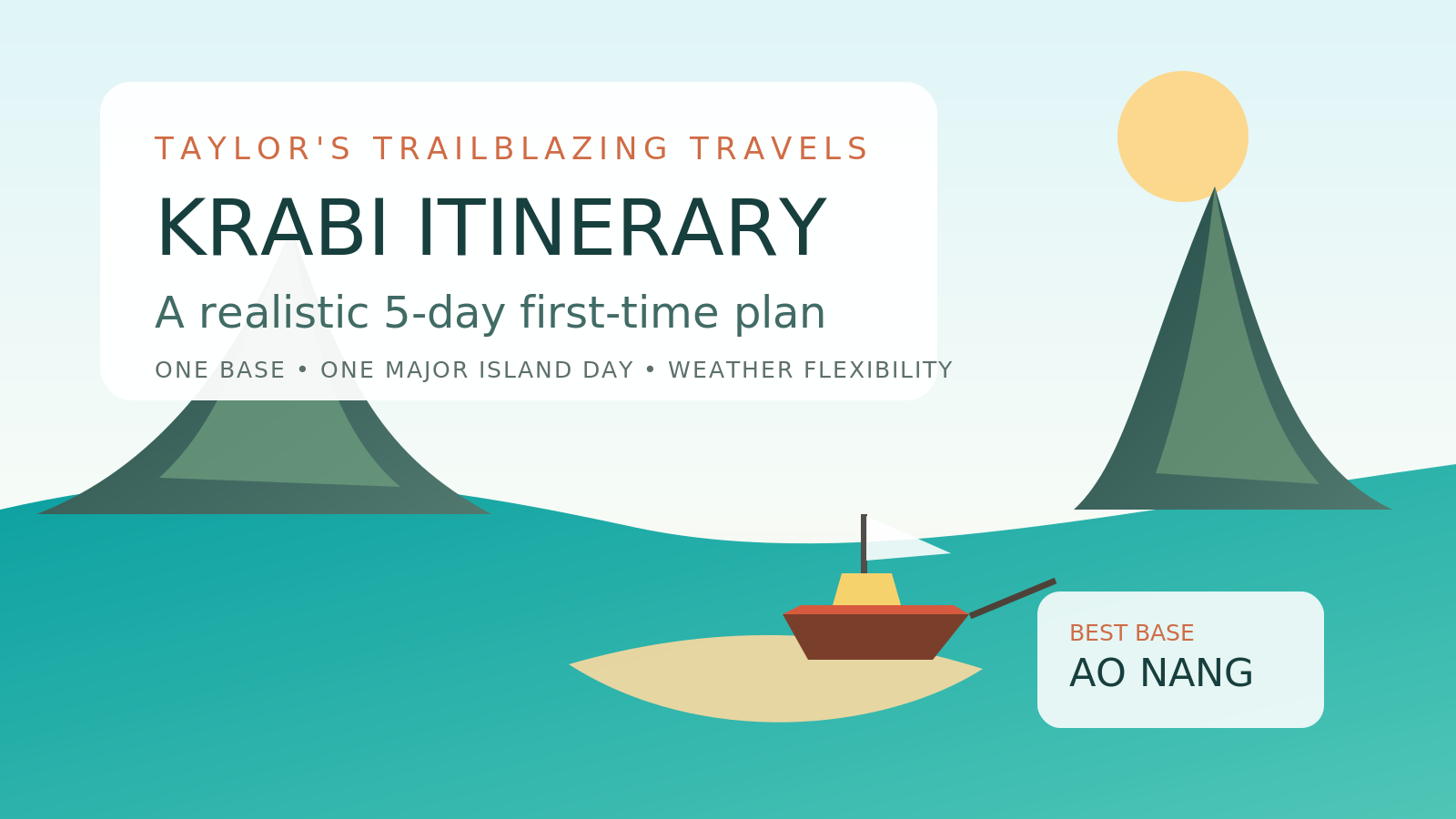
Krabi is easy to overplan. The province appears compact on a map, yet a single day can involve a hotel pickup, a pier queue, a wet long-tail boarding and several hours in full sun. A useful Krabi itinerary therefore needs contrast and breathing room, not a different speedboat every morning.
Five days works particularly well for a first visit. It gives you time to settle into Ao Nang, visit Railay independently, choose one major island circuit, explore inland Krabi and keep the last day light enough for weather changes or an onward transfer. The result feels like a holiday rather than a sequence of alarms.
Prices and journey times below are planning ranges checked for this 25 August 2026 edition. Operators, tides, park arrangements and seasonal timetables can change, so use the ranges to compare options and confirm the final details before paying.
Krabi in five days: quick answers
Five days gives one arrival day, Railay, one island day, one inland day and a weather buffer.
Ao Nang: the widest choice of hotels, food, ticket desks, pickups and boats to Railay.
Railay and Phra Nang, reached by local long-tail boat rather than a full packaged tour.
Hong Islands for limestone, lagoon scenery and a more focused day than a multi-stop marathon.
November to April is generally the easier Andaman window; daily wind and waves still decide departures.
Booking Phi Phi, Hong and the Four Islands on consecutive days, then seeing very little of Krabi itself.
In this guide
How many days do you need for a Krabi itinerary?
Three days is a highlights trip
Three days works when Krabi is one stop in a wider Thailand route. However, an evening arrival is not a sightseeing day, and every boat trip depends on check-in, boarding and the return journey. With only three usable days, stay in Ao Nang, visit Railay independently and choose either Hong Islands or an inland day. Do not add Phi Phi merely because every ticket desk sells it.
Five days is the practical first-visit sweet spot
Five days gives the coast enough breathing room. You can keep one hotel, avoid packing between Ao Nang and Railay, and separate the main boat day from the inland road day. More importantly, one flexible slot means a windy morning becomes a spa, café, Krabi Town or pool day rather than a financial disaster.
Seven days feels like a beach holiday
A week suits families, couples and travellers arriving after a long-haul flight. In addition, it allows a genuine rest day and a second sea trip only when the forecast earns it. Seven days also makes quieter Klong Muang or Tubkaak more realistic because you are not trying to reach Ao Nang ticket desks every morning.
Krabi trip length compared
| Time in Krabi | Realistic pace | What fits | Main compromise |
|---|---|---|---|
| 3 days | Fast highlights | Ao Nang, Railay and one island or inland day | Almost no weather flexibility |
| 5 days | Balanced | Arrival, Railay, one island day, inland Krabi and a buffer | Only one full rest period |
| 7 days | Relaxed | Five-day route plus rest, food, kayaking or second boat day | Higher hotel cost |
| 10+ days | Slow coast trip | Krabi plus Koh Lanta, Ko Yao or a split beach stay | Can crowd out northern Thailand |
Where to stay for this Krabi itinerary
Ao Nang: the easiest all-round base
Ao Nang is the practical centre of a first Krabi itinerary. It has the broadest mix of hotels, restaurants, pharmacies, tour desks and pickup services, while local boats leave for Railay and island tours use nearby piers or beach boarding points. The beach itself is pleasant rather than Krabi’s most spectacular, but the logistics are hard to beat.
Choose a hotel within a comfortable walk of the main road or the beachfront. A bargain room far inland can add two taxi rides every day, and a steep side road feels much longer after a wet boat landing. For most first-timers, being able to walk to dinner is worth more than a dramatic pool photograph.
Railay: the most atmospheric base
Railay is the romantic choice. TAT describes the peninsula as accessible only by boat, with limestone scenery and a strong rock-climbing identity. [1] Staying overnight gives you quieter mornings and evenings after day visitors leave. On the other hand, every airport transfer involves a road leg, a pier, a boat and a beach or floating-pier landing.
Railay works best when atmosphere matters more than transport convenience. It suits couples, climbers and travellers who are happy to keep luggage light. For a first five-day trip with several excursions, I would usually sleep in Ao Nang and visit Railay on Day 2 instead.
Krabi Town: best for food, community and lower prices
Krabi Town is not a beach base, yet it has local food, riverside life and easier access to Ko Klang. TAT’s official one-day route links Khao Khanap Nam, Ko Klang and Krabi Walking Street. [5] Rooms and meals can also cost less than at the coast. The trade-off is a road journey before most beach or island departures.
Klong Muang or Tubkaak: best for a quiet resort stay
Klong Muang and Tubkaak sit northwest of Ao Nang and feel calmer. They suit honeymoons, resort time and travellers who want a quieter beach. Nevertheless, restaurant choice is thinner, taxis cost more and many tour pickups begin earlier. Tubkaak also works well for the Khao Ngon Nak area, which TAT places roughly a 30-minute drive north of Ao Nang. [4]
Koh Lanta: an extension, not an Ao Nang substitute
Koh Lanta belongs to Krabi Province, but it is a separate destination with its own beaches, road distances and boat seasons. Do not book two nights in Ao Nang and two on Lanta and call it a relaxed four-day Krabi stay. Add Lanta after this itinerary when you have at least three extra nights and a clear transfer plan.
Krabi base comparison
| Base | Best for | Advantages | Trade-off | Airport planning range |
|---|---|---|---|---|
| Ao Nang | First-time logistics | Walkable food, tour pickups, Railay boats | Busy and commercially developed | 35–75 min |
| Railay | Scenery and romance | Cliffs, beaches, quiet early/late hours | Boat-only access; luggage handling | 60–120 min door to door |
| Krabi Town | Food and local life | Lower prices, Ko Klang, markets | No beach; road transfer to boats | 20–40 min |
| Klong Muang | Calm resort stay | Quieter coast and sunsets | Fewer restaurants; more taxis | 45–80 min |
| Tubkaak | Honeymoons and retreat time | Quiet beach, resort atmosphere | Remote for Ao Nang evenings | 50–90 min |
Ao Nang vs Railay: the short decision
Ao Nang and Railay are close across the water but function very differently. Ao Nang is a practical transport hub; Railay is a boat-access peninsula where the location creates the atmosphere and the inconvenience. For this five-day route, Ao Nang wins unless you actively want the slower Railay logistics.
| Question | Choose Ao Nang when… | Choose Railay when… |
|---|---|---|
| Airport and luggage | You want a direct road transfer and straightforward luggage handling. | You accept a road-plus-boat transfer and can pack lightly. |
| Food and evenings | You want the widest choice and the ability to walk to pharmacies, shops and casual meals. | You prefer a smaller, more atmospheric evening scene after day visitors leave. |
| Day trips | You want easy pickups for islands, inland Krabi and onward road transport. | Your priority is the Railay peninsula, climbing or quiet beach time. |
| Weather flexibility | You want simple access to inland alternatives if boats change. | You are comfortable with boat-dependent access and a more fixed local plan. |
| Best first-time use | Stay here for all five nights and visit Railay on Day 2. | Use it for a special one- or two-night extension, or choose it when the hotel itself is the trip. |
The complete 5-day Krabi itinerary
This route assumes five nights in Ao Nang and a flight or road arrival through Krabi. Swap Days 3 and 4 when the sea forecast favours the later day. Keep the final morning light, especially when you are flying rather than continuing overland.
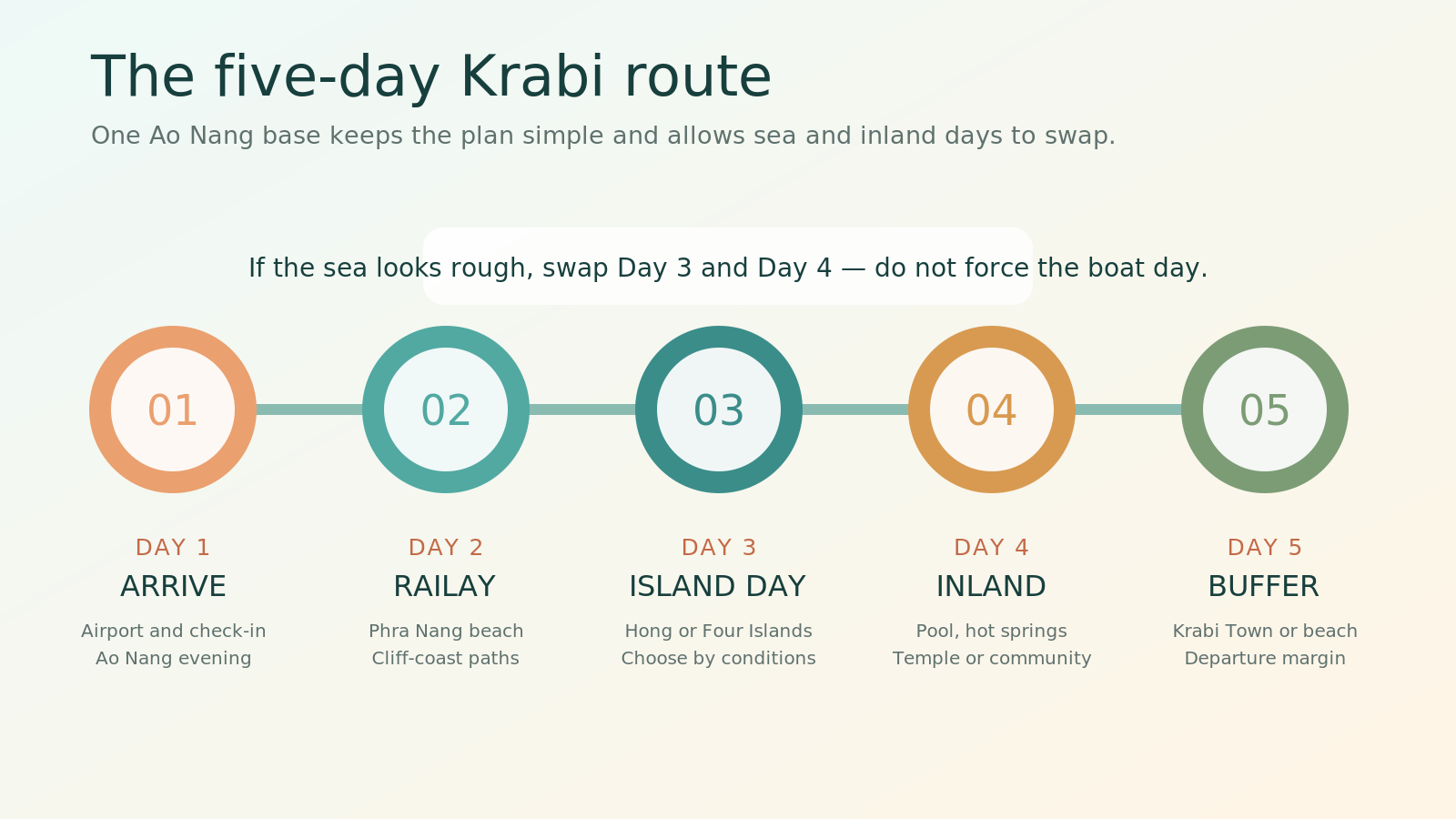
Five-day Krabi itinerary at a glance
| Day | Morning | Afternoon | Evening |
|---|---|---|---|
| 1 | Airport transfer and check-in | Ao Nang or Noppharat Thara | Local dinner and early night |
| 2 | Boat to Railay West | Phra Nang, Railay paths and optional climb | Sunset or return to Ao Nang |
| 3 | Hong Islands or Four Islands | Boat tour and swimming stops | Easy dinner; no second major booking |
| 4 | Tiger Cave Temple or inland start | Emerald Pool / hot springs / community stop | Massage or quiet dinner |
| 5 | Krabi Town and Ko Klang, or beach | Departure buffer and airport transfer | Onward travel |
Day 1: arrive, check in and stay local
Krabi Airport is close enough to the coast for a same-day beach walk, but not close enough to justify a tight paid activity. Allow roughly 35–75 minutes to Ao Nang by private car or shared transport, then add check-in, cash, SIM setup and food. The official airport site is the right place to verify current transport information before travel. [10]
Once you reach Ao Nang, walk the beachfront, continue towards Noppharat Thara if energy allows, and buy water, sun protection and a dry bag before the first boat day. TAT’s official Krabi route pairs Noppharat Thara with the province’s coastal and inland attractions. [2]
Keep dinner within walking distance. Arrival day is when travellers are most likely to accept a badly priced tour because a sales desk promises to “sort everything”. Take photographs of two or three tour boards, compare inclusions later, and sleep before paying.
Day 2: Railay, Phra Nang and the limestone coast
Railay is the easiest headline experience to do without a packaged tour. Buy a local boat ticket from the current Ao Nang departure point, keep sandals that can get wet, and carry only a small day bag. Railay’s boat-only geography is part of the experience, but it also means boarding changes with tide and weather. [1]
Morning: Railay West before the day crowds
Leave early enough to enjoy Railay West before the midday heat. Walk the sand, orient yourself and check where the return boats are gathering. Do not assume the landing point will be identical later; crews may use a different beach or pier when conditions change.
Late morning: Phra Nang Cave Beach
Follow the signed path towards Phra Nang. The walk is short, shaded in sections and dramatically enclosed by limestone. Monkeys may be present, so keep food and loose belongings inside your bag. The beach can become crowded, yet arriving before large tour groups makes a noticeable difference.
Afternoon: choose one extra, not all of them
Your sensible options are a long lunch, swimming, a beginner climbing session, or the Railay viewpoint and lagoon route. The viewpoint is steep, muddy and hands-on after rain; it is not a casual flip-flop walk. If the ground is wet or you are carrying beach gear, skip it without regret.
Day 3: choose Hong Islands or the Four Islands
Book one Krabi island circuit, not every route on the board. Hong Islands usually wins for sculpted limestone, lagoon scenery and a more focused landscape day. The Four Islands route is the classic choice for Poda, Chicken Island, snorkelling and the low-tide sandbar known as Thale Waek, which appears in TAT’s official Krabi itinerary. [2]
A shared long-tail trip can feel slower and more local, while a speedboat covers distance quickly and usually carries more people. Neither is automatically better. Ask about passenger numbers, shade, toilet access, park fees, lunch, snorkel equipment and the exact cancellation policy before comparing headline prices.
For budgeting, allow roughly 1,200–2,500 baht per adult for a mainstream shared tour before optional extras; private boats cost far more. Some operators include national-park charges and others collect them separately. That is why the cheapest poster price is not always the cheapest final day.
Day 4: inland Krabi without racing
After two coastal days, switch direction. Krabi’s inland scenery is not filler: TAT highlights Emerald Pool, Khlong Thom hot springs, Tiger Cave Temple, Khao Ngon Nak and mangrove communities as major parts of the province. [3][4][6]
Option A: Tiger Cave Temple plus one gentler stop
Tiger Cave Temple suits travellers who are fit, heat-aware and genuinely want the climb. Start early, carry water and turn around when conditions feel wrong. The famous staircase is steep and exposed; it should not be combined with an overpacked afternoon merely to justify a driver.
Option B: Emerald Pool and hot springs
Emerald Pool is the easier nature-focused choice, although it still involves walking and can be busy. TAT describes the emerald-coloured pool in Khao Pra-Bang Khra Wildlife Sanctuary and the nearby blue spring area. [3] Pair it with the Khlong Thom hot-spring area only when your driver’s timing leaves enough unhurried time at both.
Option C: Khao Ngon Nak for hikers
Khao Ngon Nak delivers the strongest land viewpoint, but it is a proper hot-weather hike rather than a photo stop. TAT places it north of Ao Nang and describes multiple viewpoints along the mountain trail. [4] Start early, carry more water than you expect to drink, and verify current trail access locally.
Day 5: Krabi Town, Ko Klang or a deliberate beach buffer
A final day should absorb uncertainty rather than create it. When your flight is late, visit Krabi Town, walk the riverside and consider a short Ko Klang community trip. TAT’s current Krabi material describes Ko Klang as a Muslim island community reached by long-tail boat, with rice farming, batik, model boats and local seafood. [6]
When departure is earlier, stay in Ao Nang, swim only when conditions are safe, have lunch near the hotel and collect luggage with time to spare. Avoid a final-morning island tour before a flight. Boat delays, wet bags and pier transfers are exactly the problems a five-day itinerary is designed to avoid.
Krabi day trips compared
Krabi sells many tours with overlapping stops. The useful question is not “Which tour has the most islands?” but “Which day feels different from the rest of my itinerary?” Railay is a flexible beach-and-cliff day; Hong is a landscape day; Four Islands is a classic snorkel circuit; Phi Phi is a long iconic-bay day; inland Krabi is the weather-resilient contrast.
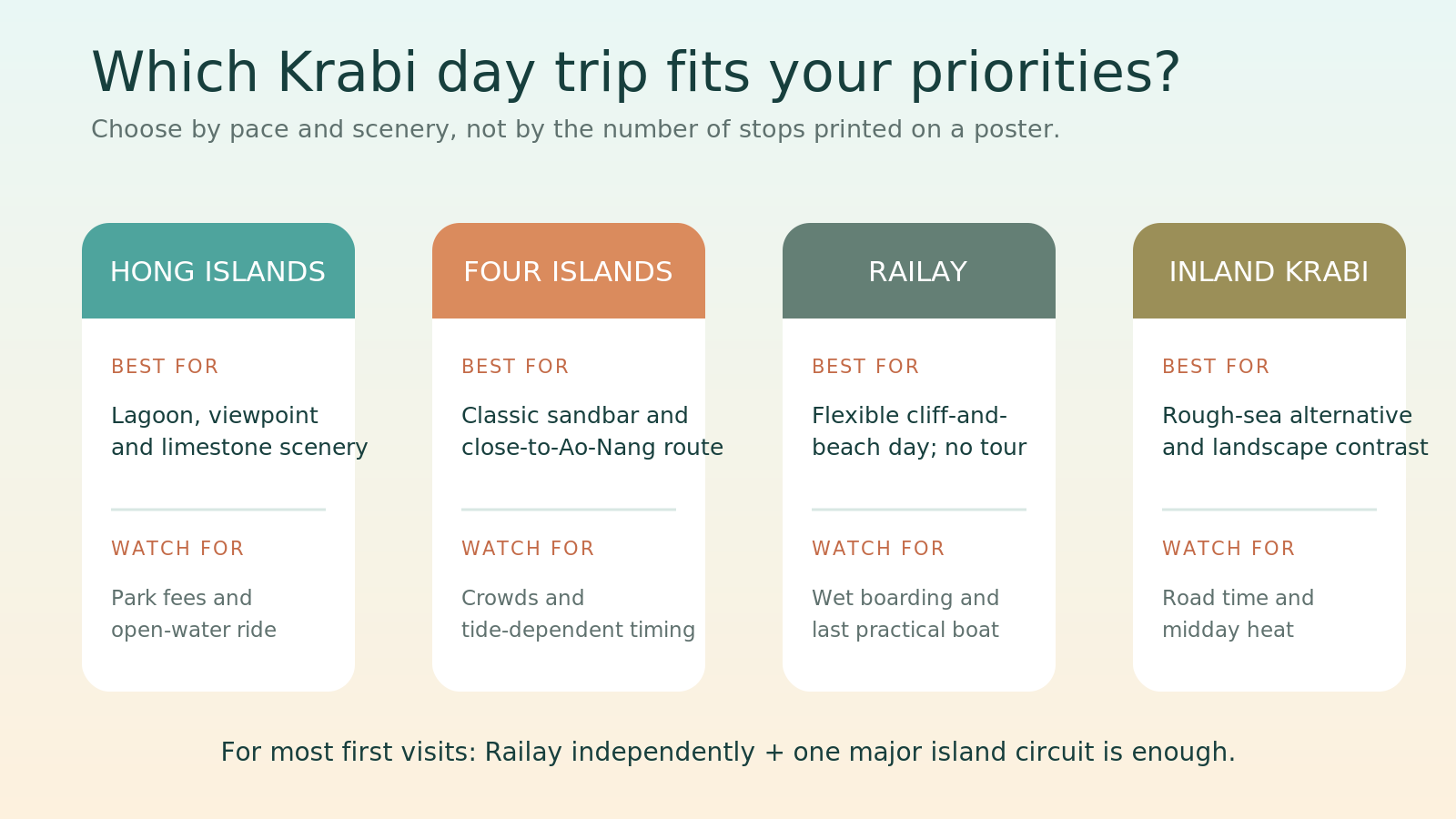
Krabi excursion comparison
| Trip | Typical time | Best for | Main advantage | Main drawback |
|---|---|---|---|---|
| Railay independent | Half or full day | Beach, cliffs and flexibility | No packaged tour required | Tide and boat boarding |
| Hong Islands | Full day | Lagoon and limestone scenery | Focused landscape payoff | Park fee may be separate |
| Four Islands | Full day | Classic sandbar and snorkel circuit | Several close-to-Ao-Nang stops | Can feel rushed or busy |
| Phi Phi | Long full day | Headline bays and famous scenery | Iconic first-visit appeal | Longest, busiest and least flexible |
| Inland Krabi | Full day | Pools, hot springs and hiking | Strong rough-sea alternative | Road-heavy day |
Railay is the best low-commitment choice
You can decide after breakfast, travel with a small bag and return when the beach day feels complete. That flexibility is valuable during shoulder season. However, local boats still need safe conditions, and the last practical departure should be confirmed before you settle into sunset drinks.
Hong Islands is the best scenery-focused tour
Hong works well when your priorities are limestone, lagoon colour, viewpoints and a polished day rather than a list of tiny stops. From Ao Nang, it is also geographically logical. For families or travellers who dislike rough rides, ask whether a larger boat option is available and how long the open-water legs last.
Four Islands is the classic first-timer circuit
The route is convenient from Ao Nang and appears in official TAT planning material. [2] Its value depends heavily on tide, crowding and how long the operator allows at each stop. A well-timed long-tail day can be delightful; a rushed speedboat with repeated boarding may feel like transport practice.
Phi Phi is optional, not compulsory
Phi Phi is famous for a reason, but it creates the longest and most structured sea day from mainland Krabi. Choose it when Maya Bay and the Phi Phi landscape are genuine priorities. Skip it when you already plan to stay on Phi Phi, dislike crowds, or would rather use the time for Hong, Railay and Krabi’s inland side.
Krabi Airport transfers and getting around
Krabi Airport to Ao Nang
The simplest choices are a shared airport van, shuttle service, fixed-price taxi or pre-booked private transfer. A useful 2026 planning range is roughly 150–250 baht per person for shared transport and 600–900 baht per vehicle for a direct car to Ao Nang, with travel commonly taking 35–75 minutes. Verify the displayed airport price on arrival because schedules and counters change.
Solo travellers with light luggage usually get the best value from shared transport. Two or three people may find a direct car competitive once the fare is divided. Late arrivals, young children and bulky luggage make the private option easier even when it is not the cheapest.
Ao Nang to Railay
Local long-tail boats are the standard link. Buy from the current official ticket point, ask which side of Railay the boat will use, and confirm the return arrangement. Budget roughly 200–400 baht return per person as a planning range, but expect night, tide or pier differences. Cash is useful.
Songthaews, taxis and ride apps
Shared songthaews connect Ao Nang and Krabi Town and can be good value when you are not in a hurry. Taxis and ride apps are useful for awkward hotel locations, early hikes and restaurant returns. Nevertheless, app supply is thinner than in Bangkok, so do not build a flight connection around an on-demand car appearing instantly.
Should you rent a scooter?
A scooter is not necessary for this itinerary. Ao Nang, organised pickups, local boats and a hired driver cover the core route. Rent only when you hold the correct licence, insurance covers the vehicle, you are comfortable with Thai road conditions and you will wear a proper helmet. Never treat a scooter as a casual holiday accessory.
Car or private driver for inland Krabi
A private driver is useful for Emerald Pool, hot springs and Tiger Cave Temple because the stops are spread out. A rental car gives flexibility, yet it also adds navigation, parking and responsibility after an early flight. For two or more travellers, compare the full driver day against separate taxis before assuming self-drive is cheaper.
How to get from Krabi to Koh Lanta, Phi Phi or Phuket
Krabi works well as the start of a longer Andaman route, but the transfer needs its own half-day budget. A listing that says two hours may describe the vehicle or ferry segment rather than hotel pickup, pier waiting and final drop-off.
Koh Lanta is the easiest relaxed extension because three or four nights create a genuine second destination. Phi Phi is better when you want to stay after day-trippers leave. Phuket makes sense for an international flight, a particular resort or a wider island itinerary, not simply because it looks nearby on the map.
| Onward route | Typical planning time | Best method to compare | Main watch-out |
|---|---|---|---|
| Krabi or Ao Nang to Koh Lanta | About 2.5-4.5 hours door to door | Compare combined van/ferry options | Journey time changes with pickup area, pier route and season. |
| Krabi to Koh Phi Phi | About 1.5-3 hours plus pier transfers | Compare ferries and transfers | Do not book a tight flight connection after the ferry. |
| Krabi to Phuket | About 2.5-4.5 hours by road | Compare road services | Phuket is large; confirm the exact terminal or hotel drop-off. |
| Bangkok to Krabi | Flight, overnight bus or mixed route | Compare route options | Include airport or bus-terminal transfers in the real total. |
Realistic Krabi costs and budget
Krabi can be inexpensive when you stay in Ao Nang, eat locally and choose one shared boat trip. Costs rise quickly with private boats, beachfront resorts, repeated taxis and imported drinks. The table below is an editorial planning guide for August 2026, assuming two people share a room and international flights are excluded.
Five-day Krabi budget planning
| Travel style | Daily per person | Five-day planning total | What that usually covers |
|---|---|---|---|
| Budget-comfort | 2,000–3,500 THB | 10,000–17,500 THB | Simple shared room, local food, shared transfers and one tour |
| Mid-range | 4,000–7,000 THB | 20,000–35,000 THB | Well-located hotel, mixed restaurants, two paid days and some taxis |
| Comfort | 8,000–14,000+ THB | 40,000–70,000+ THB | Resort, private transfers, premium boats, spa and flexible dining |
Typical line items to plan
- Airport to Ao Nang shared transfer: roughly 150–250 baht per person; direct vehicle roughly 600–900 baht as a planning range.
- Local Railay boat: budget roughly 200–400 baht return per person, depending on current pier, time and conditions.
- Shared island tour: roughly 1,200–2,500 baht per adult before optional charges; check whether national-park fees are included.
- Inland driver or group tour: roughly 1,200–3,500 baht per person or vehicle depending on format and distance.
- Local meal: roughly 80–250 baht; mid-range restaurant meal: roughly 250–700 baht before alcohol.
- Ao Nang hotel: roughly 1,200–4,500 baht per room in ordinary periods, with peak dates and beachfront resorts much higher.
Where paying more genuinely helps
Spend on location before luxury. A slightly more expensive Ao Nang room that removes daily taxis can lower the total trip cost. Next, pay for a boat operator with shade, clear insurance, realistic passenger numbers and transparent park-fee treatment. A private airport transfer is worthwhile after a late flight, but a private boat is not essential for most first visits.
Where to save without making the trip worse
Use Railay as an independent day rather than a packaged excursion, eat some meals away from the beachfront, and keep one free beach or town day. Also, compare shared long-tail and speedboat trips by inclusions rather than choosing the cheapest headline. The easiest saving is deleting one redundant boat day.
Where to eat and spend the evening
After a full boat day, the best restaurant is often the good one you can reach without another taxi. Ao Nang’s advantage is range rather than one essential venue: you can compare menus, choose a busy local kitchen, find familiar food for children or eat early after an exhausting excursion.
Krabi Town adds a more local evening and is worth combining with Day 5 when the current market schedule and flight time work. Railay is the atmospheric alternative, although the return boat matters more than the dessert menu. In quieter Klong Muang and Tubkaak, the trade-off is the same as the accommodation decision: fewer choices in exchange for space and calm.
| Area | Best for | What to expect | Planning tip |
|---|---|---|---|
| Central Ao Nang | Convenient first nights | The widest mix of Thai food, seafood, international meals and easy post-tour dinners. | Walk one or two streets back from the beachfront before deciding. |
| Noppharat Thara side | A calmer evening | More space, local-style restaurants and a less compressed feel than the busiest central strip. | Check the walking distance back to your hotel after dark. |
| Krabi Town | Markets and local atmosphere | Riverside eating, town cafes and evening markets when operating. | Confirm the current market days rather than building the itinerary around an old timetable. |
| Railay | Sunset and atmosphere | Smaller choice and higher logistics costs, balanced by the peninsula setting. | Confirm the last practical return boat before ordering a late dinner. |
| Klong Muang or Tubkaak | Resort evenings | Quiet beachfront meals and a slower pace. | Expect fewer walkable alternatives outside the resort zone. |
Weather, seasons and sea safety
November to April: the easier broad window
TAT states that the Andaman coast moves into high season from November. [7] December to March often brings the easiest combination of lower rainfall and calmer sea conditions, although prices and crowds peak around Christmas, New Year and school holidays. November and April can still work, with more day-to-day variability.
May to October: greener, cheaper and less predictable
Wet season does not mean continuous rain, but it does mean stronger uncertainty. Some days are bright with a short storm; others bring persistent rain, rough crossings or cancelled trips. TMD’s June 2026 advisory described lower-Andaman waves around two metres and higher in thunderstorms during a strong monsoon episode. [9]
Therefore, build the trip around refundable bookings, one hotel and an inland alternative. Never pressure a boat crew to depart because you paid online. The operator and harbour authorities see conditions you cannot judge from the beach.
Check the forecast twice
Use the Thai Meteorological Department’s Krabi page before the trip, then check again the evening before every sea day. [8] A generic phone icon showing “rain” is not enough; wind, waves and thunderstorms matter more than the percentage beside a cloud.
Swimming, waterfalls and red flags
Follow red flags and local lifeguard instructions. UK government travel advice notes that monsoon riptides, jellyfish and strong currents near waterfalls can be dangerous. [15] Emerald pools, hot springs and waterfalls also need local judgement after heavy rain. Clear water does not automatically mean weak current or safe access.
Drones require preparation
Krabi’s cliffs tempt travellers to unpack a drone immediately. Do not. CAAT directs pilots and aircraft registration through the UAS Portal, and national parks or sensitive areas can add separate restrictions. [14] Confirm current rules before travel rather than assuming a small recreational drone is exempt.
What to do when a Krabi boat trip is cancelled
Rain alone does not decide whether a boat runs. Wind, wave height, visibility, thunderstorms and the operator’s licensed safety decision matter more. The Thai Meteorological Department publishes current Krabi forecasts and weather warnings, so check the official forecast as well as the message from the tour company. [8]
The simplest strategy is to keep Days 3 and 4 interchangeable. If the sea looks poor, move inland. If the following day improves, take the boat then. This is easier when both bookings have clear cancellation terms and you have not changed hotels.
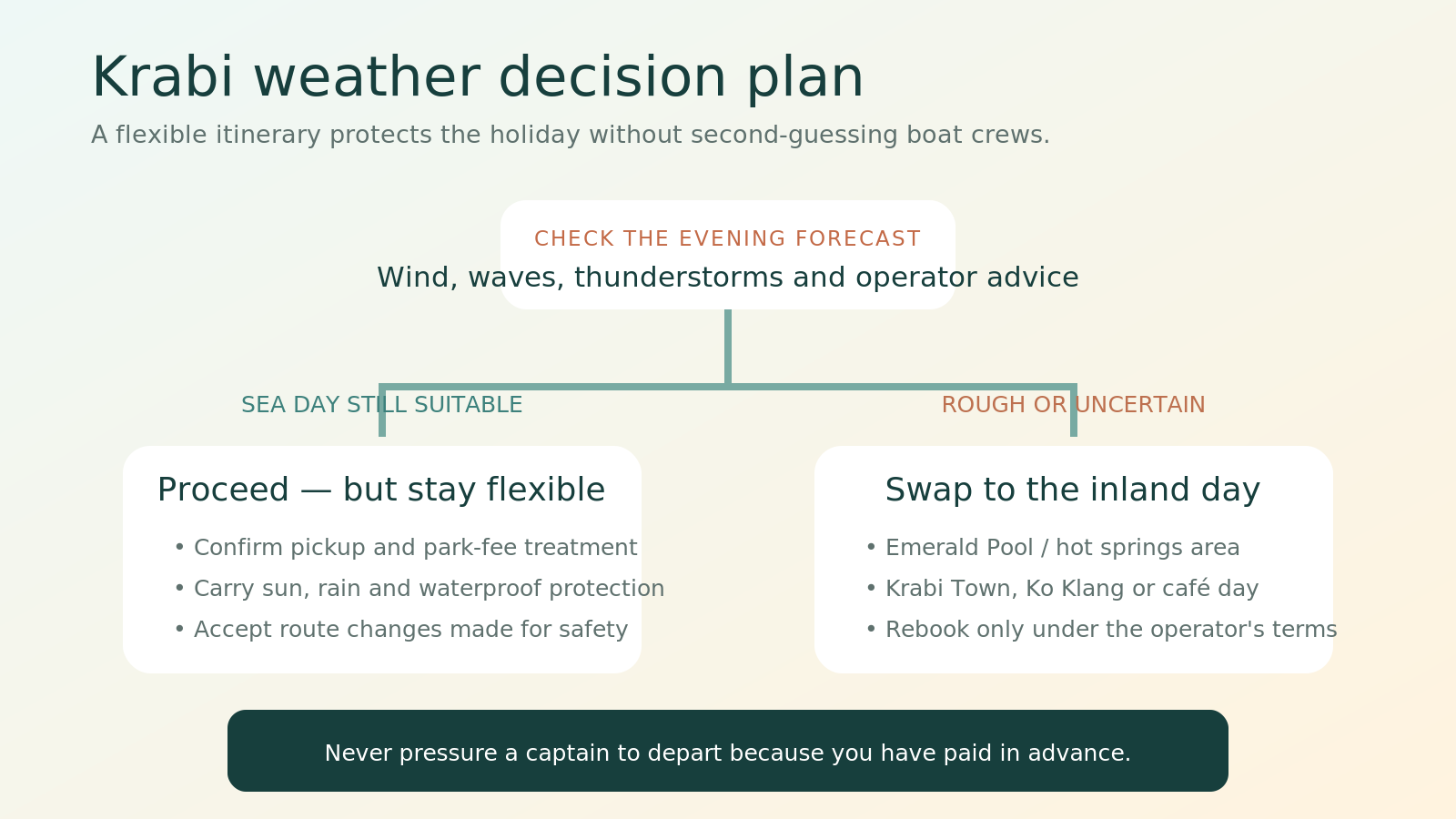
| Situation | Best response | Good alternative | Avoid |
|---|---|---|---|
| Brief shower, calm sea and operator running normally | Keep the plan but protect valuables and carry a light layer. | Shorten beach time if visibility deteriorates. | Assuming every grey cloud means cancellation. |
| Strong wind, thunderstorm risk or official marine warning | Move the boat day and follow operator or authority advice. | Emerald Pool, hot springs, Krabi Town or a flexible hotel day. | Shopping for a less cautious operator on the beach. |
| Tour cancelled by the operator | Request the stated refund or rebooking and keep written evidence. | Swap Days 3 and 4 when the next forecast is better. | Accepting a rushed replacement with unclear insurance or fees. |
| Persistent heavy rain | Reduce travel and prioritise safe road conditions. | Cafe time, massage, an indoor class or an early rest evening. | Hiking viewpoints, waterfalls in strong flow or red-flag swimming. |
Boat-day accessories compared
Krabi does not require a technical expedition kit. The useful items are the ones that prevent predictable failures: a wet phone, loose footwear during boarding, a flat battery or a day bag with no dry compartment.
Krabi boat-day product comparison
| Item | Useful for | Typical UK planning range | What to check | Main limitation |
|---|---|---|---|---|
| 5-10 litre roll-top dry bag | Towel, spare layer, wallet and small electronics | £10-£30 | Seams, closure instructions, strap and stated water resistance | Most lightweight bags are splash-proof, not suitable for prolonged submersion. |
| Waterproof phone pouch | Boarding photographs and keeping the phone accessible | £6-£20 | Seal test, phone fit, touch-screen use and the manufacturer’s depth statement | A rating does not remove the need for a pre-trip tissue test. |
| Secure water shoes or sandals | Wet landings, hot sand and rough approaches | £8-£30 | Heel security, grip, quick drying and comfort when wet | Cheap pairs can rub; break them in before the tour. |
| Reef-conscious high-SPF sunscreen | Long exposed boat days | £10-£25 | Broad-spectrum protection, water resistance and local marine guidance | Reapplication is still needed after swimming and towel drying. |
| Compact power bank | Long days with mapping, photos and e-tickets | £15-£40 | Airline capacity rules, cable type and actual device compatibility | Must remain dry and usually belongs in cabin baggage when flying. |
What to book first for a Krabi itinerary
The booking order matters because hotel location and transport are difficult to change, while a second tour is easy to add later. Reserve the fixed pieces first, then protect weather flexibility around the sea days.
| When | Book or check | Why this order works |
|---|---|---|
| As soon as dates are fixed | A well-located hotel with sensible cancellation terms | The right base saves more time than almost any tour upgrade. |
| After flights or arrival route are confirmed | Krabi Airport or onward transfer | Late arrival, luggage and final drop-off change the best option. |
| One to four weeks before travel | The single must-do island trip, preferably with flexible cancellation | You protect the priority day without locking every day to the original forecast. |
| A few days before the activity | Second excursion, inland driver or climbing session | The short-range weather picture and your energy level are clearer. |
| Evening before each sea day | TMD forecast, operator message, pickup point and park-fee method | Small changes are common and easier to solve before breakfast. |
Three-day and seven-day Krabi itineraries
A realistic three-day Krabi itinerary
Three-day version
| Day | Plan | Why it works |
|---|---|---|
| 1 | Arrive, Ao Nang and Noppharat Thara | Low commitment after travel |
| 2 | Railay and Phra Nang independently | Delivers Krabi’s signature cliffs without a long tour |
| 3 | Hong Islands if conditions are good; inland Krabi if not | Keeps one weather-dependent choice |
Skip Krabi Town unless your flight timing naturally creates a short stop. More importantly, do not squeeze Phi Phi into the departure day. Three days works because the route accepts that one major sea experience is enough.
A relaxed seven-day Krabi itinerary
Seven-day version
| Day | Plan |
|---|---|
| 1 | Arrive and settle into Ao Nang |
| 2 | Railay and Phra Nang |
| 3 | Hong Islands or Four Islands |
| 4 | Rest, beach, spa or cooking class |
| 5 | Emerald Pool and hot-spring area, or Khao Ngon Nak |
| 6 | Krabi Town and Ko Klang, or a second sea day after checking the forecast |
| 7 | Beach, lunch and departure buffer |
The extra value comes from the rest day, not from adding two more ticketed tours. When the weather is excellent, Day 6 can become Phi Phi or a private long-tail outing. When it is not, you still have a complete Krabi holiday rather than a cancelled itinerary.
Common Krabi itinerary mistakes
Mistake 1: changing hotels between Ao Nang and Railay
The places look close across the water, but luggage turns a short boat ride into a hotel-transfer operation. Visit Railay for the day unless the overnight atmosphere is a central reason for the trip.
Mistake 2: booking three consecutive boat tours
Hong, Four Islands and Phi Phi all involve pickups, waiting, boarding, sun and wet gear. By the third morning, the destinations blur together. Choose one major circuit, make Railay independent and leave one day flexible.
Mistake 3: judging tours by the number of stops
A seven-stop tour can deliver less meaningful time than a three-stop route. Ask how long the boat spends moving, how many passengers board and whether the schedule changes with tide.
Mistake 4: treating Ao Nang Beach as the final Krabi verdict
Ao Nang is a transport-friendly base, not the province’s only beach. Railay, Phra Nang, Hong, Klong Muang and Tubkaak each offer different scenery. Use Ao Nang for logistics, then explore deliberately.
Mistake 5: climbing Tiger Cave Temple in midday heat
The climb is optional and physically demanding. Start early, carry water, wear secure footwear and turn back when the heat or knees say enough. A holiday achievement is not worth a medical problem.
Mistake 6: ignoring park fees and cancellation terms
Tour posters may exclude national-park charges. Ask for the final adult and child price in writing, plus the weather-cancellation rule. DNP has used QueQ e-ticketing for Hat Noppharat Thara–Mu Ko Phi Phi, so access systems can evolve. [12]
Mistake 7: planning a boat trip before a flight
A delayed return creates stress even when the sea looks calm. Keep departure day on land and arrive at Krabi Airport with a generous buffer, particularly during high season when the airport handles increased traffic. [11]
Mistake 8: carrying loose valuables onto long-tail boats
Phones, passports and room keys disappear during wet boarding because travellers need both hands. Use a zipped pouch, keep cash separated and leave the passport in the hotel safe when the operator does not require it.
Mistake 9: renting a scooter without the correct cover
Cheap daily rent does not compensate for invalid insurance, poor road confidence or no helmet. Use a driver for inland Krabi when the alternative is learning on holiday traffic.
Mistake 10: forgetting Krabi Town and local communities
The coast is the headline, but Ko Klang, Krabi Town, mangroves and inland villages stop the trip becoming five variations of a boat photograph. TAT’s 2025 Travel with Care material specifically promotes community and nature routes across the province. [19]
Entry, insurance and safety checks before Krabi
British travellers should check the current Thailand entry page before departure. As at 25 August 2026, the FCDO page explains the passport, visa-exemption and Thailand Digital Arrival Card requirements; the TDAC should be completed only through the official Thai system. [20] [21]
Travel insurance should cover the complete itinerary and the activities you actually plan to do. That means reading the wording for boat trips, climbing, hiking, scooters and pre-existing medical conditions rather than relying on a generic ‘Thailand covered’ label. Current FCDO advice also explains that travelling against official advice can affect insurance. [22]
| Check | Action before travel | Why it matters |
|---|---|---|
| Entry rules | Check current passport, visa-exemption and Thailand Digital Arrival Card requirements for your nationality. | Rules can change and unofficial paid TDAC sites exist. |
| Travel insurance | Confirm medical, cancellation, boat, hiking, scooter and planned activity cover. | A low headline price can exclude the activity that creates the claim. |
| Emergency contacts | Save Tourist Police 1155 and your insurer assistance number offline. | You may need them when mobile data or battery power is limited. |
| Weather | Save the official TMD Krabi page and allow the operator to make the final local safety call. | A sunny hotel window does not show offshore wind or wave conditions. |
| Drones | Complete current CAAT and any other required registration before flying. | Thailand requires preparation; scenic cliffs do not create an exemption. |
Krabi itinerary FAQs
How many days are enough for Krabi?
Five days is enough for a balanced first visit. Three days covers Ao Nang, Railay and one island or inland day; seven days adds a proper rest day and more weather flexibility.
Where should first-time visitors stay in Krabi?
Ao Nang is the easiest first-time base because it combines hotels, restaurants, local boats, tour pickups and practical transport. Railay is more atmospheric but less convenient with luggage and inland trips.
Is Ao Nang or Railay better?
Ao Nang is better for logistics, restaurants and varied day trips. Railay is better for scenery, beaches and quiet mornings. Most first-time visitors should stay in Ao Nang and visit Railay for a full day.
Can I do Krabi in three days?
Yes, provided you use one hotel and choose only one major sea trip. Keep Day 1 local, spend Day 2 at Railay and use Day 3 for Hong Islands when conditions are good or inland Krabi when they are not.
What is the best island tour from Krabi?
Hong Islands is the best scenery-focused tour for many first visitors. The Four Islands route is the classic alternative for Poda, Chicken Island, snorkelling and the low-tide sandbar.
Is Phi Phi worth visiting from Krabi?
Phi Phi is worth it when Maya Bay and the famous island landscape are priorities. It is a long, structured day, so skip it when you dislike crowds or already plan to stay on Phi Phi.
Can you visit Railay without a tour?
Yes. Local long-tail boats connect Ao Nang and Railay when conditions permit. Confirm the current departure point, return arrangement and last practical boat before staying for sunset.
What is the best month for a Krabi itinerary?
December to March often gives the easiest mix of lower rainfall and calmer Andaman conditions. November and April can also work. May to October requires more flexibility and refundable sea-day bookings.
How much money do I need for five days in Krabi?
Excluding international flights, a useful planning range is about 10,000–17,500 baht per person for budget-comfort travel, 20,000–35,000 baht for mid-range travel and substantially more for resorts or private boats.
Do I need a scooter in Krabi?
No. Ao Nang, hotel pickups, local boats, songthaews, taxis and a hired driver cover the itinerary. Rent only with the correct licence, insurance, road confidence and helmet.
Is Krabi good in the rainy season?
Krabi can still be rewarding in the rainy season because the landscape is green and prices may fall. However, sea trips can change or cancel, so keep one inland day and avoid non-refundable consecutive tours.
What should I book first for Krabi?
Book a well-located hotel and your airport transfer first. Reserve one high-priority boat day with flexible cancellation, then leave the second paid excursion until the short-range sea forecast is clearer.
The five-day Krabi plan I would choose
I would stay in central Ao Nang, keep arrival day deliberately easy, take the first practical boat to Railay on Day 2, book Hong Islands on the best-looking sea day and reserve Day 4 for Emerald Pool plus one other inland stop. On Day 5, I would choose Krabi Town and Ko Klang only when the flight time leaves a comfortable airport buffer.
Krabi feels most rewarding when the itinerary contrasts its landscapes. One cliff-and-beach day, one island day, one inland day and one flexible local day reveal far more than a string of speedboat pickups. That is the route I would confidently recommend to a first-time visitor.
Sources and methodology
Research reviewed for this edition on 25 August 2026. Official tourism, weather, airport, immigration, park, aviation, police and UK travel-advice sources are prioritised. Commercial listings are used only to confirm that a linked service matches the planning decision; prices and availability must be checked live.
Official destination and itinerary planning
- Higher, Better Views! Bird’s Eye View – Ao Railay – Tourism Authority of Thailand. Official Railay geography and climbing context.
- Krabi-Trang 4 Days – Tourism Authority of Thailand. Official route linking Ko Poda, Thale Waek, Railay, Noppharat Thara and Emerald Pool.
- 10 Things to Do in Krabi – Tourism Authority of Thailand. Official overview including Railay, Hong, Emerald Pool and hot springs.
- Krabi’s Mythical Mountains – Tourism Authority of Thailand. Official inland and viewpoint planning context.
- Recommended Route for One Day in Krabi – Tourism Authority of Thailand. Official Krabi Town, Khao Khanap Nam and Ko Klang route.
- Krabi: Embrace the Charm of Nature, Relax and Unwind – Tourism Authority of Thailand. Official 2025 coverage of inland and community experiences.
- Andaman High-Season Overview – Tourism Authority of Thailand. Official seasonal Andaman context.
Weather, airports, parks and traveller safety
- Krabi Province Weather – Thai Meteorological Department. Official current and seven-day forecast.
- Heavy Rain and Strong Andaman Waves Advisory – Thai Meteorological Department. Official 2026 example showing why marine warnings matter.
- Krabi International Airport – Department of Airports, Thailand. Official airport contact and operations page.
- Krabi Airport Ready for High-Season Demand – Thailand Government Public Relations Department. Government airport operations context.
- National Park E-Ticket Pilot – Department of National Parks. Official QueQ e-ticket pilot including Hat Noppharat Thara-Mu Ko Phi Phi.
- Tourist Police Hotline 1155 – Tourist Police Bureau. Official contact page.
- Remotely Piloted Aircraft Registration – Civil Aviation Authority of Thailand. Official drone registration route.
- Thailand Safety and Security – UK Foreign, Commonwealth & Development Office. Swimming, outdoor, road and activity safety context.
Activities, transport and affiliate-link verification
- Hong Islands by Long-tail Boat listing – GetYourGuide. Commercial inventory checked for relevant duration, pickup and cancellation information.
- Four Islands Long-tail Boat listing – GetYourGuide. Commercial inventory checked for the classic Four Islands route.
- Railay Full-Day Rock Climbing listing – GetYourGuide. Commercial inventory checked to confirm a suitable supervised climbing comparison.
- Krabi Travel with Care – Tourism Authority of Thailand Tourism Product. Official sustainable community and nature route collection.
- Thailand Entry Requirements – UK Foreign, Commonwealth & Development Office. Current passport, visa and TDAC guidance for British travellers.
- Thailand Digital Arrival Card – Thailand Immigration Bureau. Official TDAC portal.
- Thailand Warnings and Insurance – UK Foreign, Commonwealth & Development Office. Current insurance and travel-advice context.
- Tiger Cave Temple, Emerald Pool and Hot Springs listing – Viator. Commercial inventory checked for a relevant combined inland tour.
- Ao Thalane Mangrove Kayaking listing – Viator. Commercial inventory checked for a lower-commitment nature option.
- Bangkok to Krabi transport inventory – 12Go Asia. Current route inventory used to confirm transport search relevance.
- Phuket to Krabi transport inventory – 12Go Asia. Current route inventory used to confirm transport search relevance.
- 12Go Affiliate Programme – 12Go Asia. Affiliate programme context; live deep links must be tested.
- Create Affiliate Links – Viator Partner Resource Center. Official affiliate-link parameter and sponsored-link guidance.
Image credits
All four editorial graphics were created specifically for Karen Taylor and Taylor’s Trailblazing Travels. No photograph, illustration or image from an earlier blog package has been reused.
Files: krabi-itinerary-2026-hero.png; krabi-five-day-route-planner.png; krabi-day-trip-comparison.png; krabi-weather-backup-plan.png.