City energy, northern culture, coastal breathing space.
A nine-night route for travellers who want three distinct chapters and accept two proper travel days.
A Thailand 10-Day Itinerary gives you enough time for three different regions, but not enough to ignore the joins between them. Bangkok, Chiang Mai and Krabi can fit into nine nights when the flights are sensible and you avoid filling every arrival afternoon with a paid excursion.
The reward is variety: a major capital, a northern city and a coastal finish. The cost is two domestic travel days, more booking decisions and less spare time in each place than the headline ten days suggests. This is an active first-trip plan, not a slow beach holiday disguised as one.
Use the full route when all three experiences genuinely matter to you. The two-base version is equally deliberate, and often better for families or anyone arriving exhausted. Neither route is ranked by commercial relationships; the comparison is based on night count, transport friction and the amount of uncommitted time left on the ground.
Three chapters
Capital, northern culture and Andaman coast.
Three nights each
Nine hotel nights; departure is day ten.
North-to-south flight
Check connections before paying for hotels.
Remove one region
Bangkok plus six nights on the coast.
How this Thailand 10-Day Itinerary fits together
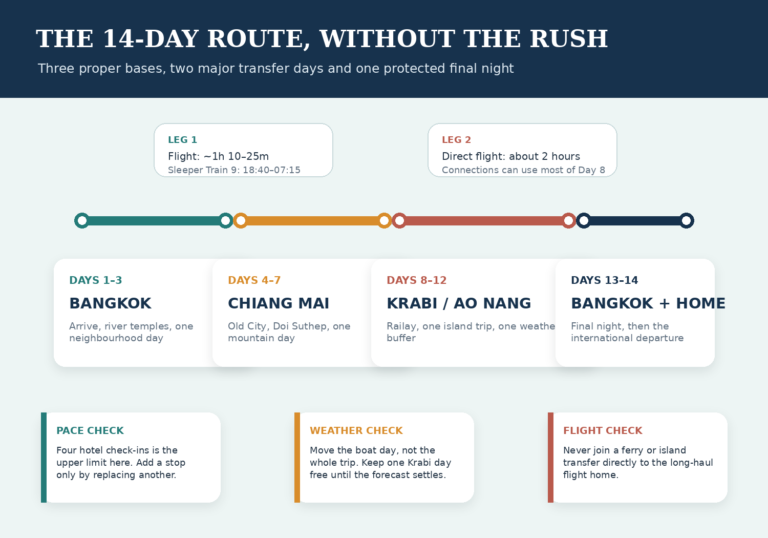
Inspect the Chiang Mai-to-Krabi flight before fixing all nine hotel nights. A route search can include connections as well as nonstop services. [1]
Nine nights, three distinct chapters
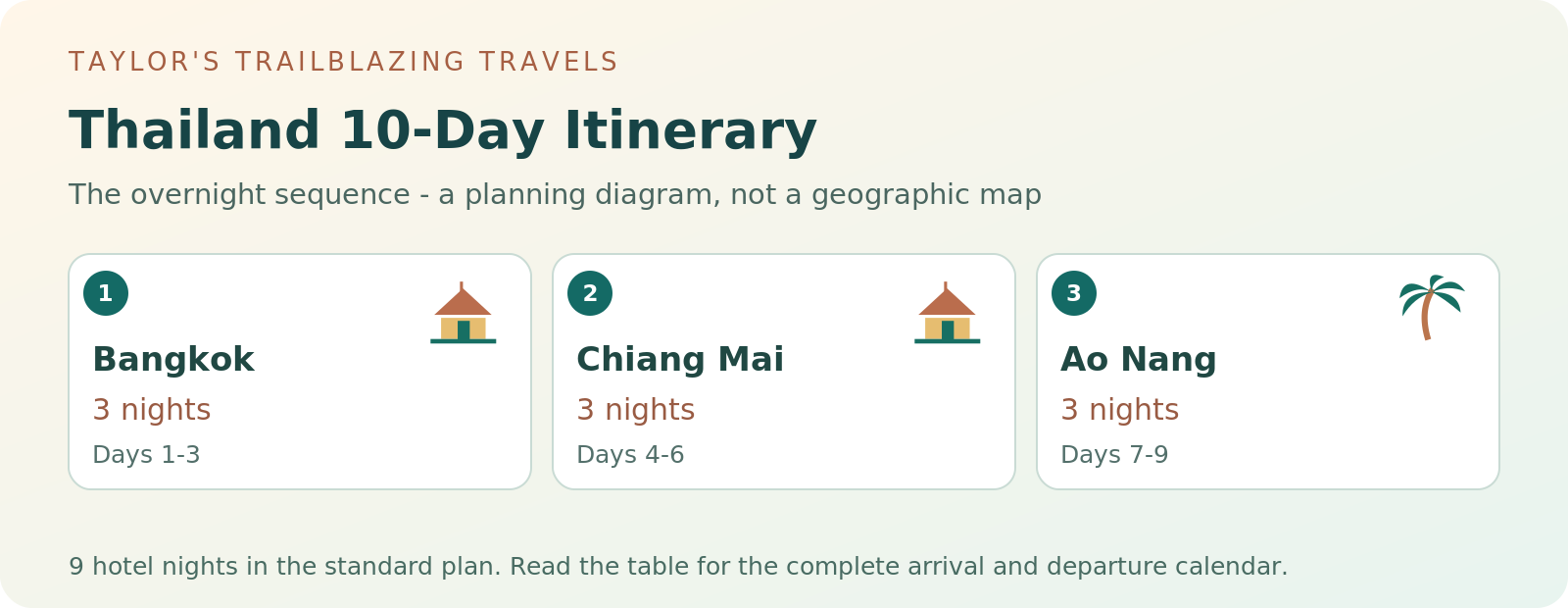
The basic allocation is three nights in Bangkok, three in Chiang Mai and three in Ao Nang. The arrival date is day one, the departure date is day ten, and the main domestic moves take place on days four and seven. That gives each destination two complete non-travel days rather than three. Keep that distinction visible when comparing the route with a package described simply as ten days in Thailand.
Bangkok provides the first city introduction; Chiang Mai earns its place through a different northern setting; Krabi supplies the coastal finish. The route is chosen for contrast and manageable stay lengths, not because it is an official recommended circuit. It assumes that suitable flights exist on the dates you choose and that you do not insist on adding an island hotel between Ao Nang and the international departure.
| Day(s) | Overnight base | Nights | Plan |
|---|---|---|---|
| 1-3 | Bangkok | 3 | Arrival and two city days |
| 4-6 | Chiang Mai | 3 | Travel north and two northern days |
| 7-9 | Ao Nang, Krabi | 3 | Travel south and two coastal days |
| 10 | Departure | 0 | A suitable onward ticket from Krabi |
This is a proposed calendar, not a published transport timetable. Scroll within the table on a small screen.
Set your personal threshold for moving around
Before booking, decide whether two domestic travel days feel acceptable. Some people enjoy a change of place every few nights; others find that the process interrupts the holiday just as they settle in. Neither preference is wrong. The simplified alternative later in the guide removes Chiang Mai and adds those nights to the coast, rather than compressing the remaining destinations to preserve an arbitrary checklist.
Day 1: reach Bangkok, recover and find your bearings
Keep the first afternoon uncommitted
Go from the arrival airport to the hotel and solve the immediate practical questions: when the room is available, where to eat nearby and how tomorrow's sightseeing begins. A morning landing can produce a useful afternoon, but immigration, baggage, traffic and the need for sleep make it unreliable as the foundation of a paid tour.
Request early access in advance when it matters, while recognising that a request is not the same as a guaranteed booking. Otherwise, plan for luggage storage and a nearby breakfast or lunch. The objective is to start the first full day rested, not to prove that every hour after landing has been used.
Choose a useful location rather than a fashionable label
For this itinerary, compare Bangkok hotels near the transport you expect to use. A straightforward walk to an MRT or BTS station may suit your city plans; a river location may suit a more tightly focused old-city visit. Check the actual route on a map, the room's noise exposure and the cancellation terms before deciding.
Spend the evening locally. Learn the hotel's entrance, save its address offline and confirm the next morning's transport. If you feel lively, extend the walk; if not, eat and sleep. Nothing essential in this ten-day route depends on achieving a major sight on arrival day.
Day 2: Bangkok's royal and riverside sights
Give one major attraction enough time
Choose the Grand Palace or Wat Pho as the morning anchor, with the other available as an optional addition. The official palace guidance has specific clothing restrictions, so dress for admission rather than hoping to solve the problem at the gate. Recheck opening notices when the date is close, especially around ceremonies or holidays. [2] [3]
Leave space for queues, shade and lunch. Two sights that look adjacent on a map can still require substantial time once entry procedures and the heat are included. An itinerary that lists them side by side should not be read as a promise that both will feel comfortable before noon.
Let the afternoon change the pace
After the main visit, take a river journey or choose one nearby riverside stop. The Chao Phraya tourist-boat network serves several useful piers, but different operators and services use different tickets and stopping patterns. Check the actual destination rather than boarding the first boat that arrives. [4]
Wat Arun can be the afternoon's temple if that remains appealing. Alternatively, stay on the east-bank side for a slow meal and a short walk. You will have another city day tomorrow and a northern temple landscape later in the trip; there is no need to make today's schedule carry every cultural experience.

Day 3: food and a Bangkok day that is not another checklist
Build a contrasting city day
Use the final full Bangkok day for a different rhythm: an indoor cultural stop, a neighbourhood walk or a meal that takes longer than usual. Jim Thompson House is one possible anchor, but its main house is visited with a guide and involves stairs. Confirm the available tour and access arrangements before fitting it into a tight timetable. [5]
Keep any shopping geographically coherent. Crossing the city repeatedly for individual shops can make the day feel like a series of transfers. Instead, choose one area that also has a useful lunch option and a simple journey back to the hotel. The aim is to leave Bangkok feeling you have experienced it, not merely moved through it.
Make the evening about food, with enough time to pack
Compare Bangkok Chinatown food walks when a guide would help you understand dishes and navigate a busy evening. Read the walking-distance and dietary information first. Independent eating works just as well for travellers who prefer to choose portions and stop when they are full.
Before leaving the hotel for the evening, check tomorrow's departure airport and pack the travel essentials separately. This removes the temptation to end a good night with a rushed search for chargers, passports and the domestic booking confirmation. A calm handover between destinations is one of the main ways the three-base route stays enjoyable.
Day 4: travel north to Chiang Mai
Choose the journey as part of the itinerary
For the standard route, fly north on day four and allow much of the day for the move. Airport access and formalities matter alongside the flight itself. A useful editorial allowance is roughly four to six hours from leaving a Bangkok hotel to settling into a Chiang Mai hotel, but actual schedules, traffic and delays can make it longer.
Compare Bangkok-to-Chiang Mai transport, then inspect the specific flight or train rather than a generic route summary. Check BKK versus DMK on the ticket. A late change of airport can be more disruptive than a slightly longer flight time, particularly when the first hotel was selected around the wrong departure point. [6]
The sleeper alternative changes a hotel night
An overnight train can replace the Bangkok hotel on night three, arriving on day four. It does not add a free extra night to the calendar. You would then have two initial Bangkok hotel nights, one rail night, three Chiang Mai nights and three Krabi nights: still nine nights altogether. Confirm the berth, boarding station and issued ticket through the dated railway information. [7]
This alternative suits travellers who want the rail experience and can tolerate uncertain sleep. It is less attractive when you would arrive needing another recovery day. Do not schedule a non-refundable morning tour immediately after the train; leave time for arrival, baggage and the hotel's check-in arrangements.
Day 5: Chiang Mai's old city and a northern food experience
Keep the first northern day close to the base
Explore a compact part of the old city rather than collecting temples on opposite sides of the wider area. A morning walk with one or two chosen visits leaves time to notice the streets, stop for lunch and return to the hotel when it gets tiring. Chiang Mai is a distinct northern destination in this route, not simply a cheaper repeat of the Bangkok chapter. [8]
Choose tomorrow's longer outing only after seeing how you feel. You may want a mountain-temple visit, a food activity or another local day. The three-night stop is short enough that adding too many distant excursions would leave little sense of the city where you are sleeping.
A cooking class can replace several smaller activities
Compare Chiang Mai cooking classes by the actual programme: class length, any market visit, transport, group size, dietary flexibility and return time. A half-day class can provide a meal and an activity in one coherent block. It should replace other plans that day, not be squeezed between an early excursion and a late market across town.
Ask which dishes can be adapted and how ingredients are handled. For serious dietary restrictions, obtain a specific answer rather than interpreting a broad label as a guarantee. Also check whether the location is in the city or at an outlying cookery school, because the transfer can materially change the day.
Day 6: Doi Suthep or a slower second northern day
Choose the mountain visit for the experience, not a promised view
Wat Phra That Doi Suthep offers a different setting from the city's temples. However, do not make a clear panorama the only reason to go: cloud, haze and rain can change what you see. Check current conditions and consider whether the temple visit itself would still be worthwhile for you. [9] [10]
Arrange the return transport before heading out. Compare how much of a tour is spent driving, what other stops are bundled in and how much time remains at the main temple. Compare Doi Suthep excursions when the transport and explanation justify the organised format. An itinerary with fewer stops can be more useful than one that promises every nearby viewpoint.
There is no obligation to leave the city again
A second local day is a good alternative, particularly after a sleeper arrival or during poor outdoor conditions. Choose another neighbourhood, an indoor activity or an extended lunch, then prepare for the next move. Do not add a long return trip to another northern city simply because it appears close enough on a regional map.
If a particular weekly market matters, check its actual operating day before moving bookings around it. A generic mention of a night market is not a reliable calendar. Keep the final northern evening flexible enough that packing and sleep are not pushed aside by an activity that was never essential to the trip.
Day 7: the important north-to-south connection
Book this leg before fixing both hotels
The Chiang Mai-to-Krabi move is the most important transport check in the itinerary. A convenient nonstop service on your dates keeps the day manageable; a connection can consume substantially more time. Search results may display both, so read the full routing and any self-transfer warning rather than assuming every result is a direct flight. [1]
Check Chiang Mai-to-Krabi options for the exact date. Compare baggage, departure time, connection protection and arrival time alongside price. If the available journey is particularly awkward, change the order of the trip or use the two-base version rather than forcing an exhausting transfer into the middle of the holiday.
Plan for an arrival evening, not an extra beach day
Reserve the whole date for travelling south and reaching the hotel. With a favourable flight you may gain a pleasant late afternoon, but it should feel like a bonus. Book no boat excursion that relies on everything running exactly on time. Confirm the ride from Krabi Airport to the hotel and whether a shared service has a collection or waiting period.
On arrival, eat locally and settle in. The next two dates are the main coastal days. Spending this evening locating the pickup point, confirming the marine forecast and understanding the hotel's surroundings is more useful than racing to a distant sunset spot with luggage still unpacked.
Day 8: a coastal day from Ao Nang
Keep one day for the nearby peninsula
Railay and the Phra Nang area are natural possibilities from Ao Nang when the conditions and boarding arrangements suit you. Use the day for a change of scenery without moving accommodation. The mainland base makes it easier to decide locally whether to go, delay or stay on land. [11]
Before departing, agree how the return works and where you need to be. Take a modest day bag rather than luggage you cannot manage comfortably around a boat landing. The activity should be shaped by the actual sea state and your abilities, not by a photograph taken on a different day.
Leave room for the setting itself
You can spend the visit walking, eating, looking at the scenery or swimming where conditions and local advice permit. There is no requirement to add climbing, a viewpoint or another boat ride. For a short coastal stay, a few unhurried hours in one place can be more memorable than repeatedly boarding transport.
Keep tomorrow as a second chance for the more weather-sensitive plan. That flexibility is useful only when you have not already booked incompatible non-refundable activities on both dates. Decide which excursion is the real priority and give it the better available conditions rather than the more convenient place in the original calendar.
Day 9: the optional island day and the final-night decision
Choose the boat trip by the day it will create
Compare Krabi island trips by pickup time, group size, time on the water, inclusions and cancellation arrangements. Check whether national-park admission or other charges are additional before comparing totals. One well-chosen outing is enough for this coastal chapter; a second full-day excursion is not required to justify travelling south.
If the weather is poor, use a land-based activity or simply stay local. Do not trade an operator cancellation for a more informal departure that ignores the reason the original trip was stopped. Current marine warnings and local safety decisions outrank the itinerary. [12] [13]
A Bangkok long-haul ticket changes today
For a separate international departure from Bangkok on day ten, return to Bangkok today instead of taking the excursion. The revised nine-night split is Bangkok three, Chiang Mai three, Ao Nang two, Bangkok one. That leaves just one complete coastal day, which may be too little to justify the full three-region route.
Compare Krabi-to-Bangkok flights before accepting that compromise. Often the better answer is the two-base route, or an international itinerary that genuinely works through Krabi. Do not quietly call a same-day self-transfer protected because it looks comfortable on paper; the contractual protection and the practical margin are separate questions.
Day 10: leave from the airport your ticket actually uses
Keep departure day local
The standard plan ends with a Krabi international departure or a suitable protected connection. Follow the airline's airport-arrival requirement and add the hotel journey on top. A late flight can allow a leisurely morning, but a distant excursion introduces unnecessary uncertainty when luggage, checkout and a fixed departure are involved.
Confirm baggage arrangements for the complete onward journey. A through-ticket may still have specific collection or check-in instructions, and a self-transfer requires even more attention. Read the airline confirmation rather than relying on the way a booking site groups flights visually.
Avoid a last-minute change of holiday geography
Do not use the final morning to visit another island, change to a different beach district or stop at several attractions on the way to the airport without a realistic time assessment. A final meal near the hotel is an entirely adequate ending. The good memories should come from the preceding days, not from discovering how close you can cut the last transfer.
The calmer two-base version and other sensible edits
Bangkok plus a longer coastal stay
For a more restful holiday, keep nights one to three in Bangkok and spend nights four to nine in the Krabi area. The six-night coastal block allows a boat day, a peninsula visit and several genuinely open days. It also means an unsuitable sea day does not necessarily remove your only chance for the preferred excursion.
This version suits families, travellers who dislike repeated packing and anyone whose main aim is a beach holiday with a city introduction. It may also make more financial sense because the north-to-south flight disappears. Do not automatically spend that saving on another overnight island move; the extra uninterrupted time is part of the benefit.
Bangkok plus Chiang Mai, without the coast
Use four Bangkok nights and five Chiang Mai nights when the cultural and food elements matter more than beaches. This removes the largest geographical jump and gives both destinations room for a rest day or a longer activity. An overnight train becomes easier to accommodate without immediately needing to prepare for another flight.
Alternatively, reverse the standard route only after comparing international gateways and domestic dates. Reversal is useful when it improves the actual flights; it is not automatically more efficient. Remember that an international arrival in Bangkok followed immediately by an unrelated domestic flight creates a new connection problem that the overnight city stay was originally avoiding.
A different coast means a replacement, not an addition
Samui can substitute for Krabi when seasonal conditions and the complete transport cost support it. Compare Koh Samui accommodation after checking the practical north-to-island connection. Do not retain Krabi as well merely because both places appeal. With ten days, that extra move would undermine the stay lengths that make this route work.
A final route test before you commit
Compare the usable days, not just the destinations
The three-base plan has six complete non-transfer days: two in Bangkok, two in Chiang Mai and two in Krabi. The two-base coastal version has seven: two in Bangkok and five in the Krabi area. Both use nine hotel nights and ten calendar dates. The difference is one fewer domestic move, plus a longer uninterrupted coastal chapter.
That extra full day is not the only gain. You also avoid one checkout, one new hotel arrival and one set of domestic baggage decisions. For a traveller who enjoys variety, those are acceptable costs of seeing the north. For someone whose priority is rest, they may be the strongest reason to choose the simpler route. Make the comparison using your preferred holiday rhythm rather than the apparent completeness of the map.
Test the international gateways as a complete booking
Compare a suitable arrival into Bangkok and departure from Krabi with the cost and practicalities of returning to Bangkok. Do not compare only the international fares: include the extra domestic ticket, transfers and any final hotel change. A multi-city international itinerary may be worth considering, but no assumption about its price or connection protection should be made until the actual offer is checked.
The reverse arrangement can also work when the dated flights favour it. However, an immediate self-transfer after a long-haul arrival creates a new vulnerable point. A route that avoids a final domestic flight is not necessarily better if it replaces that with an uncomfortably tight first-day connection. Judge both ends of the holiday together.
Make shared bookings match the group
Before payment, agree whether the group needs checked bags, adjacent seats, particular bedding or accessible rooms. A later addition to one traveller's booking can change the true price comparison. Keep the names and dates consistent across all the confirmations, especially when different people are buying different components.
Also agree which experiences are optional. Someone who does not want a mountain outing or a boat trip should have a comfortable local alternative rather than feeling obliged to attend because the group has already paid. With only two complete days at each base, a mismatch in expectations can matter more than a small difference in hotel standard.
Decide the fallback while changes are still affordable
Identify the last date for free cancellation or the actual change cost on each booking. These conditions are not always aligned: a flexible hotel does not make the associated flight flexible, and a refundable tour may still have a deadline before you see the local forecast. Save the terms with the confirmation instead of assuming they can be reconstructed later.
Should a key flight change, revisit the whole night allocation before replacing it automatically. A different travel date may create a hotel overlap or remove a complete local day. The fallback should preserve a coherent holiday, even when that means dropping a region rather than trying to maintain every original reservation.
Weather, air quality and why three regions need separate checks
Avoid a single national weather assumption
Thailand's regional weather differences matter more when one trip spans the capital, the north and the coast. The general climate background is useful, but it cannot predict the conditions of a specific ten-day window. In particular, the southern east coast can remain wet during parts of the period usually described as Thailand's cool season. [14] [15]
For Krabi, keep the coastal plans useful without daily boat access. For Chiang Mai, look at current air-quality information and outdoor conditions before paying for a landscape-focused excursion. Check the timestamps on readings: a map displaying old data is not evidence of today's conditions. [10]
Build flexibility where it has the highest value
It is usually easier to change the order of two local excursions than to move every hotel and flight. Therefore, fix the main route only after the seasonal choice makes sense, then keep individual outdoor days movable. During disruption, remove the least important activity rather than turning the following day into a catch-up marathon.
An indoor alternative should also be something you would enjoy, not an emergency chore. Identify one food or cultural activity in each city and a comfortable hotel-based option on the coast. That preparation makes a wet afternoon less consequential without pretending weather will never affect the trip.
Choose three hotels that support the route
Chiang Mai needs a city base, not just an attractive room
Compare Chiang Mai old-city accommodation with attention to the exact address, road access and recent noise comments. A hotel useful for walking and food can reduce the need for repeated transfers. However, check that the room type and access arrangements meet your needs rather than relying on the district alone.
Confirm the check-in plan after an overnight train or an early flight. Paying for guaranteed early access may be worthwhile when a poor night's sleep would otherwise waste a full day, but do not assume it is included. Luggage storage and a gentle first-day programme are the fallback, not an immediate mountain excursion.
Ao Nang should match your preferred evenings
Compare Ao Nang accommodation by the balance between restaurant access, quiet sleep and pickup convenience. A resort outside the main walking area can work beautifully for a hotel-focused finish, but the transfer implications belong in the budget. A slightly higher room price may be offset when fewer taxi journeys are needed.
Keep all three hotel confirmations together with the arrival dates and nights shown explicitly. A booking running from the fourth to the seventh is three nights, even though it touches four calendar dates. This simple check prevents the most common gap when changing from a city stay to a northern stay and then to the coast.
The cost of seeing three regions in ten days
A transparent model, not a promised package price
These illustrative allowances were prepared on 5 October 2026. They describe one adult sharing accommodation, staying nine nights and travelling for ten calendar days. The model includes two domestic flights but excludes international flights, insurance, shopping and any extra domestic return to Bangkok. Room figures are each person's share of a double or twin, not a quote for a specific hotel.
| Component / assumed allowance | Lean model | More-comfort model |
|---|---|---|
| Accommodation: 9 nights x THB 500 / 1,250 per person | THB 4,500 | THB 11,250 |
| Food: 10 days x THB 500 / 900 | THB 5,000 | THB 9,000 |
| Two domestic flights allowance | THB 5,000 | THB 9,000 |
| Airport and local transport allowance | THB 2,000 | THB 3,500 |
| Visits and selected activities | THB 3,000 | THB 5,250 |
| Subtotal | THB 19,500 | THB 38,000 |
| 15% contingency | THB 2,925 | THB 5,700 |
| Illustrative total per adult | THB 22,425 | THB 43,700 |
Planning model dated 5 October 2026. Prices are assumptions, not checked bookable offers. International flights, insurance and shopping are excluded; read the section for route-specific exclusions. Scroll this table horizontally on small screens.
Test the expensive components first
Price the north-to-south flight and the coastal hotel before deciding that the whole trip fits your budget. Those components can change significantly by date, baggage requirement and room type. If their actual quotes exceed your allowance, the two-base itinerary is a meaningful structural saving rather than a long sequence of small sacrifices.
Do not compare a flight without bags against one with the baggage you need. Similarly, compare room occupancy, taxes and cancellation conditions consistently. An apparently cheaper itinerary can become more expensive once airport transfers, additional meals in transit and a final gateway night are included.
Adjust for the people travelling
A solo traveller using private rooms will carry more of the accommodation cost. A family may share some vehicle costs but require a larger room, two rooms or specific bedding. Replace the model's assumptions with the actual booking requirements rather than multiplying one adult total by the number of people and expecting accuracy.
The reserve is not a prediction that something will go wrong. It is a way to avoid making every later decision depend on the cheapest available option. Keep it separate from discretionary spending until the final transfers and accommodation are settled.
Documents, mobile access and booking administration
Three bases create more small details to check
Use a single travel note with the arrival and departure airports, hotel addresses, booking references and luggage limits. Each time you add a booking, update the actual date and nights rather than relying on memory. A screenshot of a search result is not the same as a ticket, and an emailed receipt may not contain the final boarding instructions.
Check current Thai entry requirements for your passport and previous visits before paying for non-refundable arrangements. For British travellers, the Embassy's current guidance is particularly relevant when using visa exemption. The TDAC is a separate government arrival form, not evidence that immigration permission has been granted. [16] [17]
Keep connectivity useful but not essential to every step
Compare Thailand eSIM plans through Airalo when the phone is compatible and unlocked. Check coverage, activation rules and the validity period against the complete ten-day trip. An allowance that expires before the final transfer is less convenient than its headline data quantity suggests.
Save transport vouchers and hotel addresses offline as well. Carry the important personal items in the cabin bag and check each domestic carrier's restrictions separately. The longer international baggage allowance does not automatically apply to a domestic ticket bought on its own.
Make the three-base plan fit your energy level
Couples and friends with different priorities
Agree on the non-negotiable experience in each region before buying activities. One person may value a cookery class, another the mountain temple and another the beach. Keep those priorities, then leave the surrounding time loose enough for different energy levels. A shared itinerary need not require everyone to take every optional excursion.
Do not use the final city evening to compensate for everything missed earlier. A satisfying meal and an easy return often support the next day's journey better than one more cross-city outing. Ten days can feel generous when the travel handovers are calm, or very short when every evening ends late and every departure starts early.
Families and travellers who need more recovery time
The two-base version is the first adaptation to consider, not the last resort after all the activities have been shortened. Removing a complete hotel change creates more flexibility than trimming ten minutes from several sightseeing stops. It can also reduce the need to organise repeated car seats, luggage transfers and check-in arrangements.
With access requirements, ask the hotels and activity providers about the specific room, vehicle and boarding process. A destination-level accessibility claim cannot answer every practical question. The route should be judged by the experience of the least comfortable traveller, not the fastest member of the group.
The honest advantages and compromises
What the full route offers
The three chapters provide a broad first impression without changing hotel every night. Each base has two complete local days, and the order naturally ends with a less urban setting. For travellers who enjoy variety and do not mind flying, this can be a rewarding use of ten days.
What it cannot provide
It is not a comprehensive northern journey or an extended island holiday. Flight logistics take a meaningful share of the trip, and a separate Bangkok departure can shorten the coastal finish further. Choose the full version because the three regions matter to you, not because leaving one out feels like failing to see Thailand properly.
Mistakes that undermine the ten-day route
Booking the hotels before examining the middle flight
The north-to-south connection can determine whether the itinerary feels smooth or tiring. Check it before paying for accommodation that cannot be changed. A poor routing is a reason to revise the plan, not a detail that can always be solved cheaply afterwards.
Adding a day trip that is really another travel day
A distant northern excursion or a far-off island tour may look like one extra activity, but its transport can dominate the date. Compare the total time away from the hotel with the time at the destination. Sometimes a nearby experience gives more of what you actually wanted.
Treating protected and separate connections as equivalent
A generous gap helps a self-transfer, but it does not turn two contracts into one protected itinerary. Equally, a single online checkout does not prove that every connection is covered. Read the terms and keep the final night's accommodation aligned with the actual protection you have purchased.
Ten-day Thailand itinerary questions
Is three destinations too much for ten days?
It is workable for travellers who like variety and accept the two domestic travel dates. The decisive detail is that three nights at each base gives two complete local days, not three. If that already feels too brief, choose two destinations before booking. There is little benefit in paying for a third region while resenting the time spent getting there.
Which destination should I remove for a slower trip?
Remove Chiang Mai when the coast is the main purpose, keeping Bangkok as the city introduction. Remove Krabi when northern food, temples and a rail journey appeal more than beaches. Either edit produces a coherent holiday. Trying to retain all three while adding rest days requires more time than the ten-day calendar contains.
Can I use the sleeper train without changing the day count?
Yes. Replace the third Bangkok hotel night with the train night and arrive in Chiang Mai on day four. You still have nine nights in total, but one is on the train rather than in a hotel. Confirm the actual berth and station, and keep the arrival morning open in case sleep or the journey is less straightforward than hoped. [7]
Is a nonstop Chiang Mai-Krabi flight guaranteed?
No. Availability and timing depend on the date and airline schedule. Route-search pages can include connecting journeys, so inspect the specific result. A convenient flight may make the three-region version attractive; an awkward connection may be a reason to reverse the route or remove one region. Do not build non-refundable hotel stays around an assumed daily service. [1]
Should I spend the last night in Bangkok?
For an independently booked international departure from Bangkok, a final gateway night is the more cautious planning choice. In the standard nine-night allocation, that means removing one Ao Nang night. An international itinerary that genuinely works from Krabi may avoid this change, but verify the ticket and baggage arrangements rather than assuming the flights are connected operationally.
Is this itinerary suitable during rainy periods?
It can be, with realistic expectations and local activities that do not all depend on clear weather. Keep the two coastal dates interchangeable and choose accommodation you would enjoy during an indoor afternoon. Check current warnings before boat trips. Where seasonal conditions make the coastal choice unattractive, substitute a region or simplify the route rather than attempting to outrun the rain every day. [12]
How much advance planning is really necessary?
The international flights, night allocation and important domestic connections deserve early attention. Local afternoons do not all require reservations. Book limited-capacity experiences when they are genuine priorities, but leave enough flexibility to respond to fatigue and weather. The objective is a reliable route with adaptable days, not a document in which every meal and walk has a fixed start time.
Choose three regions only when the joins are good
Follow the three-night Bangkok, three-night Chiang Mai and three-night Krabi version when the flights work and the variety is worth the movement to you. Protect the two main transfer dates from extra obligations. Then give each place a small number of meaningful experiences rather than a long compulsory checklist.
When the north-to-south flight is awkward, the final Bangkok return removes too much beach time or the group needs a slower pace, choose two bases without apology. A well-paced ten-day holiday in two places is more complete as an experience than a three-region route that never allows you to settle anywhere.
Sources and fact-checking notes
What was checked, and what remains a planning choice
Source pages were reviewed on 5 October 2026. Official entry and attraction information supports the specific visitor details. Night allocations, suggested time margins, route comparisons and budget models are editorial planning judgements, not official itineraries, guaranteed schedules or personally tested bookings. Recheck operational notices and your actual ticket before travel.
- 12Go: Chiang Mai-Krabi route search. A dated result may mix nonstop flights with connections; inspect the actual itinerary. Reviewed 5 October 2026.
- Bureau of the Royal Household: Grand Palace visits. Official opening information, admission and clothing rules. Reviewed 5 October 2026.
- Wat Pho: plan a visit. Official visitor information and admission. Reviewed 5 October 2026.
- Chao Phraya Tourist Boat: operator information. River-boat stops and service information; check the dated timetable. Reviewed 5 October 2026.
- Jim Thompson House: visitor information. Guided entry, opening hours, luggage and stair access. Reviewed 5 October 2026.
- Airports of Thailand: airport-transfer information. BKK and DMK are different airports. The page displays conflicting hours, so no exact shuttle timetable is relied on here. Reviewed 5 October 2026.
- State Railway of Thailand: D-Ticket. Use a dated search for the station, train, berth and issued ticket. Reviewed 5 October 2026.
- Tourism Authority of Thailand: Chiang Mai. Destination context for the northern city. Reviewed 5 October 2026.
- Tourism Authority of Thailand: Wat Phra That Doi Suthep. Temple and destination background, not a promise of clear views. Reviewed 5 October 2026.
- Pollution Control Department: Air4Thai. Check current readings and their timestamps, especially before northern outdoor days. Reviewed 5 October 2026.
- Tourism Authority of Thailand: Krabi. Ao Nang as a base for the peninsula and offshore excursions. Reviewed 5 October 2026.
- Thai Meteorological Department: forecasts and warnings. Check current provincial and marine forecasts close to travel. Reviewed 5 October 2026.
- FCDO: Thailand safety and security. Transport, sea-travel, local-law and seasonal safety advice. Reviewed 5 October 2026.
- Tourism Authority of Thailand: climate and weather. Seasonal background; not a forecast for an individual holiday. Reviewed 5 October 2026.
- Thai Meteorological Department: November-January climate normals. Only the clearly labelled 1991-2020 climate-normal discussion is used; the dated forecast is not treated as a 2026 forecast. Reviewed 5 October 2026.
- Royal Thai Embassy, London: visa exemption. Current exemption conditions; the permission stamped on arrival controls the stay. Reviewed 5 October 2026.
- Thai Immigration: official arrival-card guidance. Official TDAC instructions, eligibility and submission window. Reviewed 5 October 2026.
Illustrations in this article were created for Taylor’s Trailblazing Travels. Third-party photographs, where used, are credited beside the image or in the source list.