Thailand Beaches Itinerary: 10 Days

Thailand Beaches Itinerary: 10 Days
More time beside the sea, fewer days moving between islands.
A Thailand beaches itinerary is better measured in usable beach days than in the number of islands on the booking confirmations. With ten days, moving between both coasts can leave you knowing more about piers and luggage loading than the places you came to enjoy. This route stays in the Krabi area, combining an Ao Nang base with a longer Koh Lanta stay.
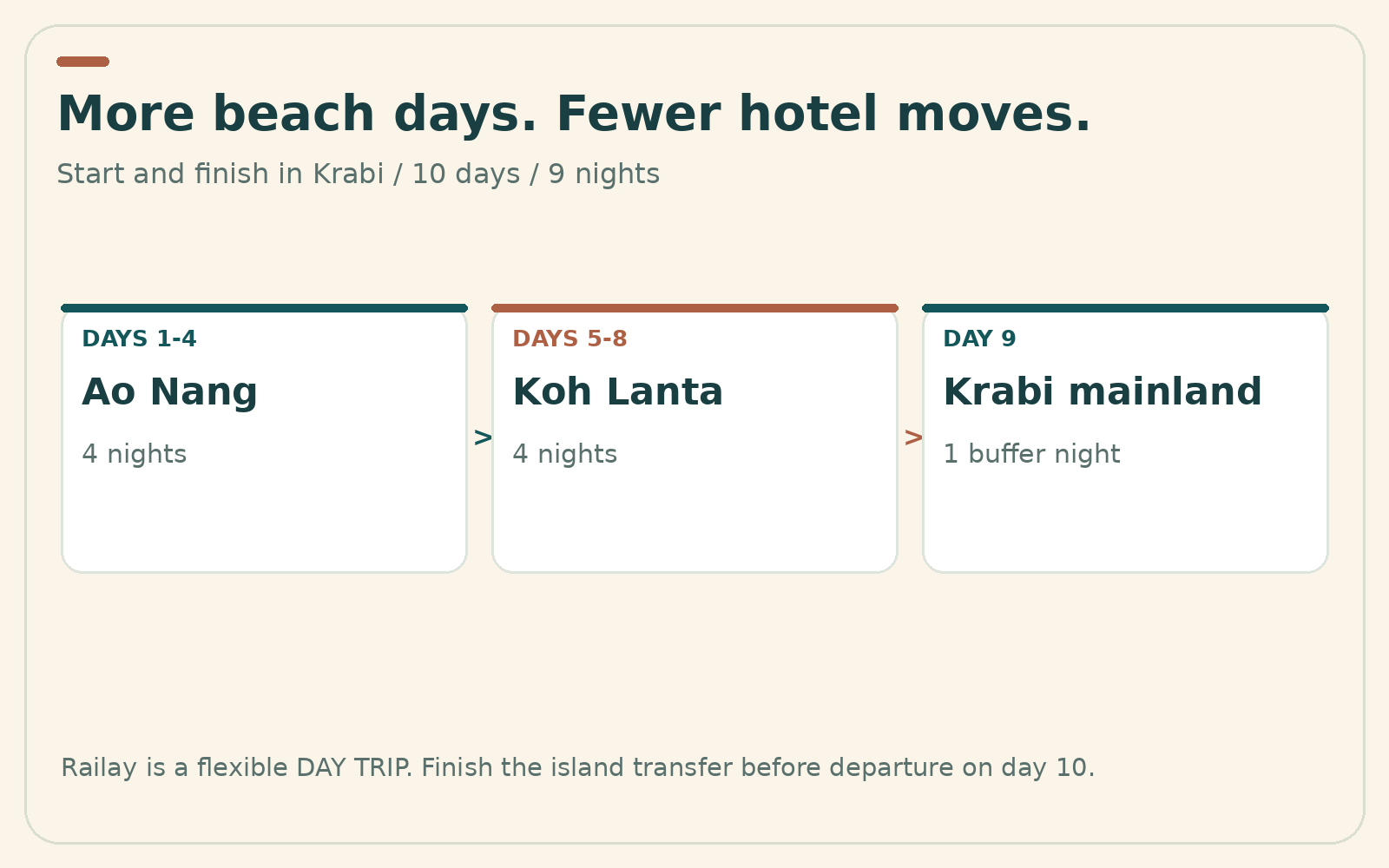
The main plan starts and ends at Krabi Airport. It uses four nights in Ao Nang, four on Koh Lanta and one final night back on the mainland, giving nine nights across ten days. Bangkok is not quietly squeezed into the arrival or departure day. Travellers whose international flights require Bangkok should add a proper gateway arrangement or use the alternative later in the guide.
These recommendations are research-led planning choices, not claims that I personally inspected every beach. Bases were compared for transfers, beach variety, everyday convenience and the ability to change plans when sea conditions deteriorate. A scenic photograph is not evidence of safe swimming on your chosen day. [1] [2]
This article contains affiliate links. If you book or buy through them, Taylor’s Trailblazing Travels may earn a commission at no extra cost to you. The route recommendations are based on the planning considerations explained in the guide.
Ao Nang + Koh Lanta
Two main beach stays, not a cross-country circuit.
Railay for the day
Avoid another hotel move unless it is a priority.
Keep a spare island day
Move or drop boat trips when necessary.
Finish on the mainland
Complete the island transfer on day nine.
Thailand beaches itinerary: a ten-day plan with room to swim
Two beach bases, plus a departure buffer
Ao Nang is the practical opening base for access to Railay and nearby coastal outings. Koh Lanta then gives the holiday a different rhythm, with several nights in the same beach area. Returning to the mainland for the last night reduces dependence on an island transfer immediately before a flight.
The last night is not an extra night outside the headline duration. Four plus four plus one equals nine, leaving departure on day ten. You may stay in Ao Nang again or choose a mainland location that better suits an early flight. The important point is to finish the island transfer on day nine.
| Days | Overnight base | Nights | Main plan |
|---|---|---|---|
| 1-4 | Ao Nang | 4 | Arrival, local beach time, flexible Railay visit and optional island outing. |
| 5-8 | Koh Lanta | 4 | Transfer, two full flexible days and a spare day for weather. |
| 9 | Krabi mainland / Ao Nang | 1 | Finish the island transfer before the flight day. |
| 10 | Depart Krabi | 0 | Airport transfer and departure. |
Total: 9 nights. The main route starts and finishes in Krabi; Bangkok is not included without an explicit adjustment.
What this route deliberately leaves out
Phuket, Phi Phi, Koh Samui and Koh Tao are not compulsory additions. Each can be worthwhile on another itinerary, but adding several of them here would replace beach time with transfers. The main route also does not require a boat trip every day. One well-chosen outing and several ordinary beach days may be the better holiday.
Think of the plan as a set of priorities rather than a fixed weather timetable. Railay and an optional island tour can swap between days two, three and four. Likewise, a Koh Lanta boat outing can move within the stay or disappear completely when conditions do not suit it.
Day 1: arrive in Krabi and settle into Ao Nang
Keep the first transfer uncomplicated
Arrange transport from Krabi Airport to the exact accommodation address. A ticket described as serving Ao Nang may use a shared route, a central drop-off or a hotel pickup zone with exceptions. Confirm luggage space and whether the quoted service is private or shared before comparing prices.
Do not book a same-afternoon island excursion around the scheduled flight arrival. A delay, baggage collection or the hotel transfer can remove that margin. Instead, check in, find a nearby meal and take a short walk once you know how much daylight and energy remain.
Choose a base that supports everyday beach time
For this itinerary, convenient access to food, transport and the waterfront usually matters more than an isolated room with a dramatic view. Check the walk from the hotel to the area you expect to use, including hills and road crossings. A broad map label does not tell you whether repeated walks will be comfortable.
A pool can be valuable because the sea will not always suit swimming. However, verify pool opening, supervision and access rules rather than treating a photograph as a guarantee. For families, a room that makes rest and early evenings easy may be more useful than a hotel chosen solely for a beach-bar atmosphere.
Day 2: an ordinary beach day is part of the point
Get to know the base before leaving it
Spend the first full day locally. Walk a manageable stretch of the coast, identify shaded breaks and decide which places feel comfortable for food and everyday supplies. This is practical orientation, not a wasted day before the 'real' holiday begins.
Assess the beach on the day itself. Look for current warning flags, lifeguard advice, boat activity and changing conditions rather than relying on the water's appearance from the road. Swimming is optional, and a pool or a shaded afternoon is the right substitute when the sea is unsuitable. [3]
Use the afternoon to make the next days easier
Check boat departure arrangements for Railay, ask the accommodation about current conditions and choose one possible island outing. You do not need to purchase every remaining activity immediately. A flexible reservation or an informed decision to wait may be more useful than a discount that locks you into a poor-weather day.
Plan an early evening when jet lag is still affecting you. A ten-day itinerary contains enough opportunities without using the first full day to prove how much you can do. Returning to the same comfortable dinner area can also reduce decision fatigue while you settle into the holiday.
Day 3: Railay without another hotel change
Go for the landscape, with realistic boat arrangements
Railay offers a distinctive limestone setting and several different waterfront areas. TAT describes access by passenger boat from the Ao Nang area; this is a boat excursion, not a place you reach by continuing along a coastal road. Confirm the current departure point, return arrangements and weather suitability locally. [4]
Keep valuables protected from splashes and take only what you can carry comfortably. Depending on the service and conditions, boarding or landing may involve an awkward step or wet feet. Travellers who need assistance should ask specifically about the actual boat and landing method before paying.
Do not treat every waterfront as the same beach
Railay West, Railay East and Phra Nang have different settings and uses. TAT distinguishes the west-facing beach from the eastern side and the Phra Nang area. Walk a sensible route between the places that interest you, while respecting access signs and avoiding an assumption that every patch of shoreline is intended for swimming. [4]
Have a clear return plan before the end of the afternoon. An advertised last departure is not a reason to wait until the final possible moment, particularly when conditions may change. If rough weather makes the excursion doubtful, move it to another day or leave it out; the hotel does not have to change for the itinerary to remain enjoyable.
When an overnight stay would be a better fit
Railay may deserve an overnight stay for travellers who specifically want its evening atmosphere or a longer climbing-focused visit. However, that is a different emphasis. For this ten-day route, a day trip preserves time on Koh Lanta and avoids handling luggage through another boat arrival and departure.
Day 4: choose one island outing, or keep it simple
Compare the actual experience rather than the island count
An organised outing can add scenery, swimming opportunities or snorkelling when conditions allow. Compare time on the boat, time at each stop, group size, pickup arrangements, life jackets and cancellation terms. A tour visiting more islands is not automatically better than one giving you meaningful time at fewer places.
Read what the price includes and whether park admissions or other charges are separate. Also ask what happens when a named stop is closed or sea conditions make the advertised route inappropriate. The answer should explain a genuine alternative or refund arrangement rather than simply promise that boats always run.
A shore-based day can be the right decision
Skip the tour when someone dislikes boats, when the forecast is poor or when you would rather spend another day on the coast. You already have a second beach base ahead. There is no need to add a tiring trip merely because it appears on most Krabi itineraries.
Use part of the afternoon to prepare for Koh Lanta: confirm the pickup, luggage arrangements and exact hotel drop-off. Then pack so you can reach water, documents and any essentials without opening the main bag during the journey. Tomorrow is a transfer day, even when the distance looks modest on a map.
Day 5: transfer to Koh Lanta and stay put
Understand what 'overland transfer' includes
Koh Lanta can be approached using road transport and a vehicle-ferry connection, as well as passenger-boat options when operating. A road-based transfer is not the same as a journey with no water crossing. Confirm the operating route, any ferry element and current conditions with the supplier. [2] [5]
For planning, reserve most of the morning or afternoon for the move. A three-to-five-hour door-to-door allowance is an editorial buffer for pickups, crossings and the final hotel drive, not a guaranteed published duration. Your actual service may differ significantly according to its route and stops. [5]
Choose one Lanta beach area for the whole stay
Four nights in one location create enough time to learn the beach's daily rhythm without continually relocating. The northern and central-western beach areas can be convenient starting points for comparing accommodation, while more distant bays may suit travellers who accept longer transfers and fewer walkable choices. Check the actual location and surroundings rather than relying on the word 'beachfront'. [2]
After arrival, eat locally and take a short orientation walk. If the transfer runs late, do not attempt to rescue the day with a cross-island drive. A comfortable first evening helps the next three days feel like a stay rather than a pause between journeys.
Day 6: make the first Lanta day genuinely slow
Start with your own beach area
Have breakfast without an early tour pickup, then spend time near the accommodation. Look at the conditions, identify a comfortable stretch of sand and check where boats, rocks or changing water levels affect use of the shore. A beach can look very different across the day, so yesterday's arrival view is only a starting point.
Keep the main bag in the room and carry only the items needed for a short outing. That makes it easier to return for shade, food or rest. Meanwhile, avoid leaving valuables unattended while everyone goes into the water; a relaxed atmosphere does not remove the need for ordinary precautions.
Choose a second outing only when it adds something
A short local visit or a different dinner setting can provide variety later, but neither is compulsory. Consider the return journey before travelling to a more isolated bay. A taxi or hotel-arranged vehicle can be preferable to renting a scooter simply because it looks convenient.
The route does not depend on self-driving. Thailand's road risks and licensing requirements deserve serious attention, and a casual rental decision is not a substitute for appropriate experience and insurance. Choose transport that suits your actual abilities rather than treating a scooter as an essential island accessory. [3]
Day 7: a conditional sea day, not a guaranteed one
Check the park and the sea before choosing the trip
Koh Lanta is used as a base for marine outings, but some surrounding islands and marine areas have seasonal closures. TAT notes typical monsoon-season closures for several offshore sites from May through October; exact current access and operating conditions must be checked with the relevant authorities and provider. [2]
Ask how long you will spend travelling compared with time in the water, whether the trip suits beginners and what supervision is provided. A small group is not by itself a safety guarantee. The boat, equipment, crew decisions and conditions matter as well.
Be prepared to say no on the day
Do not board a boat that appears overloaded or lacks a suitable life jacket for each traveller. Follow local warnings and the operator's safety briefing, and do not pressure a crew to continue in conditions it considers unsafe. Equally, a trip still being offered is not proof that it suits your comfort or needs. [6]
For non-swimmers or nervous swimmers, ask what participation actually involves before paying. A scenic boat outing and a snorkelling-focused trip are different experiences. Choosing the former, or staying ashore, can be a better fit than spending the day anxious about getting into deep water.
Day 8: protect the spare day
Use it for what the holiday still needs
The final full Lanta day can absorb a moved boat trip, a second beach day or a quieter local activity. This flexibility is one reason to stay four nights rather than two. Without it, a single poor-weather day can make the whole island visit feel like a missed opportunity.
A cooking class is one possible non-beach alternative when you want an organised experience. Check pickup, teaching format and dietary requirements, and do not assume every class will run simply because you can see an old listing. A hotel afternoon and an unhurried dinner remain equally valid choices.
Confirm the mainland return before the evening
Reconfirm tomorrow's transport, the hotel pickup time and the destination on the mainland. Choose a departure that leaves room for delays rather than arriving at the mainland accommodation at the last possible moment. The final night is a buffer, but its usefulness depends on actually completing the island transfer that day.
Pack any wet items separately and check the room carefully before leaving the next morning. A beach holiday accumulates small items in balconies, bathrooms and beach bags. Finding them now is much easier than attempting to arrange a recovery after reaching Krabi.
Days 9-10: finish on the mainland
Day 9: leave the island before flight day
Return from Koh Lanta to the Krabi mainland using a suitable confirmed service. Check the route and current conditions again, particularly if the transfer includes a ferry. A road-based option may change the nature of the journey, but it does not guarantee immunity from weather, traffic or operational disruption. [7]
Spend the last night where it best supports the departure. Ao Nang offers a familiar setting when the flight is later; a more airport-convenient mainland location may suit an early start. Compare the practical transfer rather than choosing another beach hotel solely because this is a beach itinerary.
Day 10: departure without an island connection
Arrange the correct airport transfer, reconfirm pickup and follow the airline's check-in guidance. The itinerary's margin means you are no longer relying on leaving Koh Lanta that morning. Nevertheless, the final road journey still deserves a realistic allowance and a current check for disruptions.
When an international journey requires a separate Bangkok connection, plan that explicitly. You may need to use day nine to reach Bangkok and spend the final night there instead, reducing mainland beach time. Do not describe a separate same-day domestic and international connection as protected unless the actual ticket conditions provide that protection.
Choosing the coast for your month
Use broad seasons as a starting point
The Andaman route generally makes most sense during the drier part of the year, often considered roughly November to April for planning. However, transition months and individual weeks can differ. The Thai Meteorological Department explains that monsoon effects vary across Thailand, including the different rainfall pattern along the southern east coast. [8]
Do not assume that a low rain total automatically means calm water, or that a shower automatically ruins a beach day. For swimming and boat travel, local sea conditions and warnings matter directly. Check near departure and during the trip, not only when selecting the month several months earlier.
A Bangkok-return Gulf alternative
For dates when a Gulf base is the more sensible choice, use two Bangkok nights, six Koh Samui nights and one final Bangkok night. Fly to Samui on day three and back to Bangkok on day nine, departing internationally on day ten. This version keeps the same nine-night total and avoids adding an island transfer solely to increase the destination count.
Samui is not an all-weather guarantee. In particular, the southern east coast can remain wet later in the year when the upper country is becoming drier. Choose the alternative using current seasonal information and your actual dates, not the slogan that the opposite coast is always sunny. [8]
What to do with a genuinely poor forecast
Keep the most weather-dependent bookings flexible, choose accommodation with worthwhile indoor or pool alternatives and reduce the number of boat-dependent moves. If the forecast points to significant disruption, changing the plan before travel can be better than hoping every booked crossing will operate.
At the 5 October 2026 review, UK advice included a severe-flooding notice. That is a reason for imminent travellers to check current conditions and operator information, not a claim that every beach or road in this itinerary is affected equally. [9]
How to choose the right stretch of beach
Start with what you will do every day
Before comparing hotels, decide whether the priority is walking to dinner, spending most of the day around the accommodation or exploring several places with arranged transport. Those preferences can lead to different bases even on the same island. A remote setting is not inherently better than a busy one; it simply creates different daily choices.
Read recent information about the surroundings as well as the property. Check whether the route to the beach involves a road, steps or a steep slope, and whether food is available within a distance you can comfortably manage. For a short stay, repeated small inconveniences can affect the holiday more than the difference between two attractive room photographs.
Look past the word beachfront
A beachfront hotel may face a rocky, tidal, boat-landing or otherwise unsuitable section for the swimming you imagine. Ask the property to describe the shore directly in front of it and the nearest suitable alternative, while remembering that conditions still vary by day. A pool and a pleasant coastal setting can be excellent, but they should be chosen knowingly.
For children or less confident swimmers, prioritise information and supervision rather than reassuring marketing labels. Find out where local advice is available and keep the ability to choose another activity. Paying for a sea view does not create an obligation to enter the water when it is unsafe or uncomfortable.
Compare quiet with isolation
A quiet hotel beside a walkable village and an isolated resort reached by a long transfer are different propositions. The first may provide peaceful evenings with independent dinner options; the second may suit someone happy to remain on the property. Ask how evening transport works before assuming that a distant restaurant is a casual outing.
Likewise, a more convenient base does not require spending every evening in the busiest street. Choose a room away from obvious late-night activity when sleep matters, and use a short local journey to reach livelier areas when desired. The useful distinction is control over your evening, not simply whether a map calls the neighbourhood popular.
Keeping bookings flexible without leaving everything uncertain
Fix the framework, then choose the optional pieces
Keep a short record of cancellation deadlines in local time. A booking labelled refundable may require action before a particular date or hour, and an activity sold by an intermediary may use different rules from the hotel. Save the relevant confirmation rather than relying on a general description you remember from the search results.
Ask one useful cancellation question
Before paying for a marine outing, ask what happens when the operator cancels and what happens when you choose not to travel. These are usually different situations. Also ask whether a changed route counts as delivery of the original service and how substantial the substitute can be before you have another option.
The purpose is not to negotiate every possible outcome at the pier. It is to understand the agreement while you still have time to choose another product. A slightly dearer flexible arrangement can be worthwhile when the alternative would force you to decide between losing money and taking a trip that no longer suits you.
Plan a backup you would actually enjoy
Choose one or two shore-based alternatives in advance, such as a cooking lesson, a comfortable indoor meal or a relaxed afternoon at the accommodation. A backup is more effective when it is something you genuinely like, not a reluctant list of chores for a wet day.
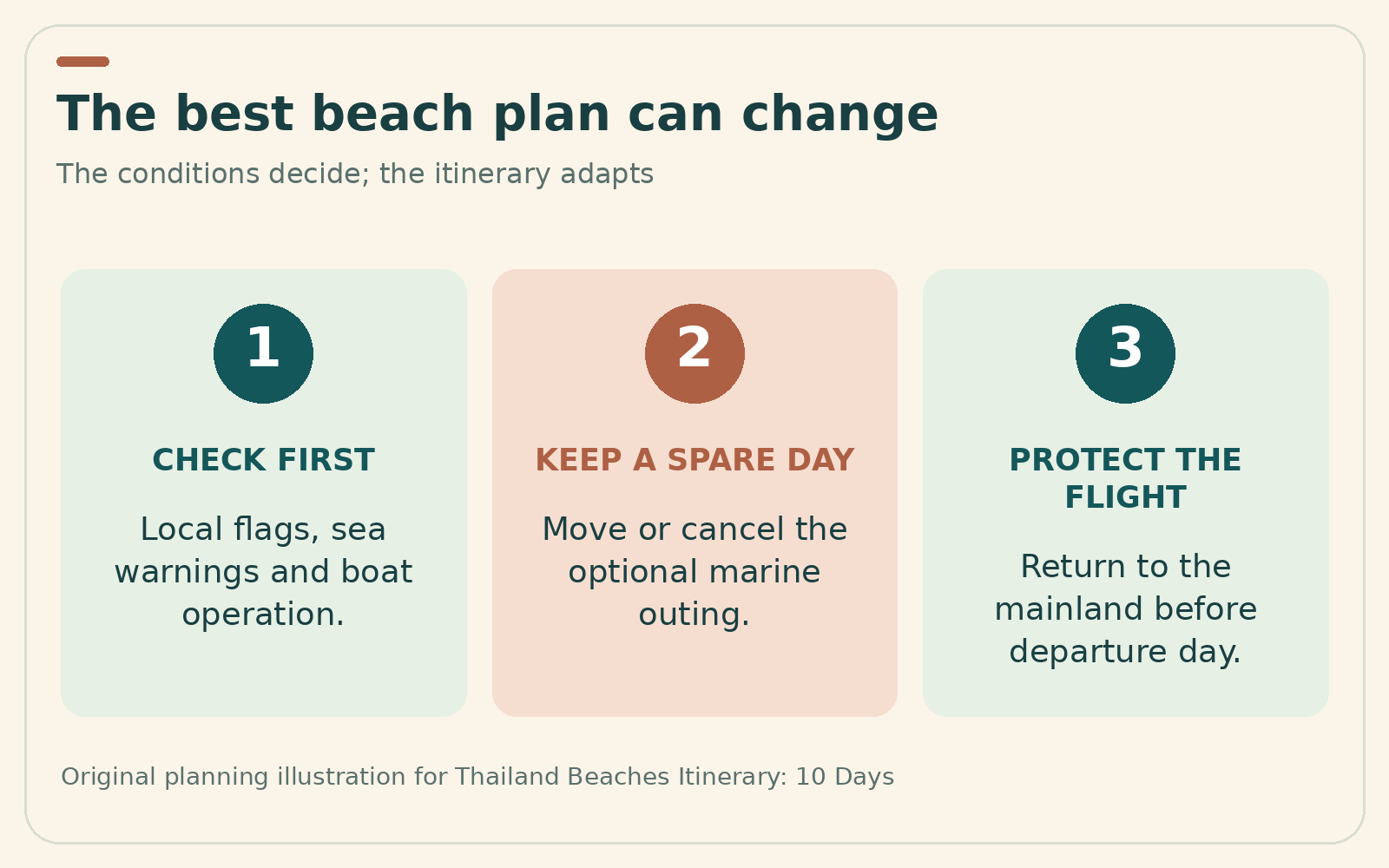
Avoid replacing a cancelled boat trip with another equally weather-dependent journey simply to keep busy. A quieter day can be the right response to rough conditions, and it leaves more energy for the next suitable beach morning. The spare day in the Lanta stay exists to support that kind of decision.
Swimming, boats and practical beach safety
Flags and local advice override the itinerary
Follow lifeguard instructions and warning flags. Do not enter the sea when a red flag or local warning indicates that it is unsafe. A calm-looking surface, other swimmers or a sheltered-looking photograph should not persuade you to ignore current advice. Conditions can change during the same day. [6]
Keep children closely supervised around both sea and pool. A life jacket or flotation aid does not replace supervision, and an adult who cannot swim confidently should not assume a short excursion will make deep-water activity manageable. Choose the environment and activity for the least confident participant, not just the strongest swimmer.
Ask about the boat, not only the destination
Before an excursion, ask about boarding, life jackets, shaded seating, toilets where relevant and the route's exposed sections. A traveller with back problems, limited mobility or a young child may need a different boat or may prefer to remain ashore. Explain those needs before payment so the provider can answer specifically.
Keep your own essentials secure and accessible: drinking water, sun protection, necessary medication and a way to protect the phone from water. Carry enough to manage the outing without turning the day bag into a second suitcase. Meanwhile, listen to the briefing even when you have taken similar trips before.
A transparent budget for ten beach days
Rooms, transfers and tours are different spending decisions
For two adults sharing, an illustrative model allocates THB 27,000 to nine hotel nights, THB 10,000 to airport and inter-base transfers, THB 12,000 to meals and everyday drinks, and THB 8,000 to selected activities. That gives THB 57,000 before contingency, flights and insurance. These editorial allowances were prepared on 5 October 2026, not obtained as supplier quotations.
| Budget line | Assumption | Allowance |
|---|---|---|
| Accommodation | 9 room nights at an assumed THB 3,000 | THB 27,000 |
| Essential transfers | Airport, inter-base and local journeys | THB 10,000 |
| Food and drinks | Ordinary meals and non-alcoholic drinks | THB 12,000 |
| Selected activities | A limited number of suitable outings | THB 8,000 |
| Illustrative total | Before flights, insurance and contingency | THB 57,000 |
These are planning assumptions, not supplier quotations. Compare full tour inclusions and price the actual room and transfer arrangements you need.
Spend more where it changes the holiday: a convenient location, a room that suits the family or a transfer with clear luggage and pickup arrangements. A cheaper remote property may require paid transport for every meal, while an expensive beachfront address does not guarantee suitable swimming in front of the hotel.
Compare the full activity price
When looking at a tour, confirm transport to the pier, equipment, meals, park fees and cancellation conditions. A lower headline price may simply leave more items to pay separately. Ask what happens if an advertised stop is unavailable and whether the alternative route would still interest you.
Carry some cash for small purchases and expenses not accepted by card, while keeping a separate reserve. Avoid relying entirely on a phone connection for tickets or hotel addresses. Download the confirmations before moving between bases, especially when the next stage involves a boat.
Adapting the route for families, couples and slower travellers
Families: optimise the room and the routine
Choose room layouts, pool arrangements and nearby food before adding more excursions. Four nights in each main base allow children to become familiar with the surroundings and reduce the number of packing mornings. A beach day close to the hotel can be easier to adjust around rest than an all-day boat tour.
Ask transfer providers about child restraints where applicable and life-jacket sizes on boats. Do not assume that equipment suitable for adults will fit a child properly. Meanwhile, keep one straightforward meal option and a shaded fallback near the accommodation so every day does not depend on everyone having the same energy.
Couples: choose atmosphere without losing practicality
A quieter bay may be worth a longer transfer when you actively want to stay around the hotel. However, check what happens in the evening: whether food is walkable, whether transport must be arranged and whether the location suits the level of independence you prefer.
For a celebratory meal or special excursion, book one memorable experience rather than upgrading every part of the route. That leaves room for the simple pleasures that attracted you to a beach holiday. A sunset walk does not need to be followed by a tightly timed transfer to count as a good evening.
Limited mobility or boat aversion: reduce dependence early
Stay on the mainland for the whole holiday when boat access or island transfers do not suit your needs. Ao Nang or another suitable Krabi-area base can support a slower coastal stay without moving to Lanta. You lose one type of variety but gain simpler transport and more predictable access to the accommodation.
Ask hotels and providers about actual steps, surfaces and boarding arrangements. Descriptions such as easy transfer or accessible beach are too vague to answer individual requirements. A workable mainland plan is better than discovering at the pier that the advertised excursion requires a difficult wet landing.
Pros and cons of the two-base beach plan
What you gain
You get several ordinary beach days, a varied opening base and a longer island stay without crossing the country. Railay remains available as a day trip, while the final mainland night separates the island transfer from departure. The itinerary also contains enough flexibility to move or cancel a boat outing.
What you give up
You will not visit every famous Thai island, and the route is not equally suitable in every month. Koh Lanta still requires a transfer involving island access, while some marine activities depend on seasonal operation. Travellers who dislike boats or repeated hotel changes may prefer one mainland base for all nine nights.
Common mistakes on a short beach holiday
Confusing a beach name with a safe swimming guarantee
Research helps you choose a base, but the day's flags and local advice decide whether to swim. Do not argue with a warning because a guide described a beach as usually sheltered or family-friendly. Those descriptions cannot account for every tide, storm or local hazard.
Counting boat journeys as full beach days
A transfer day includes packing, pickup, waiting, travel and reaching the next room. It may still leave time for the shore, but that should be a bonus rather than the foundation of the itinerary. Four nights in a base produce more useful time than repeatedly moving after a single full day.
Keeping the island transfer for the flight morning
The final mainland night is included to avoid exactly that fragile connection. Retain it unless a properly assessed alternative provides suitable protection and timing. Saving one hotel move is not automatically worth the risk of a missed flight on separate arrangements.
Frequently asked questions
Can I include Bangkok within these ten days?
The main route starts and ends in Krabi, so Bangkok is not included. To fit a Bangkok gateway within ten days, reduce the coastal nights and allocate the necessary city and flight time explicitly. The alternative in this guide uses two Bangkok nights, six Samui nights and a final Bangkok night.
Should I stay in Railay instead of Ao Nang?
Choose Railay when staying there is a priority and its boat access suits you. This plan uses Ao Nang for practical transfers and visits Railay for a day. Replacing the base changes the arrival and departure logistics, so confirm boat timing and luggage arrangements rather than treating the hotels as interchangeable.
Is Koh Lanta worth four nights?
Four nights provide three full days and room for a moved or cancelled excursion. That suits travellers who want beach time rather than only a quick look at the island. A shorter stay can work, but it makes the transfer a larger share of the visit and reduces flexibility.
Do I need to rent a scooter?
No. The route can use arranged transfers and local transport. Choose accommodation with suitable nearby amenities, then book additional journeys as needed. Renting a vehicle should depend on proper licensing, insurance and experience, not the assumption that everyone on an island must drive one.
Can I take this route in the rainy season?
It may be possible, but sea conditions, marine closures and operating patterns can reduce the value of a boat-focused plan. Choose flexible accommodation and fewer dependent crossings, or consider another coast when appropriate. No season label guarantees either constant rain or uninterrupted sunshine.
Are island tours essential?
No. They are optional additions when the route, conditions and traveller suit them. Railay plus local beach days may already provide enough variety. Spending a day enjoying the accommodation's surroundings is not a lesser version of the holiday simply because no tour voucher is involved.
Is a private transfer always quicker?
Not necessarily. It can remove shared pickups and provide a clearer departure time, but traffic, ferry queues and the route still matter. Compare the full pickup-to-hotel arrangement rather than a headline duration. Confirm passenger and luggage capacity before paying for a particular vehicle.
What happens if a boat trip is cancelled?
Use the spare day for another attempt only when conditions improve and the operator confirms suitability. Otherwise, choose a shore-based activity or simply enjoy a quieter day. Check refund and alternative-route terms before booking so a cancellation does not turn into an avoidable disagreement.
Final recommendation: spend the time where you came to be
Choose Ao Nang and Koh Lanta for a ten-day Andaman beach holiday that values time on the coast over destination collecting. Keep Railay flexible, select boat trips carefully and finish the island transfer before the flight day.
Most of all, leave enough space to do very little without feeling behind. The route succeeds when you have time to return to a beach you enjoyed, change plans with the weather and eat dinner without checking tomorrow's pier instructions. More islands would not necessarily make that holiday better.
Sources and fact-checking notes
- TAT: Krabi destination guideAo Nang as a coastal base and excursion gateway. Reviewed 5 October 2026.
- TAT: Koh Lanta destination guideIsland setting, vehicle-ferry access and typical marine-area seasonal closures. Reviewed 5 October 2026.
- FCDO: Thailand safety and securityRoad, sea and general safety context. Reviewed 5 October 2026.
- TAT: Railay BeachBoat access and the different waterfront areas. Current sea conditions determine suitability. Reviewed 5 October 2026.
- 12Go: Krabi-Koh Lanta transport listingsRoute and transport-type comparison; door-to-door allowances in this guide are editorial buffers. Reviewed 5 October 2026.
- Thailand government: waterway and beach safetyWarning flags and appropriately fitted life jackets. Local instructions take precedence. Reviewed 5 October 2026.
- 12Go: Koh Lanta-Krabi transport listingsReturn-route options; verify current operation and exact drop-off. Reviewed 5 October 2026.
- Thai Meteorological Department: seasons of ThailandBroad monsoon and seasonal context, not a forecast for an individual holiday. Reviewed 5 October 2026.
- UK Foreign, Commonwealth & Development Office: Thailand travel adviceCurrent travel notices, including the flooding notice visible at editorial review. Recheck before travel. Reviewed 5 October 2026.
Illustrations in this article were created for Taylor’s Trailblazing Travels. Third-party photographs, where used, are credited beside the image or in the source list.