
One week. Two bases. Room to breathe.
A realistic Bangkok-and-Krabi route that keeps the travel days visible and the beach days flexible.
A Thailand 7-Day Itinerary works best when it stops trying to cover the whole country. Bangkok and Krabi make a useful pairing: a city introduction first, followed by a coastal base where you can unpack rather than move between islands. The point is contrast, not a large collection of hotel check-ins.
This plan counts arrival as day one and departure as day seven. That means six hotel nights, not seven complete sightseeing days. It also means the timing of your international flights can matter more than the difference between two attractive beaches.
The route below is a research-led planning recommendation, not an account of a personal visit. Official visitor information and current transport searches support the practical details. Suggested activity lengths, transfer allowances and budgets are editorial planning assumptions, with alternatives for poor weather or awkward flight times.
Two complementary bases
City sights, river time and one coastal hotel.
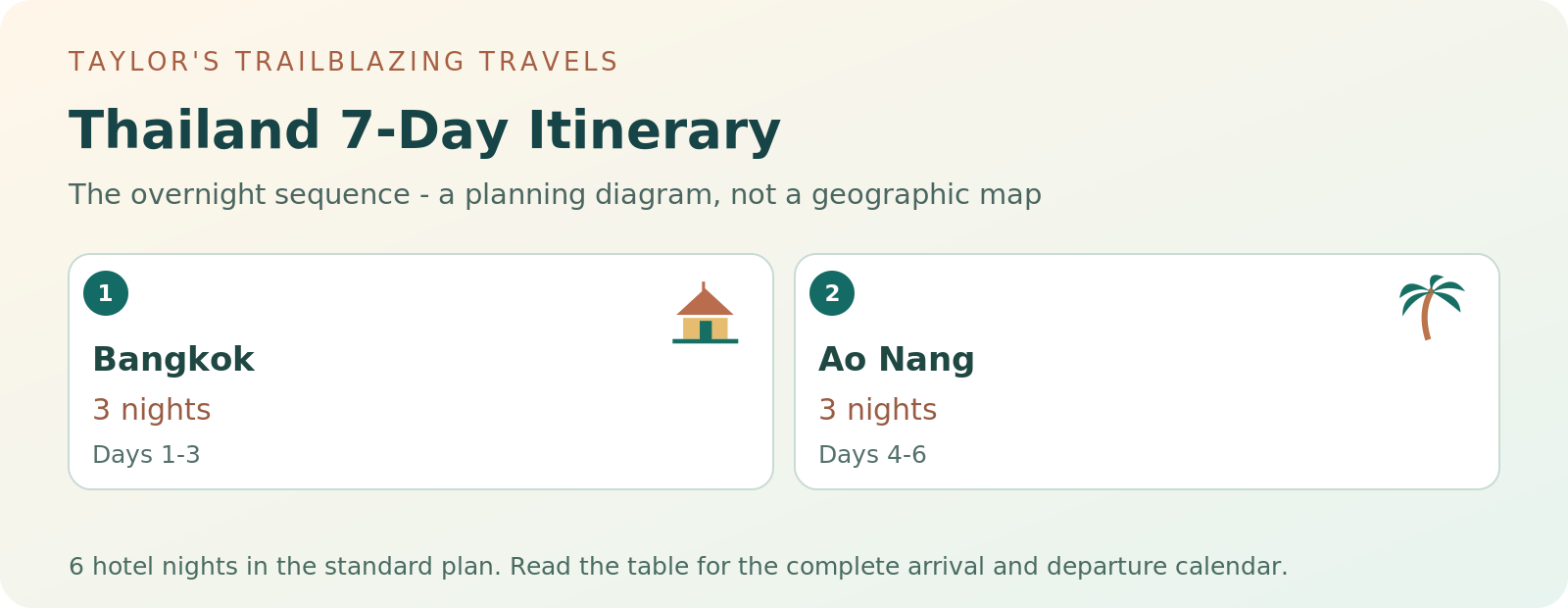
Three plus three
Six nights between arrival and departure.
The two beach days
Book sea activities around the local forecast.
Check the final flight
Separate tickets need a different last-night plan.
Your Thailand 7-Day Itinerary at a glance
A separate flight home from Bangkok needs a revised last-night plan. Make that decision before the coastal hotel becomes non-refundable.
Count the nights before choosing attractions
Use Bangkok for nights one, two and three, then Ao Nang for nights four, five and six. Day four belongs to the journey south. Day seven belongs primarily to departure, even when an evening flight leaves room for breakfast and a short walk. The route therefore gives you two full city days and two full coastal days, plus whatever useful time your arrival and transfer days allow.
This is deliberately a two-base plan. A third overnight destination would introduce another checkout, transfer, check-in and round of luggage handling. Instead, you can see a different coastal setting as a day trip when the sea permits. Ao Nang is the practical mainland base here; Railay and offshore islands are excursions rather than compulsory hotel changes. [1]
| Day(s) | Overnight base | Nights | Plan |
|---|---|---|---|
| 1-3 | Bangkok | 3 | Arrival, old-city sights and a flexible city day |
| 4-6 | Ao Nang, Krabi | 3 | Fly south, then two full coastal days |
| 7 | Departure | 0 | Krabi international departure or protected connection |
This is a proposed calendar, not a published transport timetable. Scroll within the table on a small screen.
Who should use this version?
Choose it when city culture and beach scenery both matter, you are comfortable taking a domestic flight and your onward travel works from Krabi. However, a week devoted mainly to rest might be better spent in one coastal area. Travellers interested primarily in food and temples can replace Krabi with Chiang Mai, or remain in Bangkok and add a carefully chosen day trip. Those are substitutions, not extra stops.
Day 1: arrive in Bangkok and keep the evening small
Make the hotel the first destination
After a long international journey, immigration, baggage and the ride into town already form a substantial first activity. Go to the hotel rather than booking a temple tour straight from the airport. Ask about the check-in time beforehand: arriving early in the morning does not automatically give you a room. Luggage storage, breakfast and a short local walk make a more forgiving bridge to check-in than an ambitious cross-city schedule.
Choose the first evening within an easy journey of your accommodation. A riverside stroll suits a river-area hotel; a neighbourhood meal suits a rail-connected city base. You do not need to reach the most photographed restaurant to make the first night count. Establish where to buy water, how to return to the hotel and which entrance the next morning's transport will use.
Spend money on the friction you actually have
For two people with substantial luggage, a straightforward airport transfer may be worth more than a small room upgrade. Conversely, light travellers staying beside a convenient station may prefer rail. Check the complete door-to-door journey rather than comparing only the airport portion. Bangkok's BKK and DMK airport codes refer to different places, not interchangeable terminals. [2]
For a first short stay, compare Bangkok accommodation around the river and useful transport links. Check the map, recent comments about noise and the actual walking route to transport. A room described as centrally located is not necessarily convenient for the particular sightseeing cluster in this itinerary.
Day 2: the old city, one major temple and river time
Choose a main sight, then build around it
Make the Grand Palace your main morning visit if royal architecture is a priority. Otherwise, use Wat Pho as the main temple and leave more time for the surrounding streets and river. Visiting both can work, but the second should remain optional if the heat or crowds are tiring. Do not start with a promise to complete every major temple before lunch.
As checked on 5 October 2026, the Grand Palace lists opening hours of 08:30-16:30, with ticket sales ending at 15:30 and foreign admission at THB 500. Wat Pho's official visitor page lists THB 300 admission. These are separate admissions, and ceremonial closures or revised conditions can affect a particular day. Check the official pages shortly before visiting. [3] [4]
Prepare for the visit, not just the photograph
Wear clothing that meets the attraction's rules before leaving the hotel. For the palace, choose a sleeved top and proper long trousers or an appropriate long skirt; do not rely on a loosely carried scarf to solve every restriction. Keep the day bag small enough to manage comfortably through security and crowded courtyards. A water break outside the main sightseeing block is part of the plan, not a failure to keep up. [3]
A guide is useful when historical explanation matters more to you than moving independently. Compare Bangkok palace and temple walking tours, then verify which admission tickets, languages and meeting points are included. A short itinerary benefits from a clearly defined tour rather than a vaguely described full-day collection of stops.
Use the river as transport and a change of pace
After lunch, choose one river journey or a nearby riverside stop. The tourist-boat operator serves several useful sightseeing piers, but different river services do not share identical stops or tickets. Read the destination board and ask before boarding. Wat Arun can be the afternoon visit when you still have energy; otherwise, enjoying the river without another admission is a perfectly complete day. [5]
Day 3: food, a neighbourhood and room to change your mind
Do something different from yesterday
Make the second full Bangkok day less monument-heavy. A neighbourhood walk, a food-focused activity and an indoor break create a better contrast than repeating another long temple circuit. Chinatown can work well as a focused evening rather than a place to cross the city for several disconnected meals. Keep the daytime plan close enough to your hotel that a rest remains possible.
For a cultural indoor anchor, consider Jim Thompson House. Its official visitor information requires a guided visit inside the main house and notes stairs without lifts. Therefore, check the next available tour and access requirements instead of treating it as a quick walk-through museum that can always fit into a spare twenty minutes. [6]
Make a food tour earn its place
A useful food tour should explain its walking distance, meeting point, dietary limitations and what is included. It should also leave you enough time to return and pack for tomorrow. Compare Bangkok Chinatown food walks when interpretation and ordering support would add value; independent eating is equally reasonable when you prefer to choose your own pace and dishes.
Tell the organiser about dietary requirements before payment, not at the first stall. A menu that avoids an obvious ingredient may still use it in a sauce or stock. For a serious allergy, obtain clear confirmation of what the supplier can and cannot accommodate rather than relying on the general label vegetarian or mild.
Finish the day with the next move organised
Check the airport code on the domestic ticket, baggage allowance and hotel pickup plan. Set aside the clothes and documents needed for travel so that the suitcase does not need unpacking at the airport. Then leave the final evening unhurried. A late night followed by a very early flight often makes day four feel longer than its timetable suggests.
Day 4: fly to Krabi and settle into Ao Nang
Treat the move as a half-day commitment or more
A short flight is not a short hotel-to-hotel journey. Packing, reaching the airport, check-in, security, baggage collection and the transfer to Ao Nang all sit outside the airborne time. As an editorial planning allowance, reserve roughly five to seven hours between leaving one hotel and being settled at the next, with additional margin for disruption. This is not an airline minimum or a promise of actual travel time.
Current Bangkok-Krabi searches include flights as well as much longer surface options. For a seven-day itinerary, the flight generally preserves more usable holiday time. However, inspect the result carefully: an attractive headline price can refer to an inconvenient airport, a connection or a baggage-light fare. [7]
Compare Bangkok-to-Krabi transport for your date, then check the chosen flight directly with the operating airline before payment. The issued itinerary and baggage rules matter more than a generic route-page summary.
Compare flight times as well as the fare
Imagine two otherwise suitable options: one requiring a very early hotel departure and another leaving later in the morning. The earlier flight may produce more coastal time, but only if the lost sleep does not make the afternoon unusable. These are hypothetical choices, not published departures. Compare them with the actual check-in time at the Ao Nang hotel and the way your group usually copes with travel.
A late-afternoon flight creates the opposite trade-off. You may retain a relaxed Bangkok morning, but the coastal arrival is likely to be mainly about reaching the room and finding dinner. That can still work because day four is already a transfer day. It should not, however, be sold to yourself as both an extra full Bangkok day and an extra Krabi beach day.
Before deciding, price the complete version of each option: baggage, airport transport and any room-timing arrangement you actually need. Then choose the one that produces the better day, not merely the most impressive saving on the initial search screen. On a six-night holiday, avoiding one unnecessarily exhausting handover can be worth more than adding another attraction.
Book the destination beyond the airport
Krabi Airport is not the beach. Arrange the onward ride to the exact hotel, making clear whether the price is shared or private and whether a hotel outside the normal drop-off zone costs extra. Check Krabi Airport-to-Ao Nang transfer options for a useful comparison of the whole arrival journey.
Once checked in, keep the remaining day local: unpack, locate tomorrow's meeting point and see how the beach looks in the actual conditions. Do not commit to a paid boat departure that depends on the flight landing exactly on time. An easy first evening protects the value of the two full days that follow.
Day 5: Railay when the conditions suit
A change of setting without another checkout
Use one full coastal day for Railay and the Phra Nang area if boats are operating safely. Ao Nang works as the starting base because it connects with this peninsula and nearby island trips. Nevertheless, a scenic destination is not automatically easy for every traveller: boarding arrangements, wet landings and walking surfaces deserve consideration before you choose the outing. [1]
The best version of this day has time to look around, stop for lunch and return without racing the final departure. Ask about the return arrangement before leaving Ao Nang. A one-way ticket, an open return and a fixed organised excursion are different products; none should be assumed from a photograph of a long-tail boat.
Keep optional activities genuinely optional
Swimming, a short walk or simply sitting with the view can each be the main activity. Do not add a challenging climb or exposed viewpoint because it appears in every social-media itinerary. Choose activities appropriate to your ability, the footing and the weather that day. The sea and local operator's safety decisions take priority over a prewritten list. [8]
Compare Railay excursions and activities only after deciding whether you need transport, guiding or a specific experience. Check whether hotel pickup is included and whether the departure is from the location you expect. A package can simplify the day, but it is not automatically better than a straightforward independent return journey.

Day 6: one island outing or a deliberately quiet day
Choose the excursion by its practical details
A Hong Islands trip is one possible use of the second coastal day. However, compare the amount of boat time, group size, included stops, pickup area and cancellation terms before choosing. A longer list of islands can mean less time at each one. National-park admission and optional activities may be separate from the headline tour price, so read the inclusion list rather than guessing a total. [1]
Compare Hong Islands trips from Krabi when the marine forecast and operator advice support going. The illustration in a listing cannot establish how calm the crossing will be. Do not book the only sea excursion for the final morning before an onward flight.
Keep a land-based alternative ready
When the sea is unsuitable, stay near the hotel, organise a meal or cooking activity, or take a modest mainland outing with a confirmed return plan. The alternative does not need to imitate the original excursion. Two comfortable hours outside followed by a relaxed lunch can be more enjoyable than spending an entire wet day in a vehicle trying to rescue the schedule.
You can also choose this quieter version in good weather. A short holiday does not have to produce a major excursion every day. Families in particular may get more value from a hotel pool, familiar restaurant and early night before departure than from one additional offshore stop.
Day 7: depart without an island-to-flight gamble
The standard route finishes through Krabi
The six-night split works most cleanly with an international departure from Krabi or a properly protected connection sold under one suitable booking. Read the airline's actual connection terms and baggage instructions; being shown two flights on one search screen does not itself make the connection protected. Allow the airline's required airport time plus a realistic ride from the hotel.
Do not interpret an evening flight as permission to take a distant morning boat trip. Weather, delayed returns and baggage collection can turn that into an expensive final day. A nearby breakfast, checkout and unhurried airport transfer are enough.
Change the nights for a separate Bangkok ticket
When the long-haul flight departs Bangkok on a separate booking, return to Bangkok on day six instead. Keep three Bangkok nights at the start, two Ao Nang nights on days four and five, and one final Bangkok night on day six. You still have six nights overall; you have not quietly added an eighth day.
Compare Krabi-to-Bangkok options early enough to build the return into the hotel calendar. Another workable variation is two initial Bangkok nights, three coastal nights and one final gateway night. The latter preserves two full coastal days but reduces the first Bangkok chapter. Pick the version that protects the part of the holiday you most value.
Choose the coast around the season, then check the forecast
The route is a starting point, not a weather guarantee
The Andaman version is an easy planning default for many winter trips, but Thailand does not have one identical weather pattern everywhere. The southern east coast can remain very wet during parts of the northern cool season. A national best-time label is therefore less useful than checking the specific coast, followed by the local forecast close to travel. [9] [10]
In wetter Andaman periods, favour a mainland-connected hotel and avoid making every full day dependent on a boat. Flexible excursion bookings and realistic expectations are more useful than hoping that a cheap non-refundable trip will force the weather to cooperate. Check current Thai Meteorological Department warnings rather than using last week's holiday photographs as evidence. [11]
When a Samui substitution makes sense
Koh Samui can replace Krabi when its seasonal pattern, current conditions and flight arrangements better suit the trip. Keep the same three-city-nights and three-coastal-nights structure rather than adding Samui after Krabi. Compare Koh Samui accommodation only after checking the complete arrival and departure cost, including the island's airport or any necessary ferry journey.
Alternatively, remove the coast altogether and make the second base Chiang Mai. That changes the holiday from city-and-beach to city-and-culture; it does not make it a lesser itinerary. Check current northern air quality as well as weather before choosing an outdoor-heavy stay. The useful decision is which experience will work well on your dates, not which route looks most complete on a map. [12]
Where to stay for a week that feels longer
Bangkok: choose the connection you will actually use
A riverside hotel is attractive when river sights dominate the plan, while a rail-connected location suits travellers mixing neighbourhoods and indoor stops. Compare the walk from the building to the pier or station, not merely the district name. Road crossings, uncovered pavements and carrying luggage can change how convenient a short distance feels.
For a short stay, prioritise quiet sleep, practical check-in arrangements and an easy return in the evening. An impressive rooftop is a bonus, not a substitute for a room where you can recover. Read recent comments about building work and late-night noise, then check whether breakfast starts early enough for your domestic departure.
Ao Nang: convenience before another hotel move
Compare Ao Nang hotels using the map and recent reviews. For this route, a manageable walk to food and the main pickup area is usually more useful than a remote address chosen solely for a dramatic photograph. However, travellers seeking a resort-led holiday may reasonably reverse that priority and accept more paid transfers.
Ask about steps, lifts and the exact room location when mobility matters. A hotel can advertise beach access while a particular room sits up a slope or several flights of stairs. Similarly, a family room label does not tell you whether the beds and occupancy allowance suit your children. Confirm the actual configuration before paying for a non-refundable rate.
Keep the final hotel decision separate
A gateway night before an early flight has a different job from a sightseeing stay. It should simplify departure, not win a comparison of Bangkok's most atmospheric neighbourhoods. Check which airport it serves and whether any shuttle operates at the required hour. A hotel near one Bangkok airport is not a convenient substitute for the other. [2]
A seven-day budget you can adjust honestly
Start with a constructed example
The table is an illustrative planning model prepared on 5 October 2026, not a set of live quotes or an observed average. Both columns are per adult sharing a twin or double room, for seven days and six nights. International flights, insurance, shopping and a separate return flight to Bangkok are excluded. The room allowance is each person's share, not the full room price.
| Component / assumed allowance | Lean model | More-comfort model |
|---|---|---|
| Accommodation: 6 nights x THB 450 / 1,100 per person | THB 2,700 | THB 6,600 |
| Food: 7 days x THB 400 / 800 | THB 2,800 | THB 5,600 |
| One domestic flight allowance | THB 2,200 | THB 3,500 |
| Airport and local transport allowance | THB 1,500 | THB 2,300 |
| Visits and selected activities | THB 2,000 | THB 3,500 |
| Subtotal | THB 11,200 | THB 21,500 |
| 15% contingency | THB 1,680 | THB 3,225 |
| Illustrative total per adult | THB 12,880 | THB 24,725 |
Planning model dated 5 October 2026. Prices are assumptions, not checked bookable offers. International flights, insurance and shopping are excluded; read the section for route-specific exclusions. Scroll this table horizontally on small screens.
Know which changes matter most
The model separates spending that happens daily from spending caused by the route. Food changes with your preferred meals; accommodation changes with room standard and season. Domestic flights and airport transfers are driven more directly by the decision to include a second region. Therefore, cutting a few drinks may achieve less than choosing a more sensible flight time or a hotel that reduces taxi journeys.
Solo travellers should not simply use the sharing total unchanged. A private room has to be paid for by one person, although shared transport and food may remain similar. Families need the opposite correction: some vehicle costs are shared, but rooms, child occupancy rules and activity age bands can change the total in less obvious ways.
Make the reserve available, not decorative
The sample includes a contingency, but that only helps when you can actually access it. Keep enough flexibility for an extra transfer, a rebooked domestic ticket or a hotel night if the itinerary changes. Do not spend the reserve on optional upgrades before the trip begins. A buffer is most useful for decisions you cannot price precisely in advance, particularly when weather affects the coast.
Book the difficult joins before the easy afternoons
A sensible purchase order
First confirm the international arrival and departure airports and whether any domestic connection is genuinely protected. Next choose the night split and the Bangkok-Krabi flight. Then book accommodation with cancellation terms you understand. Only after those decisions should you fix the particular sea excursion, restaurant reservation or guided activity that depends on them.
Keep the confirmation for each component in one accessible place. Record the operator, actual pickup point, luggage rule, cancellation deadline and emergency contact. An attractive booking email can still leave these practical details in a separate voucher. Download that voucher before travel rather than assuming mobile reception will be available at the moment you need it.
Do not buy a connection on headline time alone
For every transfer, distinguish the time in the vehicle from the time the whole move consumes. A shared ride may wait for other passengers; a hotel pickup can involve a collection circuit. These do not necessarily make it a poor purchase, but they matter when the next event has a hard start time. Leave optional activities on the flexible side of the schedule.
Check that the names on bookings match the travel documents. Also review payment currency, change fees and whether baggage is included before comparing two totals. The cheapest visible option is not always the lowest-cost complete journey once the same requirements are added to both.
Documents, connectivity and a manageable bag
Resolve entry questions before booking non-refundable plans
British travellers should check the current FCDO entry page and Thai Embassy guidance for their passport and visit history. A seven-day holiday still requires valid entry permission and appropriate documents. The official Thailand Digital Arrival Card is separate from a visa; complete it through the government service within the published pre-arrival window. Do not assume an airline booking grants admission. [13] [14]
For this short route, carry a small set of clothing that works for temple visits, humid sightseeing and the coast. Put travel documents, essential personal items and one change of clothes in the cabin bag. Check the domestic carrier's baggage limit independently of the international allowance, because they need not match.
Set up the tools you need before moving hotels
An eSIM is useful when your phone supports it, is unlocked and the chosen plan provides the coverage and validity you need. Compare Thailand eSIM options through Airalo, then check when the plan starts and whether it includes the services you require. Keep hotel addresses and vouchers available offline as well; connectivity is a convenience, not a substitute for a saved travel plan.
Do not use the short trip as a reason to skip insurance or ignore current travel advice. Check that planned activities and any medical circumstances are covered. For sea outings, choose an operator whose safety arrangements you are comfortable with and accept cancellations when conditions require them. [8]
Small changes for different kinds of traveller
A first trip as a couple
Agree which half of the holiday matters most before choosing flight times. One person may imagine long beach mornings while the other wants a substantial Bangkok introduction. The three-and-three split is a starting compromise, not a rule. Moving one night from the city to the coast creates an additional coastal day only when the travel schedule supports it; a late flight can consume much of the expected gain.
Keep one independently chosen activity each rather than trying to make every hour a joint favourite. For example, an extended temple visit and a quiet hotel afternoon can coexist in the same itinerary. A good short trip should not require both people to maintain the same energy level throughout.
Travelling alone
Choose accommodation from which evening food and the return journey feel straightforward to you. Shared activities can provide company, but check the end point and finish time as carefully as the start. A group tour that ends a long way from the hotel is not automatically the simplest evening option.
Review the budget as a solo traveller before judging the route affordable. Private accommodation and a private airport car do not halve themselves when only one seat is occupied. On the other hand, staying near useful transport and choosing a small number of well-targeted activities can make the spending easier to control without removing either destination.
Access and comfort needs
Ask practical questions rather than relying only on an accessibility filter. Establish whether the hotel has step-free access to the actual room, whether a vehicle can stop near reception and how any boat boarding works. A beautiful beach visit may involve a wet landing or uneven surface that changes its suitability considerably.
Build a comfortable land-based coastal day into the plan from the beginning. That gives you a worthwhile alternative if access, weather or fatigue makes the boat trip unattractive. Similarly, use the Bangkok morning for the main sight and leave the afternoon less structured. A slower pace can preserve the same two destinations without demanding the same physical effort as the standard sightseeing version.
What this route does well, and what it gives up
The advantages
Two bases keep the packing burden low while still giving the holiday two clearly different chapters. The mainland coastal stay is easier to adjust than a chain of island hotels, and the two full beach-area days can change order. You also have a clear decision point: either the onward flight works through Krabi, or the night allocation changes to protect a Bangkok departure.
The compromises
The route leaves northern Thailand out and does not provide a long beach stay. Domestic travel consumes part of the week and adds cost. Moreover, two coastal days cannot guarantee the right conditions for a particular excursion. Choose this itinerary for a varied introduction, not because it promises every major Thai experience in one week.
Common mistakes that make seven days feel shorter
Confusing arrival day with a free sightseeing day
Do not reserve an expensive first-day activity until you understand landing time, immigration, baggage and hotel access. A delayed arrival should cost you an optional walk, not a substantial non-refundable booking. The same principle applies after the domestic flight: let the hotel transfer finish before making firm evening commitments.
Adding places without removing anything
Replacing a quiet afternoon with a new overnight base is not a small adjustment. It changes transport, luggage handling and the balance of the following day. Likewise, adding an island excursion on departure morning creates a different level of risk from visiting a nearby cafe. Edit the calendar explicitly whenever a new idea appears.
Comparing incomplete booking prices
Check the same baggage, room occupancy, airport, pickup zone and cancellation terms across competing offers. A cheap transfer to a bus terminal is not equivalent to one that reaches the hotel. A room-only price is not equivalent to breakfast included when an early tour makes buying breakfast elsewhere awkward.
Thailand seven-day itinerary FAQs
Is seven days enough for a first trip?
Yes, for a selective introduction rather than a national overview. This plan gives you two full Bangkok days and two full coastal days, with the remaining dates shaped by travel. It is most rewarding when the international journey is reasonable for you and you accept leaving other regions for a future trip. A restful week at one base is also a valid first visit.
Should I choose Bangkok and Krabi or Bangkok and Chiang Mai?
Choose Krabi when coastal scenery and time by the water are central to the holiday. Choose Chiang Mai when northern food, temples and city-based cultural activities matter more. Compare the season, current air quality where relevant and actual flight arrangements. Trying to include both second destinations in this seven-day calendar would sacrifice too much of the time that makes either worthwhile.
Can I stay in Railay instead of Ao Nang?
Yes, but change the transfer plan as well as the hotel name. A stay involving boat access can be atmospheric, while adding handling steps and more sensitivity to conditions. Check the complete route from Krabi Airport, the arrival time and the final departure arrangement with the hotel. Ao Nang is the default here because the itinerary prioritises straightforward logistics.
Do I need to rent a car or scooter?
No. The proposed route can use airport transfers, city transport and selected excursions. Renting a vehicle is a separate decision involving appropriate licensing, insurance and confidence in local conditions. It should not be treated as a requirement for reaching every item on this plan, and inexperienced riding is not a sensible way to save a small amount of holiday time. [8]
How far in advance should I book the boat day?
There is no single useful deadline for every date and product. Secure genuinely limited accommodation and flights first, then choose an excursion with terms that suit the season. Reconfirm departure details close to the day and read what happens if the operator cancels. A flexible arrangement is especially valuable when you have only two possible coastal days.
Does the route work with children?
It can, provided the two-base structure is kept intact and the days are shortened around the children's needs. Check room occupancy, car-seat availability and excursion age or height rules directly. Replace a demanding boat outing with hotel time when that makes the week more comfortable. The most useful family adaptation is usually fewer fixed activities, not a more elaborate list of attractions.
What should I cut after a late arrival?
Remove the first evening's sightseeing and preserve sleep. If the delay is more substantial, choose one major Bangkok sight rather than compressing two full days into one. Avoid solving the problem by moving the southbound flight earlier. That would reduce the time in the city further and may create extra cost without improving the overall balance.
My recommendation: protect the two good halves of the week
Keep the first version simple: three nights in Bangkok, three in Ao Nang, one main domestic move and two interchangeable coastal days. Book the route only after the final airport arrangement makes sense. When a separate Bangkok departure demands a return night, change the six-night split on paper before paying for the hotels.
The strongest seven-day holiday is not the one with the longest list of places. It is the one where the city days are not spent recovering from unrealistic plans and the coastal days are not lost to avoidable packing. Choose a few experiences you genuinely care about, leave the rest optional and let the actual conditions decide the order.
Sources and fact-checking notes
What was checked, and what remains a planning choice
Source pages were reviewed on 5 October 2026. Official entry and attraction information supports the specific visitor details. Night allocations, suggested time margins, route comparisons and budget models are editorial planning judgements, not official itineraries, guaranteed schedules or personally tested bookings. Recheck operational notices and your actual ticket before travel.
- Tourism Authority of Thailand: Krabi. Ao Nang as a base for the peninsula and offshore excursions. Reviewed 5 October 2026.
- Airports of Thailand: airport-transfer information. BKK and DMK are different airports. The page displays conflicting hours, so no exact shuttle timetable is relied on here. Reviewed 5 October 2026.
- Bureau of the Royal Household: Grand Palace visits. Official opening information, admission and clothing rules. Reviewed 5 October 2026.
- Wat Pho: plan a visit. Official visitor information and admission. Reviewed 5 October 2026.
- Chao Phraya Tourist Boat: operator information. River-boat stops and service information; check the dated timetable. Reviewed 5 October 2026.
- Jim Thompson House: visitor information. Guided entry, opening hours, luggage and stair access. Reviewed 5 October 2026.
- 12Go: Bangkok-Krabi route search. Commercial route listing used for service types, not guaranteed prices or departure counts. Reviewed 5 October 2026.
- FCDO: Thailand safety and security. Transport, sea-travel, local-law and seasonal safety advice. Reviewed 5 October 2026.
- Tourism Authority of Thailand: climate and weather. Seasonal background; not a forecast for an individual holiday. Reviewed 5 October 2026.
- Thai Meteorological Department: November-January climate normals. Only the clearly labelled 1991-2020 climate-normal discussion is used; the dated forecast is not treated as a 2026 forecast. Reviewed 5 October 2026.
- Thai Meteorological Department: forecasts and warnings. Check current provincial and marine forecasts close to travel. Reviewed 5 October 2026.
- Pollution Control Department: Air4Thai. Check current readings and their timestamps, especially before northern outdoor days. Reviewed 5 October 2026.
- FCDO: Thailand entry requirements. Passport, entry permission and onward-travel requirements for British citizens. Reviewed 5 October 2026.
- Thai Immigration: official arrival-card guidance. Official TDAC instructions, eligibility and submission window. Reviewed 5 October 2026.
Illustrations in this article were created for Taylor’s Trailblazing Travels. Third-party photographs, where used, are credited beside the image or in the source list.