Connecting Flights at Kuala Lumpur Airport: Terminals and Transit Planning
Check the ticket, terminal and baggage route before deciding how much connection time you need.
AI-created conceptual airport illustration; not a photograph or a terminal layout guide.
Connecting flights at Kuala Lumpur airport can mean a straightforward walk to another gate, a transfer within Terminal 1, or a full arrival into Malaysia followed by a fresh departure from Terminal 2. The word “connection” on a booking screen does not tell you which journey you have bought.
Begin with four facts: both terminal numbers, whether the airline protects the connection, where your baggage is tagged, and whether you can obtain the onward boarding pass without leaving transit. This guide was reviewed on 7 November 2026; the worked timing examples are planning tools, not airline-approved minimum connections.
T1↔T2 is a landside transfer with entry formalities for international arrivals.
One checkout can still contain self-transfer flights. Read the actual booking terms.
Ask where the tag ends and where customs or bag collection is required.
Work back from bag drop and boarding, not only the printed departure time.
Identify which connection you actually have
Use your airline’s itinerary and baggage instructions, rather than assuming that two flights with the same airport name form one protected journey. “Airside” means inside the controlled passenger area; “landside” means the public part reached after the relevant arrival formalities.
| Your journey | Likely process | Key check |
|---|---|---|
| International → international, same terminal | Eligible through-passengers can normally follow the airside transfer route. | Onward boarding pass, through baggage and airline acceptance. |
| International → domestic | Entry immigration is required; follow the airline’s domestic transfer instructions. | Where any baggage/customs step takes place. |
| Domestic → international | Departure immigration and security form part of the transfer. | Through-checking versus collecting and checking bags again. |
| T1 ↔ T2 | Use landside terminal transport; international arrivals must enter Malaysia. | Entry eligibility and enough time for a fresh departure. |
| Separate tickets / self-transfer | You may need baggage reclaim, landside check-in and fresh checks even in one terminal. | Who pays if the first flight makes you miss the second. |
T1 transfer processes: Malaysia Airlines and JAL.[1][2] International T1–T2 immigration requirement: Irish government travel advice.[3] AirAsia Fly-Thru and separate-flight conditions: AirAsia.[4][5]
AirAsia’s Fly-Thru is a specific connecting product with route-dependent baggage and transfer arrangements. A self-transfer sold by a booking platform is different, even when the flights appear together on your receipt. Ask the airline or seller to state the protection and transfer process explicitly.[4][5]
T1, T2 and the T1 Satellite Building are different decisions
At T1, international gates C are in the Satellite Building, while gates G and H are in the main/contact-pier area. The Aerotrain links the main and satellite parts of T1. It does not carry you to Terminal 2.[1]
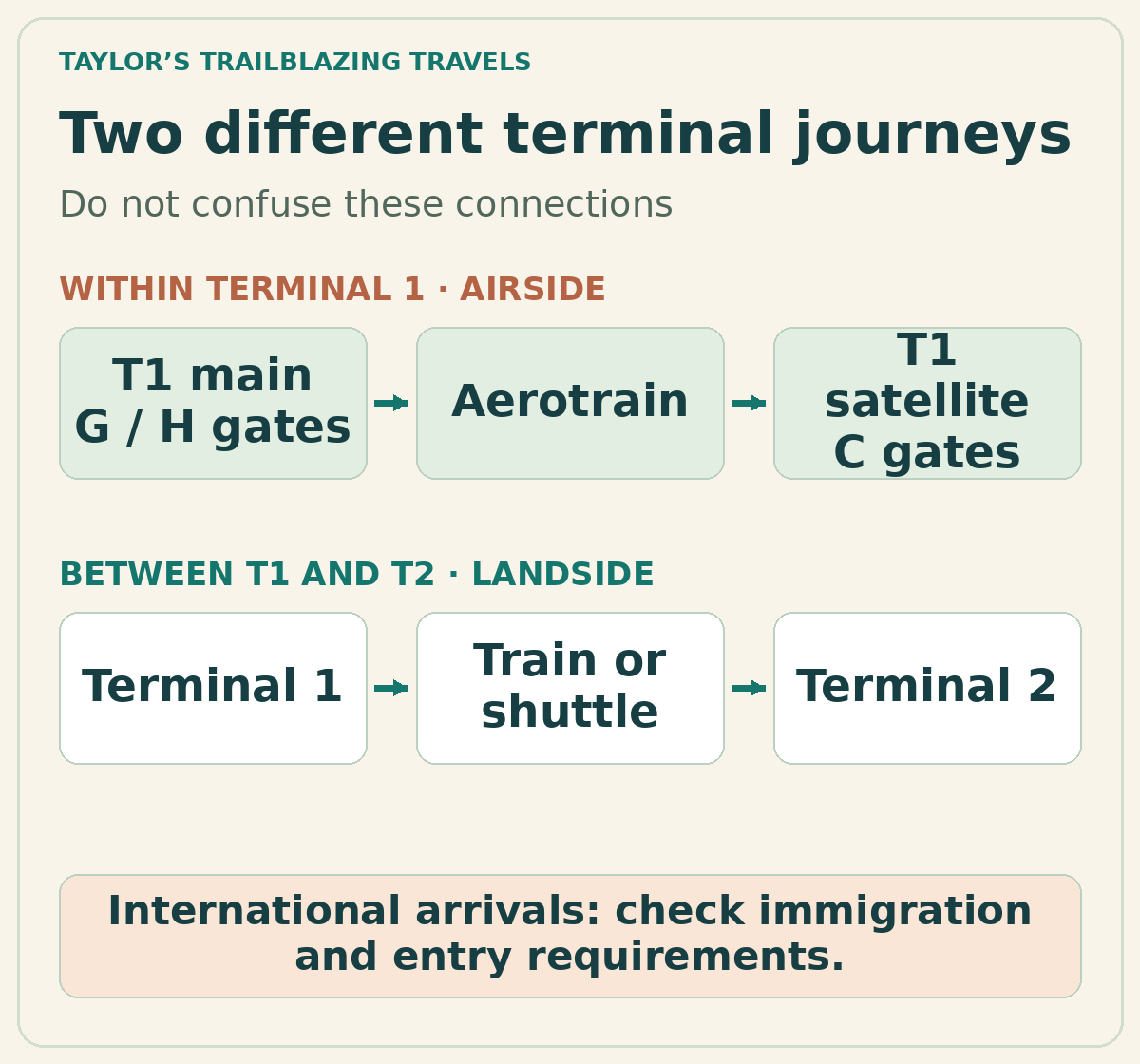
For a change between T1 and T2, go through the required arrival formalities and then use the inter-terminal service. Do not follow an airside Aerotrain sign expecting it to deliver you to an AirAsia departure at T2.
| Option | Published detail | Planning implication |
|---|---|---|
| ERL train | About three minutes on the train; published inter-terminal Transit fare RM2 adult / RM1 child aged 6–15. | Reach the station, buy the right short-sector ticket and wait for the correct service. |
| Free shuttle bus | Malaysia Airports advertises 24-hour service every 15 minutes; T1 Level 1 Door 4 and T2 Level 1 Transportation Hub, Bay A10. | Allow for the loop route, waiting, loading and the walk to departures. |
Rail duration and fares: ERL.[6][7] Shuttle frequency and stops: Malaysia Airports.[8] The train ride is only one small element of a terminal change; neither figure is a gate-to-gate connection time.
For an overnight connection, check the actual rail timetable; trains do not run continuously through the night. Confirm the current shuttle stop with airport staff if signage differs from the published information.
Build a buffer around the tasks you must complete
There is no single connection time that fits every KLIA itinerary. An airline’s accepted through-connection and a separately assembled terminal change carry different practical and financial risks. When choosing between comparable fares, prefer a longer connection if you need mobility assistance, are travelling with young children, or cannot absorb a missed onward flight.
A six-hour self-transfer stress test
Imagine an international arrival at T1 followed by a separate short-haul departure from T2. The table is an original planning model, not a forecast of airport queues. Replace each allowance with information relevant to your flight and party.
| Task | Allowance |
|---|---|
| Leave aircraft and reach the arrival process | 30 |
| Immigration, baggage collection and customs | 75 |
| Walk, wait and transfer to the other terminal | 35 |
| Onward check-in / document / bag-drop queue | 30 |
| Departure checks and walk to the gate | 45 |
| Reach the gate before scheduled departure | 30 |
| Total modelled requirement | 245 minutes: 4 hours 5 minutes |
A six-hour gap contains 360 minutes, leaving 115 minutes beyond those assumptions. An hour’s arrival delay reduces that to 55 minutes. Counter opening times, a longer queue or assistance arrangements can use more of it. This is why a four-hour gap cannot simply be described as comfortable for this example.
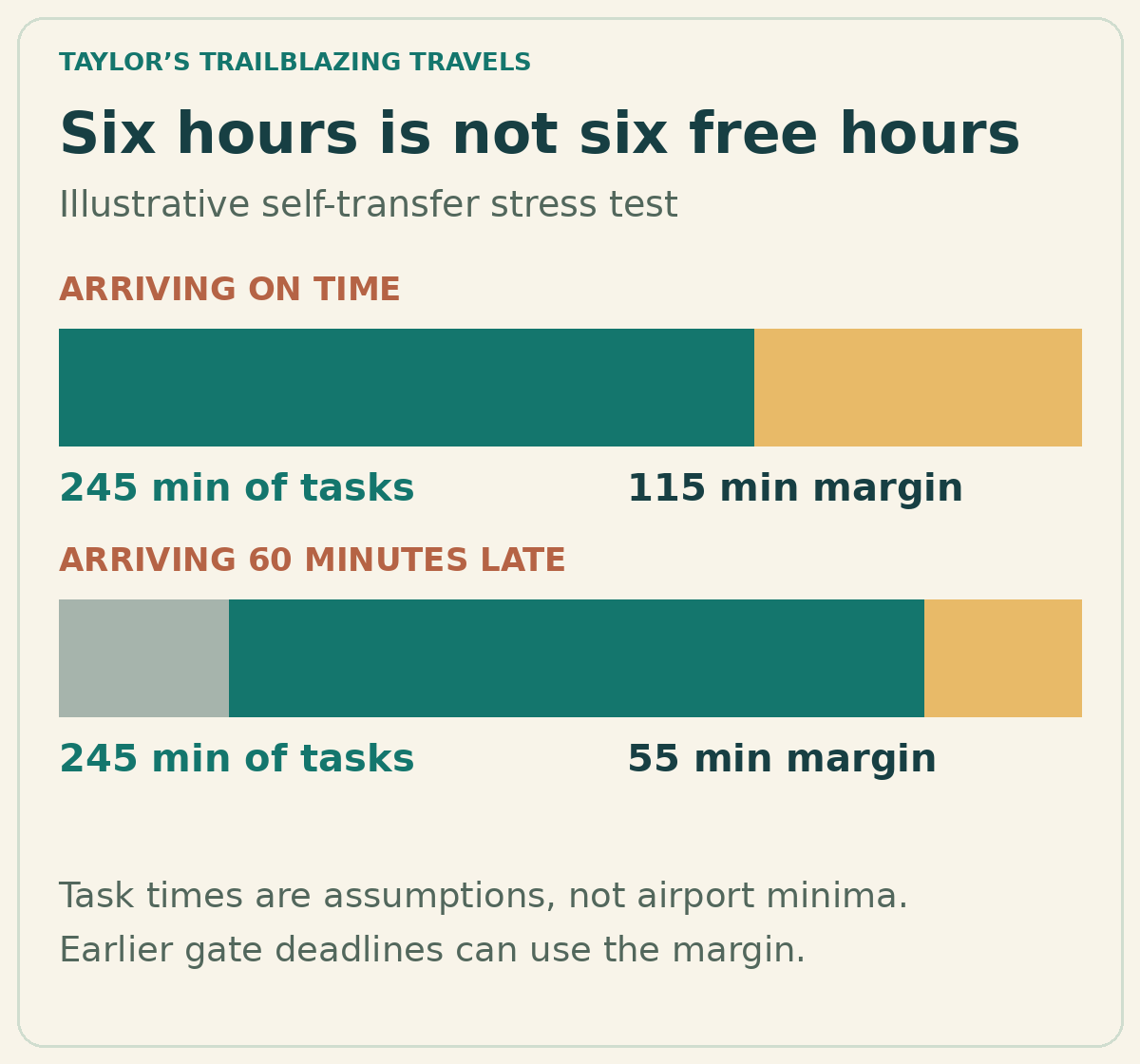
The gate target must match your airline. AirAsia’s guidance calls for arrival at the gate at least 30 minutes before AK and several other short-haul departures, but at least 90 minutes before D7/XJ departures. Its stated general gate closure is 20 minutes before departure; that is not a recommended arrival target. Replacing the model’s 30-minute target with 90 adds a full hour.[10]
Check-in deadlines are separate
At KLIA T2, AirAsia’s published counter and self bag-drop closure is one hour before departure. Malaysia Airlines also publishes a 60-minute check-in closure, with the gate closing 30 minutes before departure.[11][12] An online boarding pass does not extend bag drop or remove a required document check.
For separate tickets before an expensive long-haul journey home, compare the cost of an airport night with the cost of replacing the onward flight. An overnight stop can be the more sensible purchase when there are few later services, even if a same-day combination is technically possible.
Will you enter Malaysia, and do you need an arrival card?
A terminal change or landside hotel stay following an international arrival requires you to meet Malaysia’s entry rules. Staying in a qualifying international transit area is a different situation. Do not assume that calling the journey a “transit” exempts you from entry requirements.[3][13]
For travellers on a full British citizen passport, current UK government advice says tourism visits are normally visa-free for up to 90 days and the passport must have at least six months’ validity on arrival. It also says an arrival card is required for entry but not when you do not pass through immigration. Other nationalities and travel purposes can have different requirements.[13]
Where required, submit the Malaysia Digital Arrival Card through the official MDAC portal within the permitted three-day pre-arrival window, and check the current exemptions. An arrival card is not a visa or a guarantee of entry.[14][15]
Carry your passport for onward travel to Sabah or Sarawak as well; UK guidance flags immigration controls between Peninsular and East Malaysia.[13] Keep the onward itinerary, relevant visa and accommodation details readily available. Confirm destination-country documents too, since onward check-in may involve another document inspection.
Confirm the baggage route before the first flight
At your first check-in, ask where the baggage tag ends and whether any collection or customs step is required in Kuala Lumpur. Photograph the tag and retain the receipt. Two flights operated by the same airline do not, by themselves, prove that your baggage will be transferred automatically.
On eligible AirAsia Fly-Thru journeys, checked baggage is generally routed onwards, but instructions depend on the itinerary. On self-transfer journeys, plan to collect and check bags again unless the airline has explicitly confirmed another arrangement.[4][5] Do not leave a bag uncollected merely because you have booked a transit hotel.
For a T1 international transfer, JAL’s guide directs travellers with onward boarding passes towards their departure gate and those without them towards the relevant transfer counter. Its domestic-to-international instructions also distinguish through-checked baggage from luggage that must be reclaimed.[2] That is a useful illustration of why the baggage tag and boarding-pass situation matter more than a generic terminal map.
- Have both flight numbers and terminal names saved offline.
- Check the final airport printed on each baggage receipt.
- Ask whether an onward boarding pass is issued at origin or at a transfer desk.
- Confirm assistance through the connection, including any terminal change.
- Check departure screens again after reaching the correct terminal or concourse.
If you have only cabin baggage, you remove one task; you do not automatically remove immigration, document checks or the need to change terminals.
Choose an airport hotel you can actually access
“Airport hotel” is not enough information. Match the terminal, airside/landside location, eligible arrival/departure route and booking hours before comparing prices.
| Hotel | Location | Check before booking |
|---|---|---|
| Sama-Sama Express KLIA T1 | Airside, in T1’s Satellite Building near Gate C5. | Your access route, onward documents and baggage handling. |
| Sama-Sama Express KLIA T2 | Inside the international departure area of T2. | Eligibility for that departure area; it is not a general landside hotel. |
| Sama-Sama Hotel KLIA | Landside beside T1, connected by a covered bridge. | Entry into Malaysia, actual check-in hours and a T2 transfer if needed. |
Hotel access information: the two Sama-Sama Express FAQs and Sama-Sama Hotel’s airport guide.[16][17][18]
For a landside overnight stop beside T1, compare Sama-Sama Hotel KLIA on Agoda with Sama-Sama Hotel KLIA on Booking.com. These links are for the landside hotel, not either Express transit property. Compare the same room occupancy, taxes, cancellation conditions and arrival date; contact the property for an early-morning or daytime stay.[19][20]
For an airside stay, confirm eligibility directly with the relevant Express hotel before paying. A booking does not give permission to cross immigration or security boundaries. T2’s hotel specifically restricts access for some international-to-domestic connections, so a room with the right name can still be unusable for your route.[17]
If you choose an overnight stop, add it as a separate night in the Trip Itinerary Planner. It helps organise dates and nights; your airline still determines connection and check-in requirements.
Is there enough time to leave the airport?
Work out the usable time before buying a city excursion. Entry eligibility, baggage arrangements and re-entry to departures must all be settled first. An airport railway’s headline journey time excludes the time to get from the aircraft to its platform and the onward city connection.
Here is a deliberately simple stress test for an eight-hour arrival-to-departure gap: subtract 90 minutes for arrival formalities, 80 minutes each way for complete airport–city journeys, and 180 minutes back at the departure terminal. That leaves only 50 minutes in the city. All four allowances are planning assumptions, not guaranteed durations.
The three-hour departure allowance reflects AirAsia’s published suggestion for international departures, but your own carrier may require something different.[21] Any arrival delay or longer queue reduces the remaining time again. In this example, a city visit has little reward for the added uncertainty.
For a much longer layover, or an overnight with enough daylight either side, a short visit may make sense. Choose a small plan near your transport route, set a firm turnaround time, and keep the next flight as the first priority. A lounge, meal or correctly accessible hotel can be more useful than a rushed attraction.
If something changes, speak to the airline first
If the inbound flight is delayed, contact the airline or transfer desk as soon as the onward journey looks doubtful. AirAsia’s AK conditions provide specific remedies when its disruption causes a missed eligible Fly-Thru flight; separate point-to-point bookings do not carry that same promise.[5] Other carriers and any booking-platform guarantee have their own terms.
Before purchasing a replacement flight, ask about the rest of your ticket and any checked baggage. Save disruption messages, receipts and the advice given. Do not assume an airline will hold a gate because your other flight is late.
Can I stay airside on two separate tickets with cabin baggage?
Possibly, but only if the onward airline accepts the transfer, the boarding pass can be obtained airside, the terminals and transit route permit it, and your documents qualify. Confirm it before travel; treat an uncertain answer as a reason to plan for landside processing.
Does the three-minute terminal train make a short self-transfer safe?
No. That time excludes arrivals, baggage, access walks, waiting, check-in and departure checks. Use the complete process in your time budget.
Is an airside hotel automatically accessible to domestic passengers?
No. Check the specific property and route. Hotel names, terminals and controlled areas are not interchangeable.
The booking decision
Prefer a protected through-ticket when the connection is an essential part of your trip. If separate tickets offer enough value to justify the risk, build a generous buffer around the real tasks, verify entry eligibility and consider an overnight stop before a costly onward flight. Complete the terminal and baggage checks before choosing the shortest gap on a booking screen.
Sources and editorial approach
Reviewed on 7 November 2026. Official operator information is distinguished from illustrative calculations and editorial planning advice. Check your travel date, fare, terminal and booking terms directly with the provider.
- Malaysia Airlines — KLIA Terminal 1 passenger journey and transfer routes
- JAL — Kuala Lumpur transfer instructions (baggage and boarding-pass guidance)
- Ireland Department of Foreign Affairs — Malaysia advice, including T1–T2 immigration
- AirAsia — Fly-Thru overview and route-dependent baggage handling
- AirAsia — AK conditions of carriage, self-transfer and Fly-Thru disruption terms
- Express Rail Link — published timetable and T1–T2 train journey
- Express Rail Link — KLIA Transit inter-terminal fares
- Malaysia Airports — inter-terminal shuttle service
- Malaysia Airports — planned Aerotrain software update, announcement 7 October 2026
- AirAsia — required boarding-gate arrival times
- AirAsia — airport check-in and self bag-drop opening/closing times
- Malaysia Airlines — check-in and boarding deadlines
- UK FCDO — Malaysia entry requirements for British citizen passport holders
- Malaysian Immigration — official Malaysia Digital Arrival Card portal
- Malaysia High Commission London — MDAC submission window and exemptions
- Sama-Sama Express KLIA T1 — airside location, baggage and access FAQ
- Sama-Sama Express KLIA T2 — international-departure-area access restrictions
- Sama-Sama Hotel KLIA — landside airport access and T1 bridge
- Agoda — Sama-Sama Hotel Kuala Lumpur International Airport listing
- Booking.com — Sama Sama Hotel KLIA listing
- AirAsia — suggested arrival times before international and domestic flights
Illustrations in this article were created for Taylor’s Trailblazing Travels. Third-party photographs, where used, are credited beside the image or in the source list.