Things to Do in Kuching: Waterfront, Museums and Heritage Routes
A city day with room for riverside pauses, living streets and the stories behind the buildings.
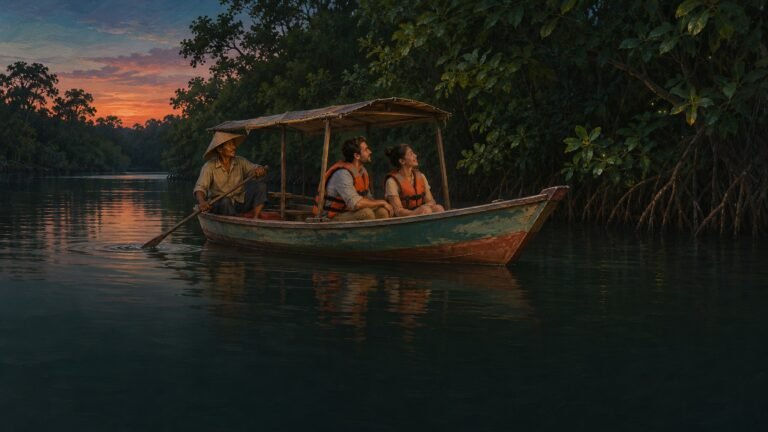
Original illustration inspired by Kuching Waterfront. It is not an eyewitness photograph or an exact route depiction.
The best things to do in Kuching fit into a few compact groups: the Sarawak River waterfront, the old trading streets behind it and the museums that give those streets context. The waterfront and Main Bazaar are natural starting points; the Borneo Cultures Museum deserves a separate block of attention. [1][2][3]
Choose one major museum, one walk and one unhurried meal before adding more stops. That combination is more useful than treating every named building as a separate attraction. The routes below are original planning suggestions, with generous stopping time rather than a promise that every doorway will be open.
Best first-day mix
One heritage walk, one substantial museum and a riverside evening.
Short visit
Keep the waterfront, old streets and Chinese History Museum together.
Rainy stretch
Give the Borneo Cultures Museum a proper block of time.
Avoid overloading
Across-river visits and out-of-town wildlife trips need their own space.
Choose the Kuching experiences that fit your day
This selection is based on the kind of experience each stop adds and how easily it combines with the others. It is not a popularity ranking. The suggested time allowances include looking, resting and some movement; they are editorial estimates, not official visit durations.
| Experience | Choose it for | Allow as a starting point | Main trade-off |
|---|---|---|---|
| Waterfront and Darul Hana Bridge | Orientation, river views and a flexible evening | 45–90 minutes | Outdoor conditions matter; a view is not access to the buildings opposite |
| Main Bazaar and Carpenter Street | Shopfronts, small businesses and a closer look at the old city | 60–90 minutes | Individual businesses keep their own hours |
| Chinese History Museum | A focused introduction beside the river | 30–60 minutes | Smaller scope than the Borneo Cultures Museum |
| Borneo Cultures Museum | Regional cultural context and a substantial indoor visit | 2–3 hours | Paid admission and enough material to reward concentration |
| Brooke Gallery at Fort Margherita | A focused look at the Brooke era | 60–90 minutes inside, plus your actual transfer | A separate journey and a narrower historical lens |
The destinations and their themes are supported by the tourism board, museum department and Brooke Heritage Trust. The grouping and time budgets are this guide’s planning judgement.
Use the waterfront as your orientation line
Kuching Waterfront follows the Sarawak River, and the Darul Hana pedestrian bridge provides another perspective on the riverfront. These are useful places to orientate yourself before branching into the older streets. The bridge is an S-shaped pedestrian crossing, not a boat tour. [1][6]
Start with a short stretch rather than aiming to walk every part of the promenade. Look back towards the city from a different point, find a comfortable place to pause and decide which part of the old town deserves more attention. Later in the day, return for the changing light if the weather suits; there is no need to attach the visit to an unverified fountain timetable.
Bridge crossing or river cruise?
A bridge walk is flexible and lets you turn back when you wish. A cruise can appeal if sitting down and seeing the riverfront from the water is the main attraction. Compare its actual boarding point, duration, seating, weather policy and inclusions before paying. A cruise does not replace the closer street-level detail of the bazaar.
Do not treat a waterfront photograph of the Astana or legislative assembly as evidence that you can freely enter those premises. Build the walk around public places and follow current access signs. Similarly, if you use a small river boat, confirm the destination, fare, lifejacket provision and return arrangement before boarding; the pedestrian bridge avoids depending on a return boat for a simple river crossing.
Follow a heritage loop without turning it into a checklist
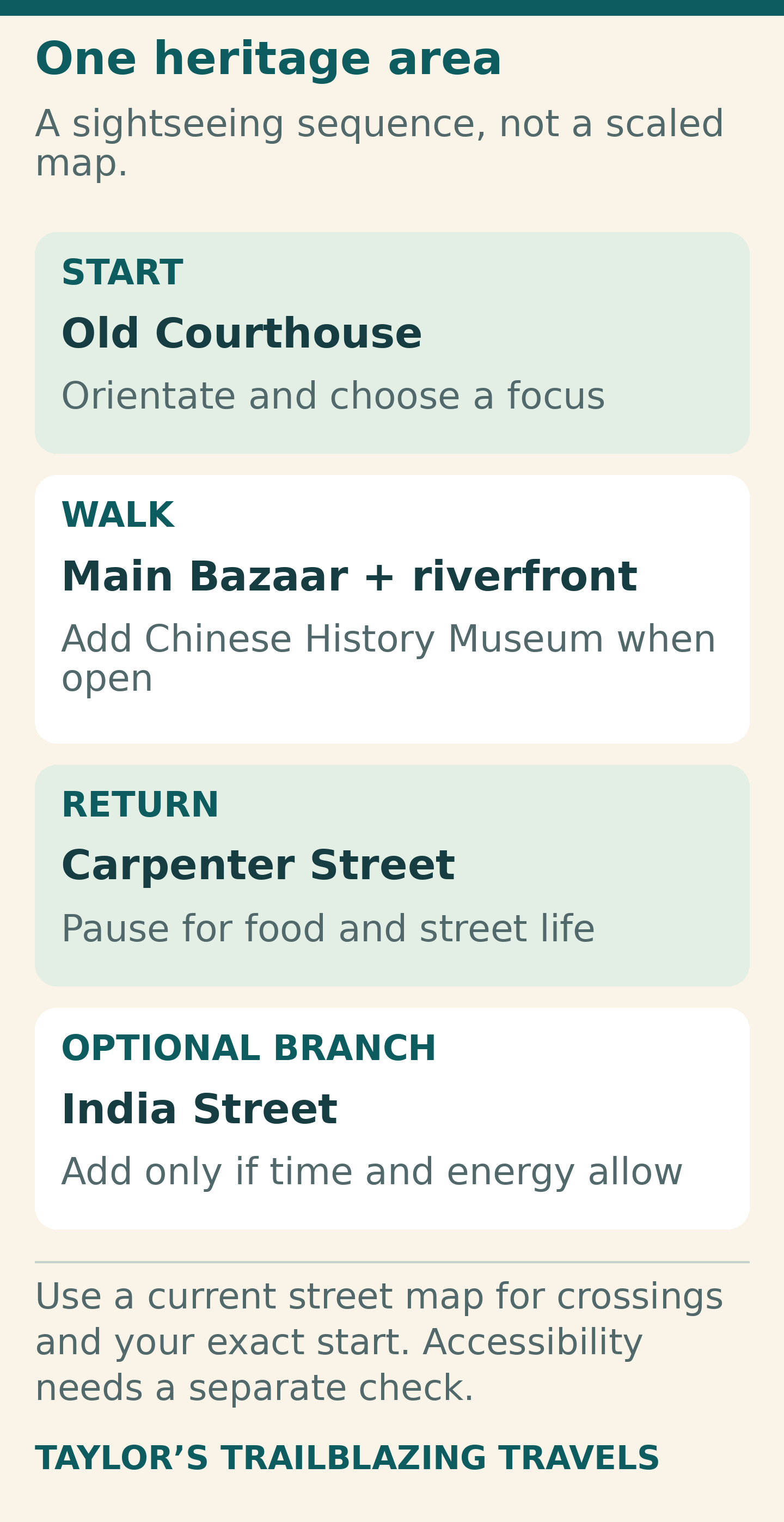
Main Bazaar faces the river, while Carpenter Street offers another layer of the old trading area. The tourism board’s heritage route also identifies the Old Courthouse, India Street and nearby religious landmarks. These streets work as a group because their interest lies in the relationships between trade, worship and daily life, not just a sequence of facades. [2]
Begin around the Old Courthouse
Use the public surroundings as an orientation point. Decide whether the morning’s priority is architecture, food or browsing; this stops a short walk becoming an exhausting attempt to see everything.
Move along Main Bazaar
Look beyond the nearest souvenir display. Ask about the maker, material and place of production when a craft interests you. A shop’s location in a historic street does not by itself prove that every item was made locally.
Add the Chinese History Museum if it is open
This makes a useful focused pause near the waterfront. If you want to read carefully, shorten the shopping part rather than rushing the exhibits.
Return through Carpenter Street
Leave room for a drink or a meal. Observe places of worship respectfully, keep entrances clear and ask before photographing people or entering a space whose public access is unclear.
Extend towards India Street only if energy allows
Think of this as an optional branch, not a missing tick. You can return another morning if you prefer a slower pace.
This is a suggested sequence through the heritage area, not turn-by-turn navigation or a measured accessible route. Check a current street map for crossings and your exact starting point. Where surfaces, kerbs or heat make a leg awkward, a short vehicle transfer is a reasonable adjustment.
For local interpretation, compare Kuching walking tours on GetYourGuide. Check the actual stops, walking distance, group size and whether any boat section is optional. A guided walk is most useful when you want explanations and conversation, not simply help following a map.
For a second comparison, browse Kuching heritage tours on Viator. Select the city walk you actually want: wider heritage categories can also include trips outside the old town.
Pick a museum for its perspective
Borneo Cultures Museum: give it time
The Borneo Cultures Museum is beside Padang Merdeka. Its galleries cover themes including relationships with nature, historical change and cultural objects; there is also a children’s gallery. This broader scope makes it the strongest single museum choice here for travellers seeking context for a wider Sarawak trip. That judgement reflects its published exhibition themes, not a personal museum visit. [3]
Choose a small number of questions to follow: how river environments shape daily life, how different communities are represented, or how objects acquire meaning. Read a few displays properly, then pause. Trying to absorb every label tends to leave less understanding than selecting a coherent thread.
Chinese History Museum: a focused riverside stop
The Chinese History Museum occupies a historic former court building and explores the Chinese communities of Sarawak. Its location makes it easy to combine with the old bazaar area. The museum department currently lists admission as free. [5]
Use it to add context to the walk, rather than expecting the breadth of the Borneo Cultures Museum. The two can complement each other, but you do not need both on an arrival day.
Brooke Gallery: a different historical lens
The Brooke Gallery at Fort Margherita presents the Brooke era through an exhibition developed with the Sarawak Museum and Brooke Heritage Trust. The trust supplied artefacts from the family collection and helped develop the interpretation. [7]
That origin is useful context when reading the displays. Pair this perspective with the wider cultural material elsewhere, and leave space to consider whose experiences are foregrounded. If choosing it, confirm the gallery’s current opening and the access route before travelling across the river; this guide does not treat the transfer as a quick automatic addition to the bazaar loop.
Check the museum hours and admission before setting out
The table records published visitor information checked on 6 November 2026. Hours can change for closures, events and public holidays. Check the museum’s own notice for your date rather than assuming a museum is open because the waterfront is busy.
| Museum | Published opening | Admission relevant to UK visitors |
|---|---|---|
| Borneo Cultures Museum | Monday–Friday 09:00–16:45; Saturday, Sunday and public holidays 09:30–16:30. Last admission 16:00; specified holiday closures apply. | International adult age 18–60: RM50; age 61+: RM25; age 12 and under: RM20; the published age 13–17 / students-with-ID category is RM25. Bring any required proof of eligibility. [4] |
| Chinese History Museum | Monday–Friday 09:00–16:45; Saturday, Sunday and public holidays 10:00–16:00. Specified holiday closures apply. | Free entry. [5] |
For two international adults aged 18–60, Borneo Cultures Museum admission is therefore RM100 before food, transport or any additional attraction. That is a simple calculation from the published adult tariff, not a total city-day budget. There is no GBP conversion here: compare the ringgit charge with the exchange rate and fees your payment provider actually applies.
The official online museum ticket service says its tickets are single-use, non-transferable and non-refundable, with redemption within 90 days of purchase. Read the conditions again before paying, particularly if your day depends on flights or weather. [4]
Build a half-day, full-day or history-focused plan
Half a day: river, streets and one small museum
Allow around three to four hours for the waterfront, part of the old bazaar area, the Chinese History Museum when open, and a meal or drink. The value comes from being selective. If you arrive after the museum closes, enjoy the public waterfront and streets, then move the museum to another day.
One full day: heritage morning, museum midday, river later
Start with a heritage loop of about 90 minutes, then allow an hour for a relaxed meal and movement towards the museum. Spend two to three hours at the Borneo Cultures Museum and leave an hour or more for a proper break before deciding on an evening waterfront walk. These blocks deliberately include breathing space; they are not a fixed tour departure schedule.
| Block | Planning allowance | What to remove if running late |
|---|---|---|
| Old town and short stops | 90 minutes | Optional India Street branch |
| Lunch and movement | 60 minutes | Keep the meal; reduce later stops |
| Borneo Cultures Museum | 120–180 minutes | Choose fewer galleries |
| Rest and flexibility | 60 minutes | Do not use all of it to chase a delayed stop |
| Waterfront return | 45–60 minutes | Bridge extension or the whole walk if tired |
The planned activity blocks total 6¼–7½ hours. They exclude any additional journey to or from your hotel and do not assume you will remain outside all day. If your party wants a slower museum visit, remove an earlier stop instead of compressing the rest.

A second city day: choose the history you missed
Make the Brooke Gallery a main interest, with its transport and access arranged first. Then add a short revisit to a favourite street or a different meal, rather than redoing the entire first-day circuit. Alternatively, use the second day for another activity entirely; a satisfying first day does not create an obligation to exhaust every museum.
If Kuching is one stop in a longer journey, use the Trip Itinerary Planner to allocate your nights and record the city days you want to keep free. It organises your choices; it does not check museum openings or transport feasibility.
Leave space for food, shade and the needs of your group
Sarawak laksa and kolo mee are useful dishes to look out for, but they are not interchangeable. The tourism board describes laksa as a rich noodle soup, commonly with prawns and chicken, and kolo mee as dry noodles often served with meat. Recipes vary, so ask about ingredients rather than judging suitability from the dish name. [8]
A food stop also creates a natural pause in the walking route. Pick somewhere that suits your party’s dietary needs and energy level; there is little benefit in taking a long detour solely because a list calls a stall the most famous. No particular restaurant or current meal price is assumed in this plan.
Heat, rain and footwear
Carry water and a compact rain layer, and make the indoor visit a useful part of the plan rather than a last-minute fallback. Wear footwear that already fits comfortably and grips wet paving. UK readers comparing ordinary city-walking footwear can browse the Skechers UK Outlet; choose by fit and the conditions you expect, not a brand name alone.
Accessibility and younger travellers
For a wheelchair, walking aid or pushchair, ask the museum about the specific entrance, lifts, accessible toilets and current arrangements, then check the street portions separately. A short-looking line on a map says little about kerbs, gradients, sheltered rests or crossings. Families may get more from one engaging gallery and a riverside pause than from a day of continuous walking.
Keep religious buildings and working streets in perspective: they remain places used by residents. Follow dress and photography instructions, avoid interrupting worship, and ask permission before making someone the subject of a photograph.
Choose a base that supports the walk you actually want
For a city-focused stay, compare the walking route from the property’s entrance to your chosen riverfront starting point, not just the words “Kuching” or “city centre” in a listing. Also check night-time noise, road crossings, lift access if needed and whether your room category includes the features that matter to you.
Search Kuching accommodation on Booking.com and compare Kuching stays on Agoda, then use each map to check the precise location. These are city searches, not a shortlist of personally inspected hotels or a claim of availability for your dates.
Once you have actual offers, put the total room price, breakfast, compulsory charges and any extra transport into the Hotel Comparison Calculator. Use one currency throughout and the same room occupancy and cancellation basis for each option.
Keep the city guide separate from a wildlife day
A Bako excursion or Semenggoh visit needs its own access, timing and return plan. Do not assume either can be slipped into spare time between city museums. Reserve a separate block for the attraction you care most about, then use this guide for the parts of Kuching that remain genuinely free.
For the wider country structure, start from the Malaysia travel hub. Additional guides should complement this city walk, rather than turn a relaxed day into an impractical circuit.
Questions before you go
Is Kuching Waterfront enough for a first visit?
It is a good start, especially on an arrival evening. For a fuller city visit, add a heritage street loop or one museum. The riverfront gives orientation; exhibitions and conversations add context.
Which museum should I choose if I have time for only one?
Choose the Borneo Cultures Museum for broad cultural context and allow a substantial visit. Choose the Chinese History Museum when your time is limited and you want a focused stop alongside the river walk. Both choices follow their published themes and location. [3][5]
Does the bridge replace a river cruise?
It replaces the need for a boat if your aim is simply a pedestrian crossing and a different viewpoint. It does not provide the same seated river journey. Decide whether the water-based experience itself justifies the booking.
Can I do the full city route on a museum holiday closure?
You can adapt the outdoor portions, but the museum-led version no longer works as written. The museum department lists specific closure dates, including Christmas Day in 2026. Check the relevant notice before building a paid museum visit into the day. [3][5]
Make room to enjoy the city
For a first Kuching city day, keep the plan simple enough to enjoy: old streets while you have energy, one museum worth concentrating on, and the river when a slower pace appeals. Add Fort Margherita or another neighbourhood because it matches your interest, not because a checklist makes the first day feel incomplete.
Sources and checks
This guide is research-led. Official information and named operators support the factual details; the choice frameworks and sample plans are editorial analysis. Check current access, prices and arrangements for your own date. Last editorial review: 6 November 2026.
- Sarawak Tourism Board — Kuching WaterfrontWaterfront setting and visitor orientation; indexed official page consulted 6 November 2026.
- Sarawak Tourism Board — Explore Kuching Heritage in 2 HoursHeritage street and landmark groupings; consulted 6 November 2026.
- Sarawak Museum Department — Borneo Cultures MuseumMuseum location, gallery themes and 2026 closure notice; consulted 6 November 2026.
- Service Sarawak — Admission Ticket to MuseumsPublished hours, international ticket categories and online conditions; checked 6 November 2026.
- Sarawak Museum Department — Chinese History MuseumMuseum subject, building, opening times and free admission; checked 6 November 2026.
- Sarawak Tourism Board — Darul Hana BridgePedestrian bridge description; consulted 6 November 2026.
- Brooke Heritage Trust — The Brooke GalleryExhibition's location, scope and development; consulted 6 November 2026.
- Sarawak Tourism Board — FoodGeneral descriptions of Sarawak laksa and kolo mee; consulted 6 November 2026.
Illustrations in this article were created for Taylor’s Trailblazing Travels. Third-party photographs, where used, are credited beside the image or in the source list.