14-Day Malaysia Nature and Wildlife Itinerary: Ethical Experiences
A slower Sabah journey that gives forests, rivers and wildlife room in the itinerary—and asks useful questions before anything is booked.
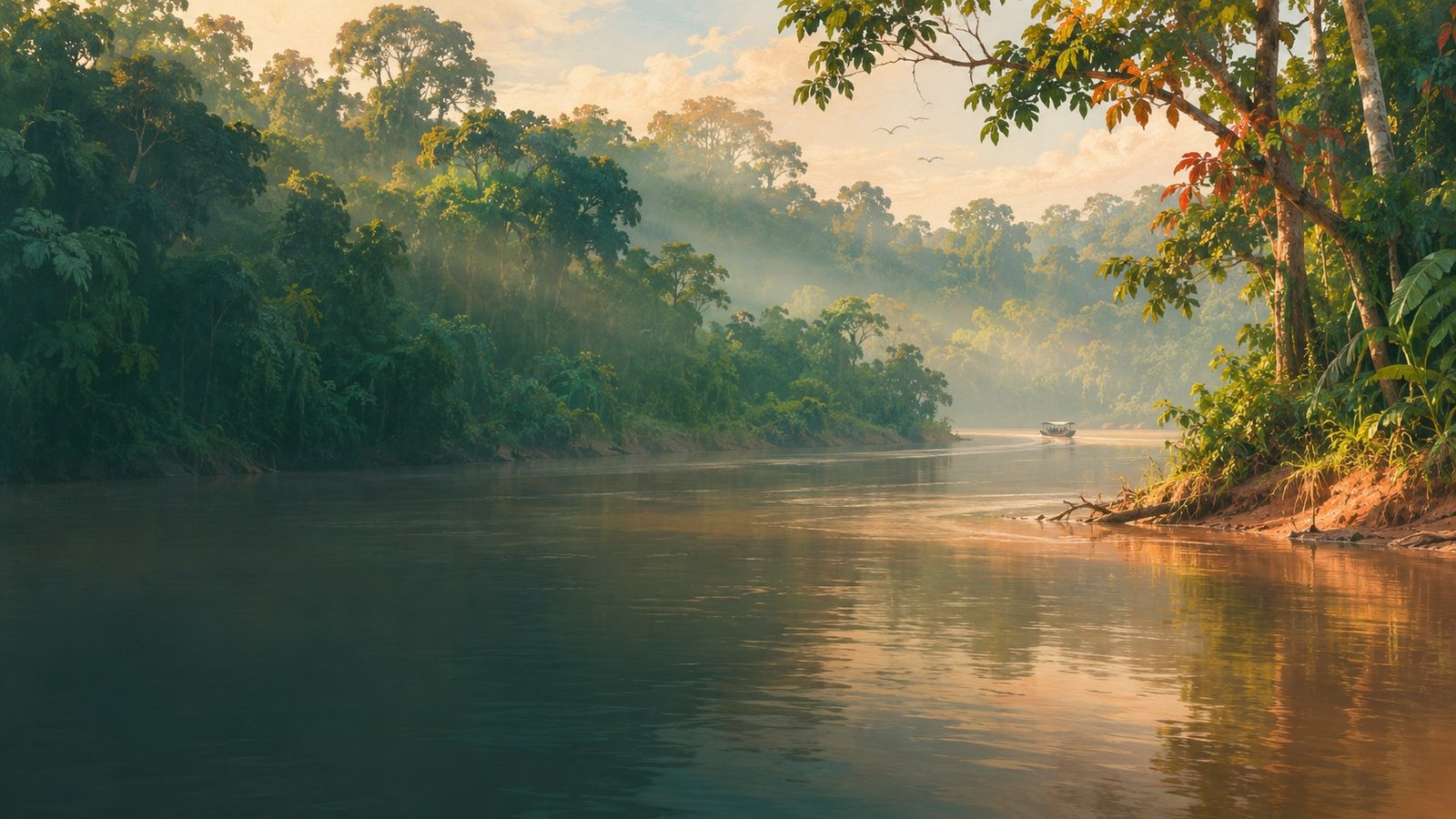
AI-generated editorial illustration inspired by the Kinabatangan; wildlife sightings are not promised.
A Malaysia nature and wildlife itinerary becomes more rewarding when it allows a second forest morning instead of another airport. This 14-day route concentrates on Sabah, with four bases and 13 nights. It does not attempt to cover Peninsular Malaysia and Borneo in the same fortnight.
The route combines rehabilitation-centre visits, wildlife observation in forest and along a river, mountain-area nature walks and an urban wetland. These are different experiences, and the distinction matters. ‘Ethical’ here describes the selection and behaviour tests used throughout the guide; it is not an independent certification of every venue or tour.
Some links in this guide are affiliate links. Taylor’s Trailblazing Travels may earn a commission if you book or buy through them, at no extra cost to you.
Arrive in Sandakan and depart from Kota Kinabalu, subject to workable flight connections.
Two full days between arrival and departure leave repeated viewing time and room for weather changes.
A river package returning to Sandakan will need a different arrangement for Kundasang.
Reject handling, tourist feeding and chasing; a conservation label alone does not answer the question.
The 13-night route, with the travel days included
| Base | Nights | Full days between moves | Why it earns its place |
|---|---|---|---|
| Sepilok area | 4: nights 1–4 | Days 2–4 | Forest time and separate rehabilitation-centre visits without rushing from an arriving flight. |
| Lower Kinabatangan | 3: nights 5–7 | Days 6–7 | Repeated river outings instead of a single chance to see wildlife. |
| Kundasang / Kinabalu Park area | 3: nights 8–10 | Days 9–10 | A change of forest environment and time for lower-level nature walks. |
| Kota Kinabalu | 3: nights 11–13 | Days 12–13 | An urban mangrove visit, recovery time and space before the flight home. |
The four-base design leaves nine days without changing accommodation. Days 5, 8 and 11 are moving days; days 1 and 14 are arrival and departure. Treat any wildlife activity on a moving day as conditional on the actual transfer, daylight and conditions.
This suits travellers who enjoy waiting, looking closely and accepting that an animal may remain unseen. It is less suitable for someone expecting a beach-resort fortnight, an intense summit climb or a guarantee of particular species. All three would need a different allocation.
The route stays on mainland Sabah. At the review date, the FCDO advised against all but essential travel to offshore islands and dive sites between Sandakan and Tawau, including Lankayan; the warning explicitly did not apply to the mainland. Check the current geographical advice and your insurance before adding an eastern island excursion. [1]
Put the stops and nights into the Trip Itinerary Planner, then use the Itinerary Pace Checker with your own door-to-door transfer estimates. These tools organise your choices; they do not check transport availability or entry rules.
Back to top ↑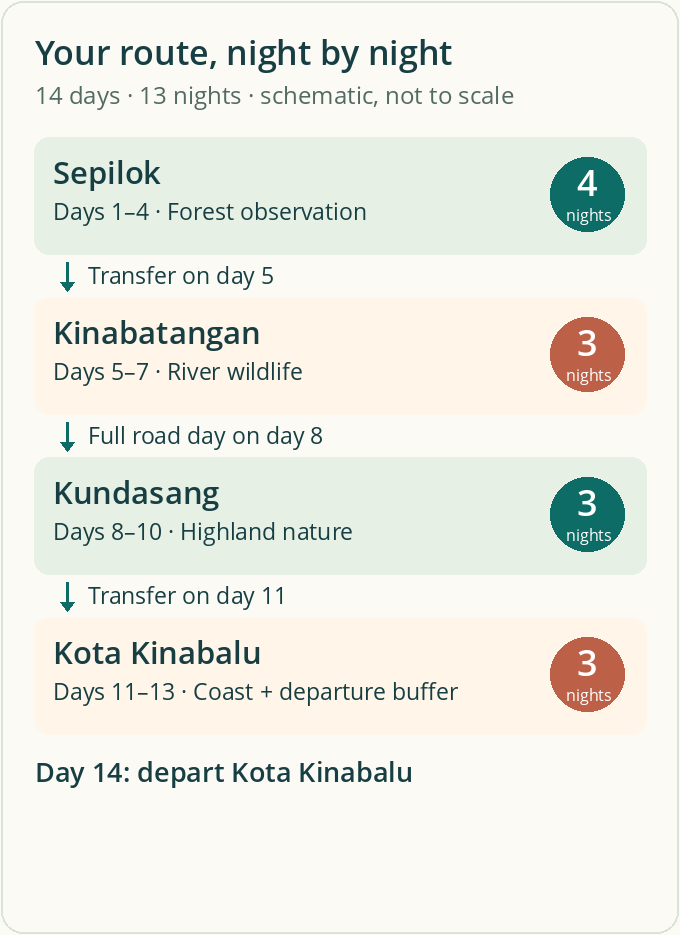
Days 1–4: Sepilok, with time to look again
Day 1: arrive through Sandakan and settle near the forest
Choose a workable flight connection into Sandakan, then transfer to the Sepilok area. Stay near the places you intend to visit rather than committing to a return journey from the city every morning. Confirm the actual route to entrances, meals and any evening walk; a short distance on a booking map does not guarantee a convenient walking route after dark.
Keep the first evening light. A pre-booked wildlife outing immediately after a long flight is easy to miss and difficult to enjoy when tired.
Day 2: understand rehabilitation before taking photographs
Visit the Sepilok Orang Utan Rehabilitation Centre and the nearby Bornean Sun Bear Conservation Centre as separate experiences. Sepilok’s work concerns rehabilitating orphaned orangutans. Its supplementary feeding sessions do not guarantee that animals will appear; the tourism board explains that finding their own food is part of the intended progress. Visitors must not touch them. [2]
The sun-bear centre describes viewing rescued former pet bears in forest enclosures. It has its own ticket and asks visitors not to feed animals, call to them or throw objects. Staff are available at the observation platform to answer questions. [3]
Leave time for those explanations. Do not describe a managed rehabilitation visit as a sighting of an entirely wild population. Keep your distance if an animal approaches a walkway and follow staff directions.
Day 3: forest observation at the Rainforest Discovery Centre
Use the Rainforest Discovery Centre for its forest trails, plant garden and elevated skywalk. Its published visitor information distinguishes daytime admission from night-walk charges, so check the arrangements for both. [4]
Make one morning or afternoon a slow observation session. A local guide can help you identify what you are looking at, but ask about the route, pace and likely conditions before paying. Book a guided night walk separately if that interests you; the tourism board says advance arrangements are needed. [5]
Day 4: repeat the experience that benefited from more time
Return to the forest, book a more focused birding session or leave part of the day clear if rain interrupted the previous visits. A repeat visit is intentional here. It allows a different time of day and removes the pressure to see everything in one hurried circuit.
Use the remaining time to confirm the next day’s lodge pickup, included meals, luggage limit and onward transfer. Avoid filling this buffer with another distant attraction simply because the calendar has a gap.
These searches cover the wider Sandakan area. Use the map to select Sepilok if that is your intended base, and confirm transfers and meals instead of assuming they come with the room.
Days 5–7: three nights on the Lower Kinabatangan
Day 5: transfer to the lodge
Book a lodge stay with the transport and guiding arrangements understood. Sabah Tourism identifies Sukau, Bilit and Abai as river-lodge areas and describes packages that can combine accommodation, meals, transport and excursions. Their geography and access are not interchangeable. [6]
For this route, a road-accessible lodge around Sukau or Bilit is the simpler starting point for arranging the later move towards Kundasang. Confirm whether a final boat crossing is required. An afternoon cruise is welcome if it fits the lodge schedule; it is not a reason to compress a delayed transfer.
Days 6 and 7: repeat river outings, with breaks between them
Use the lodge’s confirmed morning and later-day programme, with rest between outings. The river environment supports wildlife including proboscis monkeys, orangutans, hornbills and Bornean elephants, but no species should be treated as a guaranteed sighting. The tourism board recommends a stay of at least three days. [6] Three nights in this plan creates two full days after arrival, with more flexibility than a single overnight.
Before booking, ask for the number and approximate duration of the included cruises, the maximum passengers per boat, guiding language and what happens when weather stops an outing. A room-only rate and a guided full-board package cannot be compared on the accommodation price alone.
Ask the guide to avoid chasing or crowding an animal. If several boats are already gathered, waiting farther away or moving on may be the better choice. ABTA’s traveller guidance advises keeping distance and not pursuing animals that are trying to avoid people. [7]
Stay in the boat where instructed and keep clear of the river’s edge. Crocodiles occur here, so swimming is not part of this itinerary. [6] Take a properly fitting life jacket seriously even on a quiet stretch of water.
Back to top ↑Days 8–10: a full transfer day, then mountain-area nature
Day 8: travel to Kundasang in daylight
Reserve the whole day for the road transfer. Request a door-to-door quote from the actual lodge or jetty to the actual Kundasang accommodation, with stops and any final boat crossing included. This is a custom onward journey: do not assume a package’s return to Sandakan can be redirected without notice or additional cost.
Use a provisional allowance of 6–8 hours including access, stops and margin, then replace it with the operator’s current estimate. This is an editorial planning allowance, not a scheduled service. Leave early enough for a relaxed arrival and avoid booking a park activity that afternoon.
Day 9: the forest and botanical side of Kinabalu Park
Choose the park’s lower nature trails and Botanical Garden according to the conditions and your ability. Kinabalu Park offers these experiences separately from the summit route; climbing the mountain is not required to enjoy the park. [8]
Ask park staff which trails are open and what guiding arrangement is appropriate that day. Keep a shorter walk available if the ground is wet or cloud obscures the views. The aim is to notice the change in vegetation, rather than to cover a specified distance.
Day 10: keep a second morning for the park area
Use this day for another permitted nature walk or a quiet highland morning, depending on what conditions allowed on day 9. Do not promise a particular flower in bloom or a clear mountain panorama.
Be careful with older itineraries that automatically include Poring’s canopy walkway. The official park notice available at review stated that it remained temporarily closed for maintenance. Check current access before making a special journey. [9] The main route therefore works without it.
Choose accommodation by its access to the planned park visits, meals and pickup point. A remote hillside property may offer an attractive view while making every practical journey harder. Ask about steps, room heating or blankets, and transport if those details affect your comfort.
Check the exact map location against your planned park visits and pickup point. Compare the full three-night total, meals and cancellation terms; a room listing does not include your custom transfer.
Days 11–14: Kota Kinabalu, mangroves and departure space
Day 11: transfer and recover
Move to Kota Kinabalu with a provisional half-day allowance. Keep the afternoon for a meal, laundry and a short local walk. The final city stay is practical: it separates the longest rural travel from the homeward flight.
Day 12: an urban wetland visit
Kota Kinabalu Wetland has a mangrove boardwalk, a bird hide and resting areas. Its operator currently lists closure on Mondays and public holidays; check before visiting and swap days 12 and 13 if necessary. [10]
Allow a quiet morning rather than treating it as a quick stop between shopping appointments. Binoculars and patience matter more than adding another activity. Ask the visitor centre about the current trail condition and any sections unsuitable for your access needs.
Day 13: retain the buffer
Use the day for the wetland if needed, a gentle city outing or simply rest. It also provides room to absorb a manageable earlier delay without scheduling the long rural transfer on the day of departure. It cannot protect against every disruption, so keep flight and insurance arrangements sensible.
Day 14: leave through Kota Kinabalu
Check the full itinerary to the UK, including baggage, terminal changes and whether connecting flights are on one protected booking. If the flight pattern needs an additional overnight elsewhere, count it outside this 13-night Sabah plan or deliberately remove a night from the route.
Compare the hotel’s exact location, wetland transfer and airport access. These are room searches; a conservation visit or guided activity is a separate arrangement.
How to choose a wildlife experience with defensible standards
Start with what visitors are actually invited to do. ABTA’s animal-welfare guidance treats tourist contact or feeding involving great apes and bears, and human-initiated contact or feeding of animals in the wild, as unacceptable practices. [11] A tour name containing ‘eco’, ‘rescue’ or ‘sanctuary’ is not a substitute for clear answers.
| Question | A useful answer | Reason to decline or clarify |
|---|---|---|
| What interaction is offered? | Observation without tourist handling, tourist feeding or staged close-contact photographs | Holding an animal, paid feeding, riding or touching as the attraction |
| Can the animal avoid visitors? | The guide explains distance and ends or moves an encounter when needed | Chasing, blocking movement or promising a close encounter |
| What is included and controlled? | Named operator, clear boat capacity, safety equipment and a weather plan | Vague operator identity or no explanation of supervision |
| How does the claim benefit conservation or local people? | A specific, checkable programme or clear local employment arrangement | Unexplained claims that every payment ‘saves wildlife’ |
The first two questions concern animal welfare; the others test whether the overall operation is explained clearly. Do not add up a score and let good transport arrangements cancel out harmful animal handling. One unacceptable activity can be enough to reject the tour.
Rehabilitation care needs a distinction: staff-directed feeding as part of an animal’s care is different from selling tourists a feeding encounter. At any managed centre, follow the visitor boundary rather than demanding access to the care work. Observe, ask questions and accept that a quieter encounter can be the better outcome.
During forest and river visits, keep voices low, follow instructions on photography and lighting, and let the guide set the distance. World Animal Protection’s photography advice favours animals that can move freely and be photographed from a safe distance. [12] The purpose of the photograph is to record the observation, not to change the animal’s behaviour for the picture.
Back to top ↑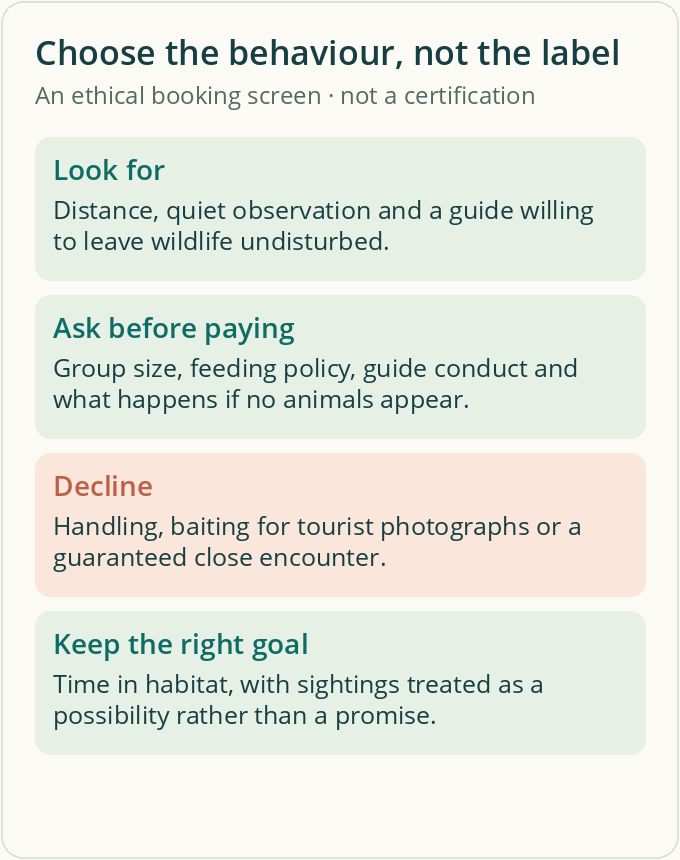
Book the transfers and compare the true package cost
Many river programmes begin in Sandakan or Sepilok. A lodge transfer may include a road journey, a boat leg or both; a public bus arriving in the wider district does not deliver you to every lodge. Confirm the exact meeting point with the accommodation. Operator information from Borneo Dream and Sukau Rainforest Lodge illustrates these different arrangements. [13] [14]
| Leg | Reserve | Essential check |
|---|---|---|
| Sandakan Airport → Sepilok | A relaxed arrival afternoon | Flight arrival, baggage and the lodge’s exact location |
| Sepilok → river lodge | About 3–4 hours for pickup, travel and settling in | Road or boat access, luggage and first included meal |
| River lodge → Kundasang | A full daylight travel day; provisionally 6–8 hours | Custom onward transport, stops, final crossing and price |
| Kundasang → Kota Kinabalu | A half day; provisionally 3–4 hours | Road conditions, hotel access and any requested stops |
The time ranges include margin and are not advertised timetable durations. They depend on the exact lodge and departure point. Do not book tight onward activities against them.
An illustrative budget for two adults
This original model uses 10 independently booked room nights plus a three-night river package. It is a set of spending assumptions dated 7 November 2026, not a quoted tour or a claim about average costs. All amounts are in Malaysian ringgit (RM/MYR).
| Item | Assumption | Total |
|---|---|---|
| Rooms outside the river stay | 10 nights × RM350 for one shared room | RM3,500 |
| Three-night river package | Allowance for two, assuming meals, scheduled guiding/cruises and Sepilok pickup | RM4,500 |
| Other meals | Combined allowance outside the river package | RM1,320 |
| Other road transfers and local travel | Combined allowance, including the custom onward journey | RM2,000 |
| Other admissions and guides | Combined allowance outside the river programme | RM900 |
| Subtotal | Before reserve | RM12,220 |
| Reserve | 15% of subtotal | RM1,833 |
| Planning total | Approximately RM14,100 for two | RM14,053 |
Replace every line with actual quotes, particularly the lodge package and day-8 transfer. Check taxes, meals, conservation fees, guide time, boat capacity and cancellation terms. Do not assume an unused return transfer to Sandakan produces a refund. If a better-matched river package costs RM1,000 more, the model rises by RM1,150 including the same reserve.
The model excludes insurance, personal equipment, gratuities and private-boat upgrades. It also assumes one shared room; solo room and transfer costs cannot simply be divided by two.
When you have actual quotes, convert them to GBP using your current payment rate before entering them in the Travel Budget Calculator. Its figures are editable and it does not convert currencies. Use the Hotel Comparison Calculator to include room extras and transfers in one currency.
Back to top ↑Weather, access and the checks that change the plan
Rain is part of this route. METMalaysia describes heavier north-east-coast Sabah rainfall during the north-east monsoon, with January the rainfall maximum and April the minimum in that regional pattern. The pattern does not apply identically to every highland or west-coast location. [15] Use it to choose a period to investigate, then check local forecasts and road or river conditions close to travel.
The route’s spare forest day, two full river days and second highland morning are the main weather adaptation. If sustained rain affects access, contact the next accommodation before leaving rather than hoping a road or boat connection will work. A cancelled wildlife outing is preferable to an unsafe departure.
Pack for wet surfaces and repeated short outings: footwear with suitable grip, a lightweight waterproof layer, a protected bag for documents and camera equipment, and binoculars if you have them. Check laundry and charging arrangements with remote accommodation. Ask about steps, boat boarding and assistance in precise terms if mobility is a concern.
The FCDO warns about poor-condition or overloaded boats and recommends checking life jackets. It also notes that roads in East Malaysia can be less well maintained than those in the peninsula. [16] The planned pace does not make every vehicle, trail or boat suitable for every traveller.
For full British citizen passports, current FCDO guidance includes six months’ validity on arrival, normal visa-free tourist admission of up to 90 days and an online arrival-card requirement subject to exemptions. Travelling between Peninsular Malaysia and Sabah also involves immigration checks: carry the passport and check the entry stamp. Other nationalities need their own current rules. [17]
Reserve in this order
- Find flight connections that support arriving in Sandakan and leaving from Kota Kinabalu.
- Choose the river programme and request the onward Kundasang transfer before paying.
- Book the remaining three bases, checking access and cancellation terms.
- Arrange particular guides or night walks once the main route is secure.
- Recheck official travel advice, attraction notices and conditions before departure.
For city arrivals and contacting accommodation, compare Airalo’s Malaysia eSIM options after checking device compatibility and included networks. Do not depend on a mobile signal at a remote lodge; save transfer contacts, booking details and maps offline.
Back to top ↑Questions before you book
Does this itinerary guarantee orangutans or elephants?
No. More time offers more opportunities to observe, but it does not create a reliable percentage chance of seeing a species. Decide whether you would still enjoy the forest, birds and river if a hoped-for mammal did not appear.
Why spend four nights near Sepilok?
That provides an arrival night and three full days, including a repeat forest visit or weather buffer. If your arrival is early and you strongly prefer more river time, move one night from Sepilok to the river stay after checking the extended package and transfers.
Can we include the Mount Kinabalu summit?
That is a separate objective with different access, guiding, fitness and timing requirements. Replace part of the itinerary and research the climb properly; do not add it as an optional half-day outing beside the Botanical Garden.
Would this work with children?
Potentially, for children comfortable with early starts, quiet observation and boat travel. Ask each lodge about minimum ages, life-jacket sizes, sleeping arrangements and the ability to skip an outing. A family wanting pools and fewer specialist logistics should choose a different route.
Can we make the route cheaper without rushing?
Compare simpler rooms, shared transfers and the included services in river packages. Retain the nights and reduce optional extras before removing the weather buffers. Savings that depend on uncertain roadside pickups or missing safety equipment undermine the plan.
Choose the route that fits your trip
Give Sabah the fortnight, confirm the custom river-to-highlands transfer and choose operators by their actual practices. A useful nature itinerary leaves time for wildlife to remain wild: repeated quiet observation, clear boundaries and the freedom to move on when an encounter should end.
Sources and editorial checks
Sources consulted for this research-led guide on 7 November 2026. Route allocations, day-by-day choices and labelled budget or transfer models are editorial planning judgements. Provider listings can change; check your dates, conditions and final totals before booking.
- [1]FCDO — Malaysia regional risks
- [2]Sabah Tourism Board — Sepilok Orang Utan Rehabilitation Centre
- [3]Bornean Sun Bear Conservation Centre — visit information
- [4]Rainforest Discovery Centre — attractions and visiting information
- [5]Sabah Tourism Board — Rainforest Discovery Centre
- [6]Sabah Tourism Board — Kinabatangan Wildlife Sanctuary
- [7]ABTA — traveller advice on activities involving animals
- [8]Sabah Tourism Board — Kinabalu Park
- [9]Sabah Parks — Poring canopy walkway closure notice
- [10]Sabah Wetlands Conservation Society — Kota Kinabalu Wetland facilities
- [11]ABTA — animal-welfare requirements and unacceptable practices
- [12]World Animal Protection — responsible travel practices
- [13]Borneo Dream — getting to the Kinabatangan River
- [14]Sukau Rainforest Lodge — getting here
- [15]METMalaysia — Malaysia’s climate
- [16]FCDO — Malaysia safety and security
- [17]FCDO — Malaysia entry requirements
Illustrations in this article were created for Taylor’s Trailblazing Travels. Third-party photographs, where used, are credited beside the image or in the source list.