
Kuala Lumpur Airport to the City: KLIA Ekspres, Bus, Taxi or Grab
Choose by your hotel door, luggage and party size—not just the advertised journey time.
AI-created conceptual illustration of a Kuala Lumpur arrival; not a photograph or an exact train route.
The best way from Kuala Lumpur airport to the city depends on where you are sleeping and how many people are sharing the bill. A fast train can lose its advantage when it leaves you with another interchange; a direct car can cost less than several rail tickets but still sit in traffic.
Start with your arrival terminal and your hotel’s exact entrance. Then compare the total fare and the complete journey from the public arrivals hall. The figures below were checked on 7 November 2026; time models are planning examples rather than measured journeys.
28 minutes T1–KL Sentral; 33 minutes from T2 on the regular express service.[1]
Compare the airport bus, including the onward journey from KL Sentral.
Compare the total car quote against all rail tickets and the last local leg.
KL Sentral is a transport hub; your hotel may still require another journey.
Kuala Lumpur airport to the city: choose your transfer
Use the table after clearing arrivals. Immigration, baggage reclaim and the walk from your aircraft are additional to every option. Prices are in Malaysian ringgit (RM), and rail fares are per person unless a group offer is specified.
| Option | Cost basis | Main journey | Best fit / trade-off |
|---|---|---|---|
| KLIA Ekspres | RM55 standard adult single; the advertised 10% direct online discount makes this RM49.50. | 28 minutes from T1; 33 from T2 during the regular express service. | Predictable rail journey; a separate local leg may remain. |
| Airport bus | SkyBus advertises RM15 to KL Sentral; check your selected departure and booking total. | Roughly an hour or more; road traffic and stops in the booked service matter. | Low individual cost; a slower and less predictable arrival. |
| Official taxi | Destination/vehicle-based coupon quote, or a metered fare. | Direct to the address; depends on traffic. | Useful without an app; confirm vehicle, fare basis and extras at the counter. |
| Grab | Current app quote for the vehicle, plus applicable extras. | Direct to the address; includes waiting for your assigned car. | Convenient for a group; check luggage capacity and the exact pick-up point. |
Rail price and timings: ERL.[1][2] Bus advertised price: SkyBus.[3] Taxi arrangements: Malaysia Airports.[8] Grab says its displayed base fare excludes tolls and surcharges.[5]
Count the journey beyond the railway platform
KLIA Ekspres serves both terminals and ends at KL Sentral. Its published timetable includes a short stop at T1 for T2 journeys. That is a station-to-station timing, not a promise of reaching a central hotel half an hour after leaving the aircraft.[2]
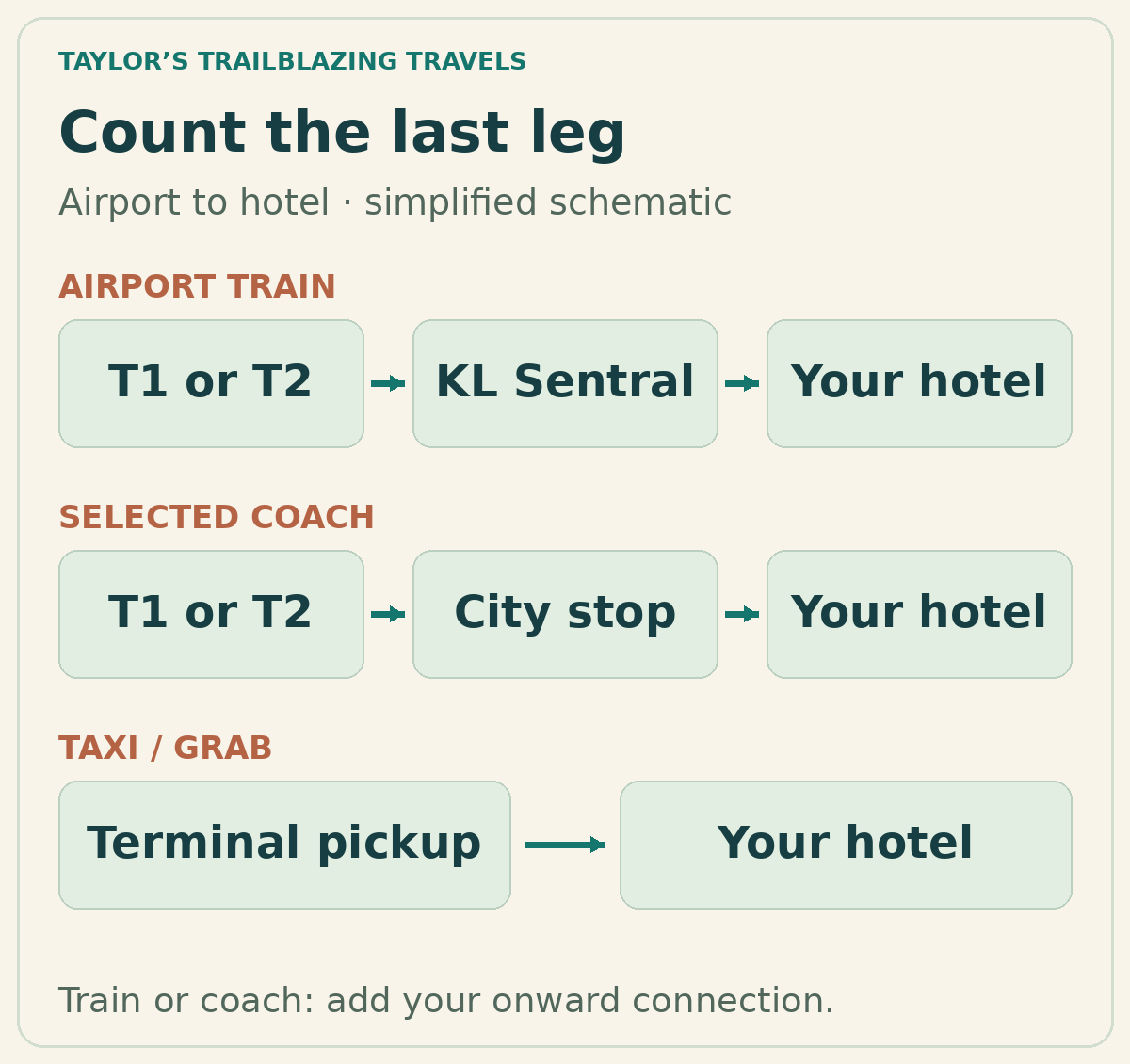
A worked arrival model
Suppose you have already cleared customs at T2 and your hotel requires a further local journey. Allow 12 minutes to find and reach the train, 10 minutes waiting, 33 minutes on the regular express, 10 minutes to change transport, and 25 minutes for the local ride and final walk. The result is 90 minutes. Only the 33-minute rail element is a published journey time; every other input is an editable planning assumption.[2]
Using the same starting point, a hypothetical car transfer with 15 minutes to meet the driver and a 70-minute road journey totals 85 minutes. With congestion making the drive 110 minutes, it becomes 125 minutes. This explains why neither “train is always fastest” nor “door to door is always quickest” is a useful rule.
For a bus example, 12 minutes reaching the platform, a 20-minute wait, a 75-minute drive and a 35-minute onward leg total 142 minutes—roughly two hours twenty. These are deliberately transparent assumptions, not timetable promises. Replace them with your booked service and destination.
Match the last leg to your hotel
For the KLCC area, the Kelana Jaya LRT connects KL Sentral with KLCC station. Bukit Bintang is also served by the Monorail from KL Sentral, but changing systems still involves walking and finding the correct platform.[17][18] Check the entrance nearest your accommodation, especially with cases or in heavy rain. A cheap rail connection is less attractive if the final walk is awkward.
KLIA Ekspres: tickets, boarding and useful alternatives
Follow the ERL railway signs in your actual arrival terminal. Select KL Sentral as the destination, buy the correct product, keep the ticket available through the exit gates, and check the next departure screen before heading to the platform. Regular daytime Ekspres departures are every 20 minutes; the late-night pattern includes stopping services.[2]
The standard adult return is RM100. Children aged 6–15 have a RM25 single fare, while children under six can travel free subject to ERL’s ticket conditions. The operator also advertises direct online discounts. Compare the final price for your actual ages and travel dates, particularly when an offer is date-specific.[1]
KLIA Transit is the stopping service. It is useful for Bandar Tasik Selatan or Putrajaya & Cyberjaya, but a through journey to KL Sentral is not automatically cheaper: the published full adult fare is also RM55. ERL gives 39 minutes for its T2–KL Sentral journey.[12] Buy the ticket for the service you intend to use; Ekspres and Transit tickets are not interchangeable.[1]
For three or more adults, check the current Group Saver before simply multiplying the standard price. The advertised November offer is RM40 per adult each way, with everyone travelling together on the selected date; it is not combined with the usual online discount. Its stated sales period ends on 31 December 2026.[9]
Use the current ERL timetable for the first or last service in your direction. A midnight flight arrival and a midnight railway departure are not interchangeable planning times: your arrival formalities come first.
Airport buses: the economical route to KL Sentral
SkyBus serves T1 and T2 as well as KL Sentral. At T1 its boarding area is at the ground floor of the Block C annexe; at T2 follow the bus signs to the Level 1 Transportation Hub. At KL Sentral the bus terminal is on the lower ground floor.[4] Check the destination displayed on the ticket and vehicle: other airport coaches serve different parts of the Klang Valley.
A bus suits a solo traveller with a flexible hotel check-in and manageable luggage. It is less appealing before a fixed reservation in the city, or when several people would then need another vehicle from KL Sentral. Your cash saving buys a longer travel allowance.
Compare the operator’s ticket with KLIA–KL Sentral transport options on 12Go. Select the right terminal, date and operator, and compare the final payable amount and cancellation terms. The comparison page lists both bus and rail products, but its headline summaries are not a substitute for the selected ticket’s details.[16]
APAD is phasing in new express-coach ticket coordination rules. Its 5 November 2026 notice permits existing booking channels during the transition, subject to further updates; confirm your online ticket and boarding procedure with the seller or departure terminal before travel.[19]
Before paying, check how the ticket is redeemed, whether a particular departure is reserved, and what happens if your flight is late. SkyBus’s FAQ describes first-come boarding and warns that very large items can depend on spare luggage capacity. Contact the operator before relying on a coach for a bicycle, surfboard or special assistance.[13]
Taxi or Grab: make the pick-up simple
Official airport taxis
Use the airport’s official counter and show the complete hotel name and address. At T1, Malaysia Airports describes both fixed-price coupon taxis and metered services, with several vehicle classes.[8] Ask whether the quoted amount includes tolls, airport charges and any late-night surcharge. Keep the receipt and use the allocated vehicle.
A counter-arranged taxi can be the easier choice if you do not have working data or would prefer staff to help match your luggage to a vehicle. A metered fare and a fixed coupon are different products; agree which you are buying before boarding.
Grab pick-up points
Enter the hotel’s actual entrance and select the terminal you are standing in. Grab currently lists T1 arrival pick-ups at Level 1 doors 1, 3 and 4, with a different location for its EV pick-up. T2’s listed point is Level 1, Door 5. Follow the location assigned in your booking and the current signs rather than going to an arbitrary arrivals kerb.[6][7]
Order when you are ready to meet the driver. Match the registration to the app, check that everyone and every case fits, and ask about a suitable child seat in advance if needed. Grab’s own descriptions distinguish ordinary cars from larger options; four people with four large cases should not assume a standard car is enough.[6]
Have a connection before requesting the ride
Set up your app and payment method before flying, and save the address offline. If your existing roaming plan is unsuitable, you can compare eSIM options at Airalo and select Malaysia or a suitable regional plan. Check device compatibility, network unlocking, coverage and activation conditions before purchase; a data plan is optional, not a requirement to use an official taxi.[14][15]
Compare the total for your whole party
The useful question is: “What direct-car total would beat our complete rail journey?” The model below uses adult fares checked on 7 November 2026, a hypothetical RM15 onward vehicle from KL Sentral, and a hypothetical RM90 airport-to-hotel car quote including all charges. Neither car amount is a live quote.
| Adults | Rail + RM15 local leg | Bus at RM15 each + local leg | Direct car example |
|---|---|---|---|
| 1 | 49.50 + 15 = 64.50 | 15 + 15 = 30 | 90 |
| 2 | 99 + 15 = 114 | 30 + 15 = 45 | 90 |
| 3 | 120 + 15 = 135 | 45 + 15 = 60 | 90 |
| 4 | 160 + 15 = 175 | 60 + 15 = 75 | 90 |
Rail inputs: direct online standard tickets for one or two adults; Group Saver for three or four.[1][9] Bus input: SkyBus’s advertised RM15, to be checked at purchase.[3] The model assumes each party and its luggage fit the quoted vehicles.
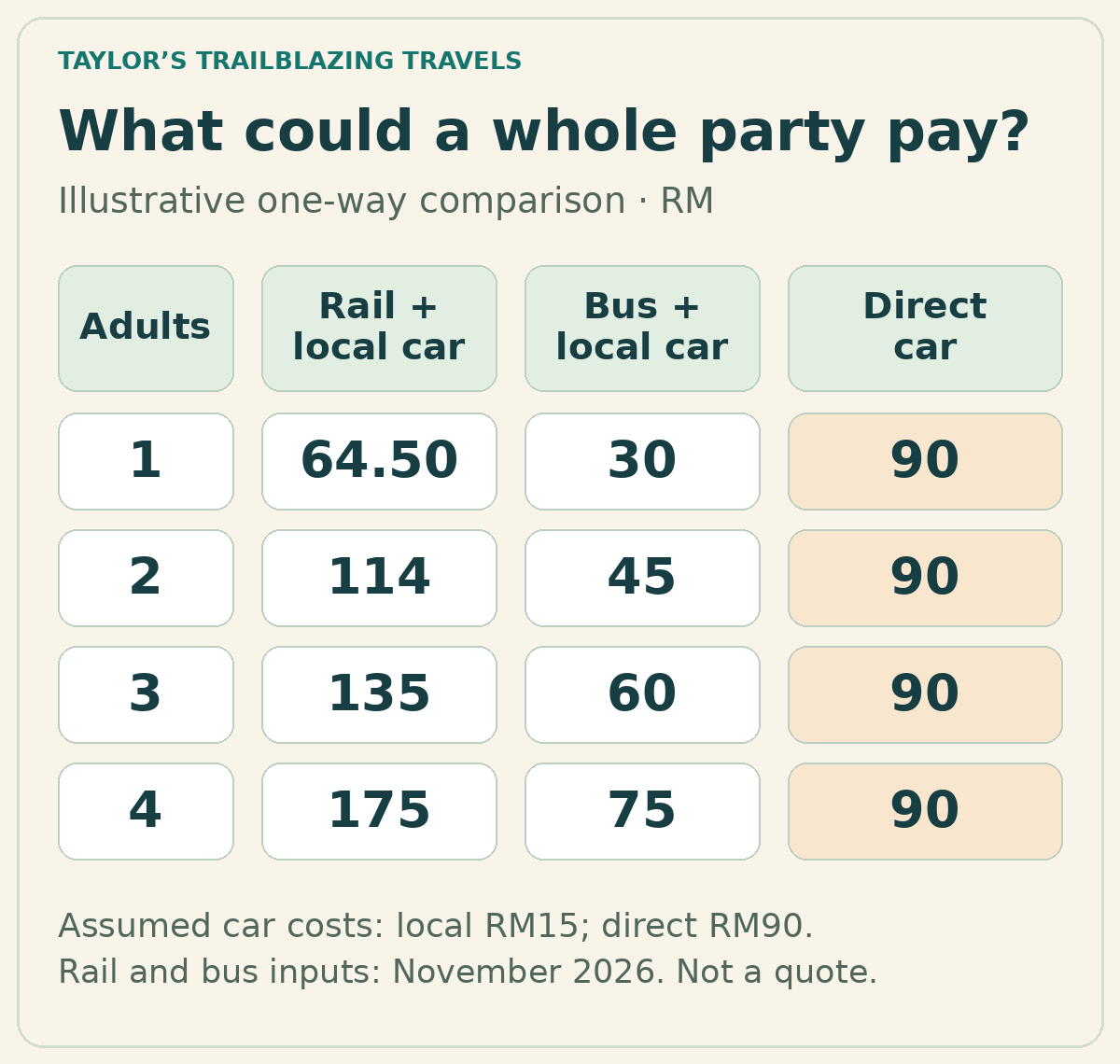
For the couple in this example, a direct car below RM114 costs less than rail plus the assumed local leg. For a solo passenger, the rail total remains lower than the RM90 car. If your hotel is beside KL Sentral, remove the RM15; if luggage requires a larger car, increase the relevant quote.
Families should price by age, not passenger count. ERL’s current family offer is RM120 one-way for two adults and two children aged 6–15, with travel-together and date conditions; its stated sales period also ends on 31 December 2026.[10] Compare that with a suitable vehicle, including any required child-seat arrangements.
Once you have actual costs, the Group Holiday Cost Splitter can allocate a shared transfer. Keep every amount in the same chosen currency; it does not convert currencies for you.
Late arrivals, heavy luggage and accessible travel
If you land late, keep a road-transfer fallback even when a train appears to fit. A delayed flight, distant gate or slow baggage delivery can consume the remaining service window. Check the onward local railway as well as ERL: reaching KL Sentral does not guarantee your next train is still operating.
For the return to the airport, enter T1 or T2 explicitly in a taxi or Grab booking and work backwards from your airline’s required arrival time. Add traffic contingency to a road journey. Choose rail when reducing that traffic exposure matters, while still allowing for your hotel-to-station journey.
ERL describes its trains as wheelchair-friendly, but this does not establish the accessibility of every onward station exit or hotel pavement.[1] Confirm assistance, lift access and the final leg for your own needs. SkyBus provides a special-assistance contact; arrange this before travel rather than assuming an ordinary coach is suitable.[13]
Questions before you choose
Is the cheapest ticket always the cheapest transfer?
No. Add the local leg, any larger-vehicle requirement, booking fees and your party’s actual ages. A low bus fare can still be the best value, but compare the complete journey.
Should I book a timed airport bus before landing?
Only after reading its late-arrival and redemption terms. A fixed booking can be useful, but avoid a departure that assumes an instant exit from the aircraft.
Does arriving at T2 mean I must travel to T1 first?
No: the main options in this guide serve T2. Use the transport available in your own terminal and avoid an unnecessary terminal change.
What if my hotel is nowhere near a railway station?
Compare a direct road quote with the rail or bus fare plus a second vehicle. The added interchange may be worthwhile in heavy traffic, but it is not free in time or effort.
The practical choice
For one traveller heading to KL Sentral, start with rail or bus. For a couple with a hotel farther away, compare a direct car against the full rail total. For a family or group, price the appropriate rail offer and a vehicle large enough for the luggage. Then let your arrival time, mobility needs and tolerance for traffic decide.
Sources and editorial approach
Reviewed on 7 November 2026. Official operator information is distinguished from illustrative calculations and editorial planning advice. Check your travel date, fare, terminal and booking terms directly with the provider.
- Express Rail Link — KLIA Ekspres fares, ticket conditions and accessibility
- Express Rail Link — current linked Ekspres timetable, effective 8 December 2025
- SkyBus — advertised KL Sentral fare and journey overview
- SkyBus — terminal boarding locations
- Grab Malaysia — transport pricing and exclusions
- Grab — KLIA Terminal 1 pick-up points and vehicle categories
- Grab — KLIA Terminal 2 pick-up point
- Malaysia Airports — Terminal 1 public transport and official taxis
- Express Rail Link — Group Saver, sales 5 October–31 December 2026
- Express Rail Link — Family Package, sales 5 October–31 December 2026
- Express Rail Link — announced fare adjustment from 1 January 2027
- Express Rail Link — KLIA Transit routes, fares and journey time
- SkyBus — ticket, luggage and special-assistance FAQ
- Airalo — Malaysia eSIM plans and activation guidance
- Airalo — eSIM compatibility and network-unlocked devices
- 12Go — KLIA to KL Sentral booking comparison
- Suria KLCC — getting to KLCC by rail
- Ministry of Transport Malaysia — rail services and Monorail route
- APAD — phased express-coach ticket coordination, official statement, 5 November 2026 (PDF)
Illustrations in this article were created for Taylor’s Trailblazing Travels. Third-party photographs, where used, are credited beside the image or in the source list.